Showing posts with label deconstruction. Show all posts

Thursday, February 25, 2016

Drizzt Do'Urden and the failure of fantasy racism

(Content: discussion of racism and other oppression.  Fun content: I hope you like elves.)

I should preface this with a giant disclaimer (in case there was any question) that I'm white, so this whole post is an extended 'it seems to me...' and I don't want to speak over anyone's experiences.  I don't think I've seen anyone address this specific flaw to supposedly progressive fantasy; I'd be happy to link to any such works if y'all know of them.  (Also, I think a lot of what I say below can translate to representation of other demographics and types of oppression, like LGBT people and comic book mutants, but it's Black History Month, so that's where we focus.)

Pictured: either my family tree or a box of assorted entertainment crackers; who can tell?

The best thing that speculative fiction can do is show us a bizarre new world that loops into our real mundane world right now and gets us to see something in a new way.  Consider classic Star Trek's episode about an alien cop chasing a fugitive, each of them literally half paper-white and half ink-black, divided down their centre line, but the cop is convinced that he's racially superior because he's black on the correct side.  The Snowpiercer movie (thankfully nothing like the original comic) is a beautiful, layered, sickening, and ruthless exploration of capitalism and literal class war.  And if I start talking about Discworld novels we'll be here all day.

Countless stories--like Star Trek there, and like Forgotten Realms and Lord of the Rings and X-Men and basically every other serialised speculative story sooner or later--take the opportunity to criticise racism, usually by showing us elves and dwarves scowling at each other or something.  The first problem with this kind of scenario is that it extrapolates human 'races' (a nebulous and nonscientific concept) into entirely different species, so that the story is about (white) humans learning to get along with weird other-y pseudo-natural entities (of colour?).  We can do better.  But, at the same time, there's no reason that identifying with the badass werewolves or dragons or fae should be restricted to white people either, so yes, let's have elves with high tops:
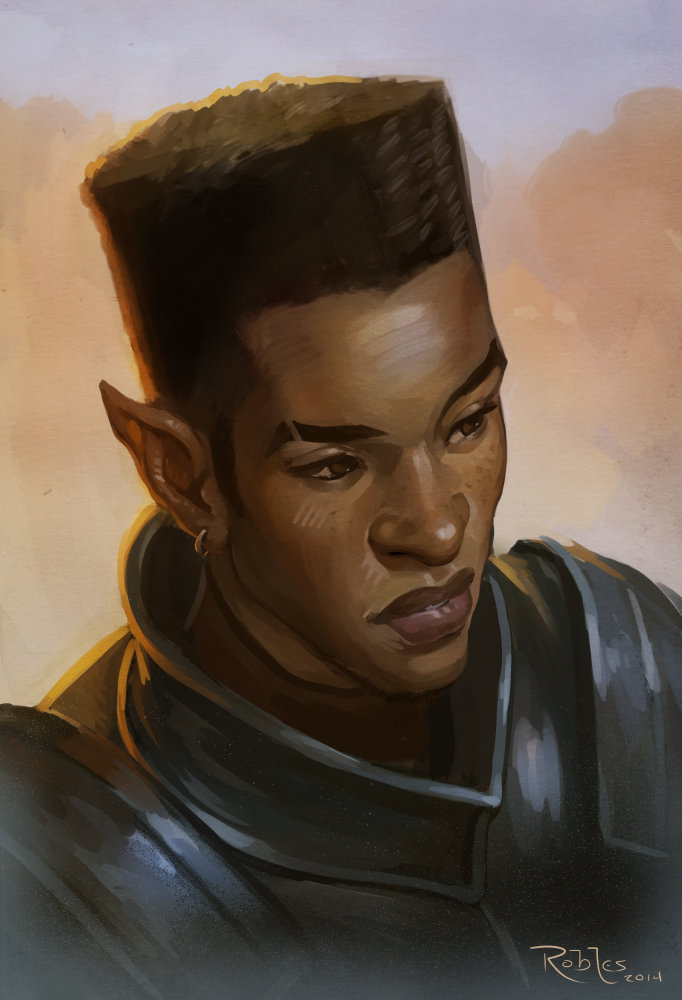
Pictured: painting of an armored elf with distinctively black features, by Nick Robles.

Running with this, writers sometimes give us a paragon of virtue like Drizzt Do'Urden.  Drizzt is one of the most iconic characters in modern fantasy: a renegade drow (dark elf, literally black-skinned) from the underground city of Menzoberranzan who grew up disgusted by his people's cruelties and so ran away to the surface, where he roams the land of Faerun slaying monsters and rescuing the helpless.  He is, of course, nevertheless hounded at every turn by people who see his black skin and assume he's a monster.  I won't speak to authorial intention here, because I haven't read RA Salvatore's mind at any point in the last thirty years, but there's only one common reading of Drizzt's story and what it symbolises for our world.  We readers look at these presumptuous bigots, who think the only good dark elf is a dead one, and scorn them for failing to get to know Drizzt before judging him.  We know better and we are enlightened.

Drizzt is a good guy.

Drizzt isn't like other drow.

Drizzt is one of the good ones.  A credit to his kind.

#notalldrow

But the thing about those narrow-minded common peasants who flinch or scream at the sight of Drizzt walking into town is that they're only wrong this time.  With literally any other member of his species, they'd be absolutely right to freak out, because a powerful and sadistic murder-specialist would have just said hello.  That's not racism; that's basic probability and pattern recognition.

Fantasy racism like a fear of dark elves is ultimately a terrible allegory for real-world racism because the dark elves have worked long and hard to gain that reputation for monstrosity, whereas in the real world white history is basically a laundry list of the other nations and peoples we've slaughtered and enslaved and oppressed for monetary gain, political power, or occasionally just for sadistic fun.  In order for Drizzt the onyx-black elf hero to be an actual metaphor for black people in North America, our continent would have to live in constant fear of invasion from a subterranean army of African-diaspora wizard-ninjas, and I figure there can't be more than five or six million registered voters who actually think that's a concern.

What I'm getting at when I say #notalldrow is that Drizzt's experience, being a variously privileged individual walking into vulnerable spaces full of people who have been hurt before by people who look like him (and who know that he has the power to hurt them further), is the experience of the oppressing class, not its victims.  White people, especially but not exclusively white men: we're the drow.  When Drizzt sees someone afraid of him at first glance, it's not because they've been arbitrarily taught that black people are inherently inferior and disgusting.  If we read these scenarios and all we think is "Bah, foolish bigots, we Drizzt would never be so villainous!" we're only reinforcing the idea that vulnerable people owe us their reflexive trust or they're the real racists.

To the credit of Drizzt's fictional persona, he sympathises with these people and is patient with the caution strangers take around him.  At least, this is a good aspect of his character if it's taken as a model for, say, white people to not go around acting indignant that people of colour aren't always ecstatic about our presence.  From the 'surface' reading of his story, where Drizzt is the victim and he is patient with having to work to personally win over every single racist he meets... that's suboptimal to say the least.  The tangle that this kind of speculative fiction has made of power dynamics makes it harder to draw any conclusive arguments out of the text beyond a lukewarm 'everyone should be good to each other'.  That kind of 'equal opportunity learning' gives us stuff like the unholy mess that was Disney's Pocahontas, in which the indigenous Powhatans are also guilty of prejudice against strangers just because the white people are here to conquer, pillage, and murder.  I cannot even.

Fantasy racism doesn't speak to real-world racism as long as it seeks to justify its existence: as long as those simple innocent farmers are afraid of orcs because orcs are literally and objectively the twisted embodiment of malevolence forged by an evil god to burn the world, fearing orcs isn't racism, it's self-preservation.  Fantasy that wants to tell us that racism is bad has to start by admitting that racism isn't a defense mechanism but a weapon--a philosophy that helps the people in power convince everyone else that it's okay to kill and exploit those other people, without provocation, because they just don't deserve any better.  Stopping racism is about acknowledging and revealing and destroying that idea, and it's got to be done in us, the privileged, oppressing class.

I'd love to add some examples here of fantasy racism done properly (purely as propaganda and not based on objectively truth) but... I'm not sure I can think of any.  Even in Discworld, the conflicts between trolls and dwarves ultimately come back to 'both sides bear guilt'.  In the Warcraft universe, primary example of a setting where orcs are heroic protagonists as often as villains, the orc-human divide stems back to those one or eight times that the orcish horde got cursed into raging berserkers and tried to burn down the planet.  In settings like Star Trek (and often Star Wars, depending on the book) aliens often are pretty one-dimensional in ways apparently defined by their species.  I think a good case can be made regarding house elves in Harry Potter, but that'd be a book unto itself and there are plenty of people who feel the text ultimately fails to make a proper case distinguishing the racist propaganda from the truth.  If any of you readers have encountered a good speculative treatment of how racism functions that doesn't make these kinds of errors, I would love to hear about it.

Let me end by sharing with you a quote from Chris Rock, in an interview from 2014 which I was lucky enough to encounter this week:
So, to say Obama is progress is saying that he’s the first black person that is qualified to be president. That’s not black progress. That’s white progress. There’s been black people qualified to be president for hundreds of years... The question is, you know, my kids are smart, educated, beautiful, polite children. There have been smart, educated, beautiful, polite black children for hundreds of years. The advantage that my children have is that my children are encountering the nicest white people that America has ever produced. Let’s hope America keeps producing nicer white people.
Hope everyone's been having a good Black History Month.

Wednesday, October 14, 2015

The Cabin In The Woods: Joss Whedon doesn't know what deconstruction means

What's this?  Not a Dresden post?  Yes, dear readers, because it is October and tumblr's love of Halloween is sufficiently infectious that I was all "Hey, we should do a bunch of posts on Halloween movies this month" and the blogqueen was all "I like that idea but let's not go overboard" and I was all "CAN'T HEAR YOU, TOO BUSY BEING THE PUMPKIN KING" and she was all "FUCK YOU I'M ALREADY WRITING A POST ON NIGHTMARE BEFORE CHRISTMAS" and she is the blogqueen, so her word is law.  But I get open the gates, with a little more than two weeks to go before Halloween, with my unrelenting judgment of Joss Whedon and all sexist nerds who think satire means 'the same old rubbish with a wink and a funny voice'.

Something Short & Snappy Hallowthon 2015 presents:
The Cabin In The Woods

This movie is three years old now, so I imagine most of the people who actually cared about seeing it unspoiled have already done so, but just in case you're not aware, the actual premise is a spoiler, so if for some reason you want to see Joss Whedon writing self-satisfied horror in the manner that he originally intended, read no further in this post.  There's not much meaningful to say about the film without talking details.

Now, as soon as I said 'Joss Whedon writing', most of us could probably guess (with or without seeing the film) that this movie is incredibly proud of how clever it is.  Horror movies come with a lot of tropes and cliches--back in the 1990s, Scream revitalised the genre by making a slasher flick full of people discussing slasher flicks, a harbinger of the super-meta media that has rocketed to popularity in the last couple of decades.  I don't actually like Scream (not least because that mask fucking terrified me as a child), but I can't deny that it was a clever idea to make a film in which people actually tell each other to do the things that the audience normally has to shout, like 'don't run upstairs, there's no escape there'.

But that's been done now (on through three sequels and a Netflix series), so how can someone brim with satisfaction at their own cleverness now?  The same way bad parodies work: force everything to fit to the cliches of the genre at their most extreme, presented utterly without commentary or analysis.  TCITW is a movie about a world (spoilers begin here) where humanity managed to seal away some eldritch horrors thousands of years ago and can only keep them sealed by performing a sacrificial ritual every year, which must fit the format of an ultra-typical horror movie.  So the movie opens on an underground complex where people are going about what seems like an ordinary semi-industrial office job, which we slowly discover is actually the central control room where they bait a group of young adults into a sealed environment (the titular cabin and woods) and let loose monsters to slaughter them.  Real people don't fit the requisite cardboard-cutout characters, of course (the jock, the nerd, the comic relief, the sexpot, and the virgin), so the action of the movie is two-sided: Our Heroes trying to escape monsters in clever ways, and the showrunners manipulating and pushing them back onto the rails like a bad tabletop gamemaster.

Thus, the ordinary is presented as clever because it gets labelled: on their way to the cabin, the kids stop and ask directions from a gruff hillbilly who tells them to turn back, and the scene gets intercut with shots of the showrunners talking about how important it is to the ritual that the kids be warned "by the Harbinger" but continue anyway.  All the protagonists start out as intelligent college kids, but (for example) the girl who's supposed to fit the 'slutty' archetype was convinced to dye her hair blonde and dosed with cognition-slowing drugs so she would drag her boyfriend out into the woods to have sex and die.  At one point the jock says 'stick together while we search the house', gets a dose of gas from the nearest air vent, turns around again and says 'actually, let's split up to cover more ground'.

They have a gas that makes people think it's a good idea to split the party.

I try to take stories in on their own terms: I'm not criticising TCITW for not being deep, or for not explaining how one invents a gas that makes people think it's a good idea to split the party.  The premise is "What if you had to orchestrate a real-life horror movie in order to save the world?" and something like that is just a throwaway joke that everyone's supposed to nod at and move past.  (I do greatly prefer the parts where things are actually orchestrated and people break the stereotypes--in keeping with exploitation horror of the past, voyeurism is a big part of the ritual, so they put the nerd in a room next to the final girl where he discovers he's got a one-way mirror to watch her undress.  Villainwise, that's a smart move to ratchet up the sexual tension, but the nerd is also not a total skeeze, so he overcomes temptation, warns her about it, and they switch rooms.  Naturally, the girl then watches the nerd, who is played by Jesse Williams and therefore hot like fire and hella jacked, take his shirt and belt off before she covers the mirror up again.)

No, if TCITW was just kind of smug about all its tropes and references, I wouldn't take much issue with it: the dialogue is often fun and funny, the cast is excellent, and it raises some interesting moral dilemmas when the heroes find out the truth and have to choose between actively murdering each other or passively ending the world.  (I disagree strongly with their conclusion, but more about that in a bit.)

My core problem with the movie is, as you readers have probably guessed, is that it involves Joss Whedon trying to be clever about gendered roles and that is a recipe for disaster.  Horror movies in general and slasher flicks in particular have a history of misogyny, sex-shaming, objectification and voyeurism, and sexualised violence against women that hardly needs to be expounded upon here.  The bright points are those rare occasions when the tradition of the 'final girl' gets turned into something like an icon of strength, resilience, and courage in women.  (Take perhaps the most famous 'final girl', Ellen Ripley of Alien--Sigourney Weaver, of course, shows up in TCITW specifically to explain the trope.)  It's sufficiently common that even this movie's 'ritual' incorporates it: as long as everyone else dies and the 'Virgin' suffers, the ritual is complete and she might be allowed to survive and win.

This is too obvious for Joss Whedon's cleverness to abide.  No, while the protagonist  Dana is a woman, the actual hero of TCITW is Marty, the comic relief.  He's resistant to the mind-warping drugs and hypnotic suggestions because he's stoned all the time, he carries a collapsible steel bong that he uses to do battle with the monsters (and successfully takes down the one that tries to kill him personally), and constantly fills the audience surrogate role of 'Hey, maybe we shouldn't do this obviously dangerous thing'.  He also locates the secret entrance to the villains' complex, hacks into their equipment, rescues Dana from her monster (after killing his with a trowel), and leads her down to the lower levels to confront the big bads.  He gives us the moral of the story as well--society is fundamentally broken and deserves to be wiped out--and the final question of the story is whether Dana will murder him (and save the world) or break the cycle (and let the ancient death gods rise up to slaughter us all).

Except: Dana doesn't even get that moment of agency, because as she's quivering, gun in hand, choosing whether to kill one person by action or billions by inaction, Marty keeps her from noticing the werewolf creeping up behind her and the clock runs down while they're fighting.  Afterwards, as they wait for their doom, Dana says she probably wouldn't have done it anyway, but actually letting her make that choice wasn't dramatic enough, apparently.

Raise your hand if you're shocked that Joss Whedon looked at a genre where strong female protagonists occasionally win (while hordes of other women are slaughtered, usually after flashing the audience) and said "No, this will not do, I need to bring something fresh to the table by having a sarcastic scruffy man save the helpless girl and drive the plot."  It's not the muscular dude, or the smart dude, or the hot chicks (either flavour, sexy or virginal) who save the day, it's the pseudophilosophical guy with funny lines and weed and no luck with women.  Yeah, that's definitely not Whedon's author avatar.

The phrase 'deconstruction' has gotten popular in the recent years, but the meaning has kinda shifted.  It's common enough now to use it as we do on this blog, to just mean 'unsympathetic critical analysis', but the word itself is older and more nuanced than that, to the point where I can't even begin to parse the original source material by Derrida.  (Neither can a lot of scholars, leading to a bunch of people trying to create secondary explanations that actually make sense.)  I'm not going to pretend I understand it either, but I can tell the difference between a meaningful commentary and shouting "Society thinks sex is dirty so the blond slut always dies first!"  Like: thanks, Joss.  We know.  We know that's how it always goes.  Are you in fact clever enough to come up with a twist on that, or are you just going to have a lot of people point out that the girl got killed five minutes after going topless and call it groundbreaking?  "But what if she was manipulated into doing it?"  SHE IS ALWAYS MANIPULATED INTO DOING IT BECAUSE THESE SCRIPTS ARE ALL ARTIFICE.  There are no actual choices going on.  The only difference this time is that the people in the script are scripted to acknowledging that they're following a script but under no circumstances question it.

Without getting too far into a very different kind of essay, I also want to vent my frustration against the ending and the idea that Our Heroes made the right choice by dooming everyone: in order for someone to say 'society is corrupt and we all deserve to burn' they have to be either the ultimate supervillain or have an incredibly narrow and specific concept of what 'the whole world' means.  We're talking about more than seven billion people in the world, all living radically different lives in different circumstances, different choices, different values, different traditions.  The typical stoner-philosopher appears to mean "Capitalism is messed up, our government is ineffective, and I can't get laid, so the whole thing might as well burn", which to my mind just shows a lack of interest or creativity.  If it's about the atrocities humans have committed in the past, well, we've got almost two billion people under the age of 15 and I'm inclined to give them a chance to do better than us.  If it's about the stories we tell supposedly illustrating our inherent corruption, well, show me an Anishinaabe slasher flick or something, because I'm not sure our traditions are as universal as you're claiming.

But I'm getting all Doylist about this instead of interrogating it from within the framework of the movie, where the logic appears to be "Humanity is under constant threat of annihilation by malevolent gods unless we make bloody sacrifices, therefore we deserve to be annihilated by malevolent gods", which... does not flow for me.

The ultimate problem with TCITW, I think, is the nature of the big bad gods behind it.  They are meant to stand for us, the audience: one girl has to get naked and die because the gods demand it, people must suffer because the gods demand it, it all has to happen over and over again because if the showrunners don't give the gods what they want, they--that is, we the audience--will rise up and end the world, and frankly that is blatant buck-passing.  The closest thing you can get to a 'message' out of TCITW is that these same horror movies keep getting made because that's supposedly what we want, but let's look at the facts: Twilight features blood and monsters and decapitation, but it also features girls who get to live forever with their infinitely-loyal sexbot husbands, and the Twilight movies made more money than you could fit in a cabin in the woods.  Google searching suggests to me that the highest-grossing slasher flick of all time, the original Scream, in total grossed about $189 million internationally (adjusted for inflation), whereas the first Twilight laughed that off at an easy $225 million and New Moon hit $326 million.

I'm not saying Twilight is good--what kind of monster do you take me for--but I am saying that in the case of Auteur Joss Whedon vs. We The Demanding And Disgusting Public, the evidence speaks soundly in favour of these things not being how you pander to the plebes.  There are no all-powerful market gods demanding that these same exploitation-film cliches get repeated over and over again: these movies get made because filmmakers like to make them.  That's the twist TCITW needed: in the end, when they've forced Dana to kill Marty to save everyone else, and everyone agrees that the rituals must go on because that's just how the world works, we find out that the Director is actually just a power-hungry misanthrope who dangles the (false) threat of ancient gods over everyone else because they just really like watching young people die naked.

Guess that was a step of realism too far?

Sunday, October 26, 2014

50 Shades Freed Chapter 1, in which, wait--we're skipping the wedding?

Will has been banished from the country, so today we have a 50 Shades post! Wait, 50 Shades and an Erika post? On a Sunday? The world has ceased to make sense, I know. Yes, I'm still around, but shortly after the last post I did my Grandfather had been given a few weeks to live, and being one of the few local relatives in town I've been pretty busy dealing with his death and taking care of my Grandmother. I'm hoping to get back into the saddle on 50 Shades soon, but my plate is loaded, so I'm just going to throw them up when I can and not try and claim a schedule until I build up a buffer.

Now, what you're here for. I got married almost a year ago (eep) and as such I expected this book to be all wedding planning and anticipation and excitement over THE BIG DAY. I was accused of being too easygoing and relaxed as a bride, and even I got swept up in it all. My own wedding planning experience was atypical, it was pretty smooth and low stress. I only got pushback on a few little things, there were no big fights or family drama*, and because I picked the off-season had vendors competing for my business. The day itself had no real snags. Despite that, I can off the top of my head think of a lot of opportunities for tension and drama and over the top fights with intense make up scenes because weddings and wedding planning brings out weird stuff in people. You know, what EL James thrives on. So, I'm confused. The wedding is skipped over almost entirely, and we get only a few little blips of wedding planning. EL James instead skips straight to THE HONEYMOON! Sort of. I will give her credit, she's learned at least one new trick between the second and third book, and that is how to write in non-linear time. We see the Greys on their honeymoon, but it's spliced with flashbacks to montage us from the engagement to the present.

“How would you feel if I went topless, like the other women on the beach?” I ask.“Displeased,” he says without hesitation. “I’m not very happy about you wearing so little right now.” He leans down and whispers in my ear. “Don’t push your luck.”“Is that a challenge, Mr. Grey?”“No. It’s a statement of fact, Mrs. Grey.”I sigh and shake my head. Oh, Christian . . . my possessive, jealous, control
freak Christian.

Yeah Ana, don't push your luck on doing what you want with your own body! And think it's cute when you're treated like you belong to another person, not yourself. I get it, referring to someone as "Mine" or being someone's is all so terribly romantic. It's not supposed to be about ownership, it's about love and passion etc etc etc. But it isn't here. Time and time again, we see Grey treating Ana as his property. He dictates how she dresses, how she eats, he gets angry when she goes out with other people and wants her to stop working. He especially dislikes Kate, who called him out on being so controlling and being concerned with how he was treating his property Ana. He also reminds her that she belongs to him a lot. Multiple times a chapter. She will sometimes smugly think "Well, he's mine" when other women gawk at Grey (so, every random woman extra they encounter) but the frequency doesn't line up, and Ana never tries to control who he sees.

The above bolded text isn't a cute challenge like the book will try to treat it, this is a command. And when Ana disobeys (she starts laying on her stomach but in her sleep rolls onto her back) he gets mad. HOW DARE OTHER PEOPLE SEE HIS WIFE'S BOOBZ! You know, ignoring the fact that they were making out in the water in plain sight so intensely people thought they were about to bone right then and there like ten minutes ago.

Now for the wedding. It takes place six months after the end of the last book, is held at Grey's parents place, and everything is white pink and silver, which is surprising to me because neither Ana nor Grey strike me as the pink type. I guess it was his Mom? The wedding is rushed through (K, you may now kiss the bride. Cool lets party. Kate says some vague snarky but supportive stuff, Jose basically reminds us he exists by telling Ana if Grey pulls anything he's here for her, silently implying he means with his junk, just, you know, a friendly open offer).  As Grey drags Ana off before she wants to leave, insisting she stay in her wedding dress (her's at least sounds moderately comfortable? Like, no mention of bodices and corset boning jabbing into her ribs) we get a quick exchange between Ana and her Mother (with Kate hovering around for reasons?).
“You didn’t promise to obey,” she reminds me tactfully. Kate tries to disguise her snort as a cough. I narrow my eyes at her. Neither she nor my mother have any idea of the fight Christian and I had about that. I don’t want to rehash that argument. Jeez, can my Fifty Shades sulk . . . and have nightmares. The memory is sobering.
This is going to be A Thing. Ana didn't promise to obey in her vows. Grey's response was to, like a mature adult, sulk.
“I can’t believe how grown-up you look right now. Beginning a new life . . .Just remember that men are from a different planet, and you’ll be fine.”I giggle. Christian is from a different universe, if only she knew.
TEE HEE BECAUSE ONLY ONE GENDER ARE REAL PEOPLE! Men are bad at feelings and women are irrational! Wimen maek babies and menz kill bear! Have I gotten regressive enough to keep up with this book yet?

So they bail on their own wedding party to go onto Grey's private jet (uggghhh) because they're on their way to Europe! All of it! Apparently there's a private room there where they bone. The sex scenes are somewhere between funny and boring to me now.

Leaving my breasts bereft he runs his hands down my stomach, over my belly, and down to my thighs, his thumbs skimming my sex.

Ana, you're a married woman now. You can say vagina. You could before, too. Here, try it with me: v-a-g-i-n-a. Vagina! PLEASE FOR THE LOVE OF GOD STOP CALLING IT YOUR SEX.
“This is like unwrapping my Christmas presents.” He smiles up at me through his long dark lashes.“A present you’ve had already . . .”He frowns in admonishment. “Oh no, baby. This time it’s really mine.”
He says to the girl whose Mother has been married three or four times. I don't even know what to do with this scene. If I were her editor I think I'd just send it back with a bunch of question marks scribbled on it. It's a lot of tongues invading and U MAEK ME THE HAPPIEST 5EVAR type thing and it's just--why is all of their sex like this? Even when they're being kinky and weird it comes back to ILY type things like all of their conversations and fights do. They just spend a lot of time saying how much they LURVE each other and I just--what else? You say you love each other and make each other happy, but short of sexy flirting they don't really talk unless they're fighting. This may be EL James' worst case of telling-not-showing.
His lips find mine, his hands curling around my head, holding me, stilling me as our tongues glory in each other.
Do you think she has a thesaurus collection? I bet she has a thesaurus collection.
He stands swiftly and in one efficient move dispenses with his pants and boxer briefs so that he’s gloriously naked and looming large and ready over me.
 It's even funnier if you imagine the music from 2001 Space Odyssey playing here.

It turns out we were getting this flashback via Ana napping on the beach, rather than EL James embracing that not all story telling needs to be perfectly linear (still an improvement!) and she's woken up riiight before she gets the D by Grey coming back to find her topless and on her back and he is PISSED, and that's the end of chapter 1! Tune in next time to find out what punishment Grey dishes up for Ana not listening to his orders which are totes only for her own good!

Oh, right, they've been calling each other Mr and Mrs. Grey or "wife" and "husband" non-stop. It's awful.

---

*Ok, my Grandmother straight up CAMPAIGNED against me on the "no kids" thing over one cousin, but she has yet to figure out that the second I realize someone is trying to guilt trip me I stop caring, so, eh. NBD.

Thursday, May 15, 2014

50 Shades Freed, prologue, in which its shortness is the nicest thing I can think to say about it

Well, about a year later, I finally return to this clusterfuck of a series. Updates will be sporadic (based on when my health allows me the mental ability, spoons, and snark to tackle this) but if there is an update, it will be on a Thursday. My goal is every other week, but I know I can't commit to that.

I tried to read this book in one go, with the intention to then go through it again and write about it chapter by chapter, but it was both too long and too awful. I honestly don't really remember what happened as far as I did read, so you all get to see my shock and disgust as I unearth these suppressed memories. Grab your drinks because you need to drink enough for both of us, dear reader.

You want to know how much I forgot? I forgot that this book opens with first-person baby Grey hanging around his Mom's corpse and being hungry and playing with cars. I--I'm not even going to quote any of it because

1) First person child narration, even when done well* is creepy and annoying.
2) EL James attempting to drama and angst porn is also creepy and annoying
3) Honestly, the writing in those two paragraphs is just such a jumble of bad I don't even know what to grab to demonstrate it.

So I will summarize: Grey hangs out with Mom-corpse, is hungry/thirsty and eats some unidentified gross stuff while puttering around not understanding that Mom isn't sleeping. Her drug-dealer ex turns up, freaks out, boots Grey in the head out of the way to investigate the body, calls the cops, and peaces out and locks the door. Cop turns up, grabs Grey who freaks out and... this leads to him forgetting how to words? Or running out of words? Even being put in this character's head at this moment, it's just all so... blunt force that I actually find myself less certain as to what is supposed to be going on with them.
Don’t touch me. I stay by Mommy. No. Stay away from me. The lady policeman has my blankie, and she grabs me. I scream. Mommy! Mommy! I want my Mommy. The words are gone. I can’t say the words. Mommy can’t hear me. I have no words.
OK, I get that we're trying to establish how he ended up doing the whole "not talking for a few years" thing (which, given the amount of therapy he was put in from such a young age, still does not seem quite feasible to me but I am not a child psychologist) and the whole "no touching" bit (that one seems more reasonable to me to have manifested in the way it did, even with being treated intensely from a young age) but eeeehhhh. At least EL James is trying to show, not tell? Like, it's an improvement.  (But she's already told us. Over. And over. And over. I no longer care to be shown.)

We then get a smash cut to Ana tearfully reassuring Grey in third person--and that is weird to me. Was EL James struggling to write Grey in first person? I get why it's not Ana, this scene is very much about Grey, but switching to third person (which we have not seen at any other point in the series) is a strange narrative choice that doesn't work for me. I think it would have worked better if the whole book was third person (James' third person is actually not nearly as terrible as her first person) or had stuck with Grey for the whole chapter.
“Ana.” He breathes her name, and it’s a talisman against the black choking panic coursing through his body.

“Hush, I’m here.” She curls around him, her limbs cocooning him, her warmth leeching into his body, forcing back the shadows, forcing back the fear. She is sunshine, she is light . . . she is his.

Grey is, as far as I can tell, in the middle of a panic attack when he wakes up. I am lucky enough to not have had a panic attack, but not all of my loved ones have been so lucky. For the sake of privacy I won't go into too much detail, but I'm like 90% sure you can't hug away a panic attack. I've tried. What surprises me is Grey, who until the last book had a lot of issues with touching, in a moment when he is, if not having a panic attack, on the cusp of maybe having one, isn't set off more by touching. That seems like it would be more internally consistent. I mean, I get Ana apparently has some high level cleric spells (she's been power leveling between books it seems) that have allowed her to become light incarnate (that's gotta be at least a level 10 spell) but being able to magic away deep rooted psychological problems is still some hella high-leveled shit and I don't think she's had enough time between books to both power level AND become a shrink. However on top of not being a child psychologist, I am actually not any kind of psychologist, so this is not my area of expertise. (That involves fire. So much fire).

I also see that even in third person Grey is claiming Ana as "his". That will never not be weird to me. I will sometimes claim The Husbeast's** limbs as my own, and ignore his protests of needing them, and there is nothing sexy or romantic about this. I do it entirely to harass him. So when I see someone claiming another person as their own, I associate it with all the wrong things and it's either creepy and Gollum-like or involves evil giggling followed by trying to hide the other person under the blanket and hope they're not like birds and think that nothing else exists now.
“Please let’s not fight.” His voice is hoarse as he wraps his arms around her.
 You were just asleep what? How does that even? I don't?


“The vows. No obeying. I can do that. We’ll find a way.” The words rush out of his mouth in a tumble of emotion and confusion and anxiety.

Dude this is a hell of a non-sequitur. I assume they were fighting about this before bed? I mean, they fight constantly in book 2 so that seems like another Tuesday in their household. I kind of like that we're being told he's disoriented and confused and anxious here--not just shaking off the (almost?) panic attack. I guess even Ana's high level light-magic healing spells can't even do that (I'd look into taking some levels in healing if I could) and as annoyingly unrealistic as Grey's feelings and trauma is--bouncing wildly between melodramatic and "tidied up neatly by the end of the episode" levels of simplicity--I do appreciate when James hits on something resembling human.

I am a concerned for Ana that Grey is only agreeing to compromise on her not agreeing to obey him, in front of all their friends and family (a call that seems painfully obvious on her part), when he's like this. Grey is shaken and upset, and Ana is the one thing (he thinks) that can help. It is taking that to have him say "OK, I need (not want) you in my life because you fix a thing, so I will do what it takes to keep you here so you can keep fixing that, 'kay?" which is still shitty and unhealthy and so typically Grey.


“Yes. We will. We’ll always find a way,” she whispers and her lips are on his, silencing him, bringing him back to the now.


HER KISS CAN TRANSPORT HIM THROUGH TIME I DON'T EVEN KNOW WHAT SPHERE THAT SPELL BELONGS TO IS ANA A MAGICAL GIRL?!


That brings us to the end of the prologue (it is, unlike every other chapter, blissfully short). Keep an eye on twitter (@SnappyErika) or tumblr (for those of you lamenting Will not being on twitter, he IS on tumblr!) for news on updates, or, you know, come back and check the 50 Shades Freed tag. Do what feels good friends. As always, your comments encourage me to forge forward into this awful, and I need all the encouragement I can get. Till another Thursday! Erika out!


*I could not finish this book because while it was very well written and engaging in a horrific sort of way my inherent lack of ability to kids made it too hard to get through for me.
**He was promoted from The Boy after we got married, and a reminder since I've been away and it keeps coming up in comments on older posts, Will and The Husbeast are not the same person. [WW note: It is impossible to overstate how important this distinction is.]

Thursday, February 27, 2014

Lullaby, Chapter 4, in which we start to see a pattern

What happens in this chapter: Carl thinks his boss is sooo not rad, is given a lead on another story, tags along with the paramedics to go sightseeing to check out some more dead babies, and finds a common denominator--the same book, open to the same page, is at the home of every death.

The book up to this point has had very weak hooks. There's been some stuff about the supernatural (haunted houses in the prologue, witch hunting in chapter 1, teasers of Carl's TRAGIC PAST TM in chapter 3) but this chapter I would say is where the real hook is. Four chapters in may seem like quite awhile to get there, but keep in mind that the end of chapter 4 is only page 26. So, without further ado, let's see what sort of ZANY HIJINKS Carl gets into this chapter!

...Getting interrogated by his boss, Duncan. Oh, okay. Back when Carl was talking about his ethics test and the inanity of "What color was the ornament FIND OUT OR GET FIRED WHAT DO?" I looked at it and thought it was stupid. Like, really, does that matter? Pick a color, and if someone says "NO THAT WAS WRONG" you can run a correction, fuck off. I'm like 35% sure newspapers are not run by Satan, Palahniuk. Apparently this is where Palahniuk decides 'nope, totes run by the devil' and we see Duncan interrogate Carl about things like the kind of sink (double or single? What kind of faucet? What kind of handles?), the make of the fridge, the calendar on the wall... all of which Carl spits out with ease because he's been doing a bang up job turning himself into a robot. The whole stomping tiny model homes is just him practicing for when he is a giant robot trying to destroy the Earth.

Now, here is where I'm unsure if Duncan is supposed to be an insufferable dolt who spits when he talks and expects the impossible (which is the feeling the text gives) or if he's seeing how much Carl remembered because holy crap he even looked into the sink to see what kind of food was dried on the plates and investigated which brand of tomato sauce was in the bin and the nutritional value of it. Duncan even says "Damn you're good", and while I think he wants all of his reporters to be this thorough, he knows that Carl's ability to do so is worthy of note, praise, and wouldn't you poke to see what bizarrely specific details he had stored away this time? The text, however, offers us little on Duncan other than that he dyes his hair and spits when he talks, so things like inflection and intention that could possibly be positive are lost to Carl (and therefore the reader) because that whole basically-dead-inside thing he's got going on these days.

So why do I think Duncan is actually not horrible and likes Carl? Well, one is that "Damn you're good", but he also put Carl on this story for slow news with the idea of it being award bait. He could have sent Carl to go report on cat shows and craft fairs and squirrels jet skiing, but instead he says "Okay, here's this thing that will actually drum up readership and maybe get you noticed". He is trying to put Carl in a position to do well, and paired with the previous comment, I think that is because Duncan has faith in Carl's abilities. He also then hands him a newspaper ad, which, when I first read, I got the in-story intent, but not what it was actually saying.
Attention Patrons of the Treeline Dining Club 
The body copy says: "Have you contracted a treatment-resistant form of chronic fatigue syndrome after eating in this establishment? Has this food-borne virus left you unable to work and live a normal life? If so, please call the following number to be part of a class action lawsuit." 
Then there's a phone number with a weird prefix, maybe a cellphone. 
Before I get into the ad its self, Duncan actually asks Carl if he thinks there's a story there. He doesn't say "Look into it", he says "Maybe this is worth your time. What do you think?" I'm just saying, Duncan may not do well in the dating department given his descriptors, but he sounds like a pretty decent boss.

Now back to the ad. This is the second time we see an ad like this--the last time was in chapter 1--but because I knew it would come back, I didn't mention it then, because I wasn't quite sure how I wanted to handle it. The short answer (and spoiler) is that these ads are placed by the fourth main member of the cast who we have not met yet: Oyster. For those of you paying a lot of attention and with incredible memories, you may remember that is the name of Mona's boyfriend. The deal with these ads is that it's a way Oyster makes money: he places these outlandish ads (the one in the first chapter was about spiders bursting out of new furniture) about high end businesses, and harvesting that sweet sweet "Shut the fuck up" money. I won't get any further into Oyster beyond what we get from this ad until we actually meet him, but there's a lot in this ad.

First being that chronic fatigue syndrome, unless my last round of food safety certification skipped bits, is not food-borne. Admittedly, it does have many causes, and you can get some pretty terrifying stuff from food (my last round of food safety certification went into great deal about a guy who got erectile dysfunction from it as well as dramatic sinister pictures of sandwiches--no, I'm not making this up) but the ad is made of Fox-News-worthy scare tactics. IT'S DANGEROUS AND IMPACTS UR LIFE OH NOES! but involves not actually really paying any attention to it to get even mildly freaked out because seriously you guys? Seriously? And that, in a nut-shell, is what Oyster thinks of the average person. That putting an ad like that out would actually damage a business rather than be laughed off as obviously fake. It says something about Palahniuk that these businesses don't just slap Oyster with a big old cease and desist, since this is slander, because it's easier to give him money (and potentially encourage repeats when he tells people about it?) rather than crush him with their terrifying lawyers. Palahniuk never tried very hard to hide his own biases in his writing though.

The rest of the chapter has less to pick over/apart. Carl going to see some more dead babies (and one dead child), and the book revels in giving us so many details of the homes, further establishing Carl's disconnect with humanity since we almost never see the parents of these dead children. We are introduced to Nash, one of the paramedics, who comments that with all these entirely clean deaths they could be working in Hollywood (and then follows up with some charmingly specific details about what bodies do when they die). The chapter ends with a bit of a cliffhanger as Carl finds out the common denominator! The thing that paramedics, doctors, and scientists have never ever been able to figure out about crib death! That they all were reading to their kids from the same library book, all opened to the same page! But Carl, being a super robot, and the perfect camera, sees and notices this.

Next chapter we get to see Helen, the supposed main character of the book, again.  Until next Thursday!

Thursday, February 6, 2014

Lullaby Chapter 3 in which Carl shares his "coping" methods with us

What happens this chapter: Carl buys a model home, builds it, and laments at how everyone is so noisy and he's so much better than them. Also some more stuff about dead babies, depression, and self-harm.

Confession. I forgot this chapter existed until I started reading it. It isn't that it isn't well written or it's a toss off, it's that I blitzed through the book so quickly when I read it as a kid that I missed what it was saying so it didn't stick. Going through again, more slowly, I see what Palahniuk was trying to do. I'm not sure what teenage me thought was going on in this chapter, mostly because she forgot it, but I suspect she came away with something different.

Last chapter, I observed that Carl desperately clung to objectivity and being detail-oriented to avoid actually dealing with his past, and commented on how he wasn't a very trustworthy narrator because he fails to own his own bias. This chapter is basically extrapolating on that. There is a lot of Carl wallowing in his own depression, anger, and smug sense of superiority, which causes me as a reader to feel conflicted. On one hand, dude's got some very real reasons to be a depressed little angst bucket and angry, and I'm sympathetic to that. On the other hand, he's smug and superior and that makes me want to go get the bees.

You have no idea how long I have been holding onto this .gif

I was at work and I noticed a customer holding a copy of Choke, another Palahniuk book. I asked how he liked it, having read it many years ago. He paused, "I really like the writing but... the characters are all so unlikable." I warned him all Palahniuk books were like that. I have to give Palahniuk credit for willingly, knowingly, and repeatedly writing unlikable characters, but it does make them harder to get through without reaching for your handy crate full of bees sometimes.
Most of the laugh tracks on television were recorded in the early 1950s. These days, most of the people you hear laughing are dead. [...] 
These people who need their television or stereo or radio playing all the time. These people so scared of silence. These are my neighbors. These sound-oholics. These quiet-ophobics. 
Laughter of the dead comes through every wall. 
I want to take a moment to remind you all that Carl is at least 40, and in fact not a college freshman. The whole chapter is spliced with him hearing his neighbors TV/radio/screaming through the walls and floor and ceiling. He is surrounded and constantly assaulted by noise (his floor and table even rattle from it) throughout this chapter. He literally starts to describe it in terms of war, battle, and assault. 
This is the arms race of sound. You don't win with a lot of treble. 
This isn't about quality. It's about volume.  
This isn't about music. This is about winning.  
You stomp the competition with the bass line. 
You rattle windows. You drop the melody line and shout the lyrics. You put in foul language and come down hard on each cussword. 
You dominate. This is really about power.
The outside world is literally invading and attacking Carl as he tries to go about his business from his perspective. Any act of creating noise in a public space, is an invasive attack.  
Anymore, no one's mind is their own. You can't concentrate. You can't think. There's always some noise worming in. singers shouting. Dead people laughing. Actors crying. All these little doses of emotion. 
Someone's always spraying the air with their mood.
In between Carl lamenting his neighbors being jerks, and how big brother is not watching us but controlling us by filling up all our attention (no really he even uses the phrase "big brother isn't watching. he's singing and dancing" and I nearly took out the bees) he goes about building a model home. He goes to the store, limping, and buys it without seeing the package at all (we're told it was $149). He goes home and meticulously blinds himself to what he's about to build, takes it out of the box in a dark bathroom, puts the box and instructions back in the bag and takes just the pieces out and begins to build. This is something he does regularly, sometimes he trashes the models by screwing something up, sometimes he doesn't. This time he doesn't and he takes us through in minute detail of attention he's pouring into this tiny house. In between building we get glimpses into his past, and how he is (not) coping.
There are worse things than finding your wife and child dead. 
You can watch the world do it. You can watch your wife get old and bored. You can watch your kids discover everything in the world you've tried to save them from. [...] 
The truth is, even if you read to your wife and child some night. You read them a lullaby. And the next morning, you wake up but your family doesn't. You lie in bed, still curled against your wife. She's still warm but not breathing. Your daughter's not crying. The house is already hectic with traffic and talk radio and stream pounding through the pipes inside the wall. The truth is you can forget even that day for the moment is takes to make a perfect knot in you tie. 
This I know. This is my life.
This is all spliced with "advice" he wants to give parents of children who have just died. Things like taking up a hobby (such as building meticulously detailed model buildings without instructions), and:
These people with a dead child, you want to tell them, go ahead. Blame yourself.
Carl is not just depressed. He's turning his mental distress into physical disability as a coping mechanism. That tiny house he is building in such detail will be set on the ground, he'll take his shoe off, and then he will go Godzilla on its ass. He will stomp it to bits, and injure his foot in the process. His depression, this self-harm, has given him a bad foot as well as an inability to deal with anything for any length of time. 
You might move away, but that's not enough. You'll take up a hobby. You'll bury yourself in work. Change your name. You'll cobble things together. Make order out of chaos. You'll do this each time your foot is healed enough, and you have the money. Organize every detail.
This isn't what a therapist will tell you to do, but it works. 
He blames himself for the death of his wife and child. He can't stand the idea of waking up and facing his own thoughts, let alone his past, and he resents everything and everyone for being able to handle their own. It seems impossible to him. So he sneers at them for refusing to allow themselves to think--because that's the only way they possibly could. Otherwise they would all pack up, move, and assume a new identity every few years. The only reason they can settle down and lead "happy" lives is because no one except for him thinks, because he's just such a special nihilistic little snowflake.

This is the bit where I start screaming THERAPY FOR ALL! Except he's obviously already tried that. Instead he opted for running away and smashing up tiny buildings as often as possible. 
The trick to forgetting the big picture is to look at everything close-up.
The shortcut to closing the door is to bury yourself in the details.
Oh hey look, that sounds a lot like how he approaches his job doesn't it? Carl's entire life is a series of activities for the sole purpose of trying to outrun his own thoughts, and up to the point where we meet him, he's failing.

Thursday, January 30, 2014

Lullabye Chapter 2 in which DEAD BABIES. DEAD BABIES EVERYWHERE.

What happens in this chapter: Carl tells us about an ethics question on his journalism exam and about the story he's about to be working on: a five-part series on sudden infant death syndrome.

Right, so: dead babies. What, did you think I was kidding? No, no, this is Palahniuk, the more morbid the better! The chapter opens with Carl talking about a the only question that was on his ethics exam before he graduated from Journalist school. The question was basically this: You're sent to get details on a kid that choked on a Christmas ornament on Christmas eve. You go, get the details, write the story, and your editor is demanding the color of the ornament for the article. Won't run the article without it.

Do you:
Call the grieving parents
Or
Refuse and lose your big shot job?

Carl, being smarter than everyone around him, especially his teachers who wrote the exam, chose neither. He'd call the paramedics! They have that catalogued, obviously. They gave his ethics a D. Carl doesn't go on about what bullshit that is, but the wording of "They gave my ethics a D" has a certain level of  a superiority complex. He's obviously being punished because he outsmarted their test and they were angry. Not because he failed to understand the point of the question. He will continue to miss the point near the end of the chapter and wonder if this was less about ethics and more his teachers trying to warn him, "Are you really sure you want to do this?"

An artist's interpretation of Carl

Carl will then go on to try to tell us how he's TOTES A RELIABLE NARRATOR! 
Instead of ethics, I learned only to tell people what they wanted to hear. I learned to write everything down. [...] And maybe I didn't learn ethics, but I learned to pay attention. No detail is too minor to note.
I definitely trust this man to be honest about what's going on and not be bias as fucking hell in all his writing, I don't know about you. A man who claims everything they do is robotic and they are a perfect machine and therefore obviously rational and what are these feelings you speak of? No no, those are for women, he is a man and has no such thing, so they couldn't possibly cloud his judgement or ability to report on things (spoiler: Yes it can).

We're told about Duncan, Carl's editor who put him on this 5 part "feel good" special about sudden infant death syndrome (more on that in a minute) and, once again, not charitable descriptions.
 The details about Duncan are he's pocked with acne scars and his scalp is brown along the hairline every two weeks when he dyes his gray roots. His computer password is "password."
I want to underline how we're not told "Duncan is like X", we're told "Duncan IS X".  Look at how hard Carl's trying to be a reliable narrator. No, no, he's just giving us the facts about Duncan and letting us form our own opinions! Doesn't matter that he draws attention only to his imperfections, and says absolutely nothing positive. That said, Carl is not supposed to be a kind or generous kind of man. 
Now, back to the dead babies. Or rather, Duncan's pitch for them.
There are so many people with infants, my editor said. It's the type of story that every parent and grandparent is too afraid to read and too afraid not to read. There's really no new information, but the idea was to profile five families that had lost a child. Show how people cope. How people move forward with their lives. ... That angle.
Award bait, basically. Carl tags along with paramedics and gets to see the scene of tragedy of the broken home as the parents tearfully answer the seemingly random questions. He snoops around the nursery with the other paramedic. As he goes through and tells us about the decor (there's a needlepoint saying "Thursday's Child has far to go"), the smell (baby powder), the books laying around (Poems and Rhymes from Around the World) and continues to try and be a machine and report this all in a very robotic way. 

Again, the narrator is trying to prove how reliable he is, but his reaction to wandering around the house of someone who just lost their kid being coolly observing his surroundings (and it is his surroundings, not the parents he notices) is telling. He is supposed to be writing about the people--profiling their family, writing about how they cope, but while he goes into such detail about what the nursery looks like there is no description at all of the parents. He may be able to notice every minor detail, but he chooses not to. He chooses to not even notice the big details of the parents.

This should be telling about his objectivity, and this is caused by his feelings, which we're given no indication on because Carl is so determined to be objective. He's so determined he leaves out his own bias and (actual spoiler) doesn't mention his own child who he lost to crib death 20ish years ago. He at no point shows us his own details or feelings on the subject of being put on this exploitative, award bait story, and why? Because he's never dealt with it, and he refuses to, because that would involve admitting he has feelings, or something like it. He just goes along and starts doing it with no hint to anyone (his editor or the reader) of his own very personal history or experience with it. There are Reasons we don't get this information yet--but it underlines just how unreliable Carl is because dude's got his own issues with refusing to have feelings and hiding behind a front of cold, rational objectivity.

The chapter ends with Carl coming to the previously-mentioned conclusion of "The test was really a warning" because, again, not projecting at all.

Thursday, January 23, 2014

Lullaby, Chapter 1

I said before that Lullaby had a linear storyline, but that isn't quite true. It is linear by Palahniuk's standard. It bounces between two points in time, but follows those two threads without jumping around on them too much. The two threads follow the past, and the present.Well, "present". This chapter opens with speculation on the subject.
The problem with every story is you tell it after the fact.  
Even play-by-play descriptions on the radio, the home runs and strikeouts, even that's delayed a few minutes. Even live television is postponed a couple seconds. 
Even sound and light can only go so fast. 
Another problem is the teller. The who, what, where, when, and why of the reporter.
I speculated at the end of the last chapter about how reliable our narrator is, apparently forgetting who wrote this book. Of course Carl isn't a reliable narrator--he's an actual character, so everything he tells us are things that happened to him.  He can pretend this is Helen's story, but it won't read like it, because he's going to be shoving himself at us even as he tries to matter-of-factly tell us what happened, and as he himself points out, he's telling us after the fact. Even the most honest person is going to make mistakes and remember things just a little bit differently than they actually were. The narration goes on to tell us that the whole book is being written on the road, from similar diners in different towns as they try to chase down the most recent "miracle".

Now, this is the danger of picking a book I've read before (but long ago, and I blitzed through it). Reading it now, it is painfully apparent who these two characters be alluded to next are supposed to be, but I'm not sure to a first time reader if it would be in another three chapters. So, compromise: I'll out one of them.

The miracle that is described is "The Flying Virgin". A young white* woman with dirty bare feet, an Indian cotton skirt, denim halter top, and dreadlocks is literally flying around (no plane, tragically no jetpack).  She sprays "STOP HAVING BABIES" in insect fogger in the sky, then accidentally flashes the crowd before blowing a few kisses, flashing some peace signs, and flying off. This woman is Mona, Helen's secretary from last chapter.

I'll get to the blatant cultural appropriation this character has going on in a moment, but first (I can't believe I'm saying this) I want to concentrate on her junk.
And there's a bush of brown hair under her arm. The moment before she starts writing, a gust of wind lifts her skirt, and the Flying Virgin's not wearing any panties. Between her legs, she's shaved.
I want to concentrate on her junk because the author so desperately wants us to. Palahniuk was very deliberate in showing us her junk, but first, in showing us that it's the only thing she shaved. Last chapter Mona was described in vaguely infantile terms (sucking on her crystal like a baby with a soother) and in this chapter she is described as seeming pretentious and clueless. She mixes and matches different cultures with little to no knowledge about what they mean and wears them as a statement, divorced of their context. You know at this point she's eventually going to talk about how Native American's are, like, sooo spiritual and isn't that like super cool?  And you're right, she will! Mona seems to think she's doing good, or at least is trying to, but is just steeped so far in her own white privilege that she can't see it. The general response to her will be people rolling their eyes at her affectionately. Oh, look at her, she thinks she's an activist!

Or... that would have been my read of her, if not for the unfortunate up-skirt here which underlines how she's unshaven where people can see it--but where only her boyfriend can see it, she's shaved. I think this is meant to underline both her hypocrisy, but also to make her "fake". Now, I am speculating on what I think Palahniuk is trying to communicate by having her shaved; these are not my feelings on women shaving what ever the hell they want. I see Palahniuk as writing this with a sneer: "Look at how hard she's trying. Look at how she bought all the accessories but in the end is just doing it all to please a man. Look at how she tries to be a child of the Earth but shaves like some sort of plastic Barbie". My general motto being "Do what ever you want so long as no one is getting hurt in ways they didn't consent to", this sort of judgement seeping in from the sides of the pages makes me uncomfortable. The random use of a woman's genitals, and the state of hair they have, as a quick character building thing is also telling of how the author (and this is the author, not the narrator) sees women. Which would not shock me usually, but Palahniuk is gay, so his investment in women's genitals took me by surprise.

Moving on, and wrapping up, Carl reports on people freaking out over the miracle (the can of insect fogger is being sent to the Vatican) in a way that again, feels almost like a sneer.  He goes on to say that this wasn't a miracle: it was magic, and he and Sarge (his travel companion, an older man) aren't chasing after these miracles for religious reasons or to witness anything. They're witch hunters! Hey, it's a fun hook, I'll give him that. We then swerve back to Carl insisting this story is about Helen.
Still, this isn't a story about here and now. Me, the Sarge, the Flying Virgin. Helen Hoover Boyle. What I'm writing is the story of how we met. How we got here. 
All of this judgement, largely aimed at women and common, blue collared folk isn't surprising, in a book that is supposedly about a woman but narrated by a man and concentrates on his feelings seems... typical. I am not sure if this is supposed to be Carl's privilege seeping in, or if it's Palahniuk's, but it's there and it's loud.

Tune in next Thursday for chapter 2!


*I assume white, given the character, but I can't seem to confirm it. However given the fact that this book is written by a white man who is encouraging me to challenge his narrator's bias, I'm going to assume from the lack of mention that she is. Carl is a journalist, and journalists never say "A young white woman" but they definitely would say "A young (any other ethnicity) woman" and another news article is reference about her, featuring a description that lacks race, so I feel this is a safe assumption.

Thursday, January 9, 2014

Lullaby, Prologue, in which we meet our "hero"

Sticks and stones may break your bones, but words will never hurt you
This is short but appropriate quote before the prologue. I realize that at some point I did something to my copy of the book I have never done to a book in my life: I wrote in it. So far I'm only seeing a few underlines, and I don't know how far I got on a re-read of it, but it's like past me is pointing out things and saying "This isn't a spoiler since you already know what happens, but remember this, this is important" and I can't help but appreciate that past me did that for me. She was a real doll sometimes.

The first chapter is simply titled "Prologue" and like many chapters in Palahniuk's books, it is short. We're dropped into descriptions of haunted houses, and then introduced to our "Hero" of the story, Helen Hoover Boyle. She's a real estate agent who runs a rather ingenious scam. She sells haunted houses. Not cold spots, but blood running down the walls. The person who moved in will call, and she convinces them that they should just let her resell it and they won't say a word. I mean, sure, they could try to prove the place is unlivable but that's hard to do and it gets publicized and then if they lose the lawsuit it's impossible to resell--and don't even unpack, we'll tell new people you're moving. For work. You loved the place! She has a rotation of houses she does this with, and is constantly watching the police scanner and the newspaper for violent crimes taking places in houses so she can add another one to the roster, which is all kept neatly written out in her daily planner, a book bound in what looks like red leather.
Helen, she's wearing a white suit and shoes, but not snow white. It's more the white of downhill skiing in Banff with a private car and driver on call, fourteen pieces of matched luggage, and a suite at the Hotel Lake Louise.
She is always monochromatic, but she's never wearing just a color, it's always described like that. I'm underlining it now, here, because Palaniuk loves to show, not tell (a breath of fresh air from 50 Shades) and so these little things that when I was younger I wrote off as stylistic moments are actually his way of telling us about a character. So what is he telling us here, and in future moments with this style of description?

We get a clear mental image of Helen, we see someone polished and posh, but not necessarily pristine. She isn't wearing virginal, pure white, she's wearing white of wealth and luxury. We see a woman who is trying to look good, and is trying to look well-off (and succeeding). Helen Hoover Boyle is pristine and ruthless. There is nothing we're given at this point to make us think anything else. The scheme she runs, and how normal her day is around it, underline how ruthless she is. Personally, I like that. It is rare we get a woman who is supposed to be sympathetic, competent, over the age of 25 (a quick google search yields no response, but Helen is somewhere in her forties to fifties) and still hyper competent and utterly ruthless.

Now, why did I put hero in quotation marks above there? I adore Helen, but I do not think of her as the main character, but rather the love interest. The narrator, who is not named or on page this chapter (Carl), is in my mind the main character. Having not read this book in 6 years, I won't speculate too much on who the main character is yet, but I don't think we're going to get a Great Gatsby scenario where Carl is the narrator but Helen is the star. Perhaps the narrative means she is, in her ruthlessness and poise, actually the more heroic one of the two, but even then that seems spotty. I'll touch on this again in later chapters.

We meet Mona (who I'll get into more next post), Helen's secretary who is a New Aged Hippy, and somewhere in her late teens to early twenties. She is employed to do things like figure out if houses Helen is hunting are haunted or not. We don't get much information about Mona yet, but I want to point out that we're given a book that has the first chapter passing the Bechdel test in between descriptions of horrific haunted houses and Helen giving fairly bland orders to Mona, pick up her dry cleaning and for the love of God can she get some decent coffee in this place what is this crap? All in-between trying to do today's crossword. The narrator, Carl, talks to the reader directly near the end of the chapter, and there is a lot of foreshadowing/establishing here, so I'll post the excerpt.
This was Helen Hoover Boyle. Our Hero. Now dead but not dead. Here was just another day in her life. This was the life she lived before I came along. Maybe this is a love story, maybe not. It depends on how much I can believe in myself. 

This is about Helen Hoover Boyle. Her haunting me. The way a song stays in your head. The way you think life should be. How anything holds your attention. How your past goes with you into every day of your future.
The book drops us in and shows us a character who is brimming with agency and her own shit, and then we have the white male protagonist tell us that this is about her as he starts making it about himself, and I can't help but wonder if this was deliberate. Did Palahniuk mean to make Carl a less reliable narrator by introducing us to him being self-absorbed, or are we meant to think he is about to tell us Helen's story, on its own merit, not only in how it related to him?

That's the end of this chapter (and post). I'm still feeling out doing a deconstruction where I'm not just suffering through obviously terrible and way too long chapters, so feel free to point out things you find are or are not working format/style wise as well as things that strike you about the book. Until next Thursday, where hopefully things will start to happen. 

Thursday, July 4, 2013

50 Shades chapter 21 in which there is a lot of super boring sex.

Last chapter ended with Ana and Grey heading to the playroom, and this chapter opens with them getting down and dirty. It is by far the kinkiest sex they have had yet (nipple clamps, bondage, blindfolding, vibrator, and some anal play all in one session) and guys... I was bored. I can't even snark at it, I just had to force myself to not skip ahead to the end. The only point of note is that Grey commented "These toys you picked are not great for you, we need to start with other things" and swapped things around, and I appreciated him calmly, and without snark, explaining sexy time safety things with her.

After the kinky stuff, they have pretty normal sex, and Ana again is overcome with how much she loves him and how much has happened and once again, immediately after orgasm, starts to cry. Grey is, rightly so, alarmed and confounded. It's all just another chance for them to talk about how much they're in love/complete each other etc etc. More fucking and pillow talk. It's cute enough, but again, boring as hell.

Then Grey vanishes into his office to play some catch up while Ana makes lunch. We find out what the deal with Taylor's daughter last night (stomach bug that his ex thought was appendicitis), are reminded that Ana is going to see Kate in the near future (I am desperately hoping she and Elliot ALSO got engaged, not gonna lie ), and is excited to chat with Ana to tell her that) and then Grey hands Ana the phone. He called Ray.

Ana is, reasonably, pissed that she was not warned, but the conversation between the two, thought totally awkward and unrealistic, is kinda nice. "This is fast, I know he's well-to-do and eligible and everything but... so soon? Are you sure?" to which Ana's response is "He is the only one there ever has been or ever will be for me. He's my happily ever after, hellz yeah" and she sounds a lot like a 14 year old girl in love for the first time. Still, it's kind of sweet that his first concern is "are YOU sure?" and when Ana shows no hesitation, he doesn't fight back and gives his blessing.

So, after lunch, Grey asks Ana why she asked him not to take pictures because that is a really random and specific thing to ask for. Ana confesses she found the pictures.

His eyes widen in shock. “You’ve been in the safe?” he asks, incredulous.
“Safe? No. I didn’t know you had a safe.”


Someone moved them! Leila, he assumes, because those pictures (the women all knew he had them) were his insurance. If they exposed him, well, he had the means to expose them back. Grey offers to shred the pictures, and is off to work, excited when Ana says she'll bake him a cake (he requests chocolate, if anyone was curious).


With Grey gone, Ana calls her Mother, and... I thought my Mom reacted poorly when her first response to "I'm engaged" was to be mad at me for not telling her in person (we lived in different cities) then told me she'd hide it from my Dad so The Boy could ask permission, and then changed the topic from "I just got engaged" to "I'm still house hunting" and started stress crying over not having found the perfect house. That was my Mother's response, and I think Ana's Mother sounds like a downright nightmare. She accuses Ana of being pregnant (because she was knocked up when she got married with Ana), tells her it's too soon (admittedly, it IS), implies she's in it for the money, and starts bawling because her Dad is dead and repeatedly implies that Ana ruined her life to the point Ana point blank ASKS if she did (her Mother naturally tells her no but still, fuck), and then flakes off because her husband is calling. Just--wow. Poor Ana, no wonder she's so confused how to handle attention and affection from others.

Grey is back in the office, and Ana pokes her head in to let him know she's going to the store for some ingredients and he objects to her dress being too short and tells her to put on pants because apparently he's her Mom.

“What if we were at the beach?” I take a different tack.
“We’re not at the beach.”
“Would you object if we were at the beach?”
He considers this for a moment. “No,” he says simply.
I roll my eyes again and smirk at him. “Well, just imagine we are. Laters.” I turn and bolt for the foyer. I make it to the elevator before he catches up with me. As the doors close, I wave at him, grinning sweetly as he watches, helpless—but fortunately amused—with narrowed eyes. He shakes his head in exasperation, then I can see him no more.


Ana then immediately feels INTENSE FEAR because that was ballsy and risky and oh noes he'll be mad and she has so little experience with men! At the same time, she feels that she should be able to wear what ever the crap she wants, and is just conflicted. On route to the store she notices her bank account is 50k above what it should be, but rolls her eyes since this is just her life now. When she gets back, she apologizes, but so does Grey, admitting that she should wear what she wants (which is impressive) and they bone, AGAIN. That's like, the 12th time today. Just, ow. Chafing? No? Not an issue here ever? Okay, then.


There's some cake, they're schmoopy, and then off to his parents' place! Ana is reasonably nervous and excited about telling his family. I admit, I'm shocked (and kind of delighted) he hasn't gotten her a ring yet. I LIKE that he hasn't because you don't see that often, but I'm surprised he doesn't have one for her to show off to his family.

So, they get in, and before they can so much as say hello, Kate, furious, drags them both off to talk to them in private.

“What the fuck is this?” she hisses and waves a piece of paper at me. Completely at a loss, I take it from her and scan it quickly. My mouth dries. Holy shit. It’s my e-mail response to Christian, discussing the contract.

And that, boys and girls, is the end of chapter 21, and why you don't fucking print off private emails when you have a smartphone! Tune in next Thursday for THE FINAL CHAPTER! As always, comments help ease the liver pain! Till next week!

Thursday, June 20, 2013

50 Shades Chapter 20 in which meh

I talk a lot about the fact that Grey is a fantasy I struggle to get. I struggle to get it because to me, it is so abusive and clingy* that I'm too hung up on those facts to see anything else. Ana Mardoll, who does an awesome (and very, very in depth) analysis of Twilight recently did a great break down on the fantasy of Edward Cullen, and Edward and Grey were initially the same character. What struck me as I nodded along was the point she makes about how "We are never invited to see Edward as real", because glittering vampire. Grey is described in many of the same terms, "perfect Greek god", but Grey is meant to be larger than life, while Edward is... not alive. Grey's actions also tend to go further than Edward's. He doesn't just watch Ana when she sleeps, he actively tracks her. He has people watching her at work. He bought the company she works for and Ana herself finds it all too much often enough. So unlike with Bella and Edward where we aren't invited to think of them as real, and Bella always sees it as sweet, we are invited to see Grey as real, and Ana isn't always comfortable with his actions. That makes it even harder for me to look past the icky parts of what he does.

Edward's bad behavior can be explained away with "He's a hella old vampire"**. The hand wave we're provided with for Grey stalking Ana after she bluntly and repeatedly asks him to stop is... he was traumatized as a child and is affected in very specific and unrealistic ways. You may ask, "Wait, you're okay with vampires, but childhood trauma is unrealistic?" Vampires are supposed to be fantasy, we're presented with Grey's back story as reasonable justification for him being a shithead which is so much bullshit I can't even.

So, with those thoughts that were bouncing around in my head out, let's get going on chapter 20! Chapter 19 ended with Ana agreeing to marry Grey after he failed to call and say "By the way, totes not dead!" after someone sabotaged his helicopter (not that they've told us yet, but come on). Sounds like solid husband material to me***. I mean, who wants their husband to check in when he may be in danger? Next he'll think to do things like let you know he'll be home late from work, or he won't be home for dinner, or is going out for drinks and ask if you want to come out! Who wants to deal with that?

After some spinning and giggling because they're just SO HAPPY YAY Grey realizes that Ana gave him the key chain when he was begging for an answer!

“I can’t believe you left me hanging.” His whisper is laced with disbelief. His expression alters subtly, his eyes gleaming wickedly, his mouth twitching into a carnal smile.
Holy hell. A thrill runs through me. What’s he thinking?
“I believe some retribution is in order, Miss Steele,” he says softly.


Just once I would like Grey's response to Ana exercising agency or free will NOT to be to "punish" her. Just once. He is so threatened by Ana doing anything other than bending to his whims that he must now immediately reassert his dominance by throwing her over his shoulder like a fucking cave man and dragging her to the shower to douse her, clothes and all, in cold water as punishment. No, really.

“Christian!” I scold loudly—his intent is now clear.
He switches the water on at max. Jeez! Arctic water spurts over my backside, and I squeal—then stop, mindful once more that José is above us. It’s cold and I’m fully clothed. The chilling water soaks into my dress, my panties, and my bra. I’m drenched and I cannot stop giggling.


I sometimes wonder how much shit I could make up before people would start questioning me, but then you guys sometimes are all "Y-you made that bit up, right? Right?" for things that actually happen, and realize the answer is "very little". So they start fooling around in the shower because that is what you do after you get engaged and your new fiancee drenches you for the sake of showing you who's boss.


My hands move involuntarily to his shirt as it clings to every line and sinew of his chest, revealing the hair scrunched beneath the white wetness.

I did a double take at "white wetness" thinking he had made a mess of his own shirt. Apparently not. Not sure if that makes it better or worse.

His lips become more insistent, more provocative, his tongue invading my mouth—and my body explodes with desire.

He planted a sexy bomb in her mouth with his tongue?

I tug his shirt hard, ripping it open. The buttons fly everywhere, ricocheting off the tiles and disappearing onto the shower floor

I am shocked it has taken this long for buttons to go flying, to be honest. Also, I'm not the only person who pictures someone letting a pair of breasts free in the wild when they read the phrase "freeing my breasts" right? Because that line is all over the damned place.

and push my breasts into his magical hands.

See? Warlock. Also: Seriously sounds like she just popped the suckers off and is all "HERE YA GO HONEY HAPPY BIRTHDAY!"

Oh yes! It’s so arousing. My inner goddess has resurfaced after her evening of rocking and weeping in the corner, and she’s wearing harlot-red lipstick.


1) "It's so arousing."? Even you don't sound sold on it Ana.
2) What the fuck is "harlot-red"?

I love him so much, and I’m suddenly overcome by the enormity of my love and the depth of my commitment to him. I will spend the rest of my life loving this man, and with that awe-inspiring thought, I detonate around him—a healing, cathartic orgasm, crying out his name as tears flow down my cheeks.

So, "Jesus fuck he nearly died and I love him so much" prompts orgasms and crying. Just:

After they finish boning they talk about how much they love each other and how scared they both were that maybe he would die because he was actually in lots of danger earlier and lied so his parents wouldn't freak out!

They go to bed, and Ana (rightly) tells him off for being a huge wank by NOT calling because he was super eager to get back since Jose was around and apparently he didn't trust Ana to not hop on his meat-pogo? She doesn't comment on the trust issue, though she should. It dissolved into "You asshat you're loved! Stop being a dickhead!" and Grey actually responds well by apologizing and realizing that he honestly panicked people and that is Not Cool even if your girlfriend who has a magical cooter is hanging out with other men and you are afraid that if they touch her cooter the black magic you've been dumping in there will cause a giant explosion.

And on to the next morning!

He looks much younger when he’s asleep, and I grin because today he’s a whole year older.

No, he's a whole day older.


Ana goes off to make Grey breakfast, and remembers Jose is still there when she finds him eating cereal at the breakfast bar. She taunts him by offering a "real" breakfast and Jose asks a bit about their relationship, and cracks a joke that she loves him because of his money. Ana, reasonably, isn't so thrilled by this.

“Hey, Ana, just kidding.”
Hmm . . . will I always have this leveled at me? That I’m marrying Christian for his money?
“Seriously, I’m kidding. You’ve never been that kind of girl.”
“Omelet good for you?” I ask, changing the subject. I don’t want to argue.


HEY LOOK I FOUND ONE OF THE THEMES FOR THE NEXT BOOK! [WW: I hoped it would be omelets but she's probably right that it's marrying Grey for his houses full of money.]Also, I find it very odd that Ana says "I don't want to argue" when he's basically taken back his tactless statement and is putting up no reason FOR them to argue. We haven't seen Ana really interact with anyone besides Grey and Jack in this book, so it's kind of interesting to see the reminder of "Right, she thinks people are constantly attacking/prying into her life". Which makes her responses to Grey all the more bizarre since he actually does do those things. 

So Grey turns up wearing his PJ bottoms that he knows makes Ana all hot and bothered because apparently she has about as much control over herself as a teenage boy (further proof Grey is using black magic) and there is even more bullshit posturing where Grey has to assert his dominance and ownership of Ana. God, when he buys her a ring she won't be able to lift her hand, the diamond will be so big. Not because Grey will want to flaunt his wealth, but because he will want to make it impossible for anyone to miss the thing. It's going to be a goddamned collar. He might as well just pee on her while making steely, unrelenting eye contact with Jose.

In a move of passive aggressiveness through civility, Grey chats Jose up. Jose talks about his and Ana's dads being BFFs and comments that he's going fishing with them. From here the two find something to gush about (fishing) and exclude Ana from the conversation entirely. When he leaves Grey maintains he still wants in Ana's panties (because women love being told that their friends are only their friends because they want to have sex with them) but is less hostile and territorial.

“You didn’t tell him we were getting married.”
“No. I figured I ought to tell Mom and Ray first.” Shit. It’s the first time I’ve thought about this since I said yes. Jeez—what are my parents going to say?
Christian nods. “Yes, you’re right. And I . . . um, I should ask your father.”
I laugh. “Oh, Christian—this isn’t the eighteenth century.”
Holy shit. What will Ray say? The thought of that conversation fills me with horror.
“It’s traditional.” Christian shrugs.


So Grey is the type to do things simply because that's how they're done, but aims to create new, safer, and more green tech constantly? And ignored his fiancee's open horror at the idea of him asking to own her? Siiiigh.

So Ana then gives him his birthday presents. Because apparently ownership of her wasn't even hers to give! One is a solar powered toy helicopter (which is kinda cute) and the other is the equivalent of sex coupons as she asks him to take her to the playroom.

After some hesitation, and pressing that she's okay with it, they head there and that is the end of chapter 20. Soon! SOON THIS BOOK WILL BE OVER!

Come back Sunday for the next Ender's Game post, next Thursday for the next 50 Shades, and as always, share your thoughts on this fluster cuck in the comments!


*I have FEELINGS on independence within relationships. To the point that Will makes fun of me for splitting apart compound words, claiming it is my deep seated desire that everyone needs their own space that causes me to do it. "NO! BE YOUR OWN WORDS!" [WW note: In proofing this very post I had to reunite several forcibly separated compounds.  She's seriously hardline on this.]
**I do not think this is a valid explanation, mind you, but we're talking about fantasies.
*** The Boy has promised to always keep me up to date on the level of exploding his plane experiences when flying.

Thursday, June 13, 2013

50 Shades chapter 19 in which Erika is grateful for it being short

This chapter is short. You may have noticed the pattern of short chapters=ones where things actually happen. I feel EL James determines her chapter length by content/when she can have a cliffhanger. I always fucking hated cliffhangers as a kid. They either worked and I read the next chapter (causing me to stay up far later than I should have) or, more commonly, I found them trite. Yet another reason for me to dislike James' writing, I suppose.

Last chapter left off with: CHRISTIAN GREY GOD AMONG MEN HAS GONE MISSING! It's cool, being a super-warlock, was there ever any doubt he'd be back by the end of the chapter? This chapter opens with Ana, nearly catatonic, staring numbly into the fire (isn't it still summer?) while pretty much the entire cast of the book loiters around Grey's apartment being WORRIED and waiting to hear from the cops. Except for Jose, who is just feeling super awkward and worried about Ana AND NO ONE ELSE and Kate who is scouring the news because Grey going missing for less than a day is news worthy. Except that it takes 24-48 hours for the police to declare an adult missing, and how did the media get wind of it?

What ever, these detail are not related to Ana and Grey and their TWU LUV so I shouldn't expect the author to pay them any mind. I should be used to this by now.

So, while Ana stares into the fire SO WORRIED AND SAD she has flashbacks to random one off things Grey has said through out the series so far. I get that James was going for "here is someone devastated" and that's hard to write from a first-person point of view, but... it just isn't well written. Like the rest of this book. WHY DO I STILL EXPECT BETTER INTERNET?

Somewhere, Taylor and Carrick are talking to the authorities who are drip-feeding us information, but it’s all meaningless. The fact is—he’s missing. He’s been missing for eight hours.

Again, 24-48 hours to legally declare someone missing, so I'm shocked the cops are doing ANYTHING. I also find the set up interesting, I skipped the women, but Mia/Grace are crying on the couch, Ana is brain-dead, the boys are around the breakfast bar talking in "hushed tones" and Taylor and Carrick, the head of the family and security guard, are the ones dealing with the news. Kate is the only one who's chosen to be alone (although she has less emotional stake in Grey individually, she is in love with his brother, and THAT should be enough to merit a LOT of concern) and is trying to be proactive in finding news. I didn't catch the gender differences in the behaviors before, but this bit makes me kinda like Kate again. Now I will save you the pages of angst because everyone loved Grey soooo much and skip ahead to when he walks in the front door.

Wait, he just walks the fuck in? Of course he does. And the jack-wagon is surprised everyone is there, and worked up.

His expression is one of utter bewilderment. He deposits his jacket and shoes on the floor in time to catch Grace, who throws her arms around his neck and kisses him hard on the cheek.
“Mom?”
Christian gazes down at her, completely at a loss.
“I thought I’d never see you again,” Grace whispers, voicing our collective fear.
“Mom, I’m here.” I hear the consternation in his voice.


Consternation. He's anxious and dismayed. At his Mom being worried that he was missing.

“I’m here. I’m good. It’s just taken me a hell of a long time to get back from Portland. What’s with the welcoming committee?” He looks up and scans the room until his eyes lock with mine.
He blinks and glances briefly at José, who lets go of my hand. Christian’s mouth tightens.


And yet he still finds time to be threatened and annoyed at another man for being near his woman. At least he's consistently a possessive jackass, right?

Wait, so Grey has been missing with no contact--his helicopter never made it where it was supposed to, right? Why is he SURPRISED that everyone lost their shit? That seems pretty reasonable. In fact, if he was fine this whole time, him not calling seems like a huge fucking dick move.

It would be, except for the fact that the entire book world will bend over backwards to excuse Grey's shitty behavior in the name of plot justification. You see, Grey's phone died, as did the phone of the person with him! So everyone stands around (Jose still being SUPER AWKWARD and Kate is trying to calm down Ana) until Grey tears himself away from his folks to go smell Ana a little bit.

“Hush,” he says and holds me, burying his face in my hair and inhaling deeply. I raise my tear-stained face to his, and he kisses me far too briefly.
“Hi,” he murmurs.
“Hi,” I whisper back, the lump in the back of my throat burning.
“Miss me?”
“A bit.”
He grins. “I can tell.”


She then starts looking for any injuries on him, frantic and relieved, and this bit I actually kind of like. This actually feel real to me. I can picture Ana, in-between sobs choking out "a bit" in an attempt to keep some humor about the situation, and Grey, grateful for it, playing along and loving her even more for it.

I step back to fetch him something, but he doesn’t let me go. He tucks me under his arm and extends a hand to José.
“Mr. Grey,” says José evenly.
Christian snorts. “Christian, please,” he says.
“Christian, welcome back. Glad you’re okay . . . and um—thanks for letting me stay.”
“No problem.” Christian narrows his eyes


I kind of love this bit. I love that Jose is SO AWKWARD even though he's saying and doing the right things. He had no reason to be there before save for a turn of circumstances, but tried to be there for his friend. Grey makes a show of being dominant, and owning Ana, and Jose still just is polite. I still don't like Jose, but I am enjoying how awkward he is in this chapter, and how Grey is STILL BEING A JACK-WAGON.


He spies Taylor hovering at the entrance and nods. Taylor nods back.
“Your daughter?”
“She’s fine now. False alarm, sir.”
“Good.” Christian smiles.
Daughter? What happened to Taylor’s daughter?


No idea Ana, and we don't get to find out, either! There's also a bit that's kinda nice between Grey and Taylor where they talk to each other like human beings who give a flying fuck about each other. This is to really explain how Grey was able to end up in a spot of trouble. WHAT HAPPENED? you ask? His helicopter exploded into an inferno and went plummeting to the ground! Grey was saved only by the liberal use of his dark magic powers! Or they happened to be flying low when BOTH engines burst into flames (Carrick makes a big deal out of this being suspicious and weird). Grey and Ros (business associate, I assume she's blond) put the fire out but they couldn't flick the electronics back on because fire.

"GPS was still working on the Blackberry, so I was able to navigate to the nearest road. Took us four hours to walk there. Ros was in heels.” Christian’s mouth presses into a disapproving flat line.
“We had no cell reception. There’s no coverage at Gifford. Ros’s battery died first. Mine dried up on the way.”


Wait--wouldn't the GPS not work if there was no signal? I don't own a smartphone, but I'm pretty sure it's the same signal your phone uses for GPS as it does for, well, calls.


“We hitched and pooled our resources. Between us, Ros and I had six hundred dollars, and we thought we’d have to bribe someone to drive us back, but a truck driver stopped and agreed to bring us home. He refused the money and shared his lunch with us.” Christian shakes his head in dismay at the memory. “Took forever. He didn’t have a cell—weird, but true. I didn’t realize.” He stops, gazing at his family.
“That we’d worry?” Grace scoffs.


So, I'm just saying, they could have ordered their own damned lunch, gotten a ride to the nearest bus or train station, bought tickets home, as well as a new pay-as-you-go garbage phone and some minutes to let everyone know they weren't dead for that amount. Or, you know, called one of their assistants to have someone come get them? THIS WHOLE SCENARIO IS HIGHLY UNLIKELY! And seriously? Grey actually assumed no one would notice or care he was gone? I get that he thinks he's totally unloved, but he has to be aware of his status within the business world. Going missing would make the news, and he's surprised by that, too. No, the reason he was too busy to stop and make a call to let people know he wasn't dead (or get a bus ticket) was because he was anxious to get back since Jose was there that night.


It has taken me far too long to find a .gif like this.

So, everyone starts to clear out because it is late as hell, and we get this.

“I was so worried, darling,” she whispers.
“I’m okay, Mom.”
She leans back and studies him intently while he holds her. “Yes. I think you are,” she says slowly, glances at me, and smiles. I flush.


GET IT GET IT BECAUSE ANA HAS RESCUED HIM FROM HIS DARK AND TRAGIC PAST YOU GUYS! Because naturally that is what any Mother would be thinking in this moment.

So Kate tells Ana that she's glad Grey is safe (for her sake) and that Ana seems happy and they'll talk tomorrow when she's not so exhausted and is off. I'm curious how this book would be going down if Kate had been around for it before this point.

“Yeah, Mrs. Jones, she showed me earlier. Quite a place you have here, Christian.”
“Thank you,” Christian says politely as he comes to stand beside me, placing his arm around my shoulders. Leaning over, he kisses my hair.
“I’m going to eat whatever Mrs. Jones has put out for me. Goodnight, José.” Christian wanders back into the great room, leaving José and me at the entrance.
Wow! Left alone with José.
“Well, goodnight.” José looks uncomfortable all of a sudden.


Because it's only now that he starts to be awkward. Also, REALLY GREY? You can't go seven seconds without being possessive?  In their moment being left alone, Jose says he's glad she's happy and if she needs him, he's there for her and goes to bed. It's meant to have some notes of HE LOVES HER SO MUCH ISN'T IT SAD? But Jose has had so little page time in this book, and been so inappropriate when he has, that I just can't muster any fucks to give.

“I need to put my jacket down,” he murmurs.
“Drop it,” I murmur against his lips.
“I can’t.”
I lean back to gaze up at him, puzzled.
He smirks at me. “This is why.” From the inside breast pocket he pulls out the small box I gave him, containing my present.


"Good thing I gave you that Fabergé egg to carry around for the last few days!" Figuring it's his birthday, she tells him to open the MYSTERY PRESENT. Which is....


His brow creases as he fishes out a small, rectangular, plastic keychain bearing a picture made up of tiny pixels that flash on and off like an LED screen. It depicts the Seattle skyline, focusing on the Space Needle, with the word SEATTLE written boldly across the landscape, flashing on and off.
He stares at it for a moment and then gazes at me bemused, a frown marring his lovely brow.


HAH PSYCHE SHE JUST GOT HIM A FLASHING KEYCHAIN! Except it says "yes" in flashing letters on the other side (is this a thing that can be done? I've seen key-chains that you can have your name put on back, but never flashing ones. Internet, help me out.) because SHE IS AGREEING TO MARRY HIM! Yeah, even with the caps I can't muster an iota of surprise. I could put the actual scene here, but it's boring, so I'll write you a better one.

"Happy birthday Grey! Your present is my ongoing servitude me!" I said, eyes beaming.

His super sexy eyes twinkled, "Good," he murmured sexily, "because the dark lord needs his sacrifice, baby. Laters."

And that is the end of this chapter! Sound off in the comments, and we'll see you next week!

("The dark lord" is what he calls his penis.)