Showing posts with label fridging women. Show all posts

Thursday, November 2, 2017

Death Note: Rules, principles, and the purpose of a remake

Oh, hello friends.  I didn't see you there.  Please, come in.  At the time of writing, I just finished watching the Death Note remake on Netflix and it proved to be the perfect material to break the ice on this long-forgotten snark platform of ours.

(I wish I could say this is the start of regular blogging here again, but that tragically seems unlikely.  I do have a twitter now, and of course the blogqueen has been tweeting prolifically for years.  We'll see if I can follow in her illustrious keysteps.)

Death Note (The American One, Mostly)

(Content: death, murder, sexual assault, misogyny.  Fun content: that depends on how much you missed me.)

I feel like any adaptation--whether it's book to film, or a series reboot or reimagining, whatever--has two extra criteria for judgment that original creations can ignore: 
  1. Does this story stand on its own, without already knowing the source material? 
  2. What value did the adapters get by changing whatever they changed?
And I feel like, regardless of one's opinions on the original story, the American Death Note fails completely on both of these points.  Its protagonist, Light, is changed in bizarre ways that sabotage the thesis of the original, while the supporting leads Mia and L are burdened with new rubbish flaws all too typical for the treatment of women and black men in US cinema.

Death Note (as in 'notebook') started out as a hit manga, which got turned into a hit anime, which got turned into a bunch of other supplementary materials and movies and such, all of which were Japanese and all telling the same core story of high school student Light Yagami, who gains magical murder powers and gets into a years-long battle of wits with law enforcement as he slaughters hundreds of criminals for the supposedly greater good.  It was far from perfect, but it was compelling and creative, telling a story of a seeming paragon of his community who didn't need to be corrupted--he just needed the opportunity to be evil and he'd drag himself down without a blink.  In the name of saving the world from dangerous criminals, he'd kill innocent people to cover his trail, to protect himself, or just to make a point.  He'd manipulate people's emotions, twist and control them, sure of his own perfection and his justified ends.

Light Yagami is a model student, a star athlete, an Encyclopedia Brown-grade genius who helps his cop father solve crimes, and gorgeous heartthrob with legions of girls swooning over him.  He might have gone on to become a brilliant lawyer or miracle doctor or follow his dad's path and be a legendary detective, but he finds a magic book that can kill people and he thinks why not be a god?  Death Note is a story about how someone who's basically modern nobility might actually be the worst kind of monster.  (Before it meant anything else, 'aristocracy' meant 'rule by the best people'.  Sometimes we have to remind ourselves not to trust that idea.)

Light Turner, the protagonist of the Netflix movie, is not this*.  Instead of the outwardly perfect superman, he's a standard American teen protagonist: a nerdy outcast, smarter than bullies but still getting into trouble, with a recently-dead mother and a crush on a cheerleader.  Where the original story makes the Yagamis a magazine-perfect family with mom, dad, and 2.3 kids, Light Turner lives with his dad in a tiny house next to a freight rail line for no apparent reason.  Class politics aren't part of this story, it's just a truth universally acknowledged that a sympathetic teenage protagonist comes from a working-class family.

Where Light Yagami showed vulcan-ish logic and emotional control, Light Turner is every inch the awkward teen, ineffectively confronting bullies and stuttering when pretty girls acknowledge his existence.  Where Light Yagami started experimenting with the killing book of his own accord and didn't hesitate to start offing detectives getting too close to his trail, Light Turner has to be pushed into using it for the first time (to rescue another student), and ultimately goes through the whole movie without killing anyone who hasn't already committed some ghastly crime.  (His second kill is the mafia goon who killed his mom in a traffic accident, who apparently went free because the mob bribed the jury.)

I spent most of the movie trying to figure out if the adaptation writers had intentionally chosen to make their protagonist nothing like the original, or if they thought we were supposed to sympathise with Light.  I think it was intentional, but good lord, at what cost?  Let's talk about the women of Death Note.

Light's mom is not significant in the original story, and she's already been killed for plot fodder in this one.  Other women were mostly extras or quickly killed.  His sister got left out of this version entirely.  The only major female character in the original is Misa Amane, a model who hero-worships Light for killing her parents' murderer and becomes his willing accomplice and nominal girlfriend.  She's clever by normal standards but, of course, foolish compared to proper geniuses like Light, and thus spends most of the story being his willing plaything, killing as he directs and absorbing whatever casual cruelty he shows because she just wants to be useful to him.  It's awful, and the audience is meant to condemn Light for his treatment of her, even if she is also a killer.

In this version, Misa becomes Mia Sutton, and she is the Real Villain of the story.  Mia is the one who pushes Light to kill more people, more publicly, to kill anyone who dares challenge him, and possibly manipulates his emotions to keep him on her side.  I'm sort of impressed that the adapters managed to substantially increase female agency while also keeping the misogyny, and even bumping it from 'evil people mistreat women' to 'the only woman is pure evil'.

Mia is introduced early in the story as the cheerleader that Light watches from the sidelines like an earnest shy creeper.  He's shocked that she knows his name (as American movie tradition demands), and the minute she shows any interest in the book he's reading, he tells her everything about it.  He even declares that she "of all people" should understand the potential of the book, indicating she has some important backstory that got cut from the final version of the movie.  They talk about being able to bring peace to those who have been let down by cops and politicians, and inventing a god of justice to make people too scared to commit crimes.  And then they have sex, because (again) American movie tradition demands it.
[Light and Mia sneak past his dad, sleeping in front of the TV, and up to his room.  Light leans toward her, then hesitates.] 
LIGHT: Can I kiss you? 
MIA: You're not supposed to ask. 
ME: AAAAAAAAAAAAAAAAAAAAAAAAAAAAAAAAAAAAAAAAAAAAAAAAAAAAA
We actually have scenes where they are actively making out or undressing each other while googling war criminals to kill off.  This is just apparently their fetish. (ERIKA NOTE: Just saying, Drawn Together picked "murder and wreckage" as a fetish for one of their episodes and probably handled it better. That is not a high bar.)  They also decide their murdersona needs a name--where the Japanese public just started referring to the force murdering all these criminals as Kira ("killer") in the original, Light intentionally chooses the name in this version, with the justification that it means 'light' in Celtic and Russian, and then tries to use the Japanese connection to throw off suspicion.  It doesn't work, and that's when we meet L.

In all versions of this story, L is the counterpart to Light.  Light appears normal, trustworthy, and pretty, and he is an utterly amoral murderer-protagonist.  L is weird, no one trusts him, he looks creepy, and he's the virtuous antagonist.  He's Light's only intellectual equal, tracking down an untraceable killer just as fast as Light can cover his tracks.

Like everything else in this story, the adapters appear to have missed or ignored the point.  Even just consider the following:

Pictured: the live-action American Light played by Nat Wolff, an archetypal gawky Movie Teen, next to the cool and precisely styled anime version of Light.

Pictured: the anime L, an unkempt man with an unsettling stare, and his American live-action counterpart, Lakeith Stanfield, who is more attractive than any human really needs to be.

Granted, apart from making L hot, the adaptation's initial depiction of him is pretty solid.  He's still eccentric, still obsessed with sweets, and they even cast a black actor in this heroic role (I'm generally for this!).  We find him inspecting a Japanese crime scene (cameo by producer Masi Oka) and then boarding a jet with his assistant, the elderly Watari, the only character who stayed Japanese through this adaptation.  L is a Sherlock-esque consulting detective, smart enough to have already narrowed down Kira's true location to Seattle.

(While the original story spends immense time on the details of Light and L's battles of wits, this movie glosses over most of them for the sake of time.  I will summarise because I have a question.  L realised that, before the Kira name started going around, a guy in Seattle in a standoff with police suddenly set his hostages free and then died in a convenient traffic accident, inexplicable events typical of Kira's murders.  To confirm his theories, L started seeding older criminal files into police databases in the Seattle region, and Light apparently used one of those to kill off gangsters in Japan.  When we first see L, he's examining a club where said gangsters appear to have killed each other, but the staff working the club are also dead.  Light wouldn't have been writing the names of the club dancers or waiters unless they were also violent criminals.  Was that just literally a Villains-Only club, or did a bunch of innocent people get killed as well?  That's not supposed to be how the Death Note works.  It has rules.  It has so many rules.**)

Once L arrives, the hunt for Kira amps up, and Light realises he's being tailed by an FBI agent (on the grounds that Light may have access to the police database, which they know Kira does).  Light, as our sympathetic protagonist, gets scared and wants to stop using the Death Note entirely, even though public faith in the justice of Lord Kira is taking off.  Mia says they just have to find out who all of the agents on the team are and kill them simultaneously, to scare off further investigation without implicating Light specifically.  Light is shocked, shocked to hear Mia suggest they use murder to solve their problems.  He's a sympathetic protagonist, after all!  All he's done is kill a few hundred bad guys.  That's what American heroes are supposed to do!  But Mia isn't an obedient girlfriend in this one--she steals a page from the book and kills the FBI agents herself, while Light just thinks it was the work of Ryuk.

(I haven't mentioned Ryuk until now because, in this version of the story, he's basically irrelevant.  Ryuk is the death god who originally owned the book, and he pushed Light to initially use it to kill the school bully who was at that moment threatening to rape another student.  In the original story, of course, Light needs no tempting, and Ryuk mostly exists so Light has an audience surrogate to explain his schemes to.  In this version, he has Mia to help with plot exposition, and she handles the corruption for him too.)

In the aftermath of the agents' mass "suicide", Light's cop father makes a public challenge to Kira, and when he doesn't die for it, L immediately concludes that Light is the killer.  (They have a showdown which is actually pretty good, because Lakeith Stanfield is a top-notch actor.)  To save himself, Light uses the book to compel Watari to go find L's real name.  (The book can "influence" someone's actions for up to two days before killing them, but One Time Only you can burn a page from the book to spare someone's life even after condemning them, so Light is planning to save Watari once he's got the information he needs.  Light's a protagonist, after all, and therefore a good guy!)

I said at the start that adaptations need to stand on their own without knowing the original version***, and this is once of the places where Death Note faceplants.  In the original story, L and some of his colleagues have a complicated and mysterious backstory that is only occasionally hinted at over the course of many chapters.  In this version, the compelled Watari phones up Light and hypnotically explains that L is an orphan raised in a special program that conditions its subjects from childhood to become ultimate detectives.  L was only initiated into the program when, at the age of six, he was able to endure the requisite seven months in solitary confinement without a complete mental breakdown.

That's...

Uh...

Look, in a fifty-episode anime or a hundred-volume comic book, okay, I guess you can spread out the heavy lifting that it takes to introduce those sorts of concepts organically, but in a robotic monologue from a hypnotised butler in the middle of this movie about the corrupting influence of power, that's fuckin' weird.  (Not to mention also being much more backstory than Mia ever gets!)

The conclusion of this is that L's name can only be found in the abandoned orphanage's records, which the writers could have done without the bizarre Ender's Game For Detectives exposition slam.  Watari goes off to hunt for the name, and his disappearance immediately causes L to crack.  Now, far be it from me to object to rational characters acting irrationally when people they care about are in danger, but for the rest of the movie L becomes an increasingly loose cannon, starting with storming the Turner house to accuse and threaten Light's life face-to-face.  That's not something the original L would ever do, and it's at best uncomfortable that they've decided to add this uncharacteristic emotional unhinging after making him the only significant black character.  (It only ramps up after the plan fails, Watari dies, and L, who hates guns, grabs a gun and steals a cop car to chase down Light.  But I'm getting ahead of myself; there's more feminine evil to discuss first.)

Lest we forget just how incredibly American this version is, the climactic events all occur on the night of the homecoming dance at Light and Mia's school.  There's some very weak misdirection involving a top hat that's supposed to let Light slip away from the dance, get L's name from Watari by phone, and then burn the page to save him, but Light discovers that page has already been taken from his book by Mia.  This knocks Light into realising that Mia, not Ryuk, was behind the deaths of the FBI agents--as she explains, she was "protecting" him, both from the cops and from his own cowardice.  She doesn't want to ever stop meting out death in judgment, so she demands that he make her the official owner of the book.  As insurance, she's written his death into it, but since she stopped him from saving Watari, the One-Time-Only Takeback can still be used to spare him.

(Side note: like a lot of the schemes in this movie, this doesn't actually make sense.  Light knows where the book is; Mia does not.  To save himself, he doesn't have to give the book to her, he just has to go burn his own page.  Mia does have one page that she stole, but that's not the one with Light's name on it.  There's no reason for him to give her the book now.)

A prolonged chase scene across the city ensues.  L manages to corner Light at one point, and Light starts to spill everything, but a random bystander shows up on the scene.  L makes the mistake of saying that he's caught Kira, and rando knocks L out with a plank because he is a true believer in Lord Kira.  Light and Mia have their final confrontation on a Ferris wheel.  Light asks her to Choose Love and give up on the book, but as soon as he's distracted she grabs for it and they both fall from the wheel.  She dramatically lands on a flower stall and dies amidst petals, while Light falls into the harbour and gets rescued.  The page with his name on it 'coincidentally' lands in a literal trash fire.

(There's then an incredibly uncomfortable scene in which a bunch of old white cops tell L that Light, currently hospitalised, is clearly not Kira and that, while L might not get jailed for his false accusation, he should know that he ain't welcome in their town anymore.  In a better movie, that kind of implicit threat would be an intentional reflection of police racism.)

Light wakes up from a two-day coma.  He's alive because everything that just happened was according to his last-ditch plan.  He used the book to compel a couple of sex offenders to rescue him from the water and hide the book while he was in his medically-induced coma, then kill themselves when their job was done.  He wrote his own survival into the book as part of their deaths, which... should not work according to any rule we've seen.  It's a book that kills, not saves.

He also wrote Mia's death in, which he admitted to her during their confrontation, but he insisted that it was a conditional thing that would only happen if she tried to steal the book.  This is presented as if it's something we should believe, but according to the rules as presented to us, the fact that he wrote 'she dies after taking the book' means she was magically compelled to steal the book, even if she really did want to Choose Love instead.  Was that what the writers intended?  Was this supposed to be a tragic mistake or a cover for a sinister plan?

Finally, Light's dad arrives and declares that he's realised Light really was the killer--no one else would have caught the connection, but the mafia goon who killed Mom Turner died right before the Kira business started.  Neither of them seems to know what to do now.  Meanwhile, L continues on his Emotionally And Morally Compromised Quest and searches Mia's home (she seems to have lived alone in an apartment, what was her backstory?!) until he finds the page of the Death Note she stole.  He twitches and cries and laughs as he stares at the page and at the nearby photo of Mia and Light together, obviously trying to decide whether to kill Light or not****.  Ryuk pops up to remark to Light that humans are "so interesting!"--and roll credits.

In summary, the white male protagonist gets rewritten as a misled but principled antihero, the white female lead gets powered up from amoral accomplice to ruthless evil mastermind temptress, and the black hero actually on the side of peace and justice goes on a rampage for revenge because he can't control his emotions.  Nothing remains of the original story of an apparent paragon of humanity becoming an unfathomable supervillain just because someone gave him the chance to act without accountability.

So what exactly was the point of this remake?

---

*When people first heard there was going to be an American remake of Death Note, many people pointed out the worst implications due to cultural differences (like American school mass murders, and the overfilling of US jails with black prisoners).  At least they avoided some of that in this script?  Which isn't to say there isn't still plenty of racism and xenophobia to go around: when we see Kira execute a military commander who's been torturing prisoners, they make sure it's an officer in some east Asian military, not American.  Acknowledging evil within the US army is going too far even for this Super Edgy movie.

**The rules of the Death Note are a central part of the original story, and we get every single one of them in detail over dozens of chapters.  This is a good choice for a battle of wits, because the audience understands exactly what the terms of the game are, and it helps us not feel like conflicts are just being resolved by someone pulling a new superpower out of their ear.  Here in this movie, we get a half-dozen rules and the rest are just blurred past with various exclamations of "Why does this thing have so many rules?"  I can see why they would do that to save time, but it does sort of undercut the characters' supposed cleverness, and Light Turner writes various things that the original rules would never have allowed.

***My personal go-to for failure on this is Star Trek Into Darkness, which wants the audience to be shocked and terrified by the revelation of the name Khan, a character who hadn't been featured anywhere in 30 years, let alone in this storyline.

****They obviously wanted to be able to pick it back up for a sequel if they could.  I'm guessing if they did that, L would in fact kill Light's dad to cause Light to suffer as L has, and then it's back to one-on-one cat-and-mouse between them because no one trusts L or believes Light is Kira.  I would protest the loss of the original conclusion as well ("teamwork > loner geniuses"), if it weren't so obvious that they're hoping to continue this story.

Wednesday, July 6, 2016

Life Is Strange: The choices we are not allowed to make

It's kind of hard to know how to talk about Life Is Strange, the 2015 episodic/serial choice-based time-travel RPG.  It's one story in five parts, and each episode tackles drastically different concepts and subject matter, sometimes in radically different ways.  The blogqueen and I played through the first four episodes saying "Okay, on the next run (which we must obviously play) we'll do this the other way" and then found that when the final credits rolled neither of us had any real desire to pick it up again.

How exactly do I talk about a story where the phrase 'that was always going to never have happened eventually' is grammatically reasonable?  I'm going to try going roughly by episode and see how that goes.  Spoilers will be progressively spoilerier as we go.  Also, this game gets into some serious and potentially very triggering material, so if that's not something you want to deal with today, I have also posted a full index of the Ender's Game posts for your re-enjoyment.

(Content: murder, suicide, terminal illness, sexual assault, loss of agency.)

Our heroine, Max(ine) Caulfield, is a waifish photography nerd at a tiny well-respected private high school somewhere in Oregon.  It's her hometown, but she's been away for five years, so it's both familiar and confusing, and she still hasn't tried to reconnect with her childhood BFFFFF, Chloe Price.  One school day she witnesses an accidental murder in the school bathroom and spontaneously develops the ability to rewind time (if only by a few minutes).  She prevents the murder and thus saves someone who turns out to be Chloe, and together they begin searching for Chloe's missing friend, Rachel Amber.  The core mechanic of the game is Max's ability to essentially save scum her own life, thus letting her decide which version of a conversation she wants to be the 'real' one, or to see how a situation goes badly, reload the past, and take steps to prevent it again.  Very meta.  I approve.

Despite this supernatural power, the game is mostly about mundane choices--who do you want to befriend, whose secrets will you keep, whose side will you take?  The one exception to this is Max's recurring dream/vision of a hurricane coming in to obliterate the town in five days' time.  Who's behind that?  Could there be--could there BE-- something sinister about the rich kids' Vortex Club and their End of the World party in only four days' time?  Other weird phenomena also start popping up: unreasonable snow and unscheduled eclipses and beaching whales.

While the game reminds you regularly that it's all about consequences, it doesn't severely drop the hammer until episode two, when Max shorts out her time powers just when she needs to talk down her suicidal friend Kate.  The situation is as wrenchingly plausible as they can make it--Kate was drunk at a party, there's a viral video going around shaming her, no one in authority cares that she says she was drugged and assaulted afterwards, and even those who believe her are going heavy on the victim-blaming.  Refreshingly, the writers behind the game make it pretty clear that we're supposed to sympathise fully with Kate and the victim-blamers are a bunch of jackasses.  It's also not as exploitative as one might expect; there is never an opportunity to watch the video, for example.  Depending on the choices you have made up to that point and while you're on the roof, Kate can be rescued.  It's a harrowing story, but very compelling.  (On our playthrough we failed to stop her at the very end, but this is a game about time travel and anything can be undone.)

Episode three gives us a new twist when Max discovers that she can use photographs to alter moments of her more distant past, and retroactively prevents the car crash that killed Chloe's father, thus drastically rewriting the entire world.  The most drastic obvious change is that Chloe has instead been in an accident herself in the last year and is now completely paralysed with progressive organ failure.  The blogqueen and I were massively apprehensive about this, since media about disabled people tends to be awkward at best and eugenicist at worst.  To our pleasant surprise, this game avoids a lot of that.  This alternate Chloe is arguably happier than her able-bodied self, and her parents have managed to equip their home with a bunch of adaptive technology that still lets her live her life.  No one ever declares that they'd rather be dead than disabled, or implies that a disabled child is an unwanted burden on their family or friends.  The game does make it clear that being disabled is horrendously expensive, but the Price parents are resolute that they'll do anything they can to improve her life.

That said, Max can also find a letter from Chloe's doctor (which Chloe apparently hasn't been told about) saying that she probably has only a few months to live no matter what they do, and ultimately Chloe asks Max to give her a morphine overdose because she'd rather not suffer through that decline (and bankrupt her family).  The player can choose to assist or refuse, and then, either way, immediately use the photograph to restore the original timeline.  So, while it's carefully set up to make it clear that this is Chloe's choice and she specifically wants to skip her own terminal case, we nevertheless get the selfless disabled person trying to spare their loved ones the burden.  Compared to the usual depiction of disability in media, I feel this lands solidly in 'better, yet not good' territory.

Episode four brings us nearly to the end of the investigation, as our reunited heroes find a well-equipped storm bunker, "the Dark Room", that someone is apparently using as their hideout to kidnap, drug, and photograph teenage girls.  (The game implies that most of the victims were not physically raped, but some probably were, and the violation is inexcusable in either case.)  Max and Chloe finally locate the body of Rachel Amber, but it's a trap and the villain ambushes them, killing Chloe (again) and kidnapping Max.

★Interlude by Erika★
I want to take a moment to talk about Rachel Amber. She is everywhere. From one of the first scenes we see graffiti about her, we see missing posters about her, people talk about her. The early episodes hit you over the head with "wonder who is Rachel, and what happened to her!" She's the reason Chloe was at the school to start with when we run into her (she was putting up missing person posters). A large majority of the plot is driven by investigating what happened to her. She is a mystery, and she is supposed to be.  From how other characters talk about her, you're never sure how you're supposed to see her. There are implications that she is, in her own way, even guiding Max, which is what made it so... anti-climactic to get the one-two punch of "she was drugged, maybe sexually abused, and definitely photographed in horrific ways" with "yep, there's her body". I never really expected to find her alive, but I had expected more from this game than what thematically amounts to "raped and murdered". While there is little room for the game to continue exploring Rachel after this point, she only comes up once more and is largely forgotten now that the mystery is solved and she is found.

★Back to Will★
Even up to this point, I was pretty well on-board with this game.  Its treatment of harsh subject matter was at least considered if not perfect, its characters are generally complicated and interesting, it has serious and impactful choices, and it's so queer.

It is so queer, y'all.

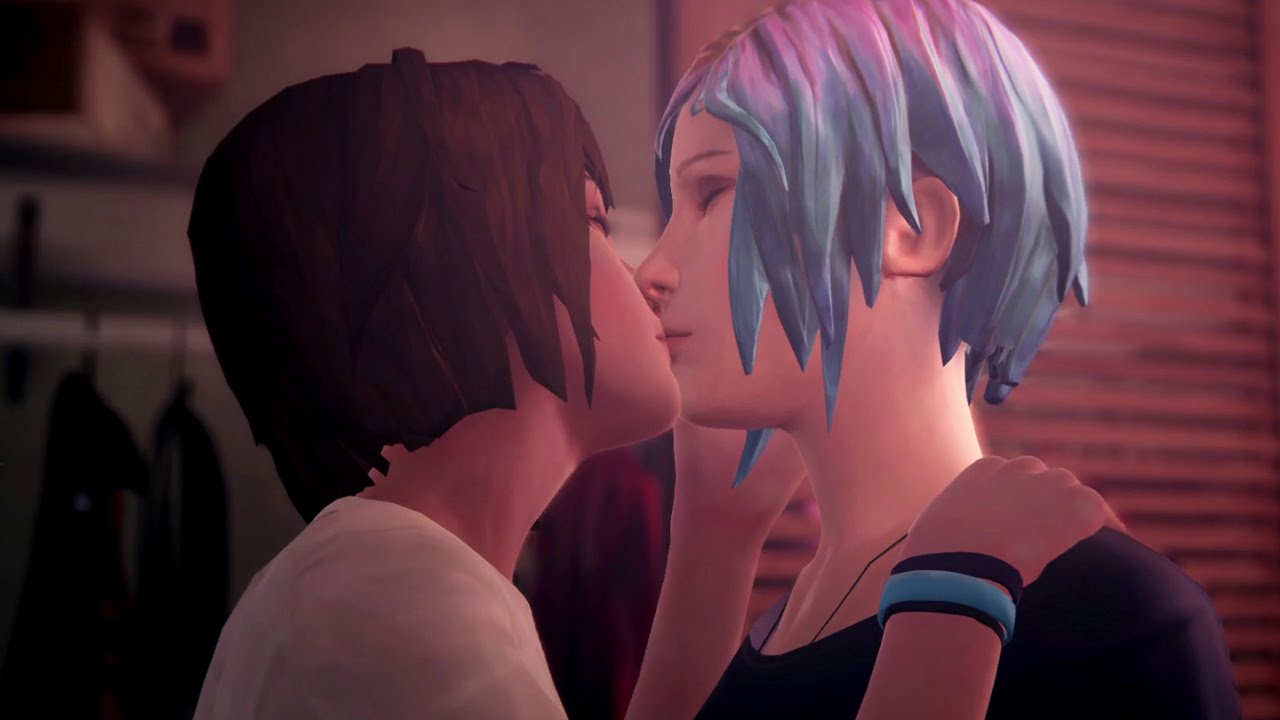
Pictured: Max kissing Chloe.  Chloe's hair is dyed in the approximate colours of the bi pride flag.

Max is bi, unquestionably.  Her close past friendship with Chloe takes on romantic overtones almost immediately after they meet again, they flirt constantly, and your first opportunity to kiss is in the middle of the game.  You can choose not to, of course, but 80% of players went for it, as is right and good.  If you do, the flirting only ramps up afterwards.  Chloe really only expresses interest in other girls, primarily Rachel, and it's hard to tell if she's just teasing you when she talks about how hot Mr Jefferson the photography goatee teacher is.  And while they have some obviously sexualised scenes (playing in the pool at night, nearly naked) it's mostly not objectifying camerawork.  (Being male, I'm probably not a good source on whether the male gaze applies.)

Max's other potential love interest is Warren, a nerdy boy who defies the vast majority of expected nerd boy cliches.  He's super excited about what a geek Max is and wants to trade classic SFF movies with her, but he never becomes the entitled and resentful Nice Guy, even if you reject him, even after he puts himself in physical harm to protect you.  IN FACT, if you turn down his date and he then learns you're spending all your time with Chloe, his response is basically "Oh, wow, yeah, if I were you I would also date her, good call".  (Erika: I remain conflicted on if I would pick him or not if Chloe wasn't the other option. He's kind of endearing, but also so thirsty.) No biphobia!  Not even a second of "wait, are you gay or something?"  Normalised bisexuality.  Truly this is a world unlike our own.  (Villains don't mind throwing in some homophobia now and then, generally by calling Chloe a dyke, which is kind of unnecessary but in line with the rest of the writers' choices.)

Most of the other characters very clearly have their virtues and flaws as well.  Victoria, alpha girl of the school, is snobbish and judgmental, but can also be kind and loyal, and is clearly motivated more by insecurity than malice.  Chloe's stepfather David is an ex-soldier, pushy, prying, secretive, and short-tempered, but genuinely cares about his family and is just very bad at simultaneously protecting and respecting people.

Nathan Prescott is worth talking about as well--he's the rich kid who never faces consequences for anything and (almost) kills Chloe in the first episode.  There's a lot of ableist talk about how he's "insane" and on a ton of prescription medications (in addition to illegal narcotics), but ultimately we're corrected: his mental problems didn't make him evil, they made him vulnerable, and while he's done inexcusable things, he's in turn a victim and pawn of bad people who are entirely sane.  Like Chloe's alternate timeline (and this time speaking as someone who does depend on medication for his mental health), I felt again like this ended up in better territory than usual, if not necessarily great.

With all that said, let's talk about how much I hated episode five.

Okay, 'hated' is a strong word; I was less uncomfortable than Erika was while we played through it (Erika: I spent most of this sequence clutching a pillow yelling "NO" and making upset noises at the TV), but in the aftermath I became more and more dissatisfied with the writers' choices, the wasted opportunities, and the confluence of really tired cliches in a situation that desperately needed the originality and unpredictability of the rest of the game.

It starts out bad: Chloe is dead, Max is captured, and the real villain has been revealed as Mr Jefferson, the hipster teacher Max has idolised for years.  It turns out that his favourite subject for photography is the destruction of innocence, so he likes to kidnap girls and photograph them as they are slowly overwhelmed by fear and despair.  Bound to a chair in his secret bunker, the player is mostly just forced to watch scenes play out, which is the first problem.  Episode five is less a game than an interactive movie--rather than making choices, you're pushed through a pretty linear sequence of events, trying desperately to find anything you can do that will make a difference.  The writers were clearly trying to evoke a sense of helplessness in the player (after four episodes of causality being your plaything), and I don't disagree that they succeeded.  What I dislike about this is that after four episodes of focusing on the agency and power and courage of this teenage girl, they decided that what we really needed to bring things home was a painfully long sequence in which our heroine is helplessly victimised by a violent man and we can do nothing but watch.  The game up to now had--usually--avoided being very voyeuristic, and that goes right out the window.  Prolonged camera shots of an underage, drugged girl.

This is not something I was looking for in my game.

After what feels like about nineteen weeks of pointless struggling, Max manages to find one of her photographs that she can use to tweak the very first scene of the game, rewriting the entire week.  Kate is alive, Chloe is alive, Mr Jefferson has been arrested, and Max is declared the winner of the photo competition, which means she's out of town at a gala when she receives word that the mysterious hurricane is nevertheless destroying the town.  She goes back to rewrite time again to make sure she's home to protect people, and consequences spill out of control such that she ends up back in Jefferson's evil lair with no photos.  Ex-soldier David comes to the rescue this time, because what we really needed was for her to get rescued by a strong man again (Max does help, but still, seriously?), and off Max goes to find the one remaining photo that will let her travel back to warn Chloe and save the day.

It works, though apparently the developers felt they needed padding or just hadn't shown off enough graphical tricks yet, because first there's an extended nightmare dungeon sequence that is pretty much exactly what I'd like to see in a horror movie, except that since when is this game a horror movie.  It was cool, and it's certainly a powerful scene when Mirror Max berates Player Max for using her time-warp powers to make people like her.  I just wish they had given us more reason for any of those scenes to be in the game, apart from 'it was cool and we had a half hour of runtime to fill'. (Erika: However it would have made for a great horror game.)

The final choice of the game comes in the same place the story starts, on a cliff, watching the hurricane bear down on Arcadia Bay.  At this point, our heroes have 'realised' that all of these bizarre phenomena are somehow caused by Max's time-warping, including this very storm.  How they've realised this remains unclear to me; it seems like a pretty strong application of post hoc ergo propter hoc.  (It would have been just as reasonable to conclude that some other force had fractured reality, causing various disasters but also somehow allowing Max to hop between possible timelines, near as I can tell.)  Regardless, Chloe realises that Max only developed her powers to prevent Chloe's death, and so offers Max a photograph that will let her travel back to day one, allow Chloe to get shot, never gain her time powers, and thus prevent any of the catastrophes that follow.

Yeah.

A brief list of things I am provisionally okay with:
  • moral conundrums where you have to choose between one person you value most or a bunch of other people
  • diabolus ex machina in which some kind of force majeure threat out of nowhere requires you to choose between two flawed results
  • villains being characterised as creepy hipster misogynists who literally see women as objects, even and especially if it's not blatantly sexual
  • gameplay sequences specifically designed to evoke a feeling of helplessness
But when you combine all of these things to tell a story about a heroine getting tied up, drugged, threatened in various physical and psychological ways, punished for every choice she makes, and ultimately told that the will of the universe is that she either allows her girlfriend to be murdered or she will personally be responsible for a random town-destroying disaster...

Again, this is not what I was looking for in this game.

On the plus side, you can choose not to sacrifice Chloe, so it doesn't have to be a story about the Tragic Lesbian who dies selflessly to save the straights.  Yet the writers obviously felt that was the stronger story, and put substantially more time into that ending than they did into the one where you let the storm run its course and then drive off into the sunrise.  (You also only kiss Chloe again if it's right before you rewind to let her die; otherwise it's hugs only.)  In both cases, I'm not sure I've ever seen a game that so desperately needed a 'where are they now' ending for its various side characters, which would have fit in perfectly as, for example, a photo album that you could flip through during the end credits.  (From what I've read, the lack of detail was intentional, especially in the ending where the storm hits, as the writers wanted to leave players in suspense about who survived the disaster.)  Instead, Erika and I agreed, the supposed consequences of all of your many other decisions throughout the game are seriously undermined, since you don't get to see any impact in the end from anything but your final choice.

★Erika★
I would go as far as to say that none of your choices matter expect the final one. You either reset, and none of it happens, or you just leave them to die.  (If Max retains her memory during the days she must now relive, they could matter more, but it is unclear if she does or not, and given the previous mechanics, implied she doesn't.)  The survivors aren't going to care whether you were nice to them or not after getting a bucket of paint dumped on them, they're going to be a little preoccupied with how their lives have been destroyed by a hurricane. For a game that let you think that its choices were so important, real lunchbox letdown.

★Will again★
I can see ways they could have spun the hurricane ending more effectively, and even the reset ending, but in both cases they'd have to have actually wanted to do so, and set up for it.  In the reset ending, a sequence (even a montage) of Max using whatever knowledge she still has in order to help people (supporting Kate, befriending the rest of the 'unsympathetic' students and stopping bullies, reconnecting with Chloe's mom and helping her through what follows) would have added a lot.  In the hurricane ending, obviously, how you've interacted with other characters could also influence the choices they're going to make, and 'former enemies come together to protect the community in a crisis' is a way better cliche than anything else we were getting in this episode.  Victoria and Frank the drug dealer come to mind as examples of people who are hostile by default but can have a conscience installed.  Give me Victoria mass-texting people to come to her family's storm bunker; give me Frank and David driving around town grabbing anybody stuck on foot on the street.

One last thing that I expected to mean more but never did was the nature of the big photo competition: "Everyday Heroes".  Max's winning picture is a shot of herself and her wall of photos, yet her heroism is not really evident to anyone else most of the time (the main exception coming to mind is her rescue of Kate).  Her heroism in the reset ending consists of choosing not to act.  Maybe the takeaway there is that 'everyday heroes' aren't often noticed or recognised, but it's kind of lacklustre, and there isn't much that can connect an act like that to the real world.  Conversely, there's a giant missed opportunity for plausible 'everyday heroism' if Max's little actions over the course of the week are allowed to add up to something significant in the end, like the townspeople being more ready and willing to protect each other.  Be good to people throughout the week, bring them closer together, make them more ready to weather the storm, and maybe they can save each other so you aren't pushed to let your girlfriend die.

And I figure that's exactly what the writers did not want to allow.  Either of these things--the reset ending where you see Max still finding ways to help people, or the hurricane ending where she's helped them become people who leap to protect each other--distracts from the focus of the ending right now, which is "are you going to kill your girlfriend and suffer like a hero or spare her like a selfish coward".  That is the extent of what the writers wanted you to be thinking about and left with, and all other possible consequences of your many, many choices are removed by fiat.  If anything, the message seems like it's supposed to be "life is strange (WINK) and therefore nothing is truly in your control and your choices and desires don't really matter".  Helplessness is in keeping with the themes of the final episode, but "you can't really have any agency" is again a thing I was not looking for in my bisexual SFF mystery game, especially as the 'twist' ending of a game that claims it's all about choices.

Wednesday, October 14, 2015

The Cabin In The Woods: Joss Whedon doesn't know what deconstruction means

What's this?  Not a Dresden post?  Yes, dear readers, because it is October and tumblr's love of Halloween is sufficiently infectious that I was all "Hey, we should do a bunch of posts on Halloween movies this month" and the blogqueen was all "I like that idea but let's not go overboard" and I was all "CAN'T HEAR YOU, TOO BUSY BEING THE PUMPKIN KING" and she was all "FUCK YOU I'M ALREADY WRITING A POST ON NIGHTMARE BEFORE CHRISTMAS" and she is the blogqueen, so her word is law.  But I get open the gates, with a little more than two weeks to go before Halloween, with my unrelenting judgment of Joss Whedon and all sexist nerds who think satire means 'the same old rubbish with a wink and a funny voice'.

Something Short & Snappy Hallowthon 2015 presents:
The Cabin In The Woods

This movie is three years old now, so I imagine most of the people who actually cared about seeing it unspoiled have already done so, but just in case you're not aware, the actual premise is a spoiler, so if for some reason you want to see Joss Whedon writing self-satisfied horror in the manner that he originally intended, read no further in this post.  There's not much meaningful to say about the film without talking details.

Now, as soon as I said 'Joss Whedon writing', most of us could probably guess (with or without seeing the film) that this movie is incredibly proud of how clever it is.  Horror movies come with a lot of tropes and cliches--back in the 1990s, Scream revitalised the genre by making a slasher flick full of people discussing slasher flicks, a harbinger of the super-meta media that has rocketed to popularity in the last couple of decades.  I don't actually like Scream (not least because that mask fucking terrified me as a child), but I can't deny that it was a clever idea to make a film in which people actually tell each other to do the things that the audience normally has to shout, like 'don't run upstairs, there's no escape there'.

But that's been done now (on through three sequels and a Netflix series), so how can someone brim with satisfaction at their own cleverness now?  The same way bad parodies work: force everything to fit to the cliches of the genre at their most extreme, presented utterly without commentary or analysis.  TCITW is a movie about a world (spoilers begin here) where humanity managed to seal away some eldritch horrors thousands of years ago and can only keep them sealed by performing a sacrificial ritual every year, which must fit the format of an ultra-typical horror movie.  So the movie opens on an underground complex where people are going about what seems like an ordinary semi-industrial office job, which we slowly discover is actually the central control room where they bait a group of young adults into a sealed environment (the titular cabin and woods) and let loose monsters to slaughter them.  Real people don't fit the requisite cardboard-cutout characters, of course (the jock, the nerd, the comic relief, the sexpot, and the virgin), so the action of the movie is two-sided: Our Heroes trying to escape monsters in clever ways, and the showrunners manipulating and pushing them back onto the rails like a bad tabletop gamemaster.

Thus, the ordinary is presented as clever because it gets labelled: on their way to the cabin, the kids stop and ask directions from a gruff hillbilly who tells them to turn back, and the scene gets intercut with shots of the showrunners talking about how important it is to the ritual that the kids be warned "by the Harbinger" but continue anyway.  All the protagonists start out as intelligent college kids, but (for example) the girl who's supposed to fit the 'slutty' archetype was convinced to dye her hair blonde and dosed with cognition-slowing drugs so she would drag her boyfriend out into the woods to have sex and die.  At one point the jock says 'stick together while we search the house', gets a dose of gas from the nearest air vent, turns around again and says 'actually, let's split up to cover more ground'.

They have a gas that makes people think it's a good idea to split the party.

I try to take stories in on their own terms: I'm not criticising TCITW for not being deep, or for not explaining how one invents a gas that makes people think it's a good idea to split the party.  The premise is "What if you had to orchestrate a real-life horror movie in order to save the world?" and something like that is just a throwaway joke that everyone's supposed to nod at and move past.  (I do greatly prefer the parts where things are actually orchestrated and people break the stereotypes--in keeping with exploitation horror of the past, voyeurism is a big part of the ritual, so they put the nerd in a room next to the final girl where he discovers he's got a one-way mirror to watch her undress.  Villainwise, that's a smart move to ratchet up the sexual tension, but the nerd is also not a total skeeze, so he overcomes temptation, warns her about it, and they switch rooms.  Naturally, the girl then watches the nerd, who is played by Jesse Williams and therefore hot like fire and hella jacked, take his shirt and belt off before she covers the mirror up again.)

No, if TCITW was just kind of smug about all its tropes and references, I wouldn't take much issue with it: the dialogue is often fun and funny, the cast is excellent, and it raises some interesting moral dilemmas when the heroes find out the truth and have to choose between actively murdering each other or passively ending the world.  (I disagree strongly with their conclusion, but more about that in a bit.)

My core problem with the movie is, as you readers have probably guessed, is that it involves Joss Whedon trying to be clever about gendered roles and that is a recipe for disaster.  Horror movies in general and slasher flicks in particular have a history of misogyny, sex-shaming, objectification and voyeurism, and sexualised violence against women that hardly needs to be expounded upon here.  The bright points are those rare occasions when the tradition of the 'final girl' gets turned into something like an icon of strength, resilience, and courage in women.  (Take perhaps the most famous 'final girl', Ellen Ripley of Alien--Sigourney Weaver, of course, shows up in TCITW specifically to explain the trope.)  It's sufficiently common that even this movie's 'ritual' incorporates it: as long as everyone else dies and the 'Virgin' suffers, the ritual is complete and she might be allowed to survive and win.

This is too obvious for Joss Whedon's cleverness to abide.  No, while the protagonist  Dana is a woman, the actual hero of TCITW is Marty, the comic relief.  He's resistant to the mind-warping drugs and hypnotic suggestions because he's stoned all the time, he carries a collapsible steel bong that he uses to do battle with the monsters (and successfully takes down the one that tries to kill him personally), and constantly fills the audience surrogate role of 'Hey, maybe we shouldn't do this obviously dangerous thing'.  He also locates the secret entrance to the villains' complex, hacks into their equipment, rescues Dana from her monster (after killing his with a trowel), and leads her down to the lower levels to confront the big bads.  He gives us the moral of the story as well--society is fundamentally broken and deserves to be wiped out--and the final question of the story is whether Dana will murder him (and save the world) or break the cycle (and let the ancient death gods rise up to slaughter us all).

Except: Dana doesn't even get that moment of agency, because as she's quivering, gun in hand, choosing whether to kill one person by action or billions by inaction, Marty keeps her from noticing the werewolf creeping up behind her and the clock runs down while they're fighting.  Afterwards, as they wait for their doom, Dana says she probably wouldn't have done it anyway, but actually letting her make that choice wasn't dramatic enough, apparently.

Raise your hand if you're shocked that Joss Whedon looked at a genre where strong female protagonists occasionally win (while hordes of other women are slaughtered, usually after flashing the audience) and said "No, this will not do, I need to bring something fresh to the table by having a sarcastic scruffy man save the helpless girl and drive the plot."  It's not the muscular dude, or the smart dude, or the hot chicks (either flavour, sexy or virginal) who save the day, it's the pseudophilosophical guy with funny lines and weed and no luck with women.  Yeah, that's definitely not Whedon's author avatar.

The phrase 'deconstruction' has gotten popular in the recent years, but the meaning has kinda shifted.  It's common enough now to use it as we do on this blog, to just mean 'unsympathetic critical analysis', but the word itself is older and more nuanced than that, to the point where I can't even begin to parse the original source material by Derrida.  (Neither can a lot of scholars, leading to a bunch of people trying to create secondary explanations that actually make sense.)  I'm not going to pretend I understand it either, but I can tell the difference between a meaningful commentary and shouting "Society thinks sex is dirty so the blond slut always dies first!"  Like: thanks, Joss.  We know.  We know that's how it always goes.  Are you in fact clever enough to come up with a twist on that, or are you just going to have a lot of people point out that the girl got killed five minutes after going topless and call it groundbreaking?  "But what if she was manipulated into doing it?"  SHE IS ALWAYS MANIPULATED INTO DOING IT BECAUSE THESE SCRIPTS ARE ALL ARTIFICE.  There are no actual choices going on.  The only difference this time is that the people in the script are scripted to acknowledging that they're following a script but under no circumstances question it.

Without getting too far into a very different kind of essay, I also want to vent my frustration against the ending and the idea that Our Heroes made the right choice by dooming everyone: in order for someone to say 'society is corrupt and we all deserve to burn' they have to be either the ultimate supervillain or have an incredibly narrow and specific concept of what 'the whole world' means.  We're talking about more than seven billion people in the world, all living radically different lives in different circumstances, different choices, different values, different traditions.  The typical stoner-philosopher appears to mean "Capitalism is messed up, our government is ineffective, and I can't get laid, so the whole thing might as well burn", which to my mind just shows a lack of interest or creativity.  If it's about the atrocities humans have committed in the past, well, we've got almost two billion people under the age of 15 and I'm inclined to give them a chance to do better than us.  If it's about the stories we tell supposedly illustrating our inherent corruption, well, show me an Anishinaabe slasher flick or something, because I'm not sure our traditions are as universal as you're claiming.

But I'm getting all Doylist about this instead of interrogating it from within the framework of the movie, where the logic appears to be "Humanity is under constant threat of annihilation by malevolent gods unless we make bloody sacrifices, therefore we deserve to be annihilated by malevolent gods", which... does not flow for me.

The ultimate problem with TCITW, I think, is the nature of the big bad gods behind it.  They are meant to stand for us, the audience: one girl has to get naked and die because the gods demand it, people must suffer because the gods demand it, it all has to happen over and over again because if the showrunners don't give the gods what they want, they--that is, we the audience--will rise up and end the world, and frankly that is blatant buck-passing.  The closest thing you can get to a 'message' out of TCITW is that these same horror movies keep getting made because that's supposedly what we want, but let's look at the facts: Twilight features blood and monsters and decapitation, but it also features girls who get to live forever with their infinitely-loyal sexbot husbands, and the Twilight movies made more money than you could fit in a cabin in the woods.  Google searching suggests to me that the highest-grossing slasher flick of all time, the original Scream, in total grossed about $189 million internationally (adjusted for inflation), whereas the first Twilight laughed that off at an easy $225 million and New Moon hit $326 million.

I'm not saying Twilight is good--what kind of monster do you take me for--but I am saying that in the case of Auteur Joss Whedon vs. We The Demanding And Disgusting Public, the evidence speaks soundly in favour of these things not being how you pander to the plebes.  There are no all-powerful market gods demanding that these same exploitation-film cliches get repeated over and over again: these movies get made because filmmakers like to make them.  That's the twist TCITW needed: in the end, when they've forced Dana to kill Marty to save everyone else, and everyone agrees that the rituals must go on because that's just how the world works, we find out that the Director is actually just a power-hungry misanthrope who dangles the (false) threat of ancient gods over everyone else because they just really like watching young people die naked.

Guess that was a step of realism too far?

Sunday, October 19, 2014

The Eye of the World, ix to xviii, in which Will fails to keep a straight face

The first character we meet in The Wheel of Time has something in common with me, in that we both brought this suffering on ourselves.

Most of you are probably at least aware of WOT, even if you've never read it--the first book came out in 1990, which is notable for me as the first year that I was aware what year it was.  These books are old, given that the series only finally ground to its conclusion quite recently.  This brick of a book I'm staring at warily is 814 pages long and has a cover with one guy wearing vaguely samurai-ish armor on horseback (with a pair of vaguely Celtic swords strapped to his back in a questionable manner) next to a woman on a much smaller horse, carrying a staff and looking like she is small enough to curl up inside his ribcage.  If I hadn't already guessed, it became apparent to me on the first page that this book is sort of a fantasy Poe: if I were to make up a random phrase that was meant to sound like an absurd parody of sword-and-sorcery mythos, it would be indistinguishable from actual text in this book.

I am not necessarily opposed to this.

If I wanted to try to come up with objective criteria on the quality of storytelling, I guess I'd have two questions: 1) How well does the story achieve what it set out to do and be, and 2) What are the real-world implications of the story?  The works of Orson Scott Card do questionably on both these counts, because people act like they got something completely different out of the book than what is in there.  What little I know of Robert Jordan's works, and his immense, Card-eclipsing popularity, suggests to me that they succeed immensely on Criterion the First: if you want this kind of unabashed over-the-top megalomagical Epic Fantasy, they will fulfill your needs.

This blog, of course, is much more focused on Criterion the Second: who gets walked all over in the service of the story's ends?  Women?  People who are disabled?  People who aren't straight?  People who aren't cis?  People who aren't white?  Some beautiful and terrible Voltron of more than one of these demographics?

What I know in advance about WOT suggests that it's going to be heavy on the gender-essentialism and the heteronormativity.  Dunno yet about the racism, ableism, or anything else.  Dunno what kind of politics it pushes or values it assumes.  I am leaping into the unknown here.  Your fates are now bound to mine.  Let's bounce.

(Content: death, ableism, binarism. Fun content: the phrase 'Nine Rods of Dominion' is used unironically.)

Eye of the World: p. ix--xviii
Prologue: Dragonmount

The first thing that leaps out at me is that this prose is hard to read.  In my own fiction, I've been debilitatingly bare-bones about description in the past, and I think these days I still tend towards sparse narrative.  Jordan does not.  Jordan's prose is the purple of a twilight sky in the eyeblink past sunset when the reds have faded but the black of night is not yet swept over the world.  It gets distracting.  We're inside a ruined palace and I'm piecing together what's going on with the help of phrases like:
Bars of sunlight cast through rents in the walls made motes of dust glitter where they yet hung in the air.
Did you parse that sentence on the first read?  I did not.  I'm also a little fuzzy on the nature of the devastation in the palace,since "scorch-marks marred the walls, the floors, the ceilings. Broad black smears crossed the blistered paints and gilt of once-bright murals, soot overlaying crumbling friezes of men and animals", but also "colorful tapestries and paintings, masterworks all, hung undisturbed".  What kind of fire hits every surface of the room but misses all the art?  Is that supposed to be indicative of something?

Also there are corpses everywhere, all sorts, all kinds, and through it all a dude cheerfully skipping along looking for his wife.  (She's dead on the floor among all the others, naturally.  Fridged Women Tally: 1.)  He spots himself in a mirror, looking mussed, and cracks up.  There's more tons of description, including a blatant taijitu (yin-yang symbol) on his cloak, although his name is Lews Therin Telamon and his dead wife is Ilyena.  Samurai armor on the cover, taijitu on the white dude; is this a secret weaboo fantasy and no one told me?

A dude pops into existence behind Lews, wearing all black and thigh-highs, so it's safe to assume he's evil, I guess.  (Thigh-high boots, that is, but I wanted y'all to consider a different mental image first.)  He's described as "fastidious" about not wanting to touch the bodies, and I begin to wonder if this is going to be a series that requires frequent consideration of queer-coding.  He calls Lews "Lord of the Morning", and we are into Poe territory immediately, because Lews asks if the stranger has "the Voice", because it's almost time for "the Singing".

All-Black Dude immediately determines that "the taint" has taken Lews (no Significant Capitalisation?) and I'm fuzzy on whether he's the devil's lieutenant or not, because he says "Shai'tan take you" in a snappish way, but also calls Lews "Light-blinded idiot".  Shaitan is straightforwardly the Islamic take on 'Satan', though sometimes a whole class of spirits rather than one single adversary.  Guessing Shai'tan is going to just be the embodiment of evil for this world; easier to stab that way.

All-Black introduces himself as "Elan Morin Tedronai", now called "Betrayer of Hope", and I wonder why we don't get titles like that more often in real life.  We never get to say stuff like 'This is my friend Eileen, the Jailor of Infinity'.  We should start doing that.  Elan says that he's embraced his title, and it's no different from people calling Lews "Dragon", though he suspects that Lews will have some public relations problems once word gets out about the massacre--apparently Lews is the one who murdered everybody, including the wife he keeps calling for.

Let me again make the nature of this text clear:
"Once you stood first among the Servants. Once you wore the Ring of Tamyrlin, and sat in the High Seat. Once you summoned the Nine Rods of Dominion. Now look at you! A pitiful, shattered wretch. But it is not enough. You humbled me in the Hall of Servants. You defeated me at the Gates of Paaran Disen. But I am the greater, now. I will not let you die without knowing that."
I was so unprepared for this I cracked up.  THE NINE RODS OF DOMINION.  This book is amazing and I regret nothing and everything.

Elan blasts Lews with "Shai'tan's healing" which wracks him with fiery agony but finally leaves him lucid, and he notices his murdered Ilyena.  (Blonde, obvs.)
"You can have her back, Kinslayer. The Great Lord of the Dark can make her live again, if you will serve him.  If you will serve me."
There go my hopes that Elan was a third party or something.  He's just our evil god's field agent.  Oh well.  Lews says the big bad has terrorised the world for ten years, Elan snaps back that it's happened since the beginning of time, and it sounds like there's a reincarnation cycle or something, "You and I have fought a thousand battles with the turning of the Wheel, a thousand times a thousand, and we will fight until time dies and the Shadow is triumphant", so I'm vaguely intrigued by this.

Elan finally makes it clear to Lews that the big bad mind-whammied him into murdering his entire family, in revenge for Lews' last attack.  Killed his wife (Ilyena Sunhair, she's even named for being blonde), his kids, his friends, his servants.
Desperately he reached out to the True Source, to tainted saidin, and he Traveled.
One of the things about these kinds of fantasy novels (Jack Vance also reads like this) is that it can be very hard to guess when a mythical thing is plot-relevant and when it's just magibabble, since references to big arcane things are getting tossed around all over the place.  Are there a lot of False Sources?  This is that same sort of 'tell the reader nothing and let them figure it out by deduction' style of worldbuilding, which I generally like, but I'm still back wondering what the Rods of Dominion are used to Dominate and why there are Nine of them, and in fact why it's so important that there are Nine of them that the word Nine is in their name, and why they have to be summoned rather than kept in a secure closet or something.

But Lews has Traveled to a huge broad plain, where "he could sense there were no people within a hundred leagues", and begs the Light to forgive him, though he doesn't believe it can.
He was still touching saidin, the male half of the power that drove the universe, that turned the Wheel of Time, and he could feel the oily taint fouling its surface [...]
Oh.  Joy.  Our magical Source is split into male and female, in turn making those universal concepts.  Betting there's no room in there for non-binary genders (and probably not intersex people either, regardless of their gender)?  If they've determined that the Source has male and female sides, would they even be looking for one?  I predict that I will spend much of this book suggesting that each plot point would be a good time for an androgyne person to bust in with new magic and save the day.

Lews blames himself and his pride for making whatever attack provoked the big bad's revenge, trying to "mend what the Creator had made and they had broken", and he overclocks himself on magic until he turns into a colossal pillar of incandescence that raises up a huge volcano in the middle of the plain, shoving the river aside and splitting it around a new island.  Elan finally catches up and mutters about how the Dragon can't escape him so easily, et cetera.

Then we get a couple of excerpts from historical texts, talking about the end of the world, when "the living envied the dead" and the only enduring memory is of "him who brought the Shadow and the Breaking of the World. And they named him Dragon", while the second excerpt calls for "the Prince of the Morning" and the "Lord of the Dawn", and then we get what I know is this series' catchphrase: "Let the Dragon ride again on the winds of time."

To sum up: big bad, eternal war, hero tried to seal big bad, fucked up, slaughtered everyone, world kind of ended but probably not really because there are fourteen books to go, and everyone is waiting for said hero's return.

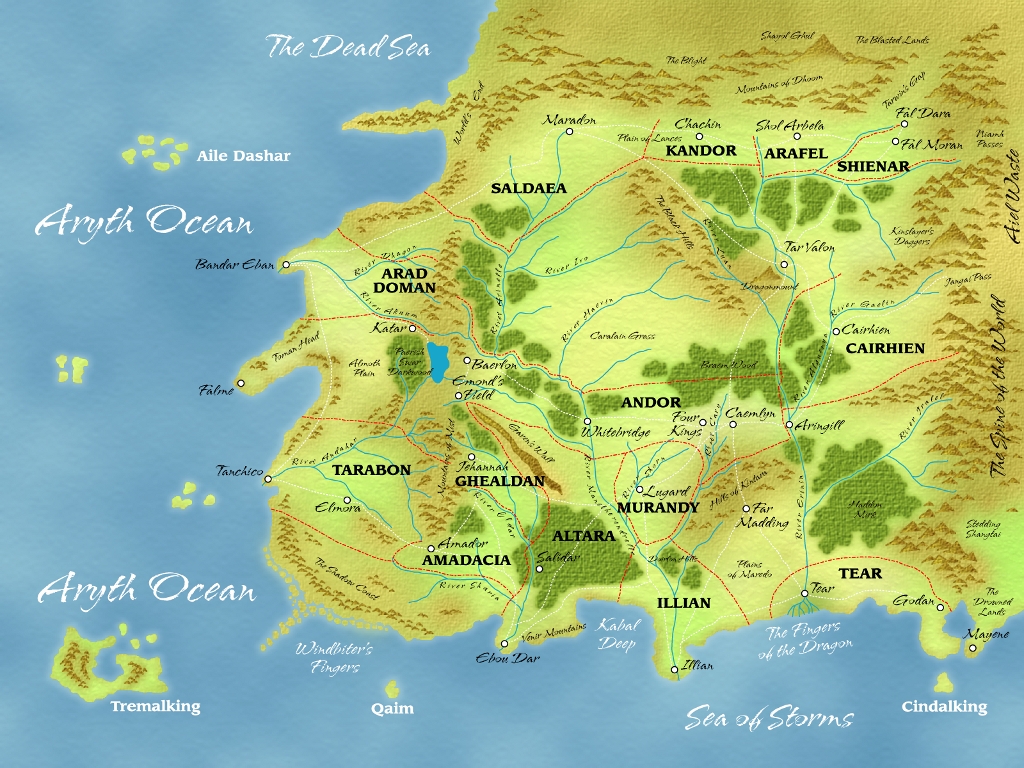
Ooh, then we get a huge convenient map:


Will you look at the 90-degree angle those mountains take?  I would normally bet massive quantities of cash that nothing plot-relevant will ever happen more than an inch beyond the borders of this map, but surely with the millions of words that make up this series I'd be wrong about that?  Please?

I also have some huge questions about the borders as defined above.  Why are they where they are?  We have a lot of weirdly-bounded territories in the world, just look at the eastern US or Europe, but there's a reason for that--they're following rivers, or mountains, or some other significant geological feature.  When we don't need to do that, we end up with things like Wyoming and Saskatchewan, boxes imposed on the boredom of the ground.  Why in the world is Tear's curvy border swooping through that field?  Who owns the ground between Tear and Illian?  There are actually an impressive number of unlabelled swathes in there--is the lack of claim there going to be explained, or are they just international territory for some reason?  These are the questions that will trouble me for months to come.

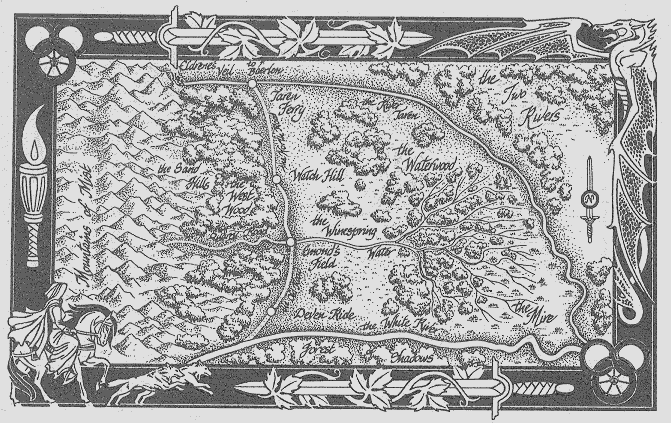
That's followed by this magnificent creation:


Now, correct me if I'm wrong, but this appears to show three rivers coming out of the mountains, and somehow the middle one shatters like a river delta in the middle of a field and branches out in dozens of different directions without ever meeting up with the other two rivers that are arcing together.  And eventually all those little streams just die out, in a presumably-damp region called 'the Mire', which I could sort of accept if not for the way there are still two massive distinct rivers bordering the Mire and cutting cleanly through the land.

I realise most fantasy authors aren't hydrologists, and if an actual hydrologist wants to correct me on this, please do because I love new knowledge, but I'm like 35% sure that is not how rivers work.

This is a bit of a short post, but that's all I can handle for now.  Come back next week for chapter one, in which we meet Our Hero, who at first glance looks to me like he's going to be a humble farmboy.  I should make so many bingo sheets.