Showing posts with label good writing. Show all posts

Thursday, February 25, 2016

Drizzt Do'Urden and the failure of fantasy racism

(Content: discussion of racism and other oppression.  Fun content: I hope you like elves.)

I should preface this with a giant disclaimer (in case there was any question) that I'm white, so this whole post is an extended 'it seems to me...' and I don't want to speak over anyone's experiences.  I don't think I've seen anyone address this specific flaw to supposedly progressive fantasy; I'd be happy to link to any such works if y'all know of them.  (Also, I think a lot of what I say below can translate to representation of other demographics and types of oppression, like LGBT people and comic book mutants, but it's Black History Month, so that's where we focus.)

Pictured: either my family tree or a box of assorted entertainment crackers; who can tell?

The best thing that speculative fiction can do is show us a bizarre new world that loops into our real mundane world right now and gets us to see something in a new way.  Consider classic Star Trek's episode about an alien cop chasing a fugitive, each of them literally half paper-white and half ink-black, divided down their centre line, but the cop is convinced that he's racially superior because he's black on the correct side.  The Snowpiercer movie (thankfully nothing like the original comic) is a beautiful, layered, sickening, and ruthless exploration of capitalism and literal class war.  And if I start talking about Discworld novels we'll be here all day.

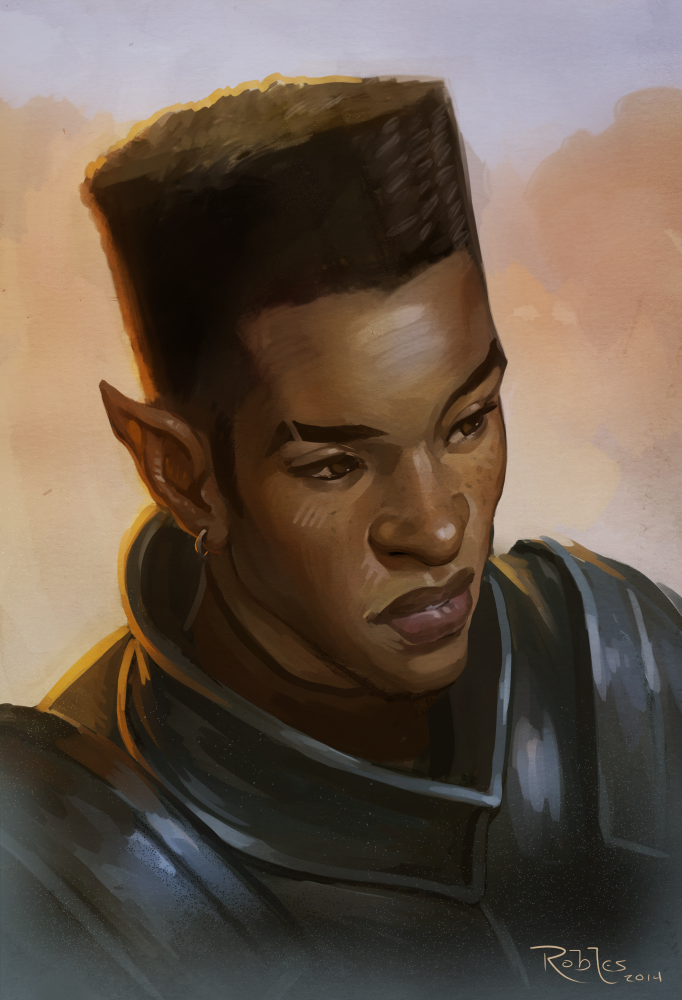
Countless stories--like Star Trek there, and like Forgotten Realms and Lord of the Rings and X-Men and basically every other serialised speculative story sooner or later--take the opportunity to criticise racism, usually by showing us elves and dwarves scowling at each other or something.  The first problem with this kind of scenario is that it extrapolates human 'races' (a nebulous and nonscientific concept) into entirely different species, so that the story is about (white) humans learning to get along with weird other-y pseudo-natural entities (of colour?).  We can do better.  But, at the same time, there's no reason that identifying with the badass werewolves or dragons or fae should be restricted to white people either, so yes, let's have elves with high tops:

Pictured: painting of an armored elf with distinctively black features, by Nick Robles.

Running with this, writers sometimes give us a paragon of virtue like Drizzt Do'Urden.  Drizzt is one of the most iconic characters in modern fantasy: a renegade drow (dark elf, literally black-skinned) from the underground city of Menzoberranzan who grew up disgusted by his people's cruelties and so ran away to the surface, where he roams the land of Faerun slaying monsters and rescuing the helpless.  He is, of course, nevertheless hounded at every turn by people who see his black skin and assume he's a monster.  I won't speak to authorial intention here, because I haven't read RA Salvatore's mind at any point in the last thirty years, but there's only one common reading of Drizzt's story and what it symbolises for our world.  We readers look at these presumptuous bigots, who think the only good dark elf is a dead one, and scorn them for failing to get to know Drizzt before judging him.  We know better and we are enlightened.

Drizzt is a good guy.

Drizzt isn't like other drow.

Drizzt is one of the good ones.  A credit to his kind.

#notalldrow

But the thing about those narrow-minded common peasants who flinch or scream at the sight of Drizzt walking into town is that they're only wrong this time.  With literally any other member of his species, they'd be absolutely right to freak out, because a powerful and sadistic murder-specialist would have just said hello.  That's not racism; that's basic probability and pattern recognition.

Fantasy racism like a fear of dark elves is ultimately a terrible allegory for real-world racism because the dark elves have worked long and hard to gain that reputation for monstrosity, whereas in the real world white history is basically a laundry list of the other nations and peoples we've slaughtered and enslaved and oppressed for monetary gain, political power, or occasionally just for sadistic fun.  In order for Drizzt the onyx-black elf hero to be an actual metaphor for black people in North America, our continent would have to live in constant fear of invasion from a subterranean army of African-diaspora wizard-ninjas, and I figure there can't be more than five or six million registered voters who actually think that's a concern.

What I'm getting at when I say #notalldrow is that Drizzt's experience, being a variously privileged individual walking into vulnerable spaces full of people who have been hurt before by people who look like him (and who know that he has the power to hurt them further), is the experience of the oppressing class, not its victims.  White people, especially but not exclusively white men: we're the drow.  When Drizzt sees someone afraid of him at first glance, it's not because they've been arbitrarily taught that black people are inherently inferior and disgusting.  If we read these scenarios and all we think is "Bah, foolish bigots, we Drizzt would never be so villainous!" we're only reinforcing the idea that vulnerable people owe us their reflexive trust or they're the real racists.

To the credit of Drizzt's fictional persona, he sympathises with these people and is patient with the caution strangers take around him.  At least, this is a good aspect of his character if it's taken as a model for, say, white people to not go around acting indignant that people of colour aren't always ecstatic about our presence.  From the 'surface' reading of his story, where Drizzt is the victim and he is patient with having to work to personally win over every single racist he meets... that's suboptimal to say the least.  The tangle that this kind of speculative fiction has made of power dynamics makes it harder to draw any conclusive arguments out of the text beyond a lukewarm 'everyone should be good to each other'.  That kind of 'equal opportunity learning' gives us stuff like the unholy mess that was Disney's Pocahontas, in which the indigenous Powhatans are also guilty of prejudice against strangers just because the white people are here to conquer, pillage, and murder.  I cannot even.

Fantasy racism doesn't speak to real-world racism as long as it seeks to justify its existence: as long as those simple innocent farmers are afraid of orcs because orcs are literally and objectively the twisted embodiment of malevolence forged by an evil god to burn the world, fearing orcs isn't racism, it's self-preservation.  Fantasy that wants to tell us that racism is bad has to start by admitting that racism isn't a defense mechanism but a weapon--a philosophy that helps the people in power convince everyone else that it's okay to kill and exploit those other people, without provocation, because they just don't deserve any better.  Stopping racism is about acknowledging and revealing and destroying that idea, and it's got to be done in us, the privileged, oppressing class.

I'd love to add some examples here of fantasy racism done properly (purely as propaganda and not based on objectively truth) but... I'm not sure I can think of any.  Even in Discworld, the conflicts between trolls and dwarves ultimately come back to 'both sides bear guilt'.  In the Warcraft universe, primary example of a setting where orcs are heroic protagonists as often as villains, the orc-human divide stems back to those one or eight times that the orcish horde got cursed into raging berserkers and tried to burn down the planet.  In settings like Star Trek (and often Star Wars, depending on the book) aliens often are pretty one-dimensional in ways apparently defined by their species.  I think a good case can be made regarding house elves in Harry Potter, but that'd be a book unto itself and there are plenty of people who feel the text ultimately fails to make a proper case distinguishing the racist propaganda from the truth.  If any of you readers have encountered a good speculative treatment of how racism functions that doesn't make these kinds of errors, I would love to hear about it.

Let me end by sharing with you a quote from Chris Rock, in an interview from 2014 which I was lucky enough to encounter this week:
So, to say Obama is progress is saying that he’s the first black person that is qualified to be president. That’s not black progress. That’s white progress. There’s been black people qualified to be president for hundreds of years... The question is, you know, my kids are smart, educated, beautiful, polite children. There have been smart, educated, beautiful, polite black children for hundreds of years. The advantage that my children have is that my children are encountering the nicest white people that America has ever produced. Let’s hope America keeps producing nicer white people.
Hope everyone's been having a good Black History Month.

Wednesday, August 26, 2015

The Eye of the World, chapter 49 to the end, in which the best and the worst of this book are on display

Here we are at last.  I could have split this across two posts, but I decided to power on ahead to the end.  Book One of the Wheel of Time comes at last to its end and we find out what passes for a climax in this unnecessary marathon of a pagecount.  Goggles on, dear readers.

The Eye of the World: p. 732--782
Chapter Forty-Nine: The Dark One Stirs

Rand wakes up and, top priority now that they are way deep in the noxious hellscape of Satan County, takes stock of how Nynaeve is feeling about getting rejected by a man.  If I thought this had anything to do with Rand thinking their group might be weakened by inner strife, I'd be less judgey.  Because Egwene is a better person in every way (and praise depersonified Light Jesus that she doesn't end up with Rand, by the way) she doesn't just stare, and instead goes to chat with Nynaeve until she manages to provoke a laugh and a hug from her wounded friend.  Rand just thinks about how "all women are Aes Sedai" because he thinks they have secret methods to read male minds, and I just can't even with this guy.  I mean, I absolutely think it's narratively stupid that Nynaeve is suddenly in love with Lan, but accepting that as our premise, we can presumably agree that Rand is contemptible for just staring at her, hurt, and thinking how freaky women are with their witch-feelings and seeeecrets.

Best possible plot twist at this point: Rand tries to stop the Dark One, instead falls to temptation, and Egwene leaps in to save the day because she is the Dragon Reborn.  Yes, after eight hundred pages it might be questionable to be all 'Hah, that protagonist was a decoy!', but there are literally ten thousand more pages still to go in this series and it's not like it stopped GRR Martin.

But let's move on or we'll never find out how disappointed I'll be.  They are once again riding towards--honest to Hotei--the Mountains of Dhoom.  Dhoom, people.  No editor stopped Jordan from doing this, and we all bear the weight of that sin.  Moiraine is taking them to the last place she found the Eye of the World, and if it moves, they'll count on the Green Man to help, because he "senses need", though why he hasn't come to them already in that case I don't know.

There's more description of the Blight, which is honestly the best part of this story right now, and when I'm this enthusiastic about description near the climax of a book you know it's dire.  The trees shed wet, decaying leaves constantly, ooze from cracks in their bark, and tremble from their footfalls as if they're turning to liquid entirely.  One of them flails around and grabs a furry creature off the ground.  Love it; A-plus evil landscape.  Lan wanders into the undergrowth to slaughter something evil, and upon his return gets jumped by some kind of murderous spider-bear, but Mat of all people takes it down with a single arrow.  That's a prelude to a mass monsters-and-monster-trees ambush, but the farm kids once again go into that ancestral battle-fugue where they shout about Manetheren and Ellisande a lot, and Moiraine elects to spam fireballs, because she definitely hasn't been saying this whole time that subtlety is paramount and we definitely don't have in-text evidence that wielding Fire weakens her more than anything else.  For reasons deeply unclear to me, Lan keeps leaving the group, diving into the trees, slaughtering things, coming back for Moiraine to cast Lay On Hands, and leaving again.  What's he getting done out there that is more valuable than directly protecting the party?  Does the forest have Strategy Bushes that direct and coordinate its malevolent intent?  Give me something, Jordan, don't just have him 'disappear' because it's supposed to be mysterious and cool.

The assault stops at the sound of some other creature's cry chasing them, which Lan identifies as Worms.  I mention this only because, to my endless delight, Jordan asserts that you can hear dramatic capitalisation:
"They were scared off by worms?" Mat said incredulously [...] 
"A Worm"--there was a sharp difference in the way the Warder said it from the way Mat had--"can kill a Fade, if the Fade hasn't the Dark One's own luck with it."
I mean, yes, Terry Pratchett also had audible capitalisation, but Discworld is an intentionally absurd place.  And well-written.  Lan volunteers to make a heroic sacrifice, but Moiraine forbids it, and Rand braces himself and thinks about how scared he is (less than relatable prose, way too tell-don't-show) when they clear a foothill and burst into a mass of healthy greenery that she declares safe.

The Green Man appears, made of nuts and leaves and butterflies, greets Loial and names Perrin a Wolfbrother, then straight up calls Rand 'Child of the Dragon', but no one thinks that might be a big deal.  He agrees instantly to take them to the Eye, and I wonder again if we've ever actually been told what it is, apart from 'plot relevant'.

Chapter Fifty: Meetings at the Eye

They wander deeper into the greenery, the Green Man weaving flower crowns for the women as they go.  Not sure why even he thinks that flowers are only for girls.  Dude is, by chance or choice, a dude, and he's partly made of flowers.  Maybe Lan is just sensitive about crowns.

(At this point, I decided to search the web for some good art of a manly man wearing a flower crown, but after the third photoshopped Benedict Cumberbatch I gave up.  On everything.  Forever.  I am a pointless meat husk screaming towards the void.)

The Eye is inside a hill, entrance marked by a stone arch, and I had thought the Green Man was hella old because he talked as if he had seen entire past turns of the Wheel, but then he says that he was made to guard it when it was first made, during the Breaking, by a hundred male and female Aes Sedai who sacrificed their lives in the effort.  Well.  That's... questionable.  Is it just me or if the villains made something out of the lives of a hundred people would we not assume it was an artifact of terrible evil?

Inside the cavern, the Eye turns out to be a big oval pool of not-water with no apparent bottom.  Mat kicks in a rock (classy) and they watch said rock dissolve into nothing.  Moiraine describes it as the essence of saidin, dude magic, which can either seal the devil's prison or bust it fully open.  Loial asks why anyone would make a thing like that:
"No one living knows [....] Neither the how, nor more of the why than that it would be needed one day, and that that need would be the greatest and most desperate the world had faced to that time. Perhaps would ever face. Many in Tar Valon have attempted to find a way to use that Power, but [...] only a man could channel it [...]"
Well.  That is also questionable.  A contingency device that can either save or end the world and can only be used by male wizards who are actively hunted because magic corrupts them.  Nothing about this plan sounds like a good idea unless you have narrative information that asserts that it will all turn out okay.  That is not a kind of prophecy I favour.

They leave again and outside run into a pair of the Forsaken, the devil's favourite servants, who are apparently loose now.  One is hella old but telekinetically smites Lan; the other is bound up in a fetish-worthy amount of leather and sets about thrashing the others before the Green Man shows up to save them.  Treebeard is not to be taken lightly--they wrassle for a moment and the Green Man looks like he'll burst into flames, but not before Captain Safeword finds himself consumed by an outburst of fungus, nettles, and weeds, plants that love the dark.  Then Big Green does topple, and his collapsing body produces a single acorn that immediately erupts into an ancient towering oak.

You know, I'm actually enjoying this book right now.  It's not exactly mindblowingly original, but at least it's operatically fantastical.  If the book only consisted of events like the last few chapters, and not five hundred pages of trudging through Generic Fantasy Farmlands, I might even recommend it to others.

Moiraine tries to trap old dude--Aginor--in a fiery chasm and tells the others to run, but Egwene tries to help as well, and Rand has to pull her away.  In literally any book where Egwene was the protagonist, it would be a sign of incredible bravery that Egwene dared throw whatever magic she could wield against the villain, and it would make some minor difference that was ultimately key to their victory, but here she's being foolish and has to be rescued by a boy.

Chapter Fifty-One: Against the Shadow

So this chapter gets trippy.  Rand runs from Aginor until he reaches a sheer cliff, inescapable, and Aginor talks about killing him (the devil being okay with undead servants), but Rand is suddenly aware of... I'm not sure.  Lifelines?  He sees a glowing cord running off Aginor, which pulses ever more intensely as they mind-battle until Aginor bursts into flames.  Rand then teleports into the middle of the battle at the borderland pass, where things are going badly for humanity, but in a fit of rage he blasts the draghkars out of the sky with lightning and summons a firestorm to scythe through most of the trollocs and Fades.  There's some unclear dialogue inside his head between himself ("It has to end!") and an unknown voice ("ONLY THE CHOSEN ONE CAN DO WHAT MUST BE DONE, IF HE WILL"), and some reasonably adept prose describing the "terrible heat of the Light" in such a way that makes it sound less cuddly and more like an overwhelming implacable force.  This I also like: if your hero is going to wield supreme power of goodness and use that power to incinerate living creatures, at least make him fucking terrified of it.  (I mean, the whole 'our hero firestorms the bad guys' is an unnecessary scene on principle, but if it's going to be here, this is an okay handling.)

As the human forces rally behind him, Rand climbs a literal stairway to heaven, steps made of light in the void, until he arrives back in the stony balcony from his dreams where he faces off against Ba'alzamon.  Rand can see Ba'alzamon also has a lifeline, and you should all be proud of me for not making any of the jokes that all but tell themselves when Rand marvels at how thick and black it is.

Ba'alzamon explains (indistinctly, but intelligibly if you know Rand's Secret Backstory) that he has orchestrated the events of Rand's ancestors to bring him here, and has only sent small armies or individual Darkfriends after Rand because he'd rather have a living servant than a dead one.  At least that tries to explain why the endless armies of evil haven't made much of an appearance, but I'm still not clear why sending a hundred Darkfriends to abduct Rand would have guaranteed his death rather than his capture.

The devil conjures up Rand's dead mother next, and she pleads with Rand to save her soul.  Fades appear and start torturing her, but Rand conjures a sword of light out of nowhere, blasts them to bits, and hacks Ba'alzamon's lifeline in half, declaring "It is ended!" in what I can only assume is a Revelation reference.  Everything bursts into flames.

Chapter Fifty-Two: There Is Neither Beginning Nor End

You say that, Jordan, but I remember the naive, callow youth I was when I started this book, and I know how eagerly I await my freedom in another twenty pages.  Also, really, that chapter was our grand climax?  Rand is separated from the others and doomed but then instinctively saves himself, saves the army, saves his mother, and sets the devil on fire?  That was literally and without exaggeration the most gratuitous, least foreshadowed, least earned, and most convenient victory I have ever read.

Wait, I'm wrong.  I once read a primary school kid's short story in which a boy gets magically transported to a realm of talking animals and told by the king lion that he is the chosen one who needs to use the magic gems to destroy the villain.  At that exact moment, the villain leaps into the king's court, and the kid raises the gems and vaporises him on the spot.  Like, the lion hadn't even finished the tutorial on these things and boom, quest over, promotions all around.

That is the only other contender for the title.

Rand awakens where he started, near the pile of gross ashes that used to be Aginor.  Memories float back and he sprints back to the others, who are all unharmed, including Moiraine.  He tells them that he killed the devil, and everything else that happened, but everyone else is too plot-savvy to believe that the devil gets dropped in book one.  Moiraine explains that she's seen evidence of Rand channelling all through the book, as far back as when she was casting Refresh Horse on everyone's mounts and Bela didn't need it--because Bela was carrying Egwene and Rand instinctively wanted her safe.  (The possibility that Egwene had refreshed Bela apparently wasn't on the table.)  Moiraine promises not to drag Rand off to be "gentled" like they normally do with man-wizards, and not to tell anyone who doesn't need to know.

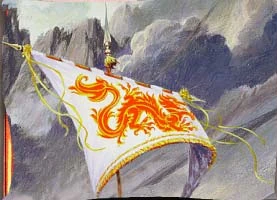
The Eye pool is apparent gone, consumed by Rand's victory lap of plot contrivance.  Instead there's a column of stone in the centre, with convenient steps to reach it.  The dudes of the pottery carry three relics retrieved from inside the prison.  First are ancient pottery fragments, which Moiraine fits together into a taijitu (last seen in the prologue) and identifies as heartstone, indestructible relic of a past age, one of seven seals on the devil's prison, shattered by unknown means.  Second is the Horn of Valere, namedropped much earlier in the book, to be used to call spirits of heroes back to fight the devil, and last is the banner of the Dragon, specifically a serpentine gold-maned red dragon.


Just so we're clear on this, Our Heroes are a sea of whitebread and ginger carrying a katana, the prime symbol of Taoism, and now a clearly Asian-style dragon banner.  I know Jordan said he was going for a sort of 'fantasy melange', but I have yet to see a single thing that makes me say 'ah, a reference to African mythology!' or really anything other than 'ah, another white author with a fetish for Asian myths minus all the Asian people!'  People who have read later books: does this ever get better?

Chapter Fifty-Three: The Wheel Turns

The Blight has eaten most of the greenery the next morning, but Loial refuses to let it have the Green Man's oak, and takes an hour (that feels like minutes) to sing a Tree Song that rejuvenates it, assuring the party that he couldn't have invoked so much power if Jolly Green's spirit wasn't still in there.  The Blight is still gross, but doesn't try to murder them as they leave--Moiraine explains that they "struck a mighty blow against the Dark One" and for some reason Rand still hasn't asked for an explanation of how she reconciles that with his memory of killing the devil.

At least the soldiers at Fal Dara aren't so hypermasculine as to reject a good flower crown, and everyone is wearing them to celebrate the incredible victory at the pass.  Moiraine waves off all healers and meets with Agelmar to show him the recovered horn and ask for a small army to escort it to Illian, for reasons not explained.  Montages happen for a week.  Lan starts teaching Rand how to actually use his sword, and everyone gets hyped about finally going to Tar Valon, but Rand refuses to join them, convinced that he'll get gentled if he goes, and go mad-corrupt if he ever accidentally uses magic again.  He's just going to wander off on his own, away from people he might hurt, cursing the luck that his crush has to be a wizard and thus dangerous.  In another garden, far away, Moiraine magically eavesdrops on them:
"The Prophecies will be fulfilled," the Aes Sedai whispered. "The Dragon is Reborn."
And that's it.  That's the book.

I am... thoroughly unimpressed, I have to admit.  I love a good ending.  I love the part of a story where we see how everything that has led to the climax fits together in order to create something with meaning.  I love Frodo and Gollum facing the will of the Ring at the Cracks of Doom, the way the hero's past mercy ultimately saves him from his own final weakness.  I love Katniss, broken and angry, still playing her character so well that she gets a shot at salvation instead of vengeance.  I love the Doctor and Rose up against an army of genocidal zealotry, saved because the Bad Wolf is damnfool implacable hope and she will do anything to protect those she loves.  I love Harry Potter and Narcissa Malfoy in the woods, speaking two words ("Yes."  "Dead.") that declare that love overwhelms hatred in the end.

And I get that those endings are the real endings and this is book one of eleventy, so it's not a fair comparison, but I just waded through seven hundred and ninety-two pages of this stuff and the ending was abrupt, unjustified, and most heinously of all, revealed nothing meaningful about who the characters are or what they believe.  This is an ending that falls like a soggy towel on the page: and there, there's a huge battle and the good guys win but for how long isn't this awesome?  Wasn't this totally worth reading about the four hundred identical innkeepers that populate this world like an unsettling mashup of Barliman Butterbur and Nurse Joy?  Isn't it great how a solid 60% of this book was just setting the stage for later books while somehow failing to have any real impact on the events of its own plot?

I am struggling to think of any way in which the plot might have been hampered if the party hadn't transitioned directly from, say, Baerlon to Fal Dara.  By my estimate, if they had done so, the book would have been about three hundred fifty pages long, maybe three hundred with better editing, a solid book but not a brick.  We lose the City of Mat Don't Touch That Dagger Oh My God, and Perrin being a Man-Wolf, and Rand flirting with a princess, but do we lose anything that actually impacts the plot?  Is there any reason not to consider the intervening thirty-some chapters glorified filler?  I'm really and truly asking.  Because I don't think it should be a controversial opinion to say 'if half your book isn't relevant to your book, cut it', and yet here we are.  And I actually liked the Travellers and the wolfpack, those are good story elements, but they could be in their own book where they were actually plot-relevant and not just a sideshow with no purpose.

Because I don't make good life choices, I am actually considering getting into the second book on this here blog, but I'm definitely not doing that right away.  I need a cleanser.  So, apart from your usual delightful insights and anecdotes, make your nominations, resilient readers, and come back in a week or two to see what I inflict on myself next.

Wednesday, June 24, 2015

Erika vs Gilmore Girls: Showdown in the Conversationdrome

I used to watch Gilmore Girls with my mother when it first came out. I think we, like a lot of mothers and daughters watching this show, wished we could be like Lorelei and Rory (bestest friends and, to quote the show, "freakishly bonded" parent and kid), when we were more like Emily and Lorelei--two people who loved each other because they were family but had no idea how to communicate despite their most earnest efforts, and just kept fighting. Which sums up the show pretty well for those of you who have never seen it: it's a comedy about mother/daughter relationships. I just finished re-watching it on Netflix from start to finish, so you all now get to be subjected to my thoughts on the matter.

First things first, here's some of what it gets wrong: There is not one canonical not-straight character in the whole series (although I will fight you that the town weirdo Kirk is bi but I'll get into that in the comments if anyone wants). The cast is very very white, although there are a few notable exceptions. There are characters who are supposed to be impoverished or struggling, yet everyone enjoys an asston of privilege, have nice homes, eat out constantly, and generally are never really shown leading a life that isn't upper middle class. The show is mainly about relationships, and while it started off being about non-romantic relationships it does develop a focus on it.

Its approach on pregnancy needs some detailing too. Lorelei Gilmore, the protagonist of the show, had her daughter, Rory, when she was 16. She then ran away from home and raised her on her own and boot-strapped her way to middle class. (Yeaaah. I mentioned this show is kind of classist, right? It has no earthly idea what anything below upper-middle-class looks like.)  The possibility of abortion for her (or anyone) is mentioned once in seven seasons, and quashed quickly and with disgust. It is not mentioned to her, but to her mother. We can assume that Lorelei wanted to have the baby, but at no point do we ever see her being offered an alternative. This is framed as having been the right call because her daughter is objectively perfect and if she did it then she wouldn't have her perfect kid! And her life is awesome now! Which is kind of nice in a way--it's a show that says over and over again "Fuck up. For glory. You can still fix it and bounce back."

In the last two seasons we see two women who are not happy to be pregnant. One is Lane, a newly wed and struggling musician who comes from a very religious household (though she mostly rejects that for herself) who gets pregnant on her honeymoon. With twins. She says, clearly, when she finds out she's pregnant that she doesn't want to be a mother. Not yet. Down the road sure, but right now? And with twins? But never does she think about an abortion, and never does someone else suggest it. Rory just tries to encourage her because she's sure she'll be a great mom! And who's ever ready for anything? They're twenty but, you know, have these kids!

The second is Sookie, Lorelei's best friend, co-worker, chef, and co-owner of a very successful small country inn. She is married with two children. After she gives birth for the second time, a nurse appears to take her husband for a vasectomy because, nope, she is done. Spoilers: He did not get the vasectomy, and he didn't tell her. At first there's no issue, but after some confusion about whether she's still on the pill she gets pregnant. She does not want to be pregnant. We see her freaking out, and Lorelai has to try and remind her of all the wonderful things about new babies to get her on board with the idea (The line "Think of that new baby smell" is used. I have never sniffed a baby; can someone who has weigh in here? Is this like people talking about eating babies feet?  Is it a 'new car smell' joke?) and slowly wins her over with "awww cute babies". I was cringing so hard I pulled a muscle in my neck in this scene. We do see her upset at her husband as an ongoing story line, which is a small mercy that cute babies doesn't fix all and also children are a huge deal. They eventually talk and resolve it, and then they're good, but this was huge to her. She was pregnant. She already had two kids. She did not want a third. Never does anyone say "You don't have to keep it", which distresses me. We have three instances of women who are pregnant who do not want to be, for very different reasons. Even if the answer each time was "No, I think I should keep the kid" clearly each time, it would have made me feel better. As it is, it made me feel like pregnancy is just... something that happens, and is ultimately a good thing because aww look at the little baby's itty bitty fingers!*

That is the bad. What do I like about this show? It is a show that at its heart is about women, relationships, and the relationships between women. In the early seasons this is specifically about mother-daughter relationships, and it isn't all sunshine and rainbows, but it isn't all doom and gloom, either. People fight, they make up, some relationships are happy and healthy, some are not! Emily, the grandmother, is downright abusive and manipulative at times (this eases up to cast her less as an antagonist and more as a real person as the show goes on). As the series progresses more romantic relationships become a central theme, but even then, the women around Lorelei and Rory remain important.

So let's talk about how the show handles its three notable characters of color. Rory's best friend in the world is Lane Kim, who's mother is a Seventh-Day Adventist. I am not terribly versed in Korean stereotypes, but I suspect they're played with by how often Lane says things like "Koreans do things like X" and there is a lot of kimchi. Mrs. Kim, Lane's mother is incredibly strict, and in the early seasons when Lane is young and living with her Mother still (I believe she's widowed, but it's never made explicit) we see Lane living under a very strict regime. She can only date Korean boys from church (who her Mother approves of) and their dates will be escorted. No chocolate or carbonated drinks in the house. No make up. Only approved music and clothes. We see Lane hiding reams and reams of cds in her floor boards to listen to at Rory's, we see her having a second bedroom set up in her closet which is her "real" room. She secretly joins a band. Her Mother eventually finds all of her illicit stashes and throws her out of the house. They eventually make up.

Despite all this, the show never vilifies Mrs. Kim. She is an antagonist, she's kind of scary, but she has motives that make sense. She ultimately loves her daughter and consistently does what she believes is best. Later on we see her shift to more middle ground stances as Lane gets older and more independent. Most of her strictness, her coldness, her rigidness is based within her being a Seventh Day Adventist, not Korean.

The other character of color is Michel. He is the concierge at the inn Lorelai and Sookie run, and a snooty French man. His character leans heavily on a lot of the prissy French man stereotypes or gay man stereotypes (strict diet and exercise, loves fashion, very "metrosexual"), but he is straight (or bi and never shown to be interested in men) and played by a black man. His character is very one-note, but at least they didn't opt to use stereotypes based on his race?

The lack of racial and sexual diversity sucks, but there are women of different ages, different body types, walks of life... Sookie is played by Melissa McCarthy. We have two other regular, reoccurring characters who are larger. We have aggressive type A "I will stab you in the throat to get my way" women, we have sweet kindergarten teachers, we have women who are a bit or both or a whole lot of neither. I love the wealth of women in this show, I love that they are (for most of the series) friends who care about each other. I love that the show is clever and never makes fat jokes. I love that fat women are shown as worthy of love, sexual attraction, and get to be happy. I love that it has antagonistic but not villainous women**. It all just feels so... novel to me. This is what it takes to make me happy you guys. "Here are a bunch of reasonably well written women" and I will binge watch 7 seasons. I hunger, ok? I admit it.

If you are looking for a comedy/drama that has a lot of relationship drama but never stuff that has you screaming "OH MY GOD JUST TALK TO THEM YOU JERK FACE", I highly recommend it. If you have any other recommendations for shows like that, toss 'em to me, I need something new to watch now.

Sound off in the comments for things you want to see me write about (movies preferred, but I'm not ridged) or things you've been enjoying yourselves lately (or yelling at). Tune in next week for Will's suffering!

*Ok, I get the baby finger thing. They are absurdly tiny. Like, how do you even get fingers that tiny? Cheat codes, probably.
**Save for early Paris, but she stops like halfway through season 1 I think?

Thursday, June 18, 2015

Stories about terrible people doing terrible things

(Sorry for the lateness of this post--I have been busy and exhausted and there's only so much of The Wheel of Time that a man should be exposed to without protective gear and a powerful course of antibiotics.)

I've had a fair heap of free time this year, which means that, among other things, I watched the entirety of Breaking Bad a few months ago.  I was underwhelmed.  I'd heard that it was ultimately an indictment of the American healthcare system, but the show very quickly and immediately goes out of its way to give its protagonist other options (so he's not just forced into a life of crime to save his family) and frequently highlights that the real problem is that he's motivated entirely by pride and (intellectual white male) entitlement.  The show wasn't strictly badly written, but I never once had sympathy for Walter White, and I mostly watched to find out who would survive the shrapnel of his inevitable downfall.  It was a show about angry men doing violent things and daring anyone else to insult their power, grr, manly grr man guns I AM THE ONE WHO KNOCKS.

Breaking Bad was absurdly popular, in the same style as The Sopranos, in no small part because it was a power fantasy for men who never got to be terrifying manly villain-heroes in their own lives and feel like they somehow got short shrift.  Neal Stephenson spoke one of our world's great truths when he wrote:
Until a man is twenty-five, he still thinks, every so often, that under the right circumstances he could be the baddest motherfucker in the world. If I moved to a martial-arts monastery in China and studied real hard for ten years. If my family was wiped out by Colombian drug dealers and I swore myself to revenge. If I got a fatal disease, had one year to live, and devoted it to wiping out street crime. If I just dropped out and devoted my life to being bad.
Breaking Bad struck me as a show for people who were well past 25 and still had those fantasies, especially if they were science nerds.  Personally, I meet enough terrible people in my day-to-day existence and don't generally feel the need to hang around more of them.  Grim gritty stories about anti-heroes and murderer-protagonists really don't compel me.  And I have even less patience for 'he's a good guy, but he's flawed, so he's racist and misogynist and homophobic'--in these cases I really want people to reconsidered what their criteria for 'good guy' should be.

All of this brings me to a new show that my Science Mom introduced me to while visiting this week, called UnREAL, which you'll forgive me for just calling Unreal hereafter.  It's a story about people making a 'reality' television show in the style of The Bachelor, called 'Everlasting', with one dude and a dwindling phalanx of women trying to win his heart.  In order to ensure high viewership, of course, the producers are in charge of making something as close to an exploitation film as possible--manipulating and provoking the women into getting intoxicated, getting naked, getting into fights, and screaming heartfelt pleas and threats in front of the cameras.

Basically everyone is terrible.  Quinn, the executive producer, is really obviously terrible: on the first night of filming, the first contestant revealed on camera is a gorgeous black woman who approaches the dude while performing a violin solo, and Quinn's response behind the scenes is to demand who allowed a black woman to be first, insisting that 'the first one is always wife material--don't look at me like that; it's not my fault America is racist'.  Our Hero Rachel, a returning producer, is first introduced looking exhausted and wearing a grey "This Is What A Feminist Looks Like" t-shirt, and seems like the most likely person to have a conscience, except that she also has a downright satanic gift for whispering exactly the right wrong words into someone's ear, and she does so again and again to keep her job.

Both of Unreal and Breaking Bad are shows about terrible people doing terrible things, but I found Breaking Bad pretentious and crude while I've found Unreal fascinating and legitimately entertaining.  Why the stark difference?

There are some obvious objective differences--the 'terrible things' on Breaking Bad tended to be 'selling drugs to recovering addicts' or 'literally murdering people', while the terrible things on Unreal are more personal and emotional betrayals.  One of these things is easier to get over than the other.  But the most important difference is that where Breaking Bad used its premise as a justification for us to just watch crimes happen, Unreal is dogged in continually dissecting and revealing as much as it can about the details of the vices at play.

Rachel's producer friend Jay (a gay black man) pulls aside the two black contestants early on to "be real" with them, stating that no black woman in the history of the show has ever gotten past the 'final four' and that there are certain archetypes they need to play into (the aggressive, loud, independent-but-jealous type) if they want to be popular enough to stay that long.  One of the women declares that all she cares about is getting some fame to boost the business she plans to start after the show, while the other calls him an Uncle Tom and refuses to pander to racist white audiences.  Far from being a throwaway 'racism exists' scene, their choices continue to be reflected in subsequent events, with an ultimate conclusion that no, you can't win at racism.  In another scene, Our Hero Rachel tries to incite a good shouting match during a ballroom dance lesson, only to have her intended puppet back off at the last minute and quietly declare "I just realised I was about to slut-shame a woman on national television, and I'm not about that." (I said before that everyone is terrible, but of course part of the point of the show is that the contestants mostly are not, and that is why they have to be manipulated into doing terrible things to make for 'better' TV.)

I'm only four episodes in to what will be a ten-episode season, so I have no idea if the show will remain good or crash and burn or what.  There are forms of representation it could improve on (our one confirmed gay character is a guy with no hint of partner, and the cast is as implied mostly white).  There's a distinct lack of supportive female friendships, but a distinct lack of friendships in general--most people are either rivals or allies of convenience, and no one is supposed to have anything as vulnerable as feelings.  But there are so many women.  It's a show filled with women, varied women, women with amazing skills and terrible flaws and complicated motivations.  (Needless to say it passes Bechdel several times per episode.)

The connection that I want to make here is ultimately that one of these shows is For Men and the other one is For Women (Breaking Bad was on AMC; Unreal is on Lifetime) and that means that when they created stories about terrible people, one was a story about a lone dude who decided he didn't have to play by the rules anymore, and the other is a story about a host of women who have been varyingly shaped to operate on the wrong sets of rules, and to one degree or another know that the system they live in is wrong but question the power they have to change it...

Well, now we're talking about something relateable.

(If you want to check Unreal out and you don't have Lifetime, I recommend you grab your pirate hat.  Putlocker has been serving me well for the first episodes.)

Sunday, December 7, 2014

The Eye of the World, chapters 14 and 15, in which a dream sequence is actually good

Only two chapters this week, because there's actually stuff worth talking about in them.  Still have to sift out great tracts of chatter, but I knew what I was getting into, and the novelty of a dream sequence that's actually got some weight to it was worth the slog.

(Content: animal death. Fun content: I am the captain of the HMS Mat/Perrin.)

The Eye of the World: p. 192--229
Chapter Fourteen: The Stag and Lion

We last left our heroes arriving at an inn, which is apparently jam-packed with waves of people finally leaving the mountains after getting snowed in all winter.  Wouldn't people leave the mountains for the winter and work mines in the summer?  I confess to not knowing standard practice, but that seems counterintuitive to me.  Lan splits off to find news from the loud and joyful common room, and Rand decides not to follow because he smells.  (Literally.  Shouldn't Lan smell just as much?  Or more?)  The ladies split off and the dudes are brought to a bath chamber, with a circle of twelve copper tubs (everyone likes washing themselves panopticon-style, right?) and inexplicably extensive quantities of hot water.  The gleeman is at one point described as sinking up to his nose, and there are four tubs, so I'm guessing 140 gallons of water at 38C, and they were just able to provide that, in this super-crowded inn in the chilly springtime, in the time it took Our Heroes to get naked.  [Drink!  Sorry, no, wait, this isn't Orson Scott Card anymore.]  The first house I rented couldn't provide that many hot baths on its best day.  Apparently there are witch-hunters in the city looking for Aes Sedai; have they searched the boiler rooms?  Or grown suspicious that there are boiler rooms?

The bathtub attendant (most awkward job?) sees their weapons and asks if there's anything Dangerous going on in hick country, and there's half a page of everyone bluffing and trying to stop Mat from revealing that they were attacked by trollocs.  Lan arrives and shoves the bath attendant out of the room.
"Don't talk about Trollocs," Lan said grimly. "Don't even think about Trollocs. [...] If the Children of the Light heard Trollocs were after you, they'd be burning to get their hands on you.  To them, it would be as much as naming you Darkfriend."
Doesn't that make the opposite of sense?  'The forces of evil want to murder him--he must be on their side!'  Shouldn't being wanted by trollocs be a badge of honour?  Anyway, Lan is so frigid about the risk they're putting Moiraine in that they all spend the rest of the bath in silence.  (That or Lan got naked and everyone was just so 'daaaamn, that butt is cubic' that they couldn't speak.)  Afterwards, despite the uber-crowded inn they get a private dining room.  There was no one else in the baths, either; how is this crowded?

Rand shows a rare flash of Doing Better when he sees Egwene again:
It seemed they could not trust anyone but themselves [....] And Egwene was still Egwene. Moiraine said it would have happened to her anyway, this touching the True Source. She had no control over it, and that meant it was not her fault. And she was still Egwene.
Folks round these parts already know my feelings on the 'born this way' argument, but if Rand's childhood friendships and teenage boners can help him grapple with the idea that people are complex and not just inherently and arbitrarily good or evil based on fairy tales, that's a start.  Of course, Egwene immediately spins away from him and he thinks 'well, if she's going to be like that about it' and they don't talk.  I would call this teenage realism, except I gather that this is going to be a running problem for everyone in the series.

The innkeeper delivers chickens and veggies for all, and his Distinguishing Character Trait is that he can't shut up, so his every appearance has resulted in at least half a page of blather, but Moiraine insists the food is a feast and he should feel proud.  I hope Lan overpays the hell out of him too and this isn't just perks of celebrity.  Lan's news says that the false Dragon, Logain, has won a major battle, but no one can agree what happened to the Aes Sedai that fought him, if they died or lived or joined him.  Rand's genre-savviness power detects that Lan and Logain were previously bros.  (Logain is such a brooding bad boy name; is he going to stay a mid-level bad guy or switch to Team Good?)

They get split among three rooms, girls in one, Lan, Thom, and Rand in another, so the good ship Mat/Perrin is still sailing steady.  Rand immediately falls into another plot-relevant dream, but I don't hate this one.  I actually think it's one of the better passages we've had so far, because Rand wanders an Escher-esque castle with a view of an impossible sky until he meets a dude who calls himself "Ba'alzamon".  I was a big fan of Digimon as a child, so I'm going to take this sole incident to call him Ballsmon and then show restraint for the rest of the series.  For some reason Rand identifies this dude as the Dark One, but he's the guy from the prologue:
Dressed in dark clothes of a fine cut, he seemed in the prime of his maturity, and Rand supposed women would have found him good-looking. [NO HOMO YOU GUYS.] 
"Once more we meet face-to-face,"the man said and, just for an instant, his mouth and eyes became openings into endless caverns of flame.
The thing that's less boring about this dream sequence is that Rand spends the whole time insisting that it is a dream and being distressed about his inability to wake up, while Ba'alzamon basically starts singing Sympathy for the Devil:
"I stood at Lews Therin Kinslayer's shoulder when he did the deed that named him. [....] I whispered in Artur Hawkwing's ear, and the length and breadth of the land Aes Sedai died."
He tries to get Rand to drink from a goblet, insists that he has never been bound and could destroy Rand at any time, mutters a lot of stuff that obviously won't make sense until later, but there's one interesting bit, when he claims that Logain and various others (past false Dragons, I assume) are "being used", as Rand will be.  He also claims that if Rand tells the Aes Sedai about this, he'll be a threat to them and they'll kill him instead of using him.  I've become so inured to people expositing half-sensical phrases at me that I mostly just enjoyed the scene.  Maybe that's the secret of the series?  Sort of like how in Fifty Shades we start looking forward to the sex scenes because people talk less, maybe Wheel of Time transitions into a state where the Generic Fantasy Cliches become a kind of bland cracker base upon which we can start to savour the hints of things that have actual flavour.  (Plus I just enjoy villains cheerfully delivering their resumes.)  When Rand finally awakes, he thinks about asking Moiraine for help with his nightmares, but doesn't, because that would make that last scene relevant.

Chapter Fifteen: Strangers and Friends

Rand wakes late with aches and a headache, which are obviously totally reasonable symptoms of a nightmare.  He sees the others have taken their weapons with them, and straps on his sword as well, with a nice lampshade as he tells himself "it was not because he had often daydreamed about walking the streets of a real city wearing a sword".  Of course, Rand knows that his heron sword hypothetically marks him as a master fencer, which could be a mite attention-grabbing, but I guess we'll just skip that for now.

Rand wanders to the kitchen, where there's a full page and a half of the innkeeper and cook talking about her cat and guest complaints, but in a shocking twist, it turns out to be plot-relevant, as a dozen rats were found around the inn with their backs broken, just as Ba'alzamon did to a rat in Rand's dream.  Interesting way to prove your power.  I don't expect this to be anything more than a throwaway scare tactic, but having sufficient physical power to snap a dozen rats in half at will seems like a waste of that power, when you're an imprisoned god of evil threatening the Chosen One.  If you know where he is (in order to kill the surrounding rats), why not drop your monster horde on him?  If you have Rat Control, why not swarm him in the night?  If you can snap bones, why not kill him outright, or one of his friends if you have some purpose for Rand left?  The only way this makes sense to me is if the Dark One only has the power to harm vermin, and can channel that into the vicinity of someone whose mind he has invaded, but can't use that connection to actually find the target.  That is a very specific power.

Perrin turns out also to be in bed, and he and Mat apparently had the same dream Rand did, but Mat tried to laugh it off, whereas Perrin still feels ill.  Rand leaves him behind, steps outside and is immediately bewildered by the sheer number of people on the street, none of whom know each other.  Rand's bemusement at the idea of people from the same city being strangers is the first rural thing with any verisimilitude about him, and I approve.

Also, called it, because a short-haired girl whom he saw talking with Moiraine the night before appears and immediately comments on how weird it is to see a country boy with a heron sword.  Rand is a bad spy.  The girl introduces herself as Min, reveals that she knows their deal, and quickly exposits that she has Plot Relevance Senses, or sees "pieces of the Pattern", if you prefer.  There's some really blatant imagery about how their party altogether creates and aura of sparks trying to ward off a great black shadow.  She also states that Rand and Egwene are in love with each other (which: what, no, they at best are in boners with each other) but are not meant for each other, so yay for the initial love interest not being the real One True Love Interest?

Oh god, it goes on with the symbolism forever, Lan has "seven ruined towers around his head" and a baby with a sword, Mat and Perrin have stuff like "an eye on a balance scale", and this would all be much more interesting to me if it were in any way informative.  It's just the author coming up with shorthand symbols for future plot points and rattling them off, so that readers can spend the rest of the series going 'That's the thing that Min meant when she saw the thing!'  Rand gets a better quality of montage, including "a sword that isn't a sword" and three women standing around his funeral bier.  That's at least got some plot gravitas to it, because we've already heard something about a legendary maybe-a-sword-but-not-quite, and in another series we might actually be wondering if Rand would die in the end.  She also sees a fuckton of lightning, which I assume hints at Rand's future duel with the false Dragon.

Pseudo-exposition done, Min lets Rand run off to wander the city in a distressed daze.  We get a solid page and a half of city description before Rand finally finds the peddler from several chapters ago, believed deceased, now a ragged homeless man.  Rand promises his horses are safe back in Emond's Field, and says he should come back with Rand to the inn, where they're staying with Moiraine.  I'm going to say 85% chance that the peddler is going to sell them out to the witch-hunting Whitecloaks in vengeance for how he feels Rand's village betrayed him.

Rand runs into Mat next, they recap their dream and the rats, and resolve not to tell Moiraine, because she's obviously untrustworthy and might murder them all on the spot if she finds out the devil is in their heads.  Rand also promised not to tell her that he found the peddler.  So beginneth the path of Oh My Fucking Word Just Tell People What You Know And Get It Over With, I think.

They spot a bunch of dudes with white cloaks and pointy metal hats, making me wonder if they are intentionally supposed to invoke the KKK.  If so: I find this sketchy, especially since thus far we have an utterly white cast.  They're the Children of the Light, of course, and because Mat makes bad decisions he 'pranks' them by using his sling to set a small avalanche of full barrels rolling into the street, thus panicking everyone and splattering the neat white cloaks with mud, ha ha.  Rand half thinks this is a bad idea and half wants to run with it, and is left laughing alone with the whitecloaks when they recover.  He tries to intimidate them by casually displaying his heron sword, to little effect, and they bluster until the town guard arrives.  I think the implication is that some magical force is pushing Rand to get into trouble, but it's not clear.

Rand escapes, they regroup with the gleeman, and recap again all that's happened.  Thom confirms that all the names in their dreams were powerful figures in history (he doesn't say what they have in common, but I'm running with 'false Dragons' for now), but he's Obi-Wan levels of vague on whether the Aes Sedai killed them.  We've also now had the Eye of the World and the Horn of Valere name-dropped as big magical artifacts (the Horn being related to the Great Hunt, which I know is book two's title) that people go on quests to find.  They return to the inn where Perrin reports that Nynaeve from back home has caught up with them, having bullied the ferryman into rowing her across the river after Moiraine obliterated his ferry.
"From my observation of the young woman," Thom said, "I don't think she will stop until she has had her say." [....] 
They exchanged glances, drew deep breaths, and marched inside as if to face Trollocs.
Totally less sexist than Tolkien, though!

Next week: 

Sunday, October 19, 2014

The Eye of the World, ix to xviii, in which Will fails to keep a straight face

The first character we meet in The Wheel of Time has something in common with me, in that we both brought this suffering on ourselves.

Most of you are probably at least aware of WOT, even if you've never read it--the first book came out in 1990, which is notable for me as the first year that I was aware what year it was.  These books are old, given that the series only finally ground to its conclusion quite recently.  This brick of a book I'm staring at warily is 814 pages long and has a cover with one guy wearing vaguely samurai-ish armor on horseback (with a pair of vaguely Celtic swords strapped to his back in a questionable manner) next to a woman on a much smaller horse, carrying a staff and looking like she is small enough to curl up inside his ribcage.  If I hadn't already guessed, it became apparent to me on the first page that this book is sort of a fantasy Poe: if I were to make up a random phrase that was meant to sound like an absurd parody of sword-and-sorcery mythos, it would be indistinguishable from actual text in this book.

I am not necessarily opposed to this.

If I wanted to try to come up with objective criteria on the quality of storytelling, I guess I'd have two questions: 1) How well does the story achieve what it set out to do and be, and 2) What are the real-world implications of the story?  The works of Orson Scott Card do questionably on both these counts, because people act like they got something completely different out of the book than what is in there.  What little I know of Robert Jordan's works, and his immense, Card-eclipsing popularity, suggests to me that they succeed immensely on Criterion the First: if you want this kind of unabashed over-the-top megalomagical Epic Fantasy, they will fulfill your needs.

This blog, of course, is much more focused on Criterion the Second: who gets walked all over in the service of the story's ends?  Women?  People who are disabled?  People who aren't straight?  People who aren't cis?  People who aren't white?  Some beautiful and terrible Voltron of more than one of these demographics?

What I know in advance about WOT suggests that it's going to be heavy on the gender-essentialism and the heteronormativity.  Dunno yet about the racism, ableism, or anything else.  Dunno what kind of politics it pushes or values it assumes.  I am leaping into the unknown here.  Your fates are now bound to mine.  Let's bounce.

(Content: death, ableism, binarism. Fun content: the phrase 'Nine Rods of Dominion' is used unironically.)

Eye of the World: p. ix--xviii
Prologue: Dragonmount

The first thing that leaps out at me is that this prose is hard to read.  In my own fiction, I've been debilitatingly bare-bones about description in the past, and I think these days I still tend towards sparse narrative.  Jordan does not.  Jordan's prose is the purple of a twilight sky in the eyeblink past sunset when the reds have faded but the black of night is not yet swept over the world.  It gets distracting.  We're inside a ruined palace and I'm piecing together what's going on with the help of phrases like:
Bars of sunlight cast through rents in the walls made motes of dust glitter where they yet hung in the air.
Did you parse that sentence on the first read?  I did not.  I'm also a little fuzzy on the nature of the devastation in the palace,since "scorch-marks marred the walls, the floors, the ceilings. Broad black smears crossed the blistered paints and gilt of once-bright murals, soot overlaying crumbling friezes of men and animals", but also "colorful tapestries and paintings, masterworks all, hung undisturbed".  What kind of fire hits every surface of the room but misses all the art?  Is that supposed to be indicative of something?

Also there are corpses everywhere, all sorts, all kinds, and through it all a dude cheerfully skipping along looking for his wife.  (She's dead on the floor among all the others, naturally.  Fridged Women Tally: 1.)  He spots himself in a mirror, looking mussed, and cracks up.  There's more tons of description, including a blatant taijitu (yin-yang symbol) on his cloak, although his name is Lews Therin Telamon and his dead wife is Ilyena.  Samurai armor on the cover, taijitu on the white dude; is this a secret weaboo fantasy and no one told me?

A dude pops into existence behind Lews, wearing all black and thigh-highs, so it's safe to assume he's evil, I guess.  (Thigh-high boots, that is, but I wanted y'all to consider a different mental image first.)  He's described as "fastidious" about not wanting to touch the bodies, and I begin to wonder if this is going to be a series that requires frequent consideration of queer-coding.  He calls Lews "Lord of the Morning", and we are into Poe territory immediately, because Lews asks if the stranger has "the Voice", because it's almost time for "the Singing".

All-Black Dude immediately determines that "the taint" has taken Lews (no Significant Capitalisation?) and I'm fuzzy on whether he's the devil's lieutenant or not, because he says "Shai'tan take you" in a snappish way, but also calls Lews "Light-blinded idiot".  Shaitan is straightforwardly the Islamic take on 'Satan', though sometimes a whole class of spirits rather than one single adversary.  Guessing Shai'tan is going to just be the embodiment of evil for this world; easier to stab that way.

All-Black introduces himself as "Elan Morin Tedronai", now called "Betrayer of Hope", and I wonder why we don't get titles like that more often in real life.  We never get to say stuff like 'This is my friend Eileen, the Jailor of Infinity'.  We should start doing that.  Elan says that he's embraced his title, and it's no different from people calling Lews "Dragon", though he suspects that Lews will have some public relations problems once word gets out about the massacre--apparently Lews is the one who murdered everybody, including the wife he keeps calling for.

Let me again make the nature of this text clear:
"Once you stood first among the Servants. Once you wore the Ring of Tamyrlin, and sat in the High Seat. Once you summoned the Nine Rods of Dominion. Now look at you! A pitiful, shattered wretch. But it is not enough. You humbled me in the Hall of Servants. You defeated me at the Gates of Paaran Disen. But I am the greater, now. I will not let you die without knowing that."
I was so unprepared for this I cracked up.  THE NINE RODS OF DOMINION.  This book is amazing and I regret nothing and everything.

Elan blasts Lews with "Shai'tan's healing" which wracks him with fiery agony but finally leaves him lucid, and he notices his murdered Ilyena.  (Blonde, obvs.)
"You can have her back, Kinslayer. The Great Lord of the Dark can make her live again, if you will serve him.  If you will serve me."
There go my hopes that Elan was a third party or something.  He's just our evil god's field agent.  Oh well.  Lews says the big bad has terrorised the world for ten years, Elan snaps back that it's happened since the beginning of time, and it sounds like there's a reincarnation cycle or something, "You and I have fought a thousand battles with the turning of the Wheel, a thousand times a thousand, and we will fight until time dies and the Shadow is triumphant", so I'm vaguely intrigued by this.

Elan finally makes it clear to Lews that the big bad mind-whammied him into murdering his entire family, in revenge for Lews' last attack.  Killed his wife (Ilyena Sunhair, she's even named for being blonde), his kids, his friends, his servants.
Desperately he reached out to the True Source, to tainted saidin, and he Traveled.
One of the things about these kinds of fantasy novels (Jack Vance also reads like this) is that it can be very hard to guess when a mythical thing is plot-relevant and when it's just magibabble, since references to big arcane things are getting tossed around all over the place.  Are there a lot of False Sources?  This is that same sort of 'tell the reader nothing and let them figure it out by deduction' style of worldbuilding, which I generally like, but I'm still back wondering what the Rods of Dominion are used to Dominate and why there are Nine of them, and in fact why it's so important that there are Nine of them that the word Nine is in their name, and why they have to be summoned rather than kept in a secure closet or something.

But Lews has Traveled to a huge broad plain, where "he could sense there were no people within a hundred leagues", and begs the Light to forgive him, though he doesn't believe it can.
He was still touching saidin, the male half of the power that drove the universe, that turned the Wheel of Time, and he could feel the oily taint fouling its surface [...]
Oh.  Joy.  Our magical Source is split into male and female, in turn making those universal concepts.  Betting there's no room in there for non-binary genders (and probably not intersex people either, regardless of their gender)?  If they've determined that the Source has male and female sides, would they even be looking for one?  I predict that I will spend much of this book suggesting that each plot point would be a good time for an androgyne person to bust in with new magic and save the day.

Lews blames himself and his pride for making whatever attack provoked the big bad's revenge, trying to "mend what the Creator had made and they had broken", and he overclocks himself on magic until he turns into a colossal pillar of incandescence that raises up a huge volcano in the middle of the plain, shoving the river aside and splitting it around a new island.  Elan finally catches up and mutters about how the Dragon can't escape him so easily, et cetera.

Then we get a couple of excerpts from historical texts, talking about the end of the world, when "the living envied the dead" and the only enduring memory is of "him who brought the Shadow and the Breaking of the World. And they named him Dragon", while the second excerpt calls for "the Prince of the Morning" and the "Lord of the Dawn", and then we get what I know is this series' catchphrase: "Let the Dragon ride again on the winds of time."

To sum up: big bad, eternal war, hero tried to seal big bad, fucked up, slaughtered everyone, world kind of ended but probably not really because there are fourteen books to go, and everyone is waiting for said hero's return.

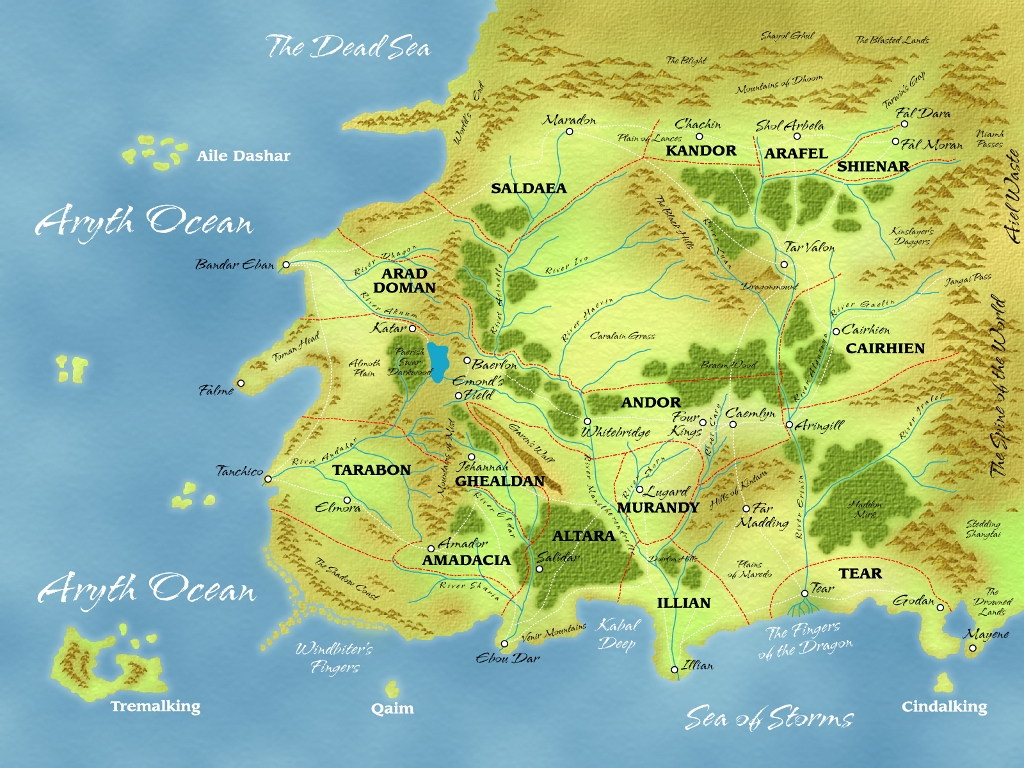
Ooh, then we get a huge convenient map:


Will you look at the 90-degree angle those mountains take?  I would normally bet massive quantities of cash that nothing plot-relevant will ever happen more than an inch beyond the borders of this map, but surely with the millions of words that make up this series I'd be wrong about that?  Please?

I also have some huge questions about the borders as defined above.  Why are they where they are?  We have a lot of weirdly-bounded territories in the world, just look at the eastern US or Europe, but there's a reason for that--they're following rivers, or mountains, or some other significant geological feature.  When we don't need to do that, we end up with things like Wyoming and Saskatchewan, boxes imposed on the boredom of the ground.  Why in the world is Tear's curvy border swooping through that field?  Who owns the ground between Tear and Illian?  There are actually an impressive number of unlabelled swathes in there--is the lack of claim there going to be explained, or are they just international territory for some reason?  These are the questions that will trouble me for months to come.

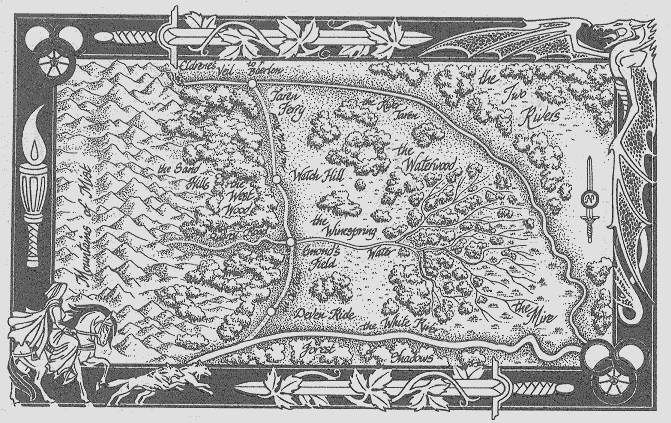
That's followed by this magnificent creation:


Now, correct me if I'm wrong, but this appears to show three rivers coming out of the mountains, and somehow the middle one shatters like a river delta in the middle of a field and branches out in dozens of different directions without ever meeting up with the other two rivers that are arcing together.  And eventually all those little streams just die out, in a presumably-damp region called 'the Mire', which I could sort of accept if not for the way there are still two massive distinct rivers bordering the Mire and cutting cleanly through the land.

I realise most fantasy authors aren't hydrologists, and if an actual hydrologist wants to correct me on this, please do because I love new knowledge, but I'm like 35% sure that is not how rivers work.

This is a bit of a short post, but that's all I can handle for now.  Come back next week for chapter one, in which we meet Our Hero, who at first glance looks to me like he's going to be a humble farmboy.  I should make so many bingo sheets.

Sunday, October 12, 2014

Ender's Shadow, chapters twenty-three and twenty-four, in which Bean steps aside

I almost put 'the last Card post ever' under the below 'fun content' tag, but of course then I remembered that, sooner or later, I'm going to have to do one more post on the Ender's Game movie.  So there's that, though I'm not sure when, exactly.

As I have vowed many times, I'm not doing any more Orson Scott Card books on this blog.  I'm quite done; this one is the best and I am not willing to spend any more of my life on his time.  So, enjoy the below, but next week be sure to come back for the very first post on: The Eye of the World, Book One of The Wheel of Time.

I'm going to regret this, I just know it.

But first, we've got to finish up with Card's books at least, so read on, you tenacious followers.  Y'all make this endurable.

(Content: ableism, genocide, child abuse. Fun content: asteroid dodgeball, male novelists, terrifying Space Humans, tons of fanfiction, Adam Savage, and yet more goddamn Bible references.)

Ender's Shadow: p. 352--379
Chapter Twenty-Three: Ender's Game

The opening exchange between Graff and Admiral Placeholder-Designed-To-Make-Others-Look-Better is predictable, as Graff tries to convince him to arrest "the Polemarch and his conspirators", although as I understand this world that means 'all Russians', so... that seems hard.  Admiral Placeholder of course refuses to "fire the first shot", because then he'll be blamed for the ensuing war, etc etc politics cowards whatever.  I hate Graff and I don't know who this guy is, so I can't imagine why I'm supposed to be invested in this subplot.  Anyway, it's xenocide time again and Bean is in prophet mode for Our MurderSaviour:
With Ender there,Bean immediately stepped back into his place among the toon leaders. No one mentioned it to him. He had been the leading commander, he had trained them well, but Ender had always been the natural commander of this group [....] They felt known by the one whose honor they needed. Bean simply did not know how to do that. His encouragement was always more obvious, a bit heavy-handed. [....] Ender was just... himself. Authority came from him like breath.
Card continues to subscribe to the notion that narrative 'showing' is only used for minor matters, like spending several pages detailing the logistics of crawling around inside an air duct, whereas the powerful art of 'telling' is saved for those grand moments when you need to contrast the essential natures of your dual protagonists to drive home your thesis on intelligence distinct from leadership.

Bean also informs us that Ender doesn't call on him nearly as much as he wishes, focusing instead on his besties: Petra, Alai, Dink, and Shen.  The previous book informed us that Ender analysed Bean's skills and found he floundered with large fleets but used small squadrons to devastating effect; here we're told that this was actually Mazer Rackham downplaying Bean's skills so that Bean can always be standing by to hit the button and take over Ender's leadership if Ender freezes or passes out in the middle of battle.

They hear about Mazer Rackham's 'testing' plan, which Bean pegs as suspicious, but the best part is this logical leap, when he sees the globe formation of the enemy ships that Rackham supposedly programmed, surrounding a single decoy queen:
So why would Rackham expect the Buggers to expect humans to strike for a single ship? 
Bean thought back to those vids that Ender had watched over and over in Battle School--all the propaganda film of the Second Invasion. 
They never showed the battle because there wasn't one. Nor did Mazer Rackham command a strike force with a brilliant strategy. Mazer Rackham hit a single ship and the war was over.
Just so we're clear here, I didn't snip out any text.  Bean makes a flying leap from 'Mazer, pretending to be the formics, is decoying with a lone ship, which he thinks the real formics will do, therefore there was no battle whatsoever in the Second Invasion'.  Now, okay, the leap to 'they're faking a queen therefore the queen is their weak point' is a legitimate move, cool, but the additional decision that there was no actual battle around Saturn is pure magical intuition.  Bean has no reason to believe that Mazer didn't kill the queen after a long and devastating battle of brilliant tactics.  If he won with one shot and not military skill, what's supposed to qualify him to program anything else the formics are doing in battle?  Why does one skill (laser tag, or alien empathy) keep translating into total mastery of war?

Bean similarly hears that the testing pattern is going to mimic a campaign, and he instantly concludes that all of his guesses are right, the formics have many worlds and the humans are invading all of them and the formics will learn from battle to battle because they have instant communications etc etc I am literally recapping Card recapping himself.  Also, Bean has apparently given up on his 'I must not believe my own wild theory' plan, continuing his signature move of completely changing his mind between scenes for no given reason.

Ender starts relying most of all on Petra (what happened to Alai running whole fleets himself?), and fails to notice as Bean does that she's a perfectionist and her mistakes are grinding her down.
He was so good with people, and yet he seemed to think she was really tough, instead of realizing that toughness was an act she put on to hide her intense anxiety.
Silly Ender, thinking that a girl is actually tough rather than just having an abrasive veneer covering her deeply vulnerable femininity.  Bean can't be bothered with her right now, of course, he's busy toughly weathering the total lack of recognition he gets (the others don't come to him for tactical support, except for Tom and Han) as he keeps an eye on everything and tries to coordinate behind the scenes as the battles get rougher.  Man Tough.  Man Tough Strong Do My Job Grr Whiskey.

Petra passes out in the middle of battle, Bean has to catch Ender's attention to get him to react, and they pull it together with heavy losses while Petra breaks down sobbing, blaming herself, until she's taken away to, presumably, the infirmary.  She comes back, "but her ebullience was gone", because if ever there was a word to summarise Petra's tactical brilliance, 'cheerful' is definitely it.  Not courage or determination or sharp calculation, but always having a smile on her face.  I'm so done with Card.

Petra's not the only one down this time; Vlad goes catatonic and Fly Molo breaks down laughing in the middle of battle.  As Ender keeps slowing down as well, Bean steps in more to clarify and support his orders, and he starts getting some acknowledgement and back-pats from his friends, and his heart grows three sizes, and then it's the final battle.

Graff comes to beg Bean to come up with some miracle to save the day.  (Bean is finally the only person to point out that Mazer is probably psychologically torn up and taking it out on Ender because all these pilots dying in battle are Mazer's friends from decades ago.  There's an underused concept there.)  Bean's got nothing, especially once he sees the formic homeworld and its ten-thousand-ship fleet in orbit.

I'm going to be a jackass about math one last time.  Let's assume for no good reason that the formic homeworld is about the same size as Earth.  Earth has a surface area of 510 million square kilometres.  Ten thousand ships in flight means each ship needs to cover about 51,000 square klicks  from a human ship reaching the surface.  Half that if they knew what direction the humans would come from and they've only covered that hemisphere of the planet, of course.  So, assuming a hex grid, each formic ship is, what, 120 klicks apart by land?  (I'm not adjusting distance for altitude of flight, but if they're flying above the atmosphere, it's obviously a much greater distance between ships.)  That's not going to give us the kind of incredibly tight swarm Card describes, so do we assume that means the formic homeworld is tiny?  If it isn't, then I'm less convinced that this is as hard a shot to pull off as they imply.  They have eighty ships; the formics need to prevent every single one of them from entering the atmosphere.  If we're looking at the planet from a distance like this but it's minutes away rather than days, all of the ships involved are obviously moving at ridiculous speeds, far beyond anything we 21st century humans have ever achieved, so if our only goal is to reach the planet (and both Bean and the formics see that it must be so), I feel like the formics are at a bigger disadvantage here than we think.  It's exactly the problem Bean described before: if they spread their fleet away from the surface (to keep humans from getting anywhere near firing range) they need exponentially more ships to create a thick enough field to ensure no one slips through.  How quickly can their ships change direction in space?  Can they get from the north pole to the southern hemisphere as quickly as humans can get from hovering out in space to the south pole?  What are our acceleration/deceleration parameters here?

A kindlier blogger would just say that, since Bean sees this as a hopeless fight, obviously the parameters are such that the formic defence swarm is indeed an impassable blockade, but you and I both know I ran out of kindliness long ago.

I'm mostly thinking that this whole fight could be adequately side-stepped if the human fleet contained 79 normal fighters and a single fighter with good cloaking technology to slip down to the south pole and shiv the planet.  Why don't we have that?  Why don't we have ten thousand drones whose sole purpose is to project a small Ecstatic Field and make it look like we have a fleet just as big as theirs, since it's canon that you can't see through shields?  Do they have a moon?  Have we considered busting that and just letting tidal forces obliterate their civilisation?  Have we considered using our sweet stolen gravity technology to give them a moon?  Is no one worried that they might have split off, you know, five hundred of their endless swarm of ships on a mission of vengeance against Earth weeks ago when they found out we had a planet-buster weapon and we were coming for them?

Where we were?

Ender stares in silence at all of this for a full minute before a blinking button lights up on Bean's console, which he knows will put him in command if he touches it.  Bean determines the teachers think that Ender has frozen up, while Bean knows Ender has just reached the same hopeless conclusion Bean has, and because he thinks it's a game, he's going to quit.  Bean agrees, and has nothing in mind except bitter irony when he says "Remember [...] the enemy's gate is down".

I'm fuzzy on why it's necessary that they "dodge here and there through the ever-shifting formations of the enemy swarms" and "every third or fourth move takes us closer and closer to the planet".  It's a straight line, the distances involved make the idea of a 'thick' swarm ridiculous, like flying through an asteroid belt and worrying about collisions.  If you can reach the edge of their swarm and not die, you can probably get to the far side before they can so much as track you.

But the formics don't strike (I'm not even sure if they're shooting), and Bean comes up with a series of hypotheses to explain this: they fear clustering and getting Doctored, they just have too many ships in flight for too few queen minds to effectively coordinate, and they're focused (inexplicably) on blocking the human retreat, because they "have finally, finally learned that we humans value each and every individual human life [....] but they've learned this lesson just in time for it to be hopelessly wrong".  There is much heroic talk about leaping on grenades to save your foxhole comrades, and suicide bombing, collectively and charming summarised as "insane".  Sigh.

Bean concludes that the formics aren't afraid of Dr Device right now because all the human fighters would die with the planet, and wonders whether Ender has somehow learned to empathise with them enough to predict this, but decides it doesn't matter even if it's all luck now, because either way Ender is the one who chose the tactics in this battle and all the others:
It was Ender whose previous victories taught the enemy to think of us as one kind of creature when we are really something quite different. He pretended all this time that humans were rational beings, when we are really the most terrible monsters these poor aliens could ever have conceived of in their nightmares.
For a refreshing break to a realm of more interesting science fiction ideas, allow me to recommend this tumblr compilation of notes on humans from the perspective of aliens.

Anyway, Bean gets around to feeling sorry for the pilots currently on their way to die committing xenocide at Ender's command, and he remembers Sister Carlotta's favourite scripture, Absalom and David, and presses the fleet override button just long enough to speak to all of the pilot simultaneously (and no one else, and apparently no one notices that Bean just took control from Ender for several seconds, and how does he give control back afterwards anyway?)--
...knowing for the first time the kind of anguish that could tear such words from a man's mouth. "My son, my son Absalom. Would God I could die for thee, O Absalom, my son. My sons!"
(Bean is tragically unaware that all of the pilots are women.  Graff's obsession with filling Battle School with more boys than pants wasn't in effect eighty years ago.)

They make their final dive, they all fire (except Petra's squadron, given rear guard duty against the actual swarm), and "the ships that launched too early watched their Dr. Device burn up in the atmosphere before it could go off", because apparently it's a missile in this continuity.  Does the Device not work on gas and vapour for some reason?  But Bean gives the last ship an order to detonate their Doctor onboard, without launching, and somehow that is close enough to hit the planet.
But long before the last ship was swallowed up, all the maneuvering had stopped. They drifted, dead. Like the dead Bugger ships in the vids of the Second Invasion.
BEAN YOU HAVE NEVER SEEN THOSE VIDS OH MY GOD CARD.

Out in the hall, Bean tells the others that, yes, those cool special effects really could happen because they did happen, they just won, and Graff appears to confirm this (I guess after Ender has already passed out or whatever) and inform them that the species is dead.  Petra, of course, immediately breaks down in tears, making her, by the way, the first person to mourn for the formics, so let's keep that in mind the next time anyone talks about how magical the Speaker for the Dead was.  Dink comforts Petra, everyone leaves except Bean and Graff, who are still chatting when gunfire sounds off from the Polemarch's rebellion.  Friendly marines secure the barracks, and Graff takes Bean to the ansible room to hear the news.  The last several lines are actually pretty funny banter and all, but whatever.  People joking around corpses is standard for this book.

Ender's Game is, quite clearly, a massive exercise in putting a child in the position of committing genocide without bearing any actual responsibility for it, because he's kept unaware.  Bean, conversely, is fully aware, totally onboard, and gives the last commands that guarantee victory.  On the other hand, Ender said in Speaker for the Dead that he retrospectively would have been onboard with it if he'd known, and therefore bears equal guilt.

There's nothing much to be said about Bean's lack of thought towards the formics that I haven't said about Ender, except for this: Bean came up with his plan (the Third Invasion) because he thought there was no ansible, so the invasion fleet would hit the formics just when they found out they had lost the Second Invasion.  When he found out there was an ansible, if he'd had the slightest sense in his head, he should have realised that the formics therefore knew they lost the moment it happened, seventy years ago, and thus could have launched their own fleet just as long ago.  We don't know how humanity found the formic homeworlds, so we don't know what kind of scanning and astrometric surveying technology we've all got, but surely we might have noticed if, the first time we Doctored one of their fleets, they decided to launch a full re-invasion fleet toward Earth, or drew their forces back to defend themselves.  Nada.  The formics haven't apparently responded to anything at all.

Bean can catch the hesitation in someone's voice and from it reason his way into understanding the entire secret strategy and technology behind the whole of the Third Invasion, but the marauding monsters (with thousands of times the ships humanity can field) spend seventy years very specifically not attacking Earth again and it doesn't pique his curiosity at all?


Bean has realised that the formics are hive-minds, Bean has thought far enough ahead to realise that the formics might not have realised that humans weren't hive-minds to start with, and all the consequences that spill out of that, and he could have done so in a matter of seconds.  The screen comes up, Ender stares flatly at the impossibility of the final battle, Bean sees the thousands of formic ships that have been built and never sent to kill anyone, and when Ender finally starts giving commands, Bean shouts: Stop.  Because instead of his hopeless "the enemy's gate is down", the lesson he remembers is 'The real enemy isn't the other army; the real enemy is the teacher'.

And that's the real strength of fanfiction that Card doesn't have, here: fanfiction is created by those who adore and immerse themselves in the story, but it is also, most importantly, created by those who didn't feel like the original story was enough.

Let's take Harry Potter here, because while I've been out of fanfic for years, some of the best I still see around the web is in that world.  Harry Potter fanfiction isn't just fun for people who like the idea of wizard school, it's also vitally important for people who want to know that they exist and are good and strong and worthy magicians despite not being cis or straight or (frankly) white, and people who need more than 'all was well' and to talk about the story of recovering and not just winning.  Harry Potter fanfiction is important for people for whom it is not adequate or acceptable that Harry grows up in an abusive environment and no one ever calls Dumbledore on it, or that the youngest survivors of the war are at risk of the same treatment again, or the idea that you can tell who's good and who's bad by the colour of their school uniform.

And Card doesn't have that, here, because he mashed several stories together, he wrote Ender's Game so he'd have his divine white saviour hero for Speaker for the Dead, and it did that job and it can't be done any other way without uprooting his whole original plan, so Bean can't say any of those things, he can't be that smart, despite day after chapter after day of doing exactly that thing, again and again.  Ender's Game, for him, is already good enough.  Ender's Shadow doesn't really exist to comment on that, or to change anything except a handful of details, and then not much--we met Petra, Corn Moon, and Wu, but Bean still says there were only a dozen girls in Battle School (estimated minimum student body of 1000).  The retcons (like everyone knowing about the formic hive-mind) are obviously unintentional.

So, in the end, I have a hard time thinking worse of Bean for going along with xenocide, because even though it could have been completely in his character to understand the situation, his writer couldn't allow him to do that, because the first story was already good enough for him.

Chapter Twenty-Four: Homecoming

Graff informs Carlotta that, before they were defeated, Russia grabbed Achilles out of whatever prison they were keeping him in, being the only Battle School child not currently under I.F. guard.  Dun dun DUNNNN.  Carlotta, of course, is a protagonist and therefore has to be shocked that Graff is up for court-martial, "a scapegoat for victory".  Sigh.

When Eros has been safely reclaimed from Russian rebels, the dream team gather at last to go see Ender, who's been unconscious the whole time.  Bean recognises that Ender has been torturing himself emotionally, grieving for the formics while Bean cares less about their whole species than he does about Poke.

Then it's mostly recapping and Bean narratively informing us how true everything is: "Bean believed him", "Bean felt the truth of that", et cetera.  There's also a line I never paid attention to before,"If the universe had any kindness in it, or even simple justice, Ender would never have to take another life", which I assume is an ironic nod to Speaker for the Dead and the transition of Human to his tree stage.  Meh.

Bean is the only one who already knows that Ender is the only one not going back to Earth, as part of the peace treaty that Locke put together.  Bean thinks of many reasons Ender's own brother would ban him from returning to Earth, but can't decide.  He vows to meet him one day and find out, and destroy Peter if Bean decides this was in fact a betrayal.  Which strikes me as deeply out of character for Bean, who has (until last chapter, when he signed off on the formics' death) never cared about revenge at all.  They're sent home, one by one, and that's the last mention of Ender in this book.

The last page and a half is, in a rare case, one of the best parts of the book.  The Delphiki parents gleefully await the arrival of their son Nikolai (but why now, when Bean started the ball rolling weeks or months ago and it takes so much longer to get back from Eros than Battle School?), and prepare a small feast, and they see the car coming, and it's only when Nikolai gets out with another tiny boy that dad finally tells Elena that Bean survived.  I'll include it here, for completeness, because Card is a terrible person who does terrible things, and it's important to also recognise that a person can be that and write this:
"He's been told that he's coming just for a visit. That legally he is not our child, but rather a ward of the state. We don't have to take him in, if you don't want to, Elena." 
"Hush, you foolish man," she said. 
[....] Her husband spoke. Elena recognized his words at once, from the gospel of St. Luke. But because he had only memorized the passage in Greek, the little on did not understand him. No matter. Nikolai began to translate into Common, the language of the fleet, and almost at once the little one recognized the words, and spoke them correctly, from memory, as Sister Carlotta had once read it to him years before. 
"Let us eat, and be merry: for this my son was dead, and is alive again; he was lost, and is found." Then the little one burst into tears and clung to his mother, and kissed his father's hand. 
"Welcome home, little brother," said Nikolai. "I told you they were nice."
This isn't a book about how hard it is to be the only special person in the room, or how morally justified murder is if we think we're threatened, or how super sad we are about the terrible things we've done for no good reason.  This is a story about what it's like to be this scrawny little genius jackass named Bean, and that is why it's better than Ender's Game.

Next week: hey, my copy of Eye of the World has a back-cover blurb from Card himself, who spoke of Robert Jordan's "powerful vision of good and evil" and "fascinating people moving through a rich and interesting world".  We're so screwed.