(Sorry this isn't the second Name of the Wind post, but my brain has been frazzled and this post has been waiting in drafts for far too long. I also suspect it's going to be topical as we continue to dig into Kvothe's adventures in the coming weeks.)
Most people who aren't Ayn Rand are willing to acknowledge a difference between things they like and things that are "good", a distinction that is at once counterintuitive and perfectly natural. It is with that distinction in mind that I watched two movies recently: Conan the Barbarian (the 1982 original) and Vampire Academy (based on books of the same name). These movies aren't good, but they are bad in specific ways that call into question what exactly we mean by "good" to begin with.
I'll start with Conan, because I have less to say about it: it's the incredibly straightforward story of a Proud Warrior Tribe kid whose village is destroyed by an evil man, who gets taken as a gladiator slave, runs away to freedom, slays monsters, has gratuitous sex with dubious consent, and finally kills the evil black wizard who slaughtered his people. He has a love interest and a couple of comic relief sidekicks of indistinct ethnicity and fundamentally racist conventions, he gets some unexpected and inexplicable Christ imagery, and assures us all that a true hero is an independent burly man who single-handedly decapitates bad guys. Throughout the adventure, he is narrated in epic saga style.
This is a bad movie, let there be no question. Even the heroic POC tend to be cowardly and animalistic, and for all that James Earl Jones does some spectacular work as the villain, the climax of the movie is a white man setting a bunch of impressionable kids free by murdering a black man. The love interest dies literally fifteen minutes after our heroes performed a magic ritual to bring Conan back from the dead, and yet no one asks whether maybe they should just do that again. There's a thoroughly unexpected scene when Conan steals an evil priest's robes by using the man's predatory gay tendencies against him. All bigoted writing--literally every word of it--is also lazy writing.
But lord how I wish we could have good movies that take their absurd epic fantasy setting this seriously. It's the problem of the 1950s: love the aesthetic, hate the politics. Where are my stories about people who aren't cis-white-hetero-men-with-arms-like-bags-of-footballs, adventuring across untamed lands to fight animated statues and free vulnerable people from charismatic dictators while a wizened wizard narrates their quest with the kind of absolute severity that would make Adam West proud? Where victory isn't always murder, where strength is community and not a weird frappuccino of the philosophy of Nietzsche and incredibly unlikely Genghis Khan attributions?
Conan the Barbarian is not a good movie, but how I wish it were.
With that, we come to Vampire Academy, the bizarre Twilight/Harry Potter hybrid that I didn't know I was waiting for. This movie is absurd and cliched, with its convenient telepathic bonds and its magic princess on the run and a vampire queen who lives in the school and calls assemblies specifically to chastise her probable successor in public (for no personal benefit). Few of the actors seem comfortable being filmed, and the mandatory hetero love interests are a blatant discount bin Edward Cullen and some kind of Star-Trek-transporter-accident fusion of Jack Black and David Bowie.
And yet this is a movie that does an astonishing number of things right. Our heroic bonded duo of vampire princess Lissa and mostly-human bodyguard Rose are complex characters with multiple conflicting motivations and flaws, going overboard in their petty revenge or overprotectiveness and then regretting it, trying to make things right. The movie starts in medias res to a degree that reminded me of the original Star Wars, with our heroes on the run, immediately provoking questions about how they got there, why they left the eponymous academy, and why they're being dragged back. (And, if you're me, whether the romantic/sexual subtext between the girls is going to remain subtextual. It is. Obvs. Sigh.) They remain, throughout the movie, likeable but imperfect, with Rose in particular (as the action hero) getting to maintain a swagger and punchiness that is usually restricted to male roles. When her platonic bro starts to make some kind of I'm A Nice Guy rant at her, Rose dismisses him instantly to focus on more important issues. When Discount Edward hangs around Lissa in awkward and potentially creepy ways, Rose bluffs to get rid of him, but later accepts that she doesn't get to pick her friend's friends and apologises for lying--while still making it clear that she thinks his behaviour was creepy.
(In one reversal that the blogqueen particularly liked, Discount Edward spends most of the movie being markedly useless and then gets exactly one dramatic effective moment during the climax, a fate that usually befalls the token female action hero.)
To my utter lack of surprise, internet investigation told me that this movie was a colossal failure commercially, and its Rotten Tomatoes page (aggregate score of 11%) is full of blurbs from grey-haired white men declaiming the film for being impossible to follow and trying to lure in silly teenager girls by mashing up all the modern trends of magic school and hot vampire boys.
We are left with the question: would this movie have done better with male leads? Rose would certainly have been a more typical male character, though being younger than his hypothetical female love interest would have been a switch. More likely that Lissa would become the love interest in need of protection (unless she was a dude too, in which case I suspect there would have been way more No Homo being thrown around and all of the leads' emotions would have to be replaced with sex or punching). This is a movie with a strong focus on social status--characters care about how they're perceived and might prefer a battle to the death over public embarrassment--which is obviously such a girl thing, innit? And yet my mind drifts back to a little English underdog hero called Eggsy who who just wanted to prove his worth compared to his condescending upper-class peers...
Over on the page for Kingsman (aggregate score of 74% and my unfathomable scorn) a veritable flood of enraptured white men cheer for its "stylish" "subversiveness", wit, charm, and "devil-may-care exuberance". May I remind you that this is a film in which a lisping media tycoon decides to save the environment by inventing a machine that makes everyone turn into murderous berserkers for only as long as he holds down the button. But "vampires want to kidnap a princess to use her healing magic for themselves" is too convoluted and weird.
And I mean: I'm not trying to argue that Vampire Academy is a Good Movie, in the sense of technical expertise or top-quality performances (apart from Rose, who was honestly delightful in every moment that she wasn't being forced into a weird romantic subplot). But I enjoyed it a hell of a lot more than plenty of other movies that are supposedly its superior, and so I start to wonder how we're defining Good Movies. Because when you get into institutions like that--film theory and literary criticism and the like--one of the first things that becomes apparent is that a lot of our metrics and expectations have been designed by aging white dudes who scorn everything that doesn't pander directly to them. How exactly do we decide which is more important: that a tertiary villain's actress has a natural style of delivery, or that the script acknowledges that women can have more than one personality trait? How do we weight fluid cinematography against the 'artistic choice' to only give speaking roles to white people?
There's some kind of idea out there, never quite stated (but clearly believed by people who consider themselves 'the default'), that you can tell an apolitical story. Like if a person just writes, lets the words flow freely without intending to make a statement about the world, they will necessarily not make a statement about the world. If they just want to tell a story about being a hero, and they coincidentally make the climax of that story a white guy brutally murdering a black guy, there is no way the story might be racist, because they weren't thinking about racism while they wrote it. It's only once other people come in and start overthinking things that we run into trouble, somehow introducing problems to the story just by observing what's in there.
If this blog had, like, a heraldic motto, it'd probably be something like what I wrote above there: all bigoted writing is lazy writing. It replaces truth and originality with lies that uphold privilege and comfort oppressors. I hope that we can, as a civilisation, move away from "X is okay if you don't mind all the bigotry" and towards "X could have been good if not for all the bigotry". A story that hates Muslims isn't 'controversial' or 'daringly un-PC', it's a bad story pushing a bad agenda.
And if we're going to recognise that bigotry is an artistic flaw, I think it's important to give artistic value to fighting bigotry. There's a new Ghostbusters out (it was great), and the choice to cast four lead women is considered a gimmick while the original's four leading men are apolitical. Nah, bruh. The original Ghostbusters has two significant women (the secretary and the damsel) and everyone else who matters is a man, and it's like that because it was written by men for themselves.* The new Ghostbusters has a quartet of proven comic ladies because the people involved in making it agreed that it's important that there are stories about women like this.
Which isn't to say that, say, casting women is always politically progressive and creative and meritorious. Joss "Female Characters Who Are Strong And Vulnerable In Exactly The Ways I Find Sexually Exciting" Whedon has taught us all that lessons several times over. Heralded for years as the great geek feminist, Whedon once imagined a conversation in which a hypothetical journalist asked him why he wrote so many female characters, setting himself up for the dazzling rejoinder "Because you're still asking that question". And yet he keeps producing exactly the same kind of character over and over again (all bigoted writing is lazy writing) because the story isn't about the representation of women, it's about that one particular kind of woman that Whedon likes best. The entire concept that launched Buffy was 'wouldn't it be weird to see a girl do this?' He was counting on women-as-gimmick to draw attention, but then circled back around to approximately-mainstream acceptance by slathering them in male gaze, and he has never stopped repeating this pattern. (And always tearing them down, showing them broken and abused and in need of saving anyway.)
I tragically can't close this by outlining the true rules for objectively determining what a good movie is. That is beyond even my power as an amateur blogger. But I think there's a lot more to be investigated in how we perceive movies aimed at or led by women. These movies can be flawed (oh, is Vampire Academy flawed) and it's easy to brush off a cheesy movie, but is it actually the cheese and the production values that people hate, or are those just the things we let a person target when they want to destroy something because it's For Girls?
---
*There will likely be at least one Ghostbusters post coming soon, possibly one about the original and one about the reboot, in case you are hungry for more of the blogqueen's vitriol for Peter Venkman.
Showing posts with label writing advice. Show all posts
Showing posts with label writing advice. Show all posts
Sunday, August 14, 2016

Thursday, February 25, 2016
Drizzt Do'Urden and the failure of fantasy racism
(Content: discussion of racism and other oppression. Fun content: I hope you like elves.)
I should preface this with a giant disclaimer (in case there was any question) that I'm white, so this whole post is an extended 'it seems to me...' and I don't want to speak over anyone's experiences. I don't think I've seen anyone address this specific flaw to supposedly progressive fantasy; I'd be happy to link to any such works if y'all know of them. (Also, I think a lot of what I say below can translate to representation of other demographics and types of oppression, like LGBT people and comic book mutants, but it's Black History Month, so that's where we focus.)

The best thing that speculative fiction can do is show us a bizarre new world that loops into our real mundane world right now and gets us to see something in a new way. Consider classic Star Trek's episode about an alien cop chasing a fugitive, each of them literally half paper-white and half ink-black, divided down their centre line, but the cop is convinced that he's racially superior because he's black on the correct side. The Snowpiercer movie (thankfully nothing like the original comic) is a beautiful, layered, sickening, and ruthless exploration of capitalism and literal class war. And if I start talking about Discworld novels we'll be here all day.
Countless stories--like Star Trek there, and like Forgotten Realms and Lord of the Rings and X-Men and basically every other serialised speculative story sooner or later--take the opportunity to criticise racism, usually by showing us elves and dwarves scowling at each other or something. The first problem with this kind of scenario is that it extrapolates human 'races' (a nebulous and nonscientific concept) into entirely different species, so that the story is about (white) humans learning to get along with weird other-y pseudo-natural entities (of colour?). We can do better. But, at the same time, there's no reason that identifying with the badass werewolves or dragons or fae should be restricted to white people either, so yes, let's have elves with high tops:

Running with this, writers sometimes give us a paragon of virtue like Drizzt Do'Urden. Drizzt is one of the most iconic characters in modern fantasy: a renegade drow (dark elf, literally black-skinned) from the underground city of Menzoberranzan who grew up disgusted by his people's cruelties and so ran away to the surface, where he roams the land of Faerun slaying monsters and rescuing the helpless. He is, of course, nevertheless hounded at every turn by people who see his black skin and assume he's a monster. I won't speak to authorial intention here, because I haven't read RA Salvatore's mind at any point in the last thirty years, but there's only one common reading of Drizzt's story and what it symbolises for our world. We readers look at these presumptuous bigots, who think the only good dark elf is a dead one, and scorn them for failing to get to know Drizzt before judging him. We know better and we are enlightened.
Drizzt is a good guy.
Drizzt isn't like other drow.
Drizzt is one of the good ones. A credit to his kind.
#notalldrow
But the thing about those narrow-minded common peasants who flinch or scream at the sight of Drizzt walking into town is that they're only wrong this time. With literally any other member of his species, they'd be absolutely right to freak out, because a powerful and sadistic murder-specialist would have just said hello. That's not racism; that's basic probability and pattern recognition.
Fantasy racism like a fear of dark elves is ultimately a terrible allegory for real-world racism because the dark elves have worked long and hard to gain that reputation for monstrosity, whereas in the real world white history is basically a laundry list of the other nations and peoples we've slaughtered and enslaved and oppressed for monetary gain, political power, or occasionally just for sadistic fun. In order for Drizzt the onyx-black elf hero to be an actual metaphor for black people in North America, our continent would have to live in constant fear of invasion from a subterranean army of African-diaspora wizard-ninjas, and I figure there can't be more than five or six million registered voters who actually think that's a concern.
What I'm getting at when I say #notalldrow is that Drizzt's experience, being a variously privileged individual walking into vulnerable spaces full of people who have been hurt before by people who look like him (and who know that he has the power to hurt them further), is the experience of the oppressing class, not its victims. White people, especially but not exclusively white men: we're the drow. When Drizzt sees someone afraid of him at first glance, it's not because they've been arbitrarily taught that black people are inherently inferior and disgusting. If we read these scenarios and all we think is "Bah, foolish bigots,we Drizzt would never be so villainous!" we're only reinforcing the idea that vulnerable people owe us their reflexive trust or they're the real racists.
To the credit of Drizzt's fictional persona, he sympathises with these people and is patient with the caution strangers take around him. At least, this is a good aspect of his character if it's taken as a model for, say, white people to not go around acting indignant that people of colour aren't always ecstatic about our presence. From the 'surface' reading of his story, where Drizzt is the victim and he is patient with having to work to personally win over every single racist he meets... that's suboptimal to say the least. The tangle that this kind of speculative fiction has made of power dynamics makes it harder to draw any conclusive arguments out of the text beyond a lukewarm 'everyone should be good to each other'. That kind of 'equal opportunity learning' gives us stuff like the unholy mess that was Disney's Pocahontas, in which the indigenous Powhatans are also guilty of prejudice against strangers just because the white people are here to conquer, pillage, and murder. I cannot even.
Fantasy racism doesn't speak to real-world racism as long as it seeks to justify its existence: as long as those simple innocent farmers are afraid of orcs because orcs are literally and objectively the twisted embodiment of malevolence forged by an evil god to burn the world, fearing orcs isn't racism, it's self-preservation. Fantasy that wants to tell us that racism is bad has to start by admitting that racism isn't a defense mechanism but a weapon--a philosophy that helps the people in power convince everyone else that it's okay to kill and exploit those other people, without provocation, because they just don't deserve any better. Stopping racism is about acknowledging and revealing and destroying that idea, and it's got to be done in us, the privileged, oppressing class.
I'd love to add some examples here of fantasy racism done properly (purely as propaganda and not based on objectively truth) but... I'm not sure I can think of any. Even in Discworld, the conflicts between trolls and dwarves ultimately come back to 'both sides bear guilt'. In the Warcraft universe, primary example of a setting where orcs are heroic protagonists as often as villains, the orc-human divide stems back to those one or eight times that the orcish horde got cursed into raging berserkers and tried to burn down the planet. In settings like Star Trek (and often Star Wars, depending on the book) aliens often are pretty one-dimensional in ways apparently defined by their species. I think a good case can be made regarding house elves in Harry Potter, but that'd be a book unto itself and there are plenty of people who feel the text ultimately fails to make a proper case distinguishing the racist propaganda from the truth. If any of you readers have encountered a good speculative treatment of how racism functions that doesn't make these kinds of errors, I would love to hear about it.
Let me end by sharing with you a quote from Chris Rock, in an interview from 2014 which I was lucky enough to encounter this week:
I should preface this with a giant disclaimer (in case there was any question) that I'm white, so this whole post is an extended 'it seems to me...' and I don't want to speak over anyone's experiences. I don't think I've seen anyone address this specific flaw to supposedly progressive fantasy; I'd be happy to link to any such works if y'all know of them. (Also, I think a lot of what I say below can translate to representation of other demographics and types of oppression, like LGBT people and comic book mutants, but it's Black History Month, so that's where we focus.)
Pictured: either my family tree or a box of assorted entertainment crackers; who can tell?
The best thing that speculative fiction can do is show us a bizarre new world that loops into our real mundane world right now and gets us to see something in a new way. Consider classic Star Trek's episode about an alien cop chasing a fugitive, each of them literally half paper-white and half ink-black, divided down their centre line, but the cop is convinced that he's racially superior because he's black on the correct side. The Snowpiercer movie (thankfully nothing like the original comic) is a beautiful, layered, sickening, and ruthless exploration of capitalism and literal class war. And if I start talking about Discworld novels we'll be here all day.
Countless stories--like Star Trek there, and like Forgotten Realms and Lord of the Rings and X-Men and basically every other serialised speculative story sooner or later--take the opportunity to criticise racism, usually by showing us elves and dwarves scowling at each other or something. The first problem with this kind of scenario is that it extrapolates human 'races' (a nebulous and nonscientific concept) into entirely different species, so that the story is about (white) humans learning to get along with weird other-y pseudo-natural entities (of colour?). We can do better. But, at the same time, there's no reason that identifying with the badass werewolves or dragons or fae should be restricted to white people either, so yes, let's have elves with high tops:
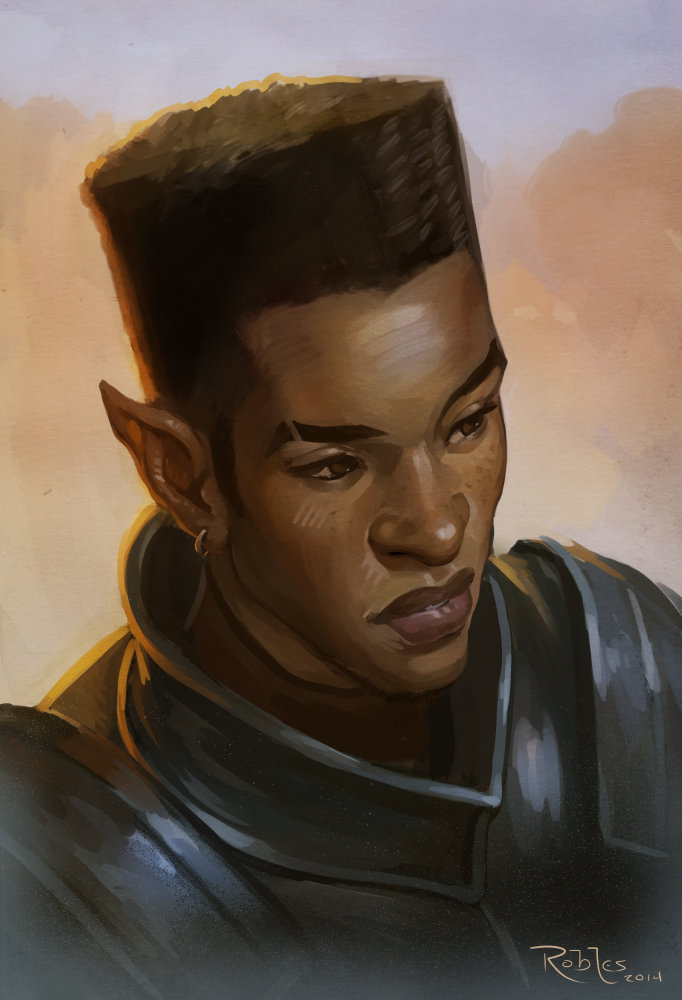
Pictured: painting of an armored elf with distinctively black features, by Nick Robles.
Running with this, writers sometimes give us a paragon of virtue like Drizzt Do'Urden. Drizzt is one of the most iconic characters in modern fantasy: a renegade drow (dark elf, literally black-skinned) from the underground city of Menzoberranzan who grew up disgusted by his people's cruelties and so ran away to the surface, where he roams the land of Faerun slaying monsters and rescuing the helpless. He is, of course, nevertheless hounded at every turn by people who see his black skin and assume he's a monster. I won't speak to authorial intention here, because I haven't read RA Salvatore's mind at any point in the last thirty years, but there's only one common reading of Drizzt's story and what it symbolises for our world. We readers look at these presumptuous bigots, who think the only good dark elf is a dead one, and scorn them for failing to get to know Drizzt before judging him. We know better and we are enlightened.
Drizzt is a good guy.
Drizzt isn't like other drow.
Drizzt is one of the good ones. A credit to his kind.
#notalldrow
But the thing about those narrow-minded common peasants who flinch or scream at the sight of Drizzt walking into town is that they're only wrong this time. With literally any other member of his species, they'd be absolutely right to freak out, because a powerful and sadistic murder-specialist would have just said hello. That's not racism; that's basic probability and pattern recognition.
Fantasy racism like a fear of dark elves is ultimately a terrible allegory for real-world racism because the dark elves have worked long and hard to gain that reputation for monstrosity, whereas in the real world white history is basically a laundry list of the other nations and peoples we've slaughtered and enslaved and oppressed for monetary gain, political power, or occasionally just for sadistic fun. In order for Drizzt the onyx-black elf hero to be an actual metaphor for black people in North America, our continent would have to live in constant fear of invasion from a subterranean army of African-diaspora wizard-ninjas, and I figure there can't be more than five or six million registered voters who actually think that's a concern.
What I'm getting at when I say #notalldrow is that Drizzt's experience, being a variously privileged individual walking into vulnerable spaces full of people who have been hurt before by people who look like him (and who know that he has the power to hurt them further), is the experience of the oppressing class, not its victims. White people, especially but not exclusively white men: we're the drow. When Drizzt sees someone afraid of him at first glance, it's not because they've been arbitrarily taught that black people are inherently inferior and disgusting. If we read these scenarios and all we think is "Bah, foolish bigots,
To the credit of Drizzt's fictional persona, he sympathises with these people and is patient with the caution strangers take around him. At least, this is a good aspect of his character if it's taken as a model for, say, white people to not go around acting indignant that people of colour aren't always ecstatic about our presence. From the 'surface' reading of his story, where Drizzt is the victim and he is patient with having to work to personally win over every single racist he meets... that's suboptimal to say the least. The tangle that this kind of speculative fiction has made of power dynamics makes it harder to draw any conclusive arguments out of the text beyond a lukewarm 'everyone should be good to each other'. That kind of 'equal opportunity learning' gives us stuff like the unholy mess that was Disney's Pocahontas, in which the indigenous Powhatans are also guilty of prejudice against strangers just because the white people are here to conquer, pillage, and murder. I cannot even.
Fantasy racism doesn't speak to real-world racism as long as it seeks to justify its existence: as long as those simple innocent farmers are afraid of orcs because orcs are literally and objectively the twisted embodiment of malevolence forged by an evil god to burn the world, fearing orcs isn't racism, it's self-preservation. Fantasy that wants to tell us that racism is bad has to start by admitting that racism isn't a defense mechanism but a weapon--a philosophy that helps the people in power convince everyone else that it's okay to kill and exploit those other people, without provocation, because they just don't deserve any better. Stopping racism is about acknowledging and revealing and destroying that idea, and it's got to be done in us, the privileged, oppressing class.
I'd love to add some examples here of fantasy racism done properly (purely as propaganda and not based on objectively truth) but... I'm not sure I can think of any. Even in Discworld, the conflicts between trolls and dwarves ultimately come back to 'both sides bear guilt'. In the Warcraft universe, primary example of a setting where orcs are heroic protagonists as often as villains, the orc-human divide stems back to those one or eight times that the orcish horde got cursed into raging berserkers and tried to burn down the planet. In settings like Star Trek (and often Star Wars, depending on the book) aliens often are pretty one-dimensional in ways apparently defined by their species. I think a good case can be made regarding house elves in Harry Potter, but that'd be a book unto itself and there are plenty of people who feel the text ultimately fails to make a proper case distinguishing the racist propaganda from the truth. If any of you readers have encountered a good speculative treatment of how racism functions that doesn't make these kinds of errors, I would love to hear about it.
Let me end by sharing with you a quote from Chris Rock, in an interview from 2014 which I was lucky enough to encounter this week:
So, to say Obama is progress is saying that he’s the first black person that is qualified to be president. That’s not black progress. That’s white progress. There’s been black people qualified to be president for hundreds of years... The question is, you know, my kids are smart, educated, beautiful, polite children. There have been smart, educated, beautiful, polite black children for hundreds of years. The advantage that my children have is that my children are encountering the nicest white people that America has ever produced. Let’s hope America keeps producing nicer white people.Hope everyone's been having a good Black History Month.
Wednesday, March 25, 2015
The Eye of the World, chapters 30, 31, 32, and 33, in which a montage could have done all this work in six pages
Sorry about the lack of post last week; I was apparently run ragged (I don't know how) and needed to pass out for many, many hours. In an attempt to make up for it, I shall forge ahead through four chapters today. Gods have mercy on our et cetera.
When last we left, I was doing my absolute damnedest to read Elyas' conversation with Perrin as "Dude, WTF" and "Yes, you are right manwolf, that was a very WTF thing for me to think", as opposed to the trainwreck I now believe it to be, in which Perrin is all "Wow, that was awful of me" and Elyas be like "Naw, dog, your plan was way better than getting eaten by ravens, don't worry that you didn't ask her if she wanted you to pre-emptively murder her".
This the first of like a fifteen-book series that is basically the icon of fantasy literature for the end of the millennium and everyone's just okay with that. Send help.
(Content: violence, animal death, misogyny.)
Perrin and Elyas are still arguing about who's got a right to kill whom when the wolves beam a warning into their heads and they rush back to obliterate their camp in a panic. Elyas whisper-shouts for Egwene to douse the fire:
My second question: how daft does Elyas have to be to not realise that pouring water all over a fire is going to create an enormous plume of steam towering over their campsite and marking it better than a properly-shielded flame ever could?
My answer to both these questions: Egwene understands the danger, you incompetent wannabe lycanthrope, but she knows that the safe way to kill the fire is to smother it and she's looking for the appropriate tools to do so, since you, Hairy Manly Survivalist, didn't think to prepare something in advance, no doubt because you were too busy unbending weeds behind yourself to exactly the most natural 82-degree angle?
I look back fondly on the days when I liked Elyas, but, as I might have guessed, Egwene the True Protagonist remains the only worthy person present.
With the fire doused and the girl chastised for her girly lack of initiative, Elyas immediately determines that there's no way of actually hiding their camp, and so they have to split up before the danger gets here, not that he's willing to spare a breath to say what the danger is, though he does say that it's not the ravens, which seems unnecessarily uninformative. Finally, as they ride away, Perrin says that the wolves saw a great bunch of humans on horses, and "they smell wrong [...] the way a rabid dog smells wrong."
There's a lot wrong with that comparison, as we shall shortly see, but first they have to scamper away into the darkness where Perrin (who has already revealed he's mind-linked with the wolves) lies about his newfound night-vision to Egwene. Egwene, literally and figuratively in the dark, proves to still be the best person by trying to reassure Perrin of their safety and get his mind off the danger (she asks if he'll dance with her if they're home by Sunday, which I take to mean the midsummer festival). Perrin is treated to a four-camera telepathic slasher flick as the humans and horses hunt the wolves in the dark and get mauled over and over again. Eventually, they're spotted hiding anyway, and we find out these people are Whitecloaks, though Perrin maintains there's something unusually evil about this batch. Perrin's about to surrender at lancepoint when Hopper, the wolf who loved to jump and wished he could fly, leaps in to the rescue, begins slaughtering, dies in a heroic sacrifice, and Perrin goes into a berserker rage before blacking out.
We have now had two sympathetic characters die, Thom and Hopper, and they both got biographical retrospectives within a couple of pages of their deaths. Is this going to be a thing? Are we going to have a bunch of two-dimensional characters running around until it's time for them to die, at which point they abruptly get a poignant backstory stapled on? It works much better here than it did for Thom, but that has everything to do with wolf telepathy and not with Jordan finding his groove on the whole death-by-backstory thing.
They waken, heavily bound, in a Whitecloak tent, where the inexplicably malicious Byar gives the gaunt Lord Captain their post-fight statistics, drastically overestimating the number of wolves they fought and inventing a bunch of Darkfriends as well. The Lord Captain knows better, and introduces himself as Geofram Bornhald, which I think makes him an ancestor of the dude back in Baerlon? There's much questioning and threatening (Perrin gets smacked with his own axe) and wild theorising by Byar before Perrin and Egwene put together a pretty solid half-true cover story, but they make the mistake of naming Shadar Logoth, which convinces the Lord Captain that they've still lied about something. He insists no one is irredeemable, especially Egwene, but some punishment awaits Perrin, who axed a couple of whitecloaks before he passed out. Conveniently, they're on their way to Caemlyn as well (they Must Not Be Late, though of course we're not told for what) so I'm not overly concerned that Perrin will get anywhere near his gibbet.
I realise that this point (as I should have long ago) that Egwene and Perrin have been split off from the main party to be our ripoffs of Merry and Pippin, minus the other heroes' desperate and sympathetic search for them. Hoping against hope that Egwene is also our Gandalf the White and saves the day with sweet wizardry.
All good things come to an end, by which I mean it's a Rand chapter next. The first several pages mostly assure us that nothing unpredictable has happened or will ever again happen: Rand and Mat are headed to Caemlyn, they hide in hedges and such whenever they see dust trails on the road ahead or behind, Mat is still ensorcelled by his evil dagger, and Thom is still dead. Villages they pass make them homesick and there's an evil voice whispering demoralising things in Rand's head. They can't sell their stuff for cash (no economy to take a heron sword or a ruby dagger), and they don't like thieving (mostly because of ever-present watchdogs).
Occasionally they do a few hours' work on a farm in exchange for room and board, but Rand gets nervous because this is time the Fades have to catch up with them. One extended episode at the Grinwell farm concerns Rand's desperate efforts not to have sex with the eldest daughter. Let me pause to note here that we're more than 460 pages in and I have no idea why Rand desperately wants to not have sex with this hot farmgirl. He's not promised or devoted to Egwene; he's barely mentioned her in chapters, although he's had enough turned-on reactions to make me think he's not asexual. Is he just generally nervous? Afraid of the consequences if they get caught? Is he a member of a religion with strict rules on sexual conduct? (I did some googling just to check up on Jordan's religion, which he described as "High Church Episcopalian", which is a welcome change from the intense LDS theology and morality underlying so much of Orson Scott Card's works. And Brandon Sanderson, for that matter, who finished WOT after Jordan's death.)
But my point is more that while this book's character exploration has at least been more show than tell, it still hasn't actually shown us much of anything. I know nothing about what Rand wants in life that would explain to me why he'd do everything to subtly indicate to a farmlady that he wanted her to stop her hot daughter from getting in his pants. I know more about the architecture of cities our characters have never been than I do about Our Hero's values. What's up with that? Is he meant to be a cipher, a blank slate onto which The Reader can project Himself? IS RAND AL'THOR THE ORIGINAL BELLA SWAN?!
Anyway, Rand starts playing the flute and Mat starts juggling (as Thom taught them), and they are able to make much better time, earning rooms in inns and aboard merchants' carts:
Four Kings is mentioned at the end of chapter 31, ominously, and proves to be a small town that gets a full page of description to start with, which is more than we can say for Rand's identity. It's dusty and barren and the women are getting catcalled so badly that "even Mat gave a start at some of them". (I assume Mat didn't try to get naked with the farmgirl because he's in a devoted relationship with his cursed dagger, which is also a clearer explanation than we have for Rand.) The misogyny continues with an innkeeper who slaps a barmaid for dissing the local musician, further driving home that these are terrible people, though Rand and Mat do zero to protest her treatment and 'these men hate women' does not feature on Rand's list of reasons he doesn't like the town. The grime is much more important. So here I guess we have another example of highlighting misogyny in order to make dudely readers feel better about themselves (they would never do such a thing) while also letting them glide past it instead of having to engage or, y'know, do anything at all ever. (Rand does threaten the innkeeper with violence if he gives them less than the food and bedding they agree upon. Priorities: sorted.)
There's some basic but serviceable foreshadowing with the occasional thunder and rising pressure as a storm rolls into town and finally bursts as they play. Casual violence and sexual harassment of barmaids continues to be the order of the day. (Rand is baffled that any of the women stay and put up with this treatment, and I'm just going to repeat what I said back in Speaker for the Dead: There are a lot of answers to that question, because people won't stop asking it, because they don't want any answer except the one they've already got, which is that if she stays, it's her own fault.) Rand and Mat agree that the evil skinny innkeeper is definitely going to rob them, but they don't leave because they're still ravenous and they don't want to sleep in a rainstorm. I'll spare y'all the prolonged pseudo-detective business that goes into working out that the one fancy dude who shows up at the inn and makes everyone uncomfortable is a rich merchant from Whitebridge who is definitely a Darkfriend.
The rest of the evening is unsurprising but serviceable Our Heroes Are Trapped tension-building, which I'd probably enjoy if I actually cared about anyone here. The innkeeper and his bouncers are menacing, the inn is described in effective decrepit terms, and as Mat and Rand try to pry the bars off their room's window, they are engaged by the merchant, Howal Gode, who does not pretend even slightly to not be a nefarious villain. The most interesting thing to get out of his monologuing is that he believes Rand and Mat are two of the new Dreadlords who will meet the devil when he awakens. I say 'interesting' because for all the random fantasy bits thrown at us, we don't actually understand how pretty much anything is structured, and I'm inexplicably hoping that 'Dreadlord' is actually a title of some defined meaning which will shed further light on bad guy logistics if we ever get it defined. I don't know why I think that's going to happen any time soon. Maybe I'm just excited that the bad guys have prophecies too.
Our Heroes are saved by a bolt of lightning that happens to hit the inn at the exact moment that Rand silently wishes for "a way out", HINT HINT, and he and Mat make their getaway in the rain as Gode's lackeys smoulder on the ground. Wow, saved at the last moment by improbability that precisely lined up with the simultaneous wishes of the character. Again. It's almost like there's magic in this world.
We ALL wait, Dark. You're not special. You're waiting for the end of all things, I'm waiting for a plot development. Want to take bets on which of us will get what we want first? Come on, I'll give you odds.
We cut to Rand and Mat riding into another village on a farmer's wagon, where they see uniformed Queen's Guards on patrol, and in a startling development, some worldbuilding actually answers my questions: Rand's never seen Queen's Guards before, and he reflects that he's vaguely aware his hometown is part of the kingdom of Andor, but they never have problems so big that they can't be settled with a meeting among a few villages' councils. (He specifically mentions Village Councils, which y'all will recall are entirely made up of men, while the Women's Circles apparently aren't involved. So feminist, y'all.)
Oh, lord. After they hop off the farmer's wagon and keep walking for Carysford, we then cut back to the end of the last chapter so Jordan can detail for us every single that happened after the lightning strike. I was not feeling deprived. This turns out to be yet another dream, in which he is somehow able to confirm that the evil Gode is dead because Rand meets Ba'alzamon wearing his charred corpse like a snuggie. Rand wakes up when he gets a fireball to the face, and Mat wakes up at the same time screaming about having lost his eyes, leading to Rand cradling Mat tenderly in the dark. (For the record, as much as I dislike most of these characters most of the time, I'm still 100% in favour of them being gay, bi, trans, or really anything other than hetero cis dudes with gender roles instead of bone marrow.
It's practically a montage: more villages and nourishing stew and gifts from farmers who would do more but always include the two-word sentence "My family" as an explanation to why they can't get more involved, more random villagers turning out to be Darkfriends, more questions raised in my mind about how and when Ba'alzamon is capable of making telepathic contact with his minions. In another inn, Rand suddenly falls ill with chills, then fever, then hallucinations, which go on for pages and tell us nothing about anything or anyone. The woman who arrives to try to treat him also turns out to be a Darkfriend, who tries to murder Rand with a magic burning dagger, and Rand has to give the usual they-are-evil-but-we-are-not speech in order to keep Mat from killing her before they stagger away.
The chapter ends with them getting on the wagon that we saw them getting off in the first scene of this same chapter, which is basically a metaphor for this entire series and also the Sisyphean hell in which I have trapped myself. It's not that this chapter was badly written at all, it had solid imagery and creepy stuff and I can legitimately feel the exhaustion that Our Heroes are forcing their way through. The problem ain't that. The problem is that we're on page 512 and this book is made of filler.
Next week: they make it to Caemlyn, but your guess is as good as mine whether anything actually happens there.
When last we left, I was doing my absolute damnedest to read Elyas' conversation with Perrin as "Dude, WTF" and "Yes, you are right manwolf, that was a very WTF thing for me to think", as opposed to the trainwreck I now believe it to be, in which Perrin is all "Wow, that was awful of me" and Elyas be like "Naw, dog, your plan was way better than getting eaten by ravens, don't worry that you didn't ask her if she wanted you to pre-emptively murder her".
This the first of like a fifteen-book series that is basically the icon of fantasy literature for the end of the millennium and everyone's just okay with that. Send help.
(Content: violence, animal death, misogyny.)
The Eye of the World: p. 440--512
Perrin and Elyas are still arguing about who's got a right to kill whom when the wolves beam a warning into their heads and they rush back to obliterate their camp in a panic. Elyas whisper-shouts for Egwene to douse the fire:
She rose to her feet, staring at him uncertainly, then stepped closer to the fire, but slowly, clearly not understanding what was happening. Elyas pushed roughly past her and snatched up the tea kettle , cursing when it burned him. Juggling the hot pot, he upended it over the fire just the same.My first question: after weeks on the run and facing death that very afternoon, why are we to believe that Egwene--quick-witted, daring Egwene--would just not clue in that she needed to hurry when she spotted Perrin and Elyas sprinting toward her with hissed warnings to douse the fire?
My second question: how daft does Elyas have to be to not realise that pouring water all over a fire is going to create an enormous plume of steam towering over their campsite and marking it better than a properly-shielded flame ever could?
My answer to both these questions: Egwene understands the danger, you incompetent wannabe lycanthrope, but she knows that the safe way to kill the fire is to smother it and she's looking for the appropriate tools to do so, since you, Hairy Manly Survivalist, didn't think to prepare something in advance, no doubt because you were too busy unbending weeds behind yourself to exactly the most natural 82-degree angle?
I look back fondly on the days when I liked Elyas, but, as I might have guessed, Egwene the True Protagonist remains the only worthy person present.
With the fire doused and the girl chastised for her girly lack of initiative, Elyas immediately determines that there's no way of actually hiding their camp, and so they have to split up before the danger gets here, not that he's willing to spare a breath to say what the danger is, though he does say that it's not the ravens, which seems unnecessarily uninformative. Finally, as they ride away, Perrin says that the wolves saw a great bunch of humans on horses, and "they smell wrong [...] the way a rabid dog smells wrong."
There's a lot wrong with that comparison, as we shall shortly see, but first they have to scamper away into the darkness where Perrin (who has already revealed he's mind-linked with the wolves) lies about his newfound night-vision to Egwene. Egwene, literally and figuratively in the dark, proves to still be the best person by trying to reassure Perrin of their safety and get his mind off the danger (she asks if he'll dance with her if they're home by Sunday, which I take to mean the midsummer festival). Perrin is treated to a four-camera telepathic slasher flick as the humans and horses hunt the wolves in the dark and get mauled over and over again. Eventually, they're spotted hiding anyway, and we find out these people are Whitecloaks, though Perrin maintains there's something unusually evil about this batch. Perrin's about to surrender at lancepoint when Hopper, the wolf who loved to jump and wished he could fly, leaps in to the rescue, begins slaughtering, dies in a heroic sacrifice, and Perrin goes into a berserker rage before blacking out.
We have now had two sympathetic characters die, Thom and Hopper, and they both got biographical retrospectives within a couple of pages of their deaths. Is this going to be a thing? Are we going to have a bunch of two-dimensional characters running around until it's time for them to die, at which point they abruptly get a poignant backstory stapled on? It works much better here than it did for Thom, but that has everything to do with wolf telepathy and not with Jordan finding his groove on the whole death-by-backstory thing.
They waken, heavily bound, in a Whitecloak tent, where the inexplicably malicious Byar gives the gaunt Lord Captain their post-fight statistics, drastically overestimating the number of wolves they fought and inventing a bunch of Darkfriends as well. The Lord Captain knows better, and introduces himself as Geofram Bornhald, which I think makes him an ancestor of the dude back in Baerlon? There's much questioning and threatening (Perrin gets smacked with his own axe) and wild theorising by Byar before Perrin and Egwene put together a pretty solid half-true cover story, but they make the mistake of naming Shadar Logoth, which convinces the Lord Captain that they've still lied about something. He insists no one is irredeemable, especially Egwene, but some punishment awaits Perrin, who axed a couple of whitecloaks before he passed out. Conveniently, they're on their way to Caemlyn as well (they Must Not Be Late, though of course we're not told for what) so I'm not overly concerned that Perrin will get anywhere near his gibbet.
I realise that this point (as I should have long ago) that Egwene and Perrin have been split off from the main party to be our ripoffs of Merry and Pippin, minus the other heroes' desperate and sympathetic search for them. Hoping against hope that Egwene is also our Gandalf the White and saves the day with sweet wizardry.
Chapter Thirty-One: Play for Your Supper
All good things come to an end, by which I mean it's a Rand chapter next. The first several pages mostly assure us that nothing unpredictable has happened or will ever again happen: Rand and Mat are headed to Caemlyn, they hide in hedges and such whenever they see dust trails on the road ahead or behind, Mat is still ensorcelled by his evil dagger, and Thom is still dead. Villages they pass make them homesick and there's an evil voice whispering demoralising things in Rand's head. They can't sell their stuff for cash (no economy to take a heron sword or a ruby dagger), and they don't like thieving (mostly because of ever-present watchdogs).
Occasionally they do a few hours' work on a farm in exchange for room and board, but Rand gets nervous because this is time the Fades have to catch up with them. One extended episode at the Grinwell farm concerns Rand's desperate efforts not to have sex with the eldest daughter. Let me pause to note here that we're more than 460 pages in and I have no idea why Rand desperately wants to not have sex with this hot farmgirl. He's not promised or devoted to Egwene; he's barely mentioned her in chapters, although he's had enough turned-on reactions to make me think he's not asexual. Is he just generally nervous? Afraid of the consequences if they get caught? Is he a member of a religion with strict rules on sexual conduct? (I did some googling just to check up on Jordan's religion, which he described as "High Church Episcopalian", which is a welcome change from the intense LDS theology and morality underlying so much of Orson Scott Card's works. And Brandon Sanderson, for that matter, who finished WOT after Jordan's death.)
But my point is more that while this book's character exploration has at least been more show than tell, it still hasn't actually shown us much of anything. I know nothing about what Rand wants in life that would explain to me why he'd do everything to subtly indicate to a farmlady that he wanted her to stop her hot daughter from getting in his pants. I know more about the architecture of cities our characters have never been than I do about Our Hero's values. What's up with that? Is he meant to be a cipher, a blank slate onto which The Reader can project Himself? IS RAND AL'THOR THE ORIGINAL BELLA SWAN?!
Anyway, Rand starts playing the flute and Mat starts juggling (as Thom taught them), and they are able to make much better time, earning rooms in inns and aboard merchants' carts:
If there was more than one inn in a village, the innkeepers would bid for them once they heard Rand's flute and saw Mat juggle. Together they still did not come close to a gleeman, but they were more than most villages saw in a year.A year? These poor bastards live in the worst of all possible worlds. A few days' flute tutelage (or 'flutelage') makes Rand a better musician than anyone in the average town? My god. Let the Dark One win.
Chapter Thirty-Two: Four Kings in Shadow
Four Kings is mentioned at the end of chapter 31, ominously, and proves to be a small town that gets a full page of description to start with, which is more than we can say for Rand's identity. It's dusty and barren and the women are getting catcalled so badly that "even Mat gave a start at some of them". (I assume Mat didn't try to get naked with the farmgirl because he's in a devoted relationship with his cursed dagger, which is also a clearer explanation than we have for Rand.) The misogyny continues with an innkeeper who slaps a barmaid for dissing the local musician, further driving home that these are terrible people, though Rand and Mat do zero to protest her treatment and 'these men hate women' does not feature on Rand's list of reasons he doesn't like the town. The grime is much more important. So here I guess we have another example of highlighting misogyny in order to make dudely readers feel better about themselves (they would never do such a thing) while also letting them glide past it instead of having to engage or, y'know, do anything at all ever. (Rand does threaten the innkeeper with violence if he gives them less than the food and bedding they agree upon. Priorities: sorted.)
There's some basic but serviceable foreshadowing with the occasional thunder and rising pressure as a storm rolls into town and finally bursts as they play. Casual violence and sexual harassment of barmaids continues to be the order of the day. (Rand is baffled that any of the women stay and put up with this treatment, and I'm just going to repeat what I said back in Speaker for the Dead: There are a lot of answers to that question, because people won't stop asking it, because they don't want any answer except the one they've already got, which is that if she stays, it's her own fault.) Rand and Mat agree that the evil skinny innkeeper is definitely going to rob them, but they don't leave because they're still ravenous and they don't want to sleep in a rainstorm. I'll spare y'all the prolonged pseudo-detective business that goes into working out that the one fancy dude who shows up at the inn and makes everyone uncomfortable is a rich merchant from Whitebridge who is definitely a Darkfriend.
The rest of the evening is unsurprising but serviceable Our Heroes Are Trapped tension-building, which I'd probably enjoy if I actually cared about anyone here. The innkeeper and his bouncers are menacing, the inn is described in effective decrepit terms, and as Mat and Rand try to pry the bars off their room's window, they are engaged by the merchant, Howal Gode, who does not pretend even slightly to not be a nefarious villain. The most interesting thing to get out of his monologuing is that he believes Rand and Mat are two of the new Dreadlords who will meet the devil when he awakens. I say 'interesting' because for all the random fantasy bits thrown at us, we don't actually understand how pretty much anything is structured, and I'm inexplicably hoping that 'Dreadlord' is actually a title of some defined meaning which will shed further light on bad guy logistics if we ever get it defined. I don't know why I think that's going to happen any time soon. Maybe I'm just excited that the bad guys have prophecies too.
Our Heroes are saved by a bolt of lightning that happens to hit the inn at the exact moment that Rand silently wishes for "a way out", HINT HINT, and he and Mat make their getaway in the rain as Gode's lackeys smoulder on the ground. Wow, saved at the last moment by improbability that precisely lined up with the simultaneous wishes of the character. Again. It's almost like there's magic in this world.
Chapter Thirty-Three: The Dark Waits
We ALL wait, Dark. You're not special. You're waiting for the end of all things, I'm waiting for a plot development. Want to take bets on which of us will get what we want first? Come on, I'll give you odds.
We cut to Rand and Mat riding into another village on a farmer's wagon, where they see uniformed Queen's Guards on patrol, and in a startling development, some worldbuilding actually answers my questions: Rand's never seen Queen's Guards before, and he reflects that he's vaguely aware his hometown is part of the kingdom of Andor, but they never have problems so big that they can't be settled with a meeting among a few villages' councils. (He specifically mentions Village Councils, which y'all will recall are entirely made up of men, while the Women's Circles apparently aren't involved. So feminist, y'all.)
Oh, lord. After they hop off the farmer's wagon and keep walking for Carysford, we then cut back to the end of the last chapter so Jordan can detail for us every single that happened after the lightning strike. I was not feeling deprived. This turns out to be yet another dream, in which he is somehow able to confirm that the evil Gode is dead because Rand meets Ba'alzamon wearing his charred corpse like a snuggie. Rand wakes up when he gets a fireball to the face, and Mat wakes up at the same time screaming about having lost his eyes, leading to Rand cradling Mat tenderly in the dark. (For the record, as much as I dislike most of these characters most of the time, I'm still 100% in favour of them being gay, bi, trans, or really anything other than hetero cis dudes with gender roles instead of bone marrow.
It's practically a montage: more villages and nourishing stew and gifts from farmers who would do more but always include the two-word sentence "My family" as an explanation to why they can't get more involved, more random villagers turning out to be Darkfriends, more questions raised in my mind about how and when Ba'alzamon is capable of making telepathic contact with his minions. In another inn, Rand suddenly falls ill with chills, then fever, then hallucinations, which go on for pages and tell us nothing about anything or anyone. The woman who arrives to try to treat him also turns out to be a Darkfriend, who tries to murder Rand with a magic burning dagger, and Rand has to give the usual they-are-evil-but-we-are-not speech in order to keep Mat from killing her before they stagger away.
The chapter ends with them getting on the wagon that we saw them getting off in the first scene of this same chapter, which is basically a metaphor for this entire series and also the Sisyphean hell in which I have trapped myself. It's not that this chapter was badly written at all, it had solid imagery and creepy stuff and I can legitimately feel the exhaustion that Our Heroes are forcing their way through. The problem ain't that. The problem is that we're on page 512 and this book is made of filler.
Next week: they make it to Caemlyn, but your guess is as good as mine whether anything actually happens there.
Wednesday, March 4, 2015
The Eye of the World, chapters 26 and 27, in which there is a shocking and unpredictable death
We come at last to the end of the beginning: this book is 782 pages long, which means the middle is page 391. To recap for those who fell asleep sometime in the late 1990s when I'm pretty sure I started these posts: Rand al'Thor is a Simple Farmboy (adopted by a master swordsman) who was born at the right time for a prophecy, so he and his besties and his not-girlfriend Egwene (the real protagonist) and his neighbourhood witch have run away from home, under guidance of a wizard and her bodyguard, to escape the hordes of the devil and take refuge in Wizardopolis. They are also accompanied by a crotchety old bard who has been helpful but formed no close personal bonds with any of our cast members, so I'm sure he'll live to see the end of the book. Everyone has magic powers and the devil haunts the three boys' dreams. Girls are scary but okay as long as they know their place. Our Heroes got split up but are making their separate ways toward the same city. Ballads are cool, and so are apostrophes.
Is there anything of real substance in the last 400 pages that I actually missed out on, there? Things that a reader would be confused not knowing if they jumped in now? I suppose I could detail more prophecies, or the specifics of their magic, or speculate on exactly what 'the sundering' was, but honestly we've only been told fragments of those things already, and they're mostly easily intuited stuff that would take the average reader about four sentences to pick up on. 'The dark lord was fought once before and sealed away but some of his power leaks through and that's how he's able to have armies of minions'--well, fricking obviously. In terms of Epic Fantasy, that's like saying 'gold can be exchanged for goods and services' or 'none of the protagonists are black'. There are certain things a reader learns to take as given.
On the boat still, Thom the gleeman and Mat have exactly the same conversation they had last chapter, about Thom taking his 'pretend the kids are your apprentices' story too seriously. Rand is shocked to hear Mat speak matter-of-factly about the possibility the rest of their party is dead, but then a voice pops into his head asking if he thinks this is all a cheerful fireside story:
There's a lot of generic ship-crew-work described, the captain fires the token sailor we hate (who kept trying to get rid of Rand and company), and gives them back the money they paid for fares, plus some, because of all the morale-boosting work Thom did. (Silver coins from Moiraine: recovered. Oh no, our heroes almost actually lost something.) The captain wants them to keep sailing with him, down to some bard competition in Illian, but Rand insists they have friends to meet nearby. Thom warns them all to be stealthy and cautious, and then completely forgets that his patchwork cloak marks him as a gleeman, the most exciting thing to ever happen to any of these peasants in their whole lives. (I'm not clear on why gleemen are such a big deal. Storytelling is important stuff, but folks in this book act like Thom is one in a million. It played much better in Backwoodston back in chapter two than it does here at a major shipping junction.)
Times are hard in fantasyland:
Thom leads them to an inn where they can decide on a course of action.
We also hear that a proclamation has gone out asking everyone to sign up for book two--I mean, swear their lives to the Great Hunt for the Horn of Valere,which must be found before the final battle with the devil. At last, Thom carefully describes the rest of Our Heroes to the innkeeper, asking if anyone has seen them, and the innkeeper does a full about-face and tells him to literally get out of town. Apparently first a locally-known 'madman' asked about them, and then a Fade started appearing out of nowhere to ask people about the three farmboys, although by cleverly keeping its hood up all the time it prevented anyone from noticing that it was an eyeless hellspawn brimming with evil powers. Our Heroes disagree further about whether they should go to Caemlyn as planned or continue to Illian, which Thom would have us believe is the Greatest City Ever, and Mat is near to shanking him with his Evil Knife when that one sailor we hate arrives in the inn and they have to book it quickly.
Thom swiftly exposits to the boys that the reason he's trying to keep them away from Tar Valon is because he was too slow (busy with work) to save his nephew Owyn, who "got in trouble" and within a few years "you could say Aes Sedai killed him", which Rand figures means Owyn had Illegal Boy Magic. Thom, who is no Abed Nadir, doesn't seem to realise that giving us his poignant backstory is like turning both keys simultaneously on his personal doomsday device, but he disappears briefly and returns in a black cloak that freaks Rand and Mat right out. They make their way out of town, and half a page later the actual Fade shows up in the middle of a marketplace. Thom rushes it, daggers out, and yells for them to run, then screams a lot in blue light while everyone everywhere runs away. Outside town, Rand and Mat agree to follow Thom's instructions (go to a Caemlyn inn called the Queen's Blessing), and off they go, harrowed by the series' first Named Character Death.
Today's aesop: If you have to shoehorn in a character's sad backstory in the last two pages before their death in order to give it any kind of emotional impact, you should probably workshop that character a bit more.
Back to Perrin, Egwene, Wolfbrother the Brother of Wolves, and theIrish Rovers Travellers. Because carelessness and laziness are not in any way problematically coded for Travellers and Romani (I'm not clear if Jordan knew the difference) we are told that they make slow time, never getting moving until mid-morning and sometimes stopping mid-afternoon if they find a nice spot. Le sigh.
There's actually a huge amount of exoticism going on with the Travellers, who are one and all "joyful on their feet", constantly dancing or singing or otherwise making music. Sweet Non-Allegorical Lion-Jesus, I just caught sight of a paragraph two pages later where it's still talking about how every last one of them "went about a myriad domestic chores as if they had not a care in the world". The kindest guess at authorial intent here is that the Travellers are analogous to Tolkien's elves, who were much the same in their song and dance, except that with the elves it was supposed to highlight how otherworldly and implausible they were, so here, applied to a particular human culture, it serves more to Other them as shallow flights of fancy with none of the serious thoughts or concerns that weigh down Our Heroes. And Aram, with whom Egwene spends much of her time dancing, is thus the most sexualised man we've encountered so far, if only because it's the first time a named girl has been blatantly attracted to anyone. (Egwene's belligerent sexual tension with Rand does not count, since we've seen exactly zero forms of healthy human affection pass between them.) Oh, joy, and then on the next page Perrin sees some Traveller women dancing for the first time and he gets the most turgid boner of his entire life. Othered, exoticised, and sexualised. I'm like a goddamn prophet.
Perrin tries to talk Egwene out of enjoying herself (and at least nominally Perrin is worried about bringing trollocs down on a pack of pacifists) but she counters that this might be their last chance to do so before Wizardopolis. There is much distress about pacifism and Perrin insistently carrying his axe, and he's increasingly aware of the thoughts of their wolf entourage as well, et cetera et cetera no plot development.
Perrin hasn't had any devil dreams for some days, but at last he does again, and in it Ba'alzamon incinerates his wolf guardian and throws a raven into his head, declaring "I mark you mine". He wakes, screaming (as are the wolves), and Elyas finally declares it's time for them to leave.
We're more than halfway through this book and pretty much every plot arc has been 'our heroes arrive somewhere comfy, our heroes try to settle in, the devil Does A Thing, our heroes decide they must run faster'. Please, for the love of sugar gliders and slow lorises, let them get to Tar Valon soon.
They have a rushed but extended farewell with literally everyone in camp, Perrin gets more boners from hugs from every girl (twice), Egwene refuses to stay with Aram, and when Raen gives them their formal farewell, Elyas replies formally as well, swearing that someone will find the song and it will be sung soon: "As it once was, so shall it be again, world without end." That... is a really weird choice of moment to toss in a King James Bible reference. The Travellers echo it back, and off they go, with Elyas gruffly explaining he was just being polite about the ceremony.
The wolves bring Elyas up to speed on Perrin's dream (they call the devil Heartfang, pretty badass) and they try to explain to Perrin that he'll only be safe when he accepts them, but Perrin makes bad decisions and forces the wolves out of his brain fully. There's a final gender joke, when Perrin asks Egwene what she was always talking to Aram's grandmother about ('advice on how to be a woman', she says, which I assume in context means flirting and maybe some HJ pointers), and he says no one needs advice on how to be a man, which Egwene says is why they're so bad at it.
Ahah.
Instead, I share with you an exchange related to me via ye olde tumblre, between a girl and her mother, bemoaning menstruation.
Is there anything of real substance in the last 400 pages that I actually missed out on, there? Things that a reader would be confused not knowing if they jumped in now? I suppose I could detail more prophecies, or the specifics of their magic, or speculate on exactly what 'the sundering' was, but honestly we've only been told fragments of those things already, and they're mostly easily intuited stuff that would take the average reader about four sentences to pick up on. 'The dark lord was fought once before and sealed away but some of his power leaks through and that's how he's able to have armies of minions'--well, fricking obviously. In terms of Epic Fantasy, that's like saying 'gold can be exchanged for goods and services' or 'none of the protagonists are black'. There are certain things a reader learns to take as given.
The Eye of theWorld: p. 378--413
Chapter Twenty-Six: Whitebridge
On the boat still, Thom the gleeman and Mat have exactly the same conversation they had last chapter, about Thom taking his 'pretend the kids are your apprentices' story too seriously. Rand is shocked to hear Mat speak matter-of-factly about the possibility the rest of their party is dead, but then a voice pops into his head asking if he thinks this is all a cheerful fireside story:
The heroes find the treasure and defeat the villain and live happily ever after? Some of his stories don'tend that way. Sometimes even heroes die. Are you a hero, Rand al'Thor? Are you a hero, sheepherder?FORESHADOW FORESHADOW. They turn a bend in the river and finally see the White Bridge, a huge smooth white-stone bridge with implausibly thin supports and no seams, and one end in the town of Whitebridge. We're told it looks like glass but it's never slippery, and it's apparently indestructible, a remnant of the Age of Legends,when apparently Aes Sedai just did this kind of thing regularly.
There's a lot of generic ship-crew-work described, the captain fires the token sailor we hate (who kept trying to get rid of Rand and company), and gives them back the money they paid for fares, plus some, because of all the morale-boosting work Thom did. (Silver coins from Moiraine: recovered. Oh no, our heroes almost actually lost something.) The captain wants them to keep sailing with him, down to some bard competition in Illian, but Rand insists they have friends to meet nearby. Thom warns them all to be stealthy and cautious, and then completely forgets that his patchwork cloak marks him as a gleeman, the most exciting thing to ever happen to any of these peasants in their whole lives. (I'm not clear on why gleemen are such a big deal. Storytelling is important stuff, but folks in this book act like Thom is one in a million. It played much better in Backwoodston back in chapter two than it does here at a major shipping junction.)
Times are hard in fantasyland:
Hawkers [...] tried to interest the passersby in their skimpy trays of fruit or vegetables, but none was getting much interest. Shops selling food had the same pitiful displays of produce Rand remembered from Baerlon. Even the fishmongers displayed only small piles of small fish, for all the boats on the river.I... no, that's the opposite of how famine works. If the best anyone can get is 'hardly anything' then even really unimpressive cabbages are going for heaps of cash and no one can keep them in stock. People are desperate for any fish at all--meat; real meat! The only reason for people to ignore the food for sale is if they already have enough themselves, which they can't if the grocers can't get any better than this. What are these people eating? (Please say it's tourists. It's time for something proper scary; let's have a town full of desperate folks eating adventurers.)
Thom leads them to an inn where they can decide on a course of action.
Rand wondered idly if all innkeepers were fat and losing their hair.It take some chutzpah to write interchangeable self-parodying stereotypes and then have your characters comment on how These People Are All The Same. After some more meandering, Thom shakes news out of the innkeeper that Logain, the guy who said he was the Dragon Reborn, has been captured by Aes Sedai and they're taking him to Tar Valon via Caemlyn, where the Queen lives. (These people have a queen? But--wait, is this feudal? Are they serfs? Do they pay taxes? Are they granted military protection? Who governs the territory around Two Rivers? I thought every town was an independent body in a semi-anarchic city-state sort of model. You can't just stick a queen on top of that and just act like it makes sense! Why was the first concern of Two Rivers not to inform their marquess or baron or something? HOW DOES THIS WORLD FUNCTION.)
We also hear that a proclamation has gone out asking everyone to sign up for book two--I mean, swear their lives to the Great Hunt for the Horn of Valere,which must be found before the final battle with the devil. At last, Thom carefully describes the rest of Our Heroes to the innkeeper, asking if anyone has seen them, and the innkeeper does a full about-face and tells him to literally get out of town. Apparently first a locally-known 'madman' asked about them, and then a Fade started appearing out of nowhere to ask people about the three farmboys, although by cleverly keeping its hood up all the time it prevented anyone from noticing that it was an eyeless hellspawn brimming with evil powers. Our Heroes disagree further about whether they should go to Caemlyn as planned or continue to Illian, which Thom would have us believe is the Greatest City Ever, and Mat is near to shanking him with his Evil Knife when that one sailor we hate arrives in the inn and they have to book it quickly.
Thom swiftly exposits to the boys that the reason he's trying to keep them away from Tar Valon is because he was too slow (busy with work) to save his nephew Owyn, who "got in trouble" and within a few years "you could say Aes Sedai killed him", which Rand figures means Owyn had Illegal Boy Magic. Thom, who is no Abed Nadir, doesn't seem to realise that giving us his poignant backstory is like turning both keys simultaneously on his personal doomsday device, but he disappears briefly and returns in a black cloak that freaks Rand and Mat right out. They make their way out of town, and half a page later the actual Fade shows up in the middle of a marketplace. Thom rushes it, daggers out, and yells for them to run, then screams a lot in blue light while everyone everywhere runs away. Outside town, Rand and Mat agree to follow Thom's instructions (go to a Caemlyn inn called the Queen's Blessing), and off they go, harrowed by the series' first Named Character Death.
Today's aesop: If you have to shoehorn in a character's sad backstory in the last two pages before their death in order to give it any kind of emotional impact, you should probably workshop that character a bit more.
Chapter Twenty-Seven: Shelter from the Storm
Back to Perrin, Egwene, Wolfbrother the Brother of Wolves, and the
There's actually a huge amount of exoticism going on with the Travellers, who are one and all "joyful on their feet", constantly dancing or singing or otherwise making music. Sweet Non-Allegorical Lion-Jesus, I just caught sight of a paragraph two pages later where it's still talking about how every last one of them "went about a myriad domestic chores as if they had not a care in the world". The kindest guess at authorial intent here is that the Travellers are analogous to Tolkien's elves, who were much the same in their song and dance, except that with the elves it was supposed to highlight how otherworldly and implausible they were, so here, applied to a particular human culture, it serves more to Other them as shallow flights of fancy with none of the serious thoughts or concerns that weigh down Our Heroes. And Aram, with whom Egwene spends much of her time dancing, is thus the most sexualised man we've encountered so far, if only because it's the first time a named girl has been blatantly attracted to anyone. (Egwene's belligerent sexual tension with Rand does not count, since we've seen exactly zero forms of healthy human affection pass between them.) Oh, joy, and then on the next page Perrin sees some Traveller women dancing for the first time and he gets the most turgid boner of his entire life. Othered, exoticised, and sexualised. I'm like a goddamn prophet.
Perrin tries to talk Egwene out of enjoying herself (and at least nominally Perrin is worried about bringing trollocs down on a pack of pacifists) but she counters that this might be their last chance to do so before Wizardopolis. There is much distress about pacifism and Perrin insistently carrying his axe, and he's increasingly aware of the thoughts of their wolf entourage as well, et cetera et cetera no plot development.
Perrin hasn't had any devil dreams for some days, but at last he does again, and in it Ba'alzamon incinerates his wolf guardian and throws a raven into his head, declaring "I mark you mine". He wakes, screaming (as are the wolves), and Elyas finally declares it's time for them to leave.
We're more than halfway through this book and pretty much every plot arc has been 'our heroes arrive somewhere comfy, our heroes try to settle in, the devil Does A Thing, our heroes decide they must run faster'. Please, for the love of sugar gliders and slow lorises, let them get to Tar Valon soon.
They have a rushed but extended farewell with literally everyone in camp, Perrin gets more boners from hugs from every girl (twice), Egwene refuses to stay with Aram, and when Raen gives them their formal farewell, Elyas replies formally as well, swearing that someone will find the song and it will be sung soon: "As it once was, so shall it be again, world without end." That... is a really weird choice of moment to toss in a King James Bible reference. The Travellers echo it back, and off they go, with Elyas gruffly explaining he was just being polite about the ceremony.
The wolves bring Elyas up to speed on Perrin's dream (they call the devil Heartfang, pretty badass) and they try to explain to Perrin that he'll only be safe when he accepts them, but Perrin makes bad decisions and forces the wolves out of his brain fully. There's a final gender joke, when Perrin asks Egwene what she was always talking to Aram's grandmother about ('advice on how to be a woman', she says, which I assume in context means flirting and maybe some HJ pointers), and he says no one needs advice on how to be a man, which Egwene says is why they're so bad at it.
Ahah.
Instead, I share with you an exchange related to me via ye olde tumblre, between a girl and her mother, bemoaning menstruation.
Mother: You're not really a woman until you've got blood on every pair of pants you own.
Girl: What about women who don't have periods?
Mother: I didn't say it had to be your own.Next week: More Nynaeve, no Rand. Still some Perrin, but I'll take what I can get.
Sunday, December 7, 2014
The Eye of the World, chapters 14 and 15, in which a dream sequence is actually good
Only two chapters this week, because there's actually stuff worth talking about in them. Still have to sift out great tracts of chatter, but I knew what I was getting into, and the novelty of a dream sequence that's actually got some weight to it was worth the slog.
(Content: animal death. Fun content: I am the captain of the HMS Mat/Perrin.)
Rand shows a rare flash of Doing Better when he sees Egwene again:
The innkeeper delivers chickens and veggies for all, and his Distinguishing Character Trait is that he can't shut up, so his every appearance has resulted in at least half a page of blather, but Moiraine insists the food is a feast and he should feel proud. I hope Lan overpays the hell out of him too and this isn't just perks of celebrity. Lan's news says that the false Dragon, Logain, has won a major battle, but no one can agree what happened to the Aes Sedai that fought him, if they died or lived or joined him. Rand's genre-savviness power detects that Lan and Logain were previously bros. (Logain is such a brooding bad boy name; is he going to stay a mid-level bad guy or switch to Team Good?)
(Content: animal death. Fun content: I am the captain of the HMS Mat/Perrin.)
The Eye of the World: p. 192--229
Chapter Fourteen: The Stag and Lion
We last left our heroes arriving at an inn, which is apparently jam-packed with waves of people finally leaving the mountains after getting snowed in all winter. Wouldn't people leave the mountains for the winter and work mines in the summer? I confess to not knowing standard practice, but that seems counterintuitive to me. Lan splits off to find news from the loud and joyful common room, and Rand decides not to follow because he smells. (Literally. Shouldn't Lan smell just as much? Or more?) The ladies split off and the dudes are brought to a bath chamber, with a circle of twelve copper tubs (everyone likes washing themselves panopticon-style, right?) and inexplicably extensive quantities of hot water. The gleeman is at one point described as sinking up to his nose, and there are four tubs, so I'm guessing 140 gallons of water at 38C, and they were just able to provide that, in this super-crowded inn in the chilly springtime, in the time it took Our Heroes to get naked. [Drink! Sorry, no, wait, this isn't Orson Scott Card anymore.] The first house I rented couldn't provide that many hot baths on its best day. Apparently there are witch-hunters in the city looking for Aes Sedai; have they searched the boiler rooms? Or grown suspicious that there are boiler rooms?
The bathtub attendant (most awkward job?) sees their weapons and asks if there's anything Dangerous going on in hick country, and there's half a page of everyone bluffing and trying to stop Mat from revealing that they were attacked by trollocs. Lan arrives and shoves the bath attendant out of the room.
"Don't talk about Trollocs," Lan said grimly. "Don't even think about Trollocs. [...] If the Children of the Light heard Trollocs were after you, they'd be burning to get their hands on you. To them, it would be as much as naming you Darkfriend."Doesn't that make the opposite of sense? 'The forces of evil want to murder him--he must be on their side!' Shouldn't being wanted by trollocs be a badge of honour? Anyway, Lan is so frigid about the risk they're putting Moiraine in that they all spend the rest of the bath in silence. (That or Lan got naked and everyone was just so 'daaaamn, that butt is cubic' that they couldn't speak.) Afterwards, despite the uber-crowded inn they get a private dining room. There was no one else in the baths, either; how is this crowded?
Rand shows a rare flash of Doing Better when he sees Egwene again:
It seemed they could not trust anyone but themselves [....] And Egwene was still Egwene. Moiraine said it would have happened to her anyway, this touching the True Source. She had no control over it, and that meant it was not her fault. And she was still Egwene.Folks round these parts already know my feelings on the 'born this way' argument, but if Rand's childhood friendships and teenage boners can help him grapple with the idea that people are complex and not just inherently and arbitrarily good or evil based on fairy tales, that's a start. Of course, Egwene immediately spins away from him and he thinks 'well, if she's going to be like that about it' and they don't talk. I would call this teenage realism, except I gather that this is going to be a running problem for everyone in the series.
The innkeeper delivers chickens and veggies for all, and his Distinguishing Character Trait is that he can't shut up, so his every appearance has resulted in at least half a page of blather, but Moiraine insists the food is a feast and he should feel proud. I hope Lan overpays the hell out of him too and this isn't just perks of celebrity. Lan's news says that the false Dragon, Logain, has won a major battle, but no one can agree what happened to the Aes Sedai that fought him, if they died or lived or joined him. Rand's genre-savviness power detects that Lan and Logain were previously bros. (Logain is such a brooding bad boy name; is he going to stay a mid-level bad guy or switch to Team Good?)
They get split among three rooms, girls in one, Lan, Thom, and Rand in another, so the good ship Mat/Perrin is still sailing steady. Rand immediately falls into another plot-relevant dream, but I don't hate this one. I actually think it's one of the better passages we've had so far, because Rand wanders an Escher-esque castle with a view of an impossible sky until he meets a dude who calls himself "Ba'alzamon". I was a big fan of Digimon as a child, so I'm going to take this sole incident to call him Ballsmon and then show restraint for the rest of the series. For some reason Rand identifies this dude as the Dark One, but he's the guy from the prologue:
Rand wakes late with aches and a headache, which are obviously totally reasonable symptoms of a nightmare. He sees the others have taken their weapons with them, and straps on his sword as well, with a nice lampshade as he tells himself "it was not because he had often daydreamed about walking the streets of a real city wearing a sword". Of course, Rand knows that his heron sword hypothetically marks him as a master fencer, which could be a mite attention-grabbing, but I guess we'll just skip that for now.
Rand wanders to the kitchen, where there's a full page and a half of the innkeeper and cook talking about her cat and guest complaints, but in a shocking twist, it turns out to be plot-relevant, as a dozen rats were found around the inn with their backs broken, just as Ba'alzamon did to a rat in Rand's dream. Interesting way to prove your power. I don't expect this to be anything more than a throwaway scare tactic, but having sufficient physical power to snap a dozen rats in half at will seems like a waste of that power, when you're an imprisoned god of evil threatening the Chosen One. If you know where he is (in order to kill the surrounding rats), why not drop your monster horde on him? If you have Rat Control, why not swarm him in the night? If you can snap bones, why not kill him outright, or one of his friends if you have some purpose for Rand left? The only way this makes sense to me is if the Dark One only has the power to harm vermin, and can channel that into the vicinity of someone whose mind he has invaded, but can't use that connection to actually find the target. That is a very specific power.
Perrin turns out also to be in bed, and he and Mat apparently had the same dream Rand did, but Mat tried to laugh it off, whereas Perrin still feels ill. Rand leaves him behind, steps outside and is immediately bewildered by the sheer number of people on the street, none of whom know each other. Rand's bemusement at the idea of people from the same city being strangers is the first rural thing with any verisimilitude about him, and I approve.
Also, called it, because a short-haired girl whom he saw talking with Moiraine the night before appears and immediately comments on how weird it is to see a country boy with a heron sword. Rand is a bad spy. The girl introduces herself as Min, reveals that she knows their deal, and quickly exposits that she has Plot Relevance Senses, or sees "pieces of the Pattern", if you prefer. There's some really blatant imagery about how their party altogether creates and aura of sparks trying to ward off a great black shadow. She also states that Rand and Egwene are in love with each other (which: what, no, they at best are in boners with each other) but are not meant for each other, so yay for the initial love interest not being the real One True Love Interest?
Oh god, it goes on with the symbolism forever, Lan has "seven ruined towers around his head" and a baby with a sword, Mat and Perrin have stuff like "an eye on a balance scale", and this would all be much more interesting to me if it were in any way informative. It's just the author coming up with shorthand symbols for future plot points and rattling them off, so that readers can spend the rest of the series going 'That's the thing that Min meant when she saw the thing!' Rand gets a better quality of montage, including "a sword that isn't a sword" and three women standing around his funeral bier. That's at least got some plot gravitas to it, because we've already heard something about a legendary maybe-a-sword-but-not-quite, and in another series we might actually be wondering if Rand would die in the end. She also sees a fuckton of lightning, which I assume hints at Rand's future duel with the false Dragon.
Pseudo-exposition done, Min lets Rand run off to wander the city in a distressed daze. We get a solid page and a half of city description before Rand finally finds the peddler from several chapters ago, believed deceased, now a ragged homeless man. Rand promises his horses are safe back in Emond's Field, and says he should come back with Rand to the inn, where they're staying with Moiraine. I'm going to say 85% chance that the peddler is going to sell them out to the witch-hunting Whitecloaks in vengeance for how he feels Rand's village betrayed him.
Rand runs into Mat next, they recap their dream and the rats, and resolve not to tell Moiraine, because she's obviously untrustworthy and might murder them all on the spot if she finds out the devil is in their heads. Rand also promised not to tell her that he found the peddler. So beginneth the path of Oh My Fucking Word Just Tell People What You Know And Get It Over With, I think.
They spot a bunch of dudes with white cloaks and pointy metal hats, making me wonder if they are intentionally supposed to invoke the KKK. If so: I find this sketchy, especially since thus far we have an utterly white cast. They're the Children of the Light, of course, and because Mat makes bad decisions he 'pranks' them by using his sling to set a small avalanche of full barrels rolling into the street, thus panicking everyone and splattering the neat white cloaks with mud, ha ha. Rand half thinks this is a bad idea and half wants to run with it, and is left laughing alone with the whitecloaks when they recover. He tries to intimidate them by casually displaying his heron sword, to little effect, and they bluster until the town guard arrives. I think the implication is that some magical force is pushing Rand to get into trouble, but it's not clear.
Rand escapes, they regroup with the gleeman, and recap again all that's happened. Thom confirms that all the names in their dreams were powerful figures in history (he doesn't say what they have in common, but I'm running with 'false Dragons' for now), but he's Obi-Wan levels of vague on whether the Aes Sedai killed them. We've also now had the Eye of the World and the Horn of Valere name-dropped as big magical artifacts (the Horn being related to the Great Hunt, which I know is book two's title) that people go on quests to find. They return to the inn where Perrin reports that Nynaeve from back home has caught up with them, having bullied the ferryman into rowing her across the river after Moiraine obliterated his ferry.
Next week:
Dressed in dark clothes of a fine cut, he seemed in the prime of his maturity, and Rand supposed women would have found him good-looking. [NO HOMO YOU GUYS.]
"Once more we meet face-to-face,"the man said and, just for an instant, his mouth and eyes became openings into endless caverns of flame.The thing that's less boring about this dream sequence is that Rand spends the whole time insisting that it is a dream and being distressed about his inability to wake up, while Ba'alzamon basically starts singing Sympathy for the Devil:
"I stood at Lews Therin Kinslayer's shoulder when he did the deed that named him. [....] I whispered in Artur Hawkwing's ear, and the length and breadth of the land Aes Sedai died."He tries to get Rand to drink from a goblet, insists that he has never been bound and could destroy Rand at any time, mutters a lot of stuff that obviously won't make sense until later, but there's one interesting bit, when he claims that Logain and various others (past false Dragons, I assume) are "being used", as Rand will be. He also claims that if Rand tells the Aes Sedai about this, he'll be a threat to them and they'll kill him instead of using him. I've become so inured to people expositing half-sensical phrases at me that I mostly just enjoyed the scene. Maybe that's the secret of the series? Sort of like how in Fifty Shades we start looking forward to the sex scenes because people talk less, maybe Wheel of Time transitions into a state where the Generic Fantasy Cliches become a kind of bland cracker base upon which we can start to savour the hints of things that have actual flavour. (Plus I just enjoy villains cheerfully delivering their resumes.) When Rand finally awakes, he thinks about asking Moiraine for help with his nightmares, but doesn't, because that would make that last scene relevant.
Chapter Fifteen: Strangers and Friends
Rand wakes late with aches and a headache, which are obviously totally reasonable symptoms of a nightmare. He sees the others have taken their weapons with them, and straps on his sword as well, with a nice lampshade as he tells himself "it was not because he had often daydreamed about walking the streets of a real city wearing a sword". Of course, Rand knows that his heron sword hypothetically marks him as a master fencer, which could be a mite attention-grabbing, but I guess we'll just skip that for now.
Rand wanders to the kitchen, where there's a full page and a half of the innkeeper and cook talking about her cat and guest complaints, but in a shocking twist, it turns out to be plot-relevant, as a dozen rats were found around the inn with their backs broken, just as Ba'alzamon did to a rat in Rand's dream. Interesting way to prove your power. I don't expect this to be anything more than a throwaway scare tactic, but having sufficient physical power to snap a dozen rats in half at will seems like a waste of that power, when you're an imprisoned god of evil threatening the Chosen One. If you know where he is (in order to kill the surrounding rats), why not drop your monster horde on him? If you have Rat Control, why not swarm him in the night? If you can snap bones, why not kill him outright, or one of his friends if you have some purpose for Rand left? The only way this makes sense to me is if the Dark One only has the power to harm vermin, and can channel that into the vicinity of someone whose mind he has invaded, but can't use that connection to actually find the target. That is a very specific power.
Perrin turns out also to be in bed, and he and Mat apparently had the same dream Rand did, but Mat tried to laugh it off, whereas Perrin still feels ill. Rand leaves him behind, steps outside and is immediately bewildered by the sheer number of people on the street, none of whom know each other. Rand's bemusement at the idea of people from the same city being strangers is the first rural thing with any verisimilitude about him, and I approve.
Also, called it, because a short-haired girl whom he saw talking with Moiraine the night before appears and immediately comments on how weird it is to see a country boy with a heron sword. Rand is a bad spy. The girl introduces herself as Min, reveals that she knows their deal, and quickly exposits that she has Plot Relevance Senses, or sees "pieces of the Pattern", if you prefer. There's some really blatant imagery about how their party altogether creates and aura of sparks trying to ward off a great black shadow. She also states that Rand and Egwene are in love with each other (which: what, no, they at best are in boners with each other) but are not meant for each other, so yay for the initial love interest not being the real One True Love Interest?
Oh god, it goes on with the symbolism forever, Lan has "seven ruined towers around his head" and a baby with a sword, Mat and Perrin have stuff like "an eye on a balance scale", and this would all be much more interesting to me if it were in any way informative. It's just the author coming up with shorthand symbols for future plot points and rattling them off, so that readers can spend the rest of the series going 'That's the thing that Min meant when she saw the thing!' Rand gets a better quality of montage, including "a sword that isn't a sword" and three women standing around his funeral bier. That's at least got some plot gravitas to it, because we've already heard something about a legendary maybe-a-sword-but-not-quite, and in another series we might actually be wondering if Rand would die in the end. She also sees a fuckton of lightning, which I assume hints at Rand's future duel with the false Dragon.
Pseudo-exposition done, Min lets Rand run off to wander the city in a distressed daze. We get a solid page and a half of city description before Rand finally finds the peddler from several chapters ago, believed deceased, now a ragged homeless man. Rand promises his horses are safe back in Emond's Field, and says he should come back with Rand to the inn, where they're staying with Moiraine. I'm going to say 85% chance that the peddler is going to sell them out to the witch-hunting Whitecloaks in vengeance for how he feels Rand's village betrayed him.
Rand runs into Mat next, they recap their dream and the rats, and resolve not to tell Moiraine, because she's obviously untrustworthy and might murder them all on the spot if she finds out the devil is in their heads. Rand also promised not to tell her that he found the peddler. So beginneth the path of Oh My Fucking Word Just Tell People What You Know And Get It Over With, I think.
They spot a bunch of dudes with white cloaks and pointy metal hats, making me wonder if they are intentionally supposed to invoke the KKK. If so: I find this sketchy, especially since thus far we have an utterly white cast. They're the Children of the Light, of course, and because Mat makes bad decisions he 'pranks' them by using his sling to set a small avalanche of full barrels rolling into the street, thus panicking everyone and splattering the neat white cloaks with mud, ha ha. Rand half thinks this is a bad idea and half wants to run with it, and is left laughing alone with the whitecloaks when they recover. He tries to intimidate them by casually displaying his heron sword, to little effect, and they bluster until the town guard arrives. I think the implication is that some magical force is pushing Rand to get into trouble, but it's not clear.
Rand escapes, they regroup with the gleeman, and recap again all that's happened. Thom confirms that all the names in their dreams were powerful figures in history (he doesn't say what they have in common, but I'm running with 'false Dragons' for now), but he's Obi-Wan levels of vague on whether the Aes Sedai killed them. We've also now had the Eye of the World and the Horn of Valere name-dropped as big magical artifacts (the Horn being related to the Great Hunt, which I know is book two's title) that people go on quests to find. They return to the inn where Perrin reports that Nynaeve from back home has caught up with them, having bullied the ferryman into rowing her across the river after Moiraine obliterated his ferry.
"From my observation of the young woman," Thom said, "I don't think she will stop until she has had her say." [....]
They exchanged glances, drew deep breaths, and marched inside as if to face Trollocs.Totally less sexist than Tolkien, though!
Next week:
Tuesday, November 11, 2014
The Eye of the World, chapters 3 and 4, in which people talk more
Sorry about the delayed post. This was a tiring weekend, and Sunday evening I finally cracked EOTW open again and the awareness that I was 35 pages in and nothing has actually happened washed over me like a pile of sodden blankets. Okay. Let's do this thing.
(Content: ableism, misogyny. Fun content: more Mallory Ortberg and a secret game of Trivial Pursuit.)
I really thought this book would take forever to dissect, but it saves a lot of time when I can summarise four dense pages with 'the peddler is a source of outside news and Rand has an emergency backup friend named Perrin, who is stocky'. The peddler is all theatrical and tells the villagers that just getting eaten by wolves is tame compared to the bad stuff happening elsewhere in the world, like war in Ghealdan. Apparently someone's popped up claiming to be the Dragon and everyone wants to murder him or murder for him.
The peddler further reports that this one who claims to be the Dragon is the first one who can wield the One Power, opening chasms and crushing walls with words and beckoning lightning at will, though this is all third- or fourth-hand information. Ewin starts shouting about how men who channel the Power always go mad and die, because it's only safe for women, everyone should know that. You know what? I take back my previous compliment about efficient exposition, because this is page flipping thirty-seven and we're still just getting people shouting world-building at each other in a panic. Women who wield the Power are apparently called Aes Sedai, and bringing them up is Not Appropriate for unclear reasons, but they're the only ones capable of fighting Dragon Dude. The Dudely Council decide they need to interrogate the peddler directly, over booze, and patronisingly tell everyone else to go home and be patient about buying stuff.
Once again, nothing happens for a couple of pages, so let's talk about this whole 'Time of Madness' and 'the One Power makes men go mad' thing. I mean, the superficial ableism is obvious--generic 'madness' as a violent affliction that inevitably results in murder and destruction--although I note that they talked about male magicians 'withering away' as well, so I hold out some vague hope that this 'madness' could actually have some nuance to it, and that depression and other such conditions (eating disorders?) might also be considered worthy of note, rather than just the Cackling Maniac style. Yes, that is how far the bar has fallen here; I'm hoping that the Fantasy Madness might be more inclusive. Because from here to Lovecraft and beyond fantasy is full of things that are so powerful that they make people 'go mad', and while that has all sorts of problems on a conceptual level, the fact that this madness always takes exactly the same stereotypical form of vaguely making a person hallucinate and talk to themselves and 'become a danger to themselves' is a whole additional level of ableism. At this point I would actually be pleased to see a case where someone says "No, Rand, don't use the One Power, you will get clinical depression and lose all energy and motivation and feeling and stop eating and die and we don't have comprehensive pharmaceuticals yet" instead of "You'll murder us all because you'll go CaRAYzy".
Obviously Rand will end up wielding the One Power and being the Dragon Reborn--I mean, I know this for a fact, spoilers, but even otherwise I would know it because on the next page we learn two more things:
Nnnnope. As they're all talking about the bad luck that befell a neighbour who had the audacity to "name the Dark One", Nynaeve the Wisdom finally makes her appearance. She is a Strong Female Character, and therefore angry and weirdly violent--she carries a wooden switch for lashing people who displease her, despite her age and her tininess (she's barely shoulder-height to them, of course). Nynaeve tells them all off, and then Rand notices she's accompanied by Egwene.
Egwene and Rand don't exactly flirt once she's gone, because they were issued Belligerent Sexual Tension in which Rand asks to dance with her and she agrees and then they spend the rest of the conversation disdaining each other--Rand realises for the first time ever that they're both going to reach 'marriageable age' at the same time, and says vaguely they it's no good rushing things, and Egwene says she might never marry because she's going to become Wisdom at some other village, and anyway she thinks it's not as if Rand would care if he never saw her again.
It turns out Perrin also saw theRingwraith black rider and Moiraine also gave him a coin to serve her, though of course Egwene thinks they're all jumping at shadows.
The gleeman that everyone's been tripping themselves over finally appears, bursting out of the inn, and Rand mostly notices that he has grey eyes (like Rand, and unlike everyone else in town). He complains for half a page about how badly he's been treated in town, and was just menaced by Nynaeve, whom he of course insists should be off chasing boys. He proceeds to describe all of the protagonists for us,Rand's height and grey eyes, Perrin's stockiness,comparing them to fantastical beasts. Literally nothing is happening for pages except pointless banter and the seasoned traveller mocking the rural hicks. I'm on page 50 of this book and I feel like I'm reading someone's warmup dialogue exercise. He does a backflip, and juggles as he lists the stories he'll tell, including:
Fancy Lady Moiraine and the gleeman spot each other, polite but obviously not pleased to see each other, and then people start pouring out of the bar again and the gleeman runs off for booze. The Dudely Council has decided to set up patrols around the area in conjunction with the other local villages, and all the boys want to sign up, but Rand's dad says they need to head back to the farm immediately. On the way home, dad al'Thor explains the intricate village politics and crowd-managing that made it actually a good idea to scare everyone with the prospect of war and roaming mages and then rush off to secret council before eventually announcing their patrol plan. I remain skeptical. Also, it turns out that lots of teenage boys have been spotting theRingwraith black rider (creeper), and so the patrols will be watching for him now too. The chapter ends with Rand feeling better, knowing that together the villagers have nothing to fear from the rider. I'm deeply disappointed he hasn't blown the whole place up yet. Robert Jordan needed to embrace in medias res a little harder.
(Content: ableism, misogyny. Fun content: more Mallory Ortberg and a secret game of Trivial Pursuit.)
The Eye of the World: p. 32--61
Chapter Three: The Peddler
I really thought this book would take forever to dissect, but it saves a lot of time when I can summarise four dense pages with 'the peddler is a source of outside news and Rand has an emergency backup friend named Perrin, who is stocky'. The peddler is all theatrical and tells the villagers that just getting eaten by wolves is tame compared to the bad stuff happening elsewhere in the world, like war in Ghealdan. Apparently someone's popped up claiming to be the Dragon and everyone wants to murder him or murder for him.
"Just as bad as the Dark One!"
"The Dragon broke the world, didn't he?"
"He started it! He caused the Time of Madness!"
"You know the prophecies! When the Dragon is reborn, your worst nightmares will seem like your fondest dreams!"No one particularly likes hanging out with the al'Exposition family, but no one can deny they're very efficient. (Is the Time of Madness over, or is it still supposed to be ongoing? It seems weird to name an era with the expectation that it's going to end. If it's indefinite, then 'the Madness' seems better, but if you're naming it in order to convince people that it will end, maybe don't call it 'the Time of Madness'?) Apparently the peddlers and merchants are the only source of this news, since no one in the village goes travelling far, which further raises the question if there isn't just a cartel agreement that everyone will tell the bumpkins about distant atrocities in order to justify higher prices.
The peddler further reports that this one who claims to be the Dragon is the first one who can wield the One Power, opening chasms and crushing walls with words and beckoning lightning at will, though this is all third- or fourth-hand information. Ewin starts shouting about how men who channel the Power always go mad and die, because it's only safe for women, everyone should know that. You know what? I take back my previous compliment about efficient exposition, because this is page flipping thirty-seven and we're still just getting people shouting world-building at each other in a panic. Women who wield the Power are apparently called Aes Sedai, and bringing them up is Not Appropriate for unclear reasons, but they're the only ones capable of fighting Dragon Dude. The Dudely Council decide they need to interrogate the peddler directly, over booze, and patronisingly tell everyone else to go home and be patient about buying stuff.
Once again, nothing happens for a couple of pages, so let's talk about this whole 'Time of Madness' and 'the One Power makes men go mad' thing. I mean, the superficial ableism is obvious--generic 'madness' as a violent affliction that inevitably results in murder and destruction--although I note that they talked about male magicians 'withering away' as well, so I hold out some vague hope that this 'madness' could actually have some nuance to it, and that depression and other such conditions (eating disorders?) might also be considered worthy of note, rather than just the Cackling Maniac style. Yes, that is how far the bar has fallen here; I'm hoping that the Fantasy Madness might be more inclusive. Because from here to Lovecraft and beyond fantasy is full of things that are so powerful that they make people 'go mad', and while that has all sorts of problems on a conceptual level, the fact that this madness always takes exactly the same stereotypical form of vaguely making a person hallucinate and talk to themselves and 'become a danger to themselves' is a whole additional level of ableism. At this point I would actually be pleased to see a case where someone says "No, Rand, don't use the One Power, you will get clinical depression and lose all energy and motivation and feeling and stop eating and die and we don't have comprehensive pharmaceuticals yet" instead of "You'll murder us all because you'll go CaRAYzy".
Obviously Rand will end up wielding the One Power and being the Dragon Reborn--I mean, I know this for a fact, spoilers, but even otherwise I would know it because on the next page we learn two more things:
"The Dragon may have started it, but it was Aes Sedai who actually broke the world."Women fucked up and obviously that means it's going to take a man to fix it. (What do they mean, 'broke the world'? I haven't seen any big cracks yet.) And:
"I heard a story once," Mat said slowly, "from a wool-buyer's guard. He said the Dragon would be reborn in mankind's greatest hour of need, and save us all."Apparently lots of people believe this, but they don't say so because it makes the Aes Sedai angry. So, obvs, the end of this book will concern the ascension of Rand to his true mantle as the Dragon and the hero who will save everyone. At least I figure it'll be the end, because this fake Dragon will be the Book One villain. Place your bets. Apparently 'the stories' vary on whether the Aes Sedai are actually villains, which just confuses me more. They're the established trustworthy magic users of the world, but some villagers don't believe they exist and some say they're 'Darkfriends' and oh my various deities could we maybe do something before we get introduced to yet another Unexplained Capitalised Title?
Nnnnope. As they're all talking about the bad luck that befell a neighbour who had the audacity to "name the Dark One", Nynaeve the Wisdom finally makes her appearance. She is a Strong Female Character, and therefore angry and weirdly violent--she carries a wooden switch for lashing people who displease her, despite her age and her tininess (she's barely shoulder-height to them, of course). Nynaeve tells them all off, and then Rand notices she's accompanied by Egwene.
Of a height with Nynaeve, and with the same dark coloring, she could at that moment have been a reflection of Nynaeve's mood, arms crossed beneath her breasts, mouth tight with disapproval. [...] Her big brown eyes held no laughter now.This is more description than any other person has received so far and it includes a completely unnecessary reference to the existence of her breasts, in case we weren't sure she was the love interest. (Join me in assuming/insisting that "same dark coloring" means both these women have deep brown skin, regardless of whether this lines up with cover art or future adjectives.) Egwene is two years younger than Rand (+5 to Love Interest) and he fumbles over trying to speak to her. Nynaeve demands to know what's been going on, and concludes that she will have to take charge:
"The Council is questioning the peddler about what's happening in Gealdan, are they? If I know them, they're asking all the wrong questions and none of the right ones. It will take the Women's Circle to find out anything useful."So, first: confirmation that the two ruling bodies of the village are the Normal People's Council and the Lady Council. Second: Mallory Ortberg is a gift that humanity has not earned.
Egwene and Rand don't exactly flirt once she's gone, because they were issued Belligerent Sexual Tension in which Rand asks to dance with her and she agrees and then they spend the rest of the conversation disdaining each other--Rand realises for the first time ever that they're both going to reach 'marriageable age' at the same time, and says vaguely they it's no good rushing things, and Egwene says she might never marry because she's going to become Wisdom at some other village, and anyway she thinks it's not as if Rand would care if he never saw her again.
He rubbed his head in frustration. How to explain? This was not the first time she had squeezed meanings from his words that he never knew were in them. In he present mood, a misstep would only make matters worse, and he was fairly sure that nearly anything he said would be a misstep.In conclusion: ugh, women, right? Bro. Bro. Level with me. Bro. Women. There's just no reasoning with them and they're so angry all the time for no reason.
It turns out Perrin also saw the
Chapter Four: The Gleeman
The gleeman that everyone's been tripping themselves over finally appears, bursting out of the inn, and Rand mostly notices that he has grey eyes (like Rand, and unlike everyone else in town). He complains for half a page about how badly he's been treated in town, and was just menaced by Nynaeve, whom he of course insists should be off chasing boys. He proceeds to describe all of the protagonists for us,Rand's height and grey eyes, Perrin's stockiness,comparing them to fantastical beasts. Literally nothing is happening for pages except pointless banter and the seasoned traveller mocking the rural hicks. I'm on page 50 of this book and I feel like I'm reading someone's warmup dialogue exercise. He does a backflip, and juggles as he lists the stories he'll tell, including:
"Tales of great wars and great heroes, for the men and boys. For the woman and girls, the entire Aptarigine Cycle. Tales of Artur Paendrag Tanreall [...]"First, why is the entire Aptarigine Cycle only suitable for women? Does it have feelings in it? Kissing? Second: Artur Paendrag are you fucking with me Robert Jordan. Okay. Deep breaths, Wildman. Hold it together. This can--oh. Egwene asks for stories about Lenn and Salya who travelled to the moon and stars in eagles made of fire, and I suddenly realise that we're going to get cute with the fourth wall.
"But I have all stories, mind you now, of Ages that were and will be. [....] I have all stories, and I will tell all stories. Tales of Mosk the Giant, with his Lance of fire that could reach around the world, and his wars with Elsbet, the Queen of All. Tales of Materese the Healer, Mother of the Wondrous Ind."Okay. So. The whole 'eventually everything becomes legend' thing is getting hammered home and this is apparently happening in our distant future but maybe also the past because time is a Wheel. I get that, and I'm potentially on board, but I'm deeply, deeply skeptical that this serves any particular purpose to the story, and it's yet again more spewing wink-nudge worldbuilding notions at me instead of having anything actually happen. This is the difference between having a clever idea and having a story.
Fancy Lady Moiraine and the gleeman spot each other, polite but obviously not pleased to see each other, and then people start pouring out of the bar again and the gleeman runs off for booze. The Dudely Council has decided to set up patrols around the area in conjunction with the other local villages, and all the boys want to sign up, but Rand's dad says they need to head back to the farm immediately. On the way home, dad al'Thor explains the intricate village politics and crowd-managing that made it actually a good idea to scare everyone with the prospect of war and roaming mages and then rush off to secret council before eventually announcing their patrol plan. I remain skeptical. Also, it turns out that lots of teenage boys have been spotting the
Sunday, November 2, 2014
The Eye of the World, chapters 1 and 2, in which nothing happens
Sorry about missing last week's post; hope you all enjoyed seeing the blogqueen back in action. I was in the American South, where it's apparently reasonable for train stations to have signs that expressly forbid all weapons "except firearms (with a permit)", which says all that is necessary about that. On the plus side, I spent some more time with my American friends, makers of the excellent YouStar web series. (I play EruditeConnoisseur64 and try to keep a straight face.) So the risk was acceptable. Everyone was very nice and I met very few huge racists.
Now, back to the Wheel of Time.
(Content: gender essentialism. Fun content: how excited are you about blatant theft from random cultures, languages, and mythologies? No? What about Mallory Ortberg?)
There's a lot of advice out there about how to start your book: with action, with things happening, with decisions being made, with whatever the real inciting event is. Famously, fantasy novels are bad at this, spending endless quantities of time meandering about with farm chores and pub crawls to be more like Lord of the Rings before they get around to the plot. I am unsurprised that EOTW is a great example of the latter.
Our Hero, Rand al'Thor (and his dad) are walking down the Quarry Road that I thought was a river but in fact just ends at the start of a river, feeling uncomfortable in his wet cloak on a blustery day, other hand on his bow in case of wolves. Summarising the first three pages: wind, trees, foresty, cold, Dad al'Thor is a tough salt-of-the-earth man, Mom al'Thor is long dead (although it's preemptive, I'm still going to call that Fridged Women Tally: 2). Four pages in, Rand sees a mysterious black rider on a black horse on the road behind them, who has disappeared by the time Rand points him out to dad. They agree they need to go smoke and booze in a warm house, and dad suggests Rand wants to see Egwene, the mayor's daughter, though Rand silently disagrees because she makes him feel funny in his bathing suit area without even meaning to.
They arrive in Emond's Field, where the heads of houses are called "goodmen" and "goodwives" and gender roles are enforced by cosmic law.
I'm skipping a lot of description of the layout of the grounds and of Pepperidge-Farm-remembers type narrative, like the Pole (obviously a maypole): "No one knew when the custom began or why--it was another thing that was the way it had always been--but it was an excuse to sing and dance, and nobody in the Two Rivers needed much excuse but that." ITS FOLKSY, GOT IT? DO YOU GET IT?
They're also very excited about the prospect of fireworks for the first time in a decade.
The al'Thors arrive at the al'Veres' place, home of the mayor/innkeeper, and they all talk grumpily about the weather and the prospect of next winter never ending and everyone freezing to death, et cetera. Rand instead talks with his buddy Mat, who plans to set an old badger loose in town to scare the girls, but by sheer coincidence he also immediately brings up that he recently saw "a man in a black cloak, on a black horse [...] and his cloak doesn't move in the wind" , just as Rand did, and then he vanished as soon as Mat looked away.
Mat gets roped into helping unload the booze from the cart, with the promise of then getting to go see the visiting gleeman, who is apparently made of awesome.
The Village Council (which appears to be all men--please tell me that the neutrally-named council isn't the male counterpart to the Women's Circle, please please please) are gathering in the mayor's home, looking grim and smoking and suchlike. The mayor's wife arrives with food, of course, and Rand likes her because she doesn't try to set his dad up with anyone.
Oh, wait, no, we play Six Degrees of Bechdel Separation, because Rand hears from Ewin who overheard the visiting lady Moiraine talking to the village Wisdom, Nynaeve, who got all huffy because Moiraine called her "child" while asking for directions. She apologised upon realising she was talking to the Wisdom, and asked a bunch more respectful questions. So our two plot-relevant living women have now been characterised by their failure to get along and Nynaeve's uncontrolled temper.
Outside, Rand gets another unpleasant feeling of being watched, which apparently comes from a raven on the roof of the inn. He and Mat both whip stones at it, but it sidesteps them, and then takes off when Moiraine appears and calls it "A vile bird [...] to be mistrusted in the best of times." Harsh, gal. #notallravens
Moiraine is indeed the tiny woman from the cover, only as tall as Rand's chest, young but "there was a maturity about her large, dark eyes, a hint of knowing that no one could have gotten young". Her clothes and jewelry get a half-page of dedicated description. They all trip over their tongues introducing themselves, and Moiraine explains that she's a historian, come to Two Rivers as "a collector of old stories". There's some rambling chatter about the Wheel of Time and the Great Pattern and how the names for things and people change over time,and then she leaves,"appearing to glide over the ground rather than walk, her cloak spreading on either side of her like wings."
So far I have no reason to believe Rand is a more interesting protagonist than Moiraine would be.
They finally spot her bodyguard, Lan, standing by the inn, stealthy and hard-faced with a hand on his sword. Ewin guesses he's a Warder, but Mat shoots this down because Warders are 1) fictional and 2) covered in gold and jewels and spend all their time slaying monsters in the Great Blight up north, which... look, are they real or not? If your case is 'that's not real', maybe just stick with that, rather than adding the details of the not-real thing you're saying doesn't exist?
Moiraine hired them all as assistants while in town, and pressed a silver coin on each of them that Rand estimates is worth a good horse. They each agree that it seems like it would be wrong to spend it, and will keep it as their bond with Moiraine, and then they see a huge eight-horse wagon rolling into town, the peddler.
So, apart from the rubbish representation of women so far, what I'm noticing is mostly that if I had actual affection for this story, instead of the cold stony husk that is my unbeating heart, I could imagine finding this crawlingly slow opening rather relaxing, the kind of thing that I would look forward to rereading on days when I just wanted something soothing and familiar to dwell in, the literary equivalent of petting a cat. However, it should probably be noted that I recently started some really great antidepressants and I find damn near everything soothing compared to how I felt a month ago, so maybe I'm not the most unbiased opinion on such matters.
Now, back to the Wheel of Time.
(Content: gender essentialism. Fun content: how excited are you about blatant theft from random cultures, languages, and mythologies? No? What about Mallory Ortberg?)
The Eye of the World: p. 1--31
Chapter 1: An Empty Road
There's a lot of advice out there about how to start your book: with action, with things happening, with decisions being made, with whatever the real inciting event is. Famously, fantasy novels are bad at this, spending endless quantities of time meandering about with farm chores and pub crawls to be more like Lord of the Rings before they get around to the plot. I am unsurprised that EOTW is a great example of the latter.
The Wheel of Time turns, and Ages come and pass, leaving memories that become legend. Legend fades to myth, and even myth is long forgotten when the Age that gave it birth comes again. In one Age, called the Third Age by some, an Age yet to come, an Age long past, a wind rose in the Mountains of Mist. The wind was not the beginning. There are neither beginnings nor endings to the turning of the Wheel of Time. But it was a beginning.Nice for them as likes it, I guess.
Our Hero, Rand al'Thor (and his dad) are walking down the Quarry Road that I thought was a river but in fact just ends at the start of a river, feeling uncomfortable in his wet cloak on a blustery day, other hand on his bow in case of wolves. Summarising the first three pages: wind, trees, foresty, cold, Dad al'Thor is a tough salt-of-the-earth man, Mom al'Thor is long dead (although it's preemptive, I'm still going to call that Fridged Women Tally: 2). Four pages in, Rand sees a mysterious black rider on a black horse on the road behind them, who has disappeared by the time Rand points him out to dad. They agree they need to go smoke and booze in a warm house, and dad suggests Rand wants to see Egwene, the mayor's daughter, though Rand silently disagrees because she makes him feel funny in his bathing suit area without even meaning to.
He we hoping his father had not noticed he was afraid when Tam said, "Remember the flame, lad, and the void."
It was an odd thing Tam had taught him. Concentrate on a single flame and feed all your passions into it--fear, hate, anger--until your mind became empty. Become one with the void, Tam said, and you could do anything. Nobody else in Emond's Field talked that way. But Tam had won the archery competition at Bel Tine every year with his flame and his void.Now we've got this randomly introduced pseudo-zen thing from Tam, but also an obvious reference to Beltane, so evidence continues to lean towards this story randomly hodgepodging cool things from various cultures however Robert Jordan whims. Is there an actual reason this farmer dude is a zen archer? I'm hoping so, but I'm also worried it's going to be terrible.
They arrive in Emond's Field, where the heads of houses are called "goodmen" and "goodwives" and gender roles are enforced by cosmic law.
Whether or not leaves had appeared on the trees, no woman would let Bel Tine come before her spring cleaning was done. [....] On roof after roof the goodman of the house clamebered about, checking the thatch to see if the winter's damage meant calling on old Cenn Buie, the thatcher.I feel like I'm in the medieval fantasy version of Pepperidge Farm, except that would probably be more like Mallory Ortberg's Letters from Chris Kimball, which are masterpieces of sothothic horror. Someone named Wit Congar stops the al'Thors to complain about the Wisdom of Emond's Field, Nynaeve, who is apparently a person and chosen by women. She apparently badly mispredicted the severity of the last winter, and Wit wants the Village Council to overrule the Women's Circle, but he gets called out by his wife Daise, "twice as wide as Wit, a hard-faced woman without an ounce of fat on her", so as we can see when people don't conform to their expected gender positions they are whiners and nags. The al'Thors book it before Daise notices them, because they are both single men and therefore the women of Emond's Field would like nothing more than to set Tam (and now Rand) with a widowed friend or someone's daughter. Rand is much too stubborn to allow himself to be set up with any farmgirl he likes, or something.
I'm skipping a lot of description of the layout of the grounds and of Pepperidge-Farm-remembers type narrative, like the Pole (obviously a maypole): "No one knew when the custom began or why--it was another thing that was the way it had always been--but it was an excuse to sing and dance, and nobody in the Two Rivers needed much excuse but that." ITS FOLKSY, GOT IT? DO YOU GET IT?
They're also very excited about the prospect of fireworks for the first time in a decade.
The al'Thors arrive at the al'Veres' place, home of the mayor/innkeeper, and they all talk grumpily about the weather and the prospect of next winter never ending and everyone freezing to death, et cetera. Rand instead talks with his buddy Mat, who plans to set an old badger loose in town to scare the girls, but by sheer coincidence he also immediately brings up that he recently saw "a man in a black cloak, on a black horse [...] and his cloak doesn't move in the wind" , just as Rand did, and then he vanished as soon as Mat looked away.
"I actually thought--just for a minute, mind--it might be the Dark One." He tried another laugh, but no sound at all came out this time.
Rand took a deep breath. As much to remind himself as for any other reason, he said by rote, "The Dark One and all of the Forsaken are bound in Shayol Ghul,beyond the Great Blight, bound by the Creator at the moment of Creation, bound until the end of time. The hand of the Creator shelters the world, and the Light shines on us all."Well, that's one way of getting exposition out of the way. Just so we're clear on this, that's Shayol as in the Hebrew Sheol, and Ghul as in demon. Jordan must have spent at least half an hour creating his mythology.
Mat gets roped into helping unload the booze from the cart, with the promise of then getting to go see the visiting gleeman, who is apparently made of awesome.
To have one there actually during Bel Tine, with his harp and his flute and his stories and all... Emond's Field would still be talking about this Festival ten years off, even if there were not any fireworks.I'm going to assume that 'gleeman' is a euphemism for 'marijuana dealer'. Nothing much else happens for the rest of the chapter as far as I can tell, beyond talking about how much people will be excited and how much the fireworks cost.
Chapter Two: Strangers
The Village Council (which appears to be all men--please tell me that the neutrally-named council isn't the male counterpart to the Women's Circle, please please please) are gathering in the mayor's home, looking grim and smoking and suchlike. The mayor's wife arrives with food, of course, and Rand likes her because she doesn't try to set his dad up with anyone.
Toward Rand her motherliness extended to warm smiles and a quick snack whenever he came by the inn, but she did as much for every young man in the area. If she occasionally looked at him as if she wanted to do more, at least she took it no further than looks, for which he was deeply grateful.The mayor's wife wants to jump our teenage hero, but she only gawks, so he's grateful for the relative lack of inappropriate actions. Le sigh. That is not how gratitude is supposed to work. I suppose/hope Jordan just means grateful in the sense of glad, but the connotation is not the same. Rand and Mat finish hauling in the booze kegs and meet a younger boy, Ewin, who tells them all about the strangers in town. Not the black rider:
"And his cloak is green. Or maybe gray. It changes. It seems to fade into wherever he's standing. Sometimes you don't see him even when you look right at him, not unless he moves. And hers is blue, like the sky, and ten times fancier than any feastday clothes I ever saw. She's ten times prettier than anybody I ever saw, too."I'm kind of charmed by the way everyone in this book at the same time has no familiarity with magic but are constantly like 'Did you see someone teleporting on the road today?' 'Yeah, and the dude in the inn can turn invisible!' It's almost like magic realism, minus the realism. Also, while the dudes thus far have been characterised with their skills, their philosophies, their senses of humour, their jobs, all that jazz, all of the women have been characterised based on their interactions with men and/or their physical attractiveness. That's a lot less charming.
Oh, wait, no, we play Six Degrees of Bechdel Separation, because Rand hears from Ewin who overheard the visiting lady Moiraine talking to the village Wisdom, Nynaeve, who got all huffy because Moiraine called her "child" while asking for directions. She apologised upon realising she was talking to the Wisdom, and asked a bunch more respectful questions. So our two plot-relevant living women have now been characterised by their failure to get along and Nynaeve's uncontrolled temper.
Outside, Rand gets another unpleasant feeling of being watched, which apparently comes from a raven on the roof of the inn. He and Mat both whip stones at it, but it sidesteps them, and then takes off when Moiraine appears and calls it "A vile bird [...] to be mistrusted in the best of times." Harsh, gal. #notallravens
Moiraine is indeed the tiny woman from the cover, only as tall as Rand's chest, young but "there was a maturity about her large, dark eyes, a hint of knowing that no one could have gotten young". Her clothes and jewelry get a half-page of dedicated description. They all trip over their tongues introducing themselves, and Moiraine explains that she's a historian, come to Two Rivers as "a collector of old stories". There's some rambling chatter about the Wheel of Time and the Great Pattern and how the names for things and people change over time,and then she leaves,"appearing to glide over the ground rather than walk, her cloak spreading on either side of her like wings."
So far I have no reason to believe Rand is a more interesting protagonist than Moiraine would be.
They finally spot her bodyguard, Lan, standing by the inn, stealthy and hard-faced with a hand on his sword. Ewin guesses he's a Warder, but Mat shoots this down because Warders are 1) fictional and 2) covered in gold and jewels and spend all their time slaying monsters in the Great Blight up north, which... look, are they real or not? If your case is 'that's not real', maybe just stick with that, rather than adding the details of the not-real thing you're saying doesn't exist?
Moiraine hired them all as assistants while in town, and pressed a silver coin on each of them that Rand estimates is worth a good horse. They each agree that it seems like it would be wrong to spend it, and will keep it as their bond with Moiraine, and then they see a huge eight-horse wagon rolling into town, the peddler.
It was going to be the best Bel Tine ever.Christmas is going to be ruined and I'm legitimately looking forward to it.
So, apart from the rubbish representation of women so far, what I'm noticing is mostly that if I had actual affection for this story, instead of the cold stony husk that is my unbeating heart, I could imagine finding this crawlingly slow opening rather relaxing, the kind of thing that I would look forward to rereading on days when I just wanted something soothing and familiar to dwell in, the literary equivalent of petting a cat. However, it should probably be noted that I recently started some really great antidepressants and I find damn near everything soothing compared to how I felt a month ago, so maybe I'm not the most unbiased opinion on such matters.
Sunday, June 29, 2014
Speaker for the Dead, introduction, in which we solve a mystery by studying its genetics
It's been a hell of a ride, hasn't it? This is the final Speaker for the Dead post, and July is a novel-writing month, so I wouldn't count on a lot of new blog content during that time. After that, I may return with Ender's Shadow, the retelling of Ender's Game from Bean's perspective, which I still consider to be Card's best novel (I just think that's a lower bar than I used to). Or maybe I'll move on to something else entirely. Maybe something good? Or at least better? Erika the Blogqueen has contemplated doing a series on Mistborn; I've got like eighteen books partly read lying around my apartment and half of Wheel of Time that I inherited from a former roommate. We'll keep you posted on our post-July posting plans.
(Content: ableism, partner abuse, racism. Fun content: y'all like point-form lists, right?)
So... Speaker for the Dead, eh? What was up with that? It takes some careful planning to create a story where all of the problems exist solely because people would literally rather die than ask a direct question. As I belaboured back in chapter fourteen, Ender was in a much better position to play an antagonist who proves to be a friend than he was to be the hero, yet he's presented to us as the hero because he's the only one who isn't afraid of the truth. This needs explaining, and in the spirit of Speaker for the Dead, I'm going to argue that we can figure out what caused this atrocity by tracing back its evolutionary history toa catastrophic plague the 1980s.
(Content: ableism, partner abuse, racism. Fun content: y'all like point-form lists, right?)
Speaker for the Dead: p. ix--xxii
Introduction
So... Speaker for the Dead, eh? What was up with that? It takes some careful planning to create a story where all of the problems exist solely because people would literally rather die than ask a direct question. As I belaboured back in chapter fourteen, Ender was in a much better position to play an antagonist who proves to be a friend than he was to be the hero, yet he's presented to us as the hero because he's the only one who isn't afraid of the truth. This needs explaining, and in the spirit of Speaker for the Dead, I'm going to argue that we can figure out what caused this atrocity by tracing back its evolutionary history to
Speaker for the Dead is a sequel, but it didn't begin life that way--and you don't have to read it that way, either. It was my intention all along for Speaker to be able to stand alone, for it to make sense whether you have read Ender's Game or not. Indeed, in my mind this was the "real" book; if I hadn't been trying to write Speaker for the Dead back in 1983, there would never have been a novel version of Ender's Game at all.Interesting premise. Let's summarise Speaker for the Dead by chapter:
- Pipo rescues young Novinha from sadness by taking her in as his daughter (in a weirdly romantic relationship with her pseudo-brother), then is horribly murdered by the mysterious primitive aliens.
- Ender Wiggin is super-smart and philosophical and a three-thousand-year-old war hero, and people have very strong opinions on the morality of being an alien because his ultra-brilliant sister wrote an essay about fjords a couple of months ago. He also owes a mysterious debt to someone.
- Novinha hides all the science that somehow led to Pipo's confrontation and death, and also breaks up with her pseudo-brother to protect him, but also summons Ender Wiggin to cross the galaxy to solve the mystery that she believes must never be solved.
- Ender Wiggin's girlfriend is the internet and he's super rich and he carries the last survivor of his accidental genocide.
- Ender Wiggin breaks up with his newlywed pregnant sister to cross the galaxy in a private star cruiser in hopes of protecting aliens. His best student figures out the truth and devotes her life to serving his sister's family.
- Novinha's children are terrible. Ender arrives and immediately astonishes the mayor with his knowledge and history, learns that Libo died after all, scares children because the Bishop has told them he's the devil, and befriends one of Novinha's kids.
- Novinha's children are terrible. Ender enters their home, subdues them by physical force or argument, refuses to leave, and tells them how foolish they are for not understanding their little brother. Novinha's dead husband used to beat her.
- Novinha comes home. Ender tells her he knows everything, she's a terrible mother, and he will redeem her.
- Ender's literal internet girlfriend Jane reveals that all of Novinha's kids were fathered by Libo. Libo's kids, Miro and Ouanda, are bad at science.
- Ender befriends the local monastic sect because he was besties with their founder two thousand years earlier. Jane distracts Ender, so he switches her off for a bit.
- Being cut off from Ender for an afternoon utterly devastates Jane and she spends the equivalent of 50,000 years in recovery, then sparks an interstellar police action.
- Ender is super rich, Novinha is obsessed with him, and her children are fractionally less terrible now that they're obsessed with him as well.
- The aliens demand to meet with Ender because he is everything. Ela reveals to Ender that she's secretly been doing real science for years.
- Miro and Ouanda take Ender to meet the aliens. Ender tells them that they're terrible scientists, and the aliens then reveal everything to him because he's so important.
- The government locks down the planetary computers, but they save some vital information because Ender is special. Ender makes the entire colony sympathise with a dead abuser by explaining that he couldn't have kids and his wife cheated on him.
- Everyone tells each other everything now that Ender is there. Miro wants to run away to the forest to marry his sister, but grievously injures himself instead through terrible science. The colony rebels because Ender is so special that he can completely prevent any consequences to rebellion for the next thirty years.
- The aliens tell Ender everything else they haven't said. Ender teaches them how not to be terrible warmongering savages, signs a contract, and ritually murder-metamorphoses an alien volunteer to seal the deal.
- Miro is permanent disabled and shoved in temporal storage for later. Ender gets the girl, brings civilisation to the primitive aliens, learns that his sister is uprooting her family to come meet him, and revives the last survivor of his war crime, clearing his conscience.
Now, on the one hand, this synopsis does make it clear that there wouldn't be much of this book left without Ender there. On the other hand, without Ender's Game as background, Ender literally never earns anything--he's just a brilliant rich straight white male ex-soldier poet-priest whose very presence elicits awe even from people who claim to hate him. I'm curious if anyone has read Speaker and not Ender's Game, and whether they found Ender remotely sufferable. I find him aggravating and I've read about all the harsh childhood and suffering and abuse that is supposed to have turned him into who he is in this book. (I've even read Ender in Exile, y'all. Never let it be said I'm not dedicated.)
Back to the introduction. Card explains that the 'speaker for the dead' concept is the result of his dislike for eulogies that erase anything uncomfortable about the dead person and therefore make them less like real people in memory. He insists that the only story worth telling (despite it being unknowable) is the story of what the person meant to do with their life. I'm a little unclear on how this is possible--surely, if the true story is unknowable, then the speaker has to take a guess at it, and in doing so they still erase the real person in favour of an explanation that makes sense to them and is therefore "much easier to live with", which is exactly the problem he has with 'normal' eulogies?
This really gets to the heart of the problem, because Card insists that intentions are all that matter to morality, but even he admits that we can never really know what a person's intentions were. In that case, the logical conclusion seems to be that we can never know how moral a person is, and maybe then we end up at the traditional Christian 'judge not', but Ender's assertion seems instead to be that everyone has good intentions all the time and therefore they are ultimately good even if shallow outsiders think they're 'bad' just because they do stuff like start bar fights and abuse their families.
The next point is interesting:
So when I thought of the idea of an alien species which, in order to reproduce, had to slaughter each other in terrible intertribal wars, it was only natural that I decided the story should be told from the viewpoint of a human scientist studying them. Only gradually, over several years, did I develop the idea of the piggies and their strange lifecycle, and the intertribal war receded in importance--so much so that I didn't need to make it an issue in Speaker for the Dead at all.
This explains a fair bit--the wars (which play some kind of vital role in Little One society by allowing males to go tree without having to be selected by the females, circumventing their usual honor-related system) seem like they should be a bigger deal, and everything that happened to Pipo and Libo would make more sense if the Little Ones specifically required speedy, violent death, but that wasn't the story Card wanted to tell. He also couldn't quite bear to get rid of it (and it does allow for that great scene where civilised white Ender teaches primitive little Human about non-aggression treaties and peaceful alliances), so it stayed in some vestigial form, an offshoot that evolution doesn't really need but hasn't had cause to eliminate either.
Originally the role was the Singer of Death, but Card's wife pointed out that all of his acclaimed works had some kind of music thing going on, so he ditched that and attached instead to the only one that didn't: the short story of Ender's Game.
What if Ender Wiggin comes to an alien world as a Speaker of Death, and accidently gets caught up in the mystery of why these piggies are slaughtering each other? It had a delicious symmetry to it--the man who, as a child, destroyed one alien species now has a chance to save another.
On the one hand, I think Card made the smart choice here by having the ultimate threat be 'scared humans with guns' rather than having to understand why the primitive aliens keep slaughtering each other when it's actually harmless. On the other hand, the story we have got is basically 'humans colonise a planet wrong, so Ender teaches them to colonise it right and the primitive natives are much better off, and this makes other humans angry'. At no point do we seem to have any hope of 'humans discover the aliens are actually handling their own affairs just fine and if they'd stop trying to force the aliens into human institutions we'd all float on okay'. One way or another, regardless of whether the endless reproducto-war is centre stage or an afterthought, we're pretty sure that Ender needs to save these people from their ignorance.
Card set up the deal for Speaker of Death in 1983, only to find:
...that the book was unwritable. In order to make the Ender Wiggin of Speaker make any kind of sense, I had to have this really long, kind of boring opening chapter that brought him from the end of the Bugger War to the beginning of the story of Speaker some three thousand years later! It was outrageous. I couldn't write it.
Card then details the short conversation that abruptly led to him having a contract to do a novel of Game before Speaker, but I'm left confused. That's quite literally what this book does for the first few chapters: show us Ender of three thousand years later, rich and respected and forgotten, and tell us all about his childhood achievements. What made the original 'outrageous' draft so different? (Card acknowledges that Ender Wiggin wasn't really a full character until he fleshed out Ender's Game, which is a fair point and presumably made a difference in trying to approach Speaker, but that's not a problem with the story of Speaker, that's a reminder that you have to know your characters before you can write them, or you'll be visibly flailing to figure out their deal on the page.)
With Ender's Game written, he approaches Speaker again, starting with Ender arriving on Lusitania to speak the death of "an old lout named Marcão", but two hundred pages in found it hollow, even after adding Novinha, Pipo, and Libo. Card was on a trip with a friend and former student, Gregg Keizer, who took some time to read the manuscript of Speaker.
He had many good ideas. Of course, most of them dealt with small fixes for problems in the manuscript as it now stood. One comment he made, however, illuminated everything for me. "I couldn't tell Novinha's kids apart," he said. "I couldn't remember which was which."This, Card tells us, was the key. Novinha's kids were "nothing but placeholders", like a younger sister in another novel whom he would forget existed for hundreds of pages at a time until he finally decided to retcon her into dying in infancy, because I guess the death of a baby sister is exactly the same as her never existing? But he couldn't just cut her kids:
Because I wanted Novinha to be voluntarily isolated, I had to have her be otherwise acceptable to her neighbors. In a Catholic colony like Lusitania, this meant Novinha needed to have a bunch of kids.Wait, what? There's an entire sect of teacher-administrators on this planet whose whole deal is that they are married without children. (I'm not entirely sure what to make of the assertion that Novinha is and had to be voluntarily isolated, given that we're told she was isolated from a young age because no one took the time to understand her and for the rest of her life no one tried to stop Marcos from beating her--Card's insistence that Novinha literally signed up for physical abuse still horrifies me.)
Once you've read Speaker, of course, you'll wonder what the story would be without Novinha's children, and the answer is, It wouldn't be much!
Novinha's children, in order of relevance:
- Miro: informed almost-protagonist, fails to get useful information, gets permanently injured trying to run away to marry his sister, gets put in storage so people don't have to deal with him being all physically disabled at them.
- (Honorable mention because she's not Novinha's kid: Ouanda: like Miro, but female and therefore less important. Does basically nothing of consequence; exists mostly to assist Ender, be told she's screwing up, and create angst for Miro.)
- Ela: runs the actual household and does the actual science. Gives Ender vital information a few times and tells everyone that all of their problems are Novinha's fault.
- Olhado: gives Ender vital information several times and likes him first. Records key incidents with his cyborg eyes because a pocket camera just wouldn't feel sci fi enough.
- Grego: poster child for broken household, violent, needs proper physical discipline from a strong man.
- Quim: religious zealot, shows that even Ender's least-rational fanatical enemies like his work.
- Quara: like Grego, but female and therefore less important. Quiet, needs signs of affection from a strong man.
Card goes on to complain that genre heroes never seem to have parents and we never see them grow up and become parents either, and he's not wrong about that. Showing protagonists as part of a larger family makes a big difference and we could do with more.
The romantic hero is unconnected. He belongs to no community; he is wandering from place to place, doing good (as he sees it), but then moving on. This is the life of the adolescent, full of passion, intensity, magic, and infinite possibility; but lacking responsibility, rarely expecting to have to stay and bear the consequences of error. [....] Only when the loneliness becomes unbearable do adolescents root themselves [....] many fail at adulthood and constantly reach backward for the freedom and passion of adolescence. But those who achieve it are the ones who create civilization.
Card decided that, if he couldn't write a parent's perspective, he could at least write the perspective of an adult who feels responsibility to a family, and thus this book was an opportunity to show"the miracle of a family in transformation". This, at least, explains a little more of why Novinha is such a non-entity in her family. Card had already decided that the caring adult was Ender, and Novinha was 'voluntarily isolated', so there was no hope of her actually doing anything for her kids.
This undertaking, Card wants us to know, was haaaaard:
Most novels get by with showing the relationships between two or, at the most, three characters. This is because the difficulty of creating a character increases with each new major character that is added to the tale.
Characters A and B just have an A-B relationship, he explains, but add C and you've got A-B, A-C, B-C, and A-B-C. And we change all the time depending on who we're dealing with, so A might be a very different person with B than with C, and so each one is multiplied and it's so hard.
What happens, then, when you start with a family with a mother, a dead father, and six troubled children, and then add a stranger who intrudes into the family and transforms every one of them?
In this book? Apparently you reduce half of them to caricatures and ignore the relationships that aren't with Mighty Whitey. Quick, someone tell me how Ela's relationship to Miro changes as a result of the transformative impact of Ender's presence on both of them over the course of the story. (I'm pretty sure they talk to each other... once in the whole novel? Was it once?)
I sat there with Gregg, assigning some immediate and obvious trait to each of the children that would help the reader keep track of them. Oh, yes, Olhado is the one with the metal eyes; Quara is the one who says outrageous things after long silences; Grego is the violent one; Quim is the religious fanatic; Ela is the weary mother-figure; Miro is the eldest son, the hero in the others' eyes. These "hooks" could only serve to introduce the children--I'd have to develop them far beyond that point--but having found those hooks, I had a plan that would let me proceed with confidence.
I'm not sure I have anything left to say about how far these characters have been developed beyond the lines above that I haven't already said over the last six months and three weeks. Perhaps it will suffice that ppfffbbfbttthaaaaahaaaahahahahaha.
Card notes as well that Jane wasn't in any of the original outlines for Speaker; Ender's computer uplink wasn't sentient (I guess he personally hacked all the things?), but Card started the idea and just enjoye it too much, finding that she brought Ender to life. This is one of those moments where someone almost has an epiphany and then just barely misses it and runs in the opposite direction: Jane made Ender more interesting because Jane is interesting and Ender's just got a lot of backstory. Sure, Jane's computer powers are a plot device, but no less than Ender's magical intuition. Jane could have made a fascinating protagonist, knowing everything and incapable of doing anything without human assistance.
She did apparently get spun off to play a major role in the third book, which came out of nowhere when Card's agent told him she had sold the 'Ender trilogy' to an English publisher. Card immediately realised that, in the same way that he had turned the Speaker idea into a book by jamming Ender into it, he could turn his concept for another story, 'Philotes', into the third book (Xenocide) by the same process.
Just in case anyone got their hopes up, I'm not reading Xenocide.
Besides--and here you are about to learn something truly vile about me--having a third book would mean that I didn't have to figure out some way to resolve the two loose threads that I knew would be dangling at the end of Speaker: what happens to the hive queen? And what happens to the fleet that Starways Congress sends?
Gotta say, not sure that's more vile than the stuff you happily publish about them disgusting homosexuals, Card. I mean, sure, self-deprecation can be comedy gold, but it kind of plays better when you're not actually terrible?
There's more rambling that doesn't strike me as vital to our purposes, except that Card loops back to the same thing he said in the last intro, that the story in the book is the result of the reader interpreting and transforming with their mind the materials that the author has put there. "I hope my tale is true enough and flexible enough that you can make it into a world worth living in."
Flexible, you say? Flexible. Okay then. Let's bend it.
What would Speaker for the Dead become if we cut Ender out of the story and split his part among other people?
- Chapters 2, 4, and 5 get ditched entirely, along with their obsession with sniping at Calvinist theology that matters so little for the rest of the book.
- Chapters 6 through 8 can get enormously condensed, because we don't need any time to fawn over the pageantry surrounding Ender's arrival or his invasion of the Ribeira house.
- Chapter 9: Someone else has to be doing the actual investigation. I nominate Ela, the only person on the planet who actually does her job (unlike Novinha the UnScientist, or Miro and Ouanda the Missionaries). The only thing Ela needs to discover in order to set everything off is that she and her siblings were fathered by Libo, not Marcos. There are a score of ways this could happen, since she's a biologist. For whatever reason (her insistence on studying Descolada in case it comes back, for example, or her desire to ensure that none of her siblings are going to die from Marcos' disease) she realises that Libo was their father, and this begins unravelling everything she thought she knew about her family history. Much like Ender, once she knows Novinha didn't hate Libo, she has to figure out why else she would try to cut him out, and steadily comes back to the way Descolada files have been locked away.
- Chapter 10 can get cut. So can 11, if scientists elsewhere in the galaxy catch Miro and Ouanda's meddling with the aliens without needing Jane's help, because at least one other scientist also does their job.
- The rest of Ender's meddling is substantially reworked. I'm going to suggest that Ela tries to engage Miro with some of the things she's discovered, but he is too removed from the family and focused on his work to particularly care. Ela argues that he's just repeating what their mother did, hiding in science because she rejected her family, he says it's not his responsibility to fix her mistakes (he considers his future family with Ouanda to be the only one he needs to care about), and we get into those same issues Card was talking about with adolescent heroes never dealing with consequences or families, and the way adulthood means dealing with the situation you are in rather than running off to somewhere fresh. Miro considers literally moving into the woods with Ouanda and cutting humanity off, since no one else can come through the fence without their clearance.
- There is still a need for the critical point where Ela confronts people with the truth--the colony knows it will be locked down, and Miro resolves to run away, but Ela drags him and Ouanda and Novinha together (maybe others? Ye Must Love Reapers?) to reveal all that she knows. Miro and Ouanda have the stark choice to either flee or to try to understand and fix things like responsible adults.
- Miro, who is his mother's repetition, stays with her and tries to hash things out about why she did everything she did (they both broke so many rules of good science for bad reasons) while Ela and Ouanda go into the woods to resolve the science mystery. (They agree that if Ouanda comes back with answers, they will rebel to defend the Little Ones, but if they get ritually murdered like Pipo and Libo, Miro will go to stand trial without her to protect the colony.) As in the book, they know the government has left them with all-or-nothing options and so they, like Ender, toss aside their not-even-half-assed attempts at secrecy, but keep to other anthropological good practice like 'Don't remake other societies in your own image'. They're also damned sure going to tell the Wives that they think they could, with permission, save the lives of the Mothers with a scalpel, some thread, and a mashed yam, rather than let the males keep that fact to themselves.
- I don't particularly care if one of them has to carve Human open to seal the contract or not.
- In a final optional twist, Novinha realises her childhood dream of becoming a Speaker for the Dead to help humanity understand the Little Ones, but not before she (with Bruxinha's permission, if she mentions Libo's infidelity with her) Speaks the death of Marcos herself.
At this point, we've covered the same ground in substantially less time and with fewer asides to talk about how much Calvinists suck and partner abusers are sometimes just misunderstood, which should leave some room to deal with the arrival of the deadly Evacuation Fleet, rather than leaving that for another book.
So now we've got Card's own account of why the hell Ender was in this book: he didn't actually realise he needed to write the other characters until someone read his manuscript and told him to write the other characters. He was more prepared to write an entire 'prequel' novel about Ender's childhood than he was to figure out what anyone on Lusitania was thinking or doing. They didn't matter until they were set pieces, the boy with cyborg eyes and the girl who doesn't talk and the young woman trying to be sister and mother and scientist all at once. He got halfway through the first draft before he acknowledged that they needed some attention. He already knew which character he identified with: the white guy from another land.
And that, as best I can tell, is what the hell was up with that. /speakerpulpit
Subscribe to:
Posts (Atom)