Showing posts with label fantasy. Show all posts

Thursday, February 25, 2016

Drizzt Do'Urden and the failure of fantasy racism

(Content: discussion of racism and other oppression.  Fun content: I hope you like elves.)

I should preface this with a giant disclaimer (in case there was any question) that I'm white, so this whole post is an extended 'it seems to me...' and I don't want to speak over anyone's experiences.  I don't think I've seen anyone address this specific flaw to supposedly progressive fantasy; I'd be happy to link to any such works if y'all know of them.  (Also, I think a lot of what I say below can translate to representation of other demographics and types of oppression, like LGBT people and comic book mutants, but it's Black History Month, so that's where we focus.)

Pictured: either my family tree or a box of assorted entertainment crackers; who can tell?

The best thing that speculative fiction can do is show us a bizarre new world that loops into our real mundane world right now and gets us to see something in a new way.  Consider classic Star Trek's episode about an alien cop chasing a fugitive, each of them literally half paper-white and half ink-black, divided down their centre line, but the cop is convinced that he's racially superior because he's black on the correct side.  The Snowpiercer movie (thankfully nothing like the original comic) is a beautiful, layered, sickening, and ruthless exploration of capitalism and literal class war.  And if I start talking about Discworld novels we'll be here all day.

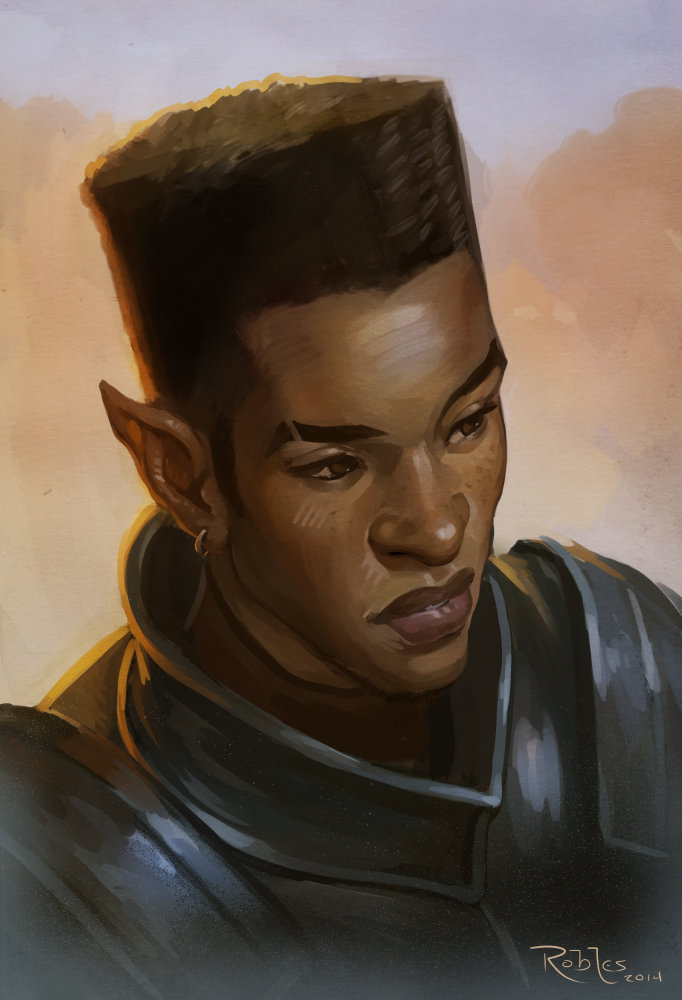
Countless stories--like Star Trek there, and like Forgotten Realms and Lord of the Rings and X-Men and basically every other serialised speculative story sooner or later--take the opportunity to criticise racism, usually by showing us elves and dwarves scowling at each other or something.  The first problem with this kind of scenario is that it extrapolates human 'races' (a nebulous and nonscientific concept) into entirely different species, so that the story is about (white) humans learning to get along with weird other-y pseudo-natural entities (of colour?).  We can do better.  But, at the same time, there's no reason that identifying with the badass werewolves or dragons or fae should be restricted to white people either, so yes, let's have elves with high tops:

Pictured: painting of an armored elf with distinctively black features, by Nick Robles.

Running with this, writers sometimes give us a paragon of virtue like Drizzt Do'Urden.  Drizzt is one of the most iconic characters in modern fantasy: a renegade drow (dark elf, literally black-skinned) from the underground city of Menzoberranzan who grew up disgusted by his people's cruelties and so ran away to the surface, where he roams the land of Faerun slaying monsters and rescuing the helpless.  He is, of course, nevertheless hounded at every turn by people who see his black skin and assume he's a monster.  I won't speak to authorial intention here, because I haven't read RA Salvatore's mind at any point in the last thirty years, but there's only one common reading of Drizzt's story and what it symbolises for our world.  We readers look at these presumptuous bigots, who think the only good dark elf is a dead one, and scorn them for failing to get to know Drizzt before judging him.  We know better and we are enlightened.

Drizzt is a good guy.

Drizzt isn't like other drow.

Drizzt is one of the good ones.  A credit to his kind.

#notalldrow

But the thing about those narrow-minded common peasants who flinch or scream at the sight of Drizzt walking into town is that they're only wrong this time.  With literally any other member of his species, they'd be absolutely right to freak out, because a powerful and sadistic murder-specialist would have just said hello.  That's not racism; that's basic probability and pattern recognition.

Fantasy racism like a fear of dark elves is ultimately a terrible allegory for real-world racism because the dark elves have worked long and hard to gain that reputation for monstrosity, whereas in the real world white history is basically a laundry list of the other nations and peoples we've slaughtered and enslaved and oppressed for monetary gain, political power, or occasionally just for sadistic fun.  In order for Drizzt the onyx-black elf hero to be an actual metaphor for black people in North America, our continent would have to live in constant fear of invasion from a subterranean army of African-diaspora wizard-ninjas, and I figure there can't be more than five or six million registered voters who actually think that's a concern.

What I'm getting at when I say #notalldrow is that Drizzt's experience, being a variously privileged individual walking into vulnerable spaces full of people who have been hurt before by people who look like him (and who know that he has the power to hurt them further), is the experience of the oppressing class, not its victims.  White people, especially but not exclusively white men: we're the drow.  When Drizzt sees someone afraid of him at first glance, it's not because they've been arbitrarily taught that black people are inherently inferior and disgusting.  If we read these scenarios and all we think is "Bah, foolish bigots, we Drizzt would never be so villainous!" we're only reinforcing the idea that vulnerable people owe us their reflexive trust or they're the real racists.

To the credit of Drizzt's fictional persona, he sympathises with these people and is patient with the caution strangers take around him.  At least, this is a good aspect of his character if it's taken as a model for, say, white people to not go around acting indignant that people of colour aren't always ecstatic about our presence.  From the 'surface' reading of his story, where Drizzt is the victim and he is patient with having to work to personally win over every single racist he meets... that's suboptimal to say the least.  The tangle that this kind of speculative fiction has made of power dynamics makes it harder to draw any conclusive arguments out of the text beyond a lukewarm 'everyone should be good to each other'.  That kind of 'equal opportunity learning' gives us stuff like the unholy mess that was Disney's Pocahontas, in which the indigenous Powhatans are also guilty of prejudice against strangers just because the white people are here to conquer, pillage, and murder.  I cannot even.

Fantasy racism doesn't speak to real-world racism as long as it seeks to justify its existence: as long as those simple innocent farmers are afraid of orcs because orcs are literally and objectively the twisted embodiment of malevolence forged by an evil god to burn the world, fearing orcs isn't racism, it's self-preservation.  Fantasy that wants to tell us that racism is bad has to start by admitting that racism isn't a defense mechanism but a weapon--a philosophy that helps the people in power convince everyone else that it's okay to kill and exploit those other people, without provocation, because they just don't deserve any better.  Stopping racism is about acknowledging and revealing and destroying that idea, and it's got to be done in us, the privileged, oppressing class.

I'd love to add some examples here of fantasy racism done properly (purely as propaganda and not based on objectively truth) but... I'm not sure I can think of any.  Even in Discworld, the conflicts between trolls and dwarves ultimately come back to 'both sides bear guilt'.  In the Warcraft universe, primary example of a setting where orcs are heroic protagonists as often as villains, the orc-human divide stems back to those one or eight times that the orcish horde got cursed into raging berserkers and tried to burn down the planet.  In settings like Star Trek (and often Star Wars, depending on the book) aliens often are pretty one-dimensional in ways apparently defined by their species.  I think a good case can be made regarding house elves in Harry Potter, but that'd be a book unto itself and there are plenty of people who feel the text ultimately fails to make a proper case distinguishing the racist propaganda from the truth.  If any of you readers have encountered a good speculative treatment of how racism functions that doesn't make these kinds of errors, I would love to hear about it.

Let me end by sharing with you a quote from Chris Rock, in an interview from 2014 which I was lucky enough to encounter this week:
So, to say Obama is progress is saying that he’s the first black person that is qualified to be president. That’s not black progress. That’s white progress. There’s been black people qualified to be president for hundreds of years... The question is, you know, my kids are smart, educated, beautiful, polite children. There have been smart, educated, beautiful, polite black children for hundreds of years. The advantage that my children have is that my children are encountering the nicest white people that America has ever produced. Let’s hope America keeps producing nicer white people.
Hope everyone's been having a good Black History Month.

Wednesday, August 26, 2015

The Eye of the World, chapter 49 to the end, in which the best and the worst of this book are on display

Here we are at last.  I could have split this across two posts, but I decided to power on ahead to the end.  Book One of the Wheel of Time comes at last to its end and we find out what passes for a climax in this unnecessary marathon of a pagecount.  Goggles on, dear readers.

The Eye of the World: p. 732--782
Chapter Forty-Nine: The Dark One Stirs

Rand wakes up and, top priority now that they are way deep in the noxious hellscape of Satan County, takes stock of how Nynaeve is feeling about getting rejected by a man.  If I thought this had anything to do with Rand thinking their group might be weakened by inner strife, I'd be less judgey.  Because Egwene is a better person in every way (and praise depersonified Light Jesus that she doesn't end up with Rand, by the way) she doesn't just stare, and instead goes to chat with Nynaeve until she manages to provoke a laugh and a hug from her wounded friend.  Rand just thinks about how "all women are Aes Sedai" because he thinks they have secret methods to read male minds, and I just can't even with this guy.  I mean, I absolutely think it's narratively stupid that Nynaeve is suddenly in love with Lan, but accepting that as our premise, we can presumably agree that Rand is contemptible for just staring at her, hurt, and thinking how freaky women are with their witch-feelings and seeeecrets.

Best possible plot twist at this point: Rand tries to stop the Dark One, instead falls to temptation, and Egwene leaps in to save the day because she is the Dragon Reborn.  Yes, after eight hundred pages it might be questionable to be all 'Hah, that protagonist was a decoy!', but there are literally ten thousand more pages still to go in this series and it's not like it stopped GRR Martin.

But let's move on or we'll never find out how disappointed I'll be.  They are once again riding towards--honest to Hotei--the Mountains of Dhoom.  Dhoom, people.  No editor stopped Jordan from doing this, and we all bear the weight of that sin.  Moiraine is taking them to the last place she found the Eye of the World, and if it moves, they'll count on the Green Man to help, because he "senses need", though why he hasn't come to them already in that case I don't know.

There's more description of the Blight, which is honestly the best part of this story right now, and when I'm this enthusiastic about description near the climax of a book you know it's dire.  The trees shed wet, decaying leaves constantly, ooze from cracks in their bark, and tremble from their footfalls as if they're turning to liquid entirely.  One of them flails around and grabs a furry creature off the ground.  Love it; A-plus evil landscape.  Lan wanders into the undergrowth to slaughter something evil, and upon his return gets jumped by some kind of murderous spider-bear, but Mat of all people takes it down with a single arrow.  That's a prelude to a mass monsters-and-monster-trees ambush, but the farm kids once again go into that ancestral battle-fugue where they shout about Manetheren and Ellisande a lot, and Moiraine elects to spam fireballs, because she definitely hasn't been saying this whole time that subtlety is paramount and we definitely don't have in-text evidence that wielding Fire weakens her more than anything else.  For reasons deeply unclear to me, Lan keeps leaving the group, diving into the trees, slaughtering things, coming back for Moiraine to cast Lay On Hands, and leaving again.  What's he getting done out there that is more valuable than directly protecting the party?  Does the forest have Strategy Bushes that direct and coordinate its malevolent intent?  Give me something, Jordan, don't just have him 'disappear' because it's supposed to be mysterious and cool.

The assault stops at the sound of some other creature's cry chasing them, which Lan identifies as Worms.  I mention this only because, to my endless delight, Jordan asserts that you can hear dramatic capitalisation:
"They were scared off by worms?" Mat said incredulously [...] 
"A Worm"--there was a sharp difference in the way the Warder said it from the way Mat had--"can kill a Fade, if the Fade hasn't the Dark One's own luck with it."
I mean, yes, Terry Pratchett also had audible capitalisation, but Discworld is an intentionally absurd place.  And well-written.  Lan volunteers to make a heroic sacrifice, but Moiraine forbids it, and Rand braces himself and thinks about how scared he is (less than relatable prose, way too tell-don't-show) when they clear a foothill and burst into a mass of healthy greenery that she declares safe.

The Green Man appears, made of nuts and leaves and butterflies, greets Loial and names Perrin a Wolfbrother, then straight up calls Rand 'Child of the Dragon', but no one thinks that might be a big deal.  He agrees instantly to take them to the Eye, and I wonder again if we've ever actually been told what it is, apart from 'plot relevant'.

Chapter Fifty: Meetings at the Eye

They wander deeper into the greenery, the Green Man weaving flower crowns for the women as they go.  Not sure why even he thinks that flowers are only for girls.  Dude is, by chance or choice, a dude, and he's partly made of flowers.  Maybe Lan is just sensitive about crowns.

(At this point, I decided to search the web for some good art of a manly man wearing a flower crown, but after the third photoshopped Benedict Cumberbatch I gave up.  On everything.  Forever.  I am a pointless meat husk screaming towards the void.)

The Eye is inside a hill, entrance marked by a stone arch, and I had thought the Green Man was hella old because he talked as if he had seen entire past turns of the Wheel, but then he says that he was made to guard it when it was first made, during the Breaking, by a hundred male and female Aes Sedai who sacrificed their lives in the effort.  Well.  That's... questionable.  Is it just me or if the villains made something out of the lives of a hundred people would we not assume it was an artifact of terrible evil?

Inside the cavern, the Eye turns out to be a big oval pool of not-water with no apparent bottom.  Mat kicks in a rock (classy) and they watch said rock dissolve into nothing.  Moiraine describes it as the essence of saidin, dude magic, which can either seal the devil's prison or bust it fully open.  Loial asks why anyone would make a thing like that:
"No one living knows [....] Neither the how, nor more of the why than that it would be needed one day, and that that need would be the greatest and most desperate the world had faced to that time. Perhaps would ever face. Many in Tar Valon have attempted to find a way to use that Power, but [...] only a man could channel it [...]"
Well.  That is also questionable.  A contingency device that can either save or end the world and can only be used by male wizards who are actively hunted because magic corrupts them.  Nothing about this plan sounds like a good idea unless you have narrative information that asserts that it will all turn out okay.  That is not a kind of prophecy I favour.

They leave again and outside run into a pair of the Forsaken, the devil's favourite servants, who are apparently loose now.  One is hella old but telekinetically smites Lan; the other is bound up in a fetish-worthy amount of leather and sets about thrashing the others before the Green Man shows up to save them.  Treebeard is not to be taken lightly--they wrassle for a moment and the Green Man looks like he'll burst into flames, but not before Captain Safeword finds himself consumed by an outburst of fungus, nettles, and weeds, plants that love the dark.  Then Big Green does topple, and his collapsing body produces a single acorn that immediately erupts into an ancient towering oak.

You know, I'm actually enjoying this book right now.  It's not exactly mindblowingly original, but at least it's operatically fantastical.  If the book only consisted of events like the last few chapters, and not five hundred pages of trudging through Generic Fantasy Farmlands, I might even recommend it to others.

Moiraine tries to trap old dude--Aginor--in a fiery chasm and tells the others to run, but Egwene tries to help as well, and Rand has to pull her away.  In literally any book where Egwene was the protagonist, it would be a sign of incredible bravery that Egwene dared throw whatever magic she could wield against the villain, and it would make some minor difference that was ultimately key to their victory, but here she's being foolish and has to be rescued by a boy.

Chapter Fifty-One: Against the Shadow

So this chapter gets trippy.  Rand runs from Aginor until he reaches a sheer cliff, inescapable, and Aginor talks about killing him (the devil being okay with undead servants), but Rand is suddenly aware of... I'm not sure.  Lifelines?  He sees a glowing cord running off Aginor, which pulses ever more intensely as they mind-battle until Aginor bursts into flames.  Rand then teleports into the middle of the battle at the borderland pass, where things are going badly for humanity, but in a fit of rage he blasts the draghkars out of the sky with lightning and summons a firestorm to scythe through most of the trollocs and Fades.  There's some unclear dialogue inside his head between himself ("It has to end!") and an unknown voice ("ONLY THE CHOSEN ONE CAN DO WHAT MUST BE DONE, IF HE WILL"), and some reasonably adept prose describing the "terrible heat of the Light" in such a way that makes it sound less cuddly and more like an overwhelming implacable force.  This I also like: if your hero is going to wield supreme power of goodness and use that power to incinerate living creatures, at least make him fucking terrified of it.  (I mean, the whole 'our hero firestorms the bad guys' is an unnecessary scene on principle, but if it's going to be here, this is an okay handling.)

As the human forces rally behind him, Rand climbs a literal stairway to heaven, steps made of light in the void, until he arrives back in the stony balcony from his dreams where he faces off against Ba'alzamon.  Rand can see Ba'alzamon also has a lifeline, and you should all be proud of me for not making any of the jokes that all but tell themselves when Rand marvels at how thick and black it is.

Ba'alzamon explains (indistinctly, but intelligibly if you know Rand's Secret Backstory) that he has orchestrated the events of Rand's ancestors to bring him here, and has only sent small armies or individual Darkfriends after Rand because he'd rather have a living servant than a dead one.  At least that tries to explain why the endless armies of evil haven't made much of an appearance, but I'm still not clear why sending a hundred Darkfriends to abduct Rand would have guaranteed his death rather than his capture.

The devil conjures up Rand's dead mother next, and she pleads with Rand to save her soul.  Fades appear and start torturing her, but Rand conjures a sword of light out of nowhere, blasts them to bits, and hacks Ba'alzamon's lifeline in half, declaring "It is ended!" in what I can only assume is a Revelation reference.  Everything bursts into flames.

Chapter Fifty-Two: There Is Neither Beginning Nor End

You say that, Jordan, but I remember the naive, callow youth I was when I started this book, and I know how eagerly I await my freedom in another twenty pages.  Also, really, that chapter was our grand climax?  Rand is separated from the others and doomed but then instinctively saves himself, saves the army, saves his mother, and sets the devil on fire?  That was literally and without exaggeration the most gratuitous, least foreshadowed, least earned, and most convenient victory I have ever read.

Wait, I'm wrong.  I once read a primary school kid's short story in which a boy gets magically transported to a realm of talking animals and told by the king lion that he is the chosen one who needs to use the magic gems to destroy the villain.  At that exact moment, the villain leaps into the king's court, and the kid raises the gems and vaporises him on the spot.  Like, the lion hadn't even finished the tutorial on these things and boom, quest over, promotions all around.

That is the only other contender for the title.

Rand awakens where he started, near the pile of gross ashes that used to be Aginor.  Memories float back and he sprints back to the others, who are all unharmed, including Moiraine.  He tells them that he killed the devil, and everything else that happened, but everyone else is too plot-savvy to believe that the devil gets dropped in book one.  Moiraine explains that she's seen evidence of Rand channelling all through the book, as far back as when she was casting Refresh Horse on everyone's mounts and Bela didn't need it--because Bela was carrying Egwene and Rand instinctively wanted her safe.  (The possibility that Egwene had refreshed Bela apparently wasn't on the table.)  Moiraine promises not to drag Rand off to be "gentled" like they normally do with man-wizards, and not to tell anyone who doesn't need to know.

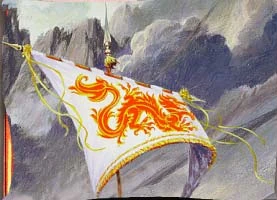
The Eye pool is apparent gone, consumed by Rand's victory lap of plot contrivance.  Instead there's a column of stone in the centre, with convenient steps to reach it.  The dudes of the pottery carry three relics retrieved from inside the prison.  First are ancient pottery fragments, which Moiraine fits together into a taijitu (last seen in the prologue) and identifies as heartstone, indestructible relic of a past age, one of seven seals on the devil's prison, shattered by unknown means.  Second is the Horn of Valere, namedropped much earlier in the book, to be used to call spirits of heroes back to fight the devil, and last is the banner of the Dragon, specifically a serpentine gold-maned red dragon.


Just so we're clear on this, Our Heroes are a sea of whitebread and ginger carrying a katana, the prime symbol of Taoism, and now a clearly Asian-style dragon banner.  I know Jordan said he was going for a sort of 'fantasy melange', but I have yet to see a single thing that makes me say 'ah, a reference to African mythology!' or really anything other than 'ah, another white author with a fetish for Asian myths minus all the Asian people!'  People who have read later books: does this ever get better?

Chapter Fifty-Three: The Wheel Turns

The Blight has eaten most of the greenery the next morning, but Loial refuses to let it have the Green Man's oak, and takes an hour (that feels like minutes) to sing a Tree Song that rejuvenates it, assuring the party that he couldn't have invoked so much power if Jolly Green's spirit wasn't still in there.  The Blight is still gross, but doesn't try to murder them as they leave--Moiraine explains that they "struck a mighty blow against the Dark One" and for some reason Rand still hasn't asked for an explanation of how she reconciles that with his memory of killing the devil.

At least the soldiers at Fal Dara aren't so hypermasculine as to reject a good flower crown, and everyone is wearing them to celebrate the incredible victory at the pass.  Moiraine waves off all healers and meets with Agelmar to show him the recovered horn and ask for a small army to escort it to Illian, for reasons not explained.  Montages happen for a week.  Lan starts teaching Rand how to actually use his sword, and everyone gets hyped about finally going to Tar Valon, but Rand refuses to join them, convinced that he'll get gentled if he goes, and go mad-corrupt if he ever accidentally uses magic again.  He's just going to wander off on his own, away from people he might hurt, cursing the luck that his crush has to be a wizard and thus dangerous.  In another garden, far away, Moiraine magically eavesdrops on them:
"The Prophecies will be fulfilled," the Aes Sedai whispered. "The Dragon is Reborn."
And that's it.  That's the book.

I am... thoroughly unimpressed, I have to admit.  I love a good ending.  I love the part of a story where we see how everything that has led to the climax fits together in order to create something with meaning.  I love Frodo and Gollum facing the will of the Ring at the Cracks of Doom, the way the hero's past mercy ultimately saves him from his own final weakness.  I love Katniss, broken and angry, still playing her character so well that she gets a shot at salvation instead of vengeance.  I love the Doctor and Rose up against an army of genocidal zealotry, saved because the Bad Wolf is damnfool implacable hope and she will do anything to protect those she loves.  I love Harry Potter and Narcissa Malfoy in the woods, speaking two words ("Yes."  "Dead.") that declare that love overwhelms hatred in the end.

And I get that those endings are the real endings and this is book one of eleventy, so it's not a fair comparison, but I just waded through seven hundred and ninety-two pages of this stuff and the ending was abrupt, unjustified, and most heinously of all, revealed nothing meaningful about who the characters are or what they believe.  This is an ending that falls like a soggy towel on the page: and there, there's a huge battle and the good guys win but for how long isn't this awesome?  Wasn't this totally worth reading about the four hundred identical innkeepers that populate this world like an unsettling mashup of Barliman Butterbur and Nurse Joy?  Isn't it great how a solid 60% of this book was just setting the stage for later books while somehow failing to have any real impact on the events of its own plot?

I am struggling to think of any way in which the plot might have been hampered if the party hadn't transitioned directly from, say, Baerlon to Fal Dara.  By my estimate, if they had done so, the book would have been about three hundred fifty pages long, maybe three hundred with better editing, a solid book but not a brick.  We lose the City of Mat Don't Touch That Dagger Oh My God, and Perrin being a Man-Wolf, and Rand flirting with a princess, but do we lose anything that actually impacts the plot?  Is there any reason not to consider the intervening thirty-some chapters glorified filler?  I'm really and truly asking.  Because I don't think it should be a controversial opinion to say 'if half your book isn't relevant to your book, cut it', and yet here we are.  And I actually liked the Travellers and the wolfpack, those are good story elements, but they could be in their own book where they were actually plot-relevant and not just a sideshow with no purpose.

Because I don't make good life choices, I am actually considering getting into the second book on this here blog, but I'm definitely not doing that right away.  I need a cleanser.  So, apart from your usual delightful insights and anecdotes, make your nominations, resilient readers, and come back in a week or two to see what I inflict on myself next.

Sunday, December 7, 2014

The Eye of the World, chapters 14 and 15, in which a dream sequence is actually good

Only two chapters this week, because there's actually stuff worth talking about in them.  Still have to sift out great tracts of chatter, but I knew what I was getting into, and the novelty of a dream sequence that's actually got some weight to it was worth the slog.

(Content: animal death. Fun content: I am the captain of the HMS Mat/Perrin.)

The Eye of the World: p. 192--229
Chapter Fourteen: The Stag and Lion

We last left our heroes arriving at an inn, which is apparently jam-packed with waves of people finally leaving the mountains after getting snowed in all winter.  Wouldn't people leave the mountains for the winter and work mines in the summer?  I confess to not knowing standard practice, but that seems counterintuitive to me.  Lan splits off to find news from the loud and joyful common room, and Rand decides not to follow because he smells.  (Literally.  Shouldn't Lan smell just as much?  Or more?)  The ladies split off and the dudes are brought to a bath chamber, with a circle of twelve copper tubs (everyone likes washing themselves panopticon-style, right?) and inexplicably extensive quantities of hot water.  The gleeman is at one point described as sinking up to his nose, and there are four tubs, so I'm guessing 140 gallons of water at 38C, and they were just able to provide that, in this super-crowded inn in the chilly springtime, in the time it took Our Heroes to get naked.  [Drink!  Sorry, no, wait, this isn't Orson Scott Card anymore.]  The first house I rented couldn't provide that many hot baths on its best day.  Apparently there are witch-hunters in the city looking for Aes Sedai; have they searched the boiler rooms?  Or grown suspicious that there are boiler rooms?

The bathtub attendant (most awkward job?) sees their weapons and asks if there's anything Dangerous going on in hick country, and there's half a page of everyone bluffing and trying to stop Mat from revealing that they were attacked by trollocs.  Lan arrives and shoves the bath attendant out of the room.
"Don't talk about Trollocs," Lan said grimly. "Don't even think about Trollocs. [...] If the Children of the Light heard Trollocs were after you, they'd be burning to get their hands on you.  To them, it would be as much as naming you Darkfriend."
Doesn't that make the opposite of sense?  'The forces of evil want to murder him--he must be on their side!'  Shouldn't being wanted by trollocs be a badge of honour?  Anyway, Lan is so frigid about the risk they're putting Moiraine in that they all spend the rest of the bath in silence.  (That or Lan got naked and everyone was just so 'daaaamn, that butt is cubic' that they couldn't speak.)  Afterwards, despite the uber-crowded inn they get a private dining room.  There was no one else in the baths, either; how is this crowded?

Rand shows a rare flash of Doing Better when he sees Egwene again:
It seemed they could not trust anyone but themselves [....] And Egwene was still Egwene. Moiraine said it would have happened to her anyway, this touching the True Source. She had no control over it, and that meant it was not her fault. And she was still Egwene.
Folks round these parts already know my feelings on the 'born this way' argument, but if Rand's childhood friendships and teenage boners can help him grapple with the idea that people are complex and not just inherently and arbitrarily good or evil based on fairy tales, that's a start.  Of course, Egwene immediately spins away from him and he thinks 'well, if she's going to be like that about it' and they don't talk.  I would call this teenage realism, except I gather that this is going to be a running problem for everyone in the series.

The innkeeper delivers chickens and veggies for all, and his Distinguishing Character Trait is that he can't shut up, so his every appearance has resulted in at least half a page of blather, but Moiraine insists the food is a feast and he should feel proud.  I hope Lan overpays the hell out of him too and this isn't just perks of celebrity.  Lan's news says that the false Dragon, Logain, has won a major battle, but no one can agree what happened to the Aes Sedai that fought him, if they died or lived or joined him.  Rand's genre-savviness power detects that Lan and Logain were previously bros.  (Logain is such a brooding bad boy name; is he going to stay a mid-level bad guy or switch to Team Good?)

They get split among three rooms, girls in one, Lan, Thom, and Rand in another, so the good ship Mat/Perrin is still sailing steady.  Rand immediately falls into another plot-relevant dream, but I don't hate this one.  I actually think it's one of the better passages we've had so far, because Rand wanders an Escher-esque castle with a view of an impossible sky until he meets a dude who calls himself "Ba'alzamon".  I was a big fan of Digimon as a child, so I'm going to take this sole incident to call him Ballsmon and then show restraint for the rest of the series.  For some reason Rand identifies this dude as the Dark One, but he's the guy from the prologue:
Dressed in dark clothes of a fine cut, he seemed in the prime of his maturity, and Rand supposed women would have found him good-looking. [NO HOMO YOU GUYS.] 
"Once more we meet face-to-face,"the man said and, just for an instant, his mouth and eyes became openings into endless caverns of flame.
The thing that's less boring about this dream sequence is that Rand spends the whole time insisting that it is a dream and being distressed about his inability to wake up, while Ba'alzamon basically starts singing Sympathy for the Devil:
"I stood at Lews Therin Kinslayer's shoulder when he did the deed that named him. [....] I whispered in Artur Hawkwing's ear, and the length and breadth of the land Aes Sedai died."
He tries to get Rand to drink from a goblet, insists that he has never been bound and could destroy Rand at any time, mutters a lot of stuff that obviously won't make sense until later, but there's one interesting bit, when he claims that Logain and various others (past false Dragons, I assume) are "being used", as Rand will be.  He also claims that if Rand tells the Aes Sedai about this, he'll be a threat to them and they'll kill him instead of using him.  I've become so inured to people expositing half-sensical phrases at me that I mostly just enjoyed the scene.  Maybe that's the secret of the series?  Sort of like how in Fifty Shades we start looking forward to the sex scenes because people talk less, maybe Wheel of Time transitions into a state where the Generic Fantasy Cliches become a kind of bland cracker base upon which we can start to savour the hints of things that have actual flavour.  (Plus I just enjoy villains cheerfully delivering their resumes.)  When Rand finally awakes, he thinks about asking Moiraine for help with his nightmares, but doesn't, because that would make that last scene relevant.

Chapter Fifteen: Strangers and Friends

Rand wakes late with aches and a headache, which are obviously totally reasonable symptoms of a nightmare.  He sees the others have taken their weapons with them, and straps on his sword as well, with a nice lampshade as he tells himself "it was not because he had often daydreamed about walking the streets of a real city wearing a sword".  Of course, Rand knows that his heron sword hypothetically marks him as a master fencer, which could be a mite attention-grabbing, but I guess we'll just skip that for now.

Rand wanders to the kitchen, where there's a full page and a half of the innkeeper and cook talking about her cat and guest complaints, but in a shocking twist, it turns out to be plot-relevant, as a dozen rats were found around the inn with their backs broken, just as Ba'alzamon did to a rat in Rand's dream.  Interesting way to prove your power.  I don't expect this to be anything more than a throwaway scare tactic, but having sufficient physical power to snap a dozen rats in half at will seems like a waste of that power, when you're an imprisoned god of evil threatening the Chosen One.  If you know where he is (in order to kill the surrounding rats), why not drop your monster horde on him?  If you have Rat Control, why not swarm him in the night?  If you can snap bones, why not kill him outright, or one of his friends if you have some purpose for Rand left?  The only way this makes sense to me is if the Dark One only has the power to harm vermin, and can channel that into the vicinity of someone whose mind he has invaded, but can't use that connection to actually find the target.  That is a very specific power.

Perrin turns out also to be in bed, and he and Mat apparently had the same dream Rand did, but Mat tried to laugh it off, whereas Perrin still feels ill.  Rand leaves him behind, steps outside and is immediately bewildered by the sheer number of people on the street, none of whom know each other.  Rand's bemusement at the idea of people from the same city being strangers is the first rural thing with any verisimilitude about him, and I approve.

Also, called it, because a short-haired girl whom he saw talking with Moiraine the night before appears and immediately comments on how weird it is to see a country boy with a heron sword.  Rand is a bad spy.  The girl introduces herself as Min, reveals that she knows their deal, and quickly exposits that she has Plot Relevance Senses, or sees "pieces of the Pattern", if you prefer.  There's some really blatant imagery about how their party altogether creates and aura of sparks trying to ward off a great black shadow.  She also states that Rand and Egwene are in love with each other (which: what, no, they at best are in boners with each other) but are not meant for each other, so yay for the initial love interest not being the real One True Love Interest?

Oh god, it goes on with the symbolism forever, Lan has "seven ruined towers around his head" and a baby with a sword, Mat and Perrin have stuff like "an eye on a balance scale", and this would all be much more interesting to me if it were in any way informative.  It's just the author coming up with shorthand symbols for future plot points and rattling them off, so that readers can spend the rest of the series going 'That's the thing that Min meant when she saw the thing!'  Rand gets a better quality of montage, including "a sword that isn't a sword" and three women standing around his funeral bier.  That's at least got some plot gravitas to it, because we've already heard something about a legendary maybe-a-sword-but-not-quite, and in another series we might actually be wondering if Rand would die in the end.  She also sees a fuckton of lightning, which I assume hints at Rand's future duel with the false Dragon.

Pseudo-exposition done, Min lets Rand run off to wander the city in a distressed daze.  We get a solid page and a half of city description before Rand finally finds the peddler from several chapters ago, believed deceased, now a ragged homeless man.  Rand promises his horses are safe back in Emond's Field, and says he should come back with Rand to the inn, where they're staying with Moiraine.  I'm going to say 85% chance that the peddler is going to sell them out to the witch-hunting Whitecloaks in vengeance for how he feels Rand's village betrayed him.

Rand runs into Mat next, they recap their dream and the rats, and resolve not to tell Moiraine, because she's obviously untrustworthy and might murder them all on the spot if she finds out the devil is in their heads.  Rand also promised not to tell her that he found the peddler.  So beginneth the path of Oh My Fucking Word Just Tell People What You Know And Get It Over With, I think.

They spot a bunch of dudes with white cloaks and pointy metal hats, making me wonder if they are intentionally supposed to invoke the KKK.  If so: I find this sketchy, especially since thus far we have an utterly white cast.  They're the Children of the Light, of course, and because Mat makes bad decisions he 'pranks' them by using his sling to set a small avalanche of full barrels rolling into the street, thus panicking everyone and splattering the neat white cloaks with mud, ha ha.  Rand half thinks this is a bad idea and half wants to run with it, and is left laughing alone with the whitecloaks when they recover.  He tries to intimidate them by casually displaying his heron sword, to little effect, and they bluster until the town guard arrives.  I think the implication is that some magical force is pushing Rand to get into trouble, but it's not clear.

Rand escapes, they regroup with the gleeman, and recap again all that's happened.  Thom confirms that all the names in their dreams were powerful figures in history (he doesn't say what they have in common, but I'm running with 'false Dragons' for now), but he's Obi-Wan levels of vague on whether the Aes Sedai killed them.  We've also now had the Eye of the World and the Horn of Valere name-dropped as big magical artifacts (the Horn being related to the Great Hunt, which I know is book two's title) that people go on quests to find.  They return to the inn where Perrin reports that Nynaeve from back home has caught up with them, having bullied the ferryman into rowing her across the river after Moiraine obliterated his ferry.
"From my observation of the young woman," Thom said, "I don't think she will stop until she has had her say." [....] 
They exchanged glances, drew deep breaths, and marched inside as if to face Trollocs.
Totally less sexist than Tolkien, though!

Next week: 

Sunday, October 19, 2014

The Eye of the World, ix to xviii, in which Will fails to keep a straight face

The first character we meet in The Wheel of Time has something in common with me, in that we both brought this suffering on ourselves.

Most of you are probably at least aware of WOT, even if you've never read it--the first book came out in 1990, which is notable for me as the first year that I was aware what year it was.  These books are old, given that the series only finally ground to its conclusion quite recently.  This brick of a book I'm staring at warily is 814 pages long and has a cover with one guy wearing vaguely samurai-ish armor on horseback (with a pair of vaguely Celtic swords strapped to his back in a questionable manner) next to a woman on a much smaller horse, carrying a staff and looking like she is small enough to curl up inside his ribcage.  If I hadn't already guessed, it became apparent to me on the first page that this book is sort of a fantasy Poe: if I were to make up a random phrase that was meant to sound like an absurd parody of sword-and-sorcery mythos, it would be indistinguishable from actual text in this book.

I am not necessarily opposed to this.

If I wanted to try to come up with objective criteria on the quality of storytelling, I guess I'd have two questions: 1) How well does the story achieve what it set out to do and be, and 2) What are the real-world implications of the story?  The works of Orson Scott Card do questionably on both these counts, because people act like they got something completely different out of the book than what is in there.  What little I know of Robert Jordan's works, and his immense, Card-eclipsing popularity, suggests to me that they succeed immensely on Criterion the First: if you want this kind of unabashed over-the-top megalomagical Epic Fantasy, they will fulfill your needs.

This blog, of course, is much more focused on Criterion the Second: who gets walked all over in the service of the story's ends?  Women?  People who are disabled?  People who aren't straight?  People who aren't cis?  People who aren't white?  Some beautiful and terrible Voltron of more than one of these demographics?

What I know in advance about WOT suggests that it's going to be heavy on the gender-essentialism and the heteronormativity.  Dunno yet about the racism, ableism, or anything else.  Dunno what kind of politics it pushes or values it assumes.  I am leaping into the unknown here.  Your fates are now bound to mine.  Let's bounce.

(Content: death, ableism, binarism. Fun content: the phrase 'Nine Rods of Dominion' is used unironically.)

Eye of the World: p. ix--xviii
Prologue: Dragonmount

The first thing that leaps out at me is that this prose is hard to read.  In my own fiction, I've been debilitatingly bare-bones about description in the past, and I think these days I still tend towards sparse narrative.  Jordan does not.  Jordan's prose is the purple of a twilight sky in the eyeblink past sunset when the reds have faded but the black of night is not yet swept over the world.  It gets distracting.  We're inside a ruined palace and I'm piecing together what's going on with the help of phrases like:
Bars of sunlight cast through rents in the walls made motes of dust glitter where they yet hung in the air.
Did you parse that sentence on the first read?  I did not.  I'm also a little fuzzy on the nature of the devastation in the palace,since "scorch-marks marred the walls, the floors, the ceilings. Broad black smears crossed the blistered paints and gilt of once-bright murals, soot overlaying crumbling friezes of men and animals", but also "colorful tapestries and paintings, masterworks all, hung undisturbed".  What kind of fire hits every surface of the room but misses all the art?  Is that supposed to be indicative of something?

Also there are corpses everywhere, all sorts, all kinds, and through it all a dude cheerfully skipping along looking for his wife.  (She's dead on the floor among all the others, naturally.  Fridged Women Tally: 1.)  He spots himself in a mirror, looking mussed, and cracks up.  There's more tons of description, including a blatant taijitu (yin-yang symbol) on his cloak, although his name is Lews Therin Telamon and his dead wife is Ilyena.  Samurai armor on the cover, taijitu on the white dude; is this a secret weaboo fantasy and no one told me?

A dude pops into existence behind Lews, wearing all black and thigh-highs, so it's safe to assume he's evil, I guess.  (Thigh-high boots, that is, but I wanted y'all to consider a different mental image first.)  He's described as "fastidious" about not wanting to touch the bodies, and I begin to wonder if this is going to be a series that requires frequent consideration of queer-coding.  He calls Lews "Lord of the Morning", and we are into Poe territory immediately, because Lews asks if the stranger has "the Voice", because it's almost time for "the Singing".

All-Black Dude immediately determines that "the taint" has taken Lews (no Significant Capitalisation?) and I'm fuzzy on whether he's the devil's lieutenant or not, because he says "Shai'tan take you" in a snappish way, but also calls Lews "Light-blinded idiot".  Shaitan is straightforwardly the Islamic take on 'Satan', though sometimes a whole class of spirits rather than one single adversary.  Guessing Shai'tan is going to just be the embodiment of evil for this world; easier to stab that way.

All-Black introduces himself as "Elan Morin Tedronai", now called "Betrayer of Hope", and I wonder why we don't get titles like that more often in real life.  We never get to say stuff like 'This is my friend Eileen, the Jailor of Infinity'.  We should start doing that.  Elan says that he's embraced his title, and it's no different from people calling Lews "Dragon", though he suspects that Lews will have some public relations problems once word gets out about the massacre--apparently Lews is the one who murdered everybody, including the wife he keeps calling for.

Let me again make the nature of this text clear:
"Once you stood first among the Servants. Once you wore the Ring of Tamyrlin, and sat in the High Seat. Once you summoned the Nine Rods of Dominion. Now look at you! A pitiful, shattered wretch. But it is not enough. You humbled me in the Hall of Servants. You defeated me at the Gates of Paaran Disen. But I am the greater, now. I will not let you die without knowing that."
I was so unprepared for this I cracked up.  THE NINE RODS OF DOMINION.  This book is amazing and I regret nothing and everything.

Elan blasts Lews with "Shai'tan's healing" which wracks him with fiery agony but finally leaves him lucid, and he notices his murdered Ilyena.  (Blonde, obvs.)
"You can have her back, Kinslayer. The Great Lord of the Dark can make her live again, if you will serve him.  If you will serve me."
There go my hopes that Elan was a third party or something.  He's just our evil god's field agent.  Oh well.  Lews says the big bad has terrorised the world for ten years, Elan snaps back that it's happened since the beginning of time, and it sounds like there's a reincarnation cycle or something, "You and I have fought a thousand battles with the turning of the Wheel, a thousand times a thousand, and we will fight until time dies and the Shadow is triumphant", so I'm vaguely intrigued by this.

Elan finally makes it clear to Lews that the big bad mind-whammied him into murdering his entire family, in revenge for Lews' last attack.  Killed his wife (Ilyena Sunhair, she's even named for being blonde), his kids, his friends, his servants.
Desperately he reached out to the True Source, to tainted saidin, and he Traveled.
One of the things about these kinds of fantasy novels (Jack Vance also reads like this) is that it can be very hard to guess when a mythical thing is plot-relevant and when it's just magibabble, since references to big arcane things are getting tossed around all over the place.  Are there a lot of False Sources?  This is that same sort of 'tell the reader nothing and let them figure it out by deduction' style of worldbuilding, which I generally like, but I'm still back wondering what the Rods of Dominion are used to Dominate and why there are Nine of them, and in fact why it's so important that there are Nine of them that the word Nine is in their name, and why they have to be summoned rather than kept in a secure closet or something.

But Lews has Traveled to a huge broad plain, where "he could sense there were no people within a hundred leagues", and begs the Light to forgive him, though he doesn't believe it can.
He was still touching saidin, the male half of the power that drove the universe, that turned the Wheel of Time, and he could feel the oily taint fouling its surface [...]
Oh.  Joy.  Our magical Source is split into male and female, in turn making those universal concepts.  Betting there's no room in there for non-binary genders (and probably not intersex people either, regardless of their gender)?  If they've determined that the Source has male and female sides, would they even be looking for one?  I predict that I will spend much of this book suggesting that each plot point would be a good time for an androgyne person to bust in with new magic and save the day.

Lews blames himself and his pride for making whatever attack provoked the big bad's revenge, trying to "mend what the Creator had made and they had broken", and he overclocks himself on magic until he turns into a colossal pillar of incandescence that raises up a huge volcano in the middle of the plain, shoving the river aside and splitting it around a new island.  Elan finally catches up and mutters about how the Dragon can't escape him so easily, et cetera.

Then we get a couple of excerpts from historical texts, talking about the end of the world, when "the living envied the dead" and the only enduring memory is of "him who brought the Shadow and the Breaking of the World. And they named him Dragon", while the second excerpt calls for "the Prince of the Morning" and the "Lord of the Dawn", and then we get what I know is this series' catchphrase: "Let the Dragon ride again on the winds of time."

To sum up: big bad, eternal war, hero tried to seal big bad, fucked up, slaughtered everyone, world kind of ended but probably not really because there are fourteen books to go, and everyone is waiting for said hero's return.

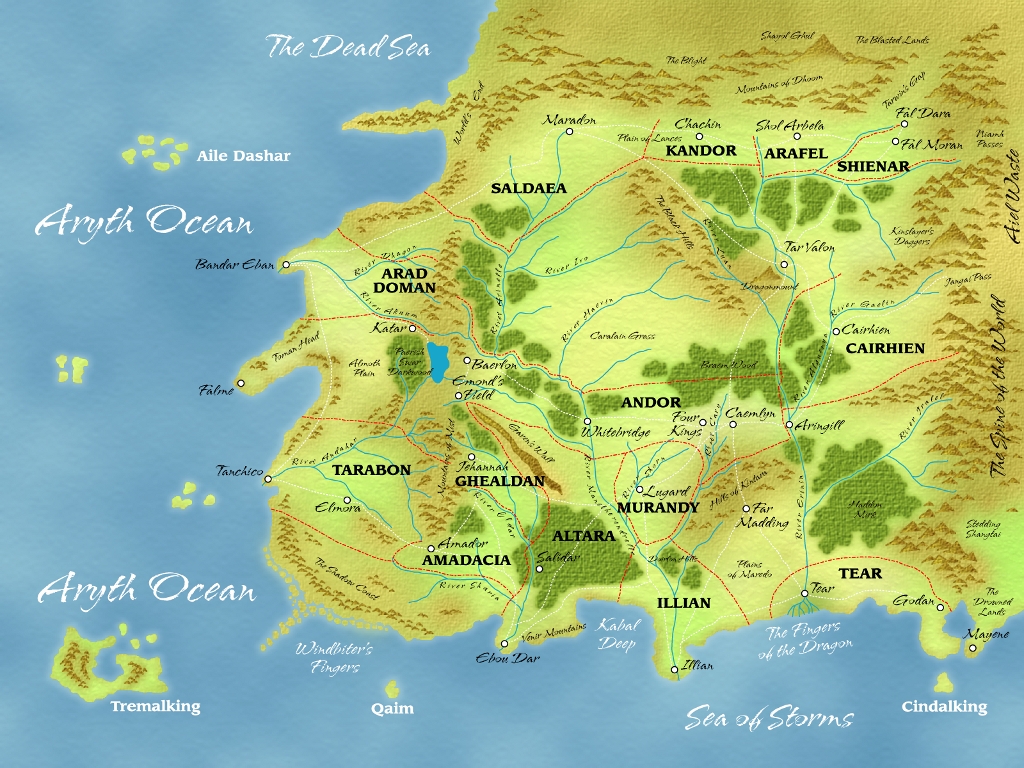
Ooh, then we get a huge convenient map:


Will you look at the 90-degree angle those mountains take?  I would normally bet massive quantities of cash that nothing plot-relevant will ever happen more than an inch beyond the borders of this map, but surely with the millions of words that make up this series I'd be wrong about that?  Please?

I also have some huge questions about the borders as defined above.  Why are they where they are?  We have a lot of weirdly-bounded territories in the world, just look at the eastern US or Europe, but there's a reason for that--they're following rivers, or mountains, or some other significant geological feature.  When we don't need to do that, we end up with things like Wyoming and Saskatchewan, boxes imposed on the boredom of the ground.  Why in the world is Tear's curvy border swooping through that field?  Who owns the ground between Tear and Illian?  There are actually an impressive number of unlabelled swathes in there--is the lack of claim there going to be explained, or are they just international territory for some reason?  These are the questions that will trouble me for months to come.

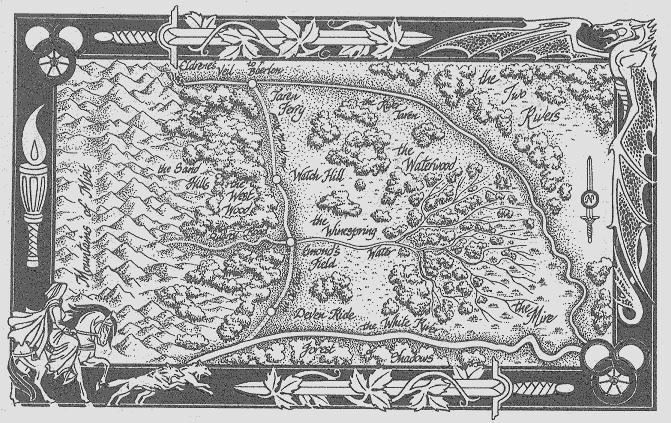
That's followed by this magnificent creation:


Now, correct me if I'm wrong, but this appears to show three rivers coming out of the mountains, and somehow the middle one shatters like a river delta in the middle of a field and branches out in dozens of different directions without ever meeting up with the other two rivers that are arcing together.  And eventually all those little streams just die out, in a presumably-damp region called 'the Mire', which I could sort of accept if not for the way there are still two massive distinct rivers bordering the Mire and cutting cleanly through the land.

I realise most fantasy authors aren't hydrologists, and if an actual hydrologist wants to correct me on this, please do because I love new knowledge, but I'm like 35% sure that is not how rivers work.

This is a bit of a short post, but that's all I can handle for now.  Come back next week for chapter one, in which we meet Our Hero, who at first glance looks to me like he's going to be a humble farmboy.  I should make so many bingo sheets.

Thursday, June 20, 2013

50 Shades Chapter 20 in which meh

I talk a lot about the fact that Grey is a fantasy I struggle to get. I struggle to get it because to me, it is so abusive and clingy* that I'm too hung up on those facts to see anything else. Ana Mardoll, who does an awesome (and very, very in depth) analysis of Twilight recently did a great break down on the fantasy of Edward Cullen, and Edward and Grey were initially the same character. What struck me as I nodded along was the point she makes about how "We are never invited to see Edward as real", because glittering vampire. Grey is described in many of the same terms, "perfect Greek god", but Grey is meant to be larger than life, while Edward is... not alive. Grey's actions also tend to go further than Edward's. He doesn't just watch Ana when she sleeps, he actively tracks her. He has people watching her at work. He bought the company she works for and Ana herself finds it all too much often enough. So unlike with Bella and Edward where we aren't invited to think of them as real, and Bella always sees it as sweet, we are invited to see Grey as real, and Ana isn't always comfortable with his actions. That makes it even harder for me to look past the icky parts of what he does.

Edward's bad behavior can be explained away with "He's a hella old vampire"**. The hand wave we're provided with for Grey stalking Ana after she bluntly and repeatedly asks him to stop is... he was traumatized as a child and is affected in very specific and unrealistic ways. You may ask, "Wait, you're okay with vampires, but childhood trauma is unrealistic?" Vampires are supposed to be fantasy, we're presented with Grey's back story as reasonable justification for him being a shithead which is so much bullshit I can't even.

So, with those thoughts that were bouncing around in my head out, let's get going on chapter 20! Chapter 19 ended with Ana agreeing to marry Grey after he failed to call and say "By the way, totes not dead!" after someone sabotaged his helicopter (not that they've told us yet, but come on). Sounds like solid husband material to me***. I mean, who wants their husband to check in when he may be in danger? Next he'll think to do things like let you know he'll be home late from work, or he won't be home for dinner, or is going out for drinks and ask if you want to come out! Who wants to deal with that?

After some spinning and giggling because they're just SO HAPPY YAY Grey realizes that Ana gave him the key chain when he was begging for an answer!

“I can’t believe you left me hanging.” His whisper is laced with disbelief. His expression alters subtly, his eyes gleaming wickedly, his mouth twitching into a carnal smile.
Holy hell. A thrill runs through me. What’s he thinking?
“I believe some retribution is in order, Miss Steele,” he says softly.


Just once I would like Grey's response to Ana exercising agency or free will NOT to be to "punish" her. Just once. He is so threatened by Ana doing anything other than bending to his whims that he must now immediately reassert his dominance by throwing her over his shoulder like a fucking cave man and dragging her to the shower to douse her, clothes and all, in cold water as punishment. No, really.

“Christian!” I scold loudly—his intent is now clear.
He switches the water on at max. Jeez! Arctic water spurts over my backside, and I squeal—then stop, mindful once more that José is above us. It’s cold and I’m fully clothed. The chilling water soaks into my dress, my panties, and my bra. I’m drenched and I cannot stop giggling.


I sometimes wonder how much shit I could make up before people would start questioning me, but then you guys sometimes are all "Y-you made that bit up, right? Right?" for things that actually happen, and realize the answer is "very little". So they start fooling around in the shower because that is what you do after you get engaged and your new fiancee drenches you for the sake of showing you who's boss.


My hands move involuntarily to his shirt as it clings to every line and sinew of his chest, revealing the hair scrunched beneath the white wetness.

I did a double take at "white wetness" thinking he had made a mess of his own shirt. Apparently not. Not sure if that makes it better or worse.

His lips become more insistent, more provocative, his tongue invading my mouth—and my body explodes with desire.

He planted a sexy bomb in her mouth with his tongue?

I tug his shirt hard, ripping it open. The buttons fly everywhere, ricocheting off the tiles and disappearing onto the shower floor

I am shocked it has taken this long for buttons to go flying, to be honest. Also, I'm not the only person who pictures someone letting a pair of breasts free in the wild when they read the phrase "freeing my breasts" right? Because that line is all over the damned place.

and push my breasts into his magical hands.

See? Warlock. Also: Seriously sounds like she just popped the suckers off and is all "HERE YA GO HONEY HAPPY BIRTHDAY!"

Oh yes! It’s so arousing. My inner goddess has resurfaced after her evening of rocking and weeping in the corner, and she’s wearing harlot-red lipstick.


1) "It's so arousing."? Even you don't sound sold on it Ana.
2) What the fuck is "harlot-red"?

I love him so much, and I’m suddenly overcome by the enormity of my love and the depth of my commitment to him. I will spend the rest of my life loving this man, and with that awe-inspiring thought, I detonate around him—a healing, cathartic orgasm, crying out his name as tears flow down my cheeks.

So, "Jesus fuck he nearly died and I love him so much" prompts orgasms and crying. Just:

After they finish boning they talk about how much they love each other and how scared they both were that maybe he would die because he was actually in lots of danger earlier and lied so his parents wouldn't freak out!

They go to bed, and Ana (rightly) tells him off for being a huge wank by NOT calling because he was super eager to get back since Jose was around and apparently he didn't trust Ana to not hop on his meat-pogo? She doesn't comment on the trust issue, though she should. It dissolved into "You asshat you're loved! Stop being a dickhead!" and Grey actually responds well by apologizing and realizing that he honestly panicked people and that is Not Cool even if your girlfriend who has a magical cooter is hanging out with other men and you are afraid that if they touch her cooter the black magic you've been dumping in there will cause a giant explosion.

And on to the next morning!

He looks much younger when he’s asleep, and I grin because today he’s a whole year older.

No, he's a whole day older.


Ana goes off to make Grey breakfast, and remembers Jose is still there when she finds him eating cereal at the breakfast bar. She taunts him by offering a "real" breakfast and Jose asks a bit about their relationship, and cracks a joke that she loves him because of his money. Ana, reasonably, isn't so thrilled by this.

“Hey, Ana, just kidding.”
Hmm . . . will I always have this leveled at me? That I’m marrying Christian for his money?
“Seriously, I’m kidding. You’ve never been that kind of girl.”
“Omelet good for you?” I ask, changing the subject. I don’t want to argue.


HEY LOOK I FOUND ONE OF THE THEMES FOR THE NEXT BOOK! [WW: I hoped it would be omelets but she's probably right that it's marrying Grey for his houses full of money.]Also, I find it very odd that Ana says "I don't want to argue" when he's basically taken back his tactless statement and is putting up no reason FOR them to argue. We haven't seen Ana really interact with anyone besides Grey and Jack in this book, so it's kind of interesting to see the reminder of "Right, she thinks people are constantly attacking/prying into her life". Which makes her responses to Grey all the more bizarre since he actually does do those things

So Grey turns up wearing his PJ bottoms that he knows makes Ana all hot and bothered because apparently she has about as much control over herself as a teenage boy (further proof Grey is using black magic) and there is even more bullshit posturing where Grey has to assert his dominance and ownership of Ana. God, when he buys her a ring she won't be able to lift her hand, the diamond will be so big. Not because Grey will want to flaunt his wealth, but because he will want to make it impossible for anyone to miss the thing. It's going to be a goddamned collar. He might as well just pee on her while making steely, unrelenting eye contact with Jose.

In a move of passive aggressiveness through civility, Grey chats Jose up. Jose talks about his and Ana's dads being BFFs and comments that he's going fishing with them. From here the two find something to gush about (fishing) and exclude Ana from the conversation entirely. When he leaves Grey maintains he still wants in Ana's panties (because women love being told that their friends are only their friends because they want to have sex with them) but is less hostile and territorial.

“You didn’t tell him we were getting married.”
“No. I figured I ought to tell Mom and Ray first.” Shit. It’s the first time I’ve thought about this since I said yes. Jeez—what are my parents going to say?
Christian nods. “Yes, you’re right. And I . . . um, I should ask your father.”
I laugh. “Oh, Christian—this isn’t the eighteenth century.”
Holy shit. What will Ray say? The thought of that conversation fills me with horror.
“It’s traditional.” Christian shrugs.


So Grey is the type to do things simply because that's how they're done, but aims to create new, safer, and more green tech constantly? And ignored his fiancee's open horror at the idea of him asking to own her? Siiiigh.

So Ana then gives him his birthday presents. Because apparently ownership of her wasn't even hers to give! One is a solar powered toy helicopter (which is kinda cute) and the other is the equivalent of sex coupons as she asks him to take her to the playroom.

After some hesitation, and pressing that she's okay with it, they head there and that is the end of chapter 20. Soon! SOON THIS BOOK WILL BE OVER!

Come back Sunday for the next Ender's Game post, next Thursday for the next 50 Shades, and as always, share your thoughts on this fluster cuck in the comments!


*I have FEELINGS on independence within relationships. To the point that Will makes fun of me for splitting apart compound words, claiming it is my deep seated desire that everyone needs their own space that causes me to do it. "NO! BE YOUR OWN WORDS!" [WW note: In proofing this very post I had to reunite several forcibly separated compounds.  She's seriously hardline on this.]
**I do not think this is a valid explanation, mind you, but we're talking about fantasies.
*** The Boy has promised to always keep me up to date on the level of exploding his plane experiences when flying.