Showing posts with label science does not work that way. Show all posts

Wednesday, September 16, 2015

Storm Front, chapters 1 and 2, in which Our Hero is one of the "nice" misogynists

I am left with a conundrum, readers.  After much contemplation and debate, I settled on reading some of Jim Butcher's Dresden Files now that WOT is on hiatus, and valued commenter Nerem provided me with a link to the ebooks so I could commence my analysis and thus provide you all with insight and entertainment.  I have wanted to check out Dresden for ages already, so I dove right in with gratitude to Nerem for assisting me in this quest.

I'm three chapters in and the question burns at the front of my mind: is Nerem in fact trying to destroy me?

The Dresden Files are urban fantasy very intentionally riffing off the style of Laurell K Hamilton's Anita Blake.  They concern Harry Dresden, working-class wizard-for-hire of Chicago.  I have never wanted to inflict violence on a protagonist so early in a story before.  Ender Wiggin is an unfortunate abused child.  Bean Delphiki even more so.  Rand al'Thor is a naive farmboy with typical teenage self-obsession.  These are people who can only bear so much responsibility for their faults.

I want to fight Harry Dresden.  But rather than just ranting, let me take you on a journey into Storm Front, the first book of the Dresden Files, and soon you, too, can feel the bone-deep certainty that the world will be made a better place when this jackass meets you in the pit.

(Content: misogyny, gore.  Fun content: I've been perusing my collection of reaction images to help me adequately respond to this tool.)

Storm Front: p. 1--?*
Chapter One: These Chapters Don't Actually Have Titles So I'm Probably Just Going To Make Some Up--This One Will Be Called "The Very Banality And Innocence" Because I Love A Good 'The King In Yellow' Reference

This book is written in first-person, which is a powerful and dangerous tool for any writer to wield--there's no more powerful way to express your protagonist's persona to the reader, but it also raises questions of reliability and relativity, and an irritating narrator is to reader interest what burning windmills are to mad scientists.  If you want to know how badly a first-person narrator can skew your book's contents to readers, ask Vladimir Nabokov to stop spinning in his grave long enough to tell you how he feels about Lolita.  In the first chapter, this won't be too pressing a matter, but in chapter two we're going to very quickly run into some serious questions about how to write flawed characters.

We meet Harry Blackstone Copperfield Dresden (forgivably over-the-top) in his office, where a new mail carrier is delivering a package and snickering at his door, which reads:
HARRY DRESDEN--Wizard.  Lost Items Found. Paranormal Investigations. Consulting. Advice. Reasonable Rates. No Love Potions, Endless Purses, Parties, or Other Entertainment.
In general, recognising that 'love potions' are fucked up is a good way to get me to like you, so I want to open by giving Dresden points for that.  At least, I hope the reason he doesn't do love potions is because he understands they are mind-control drugs specifically optimised to override sexual consent.

The mail carrier is described as "a basketball with arms and legs and a sunburned, balding head", I y'all can bet I am going to be keeping a close gorram watch on how often Butcher makes characters fat when we're not supposed to like them.  He is initially amused, then skeptical, and finally calls Dresden "a nut" before leaving.

Any urban fantasy kind of needs to open by defining its parameters--whether people in general know about magic, what kind of organisation it has in society, whether it's resulted in any major differences from our own Earth history, all that worldbuilding jazz.  Dresden informs us that magic fell out of fashion and awareness in recent centuries because science was more exciting, but "images of exploding space shuttles, crack babies, and a generation of complacent Americans who had allowed the television to raise their children" has pushed people away from "science, the largest religion of the twentieth century" and people are starting to notice magic and psychics and vampires again.

Allow me to provide a visual representation of the way I feel when people call science a religion:
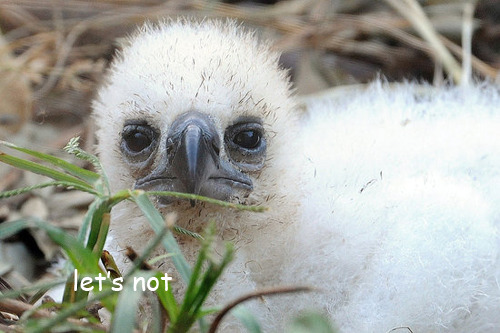
Pictured: a baby harpy eagle who would rather not, today.

Science, performed and organised correctly, is about observation and reproducibility.  It is supposed to be about throwing out old ideas when new evidence contradicts them, about taking nothing for granted, and about always chasing new knowledge.  I don't know the details of every religion in the world, obviously, but I have yet to see one that tries to draw statistical conclusions about the effectiveness and consistency of prayer or invocation.  Religion is pretty big on dogma.  Science isn't supposed to be.  If you're going to call science a religion, I need you to define your terms.  (If Dresden is trying to comment on the way the populace supposedly assumed that the invention of the airplane and the computer meant no one would ever have problems ever again, okay, that can be his opinion, but I have a lot more to say about the way good scientists would approach the discovery of magic as well, which I will spare you all for now only because I need to get to the part where you share my ire towards this jackwagon.)

Anyway.  Dresden is behind on his bills and needs cash soon.  I have some questions about what magic can or cannot do, and why a person with a rare command over supernatural powers works this and only this fetch-quest kind of job.  Like, the absolute #1 question I have about magic in every single setting is 'can magic create food', because if it can, anyone with magical skills is a colossal upset to our normal economy--they don't need to worry about their own food supply and they literally always have access to a vital commodity they can trade to other people.  JK Rowling just declared that magic couldn't conjure food from nothing, which answered that question pretty firmly, except then she footnoted that magic can multiply food, which, in the words of Hermes Conrad, just raises further questions.  I'll allow Butcher more worldbuilding time before I start interrogating his hero's premise too harshly, though.

Dresden is quickly characterised for us as an honest worker; his only job in months was investigating a country singer's house in Missouri and quickly concluding that it was not haunted, unlike the fake psychic whom the singer hired a week later to perform a big fake exorcism.  Dresden describes his own actions as "honest, righteous, and impractical", and I roll my eyes at our hero humblebragging about his heart of gold.  The phone rings with a call from a nervous housewifey kind of person who wants Dresden to find her husband.  Dresden quickly says people aren't his specialty and she should go to the police, which wins him many more points from me than he got by telling me about his honesty dealing with the singer.  She tries to beg off by saying she can't go to anyone else, but Dresden cuts her off before she can hang up.
"I'm sorry, you didn't tell me your name." [....] 
"Call me Monica." 
People who know diddly about wizards don't like to give us their names.  They're convinced that if they give a wizard their name from their own lip it could be used against them. To be fair, they're right.
Dresden will keep doing this in the next couple of chapters: 'silly superstitious people who know nothing are afraid of X, but they absolutely should be afraid of it because it's terrifying and dangerous'.  It takes a specific kind of arrogance to call someone ignorant for believing a true thing even though it sounds fake.  Sigh.

Dresden convinces Monica to come to his office in an hour and explain her situation to him directly.  The moment he sets down the phone, it rings again, and a few lines of dialogue later he declares that the appointment is in forty-five minutes, which would be clever foreshadowing in a book about time anomalies but here just vexes me.  Harry Dresden would have seen nothing wrong with the many ages of Bonzo Madrid.  The second call is from Director of Special Investigations Lieutenant Karrin Murphy of the Chicago police, and she wants Dresden (her preferred magic consultant) at the scene of a double homicide pronto.  She's not worried about Dresden missing his appointment, because she is a gruff cop, and he snappishly agrees to go and be back in time anyway.  Murphy recommends that he not eat lunch on the way.
"How bad are we talking here, Murph?" 
Her voice softened, and that scared me more than any images of gore or violent death could have. Murphy was the original tough girl, and she prided herself on never showing weakness.
I brim with apprehension whenever a female character is described like this, because it strikes me as a guarantee that their tough front will eventually be shattered and they will be left a broken wreck to show that the situation is serious.  Has a male character ever been described like this?  Someone get on that.  (Also, calling an adult woman a 'tough girl' is a blaring orange flag that worse things are ahead.)

Dresden heads out, using the stairs instead of the elevator, half because electronics are unreliable in his presence and half because it's already occurred to him that if there's a murderous wizard on the streets, Dresden himself (the cops' only wizard-on-retainer) is probably a target as well.  Not bad tension-raising for the end of the first chapter.

Chapter Two: This Is It; This Is What I Was Talking About; How Badly Do You Want To Fight Dresden Now

Jim Butcher elects to give us a physical description of his protagonist by explaining all the ways he doesn't look like Murphy, which I kind of like, if only because the duality of it raises Murphy's profile as a secondary protagonist.  Dresden is an incredibly typical brooding gritty hero, tall and lean with dark hair and angular features, while Murphy is short, stocky, blonde and blue-eyed.  Dresden also immediately informs us that Murphy never wears dresses, "though I suspected she'd have muscular, well-shaped legs, like a gymnast", which is obviously not a weird thing to think about your boss.  He goes on with her description, adding her lack of earrings and her makeup-that's-so-good-it-looks-like-she's-not-wearing-makeup, which strikes me as oddly perceptive in a world so choked with men who apparently think women are born wearing a layer of foundation and Pomegranate Extremity lipstick.

Oh my god, Dresden even has a big black duster coat.  I hope Butcher was trying really hard to write to formula here.  Wikipedia seems to suggest that the cliches are intentional.  Anyway.  He also silently gives Murphy kudos for daring to meet his eyes for half a second:
It wasn't really dangerous unless you did it for several seconds, but I was used to anyone who knew I was a wizard making it a point not to glance at my face.
There is only so far I am willing to follow you down the trail of 'I have weird mysterious powers that people are superstitious and intimidated about', Dresden.  You're so powerful that it's dangerous to look into your eyes but you're also borderline unemployed and permanently broke?  I'm going to start needing justifications soon.

They head for the door and Dresden races Murphy so he can open it for her, even though and indeed because he knows it irritates her.  Ah, and here we are:
Maybe my values are outdated, but I come from an old school of thought. I think that men ought to treat women like something other than just shorter, weaker men with breasts. Try and convict me if I'm a bad person for thinking so.
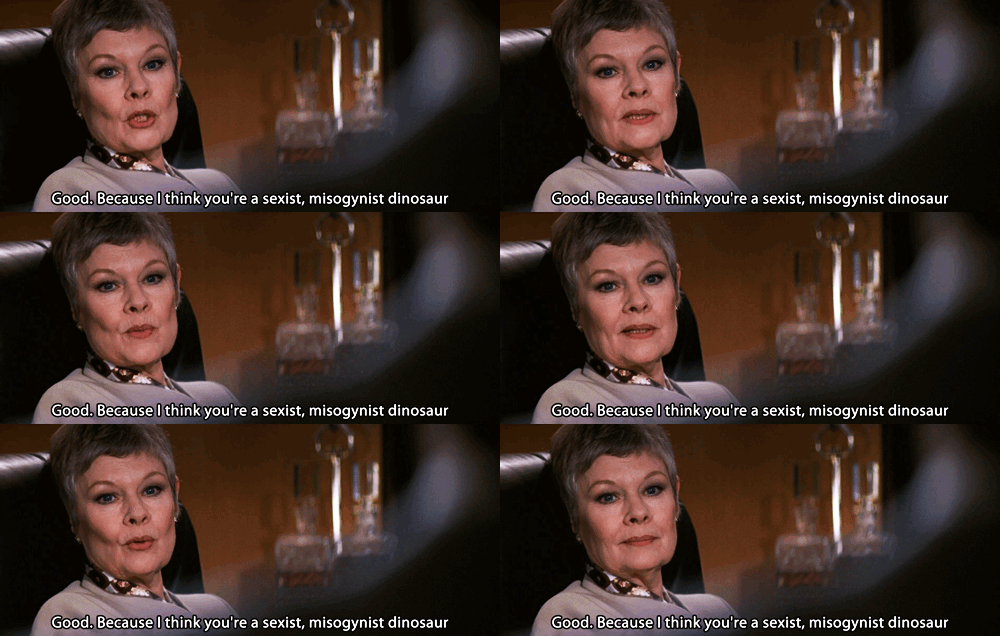
Pictured: MI6 director M is entirely willing to take up Dresden's offer to go to court.

I enjoy treating a woman like a lady, opening doors for her, paying for shared meals, giving flowers--all that sort of thing.
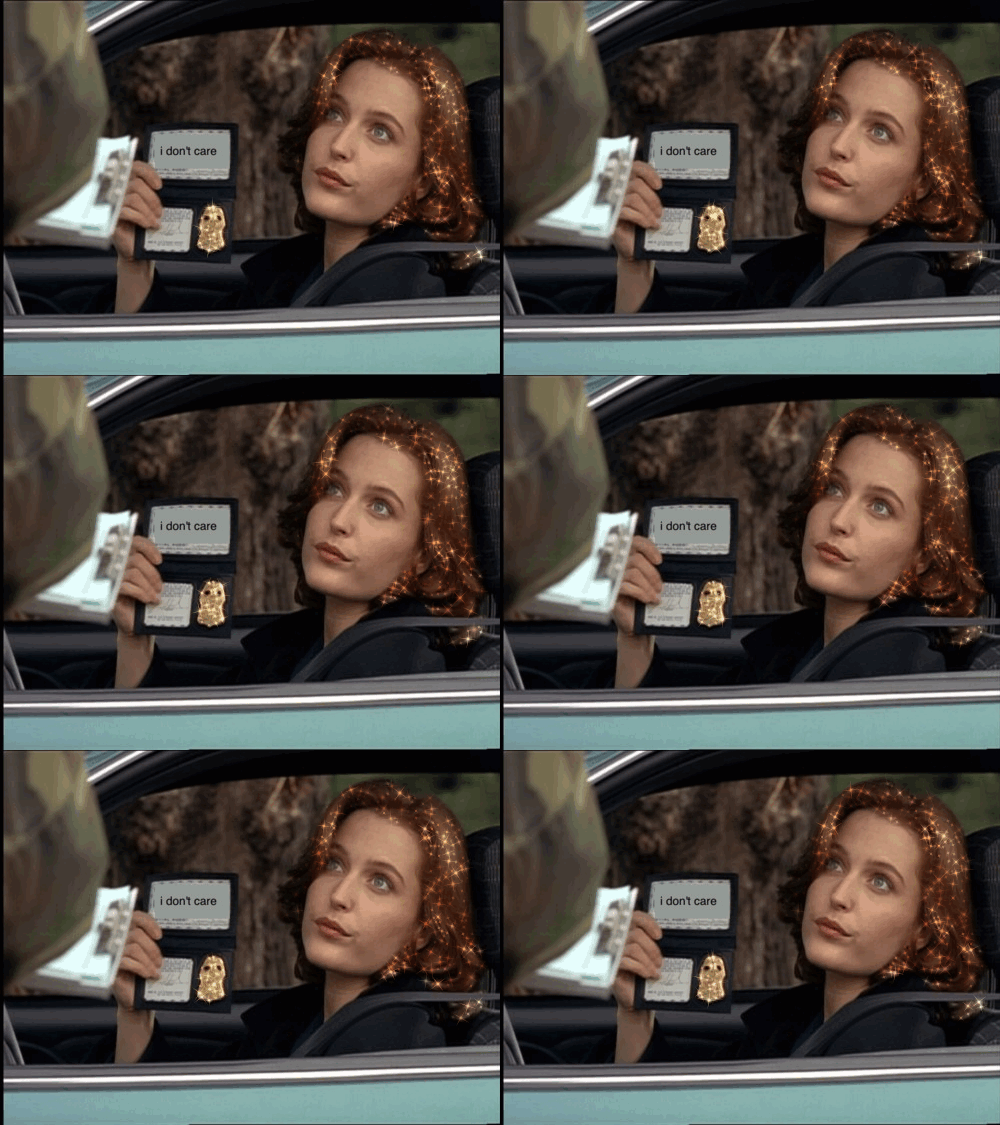

Pictured: Special Agent Dana Scully will tell Dresden when she wants his opinion on women again, which will be never.

I don't even know what to do with this.  "Men ought to treat women like something other than just shorter, weaker men with breasts."  Well, yes, that's true.  That's true for a lot of reasons, starting with women not being shorter, weaker men with breasts.  Faith and fucking begorrah.  I guess we'll start with the purely scientific objection, which is that men being stronger than women on average tells you basically nothing about whether any given man will be stronger than any given woman, because the variations within a gender are vastly greater than the difference in averages.  (Actual studies on this are not the easiest thing to find, especially if you want studies that aren't saturated with biases, bad methods, bad data presentation, and the occasional dash of MRA meninist whining.  Suffice perhaps to compare for yourselves the current world records in that manliest activity, lifting heavy objects: yes, the men's olympic lifting records are higher than the women's, but when comparing similar weight categories, the differences are fairly small and everyone is lifting multiple times their own body weight.  Dresden, bro, do you even lift?)

Next, Dresden, have you considered that maybe the correct way to treat women is LIKE PEOPLE?  Chivalry isn't dead--it's a fricking zombie that refuses to die no matter how many times we bury it because it feeds on the keening wails of men who don't understand why opening doors for women just won't translate into getting laid.  I sometimes open doors for women, I sometimes pay for meals for women, yes, and they do the same for me, and likewise with my friends who are men.  I do these things because they are nice things to do for people I like, not because I'm trying to provide women with the support they need to get over their fundamental deficiencies of ladyness.  So the real question here, Dresden, is why you're only doing nice things for women and not men.  WHY ARE YOU SUCH A MISANDRIST, DRESDEN?
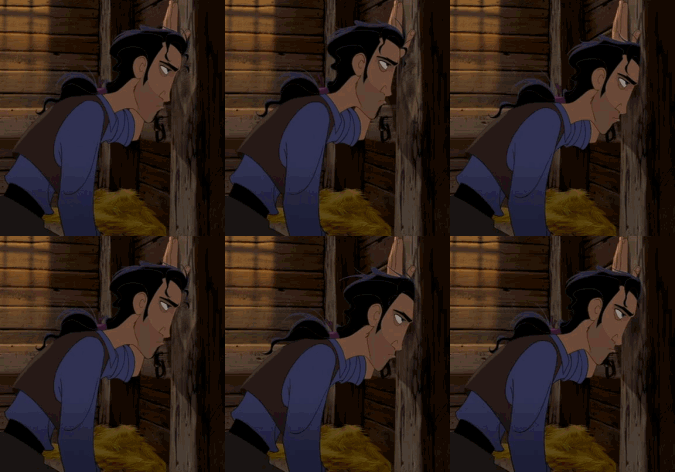

Pictured: Tulio attempts to forget the conversation he just had with a brooding antihero with a heart of chauvinist gold.  Y'all don't even know the kinds of stupid, misogynist screeds I read with my own two eyes in my quest for good data.

In short, locking women into the kitchen to be barefoot and pregnant is unquestionably terrible, but that doesn't mean that putting them on a pedestal to be delicately cared for and pruned or whatever is somehow good.  And I might not be able to convict you for being a sexist creep, Dresden, but I can definitely judge you harshly.

Where were we?  Oh, yeah, double homicide.

Dresden follows Murphy up to the seventh floor to a plush romantic suite that smells of blood.  (The elevator scene is brief, silent, and actually kind of good: "I licked my lips and looked around the interior of the car. My shadow and Murphy's fell on the floor, and almost looked as though they were sprawled there. There was something about it that bothered me, a nagging little instinct that I blew off as a case of nerves. Steady, Harry.")  Murphy leaves him in the first room for a minute, where he examines his surroundings in a vaguely ESP kind of way, making visual observations with his eyes nearly shut, noting champagne, a stray rose petal, and a half-torn black thong under a chair, which Dresden summarises as "Kinky".  Dresden has not read Fifty Shades or he'd save that for the eggbeaters.

We are then introduced to Murphy's skeptical partner, Carmichael.  Dresden rattles off a laundry list of things that are meant to make Carmichael's unattractiveness clear, starting with being fat and bald, and then goes for a swerve with "razor intellect [....] absolutely ruthless at tracking down killers".  I tentatively mark this as the second fat character we've met and the second we're not supposed to like, regardless of the 'razor intellect' remark supposedly showing that Dresden respects him.  They snipe at each other a bit before Dresden comes in to see the bodies.

Now, I realise magic is at play here, but I think it's fair to question how and why it is that these people (who died in the middle of sex) managed to remain frozen in the exact pose they had when an evil wizard literally made their hearts explode like fragmentation piñatas.  The description "she was astride him, body leaned back, back bowed like a dancer's" sounds to me like she's still more or less sitting upright, no?  Either way, now we're apparently seated in the 'erotic violence' section of the train and I'm prepared to tuck and roll.

Clues, blood, gross stuff, clues, and then Dresden finally runs out of the room to throw up--Carmichael wasn't joking when he said he'd bring a bucket.

Dresden's frantic disgusted thoughts weave in some worldbuilding:
...someone had used magic to do it. They had used magic to wreak harm on another, violating the First Law. The White Council was going to go into collective apoplexy. This hadn't been the act of a malign spirit or a malicious entity, or the attack of one of the many creatures of the Nevernever, like vampires or trolls. This had been the premeditated, deliberate act of a sorcerer, a wizard, a human being able to tap into the fundamental energies of creation and life itself.
So now we know magic does have some kind of organisation ('White Council' isn't the name I would choose, but... okay...) and laws, and we have a sort of charmingly juvenile name, 'Nevernever', for the realm of monsters.  And we're only in the second chapter!  Can you imagine how many posts into a WOT book I'd have to get before we heard about 'the Nevernever, what some call Monsterpalooza, where dwells the Scarytown Crew that you know as the Naz'gool'.

Dresden does tend a little bit that way when he starts talking magic:
"Evocation is the most direct, spectacular, and noisy form of expressed magic, or sorcery. [....] 
"What's the other option?" Murphy asked. 
"Thaumaturgy," I said. "As above, so below. Make something happen on a small scale,and give it the energy to happen on a large scale."
Which isn't bad terminology, really.  'Evocation' literally means 'calling something forth', while 'thaumaturgy' means 'magic-shaping', following the same pattern as 'metallurgy'.  I feel some small spark of hope that this will be the first fantasy series I've seen to correctly use '-mancy' suffixes only to refer to divination magic.

There's more magic worldbuilding as Dresden explains the intimacy of spellcasting and concludes that the killer had to know the victims in order to use this particular magical approach, by having intense personal reasons to want them dead. Oh, great, before this chapter can end on a strong note we have to endure another one of Dresden's pontifications on gender:
Murphy glared at me. "You keep saying 'she,' " she challenged me. "Why the hell do you think that?" 
I gestured toward the room. "Because you can't do something that bad without a whole lot of hate," I said. "Women are better at hating than men. They can focus it better, let it go better. Hell, witches** are just plain meaner than wizards. This feels like feminine vengeance of some kind to me."
Pictured: WHATNAPPLE RETURNS TO AID ME

Are you fucking kidding me, Dresden?  Jim Butcher, what the fuck?  Please tell me you're going for an unreliable narrator here.  Please don't be actually this stupid.  Please let the killer also be a man just to highlight how wrong Dresden is.
"Christ, you are a chauvinist pig, Dresden."
Lieutenant Murphy, you have my sword.

Dresden sort of agrees to try to reverse-engineer the magic, and Murphy banishes Carmichael to fetch her coffee before explaining who the victims are: the woman is a sex worker for a well-regarded company run by a vampire ("vampiress" oh my god shut up Dresden) named Bianca, and the man is the personal bodyguard to Chicago's new king of the mob, Johnny Marcone, a relatively civilised crimelord who's put an end to past bloody clashes with the police and gone all Ankh-Morpork Guild of Thieves on excessive elements in the city, doing a better job of stamping out some violent criminals than the police do.

I had honestly forgotten what it was like to have antagonists with immediate presence who are relevant to their environment and not just, like, abstract concepts and generic monsters.  I bet I'd be enjoying this book less if I hadn't just endured so much WOT.

Dresden has tried to put a disclaimer on his ability to work out how the murder spell worked, but Murphy doesn't buy it.  Dresden weasels out of explaining himself, but notes in the narration that he's got some kind of checkered past with the White Council and he's on double secret wizard probation, bearing something called the Doom of Damocles.  I like the name because it's self-explanatory (danger hanging over his head) without sacrificing some mythic flavour.  Anyway, Dresden's pretty sure he'll get a Doom to the head if word gets out that he's trying to build a murder spell, and apparently sending advance notice ("Hey, I'm tracking a murderer who broke our First Law, please don't kill me") is not an option?  He instead concludes that he'll just need to keep it quiet.  Brilliant.  If this incident is so bad, shouldn't the Council have their own investigators on the case?  Shouldn't they at least be able to spare someone to keep an eye on Dresden while he helps the police?  What are the jurisdictional rules for something like this?

They leave, Dresden's got five minutes to make the fifteen-minute trek back to his office for his appointment with Monica the mystery client, and he's halfway there when he gets surrounded by beefy goons who forcibly invite him to get into a car with Johnny Marcone, and that is where the chapter ends.

Initial impressions: Harry Dresden is a gigantic tool made of smaller tools in a sort of fractal jackwagonry array, but Murphy is a good character, I'm interested in the setting, and within a mere two chapters we've got a web of plot threads that connect us to a mysterious disappearance, a vengeful sorcerer, a vampire madam, organised crime, and the secret council that runs all magic. Rand al'Thor needs more pagetime than that to eat lunch and stare longingly at the hot girl he imagines he's in love with.  I may brim with rage throughout this book, but at least it won't linger.

---

*Thanks to ebook formatting, the pagecount varies wildly depending on how I size my reader screen, so I have little hope of keeping a consistent tally of pages as we proceed.  I'm tempted to use abstract concepts (Storm Front: p. Mangrove to Banyan) but combining that with my suggested chapter titles is just going overboard.

**ALSO I HAVE STRONG OPINIONS ON THE GENDERING OF WITCH AND WIZARD.  That's not how it works.  'Wizard' is just 'intensely wise', following the pattern of 'drunkard' and 'coward'.  'Witch' derives from 'wicce', which has a contested etymology to say the least, but originally 'wicca' was male and 'wicce' was female, and we melded both words when we took them for English.  Female wizards and male witches are 100% legit, not a weird special case, and definitely not gendered terms for identical roles.  (I'll stop here instead of further ranting on the notion that 'warlock' is the male equivalent of witch.)

Sunday, June 29, 2014

Speaker for the Dead, introduction, in which we solve a mystery by studying its genetics

It's been a hell of a ride, hasn't it?  This is the final Speaker for the Dead post, and July is a novel-writing month, so I wouldn't count on a lot of new blog content during that time.  After that, I may return with Ender's Shadow, the retelling of Ender's Game from Bean's perspective, which I still consider to be Card's best novel (I just think that's a lower bar than I used to).  Or maybe I'll move on to something else entirely.  Maybe something good?  Or at least better?  Erika the Blogqueen has contemplated doing a series on Mistborn; I've got like eighteen books partly read lying around my apartment and half of Wheel of Time that I inherited from a former roommate.  We'll keep you posted on our post-July posting plans.

(Content: ableism, partner abuse, racism. Fun content: y'all like point-form lists, right?)

Speaker for the Dead: p. ix--xxii
Introduction

So... Speaker for the Dead, eh?  What was up with that?  It takes some careful planning to create a story where all of the problems exist solely because people would literally rather die than ask a direct question.  As I belaboured back in chapter fourteen, Ender was in a much better position to play an antagonist who proves to be a friend than he was to be the hero, yet he's presented to us as the hero because he's the only one who isn't afraid of the truth.  This needs explaining, and in the spirit of Speaker for the Dead, I'm going to argue that we can figure out what caused this atrocity by tracing back its evolutionary history to a catastrophic plague the 1980s.
Speaker for the Dead is a sequel, but it didn't begin life that way--and you don't have to read it that way, either.  It was my intention all along for Speaker to be able to stand alone, for it to make sense whether you have read Ender's Game or not. Indeed, in my mind this was the "real" book; if I hadn't been trying to write Speaker for the Dead back in 1983, there would never have been a novel version of Ender's Game at all.
Interesting premise.  Let's summarise Speaker for the Dead by chapter:

  1. Pipo rescues young Novinha from sadness by taking her in as his daughter (in a weirdly romantic relationship with her pseudo-brother), then is horribly murdered by the mysterious primitive aliens.
  2. Ender Wiggin is super-smart and philosophical and a three-thousand-year-old war hero, and people have very strong opinions on the morality of being an alien because his ultra-brilliant sister wrote an essay about fjords a couple of months ago.  He also owes a mysterious debt to someone.
  3. Novinha hides all the science that somehow led to Pipo's confrontation and death, and also breaks up with her pseudo-brother to protect him, but also summons Ender Wiggin to cross the galaxy to solve the mystery that she believes must never be solved.
  4. Ender Wiggin's girlfriend is the internet and he's super rich and he carries the last survivor of his accidental genocide. 
  5. Ender Wiggin breaks up with his newlywed pregnant sister to cross the galaxy in a private star cruiser in hopes of protecting aliens.  His best student figures out the truth and devotes her life to serving his sister's family.
  6. Novinha's children are terrible.  Ender arrives and immediately astonishes the mayor with his knowledge and history, learns that Libo died after all, scares children because the Bishop has told them he's the devil, and befriends one of Novinha's kids.
  7. Novinha's children are terrible.  Ender enters their home, subdues them by physical force or argument, refuses to leave, and tells them how foolish they are for not understanding their little brother.  Novinha's dead husband used to beat her.
  8. Novinha comes home.  Ender tells her he knows everything, she's a terrible mother, and he will redeem her.
  9. Ender's literal internet girlfriend Jane reveals that all of Novinha's kids were fathered by Libo.  Libo's kids, Miro and Ouanda, are bad at science.
  10. Ender befriends the local monastic sect because he was besties with their founder two thousand years earlier.  Jane distracts Ender, so he switches her off for a bit.
  11. Being cut off from Ender for an afternoon utterly devastates Jane and she spends the equivalent of 50,000 years in recovery, then sparks an interstellar police action.
  12. Ender is super rich, Novinha is obsessed with him, and her children are fractionally less terrible now that they're obsessed with him as well.
  13. The aliens demand to meet with Ender because he is everything.  Ela reveals to Ender that she's secretly been doing real science for years.
  14. Miro and Ouanda take Ender to meet the aliens.  Ender tells them that they're terrible scientists, and the aliens then reveal everything to him because he's so important.
  15. The government locks down the planetary computers, but they save some vital information because Ender is special.  Ender makes the entire colony sympathise with a dead abuser by explaining that he couldn't have kids and his wife cheated on him.
  16. Everyone tells each other everything now that Ender is there.  Miro wants to run away to the forest to marry his sister, but grievously injures himself instead through terrible science.  The colony rebels because Ender is so special that he can completely prevent any consequences to rebellion for the next thirty years.
  17. The aliens tell Ender everything else they haven't said.  Ender teaches them how not to be terrible warmongering savages, signs a contract, and ritually murder-metamorphoses an alien volunteer to seal the deal.
  18. Miro is permanent disabled and shoved in temporal storage for later.  Ender gets the girl, brings civilisation to the primitive aliens, learns that his sister is uprooting her family to come meet him, and revives the last survivor of his war crime, clearing his conscience.
Now, on the one hand, this synopsis does make it clear that there wouldn't be much of this book left without Ender there.  On the other hand, without Ender's Game as background, Ender literally never earns anything--he's just a brilliant rich straight white male ex-soldier poet-priest whose very presence elicits awe even from people who claim to hate him.  I'm curious if anyone has read Speaker and not Ender's Game, and whether they found Ender remotely sufferable.  I find him aggravating and I've read about all the harsh childhood and suffering and abuse that is supposed to have turned him into who he is in this book.  (I've even read Ender in Exile, y'all.  Never let it be said I'm not dedicated.)

Back to the introduction.  Card explains that the 'speaker for the dead' concept is the result of his dislike for eulogies that erase anything uncomfortable about the dead person and therefore make them less like real people in memory.  He insists that the only story worth telling (despite it being unknowable) is the story of what the person meant to do with their life.  I'm a little unclear on how this is possible--surely, if the true story is unknowable, then the speaker has to take a guess at it, and in doing so they still erase the real person in favour of an explanation that makes sense to them and is therefore "much easier to live with", which is exactly the problem he has with 'normal' eulogies?

This really gets to the heart of the problem, because Card insists that intentions are all that matter to morality, but even he admits that we can never really know what a person's intentions were.  In that case, the logical conclusion seems to be that we can never know how moral a person is, and maybe then we end up at the traditional Christian 'judge not', but Ender's assertion seems instead to be that everyone has good intentions all the time and therefore they are ultimately good even if shallow outsiders think they're 'bad' just because they do stuff like start bar fights and abuse their families.

The next point is interesting:
So when I thought of the idea of an alien species which, in order to reproduce, had to slaughter each other in terrible intertribal wars, it was only natural that I decided the story should be told from the viewpoint of a human scientist studying them.  Only gradually, over several years, did I develop the idea of the piggies and their strange lifecycle, and the intertribal war receded in importance--so much so that I didn't need to make it an issue in Speaker for the Dead at all.
This explains a fair bit--the wars (which play some kind of vital role in Little One society by allowing males to go tree without having to be selected by the females, circumventing their usual honor-related system) seem like they should be a bigger deal, and everything that happened to Pipo and Libo would make more sense if the Little Ones specifically required speedy, violent death, but that wasn't the story Card wanted to tell.  He also couldn't quite bear to get rid of it (and it does allow for that great scene where civilised white Ender teaches primitive little Human about non-aggression treaties and peaceful alliances), so it stayed in some vestigial form, an offshoot that evolution doesn't really need but hasn't had cause to eliminate either.

Originally the role was the Singer of Death, but Card's wife pointed out that all of his acclaimed works had some kind of music thing going on, so he ditched that and attached instead to the only one that didn't: the short story of Ender's Game.
What if Ender Wiggin comes to an alien world as a Speaker of Death, and accidently gets caught up in the mystery of why these piggies are slaughtering each other? It had a delicious symmetry to it--the man who, as a child, destroyed one alien species now has a chance to save another.
On the one hand, I think Card made the smart choice here by having the ultimate threat be 'scared humans with guns' rather than having to understand why the primitive aliens keep slaughtering each other when it's actually harmless.  On the other hand, the story we have got is basically 'humans colonise a planet wrong, so Ender teaches them to colonise it right and the primitive natives are much better off, and this makes other humans angry'.  At no point do we seem to have any hope of 'humans discover the aliens are actually handling their own affairs just fine and if they'd stop trying to force the aliens into human institutions we'd all float on okay'.  One way or another, regardless of whether the endless reproducto-war is centre stage or an afterthought, we're pretty sure that Ender needs to save these people from their ignorance.

Card set up the deal for Speaker of Death in 1983, only to find:
...that the book was unwritable.  In order to make the Ender Wiggin of Speaker make any kind of sense, I had to have this really long, kind of boring opening chapter that brought him from the end of the Bugger War to the beginning of the story of Speaker some three thousand years later!  It was outrageous.  I couldn't write it.
Card then details the short conversation that abruptly led to him having a contract to do a novel of Game before Speaker, but I'm left confused.  That's quite literally what this book does for the first few chapters: show us Ender of three thousand years later, rich and respected and forgotten, and tell us all about his childhood achievements.  What made the original 'outrageous' draft so different?  (Card acknowledges that Ender Wiggin wasn't really a full character until he fleshed out Ender's Game, which is a fair point and presumably made a difference in trying to approach Speaker, but that's not a problem with the story of Speaker, that's a reminder that you have to know your characters before you can write them, or you'll be visibly flailing to figure out their deal on the page.)

With Ender's Game written, he approaches Speaker again, starting with Ender arriving on Lusitania to speak the death of "an old lout named Marcão", but two hundred pages in found it hollow, even after adding Novinha, Pipo, and Libo.  Card was on a trip with a friend and former student, Gregg Keizer, who took some time to read the manuscript of Speaker.
He had many good ideas. Of course, most of them dealt with small fixes for problems in the manuscript as it now stood. One comment he made, however, illuminated everything for me. "I couldn't tell Novinha's kids apart," he said. "I couldn't remember which was which."
This, Card tells us, was the key.  Novinha's kids were "nothing but placeholders", like a younger sister in another novel whom he would forget existed for hundreds of pages at a time until he finally decided to retcon her into dying in infancy, because I guess the death of a baby sister is exactly the same as her never existing?  But he couldn't just cut her kids:
Because I wanted Novinha to be voluntarily isolated, I had to have her be otherwise acceptable to her neighbors. In a Catholic colony like Lusitania, this meant Novinha needed to have a bunch of kids.
Wait, what?  There's an entire sect of teacher-administrators on this planet whose whole deal is that they are married without children.  (I'm not entirely sure what to make of the assertion that Novinha is and had to be voluntarily isolated, given that we're told she was isolated from a young age because no one took the time to understand her and for the rest of her life no one tried to stop Marcos from beating her--Card's insistence that Novinha literally signed up for physical abuse still horrifies me.)
Once you've read Speaker, of course, you'll wonder what the story would be without Novinha's children, and the answer is, It wouldn't be much!
Novinha's children, in order of relevance:
  • Miro: informed almost-protagonist, fails to get useful information, gets permanently injured trying to run away to marry his sister, gets put in storage so people don't have to deal with him being all physically disabled at them.
  • (Honorable mention because she's not Novinha's kid: Ouanda: like Miro, but female and therefore less important.  Does basically nothing of consequence; exists mostly to assist Ender, be told she's screwing up, and create angst for Miro.)
  • Ela: runs the actual household and does the actual science.  Gives Ender vital information a few times and tells everyone that all of their problems are Novinha's fault.
  • Olhado: gives Ender vital information several times and likes him first.  Records key incidents with his cyborg eyes because a pocket camera just wouldn't feel sci fi enough.
  • Grego: poster child for broken household, violent, needs proper physical discipline from a strong man.
  • Quim: religious zealot, shows that even Ender's least-rational fanatical enemies like his work.
  • Quara: like Grego, but female and therefore less important.  Quiet, needs signs of affection from a strong man.
Card goes on to complain that genre heroes never seem to have parents and we never see them grow up and become parents either, and he's not wrong about that.  Showing protagonists as part of a larger family makes a big difference and we could do with more.
The romantic hero is unconnected. He belongs to no community; he is wandering from place to place, doing good (as he sees it), but then moving on. This is the life of the adolescent, full of passion, intensity, magic, and infinite possibility; but lacking responsibility, rarely expecting to have to stay and bear the consequences of error. [....] Only when the loneliness becomes unbearable do adolescents root themselves [....] many fail at adulthood and constantly reach backward for the freedom and passion of adolescence. But those who achieve it are the ones who create civilization.
Card decided that, if he couldn't write a parent's perspective, he could at least write the perspective of an adult who feels responsibility to a family, and thus this book was an opportunity to show"the miracle of a family in transformation".  This, at least, explains a little more of why Novinha is such a non-entity in her family.  Card had already decided that the caring adult was Ender, and Novinha was 'voluntarily isolated', so there was no hope of her actually doing anything for her kids.

This undertaking, Card wants us to know, was haaaaard:
Most novels get by with showing the relationships between two or, at the most, three characters. This is because the difficulty of creating a character increases with each new major character that is added to the tale.
Characters A and B just have an A-B relationship, he explains, but add C and you've got A-B, A-C, B-C, and A-B-C.  And we change all the time depending on who we're dealing with, so A might be a very different person with B than with C, and so each one is multiplied and it's so hard.
What happens, then, when you start with a family with a mother, a dead father, and six troubled children, and then add a stranger who intrudes into the family and transforms every one of them?
In this book?  Apparently you reduce half of them to caricatures and ignore the relationships that aren't with Mighty Whitey.  Quick, someone tell me how Ela's relationship to Miro changes as a result of the transformative impact of Ender's presence on both of them over the course of the story.  (I'm pretty sure they talk to each other... once in the whole novel?  Was it once?)
I sat there with Gregg, assigning some immediate and obvious trait to each of the children that would help the reader keep track of them. Oh, yes, Olhado is the one with the metal eyes; Quara is the one who says outrageous things after long silences; Grego is the violent one; Quim is the religious fanatic; Ela is the weary mother-figure; Miro is the eldest son, the hero in the others' eyes. These "hooks" could only serve to introduce the children--I'd have to develop them far beyond that point--but having found those hooks, I had a plan that would let me proceed with confidence.
I'm not sure I have anything left to say about how far these characters have been developed beyond the lines above that I haven't already said over the last six months and three weeks.  Perhaps it will suffice that ppfffbbfbttthaaaaahaaaahahahahaha.

Card notes as well that Jane wasn't in any of the original outlines for Speaker; Ender's computer uplink wasn't sentient (I guess he personally hacked all the things?), but Card started the idea and just enjoye it too much, finding that she brought Ender to life.  This is one of those moments where someone almost has an epiphany and then just barely misses it and runs in the opposite direction: Jane made Ender more interesting because Jane is interesting and Ender's just got a lot of backstory.  Sure, Jane's computer powers are a plot device, but no less than Ender's magical intuition.  Jane could have made a fascinating protagonist, knowing everything and incapable of doing anything without human assistance.

She did apparently get spun off to play a major role in the third book, which came out of nowhere when Card's agent told him she had sold the 'Ender trilogy' to an English publisher.  Card immediately realised that, in the same way that he had turned the Speaker idea into a book by jamming Ender into it, he could turn his concept for another story, 'Philotes', into the third book (Xenocide) by the same process.

Just in case anyone got their hopes up, I'm not reading Xenocide.
Besides--and here you are about to learn something truly vile about me--having a third book would mean that I didn't have to figure out some way to resolve the two loose threads that I knew would be dangling at the end of Speaker: what happens to the hive queen? And what happens to the fleet that Starways Congress sends?
Gotta say, not sure that's more vile than the stuff you happily publish about them disgusting homosexuals, Card.  I mean, sure, self-deprecation can be comedy gold, but it kind of plays better when you're not actually terrible?

There's more rambling that doesn't strike me as vital to our purposes, except that Card loops back to the same thing he said in the last intro, that the story in the book is the result of the reader interpreting and transforming with their mind the materials that the author has put there.  "I hope my tale is true enough and flexible enough that you can make it into a world worth living in."

Flexible, you say?  Flexible.  Okay then.  Let's bend it.

What would Speaker for the Dead become if we cut Ender out of the story and split his part among other people?
  • Chapters 2, 4, and 5 get ditched entirely, along with their obsession with sniping at Calvinist theology that matters so little for the rest of the book.
  • Chapters 6 through 8 can get enormously condensed, because we don't need any time to fawn over the pageantry surrounding Ender's arrival or his invasion of the Ribeira house.
  • Chapter 9: Someone else has to be doing the actual investigation.  I nominate Ela, the only person on the planet who actually does her job (unlike Novinha the UnScientist, or Miro and Ouanda the Missionaries).  The only thing Ela needs to discover in order to set everything off is that she and her siblings were fathered by Libo, not Marcos.  There are a score of ways this could happen, since she's a biologist.  For whatever reason (her insistence on studying Descolada in case it comes back, for example, or her desire to ensure that none of her siblings are going to die from Marcos' disease) she realises that Libo was their father, and this begins unravelling everything she thought she knew about her family history.  Much like Ender, once she knows Novinha didn't hate Libo, she has to figure out why else she would try to cut him out, and steadily comes back to the way Descolada files have been locked away.
  • Chapter 10 can get cut.  So can 11, if scientists elsewhere in the galaxy catch Miro and Ouanda's meddling with the aliens without needing Jane's help, because at least one other scientist also does their job.
  • The rest of Ender's meddling is substantially reworked.  I'm going to suggest that Ela tries to engage Miro with some of the things she's discovered, but he is too removed from the family and focused on his work to particularly care.  Ela argues that he's just repeating what their mother did, hiding in science because she rejected her family, he says it's not his responsibility to fix her mistakes (he considers his future family with Ouanda to be the only one he needs to care about), and we get into those same issues Card was talking about with adolescent heroes never dealing with consequences or families, and the way adulthood means dealing with the situation you are in rather than running off to somewhere fresh.  Miro considers literally moving into the woods with Ouanda and cutting humanity off, since no one else can come through the fence without their clearance.
  • There is still a need for the critical point where Ela confronts people with the truth--the colony knows it will be locked down, and Miro resolves to run away, but Ela drags him and Ouanda and Novinha together (maybe others? Ye Must Love Reapers?) to reveal all that she knows.  Miro and Ouanda have the stark choice to either flee or to try to understand and fix things like responsible adults.
  • Miro, who is his mother's repetition, stays with her and tries to hash things out about why she did everything she did (they both broke so many rules of good science for bad reasons) while Ela and Ouanda go into the woods to resolve the science mystery.  (They agree that if Ouanda comes back with answers, they will rebel to defend the Little Ones, but if they get ritually murdered like Pipo and Libo, Miro will go to stand trial without her to protect the colony.)  As in the book, they know the government has left them with all-or-nothing options and so they, like Ender, toss aside their not-even-half-assed attempts at secrecy, but keep to other anthropological good practice like 'Don't remake other societies in your own image'.  They're also damned sure going to tell the Wives that they think they could, with permission, save the lives of the Mothers with a scalpel, some thread, and a mashed yam, rather than let the males keep that fact to themselves.
  • I don't particularly care if one of them has to carve Human open to seal the contract or not.
  • In a final optional twist, Novinha realises her childhood dream of becoming a Speaker for the Dead to help humanity understand the Little Ones, but not before she (with Bruxinha's permission, if she mentions Libo's infidelity with her) Speaks the death of Marcos herself.
At this point, we've covered the same ground in substantially less time and with fewer asides to talk about how much Calvinists suck and partner abusers are sometimes just misunderstood, which should leave some room to deal with the arrival of the deadly Evacuation Fleet, rather than leaving that for another book.

So now we've got Card's own account of why the hell Ender was in this book: he didn't actually realise he needed to write the other characters until someone read his manuscript and told him to write the other characters.  He was more prepared to write an entire 'prequel' novel about Ender's childhood than he was to figure out what anyone on Lusitania was thinking or doing.  They didn't matter until they were set pieces, the boy with cyborg eyes and the girl who doesn't talk and the young woman trying to be sister and mother and scientist all at once.  He got halfway through the first draft before he acknowledged that they needed some attention.  He already knew which character he identified with: the white guy from another land.

And that, as best I can tell, is what the hell was up with that.  /speakerpulpit

Sunday, June 22, 2014

Speaker for the Dead, chapter eighteen, in which Card hurriedly scrawls To Be Continued across the page

I don't see any useful way of splitting this chapter up, and practically nothing actually happens, so we're just going to go for a huge sprint to the end.  There is a light at the end of the tunnel, because the tunnel is on fire.

(Content: ableism, incest, sexualisation of minors, misogyny.  Fun content: Stephen Hawking's wikipedia biography tells this book's story better than it does.)

Speaker for the Dead: p. 356--382
Chapter Eighteen: The Hive Queen

The final intro-excerpt is from the Speaker for the Dead's latest publication, The Life of Human.  It's a fairly straightforward depiction of life inside the mothertree, drinking sap and occasionally making a dash for the light when the tree opens, until one day he's fast enough to make it through and discovers there is an entire new world out there, transitioning from the first life to the second life.  There's nothing particularly super-empath about this section, so I assume the magic words have to come in later (unless this is another case of Ender just intuiting information rather than asking the Little Ones what it's like inside the mothertree, or asking them to relay the words of Human's tree).

What does get me is that this is another case of a Miraculously Brilliant and Heartbreaking publication from someone only naming themselves Speaker for the Dead, and it's got to be a matter of public record that the only Speaker on Lusitania is Andrew Wiggin, and maybe someone might take another crack at piecing together the way all three of the great Speaker texts were anonymously published on planets where a guy named Andrew Wiggin lived, and the first such Andrew Wiggins were the brother of Peter the Hegemon and of Valentine who was Demosthenes and maybe could a historian connect some dots please.  (It's presumably a retcon, but according to the Shadow series, everyone found out who Locke and Demosthenes were within a couple of years of Ender and Valentine leaving Earth.)

We return to Miro, whose malice towards science has been turned back around on him, because he rapidly heals from all temporary damage but also rapidly runs into a layer of permanent damage that Dr Navio can do nothing to address, presumably because he's run out of anti-witch salt.  So, in three days Miro can sort of walk, sort of talk, like "a very healthy man who is a hundred years old", but he's going to stay that way forever.  Science.  (I'm not sure who Navio's reference point is; my grandmother is ninety-nine (and a half) and while she won't be running any marathons, she likes going for walks, she's as sharp-minded and articulate as anyone I've ever met, and for her birthday her friends got her a personalised billiard cue because she's a pool shark.  So his idea of 'very healthy for 100' seems off, to me.)

There's a nice big heap of disability tragedy porn as everyone thinks about how lucky he is not to be bedridden for the rest of his life, how awful he feels listening to his own voice slurring, how he understands why none of them want to stay home with him now that he doesn't need constant attention, and he doesn't want them to stay either; he wants to be out asking the Little Ones direct questions at last.  There's no actual explanation for why he can't do that--he's at least partly mobile, and they should be able to create some sweet mechanised wheelchairs in the future, not to mention speech-generating devices that could help with his intelligibility (he could probably even use his own voice, given all the audio notes they've saved).

Speaker was written and published in the mid-1980s, pretty much exactly the same time that Stephen Hawking was publishing A Brief History of Time and also got his first speech-generator equipment.  (I strongly recommend reading up on Hawking; his life story hits a lot of the themes that this book goes for, loss and recovery and incomparable brilliance and bringing enlightenment to the masses and complicated marriage dynamics, but without the huge shovelfuls of racism and colonialist apologism.)  I don't know if Card was making any intentional reference, or if he had any particular interest in Hawking's work, but I feel like the publication of mass-market science by a man with significant motor and verbal disabilities should probably have made it easy to find out what the cutting edge of assistive devices looks like and try extrapolating that three thousand years into the future.  My point is that Miro's life here doesn't suck because he's disabled now; Miro's life sucks because Card and all of his characters have no interest in helping Miro maintain any connections to his family, job, or lifestyle.

Card is at least upfront about some of this--Miro relays questions to Ouanda for her to ask the Little Ones, but apparently Ouanda doesn't value her colleague now that they're not going to bang, soshe gets direct answers to his questions and leaves them at that rather than ask follow-ups or probe issues.  For that matter, the Little Ones have been running around Milagre for years even when it was illegal; why aren't any of them just coming to see Miro at home and chat for a few hours?

Miro is still creepy as hell himself, since privately in his own mind he still wants to run away with Ouanda and live in the woods and Lannister it up, but he knows that she is "a believer, a belonger. She couldn't possibly violate the only universal human law."  I am deeply distressed that Miro casts 'not wanting to bone your sibling' as the product only of bowing to popular belief and not, like, a reasonable reaction to a messed-up hypothetical.  I don't think peer pressure is the issue here.  (I'm always unsettled when people talk about morality like it's the result of popular vote or only external sources, as in that old favourite 'how can you be moral without God', and I'm just saying that the main places I hear this concept come from are conservative Christians and that Miro is our only confirmed atheist in the cast.)

In a neapolitan twist of horror, Miro compares his situation to that of his mother, since Novinha and Libo boned even though it was against the rules (extramarital affairs are apparently just like incest), but concedes that there is a difference (yay) because Libo was able-bodied and "not this useless carcass" (goddammit).

Enough of Miro.  Ouanda's helping the Little Ones develop phonetic alphabets for Males' and Wives' languages,Quim is trying to figure out how to translate the gospels, and Ender and some construction workers are colonising the hell out of them by installing plumbing, computers, teaching them more agriculture, and trying to domesticate cabra to pull plows.  (Apparently they can have a computer terminal with full galactic library access but a mechanical plow is out of the question.)
At the same time, Ender was trying to keep them self-sufficient, inventive, resourceful. The dazlle of electricity would make myths that would spread through the world from tribe to tribe, but it would be no more than rumor for many, many years. It was the wooden plow, the scythe, the harrow, the amaranth seed that would make the real changes, that would allow piggy population to increase tenfold wherever they went.
Misogyny Update: medical intervention to allow mothers to survive to adulthood is disgusting colonialist meddling that might completely overturn their society in unpredictable ways, but technological intervention to increase their total population by 1000% is just neighbourly.

Ela is frankensteining away in her lab, creating anti-Descolada plants, animals, and insects from Earth roots, because clearly what this fragile ecosystem characterised by unprecedentedly weird and unspeakably fast mutation really needs is a bunch of foreign species introduced in rapid succession--I mean, they managed to dodge that amaranth had the potential to choke out literally all other vegetation on the planet, so clearly there's no risk making dozens of new species intended to neutralise the infection that is the foundation of all plant, animal, and insect reproduction in the world.  Novinha, for her part, is working specifically on creating something to let the hive queen and the formics resist the Descolada, which sounds borderline impossible, so I'm going to guess it'll take seven weeks.

More disgusting ableism through Miro, who considers himself "less human than the piggies were [....] he was varelse now".  Remember when this book started and I thought the Hierarchy of Exclusion was sort of adorably gratuitous and illustrative of Card's ego?  I hate it.  I hate it so much.  It has never once been actually used to bring someone closer together, to say 'you think these people are incomprehensible but you just don't understand them'; its sole purpose is voting people out of personhood.

One day Miro finds that he's accidentally somehow cut through multiple layers of security into Ouanda's confidential science files, but rather than admit it, he just steers the conversation towards the same subjects, and they talk a little more like old times, about actual science.  Then the computer starts feeding him everyone's files (except Ender), and becomes intuitive to his commands rather than needing exact typing every time.  When he tries to tell the mayor, Ender shows up instead and says it's not a program helping him, but a person, an impossibly fast person with very few friends.
"Not human," said Miro. 
"Raman," said Ender. "More human than most humans."
What the hell does that mean?  How are we grading humanness in this galaxy?  By my tally, here is our current in-universe ranking of humanity from most-human to least:

  • Ender Wiggin
  • People Ender Wiggin likes and/or has claimed ownership of
  • The immortal consciousness of the internet
  • Practically everyone else
  • Pig-shaped alien genius-savages who turn into trees when you cut them open (or are devoured by their young)
  • Bug-shaped alien psychics with absolute control over billions of drone-bodies they birthed themselves
  • People with disabilities
Miro snarks that he doesn't want a companion or a pet, Ender snaps at him not to be a jackass and to show her absolute trust and loyalty, because her only other friend once showed her an hour's thoughtless disloyalty and things were never the same again after that.  Miro realises that Ender is passing a dear friend over to him, and suddenly the whole thing gains a new level of creepy; a man giving ownership of a woman to another, younger man.  Not sold on the creepy?  Miro turns back to the terminal when Ender leaves, and there's a hologram:
She was small, sitting on a stool, leaning against a holographic wall. She was not beautiful. Not ugly, either. Her face had character. Her eyes were haunting, innocent, sad. Her mouth delicate, about to smile, about to weep. Her clothing seemed veil-like, insubstantial, and yet instead of being provocative, it revealed a sort of innocence, a girlish, small-breasted body, the hands clasped lightly in her lap, her legs childishly parted with the toes pointing inward. She could have been sitting on a teeter-totter in a playground. Or on the edge of her lover's bed.

Jane is smart enough to first make it clear that she's ungropeable, and Miro pauses to think about how no one will ever sleep with him because he's gross now.  She goes on about all she sees and hears in the galaxy, and Miro admits that he wants to leave Lusitania, and there's a bunch of ironic flirtation because I guess that's the only way a boy and a three-thousand-year-old philotic consciousness containing the knowledge of all humanity which is currently projecting itself in the ghostly holographic shape of a girl can really get to know each other.

Elsewhere, Ender and Olhado go exploring--he lets Olhado drive the shuttle, presumably because there are no pilots on Lusitania and also Card was exhausted after naming all those other characters.  (Plus Olhado can plug his eye into the computer and, I don't know, pilot with his mind or something; it's not clear.)  They're surveying for a spot to release the hive queen.  We get a quick breakdown of Ela's findings, which all just validate her initial guesses: land life on Lusitania consists of reeds/flies, riverbank grass/snakes, grass/goats, vines/birds, vines/worms, bushes/bugs, and trees/Little Ones.
That was the list, the whole list of surface animals and plants of Lusitania. Under water there were many, many more. But the Descolada had left Lusitania monotonous. [....] Lusitania, like Trondheim, was one of the rare worlds that was dominated by a single motif instead of displaying the whole symphony of possibility. [....] Lusitania's climate and soil cried out a welcome to the oncoming plow, the excavator's pick, the mason's trowel. Bring me to life, it said.
I don't even know what to say to that; apparently bringing landscape to life means plowing fields clear, digging up the rocks you like best, stacking them into huge buildings, and letting loose a scourge of your favourite alien critters that have been genetically engineered to kill the molecular symbiote of the entire world.
Ender did not understand that he loved this place because it was as devastated and barren as his own life, stripped and distorted in his childhood by events every bit as terrible, on a small scale, as the Descolada had been to this world. [....] He fit this place as if he had planned it. The boy who walked beside him through the grama felt like his true son, as if he had known the boy from infancy.
Ender's really an excellent poster boy for appropriation and colonisation; all he has to do is assert how strongly he feels something and suddenly 'I was severely bullied' is indistinguishable from 'mass extinction-level event', and 'I really like this kid I've hung out with for a few weeks' means he can just assert legitimate fatherhood (without asking Olhado).  I don't mean to suggest that bullying is a minor issue, or that it's not wonderful to find a person and immediately feel a comfortable, trusting bond, but the parade of Ender declaring his personal experiences and feeling equal to everything and everyone else he meets is goddamn exhausting.

They find a spot for the hive queen, and Jane reports (businesslike) that Novinha's ready with daisies that the formics can drink from to ward off the Descolada.  Ender is sad that she doesn't joke with him anymore, but reflects instead on his new family and how much he loves his almost-kids and how sad he is that Miro's life is irrevocably stolen from him and no one can do anything to help.  Olhado comes up with a solution: literally ship him away for a while, Mazer-Rackham-style, to bring him back in time for the Evacuation Fleet to arrive.  (Olhado says Rackham only experienced two years, while Ender's Game said eight, but, again, Card fucking hates calendars.)
"Miro's the smartest person in Lusitania, and the best. He doesn't get mad, you know. Even in the worst of times with Father. Marcão. Sorry, I still call him Father." 
"That's all right. In many ways he was."
Card's genetic-continuity fetish also means that it's magnanimous to declare that the person who was actually around his kids and to some degree helped raise them might have some claim to fatherhood comparable to the man who secretly provided a gamete and then never spoke to them again if he could avoid it.  Also, the kid whose most noteworthy recent decision was to cross an agony field with only the protection of alien grasses because he was afraid he wasn't going to be allowed to marry his sister--this is the guy you want making decisions in thirty years, but you also want to make sure he only has a couple of years' time to reflect and mature before he gets those responsibilities?  This sounds like a good idea... why?

As they return home, Ender admits that he is the Xenocide, and Olhado is amused because, in his estimation, saying the Speaker was the Devil made for good sermons, but if The BISHOP had said Ender was the Xenocide the people of Lusitania would have murdered him on the spot.
"Why don't you now?" 
"We know you now. That makes all the difference, doesn't it? Even Quim doesn't hate you now. When you really know somebody, you can't hate them."
Apparently, when you really know somebody, anything terrible they say and do ceases to be terrible?
"Or maybe it's just that you can't really know them until you stop hating them." 
"Is that a circular paradox? Dom Cristão says that most truth can only be expressed in circular paradoxes."
This chapter was written specifically to cause me pain.
"It's just cause and effect. We never can sort them out. Science refuses to admit any cause except first cause--knock down one domino, the one next to it also falls. But when it comes to human beings, the only type of cause that matters is final cause, the purpose. What a person had in mind. Once you understand what people really want, you can't hate them anymore. You can fear them, but you can't hate them, because you can always find the same desires in your own heart."
This would be a vastly more compelling argument to me if I felt that I had to be absolutely pure in order to draw any kind of moral conclusion.  Suffice to say that I don't.  I mean, I don't think hatred is inherently productive or valuable either, but I don't feel any particular need to try to identify with the perspective of people who hate me for whatever reason, philosophy or politics or religion or orientation.  And as I think we've seen, the stuff that Ender thinks is a universal desire includes 'expanding to engulf the whole of existence', so I don't think he's a good source on universal human nature either.

(As a side note, Ender states that even if he had known what he was doing in the final battle, he would still have destroyed the formic homeworld, thus undermining the central conceit of the book and all the vast secrecy around his training.  Olhado asks if she might not now get revenge; Ender says he's as sure of it as he is of everything, and admits he's gambling everyone's lives on it without so much as asking them.)

The next day, Valentine calls, twenty-two years older than when Ender last saw her.  She's coming to Lusitania--in the face of panic and anti-Little-One propaganda and the threat of the Descolada, she's revived Demosthenes, found out the fleet has Doctor Device, and they're leaving now, with all their electronic tracks covered by someone called Jane.  She, and Jakt, and their three kids, and Plikt.  Ender volunteers to send Miro to meet them and "make the last week of your voyage very educational", because apparently he figures Miro's two-decades-out-of-date information will be more valuable than, say, stopping to pick up an ansible transmission with a few years' worth of scientific notes and journal updates from the entire family?  He doesn't bother to ask Miro; Jane has already convinced him, and showed him the recording of Ender and Valentine's discussion, because privacy is still forbidden.  Ender is unsettled just to realise that Jane is now Miro's bestie more than his own, which is at least a taste of actually empathising with all the people whose privacy Ender has trampled every day for the last couple of decades.

Before he goes, Miro wants to know properly why Pipo and Libo died.  Ender says that it was an honor, but more to honor Leaf-eater and Mandachuva, and the only reason that the humans died instead was the Little One's I-kill-you-or-you-kill-me honor system.  Libo brought them the amaranth, but Leaf-eater convinced the Wives to allow a huge generation to be born, gambling that there would be food waiting for them when they left the tree.  (In this description, the amaranth wasn't the first technology that the xenologers gave the Little Ones--from flipping back through the book, it is possible that the first thing was the process for neutralising the cyanide in merdona root, then a bunch of other stuff like bows and arrows, then amaranth, then they killed him.)  For advocating this and being proven right, Leaf-eater was given the honor of getting sliced, but Libo refused.  Okay.  Sure.

But then we go back to Pipo and it's worse than ever.  Ender reports that Pipo's great discovery was that the plague that killed humans was naturally part of the Little Ones, "that their bodies could handle transformations that killed us".  Mandachuva's great achievement was concluding that humans were not gods, just an older and more experienced race with advanced tech.  So he was granted slicing, and asked Pipo to do it, and when he refused, tried to make Pipo's body undergo a transformation which they had literally just been told was fatal to humans.

God, I'm glad this book is almost over.
"There are worse reasons to die [...] than to die because you cannot bear to kill." 
"What about someone," said Miro, "who can't kill, and can't die, and can't live, either?" 
"Don't deceive yourself," said Ender. "You'll do all three someday."
How the hell is 'you'll kill someone someday' supposed to be heartening?

Miro leaves the next day, and no one likes hanging around at home for some weeks because they feel his absence.  Ender reflects on his own parents and suspects that they didn't hurt so much when he left, or want him back.
He already loved another man's children more than his parents had loved their own child. Well, he'd get fit revenge for their neglect of him. He'd show them, three thousand years later, how a father should behave. Bishop Peregrino married them in his chambers.
Not included: 'But Ender did not feel any hatred toward his parents, because deep inside he could find his own desire to abandon his children to a brutal military school and never see them again'.

Having reviewed all the science available, Ender lived with the Little Ones for a week while writing the Life of Human, and got reviews and input from Leaf-eater and Mandachuva (and they were to be planted within "a hand of hands of days" from Human's planting, so apparently all of this has happened in less than 25 or so days, unless the Little Ones have more than five fingers, meaning Novinha solved the Descolada for the formics in maybe two weeks, as opposed to my estimate of seven).  He invites everyone he likes out to Human's sapling, now three metres tall, and reads it to them--it takes less than an hour, and I wonder what all he has to say after the first five pages of larval form--a lot of interactions with the xenologers and blazed-out stumbling around Milagre in the middle of the night, I guess?
"Speaker," said the Bishop, "almost thou persuadest me to become a humanist."
I still don't get this.  First, why would understanding biology and alien cultures cause the Bishop (living next to aliens for decades) to abandon Catholicism in favour of a label that specifically excludes aliens?  Is he taking a subtle shot at Ender?  I think he's taking a shot at Ender and no one else is catching on.  I love meta-Bishop.
"This was why I called you here," said Novinha. "I dreamed once of writing this book.  But you had to write it."
Ender says she was important, both her scientific work and the way her family 'made him whole', thus making it appropriately clear that women support men who are responsible for actually achieving the things women aspire to.

Jane spams the galaxy with the book, and with the text of the treaty, and the images of Human being converted into a tree.  Most people think it's some kind of fake, or believe it but still think the Little Ones are too alien and terrible, but some buy into it completely and start protesting, start calling the fleet a Second Xenocide, and trouble spreads across the galaxy.  I wonder if maybe they should have tried doing that before they launched Miro into space in a time-dilation process that everyone compares to death.

And then they place the hive queen's cocoon in the ground in the spot Ender chose, next to some anti-Descolada daisies and a dead cabra, and fly off, and Ender sobs in his seat as he picks up on the philotic overflow of the queen's joy as she breaks free of the cocoon, feeds, lays the first dozen eggs, and starts to grow.

Next week: We interrogate the introduction to figure out what the hell was up with this book.

Sunday, June 8, 2014

Speaker for the Dead, chapter seventeen, part one, in which Ender is more equal than everyone

Well, that was a nice vacation.  Welcome back to the carnival of nightmares.

(Content: colonialism, ableism, misogyny, racism, dehumanization of non-parents. Fun content: hot tree sex, matriarchy, Rainbow Army.)

Speaker for the Dead: p. 312--331
Chapter Seventeen: The Wives

We start with an email from the chairman of the Xenological Oversight Committee, Gobawa Ekimbo, to the director of the Congressional Security Agency, which begins:
Find out how word got out that the Evacuation Fleet is armed with the Little Doctor. That is HIGHEST PRIORITY. Then find out who this so-called Demosthenes is.
Yup.  The fleet that is supposed to show up at Lusitania in twenty-two years and remove the colony is armed with planet-busters.  This raises a lot of questions, the first batch of which are from the realm of 'hey, remember those three millennia we skipped'?
  1. In three thousand years, no one has learned how to defend against Doctor Device?
  2. In three thousand years, no one has put legal restrictions in place so that Doctor Device has to be, like, authorised by a unanimous public vote of Starways Congress before it can be pulled out of the dusty vault where it is presumably stored?
  3. In three thousand years, no one has thought of a weapon/defence that might be more useful in maintaining a 'peaceful' planetary blockade than the World Eater?  They haven't got satellite networks that could electromagnetically stun any ships that tried to take off, or interdictor fields that prevent Park shifts?  People remember that getting into space is super hard, right?  Preventing someone from getting into space is possibly the easiest task that anyone can perform.*
Because nothing else important has happened for three thousand years, the chairman (whom I guess is also the star-emperor or what have you) makes reference to having "a hundred times the responsibility of Peter the Hegemon and about a tenth of his power", and demands to know why Lusitania would rebel over two scientists.  (He can be forgiven for forgetting how important the xenologers are to the colonists, since the colonists themselves also keep forgetting that vitally important people exist, but it should be howlingly obvious why people would object to getting completely uprooted and/or blasted into component atoms by the evacuation committee.)

Gobawa's a caricature of the pragmatically-heartless politician, so he says "When it comes to war, human is human and alien is alien. All that ramen business goes up in smoke when we're talking about survival."  The Little Ones are, of course, the first real opportunity anyone's had to put Valentine's terminology into practical use, so I guess one point for realism that no one really cares about it; the weird thing continues to be that people are even talking about the Hierarchy of Exclusion while simultaneously taking so little interest in the Little Ones themselves for decades.

Back in the forest, Human leads them through the trees and leaps around drumming on trunks, and there's more dialogue-that-doesn't-actually-communicate-anything about the third life, which has something to do with Pipo and Libo's murders.  To be clear, last chapter they explained that Miro wouldn't 'sprout' if planted, and a couple of chapters before that the Little Ones were given reason to believe that Pipo and Libo had really not wanted to be eviscerated, and still when Ender asks "What is the third life?" he gets a non-answer ("The gift that Pipo kept for himself") that assumes he knows exactly what Mandachuva means ('that thing where we murder you and you turn into a tree') but somehow hasn't caught onto what it's called.

Ouanda is still boggling at the way Ender asks direct questions, because utterly transforming the Little Ones' civilisation with foreign technology is one thing but asking them to define terms (after teaching them two entire human languages and the meanings thereof) is outrageous.  Ela, who currently bears all of my hopes for real science, is wandering among the trees and actually noticing that there are as few plant species as there are animals--one tree, one vine, one kind of undergrowth.

They arrive at a clearing with a single massive tree that they think at first is crawling with worms, but they are corrected: it's the three hundred twenty "little brothers".  (At this point, my confusion of last episode has to be considered resolved, I guess--all 320 new births in the last four years are still in larval form, which means Arrow and Cups are from a previous generation, but they only received their names within the last couple of years.)

And now it's time for the kind of sexism which is practically unavoidable when you deal with societies that have incredibly strict gender roles compounded with actual physical dimorphism, and yet still manages to find new heights of gratuity through the kind of lofty analysis of cross-gender interaction usually associated with TV shows with laugh-tracks.

A wife appears, much bigger than any male they've seen--females don't reveal their names to males, but Human confides that they call her Shouter amongst themselves.  She speaks the Wives' Language so beautifully that it sounds like singing, so obviously this can't be a pile of sexist rubbish.  She agrees to meet with Ender, and to let Ela and Ouanda come with him (being ladies and thus approved), and to allow him any translator he wants as long as it's Human.

Ender sees more female Little Ones watching him from the various houses as he approaches, and asks how many there are, but only when Shouter--fuck it, her name is Star-looker; we won't find that out for a few more chapters but I'm not using a stupid nickname just because Card thinks he's clever.  Star-looker says that among the wives, the males do not speak unless spoken to, and Ender just nods, pivots, and marches away.  Human protests, but Ender states that he will deal as equals or not at all, and it may be an honor to be among the wives but it's also an honor to have a Speaker for the Dead in their presence as well.  So.  Yeah.  Ender, whom careful readers will recall is axiomatically right about everything moral, sees no value in respecting the cultures of other species; he rejects their value system and substitutes his own, which is how we know that he's enlightened.

Human says that he can't relay Ender's words, and Ouanda contributes by realising that he means it's literally impossible to say 'this male demands not to be commanded by females' in Wives' Language, so Ender asks that they conduct their discussions in Males' Language.

Kind of funny that Ender's approach, which he describes as egalitarian, involves everyone doing everything he says and zero concessions on his part.  (This is like a case study of why people who identify as 'equalist' instead of 'feminist' or 'anti-racist' are not to be trusted.)  There's much cacophony among the wives and Ouanda critiques his anthropological practice (the only rule he hasn't broken so far is 'don't kill anyone', ha ha inside-joke foreshadowing spoilers he's going to kill someone later and it'll be the Right Thing to do), but Ender says he's there as an ambassador and thus anthropological rules don't apply.  Tragically, he seems unaware of any diplomatic rules to replace them.  Ender thinks it'll all work out:
"Because I came out of the sky. Because I'm the Speaker for the Dead." 
"Don't start thinking you're a great white god," said Ouanda. "It usually doesn't work out very well."
Here we see more proof that being aware of your clichés will not protect you from playing them perfectly straight and godawful.  Jane pops up with more impossible information, because she's started working out Wives' Language and she describes it as "more archaic--closer to the roots, more old forms", despite not having any information on what Males' Language sounded like past thirty years ago.  Information comes from nowhere in this universe and it's amazing.  (Also, in Wives', female-to-male speech is automatically imperative and male-to female speech is automatically supplicative, and 'brothers' sounds a lot like 'worms'.)


At bloody last, Ender is invited to come back, "as a sister to a brother", and Star-looker speaks in Males' Language in the holy birthing place, which Arrow declares makes this a "very great day", because apparently he has also personally ditched the idea that he will not speak unless spoken to by a wife.  Star-look is still half a metre shorter than Ender, which I'm a little sad about, because I was enjoying imagining her massive, like an eight-foot-tall bear.  There's more back and forth, which is mostly about how awesome Ender is, asking Human to speak as directly as possible and put the blame on him, the "rude framling", and asking not to be described as 'holy'.

There's a bunch of drawn out exposition and "I can't say that in any language" and so I will sum up: they learn that Little One mothers don't grow to adulthood, but give birth while still quite small and their bodies are eaten by their newborns.  The mothertree cracks open so they can see the even-tinier Little Ones inside (in the meantime, Jane works out that the trees 'speak' by reshaping their wood to modulate the echoes of existing soundwaves, which is why the Father Tongue involves drumming on trunks with sticks).  The wives were sterile or never fertilised (which involves carrying them from the mothertree out to crawl around and pick up pollen from the father trees in the forest, like Rooter, which is the real reason the males have their nipply bits--they're for young mothers to cling to during the journey).

Ouanda and Ela immediately begin wondering what could be done to allow the mothers to survive (caesarean sections and the introduction of high-protein foods to the inside of the mothertree) but of course Ender shuts them down--"How dare you!"--saying that in a few centuries if the Little Ones want to do that for themselves they can (I guess points for non-colonialist principles, but revoked for insisting it can only happen in the distant future), and then this hurricane of wrong:
"...We can't begin to guess what it would do to them if suddenly as many females as males came to maturity. To do what? They can't bear more children, can they? They can't compete with the males to become fathers, can they? What are they for?"

This, of course, is the natural conclusion of Card's genetic-continuity fetish: if you can't/don't/won't have kids, you're literally useless and dangerous and we might as well mulch you into baby formula.  He says this, out loud, in the middle of the Wives' village, populated by the most revered of the Little Ones, the leaders of their society: women who didn't give birth.  The cognitive dissonance is amazing, the offence is spectacular (lucky for him Human isn't doing a live translation or the wives would have just have all heard him say that he thinks they're pointless), and come to think of it, it raises a big question which the book will never address: do the wives grow into trees when they die?  If so, it's a bit biologically weird that they aren't able to fertilise mothers themselves in that form; here in the real world, most trees have both 'male' and 'female' components and I'm pretty sure no trees have completely non-fertile forms, so why did the trees of Lusitanian spontaneously develop infertile forms just because they merged with a strictly dimorphic animal?  The kind of Salvador-Dali-inspired evolution that had to lead to plant-animal-life-stage-hybrids was obviously focused on maintaining reproduction above all else, but either the wives' trees have no genetic contribution or the male Little Ones are the only ones who actually merged with the trees and the females are still meat-creatures from start to finish.  (I mean, in a better book, there would be actual parallels drawn to the COTMOCs and the ability of infertile people to tremendously contribute to society, the idea that people have value apart from being a link to future generations, but Ender's just completely shut that whole line of thought down.)
...Ouanda was still upset. She had made the raman transition: She thought of the piggies as us instead of them. She accepted the strange behaviour that she knew about, even the murder of her father, as within the acceptable range of alienness. This meant she was actually more tolerant and accepting of the piggies than Ela could possibly be, yet it also made her more vulnerable to the discovery of cruel, bestial behaviours among her friends.
This is just arbitrary.  She's so accepting and tolerant that she can cope with them brutally murdering her father, but that makes her more vulnerable to finding out that they have violent reproductive cycles?  Why is one 'acceptably alien' and one isn't?  Ender (Card) is just stringing words together however best fits his pet framework.  Ouanda's own dissonance could be explained in a variety of ways (she has precedent for Libo's death, she's had years to convince herself that her work is not all for naught because these are civilised people whose laws they just need to understand and now she's faced with information that drives home how dissimilar they really are and revives the spectre of possibility that her father died for no meaningful reason) but nope, it's all about how she's super-tolerant of aliens and therefore aliens being weird hurts her even more.  The Xenocide has spoken.

It turns out that Human did translate a little of this exchange, but he made sure to keep his propaganda as pro-Ender as possible: he said that Ouanda wanted to make the Little Ones be more like humans and Ender said this could never happen or he'd have to put the fence back up.

If anyone's keeping score at home:

  • Introducing new technology that allows them to birth and feed hundreds of new males per generation, completely changes their diet, equips them to hunt, and enables them to prepare for global conquest: the good and right sharing of technology among equals, well done, fifty points to Gryffindor.
  • Introducing methods that could allow a few dozen females per generation to grow to adulthood and partake in society instead of being devoured in childbirth: disgusting imperialism, you are wrong and rejected, go to skeleton hell jail.

They begin negotiations with a traditional threat from Star-looker, demanding everything humans have to offer or she'll send the males to murder the colony in their sleep.  Human explains that this is traditional Little One boilerplate for negotiations, but Ender demands that she withdraw the threat or he'll give her nothing.  (Remember, respect the Little Ones and the ways they do things different from you, except when you find it personally offensive.)  Star-looker gets up, rants to the heavens a bit about how rude Ender is, then sits down again:
"She says she'll never kill any human or let any of the brothers or wives kill any of you. She says for you to remember that you're twice as tall as any of us and you know everything and we know nothing. Now has she humiliated herself enough that you'll talk to her?" [....] 
"Yes," said Ender. "Now we can begin."
Now, that's meant to be ironic, fine, but this is exactly the 'egalitarian' problem summed up.  Ender demands that he be spoken to as an equal, but Star-looker is intensely aware that they are not equals.  Humans have better science, more resources, longer recorded history, starflight, hundreds of other worlds, and ships literally on their way to Lusitania right now with death rays that could convert the entire planet to undifferentiated minerals in the space of a couple of seconds.  Trying to pretend that they are 'equals' is completely erasing the context of the situation.  Ender can and has and continues to absolutely dictate the terms of everything that happens, and he's also the one deciding what 'equal' means.  This is a pantomime that satisfies his notions of fair play despite the fact that he's the visiting team and also all of the referees.  Star-looker opens up with the way she speaks to her equals, the wives of other forests, and Ender tells her no, this is insulting, so she sarcastically (but accurately) humiliates herself and he's good to go.

I've studied a half-dozen kinds of martial arts, most of which had some form of sparring.  When you spar, you bow to your opponent, and you keep your eyes on them.  Not because you don't trust them, but because it symbolises your respect, your acknowledgement that if you don't keep your eyes on them, they have the capacity to harm you in a surprise attack, even though they'd never do it.  Ender is the kind of guy who would take offence at this and say he was being accused of being a cheater, and demand that they avert their eyes, despite everyone in the room knowing he's never lost a fight in his entire life and he loves throwing the first punch.**

To close off this week, we leave the forest and return to Miro waking up in bed, with Novinha and other siblings present.  Novinha recaps his paralysis and says that the doctor can help him recover a lot, and they manage some yes/no communication through open mouth/closed mouth sounds.  Novinha tells him that while things may be very bad for a time, he will get better and it's worth trying, but inside her head she despairs to a degree that manages to start at 'realistic' and skip rapidly over the border to 'ableist rubbish'.  Miro's paralysis is worse to her than Olhado losing his eyes, worse than Pipo or Libo or Marcos' deaths.  Yeah.  Worse grief for the paralysed son (who she says will recover) than her husband or 'true love' dying horribly.

Quim and Olhado quickly work out a communication method, using a computer terminal to let Miro pick out letters one at a time to spell messages.  (Their method is unnecessarily slow; they rotate through the entire alphabet one at a time, rather than any kind of organization that would let him skip to later letters without having to go through the first section endlessly.  No eye-tracking either.  Sure, that might be hard for a teenager to program in the middle of the night, but--it's the year five thousand; did the notion of accessible computer interfaces just not come into fashion in this galaxy?)

Miro asks about the Little Ones and gets a recap on the rebellion and Ender going off into the forest, and arduously spells out a message to be taken to Ender immediately.  Novinha squeezes Miro's hand again (he lightly squeezes back, which is only one of many, many ways that he distinguishes himself from being a corpse oh my god Novinha you used to be cool) and leaves, scrambling over the fence after Quim with difficulty.  She remarks, half-amused, that they'll have to install a new gate next to their house, and I'm wondering:

  • Why they wouldn't just tear the entire fence down for its various valuable resources
  • If she and Quim, who have never been in the forest before, really think that carrying a vital message into alien woods in the middle of the night without a map is the best way to avoid further catastrophes
  • Why she climbs the fence right there when Ender and company left the village by a completely different direction
Speaker for the Dead: forcing us to ask the hard questions, like 'what the hell' and 'why would you ever' and 'hang on but you just said oh never mind I give up'.

Next week: Ender forces the primitive savages to give up war, and literally sympathises with an imperial colonialist murderer.  Aren't you so glad I'm back?


---

*Although I'm curious now what happens if you Park shift while on a planet instead of floating in the vacuum of space.  Do you get shredded by the atmosphere, or is it a warp field that would take a chunk of your immediate environment with you into space?  If it's not a Star Wars scenario where planetary gravity fields inherently kill warp flight, wouldn't Park-shifted ballistic weapons be a super-cheap way to bombard a planet?  Unlike typical Star Trek warp drives or Star Wars hyperspace, all indications are that near-luminal ships in Card's galaxy really are travelling at relativistic speeds in normal space.  These are questions that I want answered much more than 'how earnestly does Ender feel guilty about the terrible things he's done?'

**Utterly random tangent: at some point in my teenage years, I had a dream in which I reread Ender's Game and there was a short section I had somehow missed in all my previous reads in which Ender and Dragon Army actually lost one of their matches.  It had various minor implications for the storyline that I don't remember now; they only part that stuck in my head was that he was defeated by Rainbow Army.  Make of that absolutely everything that you like.