The Eye of the World: p. 732--782
Chapter Forty-Nine: The Dark One Stirs
Rand wakes up and, top priority now that they are way deep in the noxious hellscape of Satan County, takes stock of how Nynaeve is feeling about getting rejected by a man. If I thought this had anything to do with Rand thinking their group might be weakened by inner strife, I'd be less judgey. Because Egwene is a better person in every way (and praise depersonified Light Jesus that she doesn't end up with Rand, by the way) she doesn't just stare, and instead goes to chat with Nynaeve until she manages to provoke a laugh and a hug from her wounded friend. Rand just thinks about how "all women are Aes Sedai" because he thinks they have secret methods to read male minds, and I just can't even with this guy. I mean, I absolutely think it's narratively stupid that Nynaeve is suddenly in love with Lan, but accepting that as our premise, we can presumably agree that Rand is contemptible for just staring at her, hurt, and thinking how freaky women are with their witch-feelings and seeeecrets.
Best possible plot twist at this point: Rand tries to stop the Dark One, instead falls to temptation, and Egwene leaps in to save the day because she is the Dragon Reborn. Yes, after eight hundred pages it might be questionable to be all 'Hah, that protagonist was a decoy!', but there are literally ten thousand more pages still to go in this series and it's not like it stopped GRR Martin.
But let's move on or we'll never find out how disappointed I'll be. They are once again riding towards--honest to Hotei--the Mountains of Dhoom. Dhoom, people. No editor stopped Jordan from doing this, and we all bear the weight of that sin. Moiraine is taking them to the last place she found the Eye of the World, and if it moves, they'll count on the Green Man to help, because he "senses need", though why he hasn't come to them already in that case I don't know.
There's more description of the Blight, which is honestly the best part of this story right now, and when I'm this enthusiastic about description near the climax of a book you know it's dire. The trees shed wet, decaying leaves constantly, ooze from cracks in their bark, and tremble from their footfalls as if they're turning to liquid entirely. One of them flails around and grabs a furry creature off the ground. Love it; A-plus evil landscape. Lan wanders into the undergrowth to slaughter something evil, and upon his return gets jumped by some kind of murderous spider-bear, but Mat of all people takes it down with a single arrow. That's a prelude to a mass monsters-and-monster-trees ambush, but the farm kids once again go into that ancestral battle-fugue where they shout about Manetheren and Ellisande a lot, and Moiraine elects to spam fireballs, because she definitely hasn't been saying this whole time that subtlety is paramount and we definitely don't have in-text evidence that wielding Fire weakens her more than anything else. For reasons deeply unclear to me, Lan keeps leaving the group, diving into the trees, slaughtering things, coming back for Moiraine to cast Lay On Hands, and leaving again. What's he getting done out there that is more valuable than directly protecting the party? Does the forest have Strategy Bushes that direct and coordinate its malevolent intent? Give me something, Jordan, don't just have him 'disappear' because it's supposed to be mysterious and cool.
The assault stops at the sound of some other creature's cry chasing them, which Lan identifies as Worms. I mention this only because, to my endless delight, Jordan asserts that you can hear dramatic capitalisation:
"They were scared off by worms?" Mat said incredulously [...]
"A Worm"--there was a sharp difference in the way the Warder said it from the way Mat had--"can kill a Fade, if the Fade hasn't the Dark One's own luck with it."I mean, yes, Terry Pratchett also had audible capitalisation, but Discworld is an intentionally absurd place. And well-written. Lan volunteers to make a heroic sacrifice, but Moiraine forbids it, and Rand braces himself and thinks about how scared he is (less than relatable prose, way too tell-don't-show) when they clear a foothill and burst into a mass of healthy greenery that she declares safe.
The Green Man appears, made of nuts and leaves and butterflies, greets Loial and names Perrin a Wolfbrother, then straight up calls Rand 'Child of the Dragon', but no one thinks that might be a big deal. He agrees instantly to take them to the Eye, and I wonder again if we've ever actually been told what it is, apart from 'plot relevant'.
Chapter Fifty: Meetings at the Eye
They wander deeper into the greenery, the Green Man weaving flower crowns for the women as they go. Not sure why even he thinks that flowers are only for girls. Dude is, by chance or choice, a dude, and he's partly made of flowers. Maybe Lan is just sensitive about crowns.
(At this point, I decided to search the web for some good art of a manly man wearing a flower crown, but after the third photoshopped Benedict Cumberbatch I gave up. On everything. Forever. I am a pointless meat husk screaming towards the void.)
The Eye is inside a hill, entrance marked by a stone arch, and I had thought the Green Man was hella old because he talked as if he had seen entire past turns of the Wheel, but then he says that he was made to guard it when it was first made, during the Breaking, by a hundred male and female Aes Sedai who sacrificed their lives in the effort. Well. That's... questionable. Is it just me or if the villains made something out of the lives of a hundred people would we not assume it was an artifact of terrible evil?
Inside the cavern, the Eye turns out to be a big oval pool of not-water with no apparent bottom. Mat kicks in a rock (classy) and they watch said rock dissolve into nothing. Moiraine describes it as the essence of saidin, dude magic, which can either seal the devil's prison or bust it fully open. Loial asks why anyone would make a thing like that:
"No one living knows [....] Neither the how, nor more of the why than that it would be needed one day, and that that need would be the greatest and most desperate the world had faced to that time. Perhaps would ever face. Many in Tar Valon have attempted to find a way to use that Power, but [...] only a man could channel it [...]"Well. That is also questionable. A contingency device that can either save or end the world and can only be used by male wizards who are actively hunted because magic corrupts them. Nothing about this plan sounds like a good idea unless you have narrative information that asserts that it will all turn out okay. That is not a kind of prophecy I favour.
They leave again and outside run into a pair of the Forsaken, the devil's favourite servants, who are apparently loose now. One is hella old but telekinetically smites Lan; the other is bound up in a fetish-worthy amount of leather and sets about thrashing the others before the Green Man shows up to save them. Treebeard is not to be taken lightly--they wrassle for a moment and the Green Man looks like he'll burst into flames, but not before Captain Safeword finds himself consumed by an outburst of fungus, nettles, and weeds, plants that love the dark. Then Big Green does topple, and his collapsing body produces a single acorn that immediately erupts into an ancient towering oak.
You know, I'm actually enjoying this book right now. It's not exactly mindblowingly original, but at least it's operatically fantastical. If the book only consisted of events like the last few chapters, and not five hundred pages of trudging through Generic Fantasy Farmlands, I might even recommend it to others.
Moiraine tries to trap old dude--Aginor--in a fiery chasm and tells the others to run, but Egwene tries to help as well, and Rand has to pull her away. In literally any book where Egwene was the protagonist, it would be a sign of incredible bravery that Egwene dared throw whatever magic she could wield against the villain, and it would make some minor difference that was ultimately key to their victory, but here she's being foolish and has to be rescued by a boy.
Chapter Fifty-One: Against the Shadow
So this chapter gets trippy. Rand runs from Aginor until he reaches a sheer cliff, inescapable, and Aginor talks about killing him (the devil being okay with undead servants), but Rand is suddenly aware of... I'm not sure. Lifelines? He sees a glowing cord running off Aginor, which pulses ever more intensely as they mind-battle until Aginor bursts into flames. Rand then teleports into the middle of the battle at the borderland pass, where things are going badly for humanity, but in a fit of rage he blasts the draghkars out of the sky with lightning and summons a firestorm to scythe through most of the trollocs and Fades. There's some unclear dialogue inside his head between himself ("It has to end!") and an unknown voice ("ONLY THE CHOSEN ONE CAN DO WHAT MUST BE DONE, IF HE WILL"), and some reasonably adept prose describing the "terrible heat of the Light" in such a way that makes it sound less cuddly and more like an overwhelming implacable force. This I also like: if your hero is going to wield supreme power of goodness and use that power to incinerate living creatures, at least make him fucking terrified of it. (I mean, the whole 'our hero firestorms the bad guys' is an unnecessary scene on principle, but if it's going to be here, this is an okay handling.)
As the human forces rally behind him, Rand climbs a literal stairway to heaven, steps made of light in the void, until he arrives back in the stony balcony from his dreams where he faces off against Ba'alzamon. Rand can see Ba'alzamon also has a lifeline, and you should all be proud of me for not making any of the jokes that all but tell themselves when Rand marvels at how thick and black it is.
Ba'alzamon explains (indistinctly, but intelligibly if you know Rand's Secret Backstory) that he has orchestrated the events of Rand's ancestors to bring him here, and has only sent small armies or individual Darkfriends after Rand because he'd rather have a living servant than a dead one. At least that tries to explain why the endless armies of evil haven't made much of an appearance, but I'm still not clear why sending a hundred Darkfriends to abduct Rand would have guaranteed his death rather than his capture.
The devil conjures up Rand's dead mother next, and she pleads with Rand to save her soul. Fades appear and start torturing her, but Rand conjures a sword of light out of nowhere, blasts them to bits, and hacks Ba'alzamon's lifeline in half, declaring "It is ended!" in what I can only assume is a Revelation reference. Everything bursts into flames.
Chapter Fifty-Two: There Is Neither Beginning Nor End
You say that, Jordan, but I remember the naive, callow youth I was when I started this book, and I know how eagerly I await my freedom in another twenty pages. Also, really, that chapter was our grand climax? Rand is separated from the others and doomed but then instinctively saves himself, saves the army, saves his mother, and sets the devil on fire? That was literally and without exaggeration the most gratuitous, least foreshadowed, least earned, and most convenient victory I have ever read.
Wait, I'm wrong. I once read a primary school kid's short story in which a boy gets magically transported to a realm of talking animals and told by the king lion that he is the chosen one who needs to use the magic gems to destroy the villain. At that exact moment, the villain leaps into the king's court, and the kid raises the gems and vaporises him on the spot. Like, the lion hadn't even finished the tutorial on these things and boom, quest over, promotions all around.
That is the only other contender for the title.
Rand awakens where he started, near the pile of gross ashes that used to be Aginor. Memories float back and he sprints back to the others, who are all unharmed, including Moiraine. He tells them that he killed the devil, and everything else that happened, but everyone else is too plot-savvy to believe that the devil gets dropped in book one. Moiraine explains that she's seen evidence of Rand channelling all through the book, as far back as when she was casting Refresh Horse on everyone's mounts and Bela didn't need it--because Bela was carrying Egwene and Rand instinctively wanted her safe. (The possibility that Egwene had refreshed Bela apparently wasn't on the table.) Moiraine promises not to drag Rand off to be "gentled" like they normally do with man-wizards, and not to tell anyone who doesn't need to know.
The Eye pool is apparent gone, consumed by Rand's victory lap of plot contrivance. Instead there's a column of stone in the centre, with convenient steps to reach it. The dudes of the pottery carry three relics retrieved from inside the prison. First are ancient pottery fragments, which Moiraine fits together into a taijitu (last seen in the prologue) and identifies as heartstone, indestructible relic of a past age, one of seven seals on the devil's prison, shattered by unknown means. Second is the Horn of Valere, namedropped much earlier in the book, to be used to call spirits of heroes back to fight the devil, and last is the banner of the Dragon, specifically a serpentine gold-maned red dragon.
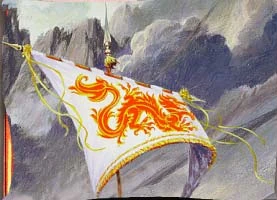
Just so we're clear on this, Our Heroes are a sea of whitebread and ginger carrying a katana, the prime symbol of Taoism, and now a clearly Asian-style dragon banner. I know Jordan said he was going for a sort of 'fantasy melange', but I have yet to see a single thing that makes me say 'ah, a reference to African mythology!' or really anything other than 'ah, another white author with a fetish for Asian myths minus all the Asian people!' People who have read later books: does this ever get better?
Chapter Fifty-Three: The Wheel Turns
The Blight has eaten most of the greenery the next morning, but Loial refuses to let it have the Green Man's oak, and takes an hour (that feels like minutes) to sing a Tree Song that rejuvenates it, assuring the party that he couldn't have invoked so much power if Jolly Green's spirit wasn't still in there. The Blight is still gross, but doesn't try to murder them as they leave--Moiraine explains that they "struck a mighty blow against the Dark One" and for some reason Rand still hasn't asked for an explanation of how she reconciles that with his memory of killing the devil.
At least the soldiers at Fal Dara aren't so hypermasculine as to reject a good flower crown, and everyone is wearing them to celebrate the incredible victory at the pass. Moiraine waves off all healers and meets with Agelmar to show him the recovered horn and ask for a small army to escort it to Illian, for reasons not explained. Montages happen for a week. Lan starts teaching Rand how to actually use his sword, and everyone gets hyped about finally going to Tar Valon, but Rand refuses to join them, convinced that he'll get gentled if he goes, and go mad-corrupt if he ever accidentally uses magic again. He's just going to wander off on his own, away from people he might hurt, cursing the luck that his crush has to be a wizard and thus dangerous. In another garden, far away, Moiraine magically eavesdrops on them:
"The Prophecies will be fulfilled," the Aes Sedai whispered. "The Dragon is Reborn."And that's it. That's the book.
I am... thoroughly unimpressed, I have to admit. I love a good ending. I love the part of a story where we see how everything that has led to the climax fits together in order to create something with meaning. I love Frodo and Gollum facing the will of the Ring at the Cracks of Doom, the way the hero's past mercy ultimately saves him from his own final weakness. I love Katniss, broken and angry, still playing her character so well that she gets a shot at salvation instead of vengeance. I love the Doctor and Rose up against an army of genocidal zealotry, saved because the Bad Wolf is damnfool implacable hope and she will do anything to protect those she loves. I love Harry Potter and Narcissa Malfoy in the woods, speaking two words ("Yes." "Dead.") that declare that love overwhelms hatred in the end.
And I get that those endings are the real endings and this is book one of eleventy, so it's not a fair comparison, but I just waded through seven hundred and ninety-two pages of this stuff and the ending was abrupt, unjustified, and most heinously of all, revealed nothing meaningful about who the characters are or what they believe. This is an ending that falls like a soggy towel on the page: and there, there's a huge battle and the good guys win but for how long isn't this awesome? Wasn't this totally worth reading about the four hundred identical innkeepers that populate this world like an unsettling mashup of Barliman Butterbur and Nurse Joy? Isn't it great how a solid 60% of this book was just setting the stage for later books while somehow failing to have any real impact on the events of its own plot?
I am struggling to think of any way in which the plot might have been hampered if the party hadn't transitioned directly from, say, Baerlon to Fal Dara. By my estimate, if they had done so, the book would have been about three hundred fifty pages long, maybe three hundred with better editing, a solid book but not a brick. We lose the City of Mat Don't Touch That Dagger Oh My God, and Perrin being a Man-Wolf, and Rand flirting with a princess, but do we lose anything that actually impacts the plot? Is there any reason not to consider the intervening thirty-some chapters glorified filler? I'm really and truly asking. Because I don't think it should be a controversial opinion to say 'if half your book isn't relevant to your book, cut it', and yet here we are. And I actually liked the Travellers and the wolfpack, those are good story elements, but they could be in their own book where they were actually plot-relevant and not just a sideshow with no purpose.
Because I don't make good life choices, I am actually considering getting into the second book on this here blog, but I'm definitely not doing that right away. I need a cleanser. So, apart from your usual delightful insights and anecdotes, make your nominations, resilient readers, and come back in a week or two to see what I inflict on myself next.

