Sunday, August 7, 2016

The Name of the Wind, chapter one, in which Will is charmed by a Science Hero

Howdy folks.  Sunday updates are back!  The long drought is once again over and we have a new project, decided by my need to resolve an apparent contradiction.  On the one hand, I have heard that The Name of the Wind is the most archetypal of male wish-fulfillment fantasy; on the other hand, I've seen women recently talking about how much they love Rothfuss, in the comments of a video of him talking at a con about proper diversity of representation in fiction.

He also posted this, presumably on July 5th:

Pictured: a status update about letting his young son wear eyeshadow and lipstick on a night out, because, quote, "Fuck it" and "Freedom".

So already I feel like I'm dealing with a much higher calibre of human being than the aw-shucks misogynist Butcher or the frothing hatemonger Card.  Male wish fulfillment and a philosophy of inclusion and free expression--these things don't have to conflict, but they are definitely an unusual combination.  Let's see if we can figure out what's going on.

No further delays.  Are you excited?  I'm excited.

(Content: referenced animal death. Fun content: chimney history, Viola Davis' poker face.)

The Name of the Wind: p. 1--
Prologue: A Silence of Three Parts

The title page informs me that this book is "The Kingkiller Chronicle: Day One", which is even more amazing than your typical 'Book One of the Interminability Cycle'.  A single day.  I assume this due to flashbacks, but suddenly I wonder why no one's tried to do the dragons-and-wizards version of 24 yet.

There is of course a map, labelled "The Four Corners of Civilization" which conveniently ends all along the right edge of the page with the practically-vertical Stormwall Mountains.  Nothing civilised anywhere else, I guess?  These people are terrible explorers or huge narcissists, but--to be clear--I am fully expecting this book to be unabashedly pretentious stereotypical fantasy, and I will not hold that against it any more than I condemned Wheel of Time for being a by-the-numbers Tolkien ripoff.  (Bad example?)  Until and unless Rothfuss earns my ire with offensive handling of actual characters, my exclamations will probably all translate to 'that is terrible I love it'.
It was night again. The Waystone Inn lay in silence, and it was a silence of three parts.
SEE PREVIOUS STATEMENT.

The first part of the silence is absence: no wind, no drinking crowd, no music.  There are a couple of guys drinking intently, whose lack of conversation "added a small, sullen silence to the larger, hollow one".  The third silence is an excuse to describe the scenery:
If you listened for an hour, you might begin to feel it in the wooden floor underfoot and in the rough, splintering barrels behind the bar [....] in the weight of the black stone hearth that held the heat of a long dead fire [....] in the hands of the man who stood there, polishing a stretch of mahogany that already gleamed in the lamplight.
He has "true-red" hair, so I assume he's a main character.  He owns the bar, and the poetic third silence: "It was the patient, cut-flower sound of a man who is waiting to die."  That's the entire prologue.  I have no idea what it means but, again, it is shamelessly over-the-top and I love it.

Chapter One: A Place for Demons

Same inn, different night?  A stock character named Old Cob is telling a quartet of young men a story of wandering hero Taborlin the Great, disarmed and imprisoned in a tower where the flames had turned blue, which the smith's apprentice correctly identifies as a sign of the Chandrian (bad guys of some type, clearly).  They pause for Medieval Fantasy Dinner, "five bowls of stew and two warm, round loaves of bread", which is some nice baking service--and then back to the story, where Taborlin turns out to be Superman levels of overpowered, because he "knew the names of all things, and so all things were to his command".  He commands the stone wall of his cell to fall apart, jumps out the hole, and "he knew the name of the wind" [DRINK!] so it caught him on his way down.  He doesn't even have the stab wound from his captors, thanks to his new magic amulet that they somehow failed to take from him.

The men start arguing over the precise rhyming scheme about being kind to tinkers (such as the one who gifted Taborlin this Amulet of Gamebreaking), and the innkeeper, Kote, interrupts for basically the first time since he moved to town a year ago:
A tinker's debt is always paid:/Once for any simple trade./Twice for freely given aid./Thrice for any insult made.
I had been thinking that the innkeeper was the protagonist, but he's got a name now, whereas the narrative has paused twice now to tell us that the smith's teenage apprentice is still always called "boy", which I find Suspicious.  Old Cob specifies that the amulet would protect Taborlin from evil, "demons and such", causing Shep to grumble about needing it himself.  Implications follow that Shep's farm may have been hit by demons last week and everyone is too polite to ask about it while sober.  I hope it was demons.  I would give a lot to see a fantasy novel written from the perspective of ordinary villagers just trying to get on with life in a world where apocalyptic devil-gods and prophesied heroes and monster hordes are as common as rainy days.

Another disagreement arises about whether the Chandrian are demons or, as Jake insists, "They were the first six people to refuse Tehlu's choice of the path", et cetera.  On the plus side, rather than everyone having a weirdly encyclopedic knowledge of their mytho-history, they seem to have various competing stories and can't agree what's what.  Already we're doing better than Wheel of Time.

No dark night in a tavern is complete without someone stumbling in on death's door, so here comes Carter, smeared with blood.  (Aside: the surname 'Walker' and the locative name 'Rannish' suggest to me that we're in an era in which surnames are relatively new, but apparently the occupational name 'Carter' has already made the jump to forename.  Reminds me of a couple of weeks ago when I asked my GM about an NPC named Christopher in a fantasy setting without Christianity.  He politely ignored my musings, which is probably for the best.  This is why I have trouble connecting with people.)  Carter is clutching a blanket that looks "as if it were wrapped around a tangle of kindling sticks" and, a paragraph later, clunks onto a table "as if it were full of stones".  I'm sure it's nothing creepy like a bunch of bones.  Carter is "crisscrossed with long, straight cuts" but insists that he's fine, although his horse didn't make it.  He is reprimanded for travelling alone when there are brigands around, until he dramatically tugs open the blanket roll to reveal a giant dead spider.

Kote casually identifies it as a scrael, then quickly insists he's never seen one before but only heard about them from travelling merchants.  He quickly sets to sciencing it as best he can--its body is stone, feet razor-sharp, no eyes, no mouth, and when he finally manages to snap it open, it's full of homogenous grey sponge "like a mushroom".  Kote is terrible at being an undercover hero, but after Dresden's tremendous disinterest in learning anything more about anything than he has to, I am all over a character whose response to monsters is to start making notes and running tests.

Everyone is deeply upset and confused by the prospect of an actual demon corpse in the bar--they don't doubt demons exist, but they're supposed to be far-off mythical things, like kings and gods.  Kote just shrugs and says they can test with iron or fire.  Graham, in the audience, helpfully specifies that demons "fear three things: cold iron, clean fire, and the holy name of God."

Kote gives him this face...

Pictured: Viola Davis, unimpressed.

...and moves on to finding iron--pure iron, not alloyed steel.  He eventually locates an appropriately pure penny (a shim--we get names for all the coin types, which is pretty good flavour without breaking our stride too much) and presses it to the scrael's stone body.  A moment later, it burns through to the table underneath.  Kote wipes his hands on his apron and asks what they should do now.  SCIENCE HERO!

Another silent scene, this time of Kote alone in his bar, cleaning everything.  It's super clean.  So clean to begin with that even after cleaning for an hour, his cleaning bucket water is still clean enough "for a lady to wash her hands".  I'm not sure if this is characterisation or what.  Is Kote obsessive or does he not sleep ever?  The narrative notes that 'Kote' is a chosen name for him, one of many (his student calls him Reshi), and implies that he's actually much older than the twentysomething he looks.  When he finally does return to his room, he's greeted by a new character, Bast, who makes me vaguely uncomfortable given that he's the first dark-skinned person we've met and is seemingly a servant, bringing food.  At least, he's described as "dark and charming, with a quick smile and cunning eyes".  'Dark' in these cases sometimes just means hair, but overall it sounds to me like a stock description of a Mildly Foreign Person whom we're meant to like but also not be sure whether to trust.  We're also in Jacob-and-Carter country, so Bast is probably meant to sound exotic (though it's a decent abbreviation of Sebastian, and apparently also a German surname).  I'm going to go ahead and picture him as mixed north African/west Asian.

But he's not just a servant, at least.  He's Kote's apprentice, by the sound of it studying magic or alchemy.  Buuuut he's also super promiscuous, as they banter and Bast admits that he didn't get any reading done today because he took his book outside and immediately got entangled with a pretty girl.  Again.  He's a big fan of all the women under thirty in this place, apparently.  So, our first POC is vaguely subservient, scholastically under-motivated, and extra sexual.  This is all discussed jovially and without any chastising from Kote, so we're probably not supposed to think less of him for this, but I become immediately suspicious when these sorts of traits line up.  (Also, we've had half a dozen named men and one Significantly Unnamed boy and the only named female character thus far is the dead horse.  Don't think I'm not noticing these things just because I am pleased with Kote's I-wonder-what-happens-if-I-do-this curiosity.)

Kote explains about the scrael, to Bast's immediate concern, but Kote reassures him that it was properly dead and he subtly made sure they disposed of it properly, with a rowan wood fire and a sufficiently deep hole and such arcane precautions.  He also mentions giving Carter about fifty stitches, and instructs Bast to tell anyone gossipy a specific backstory about learning from his father the a caravan guard.  They have further Significant Conversation that we don't fully understand, about how "they thought it was a demon" that that was probably for the best (but nothing about what it really is, ominous chord), and everyone's going to be stocking up on pure iron to fight demons and Kote wouldn't blame Bast if he wanted to leave now.  Is this implying that Bast is also not human?  I have a suspicious eye on you, Rothfuss.  (Bast says he would never leave, since Kote's his only possible teacher.)  The Bast-is-a-demon-or-something theory intensifies when the banter proceeds to Kote jokingly trying to banish him with various incantations in ancient language, to which Bast laughs through fake scowls.

Kote is left to eat in silence, and I contemplate why I enjoy the return to pretentious pseudo-poetry in the narrative here, even as it tries to quietly inform me of how special Kote is.  He reflects on his slight pride in engineering a fireplace into the middle of the room--

(I did some quick research here to try to figure out if/when this was a new creation, and discovered a book that argues that the invention of the chimney was the single greatest factor in the development of class segregation in Europe.  The world is a font of endless wonders and this sustains me through times of trouble.)

--and then spends a lot of time looking everywhere in the room except towards a particular wooden chest, "the same way you avoid meeting the eye of an old lover at a formal dinner, or that of an old enemy sitting across the room in a crowded alehouse late at night".  (I note that Rothfuss is pretty good about not gendering his hypotheticals; I feel confident Dresden would have made it very clear that the 'old lover' was a white woman as beautiful as she was cold, et cetera.)

The chest is made of roah, fantasy wood worth its weight in gold: "a chest made of it went far beyond extravagance".  I had enough of this with Trillionaire Ender Wiggin to last me a lifetime, thanks.  The chest has three locks: one iron, one copper, "and a lock that could not be seen".  DO YOU REALISE YET HOW IMPORTANT THIS BOX IS?  I'm mostly expecting it to have a weapon inside, e.g., the sword that he Swore He Would Never Wield Again, but I'm hopeful that I'll be wrong there.  He eventually locks eyes with the box, looks all weary again, and goes to bed.

Next day, the bar crowd is nervous, although not too nervous to throw us some more worldbuilding tidbits: the Penitent King is trying to suppress a rebellion in far-off Resavek, and everyone's expecting a third round of taxes this year, which will be bearable for most of the farmers except those already struggling, and "Crazy Martin", who planted barley instead of the beans that armies live on.  Travelling merchants have fewer and fewer luxuries as well.  I actually kinda like this sequence, far more than a Wheel-of-Time-y scenario where everyone's chipper but there are Grim Rumours in The East that they Foolishly Dismiss.  Not least because it only takes a couple of paragraphs for Rothfuss to sketch us a sense of village life and how they adapt to the times and economics of their world, and we aren't subject to a deluge of vaguely-rustic down-home slang.  The village is also full of gossip, since Carter is half made of stitches now, although no one really takes the claims of demonic invasion seriously.
Trying to convince folk would only make them a laughingstock, like Crazy Martin, who had been trying to dig a well inside his own house for years now.
A brief investigation has not provided me with any insight as to why people wouldn't want an indoor well.  I mean, I know wells run dry, but if you're building a house and you have a private well, is there any particular reason not to build the house around the well?  (These are the questions I ask that, four years later, cause someone to look at me bug-eyed and say 'Why do you know that?'  Funsies, my friends.  Funsies.)  Still, as Kote predicted, everyone in town finds time to drop by the blacksmith and buy a length of iron, just in case some hellspawn needs smiting.

By the end of the chapter, it has begun to drag a bit, particularly once it gets around to how "they reminisced that three years ago no one would have even thought of locking their doors at night, let alone barring them".  Pepperridge Farm remembers.  The evening's drinking stumbles to end at a slow and low point, ending the chapter, which if nothing else tells us how confident Rothfuss is that we are firmly in the grip of his narrative tension.

Still not one named human woman, but also a lack of outright misogyny or even 'benign' sexism, so this is one of those times where a score of zero is actually an improvement over most of the books you've had the joy to experience with me.  I confess I hold actual hope for this story yet.  (I can't tell if Kote and Bast are close enough in age for me to ship them yet, but I assume you're all prepared for that to start happening soon.)

Next week: a secondary protagonist named Chronicler (amazing) gets politely robbed and Kote starts to reveal his Seeeeecret Paaaast!

Wednesday, July 6, 2016

Life Is Strange: The choices we are not allowed to make

It's kind of hard to know how to talk about Life Is Strange, the 2015 episodic/serial choice-based time-travel RPG.  It's one story in five parts, and each episode tackles drastically different concepts and subject matter, sometimes in radically different ways.  The blogqueen and I played through the first four episodes saying "Okay, on the next run (which we must obviously play) we'll do this the other way" and then found that when the final credits rolled neither of us had any real desire to pick it up again.

How exactly do I talk about a story where the phrase 'that was always going to never have happened eventually' is grammatically reasonable?  I'm going to try going roughly by episode and see how that goes.  Spoilers will be progressively spoilerier as we go.  Also, this game gets into some serious and potentially very triggering material, so if that's not something you want to deal with today, I have also posted a full index of the Ender's Game posts for your re-enjoyment.

(Content: murder, suicide, terminal illness, sexual assault, loss of agency.)

Our heroine, Max(ine) Caulfield, is a waifish photography nerd at a tiny well-respected private high school somewhere in Oregon.  It's her hometown, but she's been away for five years, so it's both familiar and confusing, and she still hasn't tried to reconnect with her childhood BFFFFF, Chloe Price.  One school day she witnesses an accidental murder in the school bathroom and spontaneously develops the ability to rewind time (if only by a few minutes).  She prevents the murder and thus saves someone who turns out to be Chloe, and together they begin searching for Chloe's missing friend, Rachel Amber.  The core mechanic of the game is Max's ability to essentially save scum her own life, thus letting her decide which version of a conversation she wants to be the 'real' one, or to see how a situation goes badly, reload the past, and take steps to prevent it again.  Very meta.  I approve.

Despite this supernatural power, the game is mostly about mundane choices--who do you want to befriend, whose secrets will you keep, whose side will you take?  The one exception to this is Max's recurring dream/vision of a hurricane coming in to obliterate the town in five days' time.  Who's behind that?  Could there be--could there BE-- something sinister about the rich kids' Vortex Club and their End of the World party in only four days' time?  Other weird phenomena also start popping up: unreasonable snow and unscheduled eclipses and beaching whales.

While the game reminds you regularly that it's all about consequences, it doesn't severely drop the hammer until episode two, when Max shorts out her time powers just when she needs to talk down her suicidal friend Kate.  The situation is as wrenchingly plausible as they can make it--Kate was drunk at a party, there's a viral video going around shaming her, no one in authority cares that she says she was drugged and assaulted afterwards, and even those who believe her are going heavy on the victim-blaming.  Refreshingly, the writers behind the game make it pretty clear that we're supposed to sympathise fully with Kate and the victim-blamers are a bunch of jackasses.  It's also not as exploitative as one might expect; there is never an opportunity to watch the video, for example.  Depending on the choices you have made up to that point and while you're on the roof, Kate can be rescued.  It's a harrowing story, but very compelling.  (On our playthrough we failed to stop her at the very end, but this is a game about time travel and anything can be undone.)

Episode three gives us a new twist when Max discovers that she can use photographs to alter moments of her more distant past, and retroactively prevents the car crash that killed Chloe's father, thus drastically rewriting the entire world.  The most drastic obvious change is that Chloe has instead been in an accident herself in the last year and is now completely paralysed with progressive organ failure.  The blogqueen and I were massively apprehensive about this, since media about disabled people tends to be awkward at best and eugenicist at worst.  To our pleasant surprise, this game avoids a lot of that.  This alternate Chloe is arguably happier than her able-bodied self, and her parents have managed to equip their home with a bunch of adaptive technology that still lets her live her life.  No one ever declares that they'd rather be dead than disabled, or implies that a disabled child is an unwanted burden on their family or friends.  The game does make it clear that being disabled is horrendously expensive, but the Price parents are resolute that they'll do anything they can to improve her life.

That said, Max can also find a letter from Chloe's doctor (which Chloe apparently hasn't been told about) saying that she probably has only a few months to live no matter what they do, and ultimately Chloe asks Max to give her a morphine overdose because she'd rather not suffer through that decline (and bankrupt her family).  The player can choose to assist or refuse, and then, either way, immediately use the photograph to restore the original timeline.  So, while it's carefully set up to make it clear that this is Chloe's choice and she specifically wants to skip her own terminal case, we nevertheless get the selfless disabled person trying to spare their loved ones the burden.  Compared to the usual depiction of disability in media, I feel this lands solidly in 'better, yet not good' territory.

Episode four brings us nearly to the end of the investigation, as our reunited heroes find a well-equipped storm bunker, "the Dark Room", that someone is apparently using as their hideout to kidnap, drug, and photograph teenage girls.  (The game implies that most of the victims were not physically raped, but some probably were, and the violation is inexcusable in either case.)  Max and Chloe finally locate the body of Rachel Amber, but it's a trap and the villain ambushes them, killing Chloe (again) and kidnapping Max.

★Interlude by Erika★
I want to take a moment to talk about Rachel Amber. She is everywhere. From one of the first scenes we see graffiti about her, we see missing posters about her, people talk about her. The early episodes hit you over the head with "wonder who is Rachel, and what happened to her!" She's the reason Chloe was at the school to start with when we run into her (she was putting up missing person posters). A large majority of the plot is driven by investigating what happened to her. She is a mystery, and she is supposed to be.  From how other characters talk about her, you're never sure how you're supposed to see her. There are implications that she is, in her own way, even guiding Max, which is what made it so... anti-climactic to get the one-two punch of "she was drugged, maybe sexually abused, and definitely photographed in horrific ways" with "yep, there's her body". I never really expected to find her alive, but I had expected more from this game than what thematically amounts to "raped and murdered". While there is little room for the game to continue exploring Rachel after this point, she only comes up once more and is largely forgotten now that the mystery is solved and she is found.

★Back to Will★
Even up to this point, I was pretty well on-board with this game.  Its treatment of harsh subject matter was at least considered if not perfect, its characters are generally complicated and interesting, it has serious and impactful choices, and it's so queer.

It is so queer, y'all.

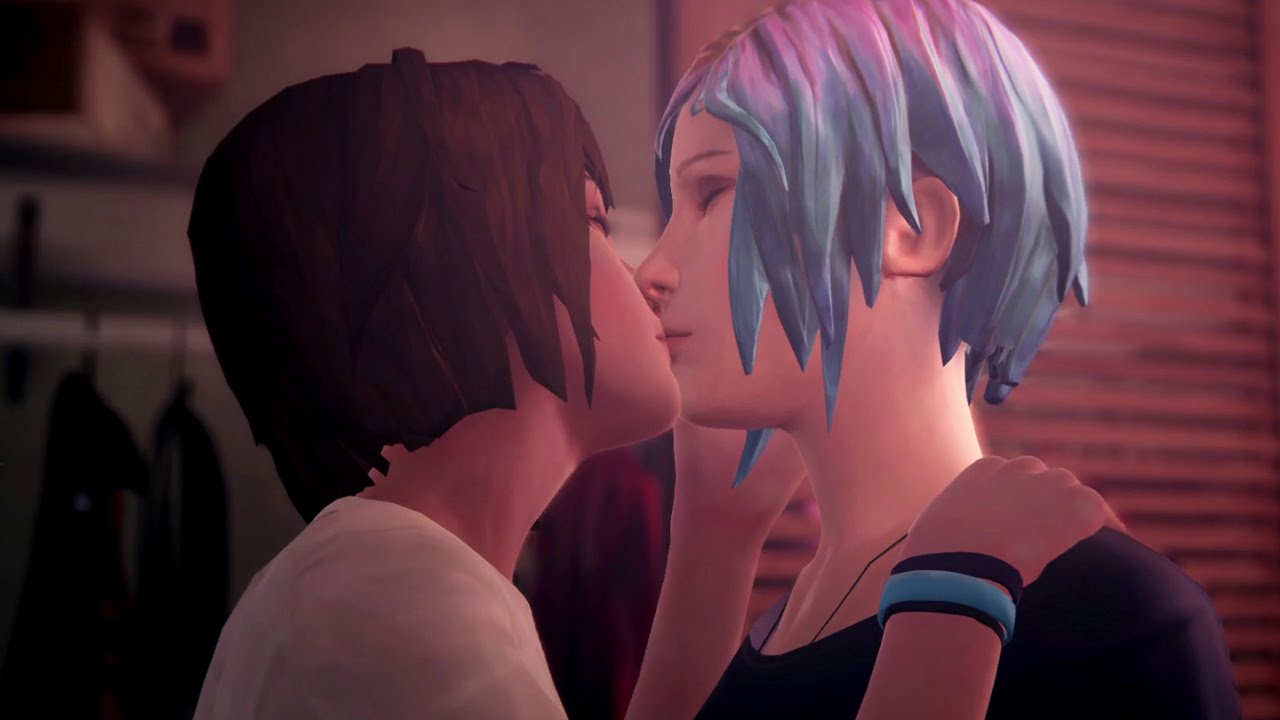
Pictured: Max kissing Chloe.  Chloe's hair is dyed in the approximate colours of the bi pride flag.

Max is bi, unquestionably.  Her close past friendship with Chloe takes on romantic overtones almost immediately after they meet again, they flirt constantly, and your first opportunity to kiss is in the middle of the game.  You can choose not to, of course, but 80% of players went for it, as is right and good.  If you do, the flirting only ramps up afterwards.  Chloe really only expresses interest in other girls, primarily Rachel, and it's hard to tell if she's just teasing you when she talks about how hot Mr Jefferson the photography goatee teacher is.  And while they have some obviously sexualised scenes (playing in the pool at night, nearly naked) it's mostly not objectifying camerawork.  (Being male, I'm probably not a good source on whether the male gaze applies.)

Max's other potential love interest is Warren, a nerdy boy who defies the vast majority of expected nerd boy cliches.  He's super excited about what a geek Max is and wants to trade classic SFF movies with her, but he never becomes the entitled and resentful Nice Guy, even if you reject him, even after he puts himself in physical harm to protect you.  IN FACT, if you turn down his date and he then learns you're spending all your time with Chloe, his response is basically "Oh, wow, yeah, if I were you I would also date her, good call".  (Erika: I remain conflicted on if I would pick him or not if Chloe wasn't the other option. He's kind of endearing, but also so thirsty.) No biphobia!  Not even a second of "wait, are you gay or something?"  Normalised bisexuality.  Truly this is a world unlike our own.  (Villains don't mind throwing in some homophobia now and then, generally by calling Chloe a dyke, which is kind of unnecessary but in line with the rest of the writers' choices.)

Most of the other characters very clearly have their virtues and flaws as well.  Victoria, alpha girl of the school, is snobbish and judgmental, but can also be kind and loyal, and is clearly motivated more by insecurity than malice.  Chloe's stepfather David is an ex-soldier, pushy, prying, secretive, and short-tempered, but genuinely cares about his family and is just very bad at simultaneously protecting and respecting people.

Nathan Prescott is worth talking about as well--he's the rich kid who never faces consequences for anything and (almost) kills Chloe in the first episode.  There's a lot of ableist talk about how he's "insane" and on a ton of prescription medications (in addition to illegal narcotics), but ultimately we're corrected: his mental problems didn't make him evil, they made him vulnerable, and while he's done inexcusable things, he's in turn a victim and pawn of bad people who are entirely sane.  Like Chloe's alternate timeline (and this time speaking as someone who does depend on medication for his mental health), I felt again like this ended up in better territory than usual, if not necessarily great.

With all that said, let's talk about how much I hated episode five.

Okay, 'hated' is a strong word; I was less uncomfortable than Erika was while we played through it (Erika: I spent most of this sequence clutching a pillow yelling "NO" and making upset noises at the TV), but in the aftermath I became more and more dissatisfied with the writers' choices, the wasted opportunities, and the confluence of really tired cliches in a situation that desperately needed the originality and unpredictability of the rest of the game.

It starts out bad: Chloe is dead, Max is captured, and the real villain has been revealed as Mr Jefferson, the hipster teacher Max has idolised for years.  It turns out that his favourite subject for photography is the destruction of innocence, so he likes to kidnap girls and photograph them as they are slowly overwhelmed by fear and despair.  Bound to a chair in his secret bunker, the player is mostly just forced to watch scenes play out, which is the first problem.  Episode five is less a game than an interactive movie--rather than making choices, you're pushed through a pretty linear sequence of events, trying desperately to find anything you can do that will make a difference.  The writers were clearly trying to evoke a sense of helplessness in the player (after four episodes of causality being your plaything), and I don't disagree that they succeeded.  What I dislike about this is that after four episodes of focusing on the agency and power and courage of this teenage girl, they decided that what we really needed to bring things home was a painfully long sequence in which our heroine is helplessly victimised by a violent man and we can do nothing but watch.  The game up to now had--usually--avoided being very voyeuristic, and that goes right out the window.  Prolonged camera shots of an underage, drugged girl.

This is not something I was looking for in my game.

After what feels like about nineteen weeks of pointless struggling, Max manages to find one of her photographs that she can use to tweak the very first scene of the game, rewriting the entire week.  Kate is alive, Chloe is alive, Mr Jefferson has been arrested, and Max is declared the winner of the photo competition, which means she's out of town at a gala when she receives word that the mysterious hurricane is nevertheless destroying the town.  She goes back to rewrite time again to make sure she's home to protect people, and consequences spill out of control such that she ends up back in Jefferson's evil lair with no photos.  Ex-soldier David comes to the rescue this time, because what we really needed was for her to get rescued by a strong man again (Max does help, but still, seriously?), and off Max goes to find the one remaining photo that will let her travel back to warn Chloe and save the day.

It works, though apparently the developers felt they needed padding or just hadn't shown off enough graphical tricks yet, because first there's an extended nightmare dungeon sequence that is pretty much exactly what I'd like to see in a horror movie, except that since when is this game a horror movie.  It was cool, and it's certainly a powerful scene when Mirror Max berates Player Max for using her time-warp powers to make people like her.  I just wish they had given us more reason for any of those scenes to be in the game, apart from 'it was cool and we had a half hour of runtime to fill'. (Erika: However it would have made for a great horror game.)

The final choice of the game comes in the same place the story starts, on a cliff, watching the hurricane bear down on Arcadia Bay.  At this point, our heroes have 'realised' that all of these bizarre phenomena are somehow caused by Max's time-warping, including this very storm.  How they've realised this remains unclear to me; it seems like a pretty strong application of post hoc ergo propter hoc.  (It would have been just as reasonable to conclude that some other force had fractured reality, causing various disasters but also somehow allowing Max to hop between possible timelines, near as I can tell.)  Regardless, Chloe realises that Max only developed her powers to prevent Chloe's death, and so offers Max a photograph that will let her travel back to day one, allow Chloe to get shot, never gain her time powers, and thus prevent any of the catastrophes that follow.

Yeah.

A brief list of things I am provisionally okay with:
  • moral conundrums where you have to choose between one person you value most or a bunch of other people
  • diabolus ex machina in which some kind of force majeure threat out of nowhere requires you to choose between two flawed results
  • villains being characterised as creepy hipster misogynists who literally see women as objects, even and especially if it's not blatantly sexual
  • gameplay sequences specifically designed to evoke a feeling of helplessness
But when you combine all of these things to tell a story about a heroine getting tied up, drugged, threatened in various physical and psychological ways, punished for every choice she makes, and ultimately told that the will of the universe is that she either allows her girlfriend to be murdered or she will personally be responsible for a random town-destroying disaster...

Again, this is not what I was looking for in this game.

On the plus side, you can choose not to sacrifice Chloe, so it doesn't have to be a story about the Tragic Lesbian who dies selflessly to save the straights.  Yet the writers obviously felt that was the stronger story, and put substantially more time into that ending than they did into the one where you let the storm run its course and then drive off into the sunrise.  (You also only kiss Chloe again if it's right before you rewind to let her die; otherwise it's hugs only.)  In both cases, I'm not sure I've ever seen a game that so desperately needed a 'where are they now' ending for its various side characters, which would have fit in perfectly as, for example, a photo album that you could flip through during the end credits.  (From what I've read, the lack of detail was intentional, especially in the ending where the storm hits, as the writers wanted to leave players in suspense about who survived the disaster.)  Instead, Erika and I agreed, the supposed consequences of all of your many other decisions throughout the game are seriously undermined, since you don't get to see any impact in the end from anything but your final choice.

★Erika★
I would go as far as to say that none of your choices matter expect the final one. You either reset, and none of it happens, or you just leave them to die.  (If Max retains her memory during the days she must now relive, they could matter more, but it is unclear if she does or not, and given the previous mechanics, implied she doesn't.)  The survivors aren't going to care whether you were nice to them or not after getting a bucket of paint dumped on them, they're going to be a little preoccupied with how their lives have been destroyed by a hurricane. For a game that let you think that its choices were so important, real lunchbox letdown.

Will again★
I can see ways they could have spun the hurricane ending more effectively, and even the reset ending, but in both cases they'd have to have actually wanted to do so, and set up for it.  In the reset ending, a sequence (even a montage) of Max using whatever knowledge she still has in order to help people (supporting Kate, befriending the rest of the 'unsympathetic' students and stopping bullies, reconnecting with Chloe's mom and helping her through what follows) would have added a lot.  In the hurricane ending, obviously, how you've interacted with other characters could also influence the choices they're going to make, and 'former enemies come together to protect the community in a crisis' is a way better cliche than anything else we were getting in this episode.  Victoria and Frank the drug dealer come to mind as examples of people who are hostile by default but can have a conscience installed.  Give me Victoria mass-texting people to come to her family's storm bunker; give me Frank and David driving around town grabbing anybody stuck on foot on the street.

One last thing that I expected to mean more but never did was the nature of the big photo competition: "Everyday Heroes".  Max's winning picture is a shot of herself and her wall of photos, yet her heroism is not really evident to anyone else most of the time (the main exception coming to mind is her rescue of Kate).  Her heroism in the reset ending consists of choosing not to act.  Maybe the takeaway there is that 'everyday heroes' aren't often noticed or recognised, but it's kind of lacklustre, and there isn't much that can connect an act like that to the real world.  Conversely, there's a giant missed opportunity for plausible 'everyday heroism' if Max's little actions over the course of the week are allowed to add up to something significant in the end, like the townspeople being more ready and willing to protect each other.  Be good to people throughout the week, bring them closer together, make them more ready to weather the storm, and maybe they can save each other so you aren't pushed to let your girlfriend die.

And I figure that's exactly what the writers did not want to allow.  Either of these things--the reset ending where you see Max still finding ways to help people, or the hurricane ending where she's helped them become people who leap to protect each other--distracts from the focus of the ending right now, which is "are you going to kill your girlfriend and suffer like a hero or spare her like a selfish coward".  That is the extent of what the writers wanted you to be thinking about and left with, and all other possible consequences of your many, many choices are removed by fiat.  If anything, the message seems like it's supposed to be "life is strange (WINK) and therefore nothing is truly in your control and your choices and desires don't really matter".  Helplessness is in keeping with the themes of the final episode, but "you can't really have any agency" is again a thing I was not looking for in my bisexual SFF mystery game, especially as the 'twist' ending of a game that claims it's all about choices.

Ender's Game: The Index

For ease of navigation and in case anyone felt like reliving the nostalgic days when I was just wading into the realm of literary analysis, herein is presented the complete list of Ender's Game posts in chronological order.  Further indices for other books will form in time.  Feel free to make suggestions or requests on the formatting of this or future index posts.
  1. Chapter one, part one, in which Will inexplicably follows in the style of the terrible decisions that have gone before
  2. Chapter one, part two, in which we immediately give up on all reasoned morality
  3. Chapter two, in which the villainous Peter Wiggin fails to be as horrifying as our hero
  4. Chapter three, which is much less terrible than previous chapters, or maybe I'm just getting inured to it all
  5. Chapter four, in which Ender Wiggin becomes the blatant reader-fantasy-insert
  6. Chapter five, in which Ender SHOWS THEM ALL and Will says 'whatever' a lot
  7. Chapter six, in which ZERO GRAVITY RACISM saves the day
  8. Chapter seven, part one, in which we just don't understand Ender's FEELINGS
  9. Chapter seven, part two, in which everyone gets naked
  10. Chapter seven, part three, in which middle schoolers are just too old to keep up with the young folks
  11. Chapter eight, part one, in which Jjjjeeeewwwwwws
  12. Chapter eight, part two, in which things are very briefly not awful
  13. Chapter nine, part one, in which blogs are taken seriously
  14. Chapter nine, part two, in which alternative interpretations abound
  15. Chapter ten, in which Ender rejects redemption and loses his boyfriend
  16. Chapter eleven, in which we get down to the WINNING
  17. Chapter twelve, in which Our Hero gets his second kill
  18. Chapter thirteen, part one, in which Ender tells the truth
  19. Chapter thirteen, part two, in which Graff ruins everything again
  20. Chapter fourteen, part one, in which Mazer Rackham doesn't replace Graff soon enough
  21. Chapter fourteen, part two, in which the plan works perfectly
  22. Chapter fifteen, in which the victims blame themselves
  23. Introduction, in which we contemplate empathy

Wednesday, June 15, 2016

Storm Front, chapters 26 and 27, in which Dresden repudiates his author

The long journey ends.  As venomously as I dislike Dresden, I won't rule out getting into another Dresden book at some point--probably the vaunted Book Seven, which legend says was designed to lure in new readers--but obviously I'm not subjecting myself to that right now.  I have confirmed that I own The Name of the Wind by Patrick Rothfuss, which I understand is a contender with WOT for most unnecessarily long fantasy nonsense, but I also have The Way of Kings by Brandon Sanderson, a brick of a book (part one of ten!) by an author who definitely has his issues but, as near as I can tell, is actually educating himself over time.  (He's spoken of having to teach new aspiring authors that having one token lady character is deeply inadequate and admitted to making the same mistake in his past writing, for example.)  So Sanderson is a bit of a mildly-problematic fave for me, which could make his book better or worse as material for our purposes.  These two are my current leanings, but I could always be convinced in a different direction; please feel free to continue suggesting.  In the meantime, let's wrap this sucker up.

Storm Front
Chapter Twenty-Six: A Truly Shocking Twist

We rejoin Dresden listing off for us at length the reasons that his current situation is bad (evil wizard, gun-toting zealots, perpetual motion scorpions), which he literally did one page ago, so this is like that moment when a show comes back from commercial and decides to replay the last twenty seconds.  That always vexed me.  Wevs.  Dresden suddenly snaps out of his doom-moping and realises that he has a broom, and therefore a fighting chance.  He quickly enchants the broom and commands it ("Pulitas!") to clean the kitchen, which includes sweeping out the swarm of not-yet-giant scorpions.
I'm pretty sure it got all the dirt on the way, too. When I do a spell, I do it right.
I mean.  Some authors would take the opportunity to have their hero note that their salvation broom didn't quite manage to sweep all the way out to the edges of the linoleum, self-deprecating shrug, at least it got the job done.  But Dresden, we are told, just has to be so awesome that his scorpion-fighting broom also flawlessly cleans the kitchen.

Aside: this is also the first time we've seen magically-animated objects put into play.  Now, I'm generally pretty happy to see things like 'hey, that old cleaning cantrip I was forced to learn at age 14 will actually buy me the time I need', but I am also kinda stuck asking now why this is the first time we've seen such a thing at play.  If it takes only a few seconds to pour enough magic into a broom that it can not only fly but outmaneuver evil scorpions, is there an actual reason Dresden doesn't have, like, a hand towel in his pocket that he can enchant to try to wrap itself around Victor's face?  Or, more simply and brutally, a paperweight that will do its damndest to tackle Victor in the back of the head over and over?  I'm sure there are ways these things can be explained (e.g., the Pulitas spell is only easy because it's a traditional and very useful spell that's been practiced and refined for centuries until it's got a form that can be done in five seconds, but free-form animation magic is really hard) but it's kind of exhausting to be forced to do all that justification work for the story.  (Expect to hear the same thing repeated in our upcoming post about indie timewarp game Life Is Strange.)

The broom successfully sweeps all the scorpions off the ledge before Victor grabs it and breaks the spell.  The Beckitts have swapped to revolvers, which are immune to techbane because look over there, but while they're reloading, Victor tries to tell Dresden he can surrender and walk away or wait for the fire to spread and kill him, but Dresden calls this bluff with the knowledge that if Victor waits, all his drugs will burn as well.  This leads to a truly bizarre hero-villain dialogue that would fit easily into a hundred formulaic adventures and tremendously not this one.
"Fire's the simplest thing you can do. All the real wizards learn that in the first couple of weeks and move on up from there." [....] 
"Shut up!" Victor snarled. "Who's the real wizard here, huh? Who's the one with all the cards and who's the one bleeding on the kitchen floor? You're nothing, Dresden, nothing. You're a loser. And do you know why?" 
"Gee," I said. "Let me think." 
He laughed, harshly. "Because you're an idiot. You're an idealist. Open your eyes, man. You're in the jungle, now."
Idealist.

Harry Dresden is being told that his critical flaw is that he is an idealist.

I don't... I am barely able to comprehend this assertion, let alone respond to it.  Dresden is a cynic who can't be bothered to comfort people he has personally terrorised, who keeps an immortal sex offender in his basement for his knowledge of recipes, who cheerfully carries on telling people about magic in a setting where they might be killed for knowing too much, and that's just in this book.  We haven't even gotten to him nonchalantly accepting the enslavement of a teenage girl by a parasitic monster because it fits his incredibly precise definition of true love.

Dresden doesn't believe in the effectiveness of law, doesn't believe in helping his fellows or his community, doesn't particularly care about the well-being of his clients (look at his scorn for Monica when he thinks her husband 'only' ran out on her), and gets confused when he feels empathy for other people's suffering.

The only ideal this man can be accused of believing in is 'fuck you, I got mine'.

Faith and begorrah.
I was in the mood to tell a white lie. "The police know all about you, Vic. I told them myself. And I told the White Council, too. You've never even heard of them, have you, Vic? They're like the Superfriends and the Inquisition all rolled up into one."
I mean, that does sound like an excellent description of the council, overflowing with power and zero recognisable morality beyond their personal definition of personal purity, but why hasn't Dresden done this, again?  He's had time in cabs when he could have at least written a letter for Murphy.  He could have told Mac 'I need your car so I can go fight the murderer Victor Sells, here's his address'.  But nope.

Victor insists that Dresden is lying, but demands to know who gave him away to start with.  In a shocking twist I did not see coming, Dresden decides not to give up Monica's name, on the basis that Victor might conceivably survive this fight and go exact vengeance.  Totally thought he was going to say it on the off chance that it would provoke Victor into a rage-mistake.  Victor just tells the Beckitts to go (apparently they're going to march out to the car naked; very subtle) and then sets about re-summoning his toad-demon, whose name turns out to be Kalshazzak.

Dresden scoffs at Victor making the rookie mistake of letting him hear the demon's name, chants it back in the thing's face, mind-wrestles with it for a second, draws heroic inspiration from the mental images of Jenny Sells, Karrin Murphy, and Susan Rodriguez (so, the actual child and two grown women Dresden just personally infantilises), and it begins to writhe on the floor.  Victor turns to run, Dresden casts a final wind spell to tackle him off his feet, and then it's What Have You Done time.
"The Fourth Law of Magic forbids the binding of any being against its will," I grated out. Pain was tight around my throat, making me fight to speak the words. "So I stepped in and cut your control over it. And didn't establish any of my own."
The toad begins stumbling toward them as Dresden makes it clear that he's okay with dying as long as Sells dies too, they wrestle at the edge of the indoor balcony and of course both throw each other over, so on top of all the other cliches we also get the hero and villain simultaneously dangling from a ledge.  Ahead, the incoming demon.  Below them, a sea of black smoke (the burning potions, I think?) with a half-dozen giant scorpion stingers sticking up like periscopes.  Victor's got a better grip and Dresden fears he'll manage to ward off the demon, so--who called it?!--blurts out that Monica was the one to betray him.  This indeed throws Victor off just long enough for the demon to sink its fangs into his throat.  Dresden is sure that he is soon to fall and die as well, but realises that he still has the handcuffs dangling from his wrist and manages to anchor himself while yanking Victor and the demon to their doom.

All y'all take a gander at this for me:
With my right [hand], I flicked the free end of the handcuffs around one of the bars of the guardrail. The ring of metal cycled around on its hinge and locked into place.
I'm preeeetty sure that this is supposed to indicate the other cuff was not merely empty but open, as in 'not locked'?  Even though the reason he needed to force the cuff off Murphy's wrist and leave it attached to his own was that he couldn't open them.  Is there something I'm missing here, or did Dresden subconsciously unlock the handcuff with magic while none of us were looking?

The scorpions kill Victor and tear the demon apart (apparently demons aren't all that after all?) and Dresden hangs painfully by one wrist, mulling his imminent death in a way that Butcher presumably wanted to be deathly stereotypical and absolutely succeeded at.  He insists for a full paragraph that he's just hallucinating as he sees Morgan burst in, carve through one of the giant scorpions ("snickersnack", which I will fully admit I would enjoy from a different author), and begin to swing his sword in Dresden's general direction when Dresden finally blacks out.  His last thoughts are of how typical it is that he would survive the villain only to get killed "by the people for whose cause I had been fighting".  Uh, Dresden, I know your 'allies' seem to turn on you a lot, but has it occurred to you that's because you constantly lie to them and have physically assaulted Morgan twice this week?

Chapter Twenty-Seven: Making Out In The Rain

Dresden awakens outside and immediately reminds us that HE'S NOT GAY.
Rain was falling on my face, and it was the greatest feeling I'd ever known. Morgan's face was over mine, and I realized he'd been giving me CPR. Eww.
NOT THAT THERE'S ANYTHING WRONG WITH THAT

JUST

I HAVE SURVIVED A LITERAL HELLHOLE BECAUSE MY PERENNIAL NEMESIS RUSHED IN TO SAVE MY LIFE AND IMMEDIATELY ATTEMPTED TO RESUSCITATE ME REGARDLESS OF ANY PERSONAL DISCOMFORT

AND I WANT YOU TO KNOW I'M NOT INTO THAT

I get that it's supposed to be a tension-breaking joke, but consider this: fuck you, Jim Butcher.  Get your cheap laughs out of a different bargain bin.
"I saw you risk your life to stop the Shadowman. Without breaking any of the Laws. You weren't the killer."
Wait, why does Morgan call Victor 'Shadowman'?  That's a nickname that Dresden has only used inside his own head.  Again, in a better book, that would be the kind of slip-up that would cause our hero to realise that there was another layer to this mystery and Morgan was hiding something.  But not here.

Here, we can't even have character development.  Despite agreeing that Dresden isn't the killer, and in fact worked to stop the killer at personal risk while still following the council's code of conduct, within a page Morgan is declaring that "We will watch you day and night, we will prove that you are a danger who must be stopped".  Dude can't even be allowed a little tsundere 'well, I guess you might not be a lurking serial killer after all, but don't think this means we're friends or anything'.  They could have formed a tenuous trust that would still allow Morgan to leap to conclusions next time something implicates Dresden's guilt, compounded with 'I can't believe I even began to trust you'.  Morgan might as well wear a sign around his neck reading I'm Not A Real Character.

At his accusation, of course, Dresden just collapses laughing.  When asked if he's all right, he responds NO HOMO "Give me about a gallon of Listerine [...] and I'll be fine", because that joke isn't played out yet.  Also, Dresden, I'm pretty sure you're bleeding from some important leg veins?  But Morgan just says the police will arrive soon and wanders off into the woods, like he do.
The police arrived in time to catch the Beckitts trying to leave and arrested them for, of all things, being naked. Later, they were implicated in the ThreeEye drug ring, and prosecuted on distribution charges.
Did... uh, did the drugs survive the fire?  How were the Beckitts connected to ThreeEye?  Did the scorpions survive the fire?  They were clearly still running around after Victor was proper dead.  Seems like that's the kind of problem Morgan might have wanted to clean up before he left.  I assume he didn't wade into the flames to finish them all off before he went back to breathe in Dresden's mouth.  (Side note: modern CPR actually doesn't call for the breathing thing, only chest compressions, but real CPR also isn't expected to resuscitate a person on its own, so whatever).

Thanks to Morgan's testimony, the council removes the Doom of Damocles ("which I had always thought a rather pretentious name in any case" uuuuugh) from Dresden's head.

Dresden ends up in the hospital, and his techbane inexplicably doesn't burn the whole place out, although they do have trouble with the x-ray machine every time they try to scan his spine, har har.  His room is just down the hall from Murphy (who survived after three days in critical care).
I sent flowers to her hospital room, along with the surviving ring of her handcuffs. I told her, in a note, not to ask how the chain between the rings had been so neatly severed. I didn't think she'd buy that someone cut it with a magic sword.
...Why not?  Murphy believes in magic, remember?  That's why she hired you?  And tried to arrest you?  You just have a fetish for withholding information, Dresden; at least admit it.
The flowers must have helped. The first time she got out of bed was to totter down the hall to my room, throw them in my face, and leave without saying a word.
Oh, those irascible womenfolk.  (I was going to say that you know a male cop wouldn't have been written expressing their anger in such an impotent way as throwing flowers in Dresden's face, but then I remembered Dresden wouldn't have sent flowers to a male cop in the first place.)  Murphy nevertheless makes sure Dresden gets paid well for his consulting, and rescinds his arrest order, and calls him in again for advice the day after she gets back to work.
But we don't joke anymore. Some wounds don't heal very quickly.
Dresden, I'm still busy being shocked that she didn't drag you into an interrogation room after all.  If nothing else, you can be sure in her place I would demand some very clear guidelines about what information is Super Secret Wizard Knowledge and what information she can actually trust out of you so she doesn't waste her time shaking you down for things you've already admitted next time.

Monica and the kids get into mundane Witness Protection, which strikes me as odd given that they had no real part in Victor's business and he's dead now.  Who are they being protected from?  Marcone's lone claim to non-super-villainy is that he wouldn't murder people if there wasn't any profit in it.  (The Beckitts, we're told, ended up in Michigan prison, apparently outside Marcone's reach.  Um.)

Susan's article headlines the next issue of the Arcane, and she drops by to flirt with Dresden in the hospital and talk about how unfortunate it is that his hips are in a cast, because, again, she's the Spicy Latina and exists entirely to be fuckable.
I used the sympathy factor to badger another date out of her, and she didn't seem to mind too much. That time, we were not interrupted by a demon. And I didn't need any of Bob's love potions or advice, thank you very much.
HAVE I TOLD YOU I AM HETEROSEXUAL TODAY

Speaking of Bob, he returns home amongst rumours of "a particularly wild party at the University of Chicago" that Dresden ignores.  I'd really like to think that 'wild party' just means that Bob used his undefined magical powers just to throw a really sweet rave with bodacious laser shows and fonts of endless champagne and non-alcoholic beverages of choice, but this is Butcher writing and I just can't quite make myself believe that.

The final page is Dresden's navel-gazing, with timeless prose like "What did I get out of it? I'm not really sure. I escaped from something that had been following me for a long time. I'm just not sure what."  Uh.  What?  Does he mean the Doom?  (I think he knows what that is.)  Does he mean the temptation of evil magic?  He didn't escape that, and he goes on to say as much at length: "The power is there. The temptation is there. That's just the way it's going to be."  This whole temptation thing would have worked much better if it had been a running theme of the book and not just shoehorned in at the last minute.  Like if back in chapter six Bob had been all 'Hey, you realise we could solve this whole problem in five minutes if we harnessed an abyssal hound' and Dresden was like 'Awesome, how do we do that' and Bob was like 'Okay, first we need the blood of three different children' and Dresden was just 'Okay, gonna stop you there'.  Temptations should be real and constant--you can stop this killer right now if you'll just pay this one little price, just compromise once--if they're going to be meaningful.  Otherwise you get, well, this slapdash mess.

Dresden continues to monologue for a bit about how the world is getting weirder and darker and heading for rough times and he's just going to try to keep his corner as safe as he can, so if you are in trouble, who ya gonna call, et cetera.  Curtain.

Well.

If it's true that Butcher wrote this as a backhanded homage to Anita Blake, intentionally working in every cliche he could possibly think of, then he absolutely succeeded.  And clearly when his teacher told him that it was publishable, she was right.

But gracious, at what cost?

I mean, that is the closest this book gets to having a moral, right?  That there are things not worth doing for success.  That even if it means you stay stuck in a rubbish little office getting laughed at by the guy who delivers your mail, it's better to be honorable than powerful, better to be good than prosperous, better to be honest than rich.  That the temptation to do something cruel for the sake of personal gain is omnipresent and it is worth resisting every time.

That if the cost of becoming a best-selling author is hammering out misogynistic, incidentally racist, casually homophobic dreck in which sex workers die messily for the reader's titillation, if the cost is writing something that you personally believe is composed of reprehensible nonsense and telling people to spend their money on it, that cost is too high.

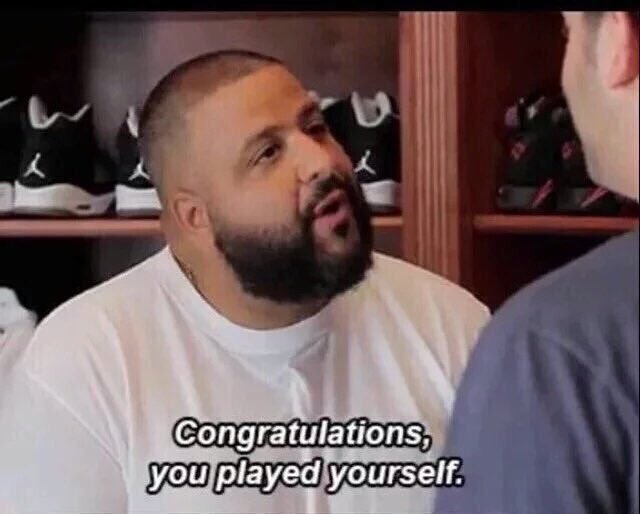
Pictured: DJ Khaled's memetic "congratulations, you played yourself".

So that's it for our time with Dresden.  Next week will probably be a post on Life Is Strange or some other one-off thing, and we'll get into our next book after that.  Feel free to get out any remaining vitriol for Dresden in the comments below, or construct your own outline for an alternate version of this book.  Maybe one that doesn't feel like it was slapped together over the course of an afternoon.

Wednesday, June 8, 2016

Storm Front, chapters 24 and 25, in which the race against time pauses for exposition

(Content: violence, implied animal abuse. Fun content: Douglas Adams' style of magic, linguistic history, and benevolent moss.)

Storm Front
Chapter Twenty-Four: So Spooky You Don't Even Know*

Dresden speeds away in  an '89 TransAm, and I wonder again briefly about the supposed rules of his techbane (we could have had a line anywhere about how Mac's car never breaks on wizards and no one's figured out why, and even that would have done something for me) as he tells us about the eldritch dusk approaching, oversaturating the greens and muting yellows and such.  Dresden's pushing over 130mph, he tells us, but "I must also have been driving during the watch rotation for the highway patrol, because not one of them tried to pull me over".  Given how little Butcher cares about the implications of his worldbuilding at this point, I'm surprised he doesn't have Dresden weave an SEP field or something around the car.  Recommendation: if you're going to "luckily" have an obvious problem not be a problem, maybe don't draw attention to it for the reader?
I hit the brakes to slow for the turn onto the lakefront road that led to the Sells house, started hydroplaning, turned into the slide with more composure and ability than I really should have had, and got the vehicle back under control in time to slide onto the correct road.
Dresden the car-slayer is nevertheless a preternaturally talented driver.  Such shock.

Dresden limps quickly up the half-flooded driveway to the house, stops, reminds us all that there are unknown numbers of mystical dangers and traps and suchlike ahead, and so Goes Loud:
So I opened my Third Eye. 
How can I explain what a wizard sees? It isn't something that lends itself readily to description. Describing something helps to define it, to give it limits, to set guardrails of understanding around it. Wizards have had the Sight since time began, and they still don't understand how it works, why it does what it does.
This is not something I'm against, in principal, because I am all for magic being a concept too vast for us to adequately understand.  Terry Pratchett wrote 'it's very hard to talk quantum in a language originally designed to tell other monkeys where the ripe fruit is' and I don't need to understand Dresden's magic sight as long as I understand the rules he personally uses to interact with it.  Let's see how that goes.

All of his normal senses are heightened ("I could abruptly smell the mud and fish odor of the lake, the trees around the house, the fresh scent of the coming rain") and into the past (he sees the house across all seasons, and each part resonates its origins, windows made from far-off sand and timbers from distant forests) and future (he sees that there are a number of possible timelines in which the house will be a giant bonfire within an hour).  Not bad for a start.

Then we get into the weirdly subjective?
The house itself was a place of power. Dark emotions--greed, lust, hatred--all hung over it as visible things, molds and slimes that were strewn over it like Spanish moss with malevolent eyes. Ghostly things [...] moved around the place, drawn to the sense of fear, despair, and anger [...] like rats in granaries.
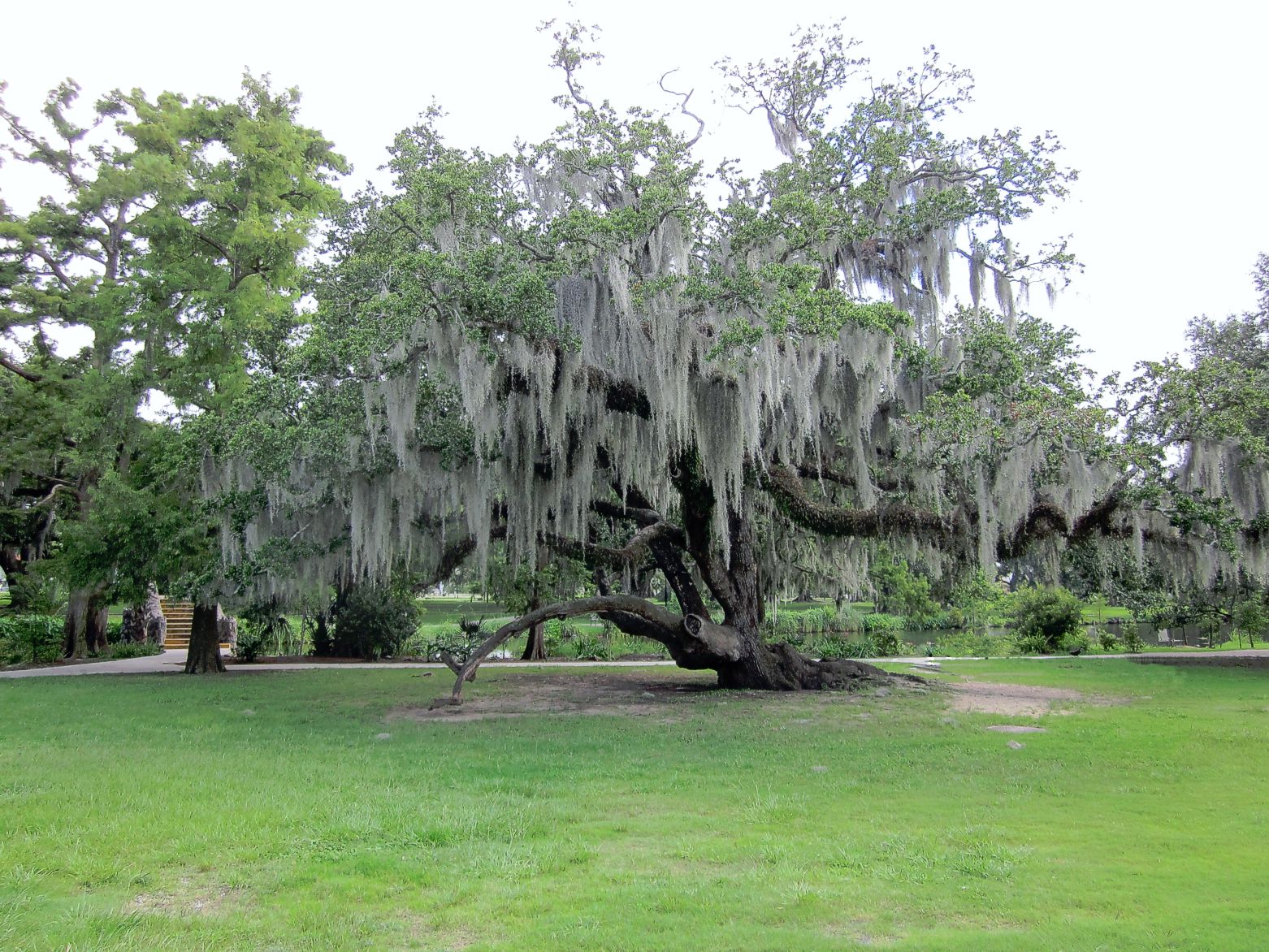
Pictured: an oak draped with Spanish moss that bears no one ill will.

We've already picked up on Butcher's choice that, in this world, 'lust' is the mindless desire for sex with no other concern for anything and is Objectively Bad (so why was that thing called a love potion and not a lust potion?) but my actual question here is: why do greed and lust look like mold?  Transitivity of grossness?  All uncomfortable things are equally interchangeable?  I mean, we had some interesting visual representations in the potion-brewing scene, with 'fiery passion' represented by ashes of a love letter and all that jazz.  Wouldn't it be more interesting if greed were represented by--I don't know, swarms of parasites, or chains wrapped around the house to protect it--MINE--from anyone else who might take it?  But no, we are not to befriend Mr Subtlety here:
Skulls were everywhere, wherever I looked, just as the edge of my vision, silent and still and bleach white, as solid and real as though a fetishist had scattered them around in anticipation of some bizarre holiday. Death.
TL;DR--every time a wizard looks at a suburban house where the family just cleared out the Halloween aisle at Wal-Mart, they are stricken with fear that this might be the home of the most evil wizard they have ever met, who is soon to kill again.
Death lay in the house's future, tangible, solid, unavoidable. [....] the future was always mutable, always something that could be changed. No one had to die tonight.
Definitely except maybe not but probably?  'This event is completely unpreventable except that it is' is a personal peeve, I guess.  Don't get me started on Doctor Who series 6.

Anyway, it's time for the Temptation of Harry Dresden, as the old flavour of evil magic calls out to him and reminds him that rejecting it once before had only earned him the suspicion and ire of wizard-kind.
 This was the sort of strength that could reach out and change the world to my will, bend it and shape it to my desiring [....] I could kill the Shadowman, now, before he knew I was here. I could call down fury and flame on the house and kill everyone in it, not leave one stone upon another.
I admit I was wondering why Harry didn't do that.  I'm not generally in favour of killing, but I don't necessarily condemn it in the name of protecting oneself or others.  If Harry had at least left word with Morgan (maybe a sticky note on his unconscious chest) that the real killer is Victor Sells, then he would only at this point be risking his own life by going in and trying to talk Sells down nonviolently.  That could be admirable.  (Though, again, Sells is like a triple murderer at least by now, so I'm pretty sure the Council is going to confiscate his head?)  But it's not quite that, either:
The energy was all there, gleeful within my anger, ready to reach out and reduce to ashes all that I hated and feared. 
The silver pentacle that had been my mother's burned cold on my chest. [....] Another hand took mine. The hand was slim, the fingers long and delicate. Feminine. The hand gently covered mine, and lifted it, like a small child's, until I held my mother's pentacle in my grasp.
There is apparently not a woman in this world who doesn't have dainty little doll hands.
Magic came from life itself, from the interaction nature and the elements, from the energy of all living beings, and especially of people. There is no truer gauge of a man's character than the way in which he employs his strength, his power.
(Wow, I have some terrible news for you, Dresden.)

We have here the first clear declaration of something that's been implied previously: magic has its own morality in Dresden's world that does not directly relate to our world or indeed to mundane morality in his.  Dresden doesn't want to magically nuke Sells' house because that would be Bad Wizardry, perverse and corrupted.  Dresden does declare "I was not a murderer" but everything else he says is about not killing with magic specifically, so it's not clear to me what the repercussions would be if he, say, brought a gun or a knife and used magic only to shield himself until he could finish Sells the old-fashioned way.  Would his magic abandon him?  I have to assume not, because Morgan ostensibly has a few magic skills in his toolbox and a sword specifically designed to kill wizards, so beheading people clearly doesn't bar him from wizardry forevermore.  And Victor has literally been magic-murdering people and his power has only grown, so clearly the power itself doesn't care how it's used.  So why is any of this about killing with magic as opposed to mundane weapons?  That seems to be a value system overlaid onto it by wizards themselves.  There could, plausibly, be some way in which using magic to kill people literally corrupts the magician, but that's not the concern at hand.

Dresden is making a solid moral choice here--I won't blow up the house because I don't want to be the kind of person who blows up houses--but he frames it in this weird paradigm that is all about magic and being different and special, rather than framing it as 'no one should murder, no exceptions for wizards'.  It's not even the Spider-Man principle that great power brings great responsibility, because Dresden clearly doesn't feel all that responsible to use his magic to benefit people.  He won't fleece them, we know this, but he'll also sit around his office for weeks at a time doing nothing, rather than (all groan as I get back on my hobby horse) asking Murphy for bits of evidence so he can track down missing persons for her.  He doesn't particularly try to educate people (except the people who come directly to his office and are easily convinced by pamphlets) on the existence or dangers of magic.  He just puts an "I'm A Wizard" ad in the phonebook and assumes this is the greatest good he can do in the world?

Anyway, with the pentacle reminding him of all the goodness of White Magic that he believes in (ew), the temptation passes, he reminds us all again how alone he is, and he walks into the skull-strewn hypno-scape.

(Maybe-final complaint: did Dresden actually learn anything from using his Third Sight here, apart from confirming that This Place Is Spooky?  I guess he confirmed there aren't any traps outside?)

Chapter Twenty-Five: I Don't Love Money, I Just Say That To Get It Into Bed

Dresden tells us more about how the capital-S Sight of the house will haunt him forever: "It seethed with negative energy, anger and pride and lust. Especially lust. Lust for wealth, lust for power, more than physical desire."  I'm no longer sure what lust is, if it's distinct from greed or envy or avarice or hunger or indulgence.  I mean, you can probably have sex with money, but if Victor Sells has a plan to get it on with power itself, I want to at least hear his weird scheme before they take him down.  Why is wanting an inherently negative emotion?  (Is there such a thing as lust for justice?  Truth?  Can you, in fact, lust for love?)
I limped up the front steps. My Sight revealed no alarms, no sorcerous trip wires. I might be giving Victor Shadowman too much credit. He was as powerful as a full-blown wizard, but he didn't have the education. Muscle, not brains, that was Victor Shadowman.
Why does Dresden keep calling him Victor Shadowman?  His name is Sells.  He gets this supervillain epithet purely because he once appeared to Dresden as an obscured figure in the rain, no one else has used it, and yet Dresden repeats it almost obsessively in his head.  It feels like he's trying to build up his opponent here into a more mythic figure, like a little kid narrating his daydream struggles against the Dark Lord of Clavaldorf (his step-dad, who means well).

The front door is unlocked.  The inside of the house is also slathered with spectral slimes-with-eyes feeding on the residual magic and slithering away when they touch Dresden's aura.  I guess he has already completely purified himself of all the power/justice-lust he was feeling a minute ago.

Dresden creeps through the completely-undefended house and catches the sound of the same music that was playing at the first murder scene with Tommy and Jennifer.  The system is in a living room at the back, connected to an upper-level kitchen/dining room that is apparently Victor's preferred ritual space.  (Maybe linoleum is easy to hose down.)  Dresden's Sight shows more of the evil slime creatures all over the speakers, feeding on the music, causing me to wonder if this is supposed to be, like, inherently evil music, or if the music itself objectively contains emotional energy, or what.  Because he needs to get some more exposition in right now, apparently, Dresden easily sneaks through to the space under the upper room, where Victor's crates of ThreeEye are just lying around, along with their raw materials.  In case we hadn't guessed, ThreeEye is a potion of Victor's own creation, starting with absinthe and then adding everything from peyote to glitter.

(Nitpick: if it weren't for Dresden outright insisting so, we would have no evidence that potion strength depends on whether the ingredients are tailored to the drinker.  Susan got full effects from Dresden's love and wind potions, and Victor's drugs apparently work fine even when mass-produced.  Aren't these things only good for a day or two?  Who's coming to pick up and immediately deliver all of this stuff?  Or is he selling this batch to other local bored rich people?  Time is money, bro.)

Dresden explains that the potions are basically inert until they're inside someone, thus he wouldn't notice their magic without full Sight, but now he's overwhelmed by all the potential suffering they radiate.
Thunder came again, more sharply, and above me, Victor's voice rose in pitch, to something audible. He was chanting in an ancient language. Egyptian? Babylonian? It didn't really matter.
Just as long as we know that it's something super exotic.  (Unless Victor also invented a potion of Duolingo, becoming fluent in ancient Coptic just to murder people seems like a lot of effort.)  He can also hear "soft sighs of pleasure from a woman", as the Beckitts are apparently providing the fornication fuel for this particular kill-spell.  Victor's chant becomes a scream just as Mrs Beckitt fakes an orgasm because this is seriously the least sexy ambience ever rises "to a fevered pitch" and Dresden (paralysed with fear for the last couple of paragraphs) leaps into action at the last second and fireballs the stereo.

Not quite as good as if he'd switched tracks over to Blinded By The Light, but I guess that'll do?

He then calls up wind to carry him to the upper level ("making my duster billow like Batman's cloak" oh my god) and sees the ritual scene, where it looks like Victor is about to kill a rabbit with Dresden's hair tied to its head.  Rude.  Shocked by Dresden's appearance, Victor moves to finish the spell, but Dresden tosses the empty film canister through his magic circle.
As a weapon, it wasn't much. But it was real, and it had been hurled by a real person, a mortal. It could shatter the integrity of a magic circle.
Okay, forget murder, how does Dresden not carry a gun just for the sake of being able to break someone's magic circle at will from a block away?  The circle bursts and hurls magical chaos in all directions; Victor tries to flamethrower Dresden but Dresden grabs fistfuls of overflowing power and conjures a shield in time.  Dresden then (reminding us again how clever he is to not get completely focused on magic like most wizards do) bodily tackles Victor to the ground and begins kicking the hell out of him, but catches a bullet in the leg from a semiautomatic gun that Mr Beckitt had on hand and has to scramble for safety in the kitchen.  The gun immediately jams, because techbane, but Victor now has enough time to let loose a tube full of his little scorpion minions and animate them.  The chapter ends with Dresden huddled behind the counter as Victor, the "naked, lean and savage-looking" Beckitts with useless guns, and a horde of expanding scorpions bearing down on him.  But Butcher very specifically mentions a broom falling into Dresden's lap, so I'm pretty sure he's going to be fine.  As usual, the action sequences in which no one says anything about human nature are the best part.

Next week: the gripping conclusion of my suffering.  Feel free to also make suggestions on what we should start in on next.  (As much as I love everyone telling me 'Will, maybe think about not torturing yourself with this stuff for a while', my personal feeling is that dissecting why a story works is usually a lot less intricate and interesting than talking about why one doesn't, so I'm skeptical how much blogworthy material I could get out of analysing my favourite books.)

---

*I suppose I should make a consistent note that these books don't have chapter titles and I'm just making them up for funsies, lest new readers be confused that the titles are so much more entertaining and thoughtful than the text.

Wednesday, June 1, 2016

Storm Front, chapters 22 and 23, in which Harry Dresden is just the best ever

(Content: misogyny. Fun content: all the salt you could ever need, plus bespoke character deconstructions.)

Storm Front
Chapter Twenty-Two: Introduction to Applied Balderdash

Dresden arrives back at his office and sprints up five floors with much aching and wheezing.  He finds his office door ajar, and conveniently hears only two sounds: a pained gasp from Murphy and the scuttling of the scorpion.
I clenched my jaw in sudden anger. Victor Sells's little beastie, whatever it was, had hurt my friend. Like hell I was going to stand out here and give it the run of my office.
These points where Dresden stops to inform us of his completely normal reactions to things really confuse me.  Last time it was his bafflement at experiencing sympathy for Monica; this time it's dashing frantically across the city to rescue Murphy just to stop outside to suddenly feel anger and reject any possibility that he might just, like, close the door and walk away now?  I feel like going grocery shopping with him would be an ordeal.  'Next item on the list: Cheerios.  I crumpled the paper in my hand, feeling the dry crackle of its pale fibers slide between my thumb and palm.  There was no way I would get this close to the Cheerios and just let them go now.  No way in hell.'

He storms into his office, rod and staff in hand, ready to do battle, and then stops to tell us about the table of free explanatory pamphlets at the door "with titles like Real Witches Don't Float So Good, and Magic in the Twenty-first Century".  Yes, the White Council is absolutely willing to murder people who learn about the truth of magic behind the masquerade, but why should that stop Dresden from handing out badly-xeroxed flyers to people who don't know any better?  I mean, PSA flyers would make some sense, like 'Running Away and Running Water: How to Survive a Demon Attack' or 'So You Think You Might be Dating a Vampire'.  Victor could have benefited from 'The Goggles Do Nothing: Why You Should Never Pursue the Third Sight Unsupervised'.  Things that normal people could actually have a use for.  I mean, maybe that information is in Dresden's pamphlets, but they sound more like heritage minutes about how wizards are actually way cooler and more practical than you silly commoners think.

Pictured: the secret formula to this blog: salt, salt, and even more salt.

Butcher actually lays out the whole office for us, the relative locations of chairs and filing cabinets and his desk by the corner and the overhead fricking fan before getting around to mentioning Murphy's presence curled up behind the desk, presumably because he has no idea how to maintain tension.  Dresden still hasn't seen the scorpion, but he kneels to help her and promises to call an ambulance.  By the description, she seems to have been stung in the shoulder?  Murphy, of course, groggily insists that Dresden set her up and handcuffs them together as soon as he hangs up the phone.
She twisted her head around, grimacing in pain, and squinted at me. "You should have talked to me this morning. Got you now, Dresden." She broke off in a panting gasp, and added, "You jerk." 
"You stubborn bitch from hell."
Quick recap: Dresden isn't actually withholding any information from Murphy, but he's decided for some reason to act like he is, and she in turn believes this (ironic), so she's decided they are Enemies and the only reason he warned her not to look in the drawer is so she would get attacked by his hell scorpion.  At which point he rushed over to the office to call for an ambulance, which she apparently thinks is just further evidence of his guilt.

Y'all know what's really compelling tension?  When two characters are fully aware of the facts but have drastically different ideas about the appropriate way to act upon them, and so are torn between their loyalty and their sense of reason.  Y'know what's not?  One character disregarding all logic and evidence to single-mindedly pursue the virtuous hero who has committed no crime, forcing our hero to insult and demean her even as he rescues her from her own terrible decisions, exampli gratia, fucking THIS.  This isn't even a Javert situation where Murphy is Lawful Neutral and intends to make Dresden pay for his crimes regardless of any other factors; he's done nothing illegal, but it lets Butcher drag the book out a little longer if she stands obstinately in his way.  See also: Morgan, who ignores all other circumstances and suspects in order to make Dresden's life harder whenever possible.  These aren't good guys or bad guys--they're just badly written.  Plot obstacles with dialogue, not characters.  If you want a reaction from me other than rolling my eyes all the way into the back of my skull, there should be at least some part of me that can see Murphy's side.  But no, she's just a "stubborn bitch from hell" and Dresden is a saint for trying to save her anyway.

(Though on further thought, Dresden is absolutely guilty of breaking/entering and assault at the Sells home, so I guess it's more accurate to say Murphy isn't accusing Dresden of anything he's actually done.  Also, why didn't he call the ambulance until now?  You'd think it'd be because he doesn't want to expose paramedics to the doom scorpion, but he's just called them in and still doesn't know where it is, so... yeah.)

The scorpion attacks from under the desk; now that it's been switched on, it's grown to the size of a terrier, blindingly fast and dripping acidic venom from its tail.  In his panic, Dresden kicks away his weapons and struggles to scurry after them since he's cuffed to Murphy, so he grabs the open desk drawer, yanks it out, and uses it as a shield/bludgeon, buying a few seconds.  Decent action sequence.
"Sometimes, Murph," I panted, "you make things just a little harder than they need to be. Anyone ever tell you that?" [....] 
"My ex-husbands."
Strong woman too stubborn for keep man in life.  Never heard that one before.  Murphy's stubbornness is quickly justified by the poison debilitating her mind, because it has been pages since the last time Dresden had to protect a drugged woman from a magical monster while she actively impeded him.  (Faith and begorrah, how great would it be if we dropped Dresden entirely and this series was just about Murphy and Susan being pals and trying to figure out what the hell is going on as irresponsible arrogant wizards spread havoc in their city?)

Murphy announces that she's gone blind, and Dresden informs us that while the common brown spider is about as poisonous as a bumblebee, the sheer dosage could be fatal.  (Also, uh, it's magical?  Is that not a concern?  Dresden knows the relative venom strengths of scorpions and bees, but he also thinks it's normal for venom to burn skin on contact?)  Dresden hauls her out of his office and kicks the door shut while the scorpion is still struggling to pull its stinger out of the wooden drawer.  The scorpion breaks through while he and Murphy (now unconscious) wait for the elevator, but Dresden knocks it back with his bulletproof forcefield (suddenly much harder to use than it was a couple of chapters ago) and makes it inside.

Dresden monologues at us about how this monster is obviously not a real live scorpion but a magical construct (you don't say) that will keep growing larger and smarter the longer it's left.  And then--miracle of miracles--Dresden's techbane actually kicks in at a bad moment and kills the elevator before it can reach the ground floor.  The scorpion breaks into the elevator shaft and begins tearing through the ceiling, and Dresden talks to us for a while about how unfocused his evocation magic is without his rod in his hand, how trying to torch it now would be as indiscriminate as a grenade.  This chapter is honestly the best we've seen magic handled in a while, with clear limitations set on everything he does (the shield takes time and concentration to form, fire needs a filter, elevators can't make it five floors with Dresden onboard).  Too bad it's tangled up with the ruination of Murphy's character.

At the last moment, Dresden flips his plans entirely and, rather than throw fire upwards, calls wind from below, forcing the elevator to rocket up the shaft in a gale, finally crushing the scorpion at the top.  Then, in the moments before it plummets back down (brakes destroyed too) he wraps himself and Murphy in several layers of shield to cushion their impact again.  Again, full marks for magic.  For once, we see Butcher treating spells as a toolbox from which solutions can be constructed, rather than a plot-shoving force with no clear rules.

It's tough to write wizards, I get that.  How can you make magic both mysterious and comprehensible, or let your characters use it to solve a problem without letting them laugh off any challenge that comes their way?  That's tricky, and there's more than one solution.  Brandon Sanderson has spoken at length about his preference, making lots and lots of rules for magic and then sticking to them, which cuts back on the mystery but drastically ramps up the problem-solving.  JK Rowling takes a little of both by emphasising that there's a lot of mysterious magic out there and our heroes just aren't informed enough to understand it, so they mostly stick to the simple point-and-click stuff.  JRR Tolkien chortles a bit and tells us we're asking the wrong question, but we don't know that's what he said because he is speaking a language he invented himself this morning over tea and toast.  So there are lots of solutions.  Butcher's approach in this chapter is pretty sustainable (although I'm not sure why he didn't call his wind staff to his hand with wind magic, as is explicitly in his skillset).  But the approach we see here--where Dresden actually has a very specific and device-dependent set of skills--is oddly out of tone with the rest of the book, where Dresden casually grabs fistfuls of sunshine and performs binding spells off the cuff with a stick and a slice of bread.  Is there a reason that he couldn't have bound the scorpion with a circle, or block the door with one?  (Or a reason that he didn't have a circle already in his office to put things like possible magic talismans inside to keep their owners from animating them into acid-venom Terminators?)

I'm just saying that this book mostly only makes sense when you forget everything that happened more than ten pages ago, which is not a criticism I've ever seen levelled at it.  We can rest assured that all of these nitpicks are addressed in Book Twelve--but can you imagine if someone tried to make that kind of case in defence of Twilight?

Anyway, the paramedics are there and waiting when Dresden and Murphy safely crash back to ground level, and he cackles for a while about how awesome he is (which is irritating and questionable but, I cannot deny, precisely in character) before he steps out into the rain, reminding us that Dresden has now lost the talisman option, his shield bangle has burnt out, and the storm is here to help Victor kill him.  Whatever shall our hero do now.

Chapter Twenty-Three: Intermediate Methods in Being Better Than Everybody Else

I'm just saying this is the perfect moment for Victor to strike, blowing up Dresden's heart right there on the street, only for Murphy to regain her senses, realise that he wasn't the killer after all, and take on the mantle of protagonist hereafter.  It's not too late.  (It has always been too late.)

Dresden's first priority, of course, is getting unshackled from the unconscious Murphy, and the ectoplasm from the spider hasn't dematerialised yet, providing lubrication to slip the cuff off Murphy's wrist.
My own hands were too broad, but Murphy had delicate little lady's hands, except where practice with her gun and her martial arts staff routines had left calluses. If she had heard me thinking that, and had been conscious, she would have punched me in the mouth for being a chauvinist pig.
I include the above garbage not because it's in any way vital to the plot, but because it's such a perfect encapsulation of the book's specific type of misogyny: women may do tough things, but they are still ultimately dainty little creature, buuuut you must never acknowledge this truth publicly because it will enrage their overwhelming emotions and they will respond with animalistic rage.  Murphy being a woman isn't a character trait, it's a running gag.

Dresden quickly informs the EMTs of Murphy's situation ("massive dose of brown scorpion venom [....] don't ask") and then lambastes himself for a moment for withholding information (no he didn't) that forced her to act against him, and if he'd been more honest this might not have happened (correct).
I didn't want to walk away from her. I didn't want to turn my back on her again and leave her behind me, alone. But I did.
Y'know: we keep getting these moments where Dresden is forced (for a given value of force) to do something that appears heartless on the surface but is arguably necessary (he has to go fight Victor before the storm reaches the lakehouse) and he wallows in self-loathing for it.  Which is a functional way of getting some angst into a story with a virtuous hero who doesn't have better flaws to actually angst over.  But Dresden does have actual flaws to criticise himself for, and he keeps skating right over those in favour of attacking himself for doing relatively harmless things.  Y'all know what'd be more interesting than another 'old-fashioned' sexist hero?  A self-aware guy who was raised in sexist environments (his dad who idolised his dead mother and dismissed all other women, his mentor who thought 'women's lib' was a stupid fad, that kind of thing) but has since realised that those lessons were wrong, that women are actually capable people with real skills and talents and value, and works steadily to undo his prejudices even as they undermine him (step one: Monica is the actual crimelord wizard villain and Victor is her dupe).

Harry spends half a page telling us how tired he is and how much that doesn't matter because he's so angry.  I particularly like this paragraph about the pain in his leg, completely removed from context:
It was like a fire in my thoughts, my concentration, burning ever more brightly, more pure, refining my anger, my hate, into something steel-hard, steel-sharp. I could feel it burning, and reached for it eagerly, shoving the pain inside to fuel my incandescent anger.
Because out of context that sounds like something from Bad Romance Novel Quotes, but in context it mostly makes me think of Kylo Ren in the final battle from The Force Awakens, punching himself in his bleeding side to draw focus and power from pain and anger.  I use the specific example illustratively, but I think in general we should be able to agree that 'refining my hate' is a questionable move for any hero to make.  That does hypothetically keep it in line with Harry's much-vaunted Dark Depths, but nothing much else about his characterisation has so far--his earlier quip about being the wizard equivalent of a computer geek seems far more appropriate (especially given the chauvinism and arrogance classic of men in tech).

Dresden goes to McAnally's again, I pass my saving throw to keep a straight face, and he finds that it's packed.  We now get Dresden's breakdown of the pub crowd here:
They were the have-nots of the magical community. Hedge magi without enough innate talent, motivation, or strength to be true wizards. Innately gifted people who knew what they were and tried to make as little of it as possible. Dabblers, herbalists, holistic healers, kitchen witches, troubled youngsters just touching their abilities and wondering what to do about it.
I'm trying to parse the phrase 'make as little of it as possible'.  Is it purely descriptive (they don't want to make magic a big part of their life, causing me to wonder why they would hang out at a magic bar), or is Dresden snipping at their lack of motivation and vision?  Because I know a literal kitchen witch, and while I don't believe she can perform magic, I do believe that she could drop Dresden and Victor in the time it took her souffle to rise.  And 'troubled youngsters', apart from being obvious YA protagonists, sound spectacularly dangerous to me, given that Victor apparently so little innate power that he didn't notice it until middle age but he's now nearly overlord of the city.  Surely a scared teenager (in a setting where magic is explicitly fueled by emotion) is a stupendous danger on several levels?

What even is a dabbler in this situation?  Dresden has just said that he's used more magic in the last day than most wizards can in a week, which by my count includes a tracking spell, a single fireball, using his forcefield three times, and a mighty wind (and maybe the couple of times he's intentionally blown out electronics with his techbane aura).  If that's the upper limits of a top-tier wizard, could a dabbler only cast one of those spells per week?  Say, a single tracking spell that will flawlessly locate a specific individual across any distance?  Because I'm pretty sure that alone is an incredibly valuable skill, especially if you're too small-time for the White Council to be permanently up in your business.  Hell, that's more tracking magic than Dresden planned to use to find Victor to begin with.

But the point of this chapter, in case we didn't notice, was that this final showdown is, once again, a thing that Dresden must do Alone Solo By Himself because no one else is awesome enough.  These people all know Dresden on sight and avert their gazes as he storms in, because they know that there's magic murder going on in town and they are hiding in a relatively protected location until it's over.  Dresden isn't here for their help.  He's here to borrow Mac's car.

Morgan arrives as well, with dramatic timing against the lightning, to declare that he's figured out 'Dresden's' scheme (storm magic to blow people up) and he intends to keep Dresden stuck in the bar at swordpoint until the storm passes.  He tries, once, to say that he knows who the real killer is (why does he not say the name; isn't knowing someone's real name also power over them?) but Morgan is plot-mandated to be bad at his job, so Dresden (exhausted, injured, non-athlete Dresden) sighs, grabs the nearest chair, and floors Morgan (rested, ready, experienced mage-killer Morgan) with a one-two combo.

Why is Morgan a Warden?  The character as presented has no qualifications.  He's a bad detective, a bad judge of character, he holds vindictive grudges that overwhelm his reasoning, and he's so useless in a fight that he can be taken down by a burnt-out geek with furniture in three seconds.  I know the council supposedly likes him because he's so loyal, but surely there are a non-zero number of competent people in the world who would love to be the attack dog for the wizard Illuminati?

Because everyone in the bar knows who Dresden is and his whole troubled backstory, he acknowledges that he appears to have just confirmed that he is "a rogue wizard fleeing justice", but embraces his stupid action hero nature and declares aloud "I haven't got time for this".  Mac calmly retrieves his car keys and hands them to Dresden again, because Mac is a designated good guy and thus apparently isn't remotely suspicious of Dresden no matter what happens, ever.  Who in blazes is Mac?  Why is he so much more certain of Harry's innocence than Murphy or Morgan?  I feel like this is the point when a properly suspicious detective (Sam Vimes, say) would wonder who would be so calm when a fugitive beats down a cop in his bar.  Might think that a hypothetical accomplice of Victor Sells (an accomplice who knows every wizard in town, who is so unnoticed that he's practically scenery, who hangs around a bad part of town and has an ideal location to do hidden business) would be very happy to see one suspected murderer go chase down the other, because when the dust settles, whoever dies, he knows that everyone will believe the perpetrator has been brought to justice and no one needs to go snooping around any more to find out who else might have profited from the ThreeEye trade.

This book claims to be noir and yet Our Hero's mysterious and most trusted ally apparently has no ulterior motives whatsoever.  I mean, this should be obvious.

Next time: four chapters to go; the final showdown begins as Harry wrestles with the Dark Side to remind us all that he's actually not such a bad dude after all.  Objectively.  Shh.  Objectively.

---

*I suppose I should make a consistent note that these books don't have chapter titles and I'm just making them up for funsies, lest new readers be confused that the titles are so much more entertaining and thoughtful than the text.