Showing posts with label suicide. Show all posts

Wednesday, July 6, 2016

Life Is Strange: The choices we are not allowed to make

It's kind of hard to know how to talk about Life Is Strange, the 2015 episodic/serial choice-based time-travel RPG.  It's one story in five parts, and each episode tackles drastically different concepts and subject matter, sometimes in radically different ways.  The blogqueen and I played through the first four episodes saying "Okay, on the next run (which we must obviously play) we'll do this the other way" and then found that when the final credits rolled neither of us had any real desire to pick it up again.

How exactly do I talk about a story where the phrase 'that was always going to never have happened eventually' is grammatically reasonable?  I'm going to try going roughly by episode and see how that goes.  Spoilers will be progressively spoilerier as we go.  Also, this game gets into some serious and potentially very triggering material, so if that's not something you want to deal with today, I have also posted a full index of the Ender's Game posts for your re-enjoyment.

(Content: murder, suicide, terminal illness, sexual assault, loss of agency.)

Our heroine, Max(ine) Caulfield, is a waifish photography nerd at a tiny well-respected private high school somewhere in Oregon.  It's her hometown, but she's been away for five years, so it's both familiar and confusing, and she still hasn't tried to reconnect with her childhood BFFFFF, Chloe Price.  One school day she witnesses an accidental murder in the school bathroom and spontaneously develops the ability to rewind time (if only by a few minutes).  She prevents the murder and thus saves someone who turns out to be Chloe, and together they begin searching for Chloe's missing friend, Rachel Amber.  The core mechanic of the game is Max's ability to essentially save scum her own life, thus letting her decide which version of a conversation she wants to be the 'real' one, or to see how a situation goes badly, reload the past, and take steps to prevent it again.  Very meta.  I approve.

Despite this supernatural power, the game is mostly about mundane choices--who do you want to befriend, whose secrets will you keep, whose side will you take?  The one exception to this is Max's recurring dream/vision of a hurricane coming in to obliterate the town in five days' time.  Who's behind that?  Could there be--could there BE-- something sinister about the rich kids' Vortex Club and their End of the World party in only four days' time?  Other weird phenomena also start popping up: unreasonable snow and unscheduled eclipses and beaching whales.

While the game reminds you regularly that it's all about consequences, it doesn't severely drop the hammer until episode two, when Max shorts out her time powers just when she needs to talk down her suicidal friend Kate.  The situation is as wrenchingly plausible as they can make it--Kate was drunk at a party, there's a viral video going around shaming her, no one in authority cares that she says she was drugged and assaulted afterwards, and even those who believe her are going heavy on the victim-blaming.  Refreshingly, the writers behind the game make it pretty clear that we're supposed to sympathise fully with Kate and the victim-blamers are a bunch of jackasses.  It's also not as exploitative as one might expect; there is never an opportunity to watch the video, for example.  Depending on the choices you have made up to that point and while you're on the roof, Kate can be rescued.  It's a harrowing story, but very compelling.  (On our playthrough we failed to stop her at the very end, but this is a game about time travel and anything can be undone.)

Episode three gives us a new twist when Max discovers that she can use photographs to alter moments of her more distant past, and retroactively prevents the car crash that killed Chloe's father, thus drastically rewriting the entire world.  The most drastic obvious change is that Chloe has instead been in an accident herself in the last year and is now completely paralysed with progressive organ failure.  The blogqueen and I were massively apprehensive about this, since media about disabled people tends to be awkward at best and eugenicist at worst.  To our pleasant surprise, this game avoids a lot of that.  This alternate Chloe is arguably happier than her able-bodied self, and her parents have managed to equip their home with a bunch of adaptive technology that still lets her live her life.  No one ever declares that they'd rather be dead than disabled, or implies that a disabled child is an unwanted burden on their family or friends.  The game does make it clear that being disabled is horrendously expensive, but the Price parents are resolute that they'll do anything they can to improve her life.

That said, Max can also find a letter from Chloe's doctor (which Chloe apparently hasn't been told about) saying that she probably has only a few months to live no matter what they do, and ultimately Chloe asks Max to give her a morphine overdose because she'd rather not suffer through that decline (and bankrupt her family).  The player can choose to assist or refuse, and then, either way, immediately use the photograph to restore the original timeline.  So, while it's carefully set up to make it clear that this is Chloe's choice and she specifically wants to skip her own terminal case, we nevertheless get the selfless disabled person trying to spare their loved ones the burden.  Compared to the usual depiction of disability in media, I feel this lands solidly in 'better, yet not good' territory.

Episode four brings us nearly to the end of the investigation, as our reunited heroes find a well-equipped storm bunker, "the Dark Room", that someone is apparently using as their hideout to kidnap, drug, and photograph teenage girls.  (The game implies that most of the victims were not physically raped, but some probably were, and the violation is inexcusable in either case.)  Max and Chloe finally locate the body of Rachel Amber, but it's a trap and the villain ambushes them, killing Chloe (again) and kidnapping Max.

★Interlude by Erika★
I want to take a moment to talk about Rachel Amber. She is everywhere. From one of the first scenes we see graffiti about her, we see missing posters about her, people talk about her. The early episodes hit you over the head with "wonder who is Rachel, and what happened to her!" She's the reason Chloe was at the school to start with when we run into her (she was putting up missing person posters). A large majority of the plot is driven by investigating what happened to her. She is a mystery, and she is supposed to be.  From how other characters talk about her, you're never sure how you're supposed to see her. There are implications that she is, in her own way, even guiding Max, which is what made it so... anti-climactic to get the one-two punch of "she was drugged, maybe sexually abused, and definitely photographed in horrific ways" with "yep, there's her body". I never really expected to find her alive, but I had expected more from this game than what thematically amounts to "raped and murdered". While there is little room for the game to continue exploring Rachel after this point, she only comes up once more and is largely forgotten now that the mystery is solved and she is found.

★Back to Will★
Even up to this point, I was pretty well on-board with this game.  Its treatment of harsh subject matter was at least considered if not perfect, its characters are generally complicated and interesting, it has serious and impactful choices, and it's so queer.

It is so queer, y'all.
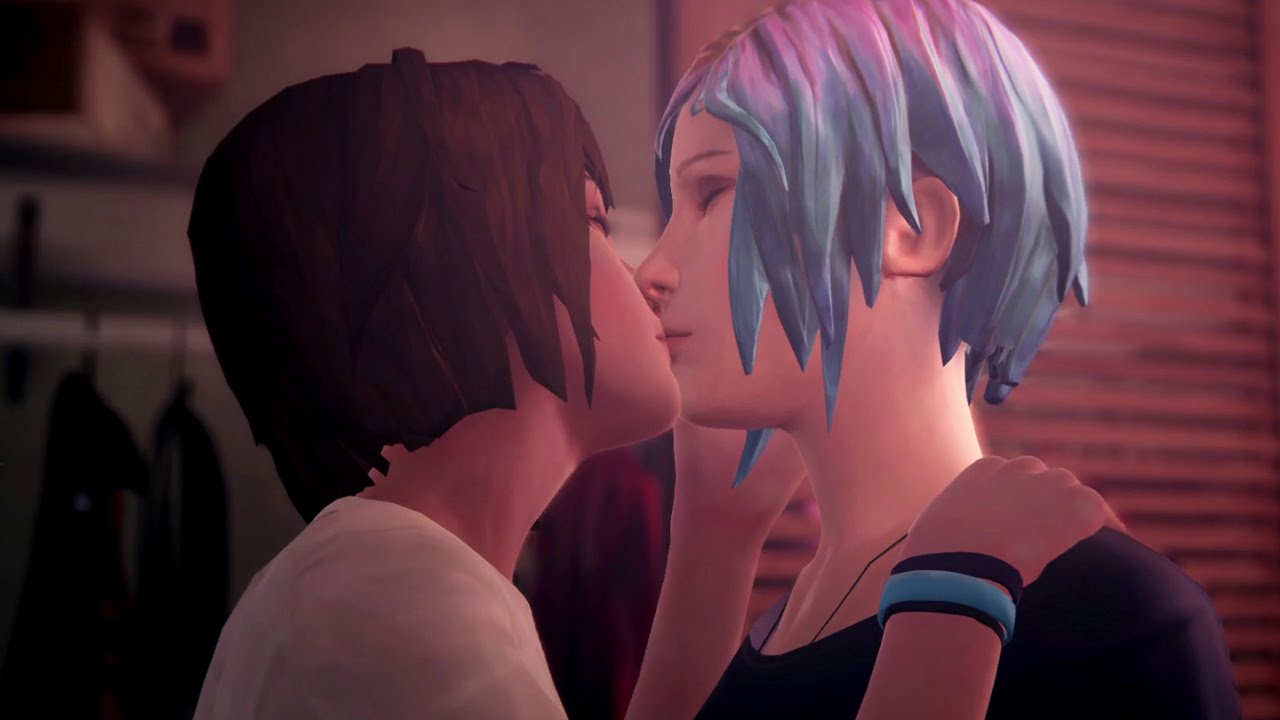
Pictured: Max kissing Chloe.  Chloe's hair is dyed in the approximate colours of the bi pride flag.

Max is bi, unquestionably.  Her close past friendship with Chloe takes on romantic overtones almost immediately after they meet again, they flirt constantly, and your first opportunity to kiss is in the middle of the game.  You can choose not to, of course, but 80% of players went for it, as is right and good.  If you do, the flirting only ramps up afterwards.  Chloe really only expresses interest in other girls, primarily Rachel, and it's hard to tell if she's just teasing you when she talks about how hot Mr Jefferson the photography goatee teacher is.  And while they have some obviously sexualised scenes (playing in the pool at night, nearly naked) it's mostly not objectifying camerawork.  (Being male, I'm probably not a good source on whether the male gaze applies.)

Max's other potential love interest is Warren, a nerdy boy who defies the vast majority of expected nerd boy cliches.  He's super excited about what a geek Max is and wants to trade classic SFF movies with her, but he never becomes the entitled and resentful Nice Guy, even if you reject him, even after he puts himself in physical harm to protect you.  IN FACT, if you turn down his date and he then learns you're spending all your time with Chloe, his response is basically "Oh, wow, yeah, if I were you I would also date her, good call".  (Erika: I remain conflicted on if I would pick him or not if Chloe wasn't the other option. He's kind of endearing, but also so thirsty.) No biphobia!  Not even a second of "wait, are you gay or something?"  Normalised bisexuality.  Truly this is a world unlike our own.  (Villains don't mind throwing in some homophobia now and then, generally by calling Chloe a dyke, which is kind of unnecessary but in line with the rest of the writers' choices.)

Most of the other characters very clearly have their virtues and flaws as well.  Victoria, alpha girl of the school, is snobbish and judgmental, but can also be kind and loyal, and is clearly motivated more by insecurity than malice.  Chloe's stepfather David is an ex-soldier, pushy, prying, secretive, and short-tempered, but genuinely cares about his family and is just very bad at simultaneously protecting and respecting people.

Nathan Prescott is worth talking about as well--he's the rich kid who never faces consequences for anything and (almost) kills Chloe in the first episode.  There's a lot of ableist talk about how he's "insane" and on a ton of prescription medications (in addition to illegal narcotics), but ultimately we're corrected: his mental problems didn't make him evil, they made him vulnerable, and while he's done inexcusable things, he's in turn a victim and pawn of bad people who are entirely sane.  Like Chloe's alternate timeline (and this time speaking as someone who does depend on medication for his mental health), I felt again like this ended up in better territory than usual, if not necessarily great.

With all that said, let's talk about how much I hated episode five.

Okay, 'hated' is a strong word; I was less uncomfortable than Erika was while we played through it (Erika: I spent most of this sequence clutching a pillow yelling "NO" and making upset noises at the TV), but in the aftermath I became more and more dissatisfied with the writers' choices, the wasted opportunities, and the confluence of really tired cliches in a situation that desperately needed the originality and unpredictability of the rest of the game.

It starts out bad: Chloe is dead, Max is captured, and the real villain has been revealed as Mr Jefferson, the hipster teacher Max has idolised for years.  It turns out that his favourite subject for photography is the destruction of innocence, so he likes to kidnap girls and photograph them as they are slowly overwhelmed by fear and despair.  Bound to a chair in his secret bunker, the player is mostly just forced to watch scenes play out, which is the first problem.  Episode five is less a game than an interactive movie--rather than making choices, you're pushed through a pretty linear sequence of events, trying desperately to find anything you can do that will make a difference.  The writers were clearly trying to evoke a sense of helplessness in the player (after four episodes of causality being your plaything), and I don't disagree that they succeeded.  What I dislike about this is that after four episodes of focusing on the agency and power and courage of this teenage girl, they decided that what we really needed to bring things home was a painfully long sequence in which our heroine is helplessly victimised by a violent man and we can do nothing but watch.  The game up to now had--usually--avoided being very voyeuristic, and that goes right out the window.  Prolonged camera shots of an underage, drugged girl.

This is not something I was looking for in my game.

After what feels like about nineteen weeks of pointless struggling, Max manages to find one of her photographs that she can use to tweak the very first scene of the game, rewriting the entire week.  Kate is alive, Chloe is alive, Mr Jefferson has been arrested, and Max is declared the winner of the photo competition, which means she's out of town at a gala when she receives word that the mysterious hurricane is nevertheless destroying the town.  She goes back to rewrite time again to make sure she's home to protect people, and consequences spill out of control such that she ends up back in Jefferson's evil lair with no photos.  Ex-soldier David comes to the rescue this time, because what we really needed was for her to get rescued by a strong man again (Max does help, but still, seriously?), and off Max goes to find the one remaining photo that will let her travel back to warn Chloe and save the day.

It works, though apparently the developers felt they needed padding or just hadn't shown off enough graphical tricks yet, because first there's an extended nightmare dungeon sequence that is pretty much exactly what I'd like to see in a horror movie, except that since when is this game a horror movie.  It was cool, and it's certainly a powerful scene when Mirror Max berates Player Max for using her time-warp powers to make people like her.  I just wish they had given us more reason for any of those scenes to be in the game, apart from 'it was cool and we had a half hour of runtime to fill'. (Erika: However it would have made for a great horror game.)

The final choice of the game comes in the same place the story starts, on a cliff, watching the hurricane bear down on Arcadia Bay.  At this point, our heroes have 'realised' that all of these bizarre phenomena are somehow caused by Max's time-warping, including this very storm.  How they've realised this remains unclear to me; it seems like a pretty strong application of post hoc ergo propter hoc.  (It would have been just as reasonable to conclude that some other force had fractured reality, causing various disasters but also somehow allowing Max to hop between possible timelines, near as I can tell.)  Regardless, Chloe realises that Max only developed her powers to prevent Chloe's death, and so offers Max a photograph that will let her travel back to day one, allow Chloe to get shot, never gain her time powers, and thus prevent any of the catastrophes that follow.

Yeah.

A brief list of things I am provisionally okay with:
  • moral conundrums where you have to choose between one person you value most or a bunch of other people
  • diabolus ex machina in which some kind of force majeure threat out of nowhere requires you to choose between two flawed results
  • villains being characterised as creepy hipster misogynists who literally see women as objects, even and especially if it's not blatantly sexual
  • gameplay sequences specifically designed to evoke a feeling of helplessness
But when you combine all of these things to tell a story about a heroine getting tied up, drugged, threatened in various physical and psychological ways, punished for every choice she makes, and ultimately told that the will of the universe is that she either allows her girlfriend to be murdered or she will personally be responsible for a random town-destroying disaster...

Again, this is not what I was looking for in this game.

On the plus side, you can choose not to sacrifice Chloe, so it doesn't have to be a story about the Tragic Lesbian who dies selflessly to save the straights.  Yet the writers obviously felt that was the stronger story, and put substantially more time into that ending than they did into the one where you let the storm run its course and then drive off into the sunrise.  (You also only kiss Chloe again if it's right before you rewind to let her die; otherwise it's hugs only.)  In both cases, I'm not sure I've ever seen a game that so desperately needed a 'where are they now' ending for its various side characters, which would have fit in perfectly as, for example, a photo album that you could flip through during the end credits.  (From what I've read, the lack of detail was intentional, especially in the ending where the storm hits, as the writers wanted to leave players in suspense about who survived the disaster.)  Instead, Erika and I agreed, the supposed consequences of all of your many other decisions throughout the game are seriously undermined, since you don't get to see any impact in the end from anything but your final choice.

★Erika★
I would go as far as to say that none of your choices matter expect the final one. You either reset, and none of it happens, or you just leave them to die.  (If Max retains her memory during the days she must now relive, they could matter more, but it is unclear if she does or not, and given the previous mechanics, implied she doesn't.)  The survivors aren't going to care whether you were nice to them or not after getting a bucket of paint dumped on them, they're going to be a little preoccupied with how their lives have been destroyed by a hurricane. For a game that let you think that its choices were so important, real lunchbox letdown.

Will again★
I can see ways they could have spun the hurricane ending more effectively, and even the reset ending, but in both cases they'd have to have actually wanted to do so, and set up for it.  In the reset ending, a sequence (even a montage) of Max using whatever knowledge she still has in order to help people (supporting Kate, befriending the rest of the 'unsympathetic' students and stopping bullies, reconnecting with Chloe's mom and helping her through what follows) would have added a lot.  In the hurricane ending, obviously, how you've interacted with other characters could also influence the choices they're going to make, and 'former enemies come together to protect the community in a crisis' is a way better cliche than anything else we were getting in this episode.  Victoria and Frank the drug dealer come to mind as examples of people who are hostile by default but can have a conscience installed.  Give me Victoria mass-texting people to come to her family's storm bunker; give me Frank and David driving around town grabbing anybody stuck on foot on the street.

One last thing that I expected to mean more but never did was the nature of the big photo competition: "Everyday Heroes".  Max's winning picture is a shot of herself and her wall of photos, yet her heroism is not really evident to anyone else most of the time (the main exception coming to mind is her rescue of Kate).  Her heroism in the reset ending consists of choosing not to act.  Maybe the takeaway there is that 'everyday heroes' aren't often noticed or recognised, but it's kind of lacklustre, and there isn't much that can connect an act like that to the real world.  Conversely, there's a giant missed opportunity for plausible 'everyday heroism' if Max's little actions over the course of the week are allowed to add up to something significant in the end, like the townspeople being more ready and willing to protect each other.  Be good to people throughout the week, bring them closer together, make them more ready to weather the storm, and maybe they can save each other so you aren't pushed to let your girlfriend die.

And I figure that's exactly what the writers did not want to allow.  Either of these things--the reset ending where you see Max still finding ways to help people, or the hurricane ending where she's helped them become people who leap to protect each other--distracts from the focus of the ending right now, which is "are you going to kill your girlfriend and suffer like a hero or spare her like a selfish coward".  That is the extent of what the writers wanted you to be thinking about and left with, and all other possible consequences of your many, many choices are removed by fiat.  If anything, the message seems like it's supposed to be "life is strange (WINK) and therefore nothing is truly in your control and your choices and desires don't really matter".  Helplessness is in keeping with the themes of the final episode, but "you can't really have any agency" is again a thing I was not looking for in my bisexual SFF mystery game, especially as the 'twist' ending of a game that claims it's all about choices.

Sunday, September 21, 2014

Ender's Shadow, chapters fifteen, sixteen, and seventeen, in which Bean is a street preacher

(Content: suicide discussion, homophobia, death. Fun content: Squirrel Prophet, Bean doesn't understand algebra.)

Ender's Shadow: p. 218--275
Chapter Fifteen: Courage

The pre-chapter Warm-Up Show With Carlotta And Graff is mostly a bunch of Ender's Game name-dropping, referencing how Demosthenes is riling up the nations of Earth to demand their supergenius commander-children back after the war.  Now, at this point, we've established that the sole reasons for so much Fleet secrecy (the location of Eros, the imaginary war fleet massed in the asteroid belt, technology like forcefields and gravity control) are to keep Earth nations from tearing apart the planet before we can kill all of the formics, because the last thing we want is to go down alone.  The reason for all of the Fleet's secrecy isn't to protect Earth from the formics, but to limit the damage from the inevitable Earth-based wars when the supergeniuses go home and get religion patriotism.  But for some reason, when Valentine or Locke or Carlotta say "You should send these kids home and damn the consequences", no one says "That is literally the last thing in the entire world that we want to have happen".
"You and I can't do anything about the fact that world war will certainly come. But we can do our best to make sure these children don't become pawns in that game. [....] Give them their chance to play." 
Well done, Carlotta, that is exactly what Jesus would say in your place.  There is a huge war coming and the best you can think of is 'let's make sure the free-for-all is properly filled with children with the talent to destroy whole worlds, who have explicitly been selected for training if they were malleable enough to be pushed into doing so by adults who don't answer their questions'.  Sigh.

It's time for Dragon Army's first battle and Beantron coolly calculates that everyone else is nervous.  He eventually acknowledges his own nerves, expressed in silent watchfulness, but goes to shower and mull how he'll one day be taller than anyone, mightier, the most beloved son of humanity regardless of his genes, "greater than Wiggin", which is super left-field to me.  They're children who haven't done anything yet and he's already thinking of Ender as a rival ("Lee and Grant [....] Bismarck and Disraeli. Napoleon and Wellington"), convinced that Ender feels the same and so keeps him down to avoid building up his own competition.  (Bean already decided Ender isn't like that, back when he analysed Ender's free-time practices and their methodology, but why would Bean remember that?  What?  Perfect memory?  Naaaah.)

Ender shows up in the showers as well because Bean is late--a scene not in Ender's Game, which would have rather changed the tone of that first battle chapter, I feel.  Ender and Bean snark at each other and Ender leaves with Bean's towel so he'll have to walk through the corridors naked [drink!], and Bean is still attacking himself for freezing up in fear (now, in the showers, and in Rotterdam, when Achilles had Poke, and before that when Poke had Achilles bleeding on the sidewalk).  This is one of the better aspects of Bean's characterisation, I think, if only because it's a real flaw, it's emotional, and it's presented as something that he's always had and always just brushed off before now.

Nikolai appears, having successfully outwitted the greatest genius in the world through the clever ruse of saying Bean had Secret Diarrhea and didn't want to tell Ender for fear he'd have to sit out the battle.  He also has Bean's towel, and they bond more about how scared they are before rejoining the team.  The battle proceeds from Bean's limited point of view as a member of Tom's C Toon, somehow stealthily circling around Rabbit Army to attack from behind despite essentially no cover.  There are some fun SFy zero-G tactics that try very hard to sell us on the idea that Ender's orientation (enemy's gate = down) is so counterintuitive that Rabbits continually fail to expect attacks from the south/below.  Bean then goes rogue, leaping off without orders and taking out the last of the Rabbit strike force solo before they freeze him, making Bean the anonymous sole casualty mentioned in their first game.

At breakfast, Bean is on an adrenaline high and can't stop talking about how awesome Ender is, because apparently his hunger to be 'greater than Wiggin' forty minutes ago has already been subsumed once again into his role as prophet of the one true god.
"And that's because Wiggin isn't just thinking about Battle School and standing and merda like that. [....] He's thinking about how to beat the Buggers. [....] He wants to come out of this with him and the toon leaders and the seconds and if he can do it every single one of his soldiers ready to command a fleet against the Buggers if we have to."

And then, the next day when they get word of their second battle so soon, Bean decides/realises that the timeline is super short and the only thing the teachers care about is testing and graduating Ender as fast as possible.
So it's already too late for me. Wiggin's the one they've chosen to rest their hopes on. Whether I'm toon leader or not will never matter. All that matters is: Will Wiggin be ready?
Bean's ambitions are all the hell over the map this chapter, eh?  But Bean decides that there will probably be plenty of war post-Third-Invasion for him to make his name in, and so he needs to build up Ender, despite their continued animosity.  I mean, I sort of like that he's got ambition, but it's also weird that all of his ambition is military for no apparent reason.  He's got no interest in solving any of Earth's other problems, putting his attention anywhere other than xenocide, despite his total despair that he's ever going to get recognition in Battle School or join the campaign.  (Actually talking to Ender again is not on his prophet checklist, so resolving their problem like that is out of the question--he actually considered it, "then common sense prevailed".  What?)

He wanders to the arcade, briefly accidentally plays the Giant's Drink, runs off when the computer (still with its difficulty setting jammed to Fuck With Your Head And Damn The Consequences) gives the giant Achilles' face, and gets cornered by Bonzo.  Bean, of course, pulls the same there-is-no-honor-in-beating-up-a-little-boy approach that Ender will use, and so doesn't get too roughed up at first, although after flinging some insults he does get choked a bit.  Bonzo calls Ender a "catamite", which is an interestingly specific choice on Card's part--Bonzo's a villain and always wrong, so we could take this as indicating that homophobia is bad, but there's still enough room to just assume that, objectively, that's a bad thing to be and therefore an appropriate insult for any occasion.

In the aftermath, Bean inexplicably refuses to tell Nikolai who choked him, but reports the incident to Dimak, who of course brushes it off, given that he's under orders from Graff and he's probably already taken odds from his bookie.

Chapter Sixteen: Companion

Oh my god this is the worst random musing in this whole book--Carlotta and Anton discussing suicide:
"We get used to everything. We find hope in anything. [....]  In my view, suicide is not really the wish for life to end. [....] It is the only way a powerless person can find to make everybody else look away from his shame. The wish is not to die, but to hide." 
"As Adam and Eve hid from the Lord. [....] If only such sad people could remember: Everyone is naked. Everyone wants to hide. But life is still sweet. Let it go on."
Where do I even begin?  Okay, first: here is an international breakdown of suicide help lines, here is a major Canadian network, and here is a major American network.  In case any of those are relevant to anyone, ever.

Second, of all of the topics for a random throwaway conversation to promote the author's pet theories and then never address again, suicide has to be the worst possible option, and at the very least Card's editing staff should have stopped him.  At least he gave genocide a whole second book to discuss--but seriously, a random toss-off exchange between two character who already agree with each other and just want to indulge each other's brilliant theological references?  Pull up your pants, man, there are children present.

Third, is it just me, or is this a very well-off-white-man theory to have?  Just last chapter we had Bean telling us that fear takes on a totally different form once you're secure enough in life that you fear shame more than personal deprivation, and now we have Card telling us that shame is the real reason people kill themselves?  Maybe it's the only reason he can ever imagine, but as we've noticed before, Card has serious trouble accepting that most people don't have the same thoughts and experiences he does, and zero grasp of clinical depression.

And let's not ignore the elevated rates of suicide among queer youth, which are already known to be associated with bullying and institutionalised discrimination.  I can't decide if Card is saying that a kid (who gets bullied all day at school and comes home to homophobic or transphobic parents and gets online and gets harassed by other gamers or bloggers or whomever) who finally ends up killing themselves is just succumbing to their own shame at how twisted and broken they are, or if he's saying that all that bullying wouldn't bother them so much if they just imagined Jesus hugging them more.  Either way, what a colossal jackass.

Moving on to Battle School again--Dragon Army gets worn down, winning game after game, until the fateful match with Salamander, their second battle of the day, with an open room and Salamander already deployed around Dragon's gate.  They do their makeshift-armorsuit trick, devastate Salamander, and Ender loudly has Bean, the Littlest Space Marine, explain how Bonzo could have won by keeping up constant movement.  Bean of course thinks this is needless provocation of Bonzo, which finally gives us something interesting:
Did he do it deliberately? Wiggin was always in control of himself, always carrying out a plan. But Bean couldn't think fo any plan that required yelling at Major Anderson and shaming Bonzo Madrid in front of his whole army. 
Why would Wiggin do such a stupid thing?
This is interesting to me simply because, if Bean is right and Ender is smart (things we can generally rely upon, in-universe) this suggests that Ender really is trying to provoke Bonzo, and if that's true, then he's either trying to make Battle School so dangerous for himself that they pull him out, or he's already trying to goad Bonzo into a deathmatch.  Chalk up another point of evidence for Team Premeditation!

Bean's started getting less-than-perfect math scores because he's too busy thinking up tactics, both for laser tag and space war, and one day decides to snark his way out of a math test by writing:
2 + 2 = π(sqrt(2 + n)) 
When you know the value of n, I'll finish this test.
Which, I mean, not to try to out-jackass Bean, but n = ((4/π)^2) - 2.  Pi is irrational, so we can't actually write it out in numeral form, but that doesn't make it somehow not a number.  Maybe this is just a notation error and n wasn't supposed to be included in the square root?  I'm not sure.

The last scene for this chapter is also kind of fun, because it's a scene that was from Bean's perspective in Ender's Game, and here it still is, but with substantially more complicated internal dialogue.  When asked to assess himself, Bean doesn't mention any of his new retconned achievements like being a source of constant new ideas and analyses to Tom, because "that would be brag and borderline insubordination", although if Tom hasn't mentioned any of that to Ender, Tom's also kind of a jerk.  Bean instead only report on his "public record", his accuracy and survival stats.  When Ender prods him into talking about the bigger picture of the war, Bean's choice to sit on the floor and not meet his eyes is now justified by Bean's fears that in the panopticon they are awlays watching his face and he mustn't give away how much he's guessed about the coming invasion.  Ender assigns Bean his special Ridiculous Ops toon, asks him to come up with stupid ideas, and as they settle into bed, Bean mulls much longer and adds two more assignments for himself--support Ender's prep for space war, and find some way to strip Bonzo's support, "so that, in the crunch, he would have to take on Ender Wiggin alone or not at all."  Ah, Bean, so redundant.

Chapter Seventeen: Deadline

Entertaining but irrelevant dialogue about whether to bring Achilles up to Battle School.  They have every reason not to, but by sufficient willful misinterpretation of psych data, Graff can justify it and try to bump the kill count a little higher before he's shipped away.

The first part of this chapter, as Bean assembles Ridiculous Ops, is actually pretty good, because it's character stuff with people leaning up against their flaws (Bean's emotional hunger, Tom's anger problems) and doing better at overcoming them, because they've learned to trust each other more, and no one says or does anything morally reprehensible for multiple pages.  It's a good run.

One of the recruits is called Shovel, but he's white, so he protests his stupid nickname, and Bean takes him seriously.
Bean thought back. Shovel's real name was Ducheval. "You prefer 'Two Horses'? Sounds kind of like a Sioux warrior."
Which: first, no it doesn't; second, 'two horses' would be 'deux chevaux', 'du cheval' means 'of horses' and Bean should know that because he speaks French; third, why is that Bean's go-to reference when he speaks like a dozen languages and has apparently already absorbed the history of the Western Hemisphere for the last thousand years?  The only reason we would think 'Two Horses' sounds like a funny name is because when people call me William they've forgotten or they never knew that it means 'Iron Helm' (or, as I prefer to translate it, 'Metalhead').

Graff, Dimak, and Dap are all arguing (both of them protesting Graff's plans to set Ender and Bean into deathmatches with their archnemeses), and Graff is not interested in this because "Self-doubt was the one thing that neither candidate could afford to have. [....] The boys had to face their worst fears, knowing that no one would intervene to help."  Dimak points out that this theory is "completely unproven and unprovable except in the blood of some child", which I guess is the first canonical confirmation we've had that Graff really did invent his educational practices out of nowhere, rather than being taught this kind of thing as standard practice.  Graff is the embodiment of author fiat.

Bean arrives and tells us all things we know--time is short, the rules are changing, you need Ender tested fully, you're testing our resourcefulness so give us some resources--and ultimately wears Graff down into letting him browse the school inventory once.  Thus Bean acquires the deadline, used to tie things together in space, thin and strong and impossible to cut except with a blowtorch.
"This is what I want." 
"Just one?" asked Dap, rather sarcastically. 
"And a blowtorch," said Bean.
Now that would have been a game of laser tag worth seeing.  'The enemy's gate is wherever the hell I decide it is'.  They have their practice, and when they leave the battleroom, the halls are full of Salamanders.  It's time for Petra's next big moment/failure, asking to talk to Ender in the halls while bullies prepare to ambush him.
Either she was a perfect actress or she was oblivious, Bean realized. She only seemed aware of the other Dragon uniforms, never as much as glancing at anybody else. She isn't in on it after all, thought Bean. She's just an idiot.
Which is about what we were left thinking in Ender's Game, although in a few chapters she'll assure us otherwise.  Bean's solution, instead, is to rush for the Rabbit Army barracks and tell them Ender is in danger, to fill the hallway with witnesses in case something happens (though of course it doesn't), and thereafter Bean sets up a rotation of constant watch on Ender--mostly.  Apparently no one is willing to skip lunch--they already missed breakfast, but given that apparently everyone we like is obsessive about not eating, you'd think someone would sit it out.  Ender, of course, just promises not to leave his quarters and everyone goes along with it because the narrative demands it.

Bean goes because he needs to make a speech on the lunch tables like a YA slice-of-life protagonist.  He hits all the classic points, like shutting down a bully with bad grades--"Your scores are pretty much in the bottom ten percent in the school, so I thought you might need a little extra help"--and starting a slow clap--"how many here think that Ender Wiggin is the one commander we would all want to follow into battle?  Come on, how many of you!" [....] Pretty soon, the whole room was clapping. Even the food servers.--and of course, that high school classic, latent homophobia--"Anybody who raises a hand against Ender Wiggin is a Bugger-lover!"

As we all know, and as Bean apparently completely failed to notice, neither Bonzo nor anyone else who really wants to murder Ender is actually in the lunchroom, and by the time Bean pieces everything together, Bonzo is dead and Dink is helping Ender back to his quarters.  Bean takes a moment to remind Dimak that he can't legally use a 'just following orders' excuse if Graff commanded him to allow the deathmatch to happen, and then goes to flop in his bunk and think about useless he is:
I'm just a street kid whose only skill was staying alive. Somehow. The only time I was in real danger, I ran like a squirrel and took refuge with Sister Carlotta. Ender went alone into battle. I go alone into my hidey-hole. I'm the guy who makes big brace speeches standing on tables in the mess hall. Ender's the guy who meets the enemy naked [drink!] and overpowers him against all odds. 
Whatever genes they altered to make me, they weren't the ones that mattered.
We come again to the sort of central conundrum of this story, which is that they're all super-wrong.  The xenocide isn't necessary, the Third Invasion isn't necessary, which means nothing that anyone achieves in this book was actually necessary and it would have been better for everyone overall if someone else had been in charge.  So if the thesis of this book is that the most important elements of a leader aren't the brilliant intellect and infinite knowledge and memory types of things, but magical charisma and unflinching willingness to kill in an instant, are we still supposed to believe that Ender is ideal?  Or do we consider that someone else being in charge might have actually dodged the tragedy and Ender might not be the objectively perfect person they assume he is?  Do we believe Bean when he says his genius isn't so important?  I suspect we're still supposed to, but as ever, I don't see why.

Next week: Bean properly demonstrates why he's better than Ender.