Showing posts with label agency. Show all posts

Wednesday, July 6, 2016

Life Is Strange: The choices we are not allowed to make

It's kind of hard to know how to talk about Life Is Strange, the 2015 episodic/serial choice-based time-travel RPG.  It's one story in five parts, and each episode tackles drastically different concepts and subject matter, sometimes in radically different ways.  The blogqueen and I played through the first four episodes saying "Okay, on the next run (which we must obviously play) we'll do this the other way" and then found that when the final credits rolled neither of us had any real desire to pick it up again.

How exactly do I talk about a story where the phrase 'that was always going to never have happened eventually' is grammatically reasonable?  I'm going to try going roughly by episode and see how that goes.  Spoilers will be progressively spoilerier as we go.  Also, this game gets into some serious and potentially very triggering material, so if that's not something you want to deal with today, I have also posted a full index of the Ender's Game posts for your re-enjoyment.

(Content: murder, suicide, terminal illness, sexual assault, loss of agency.)

Our heroine, Max(ine) Caulfield, is a waifish photography nerd at a tiny well-respected private high school somewhere in Oregon.  It's her hometown, but she's been away for five years, so it's both familiar and confusing, and she still hasn't tried to reconnect with her childhood BFFFFF, Chloe Price.  One school day she witnesses an accidental murder in the school bathroom and spontaneously develops the ability to rewind time (if only by a few minutes).  She prevents the murder and thus saves someone who turns out to be Chloe, and together they begin searching for Chloe's missing friend, Rachel Amber.  The core mechanic of the game is Max's ability to essentially save scum her own life, thus letting her decide which version of a conversation she wants to be the 'real' one, or to see how a situation goes badly, reload the past, and take steps to prevent it again.  Very meta.  I approve.

Despite this supernatural power, the game is mostly about mundane choices--who do you want to befriend, whose secrets will you keep, whose side will you take?  The one exception to this is Max's recurring dream/vision of a hurricane coming in to obliterate the town in five days' time.  Who's behind that?  Could there be--could there BE-- something sinister about the rich kids' Vortex Club and their End of the World party in only four days' time?  Other weird phenomena also start popping up: unreasonable snow and unscheduled eclipses and beaching whales.

While the game reminds you regularly that it's all about consequences, it doesn't severely drop the hammer until episode two, when Max shorts out her time powers just when she needs to talk down her suicidal friend Kate.  The situation is as wrenchingly plausible as they can make it--Kate was drunk at a party, there's a viral video going around shaming her, no one in authority cares that she says she was drugged and assaulted afterwards, and even those who believe her are going heavy on the victim-blaming.  Refreshingly, the writers behind the game make it pretty clear that we're supposed to sympathise fully with Kate and the victim-blamers are a bunch of jackasses.  It's also not as exploitative as one might expect; there is never an opportunity to watch the video, for example.  Depending on the choices you have made up to that point and while you're on the roof, Kate can be rescued.  It's a harrowing story, but very compelling.  (On our playthrough we failed to stop her at the very end, but this is a game about time travel and anything can be undone.)

Episode three gives us a new twist when Max discovers that she can use photographs to alter moments of her more distant past, and retroactively prevents the car crash that killed Chloe's father, thus drastically rewriting the entire world.  The most drastic obvious change is that Chloe has instead been in an accident herself in the last year and is now completely paralysed with progressive organ failure.  The blogqueen and I were massively apprehensive about this, since media about disabled people tends to be awkward at best and eugenicist at worst.  To our pleasant surprise, this game avoids a lot of that.  This alternate Chloe is arguably happier than her able-bodied self, and her parents have managed to equip their home with a bunch of adaptive technology that still lets her live her life.  No one ever declares that they'd rather be dead than disabled, or implies that a disabled child is an unwanted burden on their family or friends.  The game does make it clear that being disabled is horrendously expensive, but the Price parents are resolute that they'll do anything they can to improve her life.

That said, Max can also find a letter from Chloe's doctor (which Chloe apparently hasn't been told about) saying that she probably has only a few months to live no matter what they do, and ultimately Chloe asks Max to give her a morphine overdose because she'd rather not suffer through that decline (and bankrupt her family).  The player can choose to assist or refuse, and then, either way, immediately use the photograph to restore the original timeline.  So, while it's carefully set up to make it clear that this is Chloe's choice and she specifically wants to skip her own terminal case, we nevertheless get the selfless disabled person trying to spare their loved ones the burden.  Compared to the usual depiction of disability in media, I feel this lands solidly in 'better, yet not good' territory.

Episode four brings us nearly to the end of the investigation, as our reunited heroes find a well-equipped storm bunker, "the Dark Room", that someone is apparently using as their hideout to kidnap, drug, and photograph teenage girls.  (The game implies that most of the victims were not physically raped, but some probably were, and the violation is inexcusable in either case.)  Max and Chloe finally locate the body of Rachel Amber, but it's a trap and the villain ambushes them, killing Chloe (again) and kidnapping Max.

★Interlude by Erika★
I want to take a moment to talk about Rachel Amber. She is everywhere. From one of the first scenes we see graffiti about her, we see missing posters about her, people talk about her. The early episodes hit you over the head with "wonder who is Rachel, and what happened to her!" She's the reason Chloe was at the school to start with when we run into her (she was putting up missing person posters). A large majority of the plot is driven by investigating what happened to her. She is a mystery, and she is supposed to be.  From how other characters talk about her, you're never sure how you're supposed to see her. There are implications that she is, in her own way, even guiding Max, which is what made it so... anti-climactic to get the one-two punch of "she was drugged, maybe sexually abused, and definitely photographed in horrific ways" with "yep, there's her body". I never really expected to find her alive, but I had expected more from this game than what thematically amounts to "raped and murdered". While there is little room for the game to continue exploring Rachel after this point, she only comes up once more and is largely forgotten now that the mystery is solved and she is found.

★Back to Will★
Even up to this point, I was pretty well on-board with this game.  Its treatment of harsh subject matter was at least considered if not perfect, its characters are generally complicated and interesting, it has serious and impactful choices, and it's so queer.

It is so queer, y'all.
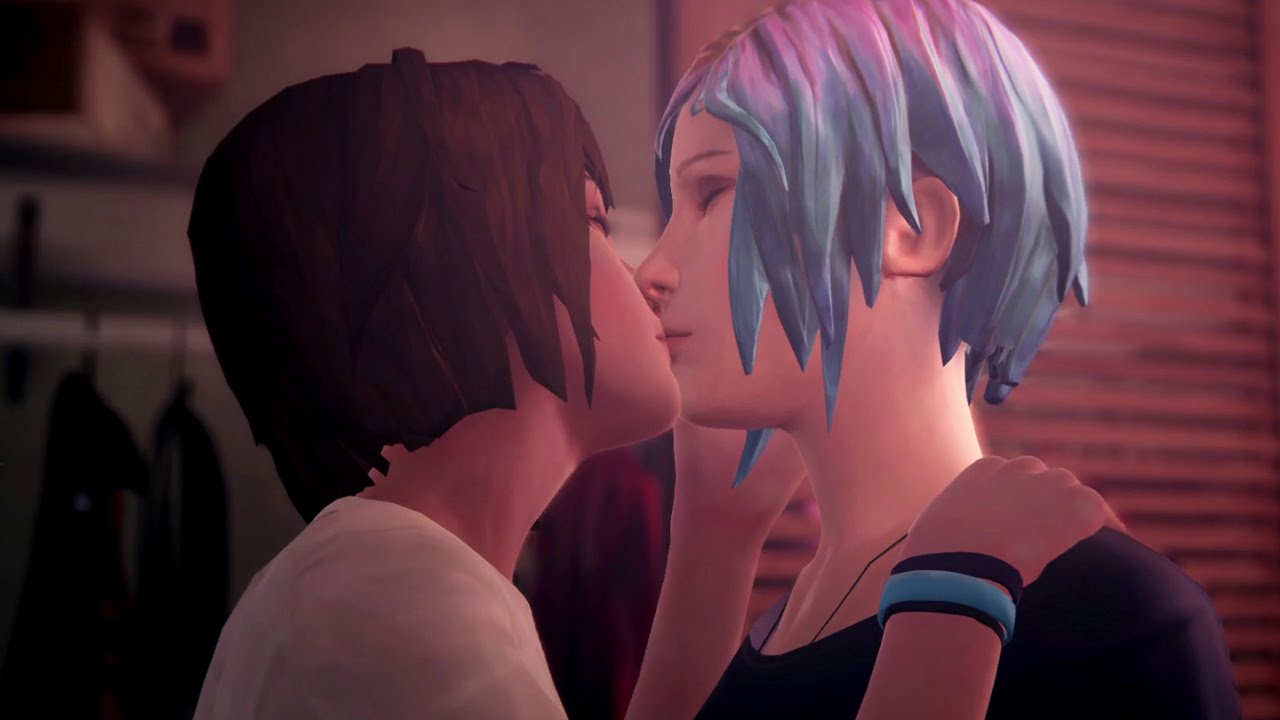
Pictured: Max kissing Chloe.  Chloe's hair is dyed in the approximate colours of the bi pride flag.

Max is bi, unquestionably.  Her close past friendship with Chloe takes on romantic overtones almost immediately after they meet again, they flirt constantly, and your first opportunity to kiss is in the middle of the game.  You can choose not to, of course, but 80% of players went for it, as is right and good.  If you do, the flirting only ramps up afterwards.  Chloe really only expresses interest in other girls, primarily Rachel, and it's hard to tell if she's just teasing you when she talks about how hot Mr Jefferson the photography goatee teacher is.  And while they have some obviously sexualised scenes (playing in the pool at night, nearly naked) it's mostly not objectifying camerawork.  (Being male, I'm probably not a good source on whether the male gaze applies.)

Max's other potential love interest is Warren, a nerdy boy who defies the vast majority of expected nerd boy cliches.  He's super excited about what a geek Max is and wants to trade classic SFF movies with her, but he never becomes the entitled and resentful Nice Guy, even if you reject him, even after he puts himself in physical harm to protect you.  IN FACT, if you turn down his date and he then learns you're spending all your time with Chloe, his response is basically "Oh, wow, yeah, if I were you I would also date her, good call".  (Erika: I remain conflicted on if I would pick him or not if Chloe wasn't the other option. He's kind of endearing, but also so thirsty.) No biphobia!  Not even a second of "wait, are you gay or something?"  Normalised bisexuality.  Truly this is a world unlike our own.  (Villains don't mind throwing in some homophobia now and then, generally by calling Chloe a dyke, which is kind of unnecessary but in line with the rest of the writers' choices.)

Most of the other characters very clearly have their virtues and flaws as well.  Victoria, alpha girl of the school, is snobbish and judgmental, but can also be kind and loyal, and is clearly motivated more by insecurity than malice.  Chloe's stepfather David is an ex-soldier, pushy, prying, secretive, and short-tempered, but genuinely cares about his family and is just very bad at simultaneously protecting and respecting people.

Nathan Prescott is worth talking about as well--he's the rich kid who never faces consequences for anything and (almost) kills Chloe in the first episode.  There's a lot of ableist talk about how he's "insane" and on a ton of prescription medications (in addition to illegal narcotics), but ultimately we're corrected: his mental problems didn't make him evil, they made him vulnerable, and while he's done inexcusable things, he's in turn a victim and pawn of bad people who are entirely sane.  Like Chloe's alternate timeline (and this time speaking as someone who does depend on medication for his mental health), I felt again like this ended up in better territory than usual, if not necessarily great.

With all that said, let's talk about how much I hated episode five.

Okay, 'hated' is a strong word; I was less uncomfortable than Erika was while we played through it (Erika: I spent most of this sequence clutching a pillow yelling "NO" and making upset noises at the TV), but in the aftermath I became more and more dissatisfied with the writers' choices, the wasted opportunities, and the confluence of really tired cliches in a situation that desperately needed the originality and unpredictability of the rest of the game.

It starts out bad: Chloe is dead, Max is captured, and the real villain has been revealed as Mr Jefferson, the hipster teacher Max has idolised for years.  It turns out that his favourite subject for photography is the destruction of innocence, so he likes to kidnap girls and photograph them as they are slowly overwhelmed by fear and despair.  Bound to a chair in his secret bunker, the player is mostly just forced to watch scenes play out, which is the first problem.  Episode five is less a game than an interactive movie--rather than making choices, you're pushed through a pretty linear sequence of events, trying desperately to find anything you can do that will make a difference.  The writers were clearly trying to evoke a sense of helplessness in the player (after four episodes of causality being your plaything), and I don't disagree that they succeeded.  What I dislike about this is that after four episodes of focusing on the agency and power and courage of this teenage girl, they decided that what we really needed to bring things home was a painfully long sequence in which our heroine is helplessly victimised by a violent man and we can do nothing but watch.  The game up to now had--usually--avoided being very voyeuristic, and that goes right out the window.  Prolonged camera shots of an underage, drugged girl.

This is not something I was looking for in my game.

After what feels like about nineteen weeks of pointless struggling, Max manages to find one of her photographs that she can use to tweak the very first scene of the game, rewriting the entire week.  Kate is alive, Chloe is alive, Mr Jefferson has been arrested, and Max is declared the winner of the photo competition, which means she's out of town at a gala when she receives word that the mysterious hurricane is nevertheless destroying the town.  She goes back to rewrite time again to make sure she's home to protect people, and consequences spill out of control such that she ends up back in Jefferson's evil lair with no photos.  Ex-soldier David comes to the rescue this time, because what we really needed was for her to get rescued by a strong man again (Max does help, but still, seriously?), and off Max goes to find the one remaining photo that will let her travel back to warn Chloe and save the day.

It works, though apparently the developers felt they needed padding or just hadn't shown off enough graphical tricks yet, because first there's an extended nightmare dungeon sequence that is pretty much exactly what I'd like to see in a horror movie, except that since when is this game a horror movie.  It was cool, and it's certainly a powerful scene when Mirror Max berates Player Max for using her time-warp powers to make people like her.  I just wish they had given us more reason for any of those scenes to be in the game, apart from 'it was cool and we had a half hour of runtime to fill'. (Erika: However it would have made for a great horror game.)

The final choice of the game comes in the same place the story starts, on a cliff, watching the hurricane bear down on Arcadia Bay.  At this point, our heroes have 'realised' that all of these bizarre phenomena are somehow caused by Max's time-warping, including this very storm.  How they've realised this remains unclear to me; it seems like a pretty strong application of post hoc ergo propter hoc.  (It would have been just as reasonable to conclude that some other force had fractured reality, causing various disasters but also somehow allowing Max to hop between possible timelines, near as I can tell.)  Regardless, Chloe realises that Max only developed her powers to prevent Chloe's death, and so offers Max a photograph that will let her travel back to day one, allow Chloe to get shot, never gain her time powers, and thus prevent any of the catastrophes that follow.

Yeah.

A brief list of things I am provisionally okay with:
  • moral conundrums where you have to choose between one person you value most or a bunch of other people
  • diabolus ex machina in which some kind of force majeure threat out of nowhere requires you to choose between two flawed results
  • villains being characterised as creepy hipster misogynists who literally see women as objects, even and especially if it's not blatantly sexual
  • gameplay sequences specifically designed to evoke a feeling of helplessness
But when you combine all of these things to tell a story about a heroine getting tied up, drugged, threatened in various physical and psychological ways, punished for every choice she makes, and ultimately told that the will of the universe is that she either allows her girlfriend to be murdered or she will personally be responsible for a random town-destroying disaster...

Again, this is not what I was looking for in this game.

On the plus side, you can choose not to sacrifice Chloe, so it doesn't have to be a story about the Tragic Lesbian who dies selflessly to save the straights.  Yet the writers obviously felt that was the stronger story, and put substantially more time into that ending than they did into the one where you let the storm run its course and then drive off into the sunrise.  (You also only kiss Chloe again if it's right before you rewind to let her die; otherwise it's hugs only.)  In both cases, I'm not sure I've ever seen a game that so desperately needed a 'where are they now' ending for its various side characters, which would have fit in perfectly as, for example, a photo album that you could flip through during the end credits.  (From what I've read, the lack of detail was intentional, especially in the ending where the storm hits, as the writers wanted to leave players in suspense about who survived the disaster.)  Instead, Erika and I agreed, the supposed consequences of all of your many other decisions throughout the game are seriously undermined, since you don't get to see any impact in the end from anything but your final choice.

★Erika★
I would go as far as to say that none of your choices matter expect the final one. You either reset, and none of it happens, or you just leave them to die.  (If Max retains her memory during the days she must now relive, they could matter more, but it is unclear if she does or not, and given the previous mechanics, implied she doesn't.)  The survivors aren't going to care whether you were nice to them or not after getting a bucket of paint dumped on them, they're going to be a little preoccupied with how their lives have been destroyed by a hurricane. For a game that let you think that its choices were so important, real lunchbox letdown.

Will again★
I can see ways they could have spun the hurricane ending more effectively, and even the reset ending, but in both cases they'd have to have actually wanted to do so, and set up for it.  In the reset ending, a sequence (even a montage) of Max using whatever knowledge she still has in order to help people (supporting Kate, befriending the rest of the 'unsympathetic' students and stopping bullies, reconnecting with Chloe's mom and helping her through what follows) would have added a lot.  In the hurricane ending, obviously, how you've interacted with other characters could also influence the choices they're going to make, and 'former enemies come together to protect the community in a crisis' is a way better cliche than anything else we were getting in this episode.  Victoria and Frank the drug dealer come to mind as examples of people who are hostile by default but can have a conscience installed.  Give me Victoria mass-texting people to come to her family's storm bunker; give me Frank and David driving around town grabbing anybody stuck on foot on the street.

One last thing that I expected to mean more but never did was the nature of the big photo competition: "Everyday Heroes".  Max's winning picture is a shot of herself and her wall of photos, yet her heroism is not really evident to anyone else most of the time (the main exception coming to mind is her rescue of Kate).  Her heroism in the reset ending consists of choosing not to act.  Maybe the takeaway there is that 'everyday heroes' aren't often noticed or recognised, but it's kind of lacklustre, and there isn't much that can connect an act like that to the real world.  Conversely, there's a giant missed opportunity for plausible 'everyday heroism' if Max's little actions over the course of the week are allowed to add up to something significant in the end, like the townspeople being more ready and willing to protect each other.  Be good to people throughout the week, bring them closer together, make them more ready to weather the storm, and maybe they can save each other so you aren't pushed to let your girlfriend die.

And I figure that's exactly what the writers did not want to allow.  Either of these things--the reset ending where you see Max still finding ways to help people, or the hurricane ending where she's helped them become people who leap to protect each other--distracts from the focus of the ending right now, which is "are you going to kill your girlfriend and suffer like a hero or spare her like a selfish coward".  That is the extent of what the writers wanted you to be thinking about and left with, and all other possible consequences of your many, many choices are removed by fiat.  If anything, the message seems like it's supposed to be "life is strange (WINK) and therefore nothing is truly in your control and your choices and desires don't really matter".  Helplessness is in keeping with the themes of the final episode, but "you can't really have any agency" is again a thing I was not looking for in my bisexual SFF mystery game, especially as the 'twist' ending of a game that claims it's all about choices.

Wednesday, September 2, 2015

This is Totally Outrageous: Erika vs Jem and The Holograms episode 1

Does anyone else have to use the disclaimer "I remember liking this thing, but I watched it a long time ago so who knows?" because I have to do that. A lot. I'm going to be very honest with you. I have a terrible memory. I usually have to get people to jar my memory on movies I've seen more than a year ago. So it should be no shock that I remember very little about Jem and the Holograms, a show I remember watching as a little kid. I remember that they're totally outrageous, I'm pretty sure there's a keytar and some Hanna Montana identity switching going on, and as I kid I freaking loved it. That.... That's about it. I remember questioning why protagonists were always blond women and Jem and the holograms being one that really made me question that, which is strange because I also remember at least one of the Holograms is black.

So let's all go on a journey together to see how the bounty of Netflix may potentially traumatize me. I mean, Netflix thinks I'll love it (5 entire stars!) but their algorithm is questionable at best.

Episode 1. Titled, creatively, The Beginning. It opens with the girls pulling up to some red carpet event with excited fans chanting "Jem" and then one by one introduces us to the girls. First out of the car is Aja, whose name we know instantly because the crowd starts to chant it. She smiles but does nothing exciting, so I assume she's more subdued or shy. Next up Shana, and again, crowd starts to chant her name. She poses and fluffs her magnificent afro (if I am incorrect in calling it an afro someone please correct me) and her pose screams "confidence" to me. She and Aja then pull out Kimber, who does a flip and is met with the same excitement. I'm assuming she's the spunky one? I am pointing this out because it's actually kind of brilliant. Each girl poses in different ways as they get out of the car which tells us a little about them as well as their names, and since they're chanted small kids have a chance at remembering them.

Lastly Jem gets out of the car, the crowd loses their collective shit, microphones of questionable physical possibility hover around the frame as she's pelted with questions about who she really is, is there another album, how does she like being famous. There is then a narrated line of "I remember how it all began. With the unexpected death of my father" and then BAM we're in a cemetery and it's raining and what is going on. This tone change was so sudden and dramatic that I'm kind of losing it over here. This is amazing.

We get about a three second scene of her by her Father's grave where a man named Eric Raymond stops to check with Jerrica (also establishing the dual identity of Jem) to ask if there's anything she needs and to tell her he's there if she needs him. Her--I'm assuming boyfriend? I think Rio is her boyfriend, I don't remember her having a brother--tells him off because she has all the help she needs.


How is that a remotely appropriate response to someone trying to offer your (I'm like 90% sure girlfriend) comfort or help as she is burying her father. There is no mention of her mother, so I can only assume Jerrica was in fact hatched from an egg her Dad found.

Jem, rather than asking Rio what the shit, apologizes FOR him as Rio drags her off angrily, and insists he means well to Raymond.

I do not like Rio.

Jerrica then tells us that her Father left her two inheritances: she inherits a foster home for girls and a record company. Both called Starlight. Her Dad either let her name everything as a child, had a strange sense of branding, or just hated thinking up names. Either way, the foster house needs money so Jerrica is off to do what her Dad did, take money from the record company! That... seems like it might have some questionable tax laws. I mean, there are donations, but it sounds kind of like he didn't donate it, just... took it.

She dodges past the security guard (rather than... wait seven seconds for him to call ahead to Raymond, or tell him who she is) because... I have no idea how old Jem is supposed to be. She seems to have a lot of agency, so I'm assuming she's not a teenager, but she's certainly acting like one. I assume all this is to establish "hey, Raymond is probably a villain messing with her dad's company and he replaced the nice security guard with this doody head" but maybe it's to show off Jerrica's infiltration skills and to hint that she might SECRETLY BE A SPY.

Slips past the new secretary, Raymond keeps calling her "darling", tells her she's just a kid (HOW OLD IS SHE WHAT THE WHAT) and insists that this is a business and he shall MAKE IT THE MOST POWERFUL RECORD COMPANY EVAR!!! And introduces his new band, The Mistfits, who ride in on fucking guitar bikes.

Pictured: The three women of the band "The Misfits" on fucking guitar motorcycles.

This is everything I have ever wanted out of life and more. Raymond has no issue with his new weirdly similar-looking girl band having apparently driven their guitar motorcycles into his office building, taken them up the elevator, and now into his office. Jerrica however is deeply offended to see her Father's office misused this way and tells them to stop ripping up the carpets yo. This leads to them laughing at her because NO ONE TELLS THE MISFITS WHAT TO DO (she just told them she owns half the company, so I have questions) before launching into a music video number where they, through a series of carnival games, throw Jerrica all over the place and I have so many questions. How are they summoning these? Do the bikes only fly during musical montages? Can they always fly? Why would you ever go anywhere that wasn't flying if that was an option?

Jerrica is now angry and starts pulling some "How dare you use MY FATHER'S COMPANY to promote this trash?!" which, naturally, the Misfits are unhappy about. I'd be pissed if someone called me trash right after I performed a whole musical number for them, complete with some weird special effects. Raymond just says "Well there's nothing you can do so neener" and she storms off.

Again, I have questions. As has been said repeatedly in this like, two minute scene, Jerrica owns half the company. Couldn't she just...go to a board meeting, get like one person on her side and outvote him? Or if she owns half the company, that means she gets half the profits--if she's so desperate for money for this foster home, why not just... take it out of the presumably huge chunks of cash she's getting from the company? Maybe it's locked and she can't access it until she turns a certain age? HOW OLD IS SHE?

It doesn't matter. Nothing matters. She gets hologram earrings and and AI named Synergy brings her to her Father's secret underground music base to show her all the clothes and car and musical gear he left for her (as well as a super high tech holographic music synth AI). Why did he hide this? Is this all tax evasion? Either way, the girls realize what they must do. Crash the battle of the bands and DEFEAT THE MISFITS. THEY MAY HAVE MAGIC HOVER GUITAR BIKES BUT WE HAVE HOLOGRAMS YO. Holograms that Jerrica's earrings can project from anywhere.

So they crash the battle of the bands. Raymond is OUTRAGED THIS CONTEST IS INVITE ONLY and Jem says "But she invited us" and with the help of her holo-earrings is then Jerrica. A deal is struck. If in six months if Jerrica can make Jem more popular than the Misfits, she gets the company. If the Misfits are more popular, she does. She takes the challenge and then out of nowhere some guy is all "Oh hey, let me get in on this. Winner gets a movie deal AND THIS SWEET MANSION."  No really. He legit offers them a mansion the same way Bob Parker says "A NEW CAR".  It's amazing.

I just--HOW OLD IS JERRICA CAN SHE LEGALLY MAKE THIS SORT OF DEAL WHY IS THERE NO PAPER WORK INVOLVED THIS IS ALL VERY QUESTIONABLE AND I THINK JERRICA NEEDS A LAWYER.

The Misfits then straight up steal their instruments, and rather than press charges, or call the cops, the girls all pile into their car and chase the van. The Misfits see this and their van mysteriously has no back door and is just... open, and start heaving their stuff. This causes the Holograms to swerve and get hung up on a cliff.

The solution? To use Synergy to project Jem to get Rio's attention.

?????

Okay. I mean, flagging for help makes sense, but, how does Rio know who Jem is? He wasn't at the battle of the bands that we saw. Did the girls on their way out stop to introduce them to his own girlfriend in disguise? Either way, it all goes well and there's some media coverage about Rio being a good dude and the girls being a band.

So, they don't call the cops on the Misfits FOR NEARLY KILLING THEM or smashing their instruments. Something Raymond points out when he's annoyed. The Misfits, like well adjusted musicians, respond to this with a song called Winning Is Everything. I'm going to be honest, the three songs we've gotten so far? They're not good. They're super repetitive. I vaguely recall not loving them as a kid either. I will admit that the singers aren't bad (Jem is actually pretty good) but it's not enough to save them.

So Raymond starts to make preparations to win the company. Like using his superior budget and connections to book the Misfits on tours, getting TV and radio play--hah, just kidding, he hires someone to break into Starlight house to scare Jerrica into being non-functional. The girls find him robbing them, he dashes off, knocks a lantern over (they currently have no power) AND OH NO THE HOUSE IS ON FIRE.

That's the end of the episode. It ends with TO BE CONTINUED

I did not realize how much I miss 90s cartoons until today. I'm kind of loving how over the top this is and hoping the song writing gets better. I've got nothing critical or insightful to say here. The group of girls is diverse (even if they all have the same body shape) and seem to have agency? Rio is around to help a lot but generally the girls seem to be doing as much or more than he is, as well as being the ones to parent the younger girls in Starlight House. It's hard to think of anything in depth to say when all you can think is "THOSE ARE FUCKING GUITAR BIKES OH MY GOD THIS IS AMAZING".

I do have some questions though. Are there no police in this world? Are they just really ineffective? How did no one ever accidentally lean on that wall to find out it was fake and find Jerrica's dad's secret holo-base? Why did her dad keep Synergy a secret from his business partner and Jerrica, but arrange for it to hunt her down after he died? Will we ever find out about the secret spy training she has, or will it just be alluded to over and over again? Where are all the lawyers in this world? What was this house made of that it caught fire so quickly? If Jerrica can project holograms, can she send Jem to go call for help? Why do we park in driveways and drive on parkways?

TUNE IN NEXT TIME FOR ALL THESE ANSWERS AND MORE!*

*I make no promises to answer any of these questions but come back next time anyways because it makes me feel loved.

Wednesday, March 11, 2015

The Eye of the World, chapters 28, 29, and 30, in which I am the least disappointed I've ever been

At some point I apparently stopped doing content notes, on the basis that most of the stuff being covered no longer seemed half as startling and triggery as Ender's Game got, but this week it's back with a vengeance because oh my god Perrin that had better have been Satan's idea and not yours.

(Content note: misogyny, discussed murder-suicide.  Fun content: candids of Moiraine and Elyas.)

The Eye of the World: p. 414--440
Chapter Twenty-Eight: Footprints in Air

We catch up with Nynaeve and her amazing pals as they also arrive at Whitebridge, and they have experienced zero change in party dynamic over their many days of travel since Shadar Logoth.  I mean, if things don't even happen on page I can't really expect them to start acting like real people off-page, can I?  She still fumes at Moiraine all day while Moiraine stays perfectly calm and says they're going to Tar Valon once they find the boys.  The only new addition to this is that Nynaeve protests a little too much inside her own head about how she totally doesn't have a boner for Lan.  Nynaeve is made of self-repression and indignation.

They arrive at Whitebridge and a bunch of homes have been burnt to the ground.  Oh no, are our heroes oh screw it if Jordan can't be bothered to create tension I'm not doing it for him.
In the next moment [Moiraine] was down off Aldieb and speaking to townsfolk. She did not ask questions; she gave sympathy, and to Nynaeve's surprise it appeared genuine. People who shied away from Lan, ready to hurry from any stranger, stopped to speak with Moiraine. They appeared startled themselves at what they were doing, but they opened up, after a fashion, under Moiraine's clear gaze and soothing voice.
So at first this seems like yet another redundant 'Moiraine is actually nice and Nynaeve should trust her' moment, but the bit about people startling themselves suggests that Moiraine is in fact using Old Jedi Mind Tricks on these folks who've just had their houses burn down.  From a narrative standpoint, I fully approve--morally, I think that's really inappropriate, but the Moiraine who steamrolls other people because she's a fricking wizard and she has things to do is the best Moiraine.  Give me all your dangerously intent wizard ladies.  She's the most compelling character we've met.

Moiraine [pictured without her magic soothing glamour].

So most people lie in spite of the glamour, and others have a host of useless rumours, but the gist of it is that folks (including a gleeman) showed up by boat, there was evil magic trouble, and the boat left again just before the mob arrived.  Nynaeve wonders aloud if this was Rand and company, because she is not Moiraine and therefore she must be wrong (they did not leave by boat).  They eat at the same inn as Rand, and Moiraine does some psychometry to confirm they were there recently, while Lan sniffs around and announces there was a Fade as well.  Nynaeve, showing again why she's actually a better person than everyone else, asks what Moiraine intends to do for Egwene, whom she never mentions in spite of Egwene supposedly being a potential superwizard, and Moiraine basically says "Oh, yeah, her too, totally, right, like totally, but shit happens, you know?"

And... oh, that's the end of this chapter.  It gave us another view of the White Bridge, and a recap of what happened last chapter, but with fewer details.  How extraordinarily unnecessary.

Chapter Twenty-Nine: Eyes Without Pity

Back with Elyas, Perrin, and Egwene, they're making double-time across the grasslands, and Elyas is trying harder to cover the signs of their camps, but...
The fires he made were small, and always hidden in a pit carefully dug where he had cut away a plug of sod. As soon as their meal was prepared, he buried the coals and replaced the plug. Before they set out again in the gray false dawn, he went over the campsite inch by inch to make sure there was no sign that anyone had ever been there. He even righted overturned rocks and straightened bent-down weeds.
Are you... are you serious?  Bent-down weeds?  Fact one: these are explicitly described as grasslands; you can't possibly erase all the footprints created by your teenage tagalongs.  Fact two: weeds can bend on their own.  Fact three: if you cut a fricking hole in the ground, anyone who's paying enough attention to notice a bent weed is going to notice the carved earth, even if you did slap it back in place like a peaty jigsaw puzzle afterwards.

We don't know what Elyas is afraid of chasing them--not trollocs, we're assured, partly because Perrin knows the wolves can't small trollocs.  He throws this in casually, despite having sworn last chapter that he would never let the wolves inside his head again.  I'm starting to feel like that last chapter was supposed to get edited out, since the dream-raven-in-the-eye and his vow against wolf telepathy have apparently been ditched this fast.

They just barely manage to (probably) not get spotted by a flock of a hundred ravens and Elyas mutters about places they can hide, noting that ravens roost at night.  Apparently the devil can control ravens' every move (we saw the flock do an abrupt about-face) but can't order them to stay up past their bedtime.  They do, however, demonstrate the scientific fact that ravens have the same jaw structure as piranhas, as they flock a fox and devour it in moments.  A raven spots Perrin, but Egwene takes it down with her sling, which apparently means that it can't report back to the rest of the flock.  I do not in any way understand the rules of the devil's raven telepathy.  It can't be one-way only, or they'd make terrible scouts, but apparently it can't give the flock orders based on what that one raven spotted?

Perrin catches the wolves' thoughts as they skirmish with the flock, but the ravens give up after just injuring them a bit.  Perrin reveals this, and apparently this is the first confirmation Egwene's had that he's got wolf telepathy, so there's all the usual 'oh no now she'll think I'm terrible and gross because I have innate magic' business, apparently forgetting that Egwene has already been marked as Future Best Wizard by Moiraine.  They move on without addressing it.  When Perrin calculates they have an hour before the second flock catches up with them, he decides not to tell Egwene, but he does wonder to himself if he'll "have the courage" to mercifully kill her first rather than let the ravens do it.

Perrin, you monstrous tool.

I mean can we just.  He doesn't ask Elyas if there's any hope of finding shelter before then (their hiding spot is two hours off, apparently), or if he's got any other solutions or defences.  He doesn't ask Egwene if she'd prefer a clean death if they know they're doomed, or if she'd rather fight to the last the way he apparently intends to do.  He doesn't ask himself if he could stomach offing himself before the ravens get him either.  This isn't a matter of grim mercy, this is a matter of a man seeing a woman as a subordinate object and himself as the one who has the responsibility to prevent her from being despoiled.  Does anyone think there's the slightest chance Perrin would be puzzling this murder-suicide business over if he were with Rand or Mat?  He sees Egwene as his lesser, incapable of bearing burdens or making difficult decisions, and above even her own life needing to be preserved in her pretty naive state.  This is a thing that happens in the real world and it's horrifying.  I can't actually think of an adequate obscenity or profanity to sum this up with.

(But he cries while he contemplates this, so we know he's really just scared and sensitive.  Retch.)

And then, conveniently enough, they walk into the safe zone ahead of schedule: a 'stedding',a haven of legend, where the One Power doesn't work and no one can touch the True Source and there's a strict limit on the use of Significant Capitalisation.  It's actually nicer inside the stedding, more green grass shoots, presumably because the devil doesn't have as much power to poison the land within.

Which... huh.

Remind me again why these places aren't incredibly important settlements where people build fortresses the forces of magic can never touch?  Would a stedding not be an ideal community spot to keep all your male wizards in to prevent them from getting magic madness?

Anyway.

They get to a cold pool and drink deeply and Perrin decides to never talk to Egwene ever about his mercy-kill plan, though a voice (guessing the devil) in his head tells him he would have done it.  There's actually some further taunting about that, about how easy or difficult it would have been, but none of it addresses the underlying misogyny that riled me in the first place, so whatever.

We get another history lesson, about how this place was going to be the capital of the empire of Artur Hawkwing, beloved king of legend who ruled most of the world under the law of Pax "I Have A Sword And No Conscience", i.e., criminals and tyrants got shanked right quick.  He also hated magic, and thus no one could heal him of his final sickness/poisoning, and then his whole peaceful world crumbled as everyone fought for the throne.  And apparently in the thousands of years that followed, no one else who hates magic ever decided to build here either.  So that question remains unanswered.

Chapter Thirty: Children of Shadow

I wasn't planning to start on another chapter, but I scoped out the first couple of pages and PRAISE ERU ILUVATAR Elyas calls out the misogynistic stupidity of Perrin's mercy-kill plan.
"You were ready to kill her because you despise her, always dragging her feet, holding you back with her womanish ways. [....] If she had to choose her way of dying, which do you think she'd pick? [....] I know which I'd take."
"I don't have any right to choose for her."
Elyas [pictured after a shave and a mani/pedi].

I am honestly blown away that this was addressed at all, and not just a throwaway moment to show that Perrin was taking the situation seriously.  I'm filled with so much less hatred right now.  My venom glands aren't even a little swollen.

Of course, these are Manly Men, so when Perrin is filled with disgust just looking at his axe, thinking about throwing it away, Elyas tells him to keep it, use it against the people who actually need an axe in the face, and only throw it away if he ever feels like he is okay with casual murder.  Can't get too soft.

[Edit: The more I thought about this after posting, the more I realised that, in the complete context of the scene, it's much more likely that Elyas is being ironic when he says 'you were ready to kill her because you hate her' in order to shake Perrin into realising that he doesn't hate Egwene and his mercy-kill plan was a completely blameless scheme of generosity, not a terrible thing at all.  BUT I CAN'T DEAL WITH THAT RIGHT NOW so I'm going to allow the above to stand.]

And that is where I will leave it for this week, because then we get into more stuff with how nowhere is safe and Jordan has the gall to kill off Hopper the bouncy wolf.  Note to my readers: if you ever feature a bouncy wolf in your stories, don't kill it off.  Make it the backup protagonist.

Thursday, August 15, 2013

The long fugue down the aisle towards children

Do you know "Here comes the bride" is styled after a funeral march? It's from one of Wagner's operas (and if you know Wagner, you probably know where this is going) and is played as the bride and groom prepare to consummate the marriage (yes, Here Comes The Bride is actually not what Elsa marches down the aisle to) when the antagonist (spoilers!) bursts in and starts killing a bunch of people. It's also meant as foreshadowing of the bride dying horribly because Wagner.

This is a song that 70% of couples choose as the opening credits to their married life, because it's what you do. No wonder it's even odds on divorce.

There is a script that we are all fed for how our lives will pan out. We'll grow up, go to school, start a career, meet someone, get married, have kids,  pressure them to do the same so we can have grandkids, retire, travel a bit, die.

I think at some point in our lives we all buy into this script, but I think it's a toxic one. It encourages us to define ourselves by our roles (wife, mother, teacher) rather than who we are (Monica with a great sense of humor, a passion for model sail boats, and salsa dancing). It tries to force everyone into one mold, and there is so much social pressure that it's hard not to try.

When I was a teenager, I assumed I probably wouldn't get married, and kids were just not on the radar. This was constantly met with people flat out telling me I was wrong and to "just wait". I was open to the idea of marriage, someday, maybe, but kids? Less likely. This went on, but would eventually die down when I didn't relent, or hide my annoyance at people telling me I was wrong and didn't know my own mind and couldn't possibly know my own mind. People would react so strongly to my rejecting the script that they would start fighting with me about it. When I was a 15 year old girl and admitted that maybe in ten years I'd feel differently, but for now?

Ten years later, I'm getting ready to walk down the aisle myself, but I still don't want kids. Those same people who were picking fights with me at 15 are still doing so at 25. Over my not wanting kids, which I've written about before, wanting to buy a condo in the city instead of a house in the suburbs, keeping my last name... People get nervous when you go off script. They get angry, I would assume (and it is just that, an assumption) that because they bought into it, it is the Right Way and by actively not choosing it, you are telling them they (and their friends and family who bought into it, too) are Wrong.

This is where it starts to get toxic. Little girls are not sold the idea of marriage, we sell them the idea of a wedding. We tell them about this magical day where they get to be a princess and everything is about them and everything will be Just. What. They. Want. It will be the happiest day of their lives! I can not count the amount of people who have told me "It's your wedding! Be more of a diva!" which strikes fear I can not readily articulate into me. We're told that this is part of growing up. If you're in a long term, seemingly happy relationship, it doesn't matter that you're 20*, people will start giving you unsolicited advice to just get married already! If you're 25 and in that position people start asking what's wrong, why haven't you done it yet?

It's hard not to be swayed by it. If it were one or two people spouting this it'd be easy enough to brush aside, but it isn't. It seems to be everyone, and it starts so early. It's hard not to internalize it. So we grow up thinking if we're not married by 25-30 we're doing something wrong. It leads to anxiety and panic and maybe getting married because we feel we're supposed to more than because we want to. It leads to having a hard time being happy for your friends when they get married because you're not yet, or because maybe you legally can't get married. It leads to unrealistic expectations of marriage, because half of us are sold a wedding, not a marriage. Which brings me back to my earlier snark about divorce rates.

Marriage is only one step in this process, though. What about kids fresh out of high school who take on staggering debt to get an education when they're not positive that's what they want because they're still kids, and because that's what they're told to do? What about the shame we push on the kids who don't go to school, or can't?

And what about kids? I've written before about how annoyed I get when people ask and insist I have kids. When people tell me I will never understand what love really means until I have kids (again the assumption that I will) and that it is the greatest thing EVAR and really I'm missing out why have I not insisted The Boy put a baby inside me already? They make some pretty horrible assumptions, and not just assuming I'm incapable of knowing what I want. They assume that I CAN have kids. I'm sick, and I don't know what's wrong with me, it's entirely possible that I physically can't. I'm a cook; I'd be skeptical if I financially could either. What about the women who desperately want to have children but for one of many, many reasons can't? What about adoption? There are a lot of reasons that can't work, either, and we talked about making obvious suggestions and how that's bad before, remember? Are we just pretending these people don't exist? That's a painful enough scenario to be in to start with, I'm not okay with adding to their pain by pretending they don't exist, and by pretending that they will never be complete or whole person until they have a child. It's bullshit, and it's toxic, harmful bullshit.

On the other side of the coin there are people who are married, and maybe things aren't going so well and they figure that they'll have a kid and that will help them through this rough patch. Adding kids to the equation doesn't mean making any major changes which will lead to stress and hardships during the time of transition! Babies are magical, after all, and bring nothing but happiness! What if THAT couple faces infertility? Will they feel their struggling (or failing) marriage is due to their inability to check off the next box on the list? Will they not be real adults until they do? What if they conceive and the child is sick and now they're even more angry and bitter at each other because remember what I said above about major life changes stressing people out?

The narrative, and the enthusiasm we push it with, often leads us into shame, embarrassment, insecurity, corners and dead ends because there is no one size fits all life, or path. Yet we push it on others, and ourselves, because that is what we think we're supposed to do. Asexual? Infertile? Disabled? Impoverished? Gay? Doesn't matter! You can** still have all these things! And if you don't then how will you ever be happy?

I feel I often stop and call for us to simply reject a cultural norm on this blog, but I fear I don't fully credit how huge a thing that can be to do. I mean, we can't just will dinosaurs back into existence, as much as I would also like to call for that. I like to think I've rejected the norm, but now that I've taken one of the Approved Steps I understand how easy it can be to get swept up in enforcing and encouraging the narrative. So what, and how, can we do it? Amber and frogs?

Step 1 is recognizing when we're enforcing it. Asking someone why they don't want to get married (or have kids, or go to college or or or) or telling someone they should seems like a good starting point. These are valid choices, or painful circumstances which are really none of our business either way.

Step 2 is having conversations about the narrative with other people. We need to talk about it, and we need to call people out for trying to push this agenda, and we need to support people resisting it.

Step 3 is to invade the media. Wait, what? I know that some of you are artists, in what ever medium you happen to art in, think about breaking that pattern as often as possible. Don't have your hero settle down with their love interest and live happily ever after! Have them find a different kind of happy ending. Seeing other narratives will help us normalize that there's more than one, which will loosen the stranglehold the current one has on us.

I am not saying that these are bad things to want, for the record. If you want to get married and be a stay at home parent? Power to you and I'm jealous you know what you want out of life! What I am condemning is how we push the idea of marriage/kids so fervently that people feel that these are just things you're supposed to do rather than choices that should have a lot of thought going into them.

---

*No, really. When I was 20 people were pushing me to just marry my high school sweetheart. Co-workers, relatives, random people I'd get chatting with at bus stops...
**I am not, by the way, saying that you can't still get married have kids etc if you ARE these things, simply that they are very real reasons why you may not want them.