Showing posts with label character growth. Show all posts

Wednesday, July 6, 2016

Life Is Strange: The choices we are not allowed to make

It's kind of hard to know how to talk about Life Is Strange, the 2015 episodic/serial choice-based time-travel RPG.  It's one story in five parts, and each episode tackles drastically different concepts and subject matter, sometimes in radically different ways.  The blogqueen and I played through the first four episodes saying "Okay, on the next run (which we must obviously play) we'll do this the other way" and then found that when the final credits rolled neither of us had any real desire to pick it up again.

How exactly do I talk about a story where the phrase 'that was always going to never have happened eventually' is grammatically reasonable?  I'm going to try going roughly by episode and see how that goes.  Spoilers will be progressively spoilerier as we go.  Also, this game gets into some serious and potentially very triggering material, so if that's not something you want to deal with today, I have also posted a full index of the Ender's Game posts for your re-enjoyment.

(Content: murder, suicide, terminal illness, sexual assault, loss of agency.)

Our heroine, Max(ine) Caulfield, is a waifish photography nerd at a tiny well-respected private high school somewhere in Oregon.  It's her hometown, but she's been away for five years, so it's both familiar and confusing, and she still hasn't tried to reconnect with her childhood BFFFFF, Chloe Price.  One school day she witnesses an accidental murder in the school bathroom and spontaneously develops the ability to rewind time (if only by a few minutes).  She prevents the murder and thus saves someone who turns out to be Chloe, and together they begin searching for Chloe's missing friend, Rachel Amber.  The core mechanic of the game is Max's ability to essentially save scum her own life, thus letting her decide which version of a conversation she wants to be the 'real' one, or to see how a situation goes badly, reload the past, and take steps to prevent it again.  Very meta.  I approve.

Despite this supernatural power, the game is mostly about mundane choices--who do you want to befriend, whose secrets will you keep, whose side will you take?  The one exception to this is Max's recurring dream/vision of a hurricane coming in to obliterate the town in five days' time.  Who's behind that?  Could there be--could there BE-- something sinister about the rich kids' Vortex Club and their End of the World party in only four days' time?  Other weird phenomena also start popping up: unreasonable snow and unscheduled eclipses and beaching whales.

While the game reminds you regularly that it's all about consequences, it doesn't severely drop the hammer until episode two, when Max shorts out her time powers just when she needs to talk down her suicidal friend Kate.  The situation is as wrenchingly plausible as they can make it--Kate was drunk at a party, there's a viral video going around shaming her, no one in authority cares that she says she was drugged and assaulted afterwards, and even those who believe her are going heavy on the victim-blaming.  Refreshingly, the writers behind the game make it pretty clear that we're supposed to sympathise fully with Kate and the victim-blamers are a bunch of jackasses.  It's also not as exploitative as one might expect; there is never an opportunity to watch the video, for example.  Depending on the choices you have made up to that point and while you're on the roof, Kate can be rescued.  It's a harrowing story, but very compelling.  (On our playthrough we failed to stop her at the very end, but this is a game about time travel and anything can be undone.)

Episode three gives us a new twist when Max discovers that she can use photographs to alter moments of her more distant past, and retroactively prevents the car crash that killed Chloe's father, thus drastically rewriting the entire world.  The most drastic obvious change is that Chloe has instead been in an accident herself in the last year and is now completely paralysed with progressive organ failure.  The blogqueen and I were massively apprehensive about this, since media about disabled people tends to be awkward at best and eugenicist at worst.  To our pleasant surprise, this game avoids a lot of that.  This alternate Chloe is arguably happier than her able-bodied self, and her parents have managed to equip their home with a bunch of adaptive technology that still lets her live her life.  No one ever declares that they'd rather be dead than disabled, or implies that a disabled child is an unwanted burden on their family or friends.  The game does make it clear that being disabled is horrendously expensive, but the Price parents are resolute that they'll do anything they can to improve her life.

That said, Max can also find a letter from Chloe's doctor (which Chloe apparently hasn't been told about) saying that she probably has only a few months to live no matter what they do, and ultimately Chloe asks Max to give her a morphine overdose because she'd rather not suffer through that decline (and bankrupt her family).  The player can choose to assist or refuse, and then, either way, immediately use the photograph to restore the original timeline.  So, while it's carefully set up to make it clear that this is Chloe's choice and she specifically wants to skip her own terminal case, we nevertheless get the selfless disabled person trying to spare their loved ones the burden.  Compared to the usual depiction of disability in media, I feel this lands solidly in 'better, yet not good' territory.

Episode four brings us nearly to the end of the investigation, as our reunited heroes find a well-equipped storm bunker, "the Dark Room", that someone is apparently using as their hideout to kidnap, drug, and photograph teenage girls.  (The game implies that most of the victims were not physically raped, but some probably were, and the violation is inexcusable in either case.)  Max and Chloe finally locate the body of Rachel Amber, but it's a trap and the villain ambushes them, killing Chloe (again) and kidnapping Max.

★Interlude by Erika★
I want to take a moment to talk about Rachel Amber. She is everywhere. From one of the first scenes we see graffiti about her, we see missing posters about her, people talk about her. The early episodes hit you over the head with "wonder who is Rachel, and what happened to her!" She's the reason Chloe was at the school to start with when we run into her (she was putting up missing person posters). A large majority of the plot is driven by investigating what happened to her. She is a mystery, and she is supposed to be.  From how other characters talk about her, you're never sure how you're supposed to see her. There are implications that she is, in her own way, even guiding Max, which is what made it so... anti-climactic to get the one-two punch of "she was drugged, maybe sexually abused, and definitely photographed in horrific ways" with "yep, there's her body". I never really expected to find her alive, but I had expected more from this game than what thematically amounts to "raped and murdered". While there is little room for the game to continue exploring Rachel after this point, she only comes up once more and is largely forgotten now that the mystery is solved and she is found.

★Back to Will★
Even up to this point, I was pretty well on-board with this game.  Its treatment of harsh subject matter was at least considered if not perfect, its characters are generally complicated and interesting, it has serious and impactful choices, and it's so queer.

It is so queer, y'all.
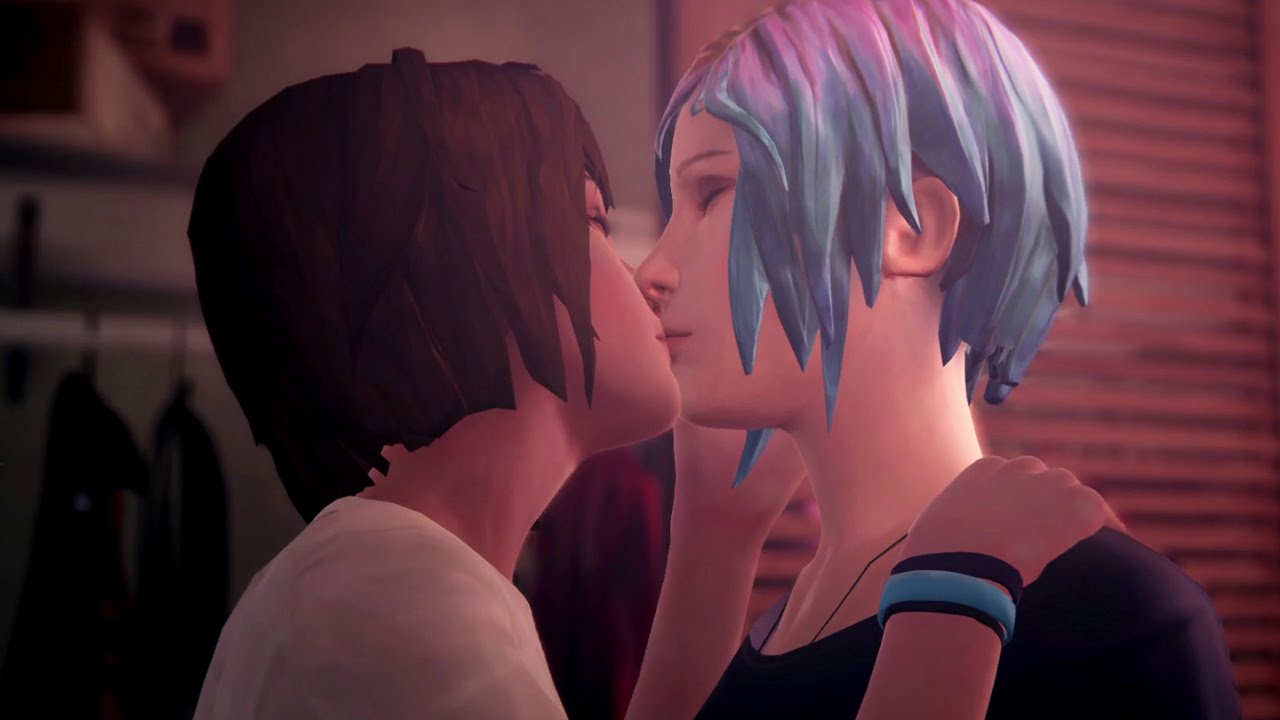
Pictured: Max kissing Chloe.  Chloe's hair is dyed in the approximate colours of the bi pride flag.

Max is bi, unquestionably.  Her close past friendship with Chloe takes on romantic overtones almost immediately after they meet again, they flirt constantly, and your first opportunity to kiss is in the middle of the game.  You can choose not to, of course, but 80% of players went for it, as is right and good.  If you do, the flirting only ramps up afterwards.  Chloe really only expresses interest in other girls, primarily Rachel, and it's hard to tell if she's just teasing you when she talks about how hot Mr Jefferson the photography goatee teacher is.  And while they have some obviously sexualised scenes (playing in the pool at night, nearly naked) it's mostly not objectifying camerawork.  (Being male, I'm probably not a good source on whether the male gaze applies.)

Max's other potential love interest is Warren, a nerdy boy who defies the vast majority of expected nerd boy cliches.  He's super excited about what a geek Max is and wants to trade classic SFF movies with her, but he never becomes the entitled and resentful Nice Guy, even if you reject him, even after he puts himself in physical harm to protect you.  IN FACT, if you turn down his date and he then learns you're spending all your time with Chloe, his response is basically "Oh, wow, yeah, if I were you I would also date her, good call".  (Erika: I remain conflicted on if I would pick him or not if Chloe wasn't the other option. He's kind of endearing, but also so thirsty.) No biphobia!  Not even a second of "wait, are you gay or something?"  Normalised bisexuality.  Truly this is a world unlike our own.  (Villains don't mind throwing in some homophobia now and then, generally by calling Chloe a dyke, which is kind of unnecessary but in line with the rest of the writers' choices.)

Most of the other characters very clearly have their virtues and flaws as well.  Victoria, alpha girl of the school, is snobbish and judgmental, but can also be kind and loyal, and is clearly motivated more by insecurity than malice.  Chloe's stepfather David is an ex-soldier, pushy, prying, secretive, and short-tempered, but genuinely cares about his family and is just very bad at simultaneously protecting and respecting people.

Nathan Prescott is worth talking about as well--he's the rich kid who never faces consequences for anything and (almost) kills Chloe in the first episode.  There's a lot of ableist talk about how he's "insane" and on a ton of prescription medications (in addition to illegal narcotics), but ultimately we're corrected: his mental problems didn't make him evil, they made him vulnerable, and while he's done inexcusable things, he's in turn a victim and pawn of bad people who are entirely sane.  Like Chloe's alternate timeline (and this time speaking as someone who does depend on medication for his mental health), I felt again like this ended up in better territory than usual, if not necessarily great.

With all that said, let's talk about how much I hated episode five.

Okay, 'hated' is a strong word; I was less uncomfortable than Erika was while we played through it (Erika: I spent most of this sequence clutching a pillow yelling "NO" and making upset noises at the TV), but in the aftermath I became more and more dissatisfied with the writers' choices, the wasted opportunities, and the confluence of really tired cliches in a situation that desperately needed the originality and unpredictability of the rest of the game.

It starts out bad: Chloe is dead, Max is captured, and the real villain has been revealed as Mr Jefferson, the hipster teacher Max has idolised for years.  It turns out that his favourite subject for photography is the destruction of innocence, so he likes to kidnap girls and photograph them as they are slowly overwhelmed by fear and despair.  Bound to a chair in his secret bunker, the player is mostly just forced to watch scenes play out, which is the first problem.  Episode five is less a game than an interactive movie--rather than making choices, you're pushed through a pretty linear sequence of events, trying desperately to find anything you can do that will make a difference.  The writers were clearly trying to evoke a sense of helplessness in the player (after four episodes of causality being your plaything), and I don't disagree that they succeeded.  What I dislike about this is that after four episodes of focusing on the agency and power and courage of this teenage girl, they decided that what we really needed to bring things home was a painfully long sequence in which our heroine is helplessly victimised by a violent man and we can do nothing but watch.  The game up to now had--usually--avoided being very voyeuristic, and that goes right out the window.  Prolonged camera shots of an underage, drugged girl.

This is not something I was looking for in my game.

After what feels like about nineteen weeks of pointless struggling, Max manages to find one of her photographs that she can use to tweak the very first scene of the game, rewriting the entire week.  Kate is alive, Chloe is alive, Mr Jefferson has been arrested, and Max is declared the winner of the photo competition, which means she's out of town at a gala when she receives word that the mysterious hurricane is nevertheless destroying the town.  She goes back to rewrite time again to make sure she's home to protect people, and consequences spill out of control such that she ends up back in Jefferson's evil lair with no photos.  Ex-soldier David comes to the rescue this time, because what we really needed was for her to get rescued by a strong man again (Max does help, but still, seriously?), and off Max goes to find the one remaining photo that will let her travel back to warn Chloe and save the day.

It works, though apparently the developers felt they needed padding or just hadn't shown off enough graphical tricks yet, because first there's an extended nightmare dungeon sequence that is pretty much exactly what I'd like to see in a horror movie, except that since when is this game a horror movie.  It was cool, and it's certainly a powerful scene when Mirror Max berates Player Max for using her time-warp powers to make people like her.  I just wish they had given us more reason for any of those scenes to be in the game, apart from 'it was cool and we had a half hour of runtime to fill'. (Erika: However it would have made for a great horror game.)

The final choice of the game comes in the same place the story starts, on a cliff, watching the hurricane bear down on Arcadia Bay.  At this point, our heroes have 'realised' that all of these bizarre phenomena are somehow caused by Max's time-warping, including this very storm.  How they've realised this remains unclear to me; it seems like a pretty strong application of post hoc ergo propter hoc.  (It would have been just as reasonable to conclude that some other force had fractured reality, causing various disasters but also somehow allowing Max to hop between possible timelines, near as I can tell.)  Regardless, Chloe realises that Max only developed her powers to prevent Chloe's death, and so offers Max a photograph that will let her travel back to day one, allow Chloe to get shot, never gain her time powers, and thus prevent any of the catastrophes that follow.

Yeah.

A brief list of things I am provisionally okay with:
  • moral conundrums where you have to choose between one person you value most or a bunch of other people
  • diabolus ex machina in which some kind of force majeure threat out of nowhere requires you to choose between two flawed results
  • villains being characterised as creepy hipster misogynists who literally see women as objects, even and especially if it's not blatantly sexual
  • gameplay sequences specifically designed to evoke a feeling of helplessness
But when you combine all of these things to tell a story about a heroine getting tied up, drugged, threatened in various physical and psychological ways, punished for every choice she makes, and ultimately told that the will of the universe is that she either allows her girlfriend to be murdered or she will personally be responsible for a random town-destroying disaster...

Again, this is not what I was looking for in this game.

On the plus side, you can choose not to sacrifice Chloe, so it doesn't have to be a story about the Tragic Lesbian who dies selflessly to save the straights.  Yet the writers obviously felt that was the stronger story, and put substantially more time into that ending than they did into the one where you let the storm run its course and then drive off into the sunrise.  (You also only kiss Chloe again if it's right before you rewind to let her die; otherwise it's hugs only.)  In both cases, I'm not sure I've ever seen a game that so desperately needed a 'where are they now' ending for its various side characters, which would have fit in perfectly as, for example, a photo album that you could flip through during the end credits.  (From what I've read, the lack of detail was intentional, especially in the ending where the storm hits, as the writers wanted to leave players in suspense about who survived the disaster.)  Instead, Erika and I agreed, the supposed consequences of all of your many other decisions throughout the game are seriously undermined, since you don't get to see any impact in the end from anything but your final choice.

★Erika★
I would go as far as to say that none of your choices matter expect the final one. You either reset, and none of it happens, or you just leave them to die.  (If Max retains her memory during the days she must now relive, they could matter more, but it is unclear if she does or not, and given the previous mechanics, implied she doesn't.)  The survivors aren't going to care whether you were nice to them or not after getting a bucket of paint dumped on them, they're going to be a little preoccupied with how their lives have been destroyed by a hurricane. For a game that let you think that its choices were so important, real lunchbox letdown.

Will again★
I can see ways they could have spun the hurricane ending more effectively, and even the reset ending, but in both cases they'd have to have actually wanted to do so, and set up for it.  In the reset ending, a sequence (even a montage) of Max using whatever knowledge she still has in order to help people (supporting Kate, befriending the rest of the 'unsympathetic' students and stopping bullies, reconnecting with Chloe's mom and helping her through what follows) would have added a lot.  In the hurricane ending, obviously, how you've interacted with other characters could also influence the choices they're going to make, and 'former enemies come together to protect the community in a crisis' is a way better cliche than anything else we were getting in this episode.  Victoria and Frank the drug dealer come to mind as examples of people who are hostile by default but can have a conscience installed.  Give me Victoria mass-texting people to come to her family's storm bunker; give me Frank and David driving around town grabbing anybody stuck on foot on the street.

One last thing that I expected to mean more but never did was the nature of the big photo competition: "Everyday Heroes".  Max's winning picture is a shot of herself and her wall of photos, yet her heroism is not really evident to anyone else most of the time (the main exception coming to mind is her rescue of Kate).  Her heroism in the reset ending consists of choosing not to act.  Maybe the takeaway there is that 'everyday heroes' aren't often noticed or recognised, but it's kind of lacklustre, and there isn't much that can connect an act like that to the real world.  Conversely, there's a giant missed opportunity for plausible 'everyday heroism' if Max's little actions over the course of the week are allowed to add up to something significant in the end, like the townspeople being more ready and willing to protect each other.  Be good to people throughout the week, bring them closer together, make them more ready to weather the storm, and maybe they can save each other so you aren't pushed to let your girlfriend die.

And I figure that's exactly what the writers did not want to allow.  Either of these things--the reset ending where you see Max still finding ways to help people, or the hurricane ending where she's helped them become people who leap to protect each other--distracts from the focus of the ending right now, which is "are you going to kill your girlfriend and suffer like a hero or spare her like a selfish coward".  That is the extent of what the writers wanted you to be thinking about and left with, and all other possible consequences of your many, many choices are removed by fiat.  If anything, the message seems like it's supposed to be "life is strange (WINK) and therefore nothing is truly in your control and your choices and desires don't really matter".  Helplessness is in keeping with the themes of the final episode, but "you can't really have any agency" is again a thing I was not looking for in my bisexual SFF mystery game, especially as the 'twist' ending of a game that claims it's all about choices.

Wednesday, June 15, 2016

Storm Front, chapters 26 and 27, in which Dresden repudiates his author

The long journey ends.  As venomously as I dislike Dresden, I won't rule out getting into another Dresden book at some point--probably the vaunted Book Seven, which legend says was designed to lure in new readers--but obviously I'm not subjecting myself to that right now.  I have confirmed that I own The Name of the Wind by Patrick Rothfuss, which I understand is a contender with WOT for most unnecessarily long fantasy nonsense, but I also have The Way of Kings by Brandon Sanderson, a brick of a book (part one of ten!) by an author who definitely has his issues but, as near as I can tell, is actually educating himself over time.  (He's spoken of having to teach new aspiring authors that having one token lady character is deeply inadequate and admitted to making the same mistake in his past writing, for example.)  So Sanderson is a bit of a mildly-problematic fave for me, which could make his book better or worse as material for our purposes.  These two are my current leanings, but I could always be convinced in a different direction; please feel free to continue suggesting.  In the meantime, let's wrap this sucker up.

Storm Front
Chapter Twenty-Six: A Truly Shocking Twist

We rejoin Dresden listing off for us at length the reasons that his current situation is bad (evil wizard, gun-toting zealots, perpetual motion scorpions), which he literally did one page ago, so this is like that moment when a show comes back from commercial and decides to replay the last twenty seconds.  That always vexed me.  Wevs.  Dresden suddenly snaps out of his doom-moping and realises that he has a broom, and therefore a fighting chance.  He quickly enchants the broom and commands it ("Pulitas!") to clean the kitchen, which includes sweeping out the swarm of not-yet-giant scorpions.
I'm pretty sure it got all the dirt on the way, too. When I do a spell, I do it right.
I mean.  Some authors would take the opportunity to have their hero note that their salvation broom didn't quite manage to sweep all the way out to the edges of the linoleum, self-deprecating shrug, at least it got the job done.  But Dresden, we are told, just has to be so awesome that his scorpion-fighting broom also flawlessly cleans the kitchen.

Aside: this is also the first time we've seen magically-animated objects put into play.  Now, I'm generally pretty happy to see things like 'hey, that old cleaning cantrip I was forced to learn at age 14 will actually buy me the time I need', but I am also kinda stuck asking now why this is the first time we've seen such a thing at play.  If it takes only a few seconds to pour enough magic into a broom that it can not only fly but outmaneuver evil scorpions, is there an actual reason Dresden doesn't have, like, a hand towel in his pocket that he can enchant to try to wrap itself around Victor's face?  Or, more simply and brutally, a paperweight that will do its damndest to tackle Victor in the back of the head over and over?  I'm sure there are ways these things can be explained (e.g., the Pulitas spell is only easy because it's a traditional and very useful spell that's been practiced and refined for centuries until it's got a form that can be done in five seconds, but free-form animation magic is really hard) but it's kind of exhausting to be forced to do all that justification work for the story.  (Expect to hear the same thing repeated in our upcoming post about indie timewarp game Life Is Strange.)

The broom successfully sweeps all the scorpions off the ledge before Victor grabs it and breaks the spell.  The Beckitts have swapped to revolvers, which are immune to techbane because look over there, but while they're reloading, Victor tries to tell Dresden he can surrender and walk away or wait for the fire to spread and kill him, but Dresden calls this bluff with the knowledge that if Victor waits, all his drugs will burn as well.  This leads to a truly bizarre hero-villain dialogue that would fit easily into a hundred formulaic adventures and tremendously not this one.
"Fire's the simplest thing you can do. All the real wizards learn that in the first couple of weeks and move on up from there." [....] 
"Shut up!" Victor snarled. "Who's the real wizard here, huh? Who's the one with all the cards and who's the one bleeding on the kitchen floor? You're nothing, Dresden, nothing. You're a loser. And do you know why?" 
"Gee," I said. "Let me think." 
He laughed, harshly. "Because you're an idiot. You're an idealist. Open your eyes, man. You're in the jungle, now."
Idealist.

Harry Dresden is being told that his critical flaw is that he is an idealist.

I don't... I am barely able to comprehend this assertion, let alone respond to it.  Dresden is a cynic who can't be bothered to comfort people he has personally terrorised, who keeps an immortal sex offender in his basement for his knowledge of recipes, who cheerfully carries on telling people about magic in a setting where they might be killed for knowing too much, and that's just in this book.  We haven't even gotten to him nonchalantly accepting the enslavement of a teenage girl by a parasitic monster because it fits his incredibly precise definition of true love.

Dresden doesn't believe in the effectiveness of law, doesn't believe in helping his fellows or his community, doesn't particularly care about the well-being of his clients (look at his scorn for Monica when he thinks her husband 'only' ran out on her), and gets confused when he feels empathy for other people's suffering.

The only ideal this man can be accused of believing in is 'fuck you, I got mine'.

Faith and begorrah.
I was in the mood to tell a white lie. "The police know all about you, Vic. I told them myself. And I told the White Council, too. You've never even heard of them, have you, Vic? They're like the Superfriends and the Inquisition all rolled up into one."
I mean, that does sound like an excellent description of the council, overflowing with power and zero recognisable morality beyond their personal definition of personal purity, but why hasn't Dresden done this, again?  He's had time in cabs when he could have at least written a letter for Murphy.  He could have told Mac 'I need your car so I can go fight the murderer Victor Sells, here's his address'.  But nope.

Victor insists that Dresden is lying, but demands to know who gave him away to start with.  In a shocking twist I did not see coming, Dresden decides not to give up Monica's name, on the basis that Victor might conceivably survive this fight and go exact vengeance.  Totally thought he was going to say it on the off chance that it would provoke Victor into a rage-mistake.  Victor just tells the Beckitts to go (apparently they're going to march out to the car naked; very subtle) and then sets about re-summoning his toad-demon, whose name turns out to be Kalshazzak.

Dresden scoffs at Victor making the rookie mistake of letting him hear the demon's name, chants it back in the thing's face, mind-wrestles with it for a second, draws heroic inspiration from the mental images of Jenny Sells, Karrin Murphy, and Susan Rodriguez (so, the actual child and two grown women Dresden just personally infantilises), and it begins to writhe on the floor.  Victor turns to run, Dresden casts a final wind spell to tackle him off his feet, and then it's What Have You Done time.
"The Fourth Law of Magic forbids the binding of any being against its will," I grated out. Pain was tight around my throat, making me fight to speak the words. "So I stepped in and cut your control over it. And didn't establish any of my own."
The toad begins stumbling toward them as Dresden makes it clear that he's okay with dying as long as Sells dies too, they wrestle at the edge of the indoor balcony and of course both throw each other over, so on top of all the other cliches we also get the hero and villain simultaneously dangling from a ledge.  Ahead, the incoming demon.  Below them, a sea of black smoke (the burning potions, I think?) with a half-dozen giant scorpion stingers sticking up like periscopes.  Victor's got a better grip and Dresden fears he'll manage to ward off the demon, so--who called it?!--blurts out that Monica was the one to betray him.  This indeed throws Victor off just long enough for the demon to sink its fangs into his throat.  Dresden is sure that he is soon to fall and die as well, but realises that he still has the handcuffs dangling from his wrist and manages to anchor himself while yanking Victor and the demon to their doom.

All y'all take a gander at this for me:
With my right [hand], I flicked the free end of the handcuffs around one of the bars of the guardrail. The ring of metal cycled around on its hinge and locked into place.
I'm preeeetty sure that this is supposed to indicate the other cuff was not merely empty but open, as in 'not locked'?  Even though the reason he needed to force the cuff off Murphy's wrist and leave it attached to his own was that he couldn't open them.  Is there something I'm missing here, or did Dresden subconsciously unlock the handcuff with magic while none of us were looking?

The scorpions kill Victor and tear the demon apart (apparently demons aren't all that after all?) and Dresden hangs painfully by one wrist, mulling his imminent death in a way that Butcher presumably wanted to be deathly stereotypical and absolutely succeeded at.  He insists for a full paragraph that he's just hallucinating as he sees Morgan burst in, carve through one of the giant scorpions ("snickersnack", which I will fully admit I would enjoy from a different author), and begin to swing his sword in Dresden's general direction when Dresden finally blacks out.  His last thoughts are of how typical it is that he would survive the villain only to get killed "by the people for whose cause I had been fighting".  Uh, Dresden, I know your 'allies' seem to turn on you a lot, but has it occurred to you that's because you constantly lie to them and have physically assaulted Morgan twice this week?

Chapter Twenty-Seven: Making Out In The Rain

Dresden awakens outside and immediately reminds us that HE'S NOT GAY.
Rain was falling on my face, and it was the greatest feeling I'd ever known. Morgan's face was over mine, and I realized he'd been giving me CPR. Eww.
NOT THAT THERE'S ANYTHING WRONG WITH THAT

JUST

I HAVE SURVIVED A LITERAL HELLHOLE BECAUSE MY PERENNIAL NEMESIS RUSHED IN TO SAVE MY LIFE AND IMMEDIATELY ATTEMPTED TO RESUSCITATE ME REGARDLESS OF ANY PERSONAL DISCOMFORT

AND I WANT YOU TO KNOW I'M NOT INTO THAT

I get that it's supposed to be a tension-breaking joke, but consider this: fuck you, Jim Butcher.  Get your cheap laughs out of a different bargain bin.
"I saw you risk your life to stop the Shadowman. Without breaking any of the Laws. You weren't the killer."
Wait, why does Morgan call Victor 'Shadowman'?  That's a nickname that Dresden has only used inside his own head.  Again, in a better book, that would be the kind of slip-up that would cause our hero to realise that there was another layer to this mystery and Morgan was hiding something.  But not here.

Here, we can't even have character development.  Despite agreeing that Dresden isn't the killer, and in fact worked to stop the killer at personal risk while still following the council's code of conduct, within a page Morgan is declaring that "We will watch you day and night, we will prove that you are a danger who must be stopped".  Dude can't even be allowed a little tsundere 'well, I guess you might not be a lurking serial killer after all, but don't think this means we're friends or anything'.  They could have formed a tenuous trust that would still allow Morgan to leap to conclusions next time something implicates Dresden's guilt, compounded with 'I can't believe I even began to trust you'.  Morgan might as well wear a sign around his neck reading I'm Not A Real Character.

At his accusation, of course, Dresden just collapses laughing.  When asked if he's all right, he responds NO HOMO "Give me about a gallon of Listerine [...] and I'll be fine", because that joke isn't played out yet.  Also, Dresden, I'm pretty sure you're bleeding from some important leg veins?  But Morgan just says the police will arrive soon and wanders off into the woods, like he do.
The police arrived in time to catch the Beckitts trying to leave and arrested them for, of all things, being naked. Later, they were implicated in the ThreeEye drug ring, and prosecuted on distribution charges.
Did... uh, did the drugs survive the fire?  How were the Beckitts connected to ThreeEye?  Did the scorpions survive the fire?  They were clearly still running around after Victor was proper dead.  Seems like that's the kind of problem Morgan might have wanted to clean up before he left.  I assume he didn't wade into the flames to finish them all off before he went back to breathe in Dresden's mouth.  (Side note: modern CPR actually doesn't call for the breathing thing, only chest compressions, but real CPR also isn't expected to resuscitate a person on its own, so whatever).

Thanks to Morgan's testimony, the council removes the Doom of Damocles ("which I had always thought a rather pretentious name in any case" uuuuugh) from Dresden's head.

Dresden ends up in the hospital, and his techbane inexplicably doesn't burn the whole place out, although they do have trouble with the x-ray machine every time they try to scan his spine, har har.  His room is just down the hall from Murphy (who survived after three days in critical care).
I sent flowers to her hospital room, along with the surviving ring of her handcuffs. I told her, in a note, not to ask how the chain between the rings had been so neatly severed. I didn't think she'd buy that someone cut it with a magic sword.
...Why not?  Murphy believes in magic, remember?  That's why she hired you?  And tried to arrest you?  You just have a fetish for withholding information, Dresden; at least admit it.
The flowers must have helped. The first time she got out of bed was to totter down the hall to my room, throw them in my face, and leave without saying a word.
Oh, those irascible womenfolk.  (I was going to say that you know a male cop wouldn't have been written expressing their anger in such an impotent way as throwing flowers in Dresden's face, but then I remembered Dresden wouldn't have sent flowers to a male cop in the first place.)  Murphy nevertheless makes sure Dresden gets paid well for his consulting, and rescinds his arrest order, and calls him in again for advice the day after she gets back to work.
But we don't joke anymore. Some wounds don't heal very quickly.
Dresden, I'm still busy being shocked that she didn't drag you into an interrogation room after all.  If nothing else, you can be sure in her place I would demand some very clear guidelines about what information is Super Secret Wizard Knowledge and what information she can actually trust out of you so she doesn't waste her time shaking you down for things you've already admitted next time.

Monica and the kids get into mundane Witness Protection, which strikes me as odd given that they had no real part in Victor's business and he's dead now.  Who are they being protected from?  Marcone's lone claim to non-super-villainy is that he wouldn't murder people if there wasn't any profit in it.  (The Beckitts, we're told, ended up in Michigan prison, apparently outside Marcone's reach.  Um.)

Susan's article headlines the next issue of the Arcane, and she drops by to flirt with Dresden in the hospital and talk about how unfortunate it is that his hips are in a cast, because, again, she's the Spicy Latina and exists entirely to be fuckable.
I used the sympathy factor to badger another date out of her, and she didn't seem to mind too much. That time, we were not interrupted by a demon. And I didn't need any of Bob's love potions or advice, thank you very much.
HAVE I TOLD YOU I AM HETEROSEXUAL TODAY

Speaking of Bob, he returns home amongst rumours of "a particularly wild party at the University of Chicago" that Dresden ignores.  I'd really like to think that 'wild party' just means that Bob used his undefined magical powers just to throw a really sweet rave with bodacious laser shows and fonts of endless champagne and non-alcoholic beverages of choice, but this is Butcher writing and I just can't quite make myself believe that.

The final page is Dresden's navel-gazing, with timeless prose like "What did I get out of it? I'm not really sure. I escaped from something that had been following me for a long time. I'm just not sure what."  Uh.  What?  Does he mean the Doom?  (I think he knows what that is.)  Does he mean the temptation of evil magic?  He didn't escape that, and he goes on to say as much at length: "The power is there. The temptation is there. That's just the way it's going to be."  This whole temptation thing would have worked much better if it had been a running theme of the book and not just shoehorned in at the last minute.  Like if back in chapter six Bob had been all 'Hey, you realise we could solve this whole problem in five minutes if we harnessed an abyssal hound' and Dresden was like 'Awesome, how do we do that' and Bob was like 'Okay, first we need the blood of three different children' and Dresden was just 'Okay, gonna stop you there'.  Temptations should be real and constant--you can stop this killer right now if you'll just pay this one little price, just compromise once--if they're going to be meaningful.  Otherwise you get, well, this slapdash mess.

Dresden continues to monologue for a bit about how the world is getting weirder and darker and heading for rough times and he's just going to try to keep his corner as safe as he can, so if you are in trouble, who ya gonna call, et cetera.  Curtain.

Well.

If it's true that Butcher wrote this as a backhanded homage to Anita Blake, intentionally working in every cliche he could possibly think of, then he absolutely succeeded.  And clearly when his teacher told him that it was publishable, she was right.

But gracious, at what cost?

I mean, that is the closest this book gets to having a moral, right?  That there are things not worth doing for success.  That even if it means you stay stuck in a rubbish little office getting laughed at by the guy who delivers your mail, it's better to be honorable than powerful, better to be good than prosperous, better to be honest than rich.  That the temptation to do something cruel for the sake of personal gain is omnipresent and it is worth resisting every time.

That if the cost of becoming a best-selling author is hammering out misogynistic, incidentally racist, casually homophobic dreck in which sex workers die messily for the reader's titillation, if the cost is writing something that you personally believe is composed of reprehensible nonsense and telling people to spend their money on it, that cost is too high.

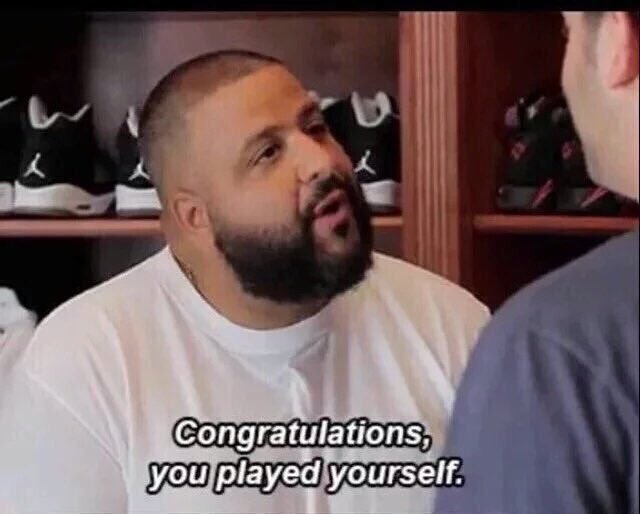
Pictured: DJ Khaled's memetic "congratulations, you played yourself".

So that's it for our time with Dresden.  Next week will probably be a post on Life Is Strange or some other one-off thing, and we'll get into our next book after that.  Feel free to get out any remaining vitriol for Dresden in the comments below, or construct your own outline for an alternate version of this book.  Maybe one that doesn't feel like it was slapped together over the course of an afternoon.

Thursday, July 30, 2015

The Eye of the World, chapters 41 and 42, in which questions are often raised and never answered

Welcome back, my friends, to the show that never ends.  This is how we live now: reading the Wheel of Time (Book One), which we are more than three-quarters of the way through and yet somehow only just finishing what feels like the prologue.  Sometimes the chapter numbers seem to change when I'm not looking, sneaking down lower, shuffling themselves around.  Did I already read this part, or are they just going into round one of recapping?  Maybe the things they're recapping haven't happened yet.  Maybe they happened a long time ago, too.  We are beyond the ideas of past and future now.  There is only this page, standing at the forefront of the legions that surround it.  There is only ever this page.

The Eye of the World: p. 619--645
Chapter Forty-One: Old Friends and New Threats

Rand returns to the inn, finds his latest plot-recruited helpful innkeeper playing a game with Loial the elf-ogre, and spends several pages recapping the spectacularly improbable events which we literally just read in the previous two chapters.  The innkeeper is at first skeptical, while Loial just mutters 'ta'veren', listens intently, and asks to join the quest.  Rand and Mat must leave the city immediately, apparently?  I'm not clear on why, but they seem pretty sure that Chief Wizard Elaida is going to send guards to hunt Rand down again imminently, despite the queen declaring him innocent and setting him free.  Does Elaida regularly ignore the queen's decisions?  Do we have a precedent?  This is an important thing to know in any circumstance, but no one says anything like 'she'll have you grabbed quietly in the night, just like that shady diplomat who vanished off his boat two days away from the city'.  Is this just part of typical anti-Aes Sedai mistrust and propaganda?  I mean, Rand is specifically running to Tar Valon, which is basically the Greater Wizardtropolitan Area, so isn't he in at least as much danger there?  For that matter, might Elaida not be very interested in helping him get there, if he explained that it was Moiraine's idea?  Does Rand have any idea what faction of wizard Elaida is from?

Only Robert Jordan could raise this many questions (and answer none of them) for no good reason in such a short period of time while mostly talking about rats and those vile vile anti-monarchists.

Rand get outright angry when Loial uses the same phrasing as Elaida, saying that "The Pattern weaves itself around you, and you stand in the heart of it".  I feel like after 600 pages Rand should have picked up enough characterisation that I would know why he's angry at the prospect of having a really dramatic fate.  Is he so intensely humble that the notion of being important offends him?  Is he scared to death of conflict and wants to believe that once he gets to Tar Valon everything will be peaceful and boring forever after?  Did he have hopes and aspirations for his life that he feels have been taken away from him?  Is he just really opposed to the notion of destiny overriding free will?  Throw me a bone, Jordan.

We have a brief and unnecessary interlude with whitecloaks in the inn's common room, who are armed and armored and angry but are inexplicably driven out by the out-of-nowhere, natural-20-intimidation-check warnings that the innkeeper gives them.  (We do get the informational tidbit that the whitecloaks "hold no writ in Caemlyn", though it's not clear to me what that means.  Are they not tax-exempt?  Do they have to obey all of the laws instead of only some of them?)

The whitecloaks are also very dismissive of the queen, which is clearly supposed to further outline how villainous they are, but to my mind it raises yet another damned question: why do we like Queen Morgase?  She's apparently abandoned substantial tracts of her queendom for generations, even as the number of monsters roaming the world increases.  She allows religious extremists to wander her cities harassing people at random.  She has no great diplomatic successes we're aware of.  She does apparently maintain some kind of substantial food security program within the capital, although the rules under which it functions aren't clear and we have no indication if it helps on other issues of health, shelter, or safety.  The two things we really know about her for certain are that she decided to let Rand go literally right after her Chief Wizard said he was super plot-relevant, and that she regularly receives prophecies from said wizard that are so mystically vague that no one has the slightest clue what they mean.  Neither of these choices reflect well on her as a protector of her realm and its inhabitants.  Near as I can tell, we're supposed to like her because she's got a crown, her family is attractive, and she was nice to the protagonist (sort of).

Just saying it's possible the white-flag revolutionaries have a point.  Of course, they don't seem to have any ideas about what they want instead of the queen, because they are evil and therefore heavily organised around the idea of taking things apart, not creating something new.  Those are the rules.

Let's get a move on, plotwise.  The moment we're done with the whitecloak interlude, someone else shows up looking for Rand and Mat, and at gorram last it's the rest of the party: Moiraine, Lan, Egwene, Nynaeve, and Perrin.  Rand hugs the girls (who of course bury themselves face-first in his chest) while also shaking Perrin's hand AS MEN DO, and the innkeeper falls all over himself for a couple of pages in subservience to Moiraine.  Rand takes them all to see Mat, and praise Buddha they immediately identify that there's something the fuck wrong with him as he hacks at them like Gollum bingeing on conspiracy theory websites and The Exorcist.
"How do you know they're really who they look like? [....] Perrin?  Is that you? You've changed, haven't you? [....] A Wisdom isn't suppose to think of herself as a woman, is she? Not a pretty woman. But you do, don't you? Now. You can't make yourself forget that you're a pretty woman, no, and it frightens you."
Nynaeve just thinks he's got a fever, but Moiraine arrives and all but leaps on him.  She quickly infodumps all the stuff we already knew about Shadar Logoth being cursed, and Mat attacks her with the knife he stole, gets stopped by Lan, and Moiraine sets about wizard medicine.  The knife is apparently a beacon of evil as well, and thus why Rand and Mat have been endlessly plagued by darkfriends and trollocs on their journey, and why (Lan informs us) the Fades are building a trolloc army outside Caemlyn in preparation to take the city.

You had one job, Rand.

Chapter Forty-Two: Remembrance of Dreams

Leaving Moiraine to exorcise Mat, Rand introduces the party to Loial in the Double Secret Parlour, where Perrin immediately starts asking Loial about steddings and whether they're really magic havens.  I have to assume at this point that Robert Jordan was badly distracted by something, or perhaps looked up from the keyboard and realised thatthe manuscript was due tomorrow, because it's only been two pages and Moiraine shows up with Mat, a bit spaced and embarrassed but otherwise completely cured of his evil possession.

Well.  That de-escalated quickly.

Moiraine quickly and quietly explains to Rand that Mat still has the knife and it's still magically bound to him, but she has purged the evil from Mat's system for now and they can get a permanent fix in Tar Valon, but Moiraine is vague about whether that's where they're going next after all.  She also warns Loial that all of the other Aes Sedai are Red Ajah, which--okay, screw it, there's a glossary in the back of this book and I am tired.
Ajah (AH-jah): Societies among the Aes Sedai, to which all Aes Sedai belong. They are designated by colours: [Blue, Red, White, Green, Brown, Yellow, and Gray]. [...] The Red Ajah bends all its energies to finding and gentling men who are attempting to wield the Power.
Well, they did just bring in the Renegade Man Wizard Logain, so maybe that's not startling, although surely Elaida isn't included in "every one but I".  I can't imagine that spending all of her time giving vague advice to the queen counts as bending all her energy to 'gentling' men.

There is yet more recapping again as Rand tells the rest about meeting the queen, and if I were running with my theory of 'the queen is actually not inherently good by right of being the queen', I would get Manchurian Candidate vibes from the way Rand spaces out as soon as he thinks of her:
"Can you imagine me meeting a Queen? She's beautiful, like the queens in stories.  So is Elayne. And Gawyn... you'd like Gawyn, Perrin."
Very nice wingmanning, Rand.  Your buddy just got into town and already you're trying to hook him up with a hot prince. (Egwene, of course, is quietly very jealous that Rand said the princess was cute, because Robert Jordan solved feminist fantasy forever.  Egwene, whom we may recall was cheerfully all up in that Traveller boy's business a few... weeks ago?  I'm fuzzy on timelines here.)  Perrin mentions the Travellers, which sets Loial talking about the Travellers who wanted to learn the tree songs from the ogiers back in his home stedding of Shangtai--

Wot.

I can cope with a lot of this nonsense, I really can.  I can roll with Mosk and Merk the warring giants, and I will roll with the cool descriptions of places and vitally important magical locations and objects that we'll apparently never see again, but when the ever-helpful non-human servitor-race guy comes from a place called Shangtai I just want to bite through someone's neck.  I desperately hope that's just a throwaway thing and not an indication that the ogiers are going to be the fantasy Asians here.  It's bad enough Rand is apparently a pasty redhead of the noble desert tribes.

Loial gets around to repeating a story that the Dark One seeks to blind the Eye of the World, and Egwene and Perrin mention hearing the same from the Travellers, and the boys finally get around to admitting to Moiraine that they've been having dreams with the devil hassling them.  Praise be to Gargamel, no more attempting to draw out tension by having people just not talk.  (For now.)

Moiraine concludes that all three boys are ta'veren (what, not Egwene and Nynaeve, previously described as potentially the most powerful wizards of the age?) and they need to leave Caemlyn immediately by unorthodox means.  She also gives us this destiny explanation:
"Sometimes being ta'veren means the Pattern is forced to bend to you, and sometimes it means the Pattern forces you to the needed path."
So... how is that different from regular free will and chance, then?  People are self-evidently bad at prophecy, so it's not like you can tell in advance whether you're making a choice because you choose to or because you've been chosen to, so what are the practical consequences of this?  It sounds like an excuse to go about your life in a normal way but make regular exclamations about how mystical it all is.  "You stole my last cupcake!" "No, I was fated to eat the last cupcake."

Actually, that could be a fun way to live.  Try it out and report back in the comments.

Speaking of which, Moiraine and Loial debate for about a page on how to leave the city, using the Ways that they can reach from a Waygate that is probably buried under the New City and will lead them to Fal Dara that was once known as Mafal Dadaranell.  (That deluge of unexplained capitalisation is a taste of what this book is like without me as your buffer.  I do actually sometimes appreciate Jordan's persistence in giving things names that change over time, like how Mafal Dadaranell's name clearly got abbreviated, but good lord, does everything on this planet have a business card the size of a surfboard?)  Loial exclaims that if they enter the ways they will all die or "be swallowed by the Shadow", and on that no-context salvo of 'dun, dun, DUNNNNNNN', the chapter abruptly ends.  The next chapter starts up immediately on the next line, no scene break or anything, which makes that a really, really odd point to choose to cut us off, but I think I can live with it.

Next time: backstory, dimension-tunnelling, and Moiraine's instincts for manipulating the narrative.

Sunday, August 3, 2014

Ender's Shadow, chapter one, in which Bean is not as smart as he thinks he is

Welcome back, gentle reader, to the blog of presumptuous, holier-than-thou mudslinging against the bestselling and most critically acclaimed literature of our times.  My novel-writing month was excellent, thank you.  I'm 50K words into a new book about a girl who takes career advice from Satan and the formerly-indentured gay dragon pianist she recruits to help her burn down the capitalist oligarchy.  I'm pretty excited about it.  But the first draft of that probably won't be done until the end of the month, and it would be excessive to leave this blog bereft of content for so long, so, without further ado or due consideration of making good decisions, let's just leap into the Parallax Novel (read: author's own fanfiction) of the first book I leapt into more than a year ago: Ender's Shadow.

(Content: starvation, death, child abuse. Fun content: WHERE CAN SHADOWS HIDE?)

There is no terrifyingly oblivious introduction to this book, only a foreword that explains how it happened: Card remembered that linear time exists, that there are 3000 years of history to cash in on between Game and Speaker, and so we get Bean's story.  Okay, I lied about leaping directly in.  First, an anecdote.

I once met Orson Scott Card, when he came to a local bookstore on the launch tour for this book.  My copy of Ender's Shadow was signed by him, so I know the date: September 29, 1999.  (The inscription to my mother, who took me to the signing and thus introduced me to his books--for which I forgive her--reads "In the light, where can shadows hide?", which I don't hate as much as you might think.  Sure, it's pretentious nonsense, but it's a neatly generic phrase that he could scribble inside basically any fan's book to make it something more than his giant signature.  It's not, like, actively offensive.  That's pretty good for Card.)

Card was, in person, pretty normal.  He said he figured everyone there was going to read the book anyway (it wasn't a huge group), so rather than read aloud a passage, he just talked.  He told us about the many failed drafts of the Ender's Game movie script, which he had to veto because they insisted on giving Ender a love interest.  He talked about how Ender killing Stilson had been cut from the script, because it didn't work as well onscreen and it gave more weight to killing Bonzo later.  He also said that he expected to keep going with these: he would write a second book with Bean, and then go back and write another book from Petra's perspective.  That ended up not happening, of course; as of the next book, Shadow of the Hegemon, Petra is a main character in this series.  And, IRONIC SPOILERS, as of the third book, Shadow Puppets, she is relegated to being Bean's love interest.  Apparently no one vetoed that.

But I don't hate Bean and Petra as a couple, partly because Bean is a vastly better character and person than Ender.  Bean gets justifications: he's wicked smart because of MAD SCIENCE, but he's grievously lacking social skills and empathy, and those things hold him back.  Bean makes actual mistakes, which Ender could never be allowed.  Bean gets to be wrong, and grow, and in spite of his supposed coldness, Bean appreciates people in a way Ender never, ever approaches.  So, with the awareness that this is still a Card novel and reliably terrible, now let's get to it.

Ender's Shadow: p. 15--24
Chapter One: Poke

We're back once more to the realm of disembodied voices.  This time, it's Sister Carlotta talking to her liaison in the International Fleet.
"You think you've found somebody, so suddenly my program gets the ax?" 
"It's not about this kid that Graff found.  It' about the low quality of what you've been finding. [....] Your kids are so malnourished that they suffer serious mental degradation before you even begin testing them." [....] 
"They also represent possibility, as all children do." 
"That's the kind of sentimentality that discredits your whole project in the eyes of the I.F."
Carlotta is a nun of the Order of St Nicholas (Santa!), travelling the slums of Europe, supposedly searching for Battle School candidates, but more accurately trying to save street children, get them food and shelter and education, and using I.F. cash to do it.  I once again credit Card's craft if not any of his ideas; he quickly anchors us at the same time that Graff has started to focus on Ender, without making a big deal about it.  (Although I do wonder how it is that Carlotta heard about Ender.  Does Graff do a weekly email blast rating children he's seen lately from best to worst?)

But the rest of the chapter happens in the slums of Rotterdam, in the Netherlands (called the International Territory in the future, for reasons that are never fully explained).  We meet a girl named Poke, nine years old, leader of a crew of even younger children, watching out for dangers like cops with magnetic whips, who harass and abuse homeless kids in her city, and for the older children, eleven to thirteen.  The adults ignore children, but the older kids, "bullies", thieve from the younger ones all the time, because it's safer than stealing from stores and they get a power rush.

While on watch, Poke spots a tiny kid (she figures age two) who has climbed a garbage can to survey the street.  Poke immediately picks him out as smart, from the alertness in his eyes as he watches, but he's also obviously starving, days from death at best.  Poke thinks he's wasting his time, and we get the absolutely cartoonish level of deprivation in the slums:
If he wanted to survive, he should be following older scavengers and licking food wrappers behind them, getting the last sheen of sugar or dusting of flour clinging to the packaging, whatever the first comer hadn't licked off.
I'm in no position to talk--I'm writing this as I eat peppered broccoli from the farmers' market next to my building--but this has always struck me as taking the 'clinging to the edge of survival' imagery too far out from reality.  Like, you could try to get by on twice-licked pastry wrappers, but I'm pretty sure simple caloric math means you're going to last a day.  What was he eating a week ago that he's alive now?

Poke is briefly accosted by a pair of twelve-year-old prostitutes, whom she attempts to placate with half a stale pastry she's saved for exactly this kind of extortion.  They end up fighting over it, the fight ends when one flees, and they immediately cease to exist in the narrative, since their purpose is complete.  It's a step up from Card's past devotion to tell-not-show.  Poke turns around to see the tiny child, whom she pushes down, but he gets back up anyway.
"No, you little bastard, you're not getting nothing from me," said Poke. "I'm not taking one bean out of the mouths of my crew, you aren't worth a bean."
Guess who the kid is!  He asks why she submits to extortion, and suggests that they should instead hire a bully: get one big kid to agree to protect them in exchange for steady food.
"You think I never thought of that, stupid?" she said. "Only once he's bought, how I keep him?  He won't fight for us." 
"If he won't, then kill him," said the boy. [....] "You kill one bully, get another to fight for you, he want your food, he scared of you too."
He argues that a crew could easily take down a bully with coordination, if they tripped him up and had bricks ready to murder with.  Poke starts out hostile, thinking she'll have to kill him for being so defiant and uppity, but the plan entices her, especially the prospect of getting into the local kitchen.  Poke's self-appointed second-in-command, Sergeant, sarcastically says the kid is, after all, worth "one damn bean", and so he is named.  Poke reluctantly gives him a half-dozen peanuts she's been saving, which he eats one at a time, because he's too weak to make a fist himself.  Fed, Bean goes back to watch from his garbage can, telling Poke again to be ready to kill the first bully if he's too dangerous.

Bean is, predictably enough, a jerk inside his head, but at least this time it makes sense.  He's contemptuous of Poke on one level, thinking she's too compassionate and not ruthless enough to keep herself well-fed, but also acknowledges that he'll only survive because she's compassionate enough not to murder him now that she's taken his idea on.

He's also contemptuous of all the other children.  He came up with his carrot-and-stick hired-bully plan as soon as he understood the way of life in the slums, but couldn't figure out why no one else did it, so he focused on learning everything he could (including Dutch and IF Common) to figure out what he had failed to take into consideration.  He ultimately concluded that there was no other factor, and the other kids hadn't already implemented his plan because they were just too stupid.

Let the record show that Poke literally said she had already thought of Bean's plan but didn't trust that any bully would stay bought.  Bean isn't smarter; he's just too arrogant to believe his plan will fail to convert everyone.

Bean watches in anguish as Poke picks what he thinks is a terrible target: a bully with a damaged leg, called Achilles.  (I'll save you all a huge re-learning headache by saying now that it's pronounced in French style, 'ah-sheel', which the book fails to mention for several chapters, at which point it was too late for me to change the way I read it.)  Bean wanted a big burly guy who wouldn't think too much, but figures Poke has gone for the easy target, since he's disabled.  Poke overacts her subservience, alerting Achilles to the ambush, but with his limp, he can't get away in time.  (Pure coincidence: I'm also walking with a limp today, due to a bike crash.  Please do not ambush-murder me on the street.)  Bean climbs down and across the street again by the time they've bricked him onto his back.
"You get us into the food line at the shelter." 
"Sure, right, I will, I promise." 
Don't believe him. Look at his eyes, checking for weakness. 
"You get more food this way, too, Achilles. You get my crew. We get enough to eat, we have more strength, we bring more to you. You need a crew. The other bullies shove you out of the way--we've seen them!--but with us, you don't got to take no shit. See how we do it? An army, that's what we are."
Let the record further show that Poke specifically tailors her recruitment speech to Achilles in a way that Bean never addressed.  She picked a bully who survives by wits and sells him more with the logic than the threat of force.  She runs with Bean's ambush idea to the point of declaring her crew to be an army that can continue to pick off bullies at will.  Poke never gets credit for any of this, is my point.  Not even in Bean's later reflections on his childhood.  Card continues his theme of writing smart, capable women and failing to acknowledge their capabilities at all.

Achilles asks why they've never done this before, and catches her eyes flicking over to Bean.
"Kill him," said Bean. 
"Don't be stupid," said Poke. "He's in." 
"That's right," said Achilles. "I'm in. It's a good idea." 
"Kill him," said Bean. "If you don't kill him now, he's going to kill you." [....] 
"The next guy won't have my bad leg," said Achilles. "The next guy won't think he needs you. I know I do. [....] It's your crew, not mine [....] This is my family.  These are my kid brothers and sisters. I got to look after my family, don't I?"
Bean instantly determines that Achilles has instantly won the little kids over, by offering them the sense of love and belonging that they hunger for, and therefore it's too late to kill him, so he has to stop Poke as she prepares to brick him one last time.  To recap, these kids were totally on-board with bricking him savagely about five minutes ago, but the instant he says 'you're my siblings' he's untouchable.  This is Ender-level magical charisma we're dealing with, but with a vitally important twist: it's in the hands of the villain.  So, while I still think it's unearned in a narrative sense, it's never bothered me as part of the story.  Villains don't have to explain their magic; that's what makes them scary.  But, at least retroactively, he works for it with his actions for the rest of the chapter.

Poke tries to tell Bean to shove off (Bean's gamble on her compassion failed after all, weird, almost like he's not as smart as he thinks he is) but Achilles turns it into a test of authority by declaring that, crew or not, Bean is family now and therefore Poke can't exile him unless she's willing to kill Achilles as well.  Poke relents.

Achilles starts checking his injuries and laughingly praises the kids who just stoned him to the ground.  He starts learning all their names, apologising when he fails.
Fifteen minutes later, they loved him. 
If he could do this, thought Bean, if he's this good at making people love him, why didn't he do it before? 
Because these fools always look up for power. People above you, that never want to share power with you. Why you look to them? They give you nothing. People below you, you give them hope, you give them respect, they give you power, cause they don't think they have any, so they don't mind giving it up.
This is a pretty good passage, even if it's a little weird for Bean to draw this conclusion after a day in which he's forced his way from starvation into a place of honor in a new street militia/family by demanding respect from people stronger than him.
[Achilles] reached into his pocket, took out the most incredible thing. A bunch of raisins. A whole handful of them. They looked at his hand as if it bore the mark of a nail in the palm.
You're a four-year-old science experiment in the Dutch slums and you don't know what a grape is, Bean; why are you making references to stigmata?

Bean gets the first raisin, as "the one who brought us all together", and Achilles jokes about how holding it in your mouth never turns it back into a grape ("What's a grape?"), and Bean thinks about how this, too, will win them away from Poke.  Poke, he explains, never gave them so much food from her own stash at once, because she never had it, but Bean is sure that they will fail to understand this and will think only of how much more generous Achilles is, "because they were stupid".  Bean hasn't been right in his estimations of anyone this chapter, but he does seem like he'd get along well with Peter 'You're All Sheeple' Wiggin.
So, on the one hand, Bean is supposed to be really bad at people; on the other, he's our viewpoint character and he's making sweeping tell-don't-show proclamations about the nature of humanity.  It's a little hard to decide if we're supposed to think he's right, here, but I suspect we are.  Still, death of the author, and I'm quite happy to take this as evidence of Bean's various failings.  Let's see how long my optimism lasts.

Next week: the Card classics: savage child violence, easily-manipulated adults, and nuns.

Sunday, March 30, 2014

Speaker for the Dead, chapter twelve, in which there are okay bits

(Content: family abuse, violation of privacy. Fun content: cool dads, space water snakes, and borderline tree erotica.)

Speaker for the Dead: p. 184--199
Chapter Twelve: Files

We have reached the middle of the book!  (Or we`re about to, at page 191 out of 382.)  We've been introduced to a wide cast of  'characters' and all the pieces have been set in motion and clearly now the actual plot will pick up and we will see people tackle their failings and grow into better individuals against a backdrop of thrilling intrigue and interrogation of what it means to be human!  The incredibly slow plot, irrational and inconsistent characters, and diligent failures of worldbuilding have clearly just been setting up for a masterpiece that may now begin.  (On a completely unrelated note, I'm also really looking forward to the Walking Dead season finale tonight!)

The chapter-prelude bit is a series of congressional orders revoking All The Things: Lusitania loses its Catholic License, all their files are confiscated for review and the colony is locked out of all their non-life-support systems, Ender's starship Havelok is commandeered to ship Miro and Ouanda to Trondheim for trial, a committee is struck to plan and implement the total human evacuation of the planet, and all evidence of human contact on Lusitania is to be obliterated, including any genetically modified organisms.  It's not clear if that means vaporising the Little Ones who've been given new tech or if they're exempt from the 'evidence of human contact' deal.

Blissfully unaware of this, Ender finally shows some evidence of being a time-refugee, because he's having to navigate computer systems without Jane's help and he's terrible at it, so he's hired Olhado to assist him.
"Olhado, just tell me what program to run." 
"I can't believe you don't know what it is. I've been doing data comparisons since I was nine years old. Everybody learns how to do it at that age."
It occurs to me at this point that we have no idea what 'normal' life is like off these backwater colonies.  Card writes about the miners and farmers as if they're what we think of today as stereotypical miners and farmers, but what 'data comparisons' would they be running? What do kids get taught in public schools? Do they learn how to operate software to do incredibly complicated mathematics like Ender did back in space school?  Are menial jobs automated and so everyone needs to be skilled in navigating computer systems in order to operate their robot farming legions?  Three thousand years in the future!  Tell me what it's like, Card.
"If I knew how to do it myself, I wouldn't have had to hire you, would I? And since I'm going to be paying you in offworld funds, your services to me will make a substantial contribution to the Lusitanian economy."
Not content with being terrible at science, psychology, and religion, Card has decided to loudly fail at economics as well.  Lusitania has no exports and to our knowledge few or no physical imports.  The only transactions they could conceivably have are ansible communications, and seeing as they're a government-mandated scientific outpost, there's no reason for their ansible not to be free (if perhaps regulated, if we're going to play along with Card's ridiculous assertion that ansible transmissions are expensive). Since they don't export anything, they can't afford to independently sustain offworld payments for the ansible anyway.  There isn't even a good reason for them to pay taxes at the interplanetary level.  All of their transactions are internal, which means that bringing in more money (Ender's promised offworld funds) will just lead to inflation devaluing everyone else's savings, unless Olhado just uses his paycheque to cover everyone's ansible charges for however long.  (I'm assuming that Ender Forty-billion-is-a-drop-in-the-bucket Wiggin will be hilariously overpaying Olhado.)

Ender reveals that he also has no idea what his password is, and explains that this has all been automated for him for ages--Olhado calls Jane a 'slave program' and says they're illegal, but Ender just responds that it wasn't illegal for him, once again avoiding telling us whether he has tons of government pull or if he's just thinking that Jane is so unique that the law doesn't apply to her.
"I got no eyes, Speaker, but at least that wasn't my own fault. You can't do anything." Only after he said it did Olhado realize he was talking to the Speaker as brusquely as if he were another kid. 
"I imagine courtesy is something they teach to thirteen-year-olds," the Speaker said. Olhado glanced at him. He was smiling. Father would have yelled at him, and then probably gone in and beaten up Mother because she didn't teach manners to her kids. But then, Olhado would never have said anything like that to Father.
Ender's not a normal dad; Ender is a cool dad.  I have a sinking feeling that Marcos' abuse is primarily going to be used to make Ender seem even more awesome than he already is (because he passes the unfathomably low bar of not raging and beating people), rather than exploring how it may have affected Novinha's psychology if her most constant and legally-bound companion for the last twenty years was actively hostile and blamed her for everything, including things outside of her control.

Ender eventually manages to guess his password, which is..."Ender".  I'm going to be kind and assume that Jane intentionally made it something he'd be able to guess in an emergency, and not a security protocol, given that she is the internet and therefore would have the ability to simply deny access to anyone else.  Olhado sees his accounts, and although Ender has no concept of what money means these days, Olhado suggests that, rather than a wage, he be paid "one thousandth of one percent [of the interest this gets during the time I work for you]. Then in a couple of weeks I can afford to buy Lusitania and ship the topsoil to another planet." Ender says that his investments must have just done well; Olhado (first jokingly, then seriously) guesses that Ender must be millennia old.

The 'data comparisons' that started all of this turn out to be comparing Pipo's and Libo's files in the weeks before their respective deaths, trying to piece together the common elements. They get nowhere, but Olhado realises that Ender didn't actually expect to get anywhere: he just wanted to see how Olhado worked the program so that he could then run his own searches in private later on.  Olhado thinks this is foolish, not least because he already knows some of Andrew's secrets, like the way his "Ender" password gets him basically everywhere--for example, into the mayor's and bishop's files.
No need to keep a secret from me. You've only been here three days, but I know you well enough to like you, and I like you well enough that I'd do anything for you, as long as it didn't hurt my family. And you'd never do anything to hurt my family.
I keep thinking Card will get bored of having people rhapsodise about how wonderful Ender is.  I don't know why I haven't caught on yet.  Aside from the Ender-worship and the worldbuilding blanks and the failure of economics, this was, however, a pretty good scene, and that's rare enough that I feel like being explicit about it or I'll just end up in a heap of despair that there's anything good in the world.  (And, again, I'm bracing myself for whatever dreck the Walking Dead writers will think they're being clever about next.)

The next morning, Novinha fumes about how Ender was rooting around in her root directories all night (when I started that sentence it was just a pun and not a horrendous innuendo but this is where life has taken us) and didn't even bother to cover his digital tracks.  We get, at last, some blessed relief from being told how wonderful Ender is, because his presence did not magically heal the Ribeira house: Grego has been cutting up sheets and headbutted one of his teachers in the crotch; Miro and Ela have slid back into grumpiness.  On the other hand, ever-silent Quara apparently started talking loudly in class about how she met the Speaker and he's terrible like the Bishop said and he tortured her little brother, until the teacher actually had to demand she stop talking.  And Olhado has obviously shifted to hero-worship, which has inspired Quim to threaten to have him exorcised.

Olhado has noticed that Ender seems to speak Stark as his native tongue, which is apparently super-weird.  I find this fascinating, because if true this means that the galaxy of the future is not mostly populated by English-speakers.  (Stark isn't technically English, but Ender spoke English first and obviously still does.)  As much as I scorn Epcot Galaxy, it is at least different from the usual pasty anglo SF environment, to the point where English is properly recognised as a minority. Olhado wonders if Ender comes from Earth, which in turn makes me wonder two things: are the people who natively speak Stark the same demographic as the people who previously natively spoke English, or has future-English mutated into some other language while Stark actually bears a closer resemblance to 20th-centry English?  Did everyone default to their non-English ancestry, so that someone like me would grow up speaking Cymraeg (Welsh) or Irish Gaelic and then learn Stark at school?

Novinha spends her whole day thinking about her family, her secrets, her illegitimate children and how she'll have to one day tell Miro about his real father to keep him from marrying Ouanda, and engages in a whole lot of internalised victim-blaming and ascribing her abuse by Marcos to the delivery of divinely-approved vengeance. Novinha has 'discovered' that she is religious after all, but she only believes in the vengeful old god and not the mercy of Christianity.

Quim shows up to say that Quara went to the Speaker's house after school, and to complain that Novinha isn't fighting him harder. They recriminate each other, with Quim varyingly accusing and apologising to her, until Novinha lashes out to strike him, and then they both crumple to the floor as she tries to comfort him. I'm tempted to call this a relatively realistic depiction of severely dysfunctional relationships in which abuse has been normalised (although apparently Novinha kept Marcos from ever attacking the kids).

They decide to go to Ender's house, though Novinha's not sure whether she wants to take Quara away from there if it's got her talking.  (Their path is scattered with molted water snake skins, which is firstly a very Earthlike sort of animal to find on an alien planet and secondly why would anyone ever be okay with water snakes as their primary form of vermin that's terrifying.  Although Novinha mentions that they make the riverbanks smelly with musk, so I guess these are Space Northern Water Snakes and not Space Cottonmouths, which is some relief.)  Quim and Novinha argue about confrontations between good and evil, until she tells him that she's been there and he's only seen the map and so has nothing to say on the matter, and he stalks off.

Quara greets her happily and brings her inside, where Ender and Olhado are playing a video game of duelling fleets--she arrives in time to see Olhado wipe out half of Ender's ships in a moment, I assume because Ender is letting him win and apparently has no problem replaying the same game that was his life and education and religion and torment as a child, the illusion that allowed him to slaughter an entire species and define human interaction with alien life and the evolution of philosophy for three thousand years.  No big.
...She certainly didn't approve of him playing games of warfare. It was so archaic and outmoded, anyway. There hadn't been any battles in space in hundreds of years, unless running fights with smugglers counted. [....] Maybe it was something evolution had bred into males of the species, the desire to blast rivals into little bits or mash them to the ground.
Ah, it's been a little while since we got that evo-bio gender essentialism; I knew it had to be lying around somewhere.  Predictably, Ender then wipes out Olhado's entire side in a single shot and tells him to replay the memory until he figures out how to counter it next time. (I guess Doctor Device is still considered a normal armament in space war?  Or I wonder if people think that it's just a fiction of the game, and the story of how Ender destroyed the formic homeworld is blurry and rewritten.)

Ender and Novinha have a fairly predictable conversation--he lays out what he's learned so far and demands to know what Pipo learned that led to his death; Novinha says she'll never tell anyone (although she never puzzled it out herself either), Ender says that knowing will protect Miro and his sister where ignorance got Libo and Pipo killed.
"Tomorrow I'm going with them, because I can't speak Pipo's death without talking to the piggies--" 
"I don't want you to speak Pipo's death." 
"I don't care what you want, I'm not doing it for you. But I am begging you to let me know what Pipo knew."
Soooo... apparently Speakers can't speak someone's death unless requested, but if requested it's irrevocable?  I know there was that whole thing about how you can't turn a speaker back once they've left whatever world they came from, but being unable to protect your personal privacy from someone depending on the exact moment they hopped on their space yacht is distressing.

Ender then implicitly compares himself to Pipo (in that he's rescuing and healing the damaged little girl, Quara). Novinha is of course enraged and storms out, without Quara, realising as she leaves that Ender said "your son and his sister"--he knows all her kids were with Libo.  Then Olhado turns accusatory, for Ender having "made a traitor out of me", using the search skills Olhado taught him to investigate his mother.  Ender feels enough pain at Olhado's departure that he even attracts the Hive Queen's attention.
And he felt her touch him inwardly, touch him like the breeze in the leaves of a tree; he felt the strength and vigor of upward-thrusting wood, the firm grip of roots in earth, the gentle play of sunlight on passionate leaves.
Man, can you imagine if Card just wrote poetry and not bigoted propaganda masquerading as serious philosophical literature? I mean upward-thrusting wood and passionate leaves, okay, phrasing, but these moments really stand out in the dross and I legitimately wish there were more of them.  Also, I think we can take from this that the Hive Queen's new companion is indeed the consciousnesses of 'dead' Little Ones inside their trees, if there were any question left in that at all.

Ender is left with Quara, who cheerfully remarks that in a couple of days he's managed to make everyone hate him (including her), and then turns on his terminal and brings up arithmetic problems, which she invites him to watch her solve.  Ender says they look hard; Quara boasts that she can solve them faster than anyone.  I'm not sure what to make of Quara yet, but she's smart and cheerful and says she hates Ender, so I'm on board for now.

Next week: My conviction that the plot is actually going to happen begins to waver.