Showing posts with label Lord of the Rings fanfiction. Show all posts

Thursday, February 25, 2016

Drizzt Do'Urden and the failure of fantasy racism

(Content: discussion of racism and other oppression.  Fun content: I hope you like elves.)

I should preface this with a giant disclaimer (in case there was any question) that I'm white, so this whole post is an extended 'it seems to me...' and I don't want to speak over anyone's experiences.  I don't think I've seen anyone address this specific flaw to supposedly progressive fantasy; I'd be happy to link to any such works if y'all know of them.  (Also, I think a lot of what I say below can translate to representation of other demographics and types of oppression, like LGBT people and comic book mutants, but it's Black History Month, so that's where we focus.)

Pictured: either my family tree or a box of assorted entertainment crackers; who can tell?

The best thing that speculative fiction can do is show us a bizarre new world that loops into our real mundane world right now and gets us to see something in a new way.  Consider classic Star Trek's episode about an alien cop chasing a fugitive, each of them literally half paper-white and half ink-black, divided down their centre line, but the cop is convinced that he's racially superior because he's black on the correct side.  The Snowpiercer movie (thankfully nothing like the original comic) is a beautiful, layered, sickening, and ruthless exploration of capitalism and literal class war.  And if I start talking about Discworld novels we'll be here all day.

Countless stories--like Star Trek there, and like Forgotten Realms and Lord of the Rings and X-Men and basically every other serialised speculative story sooner or later--take the opportunity to criticise racism, usually by showing us elves and dwarves scowling at each other or something.  The first problem with this kind of scenario is that it extrapolates human 'races' (a nebulous and nonscientific concept) into entirely different species, so that the story is about (white) humans learning to get along with weird other-y pseudo-natural entities (of colour?).  We can do better.  But, at the same time, there's no reason that identifying with the badass werewolves or dragons or fae should be restricted to white people either, so yes, let's have elves with high tops:
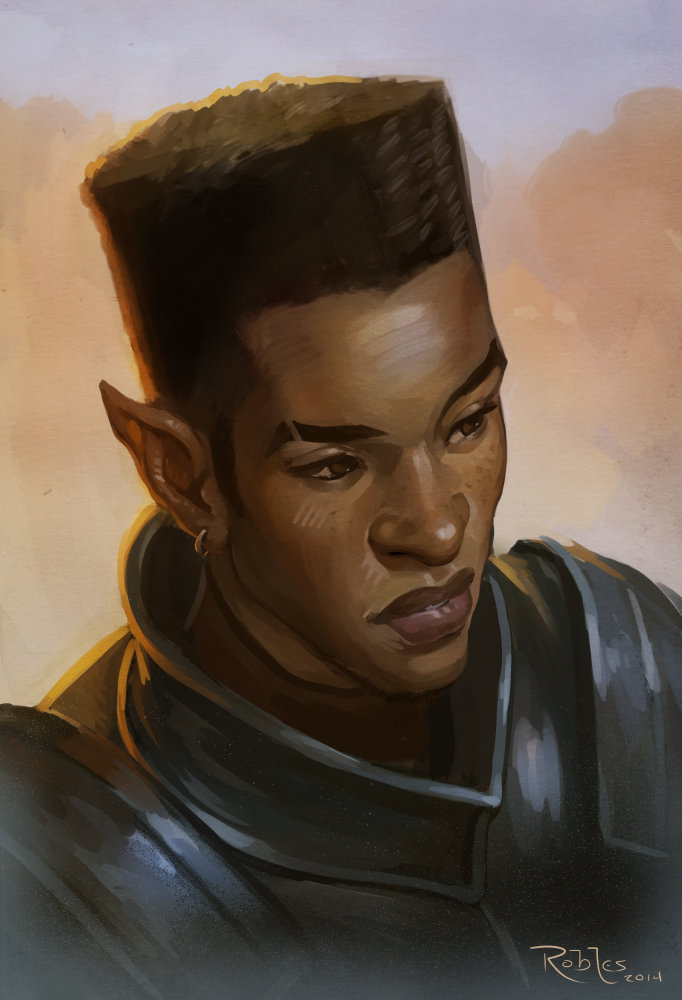
Pictured: painting of an armored elf with distinctively black features, by Nick Robles.

Running with this, writers sometimes give us a paragon of virtue like Drizzt Do'Urden.  Drizzt is one of the most iconic characters in modern fantasy: a renegade drow (dark elf, literally black-skinned) from the underground city of Menzoberranzan who grew up disgusted by his people's cruelties and so ran away to the surface, where he roams the land of Faerun slaying monsters and rescuing the helpless.  He is, of course, nevertheless hounded at every turn by people who see his black skin and assume he's a monster.  I won't speak to authorial intention here, because I haven't read RA Salvatore's mind at any point in the last thirty years, but there's only one common reading of Drizzt's story and what it symbolises for our world.  We readers look at these presumptuous bigots, who think the only good dark elf is a dead one, and scorn them for failing to get to know Drizzt before judging him.  We know better and we are enlightened.

Drizzt is a good guy.

Drizzt isn't like other drow.

Drizzt is one of the good ones.  A credit to his kind.

#notalldrow

But the thing about those narrow-minded common peasants who flinch or scream at the sight of Drizzt walking into town is that they're only wrong this time.  With literally any other member of his species, they'd be absolutely right to freak out, because a powerful and sadistic murder-specialist would have just said hello.  That's not racism; that's basic probability and pattern recognition.

Fantasy racism like a fear of dark elves is ultimately a terrible allegory for real-world racism because the dark elves have worked long and hard to gain that reputation for monstrosity, whereas in the real world white history is basically a laundry list of the other nations and peoples we've slaughtered and enslaved and oppressed for monetary gain, political power, or occasionally just for sadistic fun.  In order for Drizzt the onyx-black elf hero to be an actual metaphor for black people in North America, our continent would have to live in constant fear of invasion from a subterranean army of African-diaspora wizard-ninjas, and I figure there can't be more than five or six million registered voters who actually think that's a concern.

What I'm getting at when I say #notalldrow is that Drizzt's experience, being a variously privileged individual walking into vulnerable spaces full of people who have been hurt before by people who look like him (and who know that he has the power to hurt them further), is the experience of the oppressing class, not its victims.  White people, especially but not exclusively white men: we're the drow.  When Drizzt sees someone afraid of him at first glance, it's not because they've been arbitrarily taught that black people are inherently inferior and disgusting.  If we read these scenarios and all we think is "Bah, foolish bigots, we Drizzt would never be so villainous!" we're only reinforcing the idea that vulnerable people owe us their reflexive trust or they're the real racists.

To the credit of Drizzt's fictional persona, he sympathises with these people and is patient with the caution strangers take around him.  At least, this is a good aspect of his character if it's taken as a model for, say, white people to not go around acting indignant that people of colour aren't always ecstatic about our presence.  From the 'surface' reading of his story, where Drizzt is the victim and he is patient with having to work to personally win over every single racist he meets... that's suboptimal to say the least.  The tangle that this kind of speculative fiction has made of power dynamics makes it harder to draw any conclusive arguments out of the text beyond a lukewarm 'everyone should be good to each other'.  That kind of 'equal opportunity learning' gives us stuff like the unholy mess that was Disney's Pocahontas, in which the indigenous Powhatans are also guilty of prejudice against strangers just because the white people are here to conquer, pillage, and murder.  I cannot even.

Fantasy racism doesn't speak to real-world racism as long as it seeks to justify its existence: as long as those simple innocent farmers are afraid of orcs because orcs are literally and objectively the twisted embodiment of malevolence forged by an evil god to burn the world, fearing orcs isn't racism, it's self-preservation.  Fantasy that wants to tell us that racism is bad has to start by admitting that racism isn't a defense mechanism but a weapon--a philosophy that helps the people in power convince everyone else that it's okay to kill and exploit those other people, without provocation, because they just don't deserve any better.  Stopping racism is about acknowledging and revealing and destroying that idea, and it's got to be done in us, the privileged, oppressing class.

I'd love to add some examples here of fantasy racism done properly (purely as propaganda and not based on objectively truth) but... I'm not sure I can think of any.  Even in Discworld, the conflicts between trolls and dwarves ultimately come back to 'both sides bear guilt'.  In the Warcraft universe, primary example of a setting where orcs are heroic protagonists as often as villains, the orc-human divide stems back to those one or eight times that the orcish horde got cursed into raging berserkers and tried to burn down the planet.  In settings like Star Trek (and often Star Wars, depending on the book) aliens often are pretty one-dimensional in ways apparently defined by their species.  I think a good case can be made regarding house elves in Harry Potter, but that'd be a book unto itself and there are plenty of people who feel the text ultimately fails to make a proper case distinguishing the racist propaganda from the truth.  If any of you readers have encountered a good speculative treatment of how racism functions that doesn't make these kinds of errors, I would love to hear about it.

Let me end by sharing with you a quote from Chris Rock, in an interview from 2014 which I was lucky enough to encounter this week:
So, to say Obama is progress is saying that he’s the first black person that is qualified to be president. That’s not black progress. That’s white progress. There’s been black people qualified to be president for hundreds of years... The question is, you know, my kids are smart, educated, beautiful, polite children. There have been smart, educated, beautiful, polite black children for hundreds of years. The advantage that my children have is that my children are encountering the nicest white people that America has ever produced. Let’s hope America keeps producing nicer white people.
Hope everyone's been having a good Black History Month.

Wednesday, August 19, 2015

The Eye of the World, chapters 46, 47, and 48, in which Lan is voted Sexiest Man of the Age

Fewer than one hundred pages left to go, dear and loyal readers.  Three posts to the end, depending on how much nonsense I just dismiss and whether anything is actually going to happen.  Rally your courage; gird the bits that need girding.  (I didn't know this for ages, but apparently there is a specific girding protocol, shown here.)

The Eye of the World: p. 689--731
Chapter Forty-Six: Fal Dara

We left off last time with Our Plodding Heroes escaping the Black Wind in the Ways, a creation from the Time of Madness or possibly the War of the Shadow which was also called the War of Power.  (I kid you not, that's the explanation we get, with all of those namedrops.)  They have arrived in Shienar, in a frigid spring, and Lan cheerfully tells them it'll be warm when the get to the Blight, mythic land of monsters and eternal war.  They pass by a lot of abandoned farms--Egwene and Nynaeve note that they were recently abandoned, since the windows have light spring curtains hung instead of heavier ones for winter.  Perrin laughs at this because he's the worst, but when glared at he whirls on Mat to say that the abandoned scythe they saw only had a week's rust on it, which should have made it obvious even to him.

There's something spectacularly patronising about the constant implications that the scariest thing a woman can do to a man is glare at him like a miffed governess.

Rand tries again to convince The Girls to run off somewhere safer, and Nynaeve gets a full page of shutting him down, which is nice, apart from a few really stupid lines, such as:
"I have little liking for any Aes Sedai,and this one least of all, I think."
NYNAEVE SHE HAS LITERALLY SAVED YOUR LIFE MULTIPLE TIMES AND IS DRAGGING YOU TO SAVE THE WORLD.  Other Aes Sedai impacts on your life have included 'nothing' and 'actively trying to cause harm to your friends'.  This is nonsensical.

She also throws in calling them "you boys... you men", which thrills or baffles Mat no end.  Egwene decides to take the opportunity to ask Rand if he's upset that she danced with Aram, because Girl Priorities.  Rand flashes back to Min (SPOILER: one of his three future wives) who told him that he and Egwene were not destined to go at it like a sack of weasels, and then that bit is over with no impact on the rest of the scene or other plot relevance except to mind us of a prophecy that we might have forgotten in the intervening five hundred pages.  This book is so long that it includes 'Last time on our show...' within the same book.

They arrive at the fortress town of Fal Dara, where it's forbidden to hide your face for fear of Fades moving in unnoticed.  In the hands of a better author, I'd be interested to see a resolution of a conflict if heroes showed up (like Rand) from a culture that had strict rules about coverage with veils/hoods/scarves.  A resolution that wasn't just 'well, I guess I'll just ignore my religion while I'm here', but found a way to accommodate honoured guests and the needs of security as well.  The guards are hella psyched to see Lan arriving, shouting "Glory to the Builders!" and addressing him as Dai Shan.  (This might just be generic syllables, as it apparently means 'battle lord' in this world, but I think it also could mean 'tall mountain' in Chinese, written 大山?  I am in no way an expert in Chinese, but I suspect neither was Robert Jordan, and he does seem to want Lan to be vaguely Asian-flavoured.  ...Oh my god, but in Japanese it might be translated as 'big beautiful' this is the best thing people.)

Anyway.  The description of the fortress town is pretty vivid, if only descriptions of mundane pretty things were the reason I showed up to this story.  Lan is also called the Golden Crane, because having only one title is a hanging offence in WOTland.  We meet a bunch of the local soldiers, who assure Lan that things are never as bad as they look in spite of heavy raiding, and there's a lot of use of 'formal language', which appears to be vaguely Japanese--it's polysyllabic, unlike Chinese, but heavy on particle usage (ga, no, ni) and the phrase "kiserai ti wansho hei" appears to be a greeting.  (Or not; it's used later like a lament.  What?)  Agelmar, their leader, states instead that the trollocs are massing for a full invasion, cities are falling, they desperately need hope, and they need Lan and Moiraine to help--Moiraine for badass wizardry, Lan because he is "a Diademed Battle Lord of Malkier" and they need him for "the last Ingathering of the Lances".

So, in case we weren't sure, Lan appears to be the Aragorn of the story, heir to ancient titles and leadership but convinced he can and must only follow the humble path of the outlander.  After dinner, he recites a rhymeless verse about beauty and death.
Poetry out of Lan? The man was like an onion; every time Rand thought he knew something about the Warder, he discovered another layer underneath.
(In contrast, ogiers really are more like parfaits, minus the part where everyone likes them.)

The guards arrive to announce that they found a "madman" trying to get in to see Agelmar, who turns out to be the peddler Padan Fain who's been following Our Heroes since the start of the book.  He's really obviously half-possessed (interestingly, the locals believe that the Light protects people who are insane, and might even be the cause of insanity--is this ever expanded upon in later books?) and tries a sort of good-intentions-tempting spiel on Agelmar before Moiraine does the Vulcan nerve pinch and drags him away for questioning.

Chapter Forty-Seven: More Tales of the Wheel

Even the chapter title sounds done.  Book three, chapter twenty-seven: Yet Another Fricking Tale of the Wheel Are You People Satisfied Yet.  We don't get to see the interrogation, just people milling around impatiently.  Filler filler filler... oh, how delightful, Lan's backstory.  He's the son of the last king of Malkier, which makes him "al'Lan Mandragoran, Lord of the Seven Towers, Lord of the Lakes, crownless King of the Malkieri".  Political treacheries and jealousies explain how the last generation of Malkier's rulers obliterated themselves with the help of Cowin Fairheart, secret Darkfriend.  Lan's parents apparently saw nothing fucked up about swearing an oath to fight evil and defend the Malkieri on behalf of their infant son, whom they literally had holding the oath-making sword while he was in his cradle.  They charged off to fight a doomed last stand and Lan was sent off with a mess of loyal bodyguards to be raised as the ultimate warrior.  He is the best of the best of the best, SIR, and the only reason he hasn't rallied an army (as would instantly happen if he flew his Golden Crane banner) is that he doesn't want to lead anyone but himself to their deaths.

TL;DR: Aragorn.  He's literally Aragorn, with the exception that a lot of people just thought Aragorn was a weird loner instead of literally everyone flinging themselves at him in desperate war-puppy adoration.

So Padan Fain has been a Darkfriend for forty years and a special hound of the devil for the last three, homing in ever more closely on Rand al'Thor And His Amazing Friends, with regular vacations to perform unspeakably vile deeds and rituals that bound him more closely to Satan.  Which... I really hope after all that time he had a better plan for this part than 'walk in and get caught', but it doesn't seem like it.  Also, he was the guy following them back in the Ways that Lan declared they had no time to stop and investigate, and the Black Wind inexplicably spared him, probably because he's full of devil juice.  Nothing else actually happens in this chapter except recapping their plans: Moiraine is going to drag the most plot-relevant people she can to the Eye of the World in hopes of defeating the devil through narrative superiority, time is running out because he's starting to be able to project his thoughts into physical form, and no one else can go with them.  Et fucking cetera.

Chapter Forty-Eight: The Blight

More nice scenery as they march to Tarwin's Gap, the pass into the Blight.  So much scenery.  Occasionally I see something really cool and purely visual, like a photo list of abandoned places, and I think "Hey, 33 places, 33 chapters, I wonder if I could write a book on the premise that each major scene occurs in one of these locations?"  I feel sometimes like Robert Jordan did that, except he had six places and eleven thousand chapters so he filled the rest with dream sequences, bland banter, and unexpected capitalisation.

More description of where regiments of soldiers marched and when--these, at least, are of a different descriptive flavour than the parades of interchangeable inns and Inexplicably Identical Innkeepers we've been living with for all these pages.  Of course, references to the last guards left in the fortress, "soldiers and a sprinkling of old men, their wives dead and their grown children making the slow way south" remind us that while individual women are powerful plot-relevant in this series, women as a whole would never be accepted as regular soldiers for an army that desperately needs every fighter it can to hold back the literal legions of Satan.  What are you, some kind of feminist?

The Blight is all wrong, warm for no reason, and the sun is red despite being high in a cloudless sky, which I feel raises a variety of meteorological questions.  Our Heroes are warned not to touch anything--Lan describes, for example, a stick insect with an unspeakable dissolving venom that can only be stopped by severing your bitten limb.  This is a fantasy environment I can get behind--for whatever reason, I have always loved a vile and malicious wilderness.  Bring on your best horrors, Jordan.

We get a quality lake monster (tentacles with hands on the end, giant stingers, good stuff) before they camp for the night, and Moiraine throws a cloaking field around the camp.  Straight up invisible, I tell you no lie.  WHY HAS SHE NEVER DONE THIS BEFORE?!  I can think of a few times when invisibility might have been useful, such as their many, many failed stealthy escape attempts.  If said field is stationary, okay, but they've been interrupted in the night way too many times already for this to have not been relevant.  What in the hell.  What have I said about just randomly giving heroes problem-solving magic, Robert Jordan?  Come back from the dead and answer to my blog for these books you wrote twenty-five years ago!

And one more WTF moment to close the chapter: after Egwene talks about everyone going to Tar Valon after this and Rand becoming her Warder (he thinks about how he's deeply in boners with her but Min said they're not fated), they get to sleep, but Rand awakens to find Nynaeve and Lan sitting up together.  Nynaeve wants him bad, apparently, and Lan doesn't think he's good enough or safe enough.  Plus, you know, misogyny:
"Aes Sedai marry as seldom as Wisdoms. Few men can live with so much power in a wife, dimming them by her radiance whether she wishes to or not."
Even the metaphor doesn't work--standing next to something radiant doesn't make you dim, it makes you shine.  The moon is bright because of the sun, not in spite of it.  Fucking patriarchs.
"Some men are strong enough. I know one such. [....] Will you shame me to the point of asking you?"
Wait, it's shameful for a woman to ask a man to marry him?  Since when?  Why?  Aes Sedai and Wisdoms and queens regnant and Daughter-Heirs--shouldn't this culture be brimful with the idea that women take leadership, take initiative, make decisions?  Why should it be a mark of shame for a woman to decide she wants this guy instead of having to sit there waiting for him to approach her?

And, quite apart from the philosophical questions: what the fuck Nynaeve why are you asking Lan to marry you since when do you care about him at all you have nothing in common and he's oath-bound to a woman you claim to hate--ohhhhhh.  She figures Lan and Moiraine are a thing and she wants in on some threesomes.  It all becomes clear.

The chapter ends there, because the charge towards the climactic semi-conclusion is obviously the right time to slow down for regular romantic subplot speed bumps.

NEXT TIME: In a desperate rush to cram a few more Tolkien ripoffs into this book, Robert Jordan just straight-up copies Treebeard.

Sunday, November 23, 2014

The Eye of the World, chapters eight, nine, and ten, in which they bravely run away

I cannot believe how fast this book goes by, despite being a massive brick.  It doesn't ask to be engaged with at all, and the prose is pretty poetic at times, so it's really, really easy to skim through and not miss anything.  Plus so far all the characters have been recapping everything that happens to them at least twice, so if you do somehow manage to miss something, you get a second chance later on.  This is the essence of shut-your-processor-off fantasy.

The Eye of the World: p. 104--147
Chapter Eight: A Place of Safety

When I was in high school (I have now been out of school for as long as I was in school, which is very weird) I knew a guy who summed up his abandonment of the Wheel of Time by saying "Let me guess what happens in the next book: they're going to talk some more".  The quantity of unnecessary dialogue in this book really is spectacular.  It's like stream-of-consciousness writing, the type that is supposed to get edited later.  I'm sure to some readers it creates a sense of realism and makes it feel like the village really is full of lots of different people, but they're all so interchangeable they kind of blend together for me into a single six-armed eleven-eyed aberration, Rufus al'Plainspoken, the Son of the Soil, the Earth-Salted One.  So I hope you'll continue to forgive me for skimming swathes of dialogue that don't actually serve any long-term purpose.

I also hope it's supposed to be kind of funny that Rand continues to be so intense about being adopted:
While he was still coming through the door Rand's eyes went to his father--his father no matter what anyone said.
No one has said anything because no one knows except you and your dad, Rand, you can probably take a breath.  Sorry.  If I had feelings instead of this damned mechanical ticking contraption in my chest I'd probably think his anxiety was adorable and sad.  There is much shuffling and muttering as people get told where to go and then Moiraine settles down by Tam's bedside to work her mojo.
In the stories Aes Sedai wonders were always accompanied by flashes and thunderclaps, or other signs to indicate mighty works and great powers. The Power. The One Power, drawn from the True Source that drove the Wheel of Time. [....] For all he could tell, though, Moiraine might just as well have gone to sleep.
I am left wondering if there's going to be any explanation for any of the Capitalised Terms of this mythos, and if they will actually matter.  Why is it the One Power?  (Especially if it comes in male and female flavours and they apparently don't touch enough for the curse on the male part to infect the female part?)  Are there False Sources?

Lan notices Rand's sword, and explains that the herons are a mark of a master swordsman, and remarks like eight times on how strange it is for it to be in the hands of a sheepherder.  (Isn't shepherd a word here?)  Rand diverts to talk about the Black Rider, which Moiraine says doesn't matter much now and wouldn't have helped even if they'd known in advance.  She slanders carrion-eaters more as minions for the Dark One, and then Rand notes that his dad is looking better.  Moiraine explains Morgul Shayol Ghul blades for anyone who hasn't read Lord of the Rings already, and says that even her angreal can't do too much for a tainted wound.  (Not sure why exactly she flashes the holy irreplaceable relic at Rand.)  There's more capitalised talk about how the black rider was a Myrddraal which is also called a Halfman, Lurk, Fade, or Shadowman, spawned from early experiments by Dreadlords when they were making Trollocs.  There's a kind of unrepentant enthusiasm for just throwing in new words that I am starting to get caught up in again.  Dwerrow.  That's not in the book, I just like to say it.

Moiraine and Lan exposit further that the trollocs were in town searching for a boy of very specific age, in the range of Rand, Mat, and Perrin, who were all born within weeks of each other, and therefore the three of them must leave the village to protect it.  Why me, I'm not special, the Dark One couldn't possibly be interested in me, et cetera.  The threat of further battles torching the whole countryside before the Aes Sedai could kill all the trollocs and myrddraal reinforcements convinces Rand to go, and Moiraine advises him to leave his dad a note, since they'll have to take off that night.  (Rand hasn't slept yet after a day of hauling and farming followed by a night of running and murdinating; does she think he will just keep walking?)  I'm not sure if this is considered reasonable or if we're supposed to think Moiraine is heartless for being all "Time to go to the city of witches for an indeterminate length of time, leave your not-quite-dead Mystery Dad Swordsman a note on the fridge".  Rand still hopes to get to talk to his father before they leave, and et cetera domesticity and soup, he falls asleep in a chair by the fire.

Chapter Nine: Tellings of the Wheel

Is this going to be a prophetic dream?  Let me flip ahead.  Yes.  It is five pages of prophetic dream.  The landscapes are nicely described, first jagged stone ridges and mist-rivers leading to a huge black mountain where Rand feels Shai'tan demanding his service (hot), then the broken mountain from the prologue, which is now the site of Gondor Tar Valon, I think, and he's still being chased by the devil, smash cut to inside the city, full of all the wonders of architecture.  This bit is actually nicely creepy, as he keeps trying to delay going to a white tower that always seems to be up ahead, and everyone in the street gets sad and impatient, but when he relents and starts toward the tower they begin to cheer and dance for him.  At least, I think it's supposed to be creepy?  They all keep insisting only he can save them, and girls dance around him and throw flowers at him until he starts dancing, and when he finally steps inside the tower the doors shut and he's faced with a myrddraal, JUMP SCARE, fade to black.  So, he's being chased by the devil, we've had some establishing shots of Mordor and Gondor, and Rand subconsciously knows he's the protagonist.  (Unless Mat and Perrin have the same dreams.  How much fun would it be if three friends all thought that they were the only Chosen One and they had to stop each other because if anyone except the right Chosen One tried to fulfill the prophecy they'd ruin everything?  Betting we don't get that in this book.)

The food Rand didn't eat has been replaced by Mrs al'Vere, who is apparently an aggressive feeder (gender roooooles), and to my mild surprise Dad al'Thor actually wakes up and talks to Rand, there is much recapping.  Dad admits that Rand really should go to Witch City (Tar Valon) but he insists that Rand pay very close attention to the Aes Sedai's words, because she might not lie but she will happily and constantly mislead.  Women, amirite?

More exposition about how Warders are bonded (shockingly, not Bonded) to their Aes Sedai and get some generic Captain America powers out of it, fast healing and such, and Rand speculates that the Aes Sedai must get something out of it too or they'd never make a deal.  Superhuman bodyguards aren't good enough, Rand?  We've got dainty perfect lady wizards running around pair-bonded with super-ripped gruff brawlers, do we not think that most of them are doing each other like crossword puzzles?  Because I'd expect a lot of that, with or without associated romantic entanglements.

Rand never does ask his dad about Heroic Adoption, and then Lan drags him outside where there's a mob come to chase the witch out of town.  The mayor and smith intervene, pointing out how she healed everyone last night, but Moiraine steps in herself with white fire sparking off her staff and rants for about a page about how awesome this part of the world used to be, back when the river was called, I kid you not, Manetherendrelle.
"Their King was Aemon al Caar al Thorin, Aemon son of Caar son of Thorin [if I made a drinking game out of this there would be no survivors], and Eldrene ay Ellan ay Carlan was his Queen. Aemon, a man so fearless that the greatest compliment for courage any could give, even among his enemies, was to say a man had Aemon's heart.  Eldrene, so beautiful that it was said the flowers bloomed to make her smile."
So, as we guessed, al'Thor is 'son of Thor', and apparently the 'daughter of' thing was just tossed out entirely somewhere along the line.  I would have guessed that this was because the fall of the noble past led to more patriarchy, but then we find out that in the golden age the king was fearless (allowing him to take the right action in any situation, presumably) and the queen was hot (making it unnecessary for her to take any action in order to justify her existence, presumably).  This is billed as less sexist than Tolkien.  Absolutely, there are more female characters in this book, but their treatment is consistently lacklustre and they all have to be dainty and pretty (and implicitly white and straight).

Moiraine goes on talking about how the people from here were devastating warriors around the world, and how they rushed home when they heard the trollocs were attacking their homeland, how terrifying their enemies were.  All of them men, of course.  Only men.  It's a big deal when after ten days they think they're doomed and the men and women (with their husband, no single women allowed ever) finally came to their aid.

Ah, but no, Eldrene the Hot Queen is obviously a strong female character, because when she's busy evacuating civilians she can feel her husband die in battle, and on the spot she wills the whole evil army to burst into flames, at the cost of her own life as well, and the stones of her now-empty city.  (Call me ruthless, but the body count of her people at this point is, like, a billion, there's been slaughtering across the border for weeks; could she not have taken them all down with her on day one and let the army mop up with vastly fewer casualties?)  Moiraine finishes by explaining how the kingdom never recovered and now the villagers are the only descendants, so shame on them for being scared because a witch showed up in town and then orcs burned half of it down.  Bit by bit they apologise and shuffle away, and Lan tells the boys to get a move on already.
This was the real beginning, leaving the inn and following the Warder into the night...
YOU'RE NOT WRONG BUT WE'RE ON PAGE 135 COME ON.  I mean, I know Fellowship of the Ring has the slowest start in the world, book one is basically a six-month pub crawl, but of all the aspects to copy, who thinks that's the best possible one?  If Jordan is serious, I am curious if things will happen at any sort of meaningful pace now.

Chapter Ten: Leavetaking

Welp, they are going signature-weapon style: as Lan preps the horses, they tease Rand about his heron sword, while Mat's got a bow and Perrin's got a honking great axe.  They confer and recap with each other more about what's already happened (Mat and Perrin only left notes for their families, as ordered), and then Egwene arrives to declare they're not leaving without her, because she wants to see the world.  (Lan didn't hear her coming.  Lan was just chastising the others for not paying attention to their surroundings two pages ago.  Lan is bad at things.)  Twice in four pages Moiraine is all 'It's part of the Pattern now, nothing we can do about it' and agrees to bring her along.  What does that mean?  If someone starts to do something, they can't be stopped, because it's part of the pattern?  Why wasn't the destruction of the village part of the pattern?  Is this just going to be the Aes Sedai's go-to phrase for 'shut up I've made my decision'?  It turns out the gleeman Thom is also hanging out in the loft (Lan you're so bad at this) and he wants to perform in Tar Valon, and lampshades Moiraine's 'part of the pattern now' thing, so Rand fetches his family horse Bela for Egwene.
"I still think you shouldn't come," he said. "I wasn't making it up about the trollocs. But I promise I will take care of you." 
"Perhaps I'll take care of you," she replied lightly.
Strong Female Character is a go.  The seven of them finally head out (two more to go for a full fellowship?) and pass a patrol of ill-equipped villagers.  Lan judges that two trollocs would slaughter them all, but figures they're better than nothing.  I hate that.  Rand killed one trolloc by accident and Dad al'Thor took two out in two swings when ambushed.  If I'm supposed to be afraid of the Big Bad's lackeys, they need to actually be played as dangerous, not just described as more than a match for the NPCs.  (This was something that I thought Mistborn did very well--the Inquisitors are meant to be scary, and they are, to the point where it's a huge deal when they finally take one down, at terrible cost to the heroes.  More of that, less of this, please.)

Rand spots a thing that he hopes was just a bat against the moon, but he judges the distance and realises it's too massive, and they collectively identify it as a Draghkar, even worse than trollocs and myrddraal (though still under the myrddraal's command), and that means they'll be spotted soon, so they rush for the ferry.  ...The ferry.  They're fleeing the bad guys by ferry in the middle of the night.  All I can hear is Dominic Monaghan saying that the only other crossing is 'toenty muyales' away in an accent never before used by the human tongue.

We're now 148 pages in.  We're keeping pretty good pace with Fellowship, actually; on page 148 of my copy they've just arrived at the inn of the Prancing Pony, just past the movie's scene with the ferry crossing.  But those 148 pages include Tom gorram Bombadil on top of the birthday party and pub crawl and Black Riders.  I will not hear a word against Tom Bombadil, but let's not pretend he was a vital plot force, and even with him Fellowship is moving faster.

Next week: Egwene's gonna be a totally sweet wizard.