Showing posts with label hashtag notallmen. Show all posts

Thursday, February 25, 2016

Drizzt Do'Urden and the failure of fantasy racism

(Content: discussion of racism and other oppression.  Fun content: I hope you like elves.)

I should preface this with a giant disclaimer (in case there was any question) that I'm white, so this whole post is an extended 'it seems to me...' and I don't want to speak over anyone's experiences.  I don't think I've seen anyone address this specific flaw to supposedly progressive fantasy; I'd be happy to link to any such works if y'all know of them.  (Also, I think a lot of what I say below can translate to representation of other demographics and types of oppression, like LGBT people and comic book mutants, but it's Black History Month, so that's where we focus.)

Pictured: either my family tree or a box of assorted entertainment crackers; who can tell?

The best thing that speculative fiction can do is show us a bizarre new world that loops into our real mundane world right now and gets us to see something in a new way.  Consider classic Star Trek's episode about an alien cop chasing a fugitive, each of them literally half paper-white and half ink-black, divided down their centre line, but the cop is convinced that he's racially superior because he's black on the correct side.  The Snowpiercer movie (thankfully nothing like the original comic) is a beautiful, layered, sickening, and ruthless exploration of capitalism and literal class war.  And if I start talking about Discworld novels we'll be here all day.

Countless stories--like Star Trek there, and like Forgotten Realms and Lord of the Rings and X-Men and basically every other serialised speculative story sooner or later--take the opportunity to criticise racism, usually by showing us elves and dwarves scowling at each other or something.  The first problem with this kind of scenario is that it extrapolates human 'races' (a nebulous and nonscientific concept) into entirely different species, so that the story is about (white) humans learning to get along with weird other-y pseudo-natural entities (of colour?).  We can do better.  But, at the same time, there's no reason that identifying with the badass werewolves or dragons or fae should be restricted to white people either, so yes, let's have elves with high tops:
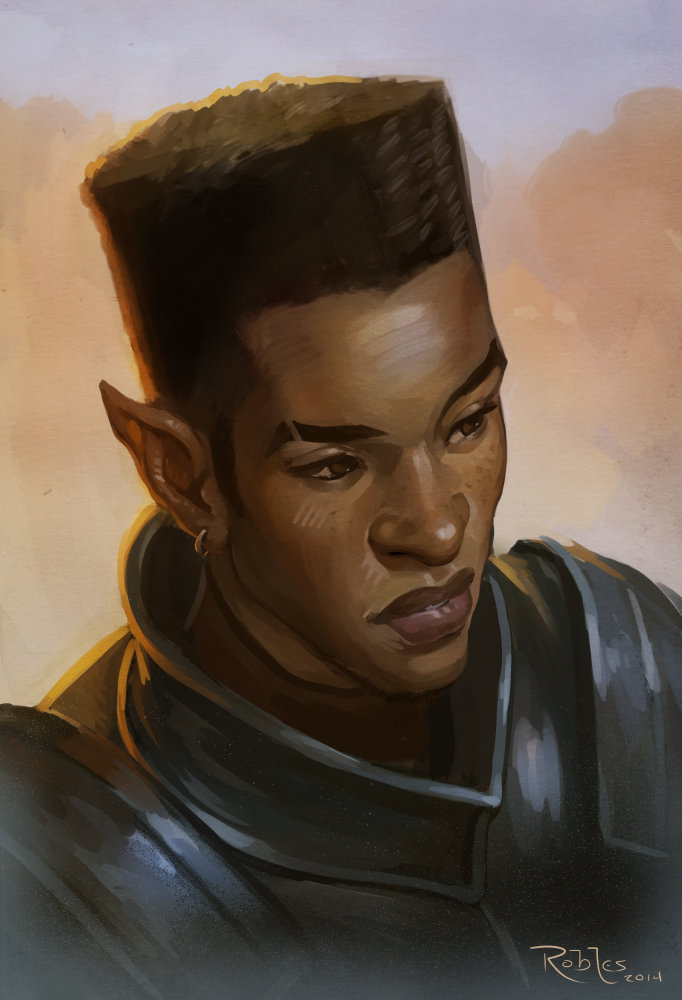
Pictured: painting of an armored elf with distinctively black features, by Nick Robles.

Running with this, writers sometimes give us a paragon of virtue like Drizzt Do'Urden.  Drizzt is one of the most iconic characters in modern fantasy: a renegade drow (dark elf, literally black-skinned) from the underground city of Menzoberranzan who grew up disgusted by his people's cruelties and so ran away to the surface, where he roams the land of Faerun slaying monsters and rescuing the helpless.  He is, of course, nevertheless hounded at every turn by people who see his black skin and assume he's a monster.  I won't speak to authorial intention here, because I haven't read RA Salvatore's mind at any point in the last thirty years, but there's only one common reading of Drizzt's story and what it symbolises for our world.  We readers look at these presumptuous bigots, who think the only good dark elf is a dead one, and scorn them for failing to get to know Drizzt before judging him.  We know better and we are enlightened.

Drizzt is a good guy.

Drizzt isn't like other drow.

Drizzt is one of the good ones.  A credit to his kind.

#notalldrow

But the thing about those narrow-minded common peasants who flinch or scream at the sight of Drizzt walking into town is that they're only wrong this time.  With literally any other member of his species, they'd be absolutely right to freak out, because a powerful and sadistic murder-specialist would have just said hello.  That's not racism; that's basic probability and pattern recognition.

Fantasy racism like a fear of dark elves is ultimately a terrible allegory for real-world racism because the dark elves have worked long and hard to gain that reputation for monstrosity, whereas in the real world white history is basically a laundry list of the other nations and peoples we've slaughtered and enslaved and oppressed for monetary gain, political power, or occasionally just for sadistic fun.  In order for Drizzt the onyx-black elf hero to be an actual metaphor for black people in North America, our continent would have to live in constant fear of invasion from a subterranean army of African-diaspora wizard-ninjas, and I figure there can't be more than five or six million registered voters who actually think that's a concern.

What I'm getting at when I say #notalldrow is that Drizzt's experience, being a variously privileged individual walking into vulnerable spaces full of people who have been hurt before by people who look like him (and who know that he has the power to hurt them further), is the experience of the oppressing class, not its victims.  White people, especially but not exclusively white men: we're the drow.  When Drizzt sees someone afraid of him at first glance, it's not because they've been arbitrarily taught that black people are inherently inferior and disgusting.  If we read these scenarios and all we think is "Bah, foolish bigots, we Drizzt would never be so villainous!" we're only reinforcing the idea that vulnerable people owe us their reflexive trust or they're the real racists.

To the credit of Drizzt's fictional persona, he sympathises with these people and is patient with the caution strangers take around him.  At least, this is a good aspect of his character if it's taken as a model for, say, white people to not go around acting indignant that people of colour aren't always ecstatic about our presence.  From the 'surface' reading of his story, where Drizzt is the victim and he is patient with having to work to personally win over every single racist he meets... that's suboptimal to say the least.  The tangle that this kind of speculative fiction has made of power dynamics makes it harder to draw any conclusive arguments out of the text beyond a lukewarm 'everyone should be good to each other'.  That kind of 'equal opportunity learning' gives us stuff like the unholy mess that was Disney's Pocahontas, in which the indigenous Powhatans are also guilty of prejudice against strangers just because the white people are here to conquer, pillage, and murder.  I cannot even.

Fantasy racism doesn't speak to real-world racism as long as it seeks to justify its existence: as long as those simple innocent farmers are afraid of orcs because orcs are literally and objectively the twisted embodiment of malevolence forged by an evil god to burn the world, fearing orcs isn't racism, it's self-preservation.  Fantasy that wants to tell us that racism is bad has to start by admitting that racism isn't a defense mechanism but a weapon--a philosophy that helps the people in power convince everyone else that it's okay to kill and exploit those other people, without provocation, because they just don't deserve any better.  Stopping racism is about acknowledging and revealing and destroying that idea, and it's got to be done in us, the privileged, oppressing class.

I'd love to add some examples here of fantasy racism done properly (purely as propaganda and not based on objectively truth) but... I'm not sure I can think of any.  Even in Discworld, the conflicts between trolls and dwarves ultimately come back to 'both sides bear guilt'.  In the Warcraft universe, primary example of a setting where orcs are heroic protagonists as often as villains, the orc-human divide stems back to those one or eight times that the orcish horde got cursed into raging berserkers and tried to burn down the planet.  In settings like Star Trek (and often Star Wars, depending on the book) aliens often are pretty one-dimensional in ways apparently defined by their species.  I think a good case can be made regarding house elves in Harry Potter, but that'd be a book unto itself and there are plenty of people who feel the text ultimately fails to make a proper case distinguishing the racist propaganda from the truth.  If any of you readers have encountered a good speculative treatment of how racism functions that doesn't make these kinds of errors, I would love to hear about it.

Let me end by sharing with you a quote from Chris Rock, in an interview from 2014 which I was lucky enough to encounter this week:
So, to say Obama is progress is saying that he’s the first black person that is qualified to be president. That’s not black progress. That’s white progress. There’s been black people qualified to be president for hundreds of years... The question is, you know, my kids are smart, educated, beautiful, polite children. There have been smart, educated, beautiful, polite black children for hundreds of years. The advantage that my children have is that my children are encountering the nicest white people that America has ever produced. Let’s hope America keeps producing nicer white people.
Hope everyone's been having a good Black History Month.

Wednesday, December 9, 2015

Tarzan: Gender in the jungle

I was planning to write a thing today about therapy, about depression, about the general malaise and despair that comes from doing the things that are supposed to make you better and seeing no difference and having no idea where to turn to find any alternative, but 1) it was itself hella depressing to write and 2) it went nowhere productive.  Maybe I'll try writing a thing about therapy again some time in the future.  Right now if you want to understand where I'm at mentally just read the first half of Depression Part Two by Allie Brosh (everything before things start to get hopeful) and also this tumblr post by Cliff Pervocracy.

So instead today we are going to talk Tarzan, specifically Disney's Tarzan from 1998 and what it's got for it and against it.  This is actually an oddly appropriate followup to my previous post about Kingsman, because both stories are about men (Manly Men) and the true marks of civilisation, and are unnecessarily white and prevent the women from having any substantial agency in key moments.  (I listed some of my thoughts to the blogqueen over skype, which she summarised as "So, needs more lesbians".  She's not wrong.)

Disney did not shake up the classic Tarzan story in any major way: an English couple suffer a shipwreck somewhere on the massive coast of Africa (no more specific than a whole continent) and do their best to survive before getting killed by a leopard, but their infant son survives to be raised by a passing clan of gorillas.  Years later, more English explorers arrive, leading Tarzan to the shocking discovery that he's not just a pasty hairless gorilla, but another species entirely, he falls in love with Jane, the young woman on the expedition, and they are torn between his jungle home and hers in London.

The movie has some strong points; one that jumped out at me this time was Clayton, the villain, who follows more in the style of Gaston than Scar, Jafar, or Dr Facilier--far from being a fastidious conniver sowing chaos through whispers (like some kind of woman), he's a great burly gun-toting explorer out to take what he wants from the wilderness through right of conquest.  In another time, Clayton would be the intended hero of the story (the writers did this very intentionally--in the original novels, Tarzan's human name was John Clayton).  Instead, he's played here as contemptible from the outset, pointing his gun where it doesn't belong and assuming he can get what he wants by shouting demands.

In a movie that's all about Tarzan trying to figure out his identity, Clayton very quickly sees himself as Tarzan's model for what a man is supposed to be: strong, commanding, and ruthless.  Tarzan's own father-figure, the gorilla Kerchak, is distant and dismissive, which might have made this a compelling possible bond, but Tarzan spends the middle of the movie focused on Jane, who is helping him discover things like written language, astronomy, and erections.  I think maybe my favourite thing about Tarzan's story is that he never does attach himself to a father-figure; his biggest influences are all women (mother Kala, best friend Terk, and love interest Jane).  His most important moments with men are rejections: he refuses to let Kerchak's judgment discourage him, he refuses to operate on Kerchak's principles of defensive xenophobia, and he rejects Clayton's temptation to might-makes-right conquest.  When Clayton's Evil Scheme to capture all the gorillas is inevitably foiled and Tarzan has him at gunpoint, Clayton even goads him to shoot: "Be a man."  Tarzan instead smashes the rifle and declares "Not a man like you" before the forces of plot convenience go to work and Clayton accidentally hangs himself with a vine.  It's not uncommon for Disney to allow the hero to keep their hands clean while still killing the villain (Gaston doesn't even get pushed--he just trips and falls to his death once his role in Beauty and the Beast has been completed).  It's a little less common for the hero's refusal to implicitly be a rejection of white male entitlement as a whole.  So, like, high five on that part, writers.

But on this viewing, what I mostly felt was that Tarzan is a layered story about bigotry and the struggles of mixed identities (from a child's despairing 'why don't I look like everyone else' to an adult's ongoing efforts to not lose either side of himself) which is tragically wasted on a straight white dude.  A white dude with dreads.  (Fellow white people: as you are hopefully aware, our hair doesn't do dreadlocks.  No, the Norse didn't do dreadlocks either.)  This whole movie is white.  The humans are all white (even the unvoiced extras), the gorillas are all voiced by white actors, everyone.  The only character for whom whiteness is arguably an integral part of his character is Clayton, who embodies the colonialist English 'adventurer'--that kind of entitlement is very us.  Our other three significant humans are Tarzan himself (whose parents are also onscreen for the intro song), Jane, and Jane's father, Professor Porter.  None of these people need to be white.

I'm aware that in the original novels (which are deeply racist and stunningly misogynistic, surprising no one) Tarzan turns out to have been an English Viscount, which has largely been a whites-only club for most of history.  (Although the crown was a fan of granting Indian people aristocratic titles under the British Raj.)  But the original novels also don't feature any musical numbers with Rosie O'Donnell, so it's not like we're trying to be that purist, and in this movie, Tarzan's parents don't even get dialogue, let alone backstory, so they could be literally anyone and not impact the story.  Similarly, even if we imagine that only a white Professor Porter would be likely to have the wealth to boat down to Africa to study wildlife, there's no reason his (dead, never-pictured) wife should have to be white as well, and a biracial Jane opens up a whole new connection to Tarzan, who has also grown up with all the joys of being visibly different from his peers.

(Disney isn't exactly known for doing intricate love stories, and this movie as it stands is no exception: Tarzan admires Jane's fieldwork and she's amazed by his expertise in navigating the wilderness, but for the most part they appear to love each other because they're both very pretty and have literally no other viable partners.  It's hard not to wonder whether, five years after the movie, Jane doesn't perhaps raise the subject of making a quick jaunt home to pick up some books and penicillin and clothes not made of skin, especially once she learns that basically all animals can 'talk'.)

Lastly, in a movie about Manly Men Doing Manly Things (not referring to this excellent webcomic of the same name, sadly), how do the women fare?  I've already listed the three named women, all defined by their relation to Tarzan--his mother, his bestie, his ladyfriend.  Kala is a typical Disney mother (caring and understanding in all things) who at least gets to survive the movie.  Jane is primarily a plot object with only one goal (meet the gorillas) who casts aside her entire life up to that point, and any of her prior goals and dreams, to be with her man.  (Any hope of interpreting her choice to live in the jungle as something to do with studying the apes is undercut by her willingness to leave until her father reminds her "But you love him".)  The least stereotypical woman in the cast is Terk, Tarzan's best friend, who tends toward the disruptive, sarcastic, and acerbic, but this ultimately doesn't do much for her agency.  None of her choices really impact the plot--in the moment when she might be most relevant, when Tarzan has decided to leave with Jane but immediately then been captured by Clayton's goons, it's not her loyalty that leads to his rescue--it's the tertiary elephant friend Tantor who overcomes his timidity to reprimand Terk for being emotionally withdrawn and then charges in to save the day.  Narratively, I get why the writers would think this is a good twist--the timid character finally standing up to the heroes is generally good stuff, like Neville facing down the trio in the first Harry Potter--but here it means that Terk's last chance to impact the story is instead handed off to the nearest man and she is a barely-consulted tagalong.

I do like this story as it works for the men and the contrasting manly identities, but stories for men aren't a rare commodity.  I'm aware of one retelling of Tarzan from Jane's perspective, about which I've heard deeply mixed things, and given the dozens upon dozens of Tarzan stories at this point, I think we can do with a few more that maybe ask what kind of person you have to be to leave civilisation behind, charge headlong into the merciless wilds, and decide that this is the place you will feel most at home, with your mighty half-intelligible beast-master husband at your side.  Or wife.  Like we always say here at SS&S: this story could have been about lesbians.

Wednesday, August 5, 2015

Erika vs Good Morning Vietnam in: The Mysterious Case of the Missing Plot

(Content: misogyny, racism, and their fusion dance super form, racialised misogyny.)

You know those movies that are classics and you always hear about in such hushed tones, but when you sit down and finally watch them think "That's it?" If I had known anything about Good Morning Vietnam besides "It's a movie that is fairly well liked and also has Robin Williams in it", that is how I would have felt. However, I had heard next to nothing about it in any specific way and still managed to be completely underwhelmed. Which was impressive, but not enough to overcome how boring this movie got at times.

So, for those of you who, like me, managed to not actually know anything about this movie, a quick run down: Adrian Cronauer (Robin Williams) is an air force somethingorother transferred from Greece to Vietnam in 1965 (before people were calling it a war) to work as the base's radio DJ.

A solid hook, but that's kind of where any semblance of a coherent plot ends. He goes there and then things happen and Adrian doesn't really grow or change. He gets out of a slump at one point? So strap in while I tell you about the series of events that are trying to be a plot. Or at least the parts of it that are relevant to what I want to write about.

We are introduced to Adrian's two immediate bosses, and we know they are Bad People who should be shunned and mocked. Why? Because they don't think Adrian is a perfect little hilarious person whose best friend you want to be. That is consistently a metric for how we should view characters. Do they like Adrian: Yes/No?  If no, they are The Worst. Because as we all know those guys who are smart and funny and think they're too good in their cleverness for authority or rules of any semblance are charming, and not arrogant and tedious when dealing with them in real life.

Like many of those other "I'm so funny and smart I don't need rules" types of characters/people, Adrian Cronauer is also impressively sexist and racist. This is also a fact made very clear to us very early. 'One of the first scenes of the movie' early.
Adrian: Mayday! Mayday! Dragon lady with incredible figure at eleven o'clock! Stop the car.
Garlick: I can't do that, sir.
Adrian: Oh, Edward, Edward, you don't understand. I've been on a small Greek island with a lot of women who look like Zorba. I never thought I'd find women attractive ever again. And now that I do, you won't even turn the car around? Thanks a lot.
Garlick: You have a very important meeting with the top brass.
Adrian: Oh! There she is again! How'd she get ahead of us?
Garlick: That's another person, sir.
Adrian: Ah, she's beautiful and quick. Speed up. Check her stamina. This is incredible! Oh, my God! They're quick, they're fast and small.
To further drive the "all Vietnamese women look alike" gag home, when he sees another pretty Vietnamese woman wearing white he insists it's the same woman, and approaches her. She turns him down in incoherent English (HA FOREIGNERS CAN'T SPEAK ENGLISH--except, you know, Adrian hasn't tried to learn a word of Vietnamese).  His completely reasonable and charming response is to stalk her to her English class, pay the teacher to let him take over said English class to try to get her number, and when her brother Tuan (who speaks English fairly well) tells him to back off, Adrian decides "Nah, gonna befriend this kid so I can try to bone his sister".

Tuan makes it very clear he knows exactly what he's doing, but says sure, you can buy me lunch. Kid knows free food is good food and strangers have the best candy. He calls out Adrian for how a lot of foreigners treat Vietnamese women as objects to be bought and boned, and how sex is much less free flowing here and has meaning here, and he's as skeevy as the rest of them for it. He doesn't even know Adrian has been trying to requisition a gingerbread house to try to lure children to base to make stew with them at this point. Adrian doesn't get what Tuan is saying. Why would there ever under any circumstance be something wrong with trying to sleep with a woman? I mean, we're talking about buying her dinner first here, that's like, as classy as you can get! He was even going to wear pants, okay? Adrian's no pig, he wasn't planning to open with showing her his collection of vintage pictures of fresh produce with small birds! That's like, third date the earliest. After lunch he takes Tuan (who is I think about 16) to the local army bar (see? totally classy and responsible), where Adrian's army buddies are trying to figure out how to approach a pack of women. Adrian's answer? Hold up a wad of cash and call them over as if they were dogs.

No, I'm not exaggerating. I wish I were.

It works.

For the second time I nearly stopped watching the movie at this point.

The men who were talking to these women come over and take issue with Adrian having brought a local in (or, as they so charmingly put it, g**k). This isn't actually because of Tuan, but because they perceive Adrian as having stolen their women (because they were talking to them, therefore they were their property and owning people is legal and not at all morally questionable at all) for his own group. Adrian is shown to be a "good guy" because he calls these skin sacks out on being ignorant racists and starts a fight with them (HEADBUTT OF JUSTICE! Only works the first time).  The owner in the background says "it's ok" about how much the slur is being used. The military naturally is UNHAPPY with Adrian for getting in a fight in a civilian owned bar and he faces SERIOUS CONSEQUENCES despite how beloved he is. Hah, just kidding, that's not how the world works for guys like Adrian. He gets yelled at a bit and told not to do it again or else they're taking away his collection of pictures of fresh produce.

Jumping ahead, we have Adrian being shown as being a Good Guy because as he takes over the English class he is warm, friendly, and affectionate to his students, and respectful of the culture. You know, while the source of humor in these scenes is people who are still learning English speaking it poorly and being taught how to swear. Because that's not fucked up at all. Not like these people are paying for a class to try to learn the language of the people occupying their country, instead being told to flip people off. That couldn't possibly endanger them when dealing with hot headed army men.

This is kind of where the movie loses what semblance of the plot it did have. Adrian still goes after Tuan's sister (who was such a non-entity I can't even recall her name) and Tuan, after seeing Adrian treat a group of local women like literal dogs and flashing a wad of cash at them, doubles down and says "Stay the ever living fuck away from my sister or so help me God I might only be like 16 but I will develop laser eyes and set you ablaze with them". HAH JUST KIDDING THAT WAS JUST GUYS BEING DUDES! Besides, he defended him against slur-using skin sacks! So he's cool, plus, he's funny! Tuan: confirmed for likeable. So likeable he and Adrian become besties. We never get shown their friendship bracelets, but you can't convince me they don't have them. Tuan even helps Adrian get close to his sister! Although, to be fair to Tuan, his goal is to show Adrian how hopeless this is. Which he does by setting up a date between the two. With about a dozen odd relatives going as escorts. Adrian, to his credit, rolls with it and takes the whole lot of them to go see a movie, which will later lead to one of the few moments I have zero problems with.

Tuan convinces him to come back home with him (where his sister is) to come hang out later on. It is at this time she tells him "No, we can't date. We're too different" and Adrian very simply says "Listen, I know this can't work, but can't we just enjoy it for awhile? Have a few laughs? I like being around you, I'll take what ever you're willing to give. If that's just being friends that's fine." And when she insists no, this isn't something that will happen? He gives her space and keeps being friends with her brother. Adrien Cronauer: 1, Christian Grey: negative lots. This is one of very few scenes in the movie that makes me think Adrian might be a decent dude. I mean, he's not, but they tricked me for a second there.

Now that we've covered how the movie handles women, let's consider how it handles POC! I will take a moment to give a little credit here, there are two or three minor characters that are meant to be likeable besides Adrian who are white. None of the antagonists are POC. Every other sympathetic character is either Vietnamese or black (not that it's tons, but it's something) but the other two characters who we're supposed to both like and get to know at all are Garlick and Tuan.

I really like both of these characters, but let's start with Edward Garlick because I have less to say about him.


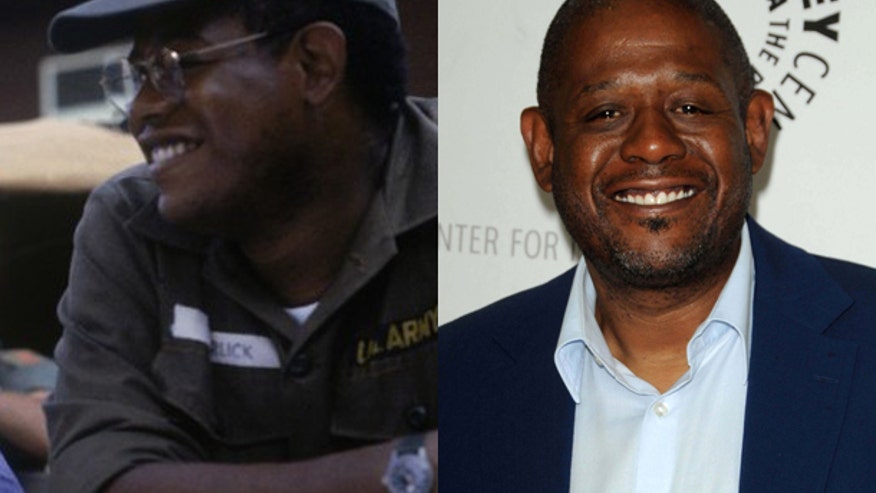
Look at that smile. He looks like a 6'02 teddy bear. This was the only decent image I could find of him not flanked by other characters, so enjoy the time gap image of Forrest Whitaker. So, Garlick is a massive black man. He is also gentle, soft spoken, kind, and well humored. He is nowhere near the "angry black man" or "zany comedic sidekick" tropes which I greatly appreciate. When he gets to be funny, he's clever, not sassy. He occasionally gets to affect the plot, but only in relation to Adrian (dragging him out of a slump, taking over as DJ at the end of the movie, playing Adrian's goodbye tape even though he could get in huge trouble for it). I would not be surprised if he had a small garden of fresh herbs he tried to grow, but wasn't great at it, but kept at it because he likes seeing them grow from seeds so much.

Then there's Tuan. Tuan becomes Adrian's best friend and guide into the world of locals. He's snarky, clever, assertive, and often far nicer to Adrian than I would be. He saves Adrian's life twice, both times from the VC, which we find out in the climax is because he is one. Upon discovering this Adrian looses his shit, and freaks out and screams at Tuan for betraying him. I'll post the excerpt of the script.
Adrian: You used me to kill two people. Two people died in that fuckin' bar.
Tuan: Big fucking deal! My mother is dead. And my older brother, who be 29 years old, he dead. Shot by Americans. My neighbour, dead. His wife, dead. Why? Because we're not human to them. We're only little Vietnamese. And I'm stupid enough to save your bullshit life at An Lac. [Tuan runs away.]
Adrian: Wait. (Yelling after him) We're here to help this country. Where the fuck you goin'? It's unbelievable. Five months in Saigon... and my best friend turns out to be a VC. This will not look good on a résumé!
Not pictured: Adrian sadly taking their BEST FRIENDS FOREVER bracelet off and dropping it in the street as he walks away sadly.

Tuan is trying to fight back against people who have come into his country and been slaughtering his people. Adrian still thinks that he is on the side of the good guys, that they're helping, that they're right, and circles it all back around to himself. He is betrayed. This is going to make him look bad. And this moment is a big part of the reason why I struggle to think Adrian is a good guy, despite the movie constantly telling me so. He doesn't even consider what Tuan just said. The hurt that has been caused to the locals. The dehumanization. He thinks "Well, I'm nice to them" and therefore doesn't think he is complicit in the damage or harm being done. That's basically the movie.  Adrian, since he is friends with a VC, is sent back to the US with an honorable discharge. Before this happens the movie tries very hard to make sure we know that Adrian is in fact a good guy. Don't let his brushing off of Tuan fool you! He goes, plays baseball with his English class (something that had been alluded to earlier in the movie) and Tuan's sister literally comes over to apologize for not being able to touch her genitals to his genitals, because he's such a good person.

One of the last scenes of the movie, on the tail of the first time someone criticize the US for being in Vietnam, is a Vietnamese woman (the sister of the character to do the calling out) reassuring Adrian and the audience that he is still a good man. The movie wanted to say something. That was obvious. But it doesn't. It refuses to. Adrian staunchly keeps supporting the army (his farewell being one last attempt to try and keep morale up) while trying to befriend the local populace.  The movie asks me to see someone being benevolent, but all I see is someone who refuses to have any actual convictions or be critical of their own actions.

Adrien is, after all, Not Like Other Soldiers, (I mean he's air force!) and since he is different and special, he is above judgement for the actions of the group he is a member of and supports. Which invites the viewers, all of which presumably found Adrian charming and are therefore Good People to think they, too, are absolved of judgement for their actions, direct or indirect. After all, they get it! And for people who disagree? Well, that makes us like his evil and unlikeable bosses, and you don't want to be one of those wet blankets, do you? This movie while trying to say something about Vietnam (war sucks, but hey, we were trying to help) is really saying that people being too critical don't get it. It's an approach and mindset that is dangerous and prevalent to this day. The whole message of the movie feels a lot like all of those guys like Adrian, charming and funny and thinking they're smarter than anyone with authority over them, sitting me down and with a warm smile patting me on the knee (with no regard for how unwelcome that contact is) and saying "Sweetheart, it's not that bad. Relax. Learn to take a joke!"  I'm sick of being told to lighten up when protesting a point on the grounds that it literally gets people killed, and I especially don't want to hear that from someone who has a collection of vintage photos of produce with small birds.