Showing posts with label Egwene should not have to put up with this. Show all posts

Wednesday, August 26, 2015

The Eye of the World, chapter 49 to the end, in which the best and the worst of this book are on display

Here we are at last.  I could have split this across two posts, but I decided to power on ahead to the end.  Book One of the Wheel of Time comes at last to its end and we find out what passes for a climax in this unnecessary marathon of a pagecount.  Goggles on, dear readers.

The Eye of the World: p. 732--782
Chapter Forty-Nine: The Dark One Stirs

Rand wakes up and, top priority now that they are way deep in the noxious hellscape of Satan County, takes stock of how Nynaeve is feeling about getting rejected by a man.  If I thought this had anything to do with Rand thinking their group might be weakened by inner strife, I'd be less judgey.  Because Egwene is a better person in every way (and praise depersonified Light Jesus that she doesn't end up with Rand, by the way) she doesn't just stare, and instead goes to chat with Nynaeve until she manages to provoke a laugh and a hug from her wounded friend.  Rand just thinks about how "all women are Aes Sedai" because he thinks they have secret methods to read male minds, and I just can't even with this guy.  I mean, I absolutely think it's narratively stupid that Nynaeve is suddenly in love with Lan, but accepting that as our premise, we can presumably agree that Rand is contemptible for just staring at her, hurt, and thinking how freaky women are with their witch-feelings and seeeecrets.

Best possible plot twist at this point: Rand tries to stop the Dark One, instead falls to temptation, and Egwene leaps in to save the day because she is the Dragon Reborn.  Yes, after eight hundred pages it might be questionable to be all 'Hah, that protagonist was a decoy!', but there are literally ten thousand more pages still to go in this series and it's not like it stopped GRR Martin.

But let's move on or we'll never find out how disappointed I'll be.  They are once again riding towards--honest to Hotei--the Mountains of Dhoom.  Dhoom, people.  No editor stopped Jordan from doing this, and we all bear the weight of that sin.  Moiraine is taking them to the last place she found the Eye of the World, and if it moves, they'll count on the Green Man to help, because he "senses need", though why he hasn't come to them already in that case I don't know.

There's more description of the Blight, which is honestly the best part of this story right now, and when I'm this enthusiastic about description near the climax of a book you know it's dire.  The trees shed wet, decaying leaves constantly, ooze from cracks in their bark, and tremble from their footfalls as if they're turning to liquid entirely.  One of them flails around and grabs a furry creature off the ground.  Love it; A-plus evil landscape.  Lan wanders into the undergrowth to slaughter something evil, and upon his return gets jumped by some kind of murderous spider-bear, but Mat of all people takes it down with a single arrow.  That's a prelude to a mass monsters-and-monster-trees ambush, but the farm kids once again go into that ancestral battle-fugue where they shout about Manetheren and Ellisande a lot, and Moiraine elects to spam fireballs, because she definitely hasn't been saying this whole time that subtlety is paramount and we definitely don't have in-text evidence that wielding Fire weakens her more than anything else.  For reasons deeply unclear to me, Lan keeps leaving the group, diving into the trees, slaughtering things, coming back for Moiraine to cast Lay On Hands, and leaving again.  What's he getting done out there that is more valuable than directly protecting the party?  Does the forest have Strategy Bushes that direct and coordinate its malevolent intent?  Give me something, Jordan, don't just have him 'disappear' because it's supposed to be mysterious and cool.

The assault stops at the sound of some other creature's cry chasing them, which Lan identifies as Worms.  I mention this only because, to my endless delight, Jordan asserts that you can hear dramatic capitalisation:
"They were scared off by worms?" Mat said incredulously [...] 
"A Worm"--there was a sharp difference in the way the Warder said it from the way Mat had--"can kill a Fade, if the Fade hasn't the Dark One's own luck with it."
I mean, yes, Terry Pratchett also had audible capitalisation, but Discworld is an intentionally absurd place.  And well-written.  Lan volunteers to make a heroic sacrifice, but Moiraine forbids it, and Rand braces himself and thinks about how scared he is (less than relatable prose, way too tell-don't-show) when they clear a foothill and burst into a mass of healthy greenery that she declares safe.

The Green Man appears, made of nuts and leaves and butterflies, greets Loial and names Perrin a Wolfbrother, then straight up calls Rand 'Child of the Dragon', but no one thinks that might be a big deal.  He agrees instantly to take them to the Eye, and I wonder again if we've ever actually been told what it is, apart from 'plot relevant'.

Chapter Fifty: Meetings at the Eye

They wander deeper into the greenery, the Green Man weaving flower crowns for the women as they go.  Not sure why even he thinks that flowers are only for girls.  Dude is, by chance or choice, a dude, and he's partly made of flowers.  Maybe Lan is just sensitive about crowns.

(At this point, I decided to search the web for some good art of a manly man wearing a flower crown, but after the third photoshopped Benedict Cumberbatch I gave up.  On everything.  Forever.  I am a pointless meat husk screaming towards the void.)

The Eye is inside a hill, entrance marked by a stone arch, and I had thought the Green Man was hella old because he talked as if he had seen entire past turns of the Wheel, but then he says that he was made to guard it when it was first made, during the Breaking, by a hundred male and female Aes Sedai who sacrificed their lives in the effort.  Well.  That's... questionable.  Is it just me or if the villains made something out of the lives of a hundred people would we not assume it was an artifact of terrible evil?

Inside the cavern, the Eye turns out to be a big oval pool of not-water with no apparent bottom.  Mat kicks in a rock (classy) and they watch said rock dissolve into nothing.  Moiraine describes it as the essence of saidin, dude magic, which can either seal the devil's prison or bust it fully open.  Loial asks why anyone would make a thing like that:
"No one living knows [....] Neither the how, nor more of the why than that it would be needed one day, and that that need would be the greatest and most desperate the world had faced to that time. Perhaps would ever face. Many in Tar Valon have attempted to find a way to use that Power, but [...] only a man could channel it [...]"
Well.  That is also questionable.  A contingency device that can either save or end the world and can only be used by male wizards who are actively hunted because magic corrupts them.  Nothing about this plan sounds like a good idea unless you have narrative information that asserts that it will all turn out okay.  That is not a kind of prophecy I favour.

They leave again and outside run into a pair of the Forsaken, the devil's favourite servants, who are apparently loose now.  One is hella old but telekinetically smites Lan; the other is bound up in a fetish-worthy amount of leather and sets about thrashing the others before the Green Man shows up to save them.  Treebeard is not to be taken lightly--they wrassle for a moment and the Green Man looks like he'll burst into flames, but not before Captain Safeword finds himself consumed by an outburst of fungus, nettles, and weeds, plants that love the dark.  Then Big Green does topple, and his collapsing body produces a single acorn that immediately erupts into an ancient towering oak.

You know, I'm actually enjoying this book right now.  It's not exactly mindblowingly original, but at least it's operatically fantastical.  If the book only consisted of events like the last few chapters, and not five hundred pages of trudging through Generic Fantasy Farmlands, I might even recommend it to others.

Moiraine tries to trap old dude--Aginor--in a fiery chasm and tells the others to run, but Egwene tries to help as well, and Rand has to pull her away.  In literally any book where Egwene was the protagonist, it would be a sign of incredible bravery that Egwene dared throw whatever magic she could wield against the villain, and it would make some minor difference that was ultimately key to their victory, but here she's being foolish and has to be rescued by a boy.

Chapter Fifty-One: Against the Shadow

So this chapter gets trippy.  Rand runs from Aginor until he reaches a sheer cliff, inescapable, and Aginor talks about killing him (the devil being okay with undead servants), but Rand is suddenly aware of... I'm not sure.  Lifelines?  He sees a glowing cord running off Aginor, which pulses ever more intensely as they mind-battle until Aginor bursts into flames.  Rand then teleports into the middle of the battle at the borderland pass, where things are going badly for humanity, but in a fit of rage he blasts the draghkars out of the sky with lightning and summons a firestorm to scythe through most of the trollocs and Fades.  There's some unclear dialogue inside his head between himself ("It has to end!") and an unknown voice ("ONLY THE CHOSEN ONE CAN DO WHAT MUST BE DONE, IF HE WILL"), and some reasonably adept prose describing the "terrible heat of the Light" in such a way that makes it sound less cuddly and more like an overwhelming implacable force.  This I also like: if your hero is going to wield supreme power of goodness and use that power to incinerate living creatures, at least make him fucking terrified of it.  (I mean, the whole 'our hero firestorms the bad guys' is an unnecessary scene on principle, but if it's going to be here, this is an okay handling.)

As the human forces rally behind him, Rand climbs a literal stairway to heaven, steps made of light in the void, until he arrives back in the stony balcony from his dreams where he faces off against Ba'alzamon.  Rand can see Ba'alzamon also has a lifeline, and you should all be proud of me for not making any of the jokes that all but tell themselves when Rand marvels at how thick and black it is.

Ba'alzamon explains (indistinctly, but intelligibly if you know Rand's Secret Backstory) that he has orchestrated the events of Rand's ancestors to bring him here, and has only sent small armies or individual Darkfriends after Rand because he'd rather have a living servant than a dead one.  At least that tries to explain why the endless armies of evil haven't made much of an appearance, but I'm still not clear why sending a hundred Darkfriends to abduct Rand would have guaranteed his death rather than his capture.

The devil conjures up Rand's dead mother next, and she pleads with Rand to save her soul.  Fades appear and start torturing her, but Rand conjures a sword of light out of nowhere, blasts them to bits, and hacks Ba'alzamon's lifeline in half, declaring "It is ended!" in what I can only assume is a Revelation reference.  Everything bursts into flames.

Chapter Fifty-Two: There Is Neither Beginning Nor End

You say that, Jordan, but I remember the naive, callow youth I was when I started this book, and I know how eagerly I await my freedom in another twenty pages.  Also, really, that chapter was our grand climax?  Rand is separated from the others and doomed but then instinctively saves himself, saves the army, saves his mother, and sets the devil on fire?  That was literally and without exaggeration the most gratuitous, least foreshadowed, least earned, and most convenient victory I have ever read.

Wait, I'm wrong.  I once read a primary school kid's short story in which a boy gets magically transported to a realm of talking animals and told by the king lion that he is the chosen one who needs to use the magic gems to destroy the villain.  At that exact moment, the villain leaps into the king's court, and the kid raises the gems and vaporises him on the spot.  Like, the lion hadn't even finished the tutorial on these things and boom, quest over, promotions all around.

That is the only other contender for the title.

Rand awakens where he started, near the pile of gross ashes that used to be Aginor.  Memories float back and he sprints back to the others, who are all unharmed, including Moiraine.  He tells them that he killed the devil, and everything else that happened, but everyone else is too plot-savvy to believe that the devil gets dropped in book one.  Moiraine explains that she's seen evidence of Rand channelling all through the book, as far back as when she was casting Refresh Horse on everyone's mounts and Bela didn't need it--because Bela was carrying Egwene and Rand instinctively wanted her safe.  (The possibility that Egwene had refreshed Bela apparently wasn't on the table.)  Moiraine promises not to drag Rand off to be "gentled" like they normally do with man-wizards, and not to tell anyone who doesn't need to know.

The Eye pool is apparent gone, consumed by Rand's victory lap of plot contrivance.  Instead there's a column of stone in the centre, with convenient steps to reach it.  The dudes of the pottery carry three relics retrieved from inside the prison.  First are ancient pottery fragments, which Moiraine fits together into a taijitu (last seen in the prologue) and identifies as heartstone, indestructible relic of a past age, one of seven seals on the devil's prison, shattered by unknown means.  Second is the Horn of Valere, namedropped much earlier in the book, to be used to call spirits of heroes back to fight the devil, and last is the banner of the Dragon, specifically a serpentine gold-maned red dragon.
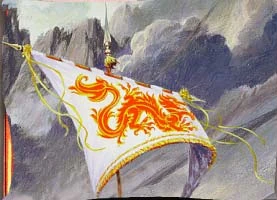

Just so we're clear on this, Our Heroes are a sea of whitebread and ginger carrying a katana, the prime symbol of Taoism, and now a clearly Asian-style dragon banner.  I know Jordan said he was going for a sort of 'fantasy melange', but I have yet to see a single thing that makes me say 'ah, a reference to African mythology!' or really anything other than 'ah, another white author with a fetish for Asian myths minus all the Asian people!'  People who have read later books: does this ever get better?

Chapter Fifty-Three: The Wheel Turns

The Blight has eaten most of the greenery the next morning, but Loial refuses to let it have the Green Man's oak, and takes an hour (that feels like minutes) to sing a Tree Song that rejuvenates it, assuring the party that he couldn't have invoked so much power if Jolly Green's spirit wasn't still in there.  The Blight is still gross, but doesn't try to murder them as they leave--Moiraine explains that they "struck a mighty blow against the Dark One" and for some reason Rand still hasn't asked for an explanation of how she reconciles that with his memory of killing the devil.

At least the soldiers at Fal Dara aren't so hypermasculine as to reject a good flower crown, and everyone is wearing them to celebrate the incredible victory at the pass.  Moiraine waves off all healers and meets with Agelmar to show him the recovered horn and ask for a small army to escort it to Illian, for reasons not explained.  Montages happen for a week.  Lan starts teaching Rand how to actually use his sword, and everyone gets hyped about finally going to Tar Valon, but Rand refuses to join them, convinced that he'll get gentled if he goes, and go mad-corrupt if he ever accidentally uses magic again.  He's just going to wander off on his own, away from people he might hurt, cursing the luck that his crush has to be a wizard and thus dangerous.  In another garden, far away, Moiraine magically eavesdrops on them:
"The Prophecies will be fulfilled," the Aes Sedai whispered. "The Dragon is Reborn."
And that's it.  That's the book.

I am... thoroughly unimpressed, I have to admit.  I love a good ending.  I love the part of a story where we see how everything that has led to the climax fits together in order to create something with meaning.  I love Frodo and Gollum facing the will of the Ring at the Cracks of Doom, the way the hero's past mercy ultimately saves him from his own final weakness.  I love Katniss, broken and angry, still playing her character so well that she gets a shot at salvation instead of vengeance.  I love the Doctor and Rose up against an army of genocidal zealotry, saved because the Bad Wolf is damnfool implacable hope and she will do anything to protect those she loves.  I love Harry Potter and Narcissa Malfoy in the woods, speaking two words ("Yes."  "Dead.") that declare that love overwhelms hatred in the end.

And I get that those endings are the real endings and this is book one of eleventy, so it's not a fair comparison, but I just waded through seven hundred and ninety-two pages of this stuff and the ending was abrupt, unjustified, and most heinously of all, revealed nothing meaningful about who the characters are or what they believe.  This is an ending that falls like a soggy towel on the page: and there, there's a huge battle and the good guys win but for how long isn't this awesome?  Wasn't this totally worth reading about the four hundred identical innkeepers that populate this world like an unsettling mashup of Barliman Butterbur and Nurse Joy?  Isn't it great how a solid 60% of this book was just setting the stage for later books while somehow failing to have any real impact on the events of its own plot?

I am struggling to think of any way in which the plot might have been hampered if the party hadn't transitioned directly from, say, Baerlon to Fal Dara.  By my estimate, if they had done so, the book would have been about three hundred fifty pages long, maybe three hundred with better editing, a solid book but not a brick.  We lose the City of Mat Don't Touch That Dagger Oh My God, and Perrin being a Man-Wolf, and Rand flirting with a princess, but do we lose anything that actually impacts the plot?  Is there any reason not to consider the intervening thirty-some chapters glorified filler?  I'm really and truly asking.  Because I don't think it should be a controversial opinion to say 'if half your book isn't relevant to your book, cut it', and yet here we are.  And I actually liked the Travellers and the wolfpack, those are good story elements, but they could be in their own book where they were actually plot-relevant and not just a sideshow with no purpose.

Because I don't make good life choices, I am actually considering getting into the second book on this here blog, but I'm definitely not doing that right away.  I need a cleanser.  So, apart from your usual delightful insights and anecdotes, make your nominations, resilient readers, and come back in a week or two to see what I inflict on myself next.

Wednesday, August 19, 2015

The Eye of the World, chapters 46, 47, and 48, in which Lan is voted Sexiest Man of the Age

Fewer than one hundred pages left to go, dear and loyal readers.  Three posts to the end, depending on how much nonsense I just dismiss and whether anything is actually going to happen.  Rally your courage; gird the bits that need girding.  (I didn't know this for ages, but apparently there is a specific girding protocol, shown here.)

The Eye of the World: p. 689--731
Chapter Forty-Six: Fal Dara

We left off last time with Our Plodding Heroes escaping the Black Wind in the Ways, a creation from the Time of Madness or possibly the War of the Shadow which was also called the War of Power.  (I kid you not, that's the explanation we get, with all of those namedrops.)  They have arrived in Shienar, in a frigid spring, and Lan cheerfully tells them it'll be warm when the get to the Blight, mythic land of monsters and eternal war.  They pass by a lot of abandoned farms--Egwene and Nynaeve note that they were recently abandoned, since the windows have light spring curtains hung instead of heavier ones for winter.  Perrin laughs at this because he's the worst, but when glared at he whirls on Mat to say that the abandoned scythe they saw only had a week's rust on it, which should have made it obvious even to him.

There's something spectacularly patronising about the constant implications that the scariest thing a woman can do to a man is glare at him like a miffed governess.

Rand tries again to convince The Girls to run off somewhere safer, and Nynaeve gets a full page of shutting him down, which is nice, apart from a few really stupid lines, such as:
"I have little liking for any Aes Sedai,and this one least of all, I think."
NYNAEVE SHE HAS LITERALLY SAVED YOUR LIFE MULTIPLE TIMES AND IS DRAGGING YOU TO SAVE THE WORLD.  Other Aes Sedai impacts on your life have included 'nothing' and 'actively trying to cause harm to your friends'.  This is nonsensical.

She also throws in calling them "you boys... you men", which thrills or baffles Mat no end.  Egwene decides to take the opportunity to ask Rand if he's upset that she danced with Aram, because Girl Priorities.  Rand flashes back to Min (SPOILER: one of his three future wives) who told him that he and Egwene were not destined to go at it like a sack of weasels, and then that bit is over with no impact on the rest of the scene or other plot relevance except to mind us of a prophecy that we might have forgotten in the intervening five hundred pages.  This book is so long that it includes 'Last time on our show...' within the same book.

They arrive at the fortress town of Fal Dara, where it's forbidden to hide your face for fear of Fades moving in unnoticed.  In the hands of a better author, I'd be interested to see a resolution of a conflict if heroes showed up (like Rand) from a culture that had strict rules about coverage with veils/hoods/scarves.  A resolution that wasn't just 'well, I guess I'll just ignore my religion while I'm here', but found a way to accommodate honoured guests and the needs of security as well.  The guards are hella psyched to see Lan arriving, shouting "Glory to the Builders!" and addressing him as Dai Shan.  (This might just be generic syllables, as it apparently means 'battle lord' in this world, but I think it also could mean 'tall mountain' in Chinese, written 大山?  I am in no way an expert in Chinese, but I suspect neither was Robert Jordan, and he does seem to want Lan to be vaguely Asian-flavoured.  ...Oh my god, but in Japanese it might be translated as 'big beautiful' this is the best thing people.)

Anyway.  The description of the fortress town is pretty vivid, if only descriptions of mundane pretty things were the reason I showed up to this story.  Lan is also called the Golden Crane, because having only one title is a hanging offence in WOTland.  We meet a bunch of the local soldiers, who assure Lan that things are never as bad as they look in spite of heavy raiding, and there's a lot of use of 'formal language', which appears to be vaguely Japanese--it's polysyllabic, unlike Chinese, but heavy on particle usage (ga, no, ni) and the phrase "kiserai ti wansho hei" appears to be a greeting.  (Or not; it's used later like a lament.  What?)  Agelmar, their leader, states instead that the trollocs are massing for a full invasion, cities are falling, they desperately need hope, and they need Lan and Moiraine to help--Moiraine for badass wizardry, Lan because he is "a Diademed Battle Lord of Malkier" and they need him for "the last Ingathering of the Lances".

So, in case we weren't sure, Lan appears to be the Aragorn of the story, heir to ancient titles and leadership but convinced he can and must only follow the humble path of the outlander.  After dinner, he recites a rhymeless verse about beauty and death.
Poetry out of Lan? The man was like an onion; every time Rand thought he knew something about the Warder, he discovered another layer underneath.
(In contrast, ogiers really are more like parfaits, minus the part where everyone likes them.)

The guards arrive to announce that they found a "madman" trying to get in to see Agelmar, who turns out to be the peddler Padan Fain who's been following Our Heroes since the start of the book.  He's really obviously half-possessed (interestingly, the locals believe that the Light protects people who are insane, and might even be the cause of insanity--is this ever expanded upon in later books?) and tries a sort of good-intentions-tempting spiel on Agelmar before Moiraine does the Vulcan nerve pinch and drags him away for questioning.

Chapter Forty-Seven: More Tales of the Wheel

Even the chapter title sounds done.  Book three, chapter twenty-seven: Yet Another Fricking Tale of the Wheel Are You People Satisfied Yet.  We don't get to see the interrogation, just people milling around impatiently.  Filler filler filler... oh, how delightful, Lan's backstory.  He's the son of the last king of Malkier, which makes him "al'Lan Mandragoran, Lord of the Seven Towers, Lord of the Lakes, crownless King of the Malkieri".  Political treacheries and jealousies explain how the last generation of Malkier's rulers obliterated themselves with the help of Cowin Fairheart, secret Darkfriend.  Lan's parents apparently saw nothing fucked up about swearing an oath to fight evil and defend the Malkieri on behalf of their infant son, whom they literally had holding the oath-making sword while he was in his cradle.  They charged off to fight a doomed last stand and Lan was sent off with a mess of loyal bodyguards to be raised as the ultimate warrior.  He is the best of the best of the best, SIR, and the only reason he hasn't rallied an army (as would instantly happen if he flew his Golden Crane banner) is that he doesn't want to lead anyone but himself to their deaths.

TL;DR: Aragorn.  He's literally Aragorn, with the exception that a lot of people just thought Aragorn was a weird loner instead of literally everyone flinging themselves at him in desperate war-puppy adoration.

So Padan Fain has been a Darkfriend for forty years and a special hound of the devil for the last three, homing in ever more closely on Rand al'Thor And His Amazing Friends, with regular vacations to perform unspeakably vile deeds and rituals that bound him more closely to Satan.  Which... I really hope after all that time he had a better plan for this part than 'walk in and get caught', but it doesn't seem like it.  Also, he was the guy following them back in the Ways that Lan declared they had no time to stop and investigate, and the Black Wind inexplicably spared him, probably because he's full of devil juice.  Nothing else actually happens in this chapter except recapping their plans: Moiraine is going to drag the most plot-relevant people she can to the Eye of the World in hopes of defeating the devil through narrative superiority, time is running out because he's starting to be able to project his thoughts into physical form, and no one else can go with them.  Et fucking cetera.

Chapter Forty-Eight: The Blight

More nice scenery as they march to Tarwin's Gap, the pass into the Blight.  So much scenery.  Occasionally I see something really cool and purely visual, like a photo list of abandoned places, and I think "Hey, 33 places, 33 chapters, I wonder if I could write a book on the premise that each major scene occurs in one of these locations?"  I feel sometimes like Robert Jordan did that, except he had six places and eleven thousand chapters so he filled the rest with dream sequences, bland banter, and unexpected capitalisation.

More description of where regiments of soldiers marched and when--these, at least, are of a different descriptive flavour than the parades of interchangeable inns and Inexplicably Identical Innkeepers we've been living with for all these pages.  Of course, references to the last guards left in the fortress, "soldiers and a sprinkling of old men, their wives dead and their grown children making the slow way south" remind us that while individual women are powerful plot-relevant in this series, women as a whole would never be accepted as regular soldiers for an army that desperately needs every fighter it can to hold back the literal legions of Satan.  What are you, some kind of feminist?

The Blight is all wrong, warm for no reason, and the sun is red despite being high in a cloudless sky, which I feel raises a variety of meteorological questions.  Our Heroes are warned not to touch anything--Lan describes, for example, a stick insect with an unspeakable dissolving venom that can only be stopped by severing your bitten limb.  This is a fantasy environment I can get behind--for whatever reason, I have always loved a vile and malicious wilderness.  Bring on your best horrors, Jordan.

We get a quality lake monster (tentacles with hands on the end, giant stingers, good stuff) before they camp for the night, and Moiraine throws a cloaking field around the camp.  Straight up invisible, I tell you no lie.  WHY HAS SHE NEVER DONE THIS BEFORE?!  I can think of a few times when invisibility might have been useful, such as their many, many failed stealthy escape attempts.  If said field is stationary, okay, but they've been interrupted in the night way too many times already for this to have not been relevant.  What in the hell.  What have I said about just randomly giving heroes problem-solving magic, Robert Jordan?  Come back from the dead and answer to my blog for these books you wrote twenty-five years ago!

And one more WTF moment to close the chapter: after Egwene talks about everyone going to Tar Valon after this and Rand becoming her Warder (he thinks about how he's deeply in boners with her but Min said they're not fated), they get to sleep, but Rand awakens to find Nynaeve and Lan sitting up together.  Nynaeve wants him bad, apparently, and Lan doesn't think he's good enough or safe enough.  Plus, you know, misogyny:
"Aes Sedai marry as seldom as Wisdoms. Few men can live with so much power in a wife, dimming them by her radiance whether she wishes to or not."
Even the metaphor doesn't work--standing next to something radiant doesn't make you dim, it makes you shine.  The moon is bright because of the sun, not in spite of it.  Fucking patriarchs.
"Some men are strong enough. I know one such. [....] Will you shame me to the point of asking you?"
Wait, it's shameful for a woman to ask a man to marry him?  Since when?  Why?  Aes Sedai and Wisdoms and queens regnant and Daughter-Heirs--shouldn't this culture be brimful with the idea that women take leadership, take initiative, make decisions?  Why should it be a mark of shame for a woman to decide she wants this guy instead of having to sit there waiting for him to approach her?

And, quite apart from the philosophical questions: what the fuck Nynaeve why are you asking Lan to marry you since when do you care about him at all you have nothing in common and he's oath-bound to a woman you claim to hate--ohhhhhh.  She figures Lan and Moiraine are a thing and she wants in on some threesomes.  It all becomes clear.

The chapter ends there, because the charge towards the climactic semi-conclusion is obviously the right time to slow down for regular romantic subplot speed bumps.

NEXT TIME: In a desperate rush to cram a few more Tolkien ripoffs into this book, Robert Jordan just straight-up copies Treebeard.

Wednesday, August 12, 2015

The Eye of the World, chapters 43, 44, and 45, in which Our Heroes meander through the infinite void

We're close enough to the end of this book that I, ever eager, have begun to look to what we'll be investigating next.  Suffice to say it will not be Wheel of Time Book Two unless something absolutely gobsmackingly unexpected happens in the next 150 pages.  I'm currently leaning towards The Way of Kings, book one in Brandon Sanderson's Stormlight Archive mega-series.  My reasons are manifold: I actually like Sanderson's work, but I have yet to read anything of his that didn't still have some substantial issues with women at the least, with some options on implied racism as well.  (He has identified a handful of characters as lesbian/gay, but no one's confirmed in text yet.  Apparently Ranette will be explicit about it in the next Mistborn novel.)  I've also been plagued by friends to read Way of Kings since it came out, but I haven't been able to summon the energy because the first thing that drew me to Sanderson's books was his ability to write fantasy that wasn't a ten-part doorstopper, and Stormlight Archive is his ten-part doorstopper.  So with any luck, a series on Way of Kings will be less painful than Eye of the World, will still give us some issues worth talking about, and might go a bit faster, like Ender's Shadow versus Ender's Game.

However!  I'm always open to other suggestions for reading materials that you, my dear and clever readers, think would be worth a dissection (keeping in mind that I will have to somehow acquire a copy of anything terrible that we carve up, and I have moral objections to giving money to terrible people).  The first alternative that comes to mind is H.P. Lovecraft, whose works are public domain and famously brimming with every possible kind of bigotry.  I loves me some sothothic horror, and it's best to do so with an understanding of how fucked up its great propagator was.  (I prefer instead to reference Robert Chambers' prior masterwork, The King in Yellow, which is hardly progressive but at least isn't gross.)

But before we can move on to such business, we have to finish up this rollicking epic timeless exceptional memorable adequate published book second draft.

The Eye of the World: p. 646--687
Chapter Forty-Three: Decisions and Apparitions

We left off last time with fearful discussion of the safety of the Ways, and open now with Loial and Moiraine taking a couple of pages to spit out that the Ways were a gift from not-yet-fully-broken male Aes Sedai to the ogiers that gave them sanctuary, and they let a person tunnel through time and space to hop across the world.  There's a lot of talk about aspects of ogier culture and magic--the Exile, the Long Wandering, the Longing--all of which are capitalised and none of which are explained.  You might at this point be thinking "Make up your mind, Will, do you want things to be brief or do you want them to explain what every term means?", and the answer is that if you don't have time to explain what a term means, there had better be a good excuse for dropping it into the conversation six times.  If you can use a term that much without having to explain what it means, maybe it's not actually relevant to the topic at hand and you're just bragging about how many things you've capitalised today.

Although the Ways survived the Breaking, they were still apparently tainted by Dude Magic and so began to rot a millennium ago, thus Loial's conviction that they're all going to die.  Moiraine counters, with shocking savviness, that they've heard far too many warnings about the Eye of the World and thus their best move now is to drag the ta'veren there and just let a big ol' destiny pile-up happen.

I'm trying to move at a pace now, but Rand and Egwene haven't seen each other in chapters and they've about to plunge into peril, so their brief scene together is worth a closer look, because oh my gods and monsters.  Rand tells Egwene that she's not predestined and she should take the safe route, not with them, and she tells him he's very sweet but she is plot-relevant thankyouverymuch and she's going anyway.  With her strength and importance thus duly noted, she asks again who this hot Elayne girl is.
For a minute he stared at her, then told the simple truth. "She's the Daughter-Heir to the throne of Andor." 
Her eyes seemed to catch fire. "If you can't be serious for more than a minute, Rand al'Thor, I do not want to talk to you."
Rand mentioned Elayne during his explanation about meeting the queen, but obviously meeting the princess is a heartless fiction meant only to toy with Egwene's emotions and cover up... actually, I can't even imagine what Egwene thinks he's lying about.  Some random girl Rand hooked up with at an inn along the way and decided to spontaneously namedrop in the middle of rambling about meeting their monarch?  This exchange is 100% pure not-from-concentrate Oh Those Hysterical Ladyfolk.  Faith and begorrah.

We get another (final? please?) dream sequence, which Rand recognises as a dream.  He focuses all his energy on thinking about how much he denies the devil, who takes the opportunity to exposit at us: time repeats itself, this is the jillionth time they've faced off and Rand's choices are always to die or to become the Vader to the devil's Emperor, and by the way the Black Ajah (secret devil-worshipping Aes Sedai) are totes real.  Is it just me, or do secret societies get a lot of their effectiveness from their secrecy?  Why confirm one?  If anything, this ought to be a ruse wherein the devil is trying to set the Aes Sedai on an internal witch hunt in order to weaken and distract them.

Apart from that, it's a pretty good creepy atmosphere, but it's still just a dream sequence, so wevs.  Rand awakens to find Mat is still asleep in the other bed and muttering constant devil-denials.  There's still a giant splinter in Rand's palm from the dream, which vanishes when he pulls it out, but the wound remains.  Like I said, decently creepy if we weren't supposed to be in the third act rush to the climax.  Fortunately, Moiraine arrives to insta-mend his palm and tell them to get moving already.

Chapter Forty-Four: The Dark Along The Ways

I've skimmed ahead far enough to know that it's going to take us two solid chapters to complete the 'dimensional tunnelling' adventure.  Let's keep things brisk.  Several pages detail Our Heroes acquiring their horses from the infinitely helpful innkeeper and creeping through the shadowy streets to find the Waygate, which is (all these centuries later) now part of someone's basement.  Conveniently enough, there's an external cellar door big enough to fit their horses, and Moiraine prepared knock this morning.  An intricately leaf-carved wall opens up to reveal a stargate shiny portal surface.  On the other side, everything turns out to be total darkness apart from the lantern glow and an old, broken stone path to follow.

Left to right: Rand, Lan, Egwene, and Loial bond* fraternise on their interdimensional journey.

(*I only just discovered what 'bonding' means in this series, thanks to some wiki'ing, and I'm slightly creeped out.  No, in order to consider someone an honorary sibling I don't actually need to experience a mental pseudo-womb with them, thanks.)

This chapter does not feature plot developments, and is thoroughly devoted to convincing us of how creepy the atmosphere of the darkened Ways is: they move along the road to Islands connected by bridges, where engraved stones called Guidings give directions in Ogier.  (Although according to Loial, it's not enough just to speak Ogier to understand them?)  Rand resolutely refuses to believe that they could have left one Island by a long curving upward slope and arrived on a second Island that is directly above the first one.  I truly and honestly cannot comprehend why he's convinced that's impossible, but he's quite definitive about it.

Everyone is always on horseback in here as well, apart from maybe whomever is leading their giant packhorse, which I'd like to point out is also a mistake.  Humans are vastly better endurance runners than basically any other animal.  Don't get me wrong, horses are pretty good, but the real advantage of horse-based travel is their carrying capacity and the fact that a person in a hurry can switch horses periodically to maintain top speed.  If you're just going to plod slowly along the Ways for a couple of days, there's literally no reason to ride instead of walking.  Walking is the only thing humans excel at.  Our Heroes are just lazily throwing the burden onto the horses who have done nothing wrong and frankly Bela deserves a medal for not kicking anyone to death yet.  Trollocs?  Bela didn't sign up for trollocs.

I know that the slowness of their plodding is supposed to help with the creepy atmosphere, but honestly at this point in the story we desperately need some urgency, and I especially think that racing around through interdimensional voids at top speed could tap into some readers' lingering nightmares:

For film producers' consideration, I submit "Mad Max: Rainbow Road".

The chapter ends when they come to a broken bridge.  Le gasp.

Chapter Forty-Five: What Follows in Shadow

Loial is pretty sure he can still get them to Fal Dara, but they'll have to take the scenic route.  Our Heroes take the opportunity when they stop for the evening to tease Rand and Egwene about all of the reasons they might be jealous of each other: Mat brings up psychic waif Min's crush on Rand, Perrin counters with Egwene's vigorous dancing with Aram, Mat references Else the farmers' daughter, and Rand and Egwene both pointedly and embarrassedly go to bed at each other.  This is definitely the gripping interlude we need right now to remind us that these characters are deeply in love and deserve our attention.

This chapter is also mostly boring, so I'd like to detail again: Rand and Egwene are not in love.  The book tells us they are, but they don't actually like each other.  They have a good neighbourly protective attitude at times and they both kind of want in the other's pants, and that's it.  The only conversations we've seen them have in the last, what, 400 pages have been 1) I'm glad you're not dead, 2) are girls real people, yes/no, and 3) stop being attracted to anyone but me.  That's a truly godawful foundation for a relationship.  (Out of morbid curiosity, I just wiki'd who Rand's actual love interest is.  He basically marries three different women, and by the end of the series at least one bears his children.  Twins.  What.)

Also, Moiraine informs the party that's she's pretty sure Thom Merrilin isn't dead, because he's too plot-relevant.  I am in no way exaggerating.
"And Thom is a part of the Pattern that weaves itself around you three. Too important a part, I believe, to be cut off yet."
If it's possible to survive by being plot-relevant how is anyone in danger?  The hell.  I mean, her corroborating evidence is that no one in Whitebridge had mentioned a dead gleeman--I don't remember when Moiraine passed through Whitebridge, but I question the circumstances in which she heard about a gleeman but didn't specifically get to ask 'oh, when was that and where did he go?'  Is there a good reason I'm forgetting?  I'm not even sure which chapter to check.

They realise the next day that they're being followed, but brush it off as less relevant than pressing on ahead.  Literally three minutes later they find one of the guidestones has been carved up with trolloc runes, proving that the Fades have found their way into the Ways and have been using them to transport trollocs across the country, which is how they were able to build up such a huge army around Caemlyn so stealthily.

Y'all know what?  This is the best plot development yet.  It involves characters actually taking advantage of a feature of their fantastical world and making intelligent use of it instead of just treating it like a curious museum piece.  The devil's power apparently suffuses the Ways at this point, so why wouldn't he use it as a troop transport?  Praise be to Eru Iluvatar, we now have two cases in a single post wherein people make intelligent decisions based on their knowledge of the structure of the world.

Lan investigates and finds that the closest bridge to Tar Valon is a total mess of melted stone and mutilated trollocs--Moiraine concludes that the wizard men who built the Ways also incorporated anti-monster traps, thus quickly removing the tension that the scene had accidentally started to develop.  Some hours later, a different random threat gets thrown at them instead, as Rand notices a slight breeze in the supposedly wind-free void, which Loial identifies as the Black Wind.  You can tell it's evil because it's black, as is traditional.

(One of the many story notions bouncing around in my head has to do with a universe that has largely been overrun by sothothic horrors, and the remnants of civilisation live their lives in space stations that are basically submarines permanently running silent.  For such people, 'black' means not giving off any signals, light or otherwise, that might draw the attention of monsters, and is thus also a colloquial term for 'safe and secure', and consequently for good things in general.  "Everything all black in here?"  "Yeah, we're doing fine."  Creating good slang is one of the hardest things to do in speculative fiction, but every once in a while I find something I really enjoy.)

Our Heroes make a breakneck sprint for the door, which is missing its keystone, but Moiraine turns her staff into a cutting torch, burns through a large arc, and Lan's horse shoulder-checks it out, breaking open an escape route, and Moiraine wards off the approaching wind with her flamethrower while everyone slips through.  In the last moments, Rand can hear the wind muttering, and ten points to Robert Jordan: it's creepy as hell, talking about carving flesh and braiding it back together.  Mind you, it's still just yet another random threat tossed at the protagonists to force them to end a chapter in a sprint.  Maybe in some future book it'll become relevant again?  I would prefer to read a book without feeling like I had to read a further dozen in order to get any kind of narrative payoff.  It has become eminently clear to me that this is the wrong series for that.

Next week: Lan's mysterious backstory becomes slightly less mysterious and possibly slightly Asian?  (I guess that would help explain why he's got a kabuto on the cover.  Maybe not justify it, but explain.)

Wednesday, February 25, 2015

The Eye of the World, chapters 24 and 25, in which nothing happens

Another two-chapter post this week because these chapters sap my will to live.  They also form a nice duology of toss-off ideas.  My working theory at this point is that Robert Jordan realised that instead of writing a lot of books with specific premises, he could write one book that contained six hundred premises and just tour around them without ever developing any, and that would be just as popular but much easier to write.

The Eye of the World: p. 348--378
Chapter Twenty-Four: Flight Down the Arinelle

This chapter again begins with a dream sequence as Rand is running around a fantastical maze, and the scenery as described is all very pretty but it does basically zero to advance the plot.  He's being hunted by the devil, he runs into the devil, he screams that it's all a dream and wakes up, but his finger is still bleeding from a thorn he touched in the dream.  I just gave you several minutes of your life back.  Then it's boat time again:
The Spray made haste slowly down the Arinelle.
FIGHT ME ROBERT JORDAN.

(There's also a note that all the sailors go barefoot because "boots could slip on a wet deck".  I don't--are human feet covered in suckers like octopus tentacles in this world?  I'm pretty sure humans are capable of creating boots with higher coefficients of static and kinetic friction than our feet.)

Most of this chapter appears to be filler--we get rundowns of the cyclical ire of the crew, between working hard to escape trollocs and grumbling that they've left the trollocs far behind; we get descriptions of how Thom keeps up the pretense that he's apprenticing Rand and Mat; we get talk of how Mat is constantly creeping away to 'be alone', which would be more sinister if Mat weren't a fairly typical teenage boy.  Mat does seem to have developed something of a treasure obsession, but since it has no plot relevance yet, I don't care.

Captain Domon rambles for a few pages (I am not exaggerating) about the wondrous things he's seen in the world, cursed metal towers and skeletons of ancient beasts.  Same old same old: instead of any kind of actual depth to the structure of the world, we're 356 pages in and the vastness of this land with its perfectly rectangular borders is being emphasised to us through endless lists of one-off wonders that we'll never hear of again.  There's mention in there of a crater somewhere with a giant silver spike in the centre that kills anyone who comes within a mile of it, and I spent a few minutes struggling to think of any reason that the existence of an instant-kill magic zone wouldn't be extremely important and interesting in a world with a lot of monsters that seem to have trouble properly dying.  These are all cool notions to throw into the world, but it bugs me that everyone's apparently just happy to let these things be completely mysterious untouched curiosities rather than actually incorporating them into their lives.  It doesn't feel more like a great big world to me; it feels like a weird museum for the protagonist to wander.

There's then a detailed explanation of how Rand messes about on top of the mast one day, freaks out the crew, Thom comes to get him, and he inexplicably nimbly clambers down again, in the perfect place to see why Mat keeps sneaking off all the time--he is, as anyone could have guessed, playing with his dagger.  Oh, an actual dagger?  Okay then.  It's very fancy and golden and he took it from Shadar Logoth, but it wasn't a gift so he's sure he didn't accidentally release that incredibly evil ghost-dude Moiraine warned them about.  This, obvs, is the source of his new obsession with treasure, but Rand agrees not to tell anyone, because Rand failed his Genre Savviness check today.  Rand talks about all the cash they'll get by selling it and Mat just says 'if we have to'.  He is also reluctant to admit he's been having more dreams, like Rand, and then they Don't Talk About That for a while.  Rand also retroactively freaks out about the stunts he pulled on the mast, and becomes more convinced that something is messing with his head.

Chapter Twenty-Five: The Traveling People

Oh fuck, are we going to get Fantasy Romani now?  This is gonna suck.  Egwene and the horse, Bela, do not particularly trust the wolf pack now just hanging out with them as they stroll onwards.  I thought for a moment that this was actually from Egwene's perspective, but no, that would be silly because she is a girl and therefore a distraction from serious, slow, thoughtful Perrin the cool dude who can, like, talk to wolves.  Egwene tries to get Elyas to share in riding Bela, like she and Perrin do, and he refuses:
She took a deep breath, and Perrin was wondering if she would succeed in bullying Elyas the way she did him, when he realized she was standing there with her mouth open, not saying a word.  Elyas was looking at her, just looking, with those yellow wolf's eyes. Egwene stepped back from the raw-boned man, and licked her lips, and stepped back again.
We know Elyas is cool because he can make girls shut up just by looking at them, when they try to 'bully' him with their logic and courteous offers.

It's like Tolkien, but feminist!  (Also, raw-boned?  What does that even mean?)

Perrin is slowly adjusting to his new wolfdar, constantly pointing out their presence to him, but he's comforted by his dreams, which no longer feature Ba'alzamon--they're normal dreams like he had back home, except that there's always a wolf in the background, facing away from him like a watchdog.  This is probably one of my favourite mystical things we've seen so far: and it's remarkably succinct and understated rather than getting three pages of explication.  I don't think that's coincidental.

And yet, because Perrin is a useless sack, he also resents and fears the wolves that speak to him, guard him, and bring him food, and thinks he'd be willing to go hungry if they'd just go away.  He also almost takes a shot at some giant mastiffs that leap out of a copse of trees, but Elyas calms them and explains that there are Tuatha'an camping within, and because everything has like fifty names in this world, they're also known as Tinkers or the Traveling People.  Okay, not Fantasy Romani, then, but Fantasy Irish Travellers.  Egwene immediately brings up the stereotype that they're all thieves, and Elyas shuts her down.  Elyas remains the Best Dude, but really, can Egwene just not have nice things anymore?  Perrin has heard about the their legendary tinsmithing skills and wants to check it out.  One point to House Useless Sack.

(We pause now to talk about demonyms.  I note that Jordan here uses most of the common terms for Travellers except for 'gypsy', which is a racial slur, specifically against the Romani and related peoples.  I would give points for that, except that I'm guessing he didn't use it because it sounded too Earthlike, while 'Tuatha'an' is just, like, Dog Gaelic.  WOT hereafter refers to these people mostly as 'tinkers', but the interwebs inform me that this is also sometimes used as a pejorative against actual Irish Travellers, so I'm going to skip that for the sake of simplicity and courtesy.)

Elyas leads them into the trees, and while Perrin has never seen Travellers before, their camp is exactly what he expects from stories, because stories about exotic ethnic minorities are always perfectly accurate and don't overstate anything.  (Except for the stealing, apparently.)  The camp is exactly what a stereotypical Traveller or Romani camp looks like, with giant brightly-painted wagons and clothes with eye-hurtingly contrasting vivid colours.  Well, I say vivid colours, but the other obvious reason to base these people on Irish Travellers instead of Romani is that we were in great danger of accidentally including brown people in this story.  Dodged a bullet there.

They sit down for a meal with the elder and his wife, and a grandson who shows up to hit on Egwene.  (Perrin admits he's cute but figures he's like that player back home who dates all the girls at once.)  We also get some infodumps on Traveller pacifism (they're very pacifist) and Aram takes Egwene away to dance.  The elder relates a story of news from a couple of years ago, some warning that a Traveller band got from a dying Aiel warrior while crossing the Wastes, saying that the Dark One is coming to blind the Eye of the World and kill the World-Serpent.  Perrin spends most of this time baffled at the notion of a society where female warriors are common and accepted.  Egwene dances with Aram until it's late, snaps at Perrin that Aram is a sweet fun boy and not just a player, and then breaks down in tears and begs him to tell her that the others are still alive, before she kisses him on the cheek and heads to bed down among the women.

Why in the world is Perrin our POV character here?  He has, like, two emotions and no direction in life.  Egwene frequently acts like a real person and has a vastly more interesting potential storyline, but she's too busy getting saddled with the role of overemotional token chick who needs a man to support her.  At least if their roles were swapped Perrin wouldn't have any personality to waste on his overwrought outbursts.

I'm also curious about the pacifism the Travellers expound, because the narrative certainly treats them like they're sensible rather than naive fools, but the narrative is also totally onboard with Our Heroes beheading enemies all over the place.  The elder would have Perrin believe that the spiritual self-harm that results from doing violence to other people is much worse than the physical violence that they're doing, but he's saying this in a world with a malevolent ancient god that works tirelessly to destroy all of existence, which makes 'running away' a questionable plan at best.  I mean, I guess it's supposed to be an even presentation of the options, but it feels rather more like 'I beat a bad guy to death with another bad guy this morning, but I appreciate pacifism, so you know I'm a good dude'.  Whereas Egwene, who supports this pacifist notion much more strongly, is an overemotional wreck who needs to deal with her emotions by shoving her tongue down hot nomad boy's throat like it's an ovipositor.

I'm saying that Ender's Game was supposedly about peace and mercy too, and that's full of people who are all about that genocide, 'bout that genocide, 'bout that genocide, no trouble.  Pacifism in fantasy would be more interesting if it were ever brought up with more depth than 'foolish idealism' or 'theoretical notion that we don't actually need to engage with'.

Next week: Rand arrives at Whitebridge, at the end of the White Bridge, which I can only assume is some kind of gated community with a lot of dentists and financiers.

Wednesday, February 18, 2015

The Eye of the World, chapters 21, 22, and 23, in which girls get put in their places a lot

In an unexpected twist this week, we get three straight chapters with no Rand at all.  It turns out Perrin is not an improvement.

The Eye of the World: p. 314--347
Chapter Twenty-One: Listen to the Wind

For our second perspective swap, we wake up in Nynaeve's head, giving us our first opportunity to see how Jordan thinks woman work on the inside.  She didn't meet up with any of the rest of Our Heroes in their frantic dash out of the city of murder-fog, so she awakens sitting up against a tree when the sunlight stirs her sleeping horse and it shakes the reins in her hand.  I would like to note again that the last time Our Heroes slept properly was that first night in Baerlon, and that was also their first rest in like a week, so everyone is hella sleep deprived, but she still curses herself for falling asleep at all, and for thinking the others might not have survived.
Not even Winternight, or the battle before Shadar Logoth, had prepared her for last night, for that thing, Mashadar. All that frantic galloping, wondering if anyone else was still alive, wondering when she was going to come face-to-face with a Fade, or Trollocs.
I'm generally of the opinion that an author shouldn't need to tell us when one of his action scenes was way more intense than any of the other ones.  Did he realise how hard it was to take the creeping fog tendril seriously, compared to wraiths and beast-people appearing in the middle of the night to torch your whole village?  This is blatant shilling and it's not a good sign when you need to do that halfway through book one of fifteen.

I'm not clear on why Nynaeve was worried about getting caught by trollocs while asleep, since she also tells us how she ran into a pack of them last night, outside the city, and when they recognised her they turned and ran in another direction, since their mission is to capture the Important Boys.  Nynaeve sets out with her elite tracking skills and fails to find the boys' trails, but does locate Moiraine and Lan by the smell of their campfire.  She eavesdrops for a while--they are incredibly roundabout, but the point is Lan is worried the bad guys have regained the old Mass Teleport magic and are using it to move troops--before Moiraine calls her out of hiding.

Their new argument begins with a nonsensical rejoinder:
"No, I don't want any tea. I would not drink your tea if I was dying of thirst. You won't use any Emond's Field folk in your dirty Aes Sedai schemes." 
"You have very little room to talk, Wisdom [....] You can wield the One Power yourself, after a fashion."
I--wait, what?  'You're using my neighbours in your wizardly plots!' 'Well, you're a wizard too!'  That is not a convincing counterargument, Moiraine!  That looks like an admission of guilt!  Do better.  Nynaeve scoffs at the idea of her wizardry and Moiraine rants a bit about how she obviously is magic, and insists that's why she could detect Nynaeve's presence.  Nynaeve's too young to be such a good healer and wind-reader--"Oh, it has nothing to do with the wind, of course. It is of Air and Water", not that we're told how that's different--and then Moiraine speculates at Nynaeve's backstory, at some early incident in life when she accidentally used magic to save herself or a friend and then later felt shakes or numbness.  She also must have, I quote, "used the Power to Heal either Perrin or Egwene", because you can always sense people you once healed, and that was how she figured out so fast which inn they had stayed at in Baerlon.  You can tell it's magical because there are so many capitalisations.  If you think Healing is impressive, wait until you trying HeAlING.

(If the bond is that strong and long-lasting, why in blazes didn't Moiraine quickly Heal a bruise on the rest of the party so she'd be able to find them at will for the rest of forever?  That business with the silver coins was unnecessarily roundabout and fallible.)

Obviously, Nynaeve eventually is forced to admit that everything Moiraine said is true, including stories about other Wisdom girls dying with symptoms that match her description of people who don't learn how to safely touch the True Source and burn out instead.  She then completely falls for reverse psychology ('Well, I guess you won't be coming south with us', 'Oh, no, I'm headed south too, towards the sacred valley of FUCK YOU LAN') and they plan where to go next, with further sniping at Moiraine of the 'I know you're right but I'm petty and stubborn' variety.  Further points to Nynaeve, though: she wants to find Egwene quickly and make sure she's safe, while Moiraine is all 'Eh, wevs, she's probably fine'.

The complete decimation of her arguments pushes Nynaeve to tears, obviously, and when Lan's eyes widen in his blank face, she silently accuses him of mocking her and whirls away to wipe her cheeks.

There you have it, folks: we've had precisely two mentions of crying from Our Heroes so far, and they've been Egwene when she 'realised' she was in real danger instead of just an adventure, and Nynaeve when she 'realised' that she was wrong about everything and she had no choice but to do exactly what that witch said.  Is it too much to ask that a story that's supposedly setting out to say things about gender equality maybe try not to associate femininity with weakness and irrationality?  I realise Moiraine is a woman as well, but apart from having breasts and a pretty dress, she's been characterised mostly with the traits lauded in male heroes: brute force power and Doing Her Job and Making The Hard Decisions.  So far this feels about as progressive as hating Sansa Stark.  (Friends don't let friends hate on Sansa Stark.)

Chapter Twenty-Two: A Path Chosen

Now we're back to Perrin, who napped under some branches after losing Egwene crossing the river.  Perrin displays a unique gift for blankness by talking for several pages without actually revealing anything new about his personality, history, or desires.  I'm trying to remember which writer said never to have a character just 'read a newspaper': have them flip to the business section or personals or comics or fashion, anything to show the reader more about who they are.  Perrin is the embodiment of the generic newspaper.

He wanders until he finds horseshoe prints, specifically matching the design used by his teacher back home, and follows them to Egwene and Bela the horse in their own nook, warming themselves by the fire.  You know what this is reminding me of?  The latter half of Walking Dead season four, when every fricking episode was 'a couple more cast members find each other and despair and find the strength to keep going'.  That wasn't why I stopped watching TWD (that was the atrocious season finale), but it didn't help, either.

Perrin and Egwene discuss whether everyone else might be dead and where they can go,and especially whether they won't just walk into a pack of trollocs if they head for their supposed next destination (Whitebridge).  Perrin is constantly described as speaking "slowly", in case we forgot he's the Very Deliberate Thinker, and he lays out why every option they seem to have is a bad idea.
"But every time we think we are free, Fades and Trollocs find us again.  I don't know if there is anyplace we could hide from them. I don't like it much, but we need Moiraine." 
"I don't understand then, Perrin.  Where do we go?" 
He blinked in surprise. She was waiting for his answer. Waiting for him to tell her what to do. Egwene never liked doing what someone else had planned out, and she never let anybody tell her what to do.
Faith and fucking begorrah, what am I reading?  Perrin basically says 'We can't do any of the things, so we have to do this thing', Egwene responds with 'I don't get it, what do you mean?' and he interprets that as proud stubborn Egwene asking him to lead her?  Are we supposed to think Perrin is thick as a post for his analysis?  Or are we supposed to take the narrative at face value and see this as Egwene, in her desperation, finally letting a man direct her?  Is there some reason Jordan thought it was important to introduce his female lead as an enthusiastic adventurer and then grind her down into despair right away?

They agree to go to Caemlyn, Perrin asks for more food and Egwene just says they need to ration it, and Perrin concludes that "there were limits to how much leadership she was willing to accept".  This is the only part of our fragmented party where there's any talk of 'leadership' and there are only two of them.  I hate everything.  Perrin gets ready to start walking (still damp), and puts out the fire, having decided that "If he was the leader, it was time to start leading".  Changed my mind again, Perrin is not too good for Mat; they're both useless.

Chapter Twenty-Three: Wolfbrother

With a title like that, I can only assume we're going to meet the Beorn ripoff in this chapter.  I immediately begin to pray we do, as the first page is Egwene being a Bitchy Feminist and Perrin literally putting her in her place.  They argue over who'll ride Bela: Egwene insists they share, Perrin says he's too big and he'd rather walk, Egwene says she's just as good at walking and he'll probably expect her to take care of him when he's ruined his feet from his stubborn marching, and she only relents and gets into the saddle after Perrin says she rides first or he'll heave her into it himself.

It's like Tolkien, but feminist!

They do some pretty typical implausible fantasy wilderness camping (they have time to locate rabbit runs and set snares in the area, and Perrin slings down a single "scrawny rabbit" and declares that they'll eat well that night).  Egwene clearly read last week's post and tries to use magic to start a fire, but Perrin freaks out and makes her promise not to.  They scavenge badly before the next few days, before finally creeping up on the smell of a cooking fire again, where predictably Perrin is silent but the man covered in furs knows he's there anyway, and has been watching them both starve for days.  Furry dude is named Elyas Machera, predictable professional loner who doesn't like cities and people, and the 'friends' he keeps mentioning who are on their way turn out to be a pack of wolves.  (Elyas has yellow eyes, just like the wolves, which raises further questions about narrative convenience and genetics.)  Apparently he used to be a normal village dude, and then one day wolves started showing up around him, normal people started avoiding him, and he moved out to hang with them.  The wolves are the ones with a gift for understanding him, not the other way around, which is at least a different take.  This is one of those chapters that's just fun fantasy, with much talk of how wolves speak in feelings and have names that can't be put into words because they're too complicated, and I hold some vague hope that Elyas won't just be a pointless cameo.

The wolves apparently have ancestral memory, back to the dawn of history when they used to hunt alongside wolves, and they say--oh, balls.  They say that you can't learn to communicate with wolves, you have to be born with the gift, and Egwene doesn't have it but Perrin does.  Heavens forfend we spend any length of time focused on the wizard girl without making sure the boys have badass magic powers too.  Perrin is boring, wolves!  Y'all can find a better packmate!

Egwene gives their cover story for how they ended up wandering the wilderness, which they've been prepping for days and Perrin thinks sounds brilliant, but of course "Dapple says she smelled Halfmen and Trollocs in your minds while were telling that fool story" and with a low howl they're surrounded.  Egwene of course looks to Perrin to save the day, and he instead tells the real story, which calms them more, although Elyas hates Aes Sedai and claims to have killed Warders to escape them.  There's one worldbuilding point:
"They don't like that either, Aes Sedai. Old things coming again. I'm not the onlyone. There are other things, other folk. Makes Aes Sedai nervous, makes them mutter about ancient barriers weakening. Things are breaking apart, they say."
I'll give this to Elyas: when he's talking, I do not hate this book.  He agrees to take them south, with the pack, and hunt any monsters they find along the way, because apparently wolves are the anti-crow and have an eternal feud with Trollocs and the like.  (I've skipped yet more snarking with Perrin telling Egwene off for making decisions without talking to him first, because it sucks and it gives us nothing, but it's important to note that it's still there because it's everywhere and we can't have nice things.)

Next week: Does anyone feel like it's been too long since we had a dream sequence?  Rand is here to solve the problem that we didn't have.