Showing posts with label Eye of the World. Show all posts

Wednesday, August 26, 2015

The Eye of the World, chapter 49 to the end, in which the best and the worst of this book are on display

Here we are at last.  I could have split this across two posts, but I decided to power on ahead to the end.  Book One of the Wheel of Time comes at last to its end and we find out what passes for a climax in this unnecessary marathon of a pagecount.  Goggles on, dear readers.

The Eye of the World: p. 732--782
Chapter Forty-Nine: The Dark One Stirs

Rand wakes up and, top priority now that they are way deep in the noxious hellscape of Satan County, takes stock of how Nynaeve is feeling about getting rejected by a man.  If I thought this had anything to do with Rand thinking their group might be weakened by inner strife, I'd be less judgey.  Because Egwene is a better person in every way (and praise depersonified Light Jesus that she doesn't end up with Rand, by the way) she doesn't just stare, and instead goes to chat with Nynaeve until she manages to provoke a laugh and a hug from her wounded friend.  Rand just thinks about how "all women are Aes Sedai" because he thinks they have secret methods to read male minds, and I just can't even with this guy.  I mean, I absolutely think it's narratively stupid that Nynaeve is suddenly in love with Lan, but accepting that as our premise, we can presumably agree that Rand is contemptible for just staring at her, hurt, and thinking how freaky women are with their witch-feelings and seeeecrets.

Best possible plot twist at this point: Rand tries to stop the Dark One, instead falls to temptation, and Egwene leaps in to save the day because she is the Dragon Reborn.  Yes, after eight hundred pages it might be questionable to be all 'Hah, that protagonist was a decoy!', but there are literally ten thousand more pages still to go in this series and it's not like it stopped GRR Martin.

But let's move on or we'll never find out how disappointed I'll be.  They are once again riding towards--honest to Hotei--the Mountains of Dhoom.  Dhoom, people.  No editor stopped Jordan from doing this, and we all bear the weight of that sin.  Moiraine is taking them to the last place she found the Eye of the World, and if it moves, they'll count on the Green Man to help, because he "senses need", though why he hasn't come to them already in that case I don't know.

There's more description of the Blight, which is honestly the best part of this story right now, and when I'm this enthusiastic about description near the climax of a book you know it's dire.  The trees shed wet, decaying leaves constantly, ooze from cracks in their bark, and tremble from their footfalls as if they're turning to liquid entirely.  One of them flails around and grabs a furry creature off the ground.  Love it; A-plus evil landscape.  Lan wanders into the undergrowth to slaughter something evil, and upon his return gets jumped by some kind of murderous spider-bear, but Mat of all people takes it down with a single arrow.  That's a prelude to a mass monsters-and-monster-trees ambush, but the farm kids once again go into that ancestral battle-fugue where they shout about Manetheren and Ellisande a lot, and Moiraine elects to spam fireballs, because she definitely hasn't been saying this whole time that subtlety is paramount and we definitely don't have in-text evidence that wielding Fire weakens her more than anything else.  For reasons deeply unclear to me, Lan keeps leaving the group, diving into the trees, slaughtering things, coming back for Moiraine to cast Lay On Hands, and leaving again.  What's he getting done out there that is more valuable than directly protecting the party?  Does the forest have Strategy Bushes that direct and coordinate its malevolent intent?  Give me something, Jordan, don't just have him 'disappear' because it's supposed to be mysterious and cool.

The assault stops at the sound of some other creature's cry chasing them, which Lan identifies as Worms.  I mention this only because, to my endless delight, Jordan asserts that you can hear dramatic capitalisation:
"They were scared off by worms?" Mat said incredulously [...] 
"A Worm"--there was a sharp difference in the way the Warder said it from the way Mat had--"can kill a Fade, if the Fade hasn't the Dark One's own luck with it."
I mean, yes, Terry Pratchett also had audible capitalisation, but Discworld is an intentionally absurd place.  And well-written.  Lan volunteers to make a heroic sacrifice, but Moiraine forbids it, and Rand braces himself and thinks about how scared he is (less than relatable prose, way too tell-don't-show) when they clear a foothill and burst into a mass of healthy greenery that she declares safe.

The Green Man appears, made of nuts and leaves and butterflies, greets Loial and names Perrin a Wolfbrother, then straight up calls Rand 'Child of the Dragon', but no one thinks that might be a big deal.  He agrees instantly to take them to the Eye, and I wonder again if we've ever actually been told what it is, apart from 'plot relevant'.

Chapter Fifty: Meetings at the Eye

They wander deeper into the greenery, the Green Man weaving flower crowns for the women as they go.  Not sure why even he thinks that flowers are only for girls.  Dude is, by chance or choice, a dude, and he's partly made of flowers.  Maybe Lan is just sensitive about crowns.

(At this point, I decided to search the web for some good art of a manly man wearing a flower crown, but after the third photoshopped Benedict Cumberbatch I gave up.  On everything.  Forever.  I am a pointless meat husk screaming towards the void.)

The Eye is inside a hill, entrance marked by a stone arch, and I had thought the Green Man was hella old because he talked as if he had seen entire past turns of the Wheel, but then he says that he was made to guard it when it was first made, during the Breaking, by a hundred male and female Aes Sedai who sacrificed their lives in the effort.  Well.  That's... questionable.  Is it just me or if the villains made something out of the lives of a hundred people would we not assume it was an artifact of terrible evil?

Inside the cavern, the Eye turns out to be a big oval pool of not-water with no apparent bottom.  Mat kicks in a rock (classy) and they watch said rock dissolve into nothing.  Moiraine describes it as the essence of saidin, dude magic, which can either seal the devil's prison or bust it fully open.  Loial asks why anyone would make a thing like that:
"No one living knows [....] Neither the how, nor more of the why than that it would be needed one day, and that that need would be the greatest and most desperate the world had faced to that time. Perhaps would ever face. Many in Tar Valon have attempted to find a way to use that Power, but [...] only a man could channel it [...]"
Well.  That is also questionable.  A contingency device that can either save or end the world and can only be used by male wizards who are actively hunted because magic corrupts them.  Nothing about this plan sounds like a good idea unless you have narrative information that asserts that it will all turn out okay.  That is not a kind of prophecy I favour.

They leave again and outside run into a pair of the Forsaken, the devil's favourite servants, who are apparently loose now.  One is hella old but telekinetically smites Lan; the other is bound up in a fetish-worthy amount of leather and sets about thrashing the others before the Green Man shows up to save them.  Treebeard is not to be taken lightly--they wrassle for a moment and the Green Man looks like he'll burst into flames, but not before Captain Safeword finds himself consumed by an outburst of fungus, nettles, and weeds, plants that love the dark.  Then Big Green does topple, and his collapsing body produces a single acorn that immediately erupts into an ancient towering oak.

You know, I'm actually enjoying this book right now.  It's not exactly mindblowingly original, but at least it's operatically fantastical.  If the book only consisted of events like the last few chapters, and not five hundred pages of trudging through Generic Fantasy Farmlands, I might even recommend it to others.

Moiraine tries to trap old dude--Aginor--in a fiery chasm and tells the others to run, but Egwene tries to help as well, and Rand has to pull her away.  In literally any book where Egwene was the protagonist, it would be a sign of incredible bravery that Egwene dared throw whatever magic she could wield against the villain, and it would make some minor difference that was ultimately key to their victory, but here she's being foolish and has to be rescued by a boy.

Chapter Fifty-One: Against the Shadow

So this chapter gets trippy.  Rand runs from Aginor until he reaches a sheer cliff, inescapable, and Aginor talks about killing him (the devil being okay with undead servants), but Rand is suddenly aware of... I'm not sure.  Lifelines?  He sees a glowing cord running off Aginor, which pulses ever more intensely as they mind-battle until Aginor bursts into flames.  Rand then teleports into the middle of the battle at the borderland pass, where things are going badly for humanity, but in a fit of rage he blasts the draghkars out of the sky with lightning and summons a firestorm to scythe through most of the trollocs and Fades.  There's some unclear dialogue inside his head between himself ("It has to end!") and an unknown voice ("ONLY THE CHOSEN ONE CAN DO WHAT MUST BE DONE, IF HE WILL"), and some reasonably adept prose describing the "terrible heat of the Light" in such a way that makes it sound less cuddly and more like an overwhelming implacable force.  This I also like: if your hero is going to wield supreme power of goodness and use that power to incinerate living creatures, at least make him fucking terrified of it.  (I mean, the whole 'our hero firestorms the bad guys' is an unnecessary scene on principle, but if it's going to be here, this is an okay handling.)

As the human forces rally behind him, Rand climbs a literal stairway to heaven, steps made of light in the void, until he arrives back in the stony balcony from his dreams where he faces off against Ba'alzamon.  Rand can see Ba'alzamon also has a lifeline, and you should all be proud of me for not making any of the jokes that all but tell themselves when Rand marvels at how thick and black it is.

Ba'alzamon explains (indistinctly, but intelligibly if you know Rand's Secret Backstory) that he has orchestrated the events of Rand's ancestors to bring him here, and has only sent small armies or individual Darkfriends after Rand because he'd rather have a living servant than a dead one.  At least that tries to explain why the endless armies of evil haven't made much of an appearance, but I'm still not clear why sending a hundred Darkfriends to abduct Rand would have guaranteed his death rather than his capture.

The devil conjures up Rand's dead mother next, and she pleads with Rand to save her soul.  Fades appear and start torturing her, but Rand conjures a sword of light out of nowhere, blasts them to bits, and hacks Ba'alzamon's lifeline in half, declaring "It is ended!" in what I can only assume is a Revelation reference.  Everything bursts into flames.

Chapter Fifty-Two: There Is Neither Beginning Nor End

You say that, Jordan, but I remember the naive, callow youth I was when I started this book, and I know how eagerly I await my freedom in another twenty pages.  Also, really, that chapter was our grand climax?  Rand is separated from the others and doomed but then instinctively saves himself, saves the army, saves his mother, and sets the devil on fire?  That was literally and without exaggeration the most gratuitous, least foreshadowed, least earned, and most convenient victory I have ever read.

Wait, I'm wrong.  I once read a primary school kid's short story in which a boy gets magically transported to a realm of talking animals and told by the king lion that he is the chosen one who needs to use the magic gems to destroy the villain.  At that exact moment, the villain leaps into the king's court, and the kid raises the gems and vaporises him on the spot.  Like, the lion hadn't even finished the tutorial on these things and boom, quest over, promotions all around.

That is the only other contender for the title.

Rand awakens where he started, near the pile of gross ashes that used to be Aginor.  Memories float back and he sprints back to the others, who are all unharmed, including Moiraine.  He tells them that he killed the devil, and everything else that happened, but everyone else is too plot-savvy to believe that the devil gets dropped in book one.  Moiraine explains that she's seen evidence of Rand channelling all through the book, as far back as when she was casting Refresh Horse on everyone's mounts and Bela didn't need it--because Bela was carrying Egwene and Rand instinctively wanted her safe.  (The possibility that Egwene had refreshed Bela apparently wasn't on the table.)  Moiraine promises not to drag Rand off to be "gentled" like they normally do with man-wizards, and not to tell anyone who doesn't need to know.

The Eye pool is apparent gone, consumed by Rand's victory lap of plot contrivance.  Instead there's a column of stone in the centre, with convenient steps to reach it.  The dudes of the pottery carry three relics retrieved from inside the prison.  First are ancient pottery fragments, which Moiraine fits together into a taijitu (last seen in the prologue) and identifies as heartstone, indestructible relic of a past age, one of seven seals on the devil's prison, shattered by unknown means.  Second is the Horn of Valere, namedropped much earlier in the book, to be used to call spirits of heroes back to fight the devil, and last is the banner of the Dragon, specifically a serpentine gold-maned red dragon.
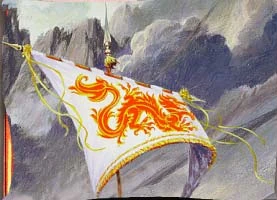

Just so we're clear on this, Our Heroes are a sea of whitebread and ginger carrying a katana, the prime symbol of Taoism, and now a clearly Asian-style dragon banner.  I know Jordan said he was going for a sort of 'fantasy melange', but I have yet to see a single thing that makes me say 'ah, a reference to African mythology!' or really anything other than 'ah, another white author with a fetish for Asian myths minus all the Asian people!'  People who have read later books: does this ever get better?

Chapter Fifty-Three: The Wheel Turns

The Blight has eaten most of the greenery the next morning, but Loial refuses to let it have the Green Man's oak, and takes an hour (that feels like minutes) to sing a Tree Song that rejuvenates it, assuring the party that he couldn't have invoked so much power if Jolly Green's spirit wasn't still in there.  The Blight is still gross, but doesn't try to murder them as they leave--Moiraine explains that they "struck a mighty blow against the Dark One" and for some reason Rand still hasn't asked for an explanation of how she reconciles that with his memory of killing the devil.

At least the soldiers at Fal Dara aren't so hypermasculine as to reject a good flower crown, and everyone is wearing them to celebrate the incredible victory at the pass.  Moiraine waves off all healers and meets with Agelmar to show him the recovered horn and ask for a small army to escort it to Illian, for reasons not explained.  Montages happen for a week.  Lan starts teaching Rand how to actually use his sword, and everyone gets hyped about finally going to Tar Valon, but Rand refuses to join them, convinced that he'll get gentled if he goes, and go mad-corrupt if he ever accidentally uses magic again.  He's just going to wander off on his own, away from people he might hurt, cursing the luck that his crush has to be a wizard and thus dangerous.  In another garden, far away, Moiraine magically eavesdrops on them:
"The Prophecies will be fulfilled," the Aes Sedai whispered. "The Dragon is Reborn."
And that's it.  That's the book.

I am... thoroughly unimpressed, I have to admit.  I love a good ending.  I love the part of a story where we see how everything that has led to the climax fits together in order to create something with meaning.  I love Frodo and Gollum facing the will of the Ring at the Cracks of Doom, the way the hero's past mercy ultimately saves him from his own final weakness.  I love Katniss, broken and angry, still playing her character so well that she gets a shot at salvation instead of vengeance.  I love the Doctor and Rose up against an army of genocidal zealotry, saved because the Bad Wolf is damnfool implacable hope and she will do anything to protect those she loves.  I love Harry Potter and Narcissa Malfoy in the woods, speaking two words ("Yes."  "Dead.") that declare that love overwhelms hatred in the end.

And I get that those endings are the real endings and this is book one of eleventy, so it's not a fair comparison, but I just waded through seven hundred and ninety-two pages of this stuff and the ending was abrupt, unjustified, and most heinously of all, revealed nothing meaningful about who the characters are or what they believe.  This is an ending that falls like a soggy towel on the page: and there, there's a huge battle and the good guys win but for how long isn't this awesome?  Wasn't this totally worth reading about the four hundred identical innkeepers that populate this world like an unsettling mashup of Barliman Butterbur and Nurse Joy?  Isn't it great how a solid 60% of this book was just setting the stage for later books while somehow failing to have any real impact on the events of its own plot?

I am struggling to think of any way in which the plot might have been hampered if the party hadn't transitioned directly from, say, Baerlon to Fal Dara.  By my estimate, if they had done so, the book would have been about three hundred fifty pages long, maybe three hundred with better editing, a solid book but not a brick.  We lose the City of Mat Don't Touch That Dagger Oh My God, and Perrin being a Man-Wolf, and Rand flirting with a princess, but do we lose anything that actually impacts the plot?  Is there any reason not to consider the intervening thirty-some chapters glorified filler?  I'm really and truly asking.  Because I don't think it should be a controversial opinion to say 'if half your book isn't relevant to your book, cut it', and yet here we are.  And I actually liked the Travellers and the wolfpack, those are good story elements, but they could be in their own book where they were actually plot-relevant and not just a sideshow with no purpose.

Because I don't make good life choices, I am actually considering getting into the second book on this here blog, but I'm definitely not doing that right away.  I need a cleanser.  So, apart from your usual delightful insights and anecdotes, make your nominations, resilient readers, and come back in a week or two to see what I inflict on myself next.

Wednesday, August 19, 2015

The Eye of the World, chapters 46, 47, and 48, in which Lan is voted Sexiest Man of the Age

Fewer than one hundred pages left to go, dear and loyal readers.  Three posts to the end, depending on how much nonsense I just dismiss and whether anything is actually going to happen.  Rally your courage; gird the bits that need girding.  (I didn't know this for ages, but apparently there is a specific girding protocol, shown here.)

The Eye of the World: p. 689--731
Chapter Forty-Six: Fal Dara

We left off last time with Our Plodding Heroes escaping the Black Wind in the Ways, a creation from the Time of Madness or possibly the War of the Shadow which was also called the War of Power.  (I kid you not, that's the explanation we get, with all of those namedrops.)  They have arrived in Shienar, in a frigid spring, and Lan cheerfully tells them it'll be warm when the get to the Blight, mythic land of monsters and eternal war.  They pass by a lot of abandoned farms--Egwene and Nynaeve note that they were recently abandoned, since the windows have light spring curtains hung instead of heavier ones for winter.  Perrin laughs at this because he's the worst, but when glared at he whirls on Mat to say that the abandoned scythe they saw only had a week's rust on it, which should have made it obvious even to him.

There's something spectacularly patronising about the constant implications that the scariest thing a woman can do to a man is glare at him like a miffed governess.

Rand tries again to convince The Girls to run off somewhere safer, and Nynaeve gets a full page of shutting him down, which is nice, apart from a few really stupid lines, such as:
"I have little liking for any Aes Sedai,and this one least of all, I think."
NYNAEVE SHE HAS LITERALLY SAVED YOUR LIFE MULTIPLE TIMES AND IS DRAGGING YOU TO SAVE THE WORLD.  Other Aes Sedai impacts on your life have included 'nothing' and 'actively trying to cause harm to your friends'.  This is nonsensical.

She also throws in calling them "you boys... you men", which thrills or baffles Mat no end.  Egwene decides to take the opportunity to ask Rand if he's upset that she danced with Aram, because Girl Priorities.  Rand flashes back to Min (SPOILER: one of his three future wives) who told him that he and Egwene were not destined to go at it like a sack of weasels, and then that bit is over with no impact on the rest of the scene or other plot relevance except to mind us of a prophecy that we might have forgotten in the intervening five hundred pages.  This book is so long that it includes 'Last time on our show...' within the same book.

They arrive at the fortress town of Fal Dara, where it's forbidden to hide your face for fear of Fades moving in unnoticed.  In the hands of a better author, I'd be interested to see a resolution of a conflict if heroes showed up (like Rand) from a culture that had strict rules about coverage with veils/hoods/scarves.  A resolution that wasn't just 'well, I guess I'll just ignore my religion while I'm here', but found a way to accommodate honoured guests and the needs of security as well.  The guards are hella psyched to see Lan arriving, shouting "Glory to the Builders!" and addressing him as Dai Shan.  (This might just be generic syllables, as it apparently means 'battle lord' in this world, but I think it also could mean 'tall mountain' in Chinese, written 大山?  I am in no way an expert in Chinese, but I suspect neither was Robert Jordan, and he does seem to want Lan to be vaguely Asian-flavoured.  ...Oh my god, but in Japanese it might be translated as 'big beautiful' this is the best thing people.)

Anyway.  The description of the fortress town is pretty vivid, if only descriptions of mundane pretty things were the reason I showed up to this story.  Lan is also called the Golden Crane, because having only one title is a hanging offence in WOTland.  We meet a bunch of the local soldiers, who assure Lan that things are never as bad as they look in spite of heavy raiding, and there's a lot of use of 'formal language', which appears to be vaguely Japanese--it's polysyllabic, unlike Chinese, but heavy on particle usage (ga, no, ni) and the phrase "kiserai ti wansho hei" appears to be a greeting.  (Or not; it's used later like a lament.  What?)  Agelmar, their leader, states instead that the trollocs are massing for a full invasion, cities are falling, they desperately need hope, and they need Lan and Moiraine to help--Moiraine for badass wizardry, Lan because he is "a Diademed Battle Lord of Malkier" and they need him for "the last Ingathering of the Lances".

So, in case we weren't sure, Lan appears to be the Aragorn of the story, heir to ancient titles and leadership but convinced he can and must only follow the humble path of the outlander.  After dinner, he recites a rhymeless verse about beauty and death.
Poetry out of Lan? The man was like an onion; every time Rand thought he knew something about the Warder, he discovered another layer underneath.
(In contrast, ogiers really are more like parfaits, minus the part where everyone likes them.)

The guards arrive to announce that they found a "madman" trying to get in to see Agelmar, who turns out to be the peddler Padan Fain who's been following Our Heroes since the start of the book.  He's really obviously half-possessed (interestingly, the locals believe that the Light protects people who are insane, and might even be the cause of insanity--is this ever expanded upon in later books?) and tries a sort of good-intentions-tempting spiel on Agelmar before Moiraine does the Vulcan nerve pinch and drags him away for questioning.

Chapter Forty-Seven: More Tales of the Wheel

Even the chapter title sounds done.  Book three, chapter twenty-seven: Yet Another Fricking Tale of the Wheel Are You People Satisfied Yet.  We don't get to see the interrogation, just people milling around impatiently.  Filler filler filler... oh, how delightful, Lan's backstory.  He's the son of the last king of Malkier, which makes him "al'Lan Mandragoran, Lord of the Seven Towers, Lord of the Lakes, crownless King of the Malkieri".  Political treacheries and jealousies explain how the last generation of Malkier's rulers obliterated themselves with the help of Cowin Fairheart, secret Darkfriend.  Lan's parents apparently saw nothing fucked up about swearing an oath to fight evil and defend the Malkieri on behalf of their infant son, whom they literally had holding the oath-making sword while he was in his cradle.  They charged off to fight a doomed last stand and Lan was sent off with a mess of loyal bodyguards to be raised as the ultimate warrior.  He is the best of the best of the best, SIR, and the only reason he hasn't rallied an army (as would instantly happen if he flew his Golden Crane banner) is that he doesn't want to lead anyone but himself to their deaths.

TL;DR: Aragorn.  He's literally Aragorn, with the exception that a lot of people just thought Aragorn was a weird loner instead of literally everyone flinging themselves at him in desperate war-puppy adoration.

So Padan Fain has been a Darkfriend for forty years and a special hound of the devil for the last three, homing in ever more closely on Rand al'Thor And His Amazing Friends, with regular vacations to perform unspeakably vile deeds and rituals that bound him more closely to Satan.  Which... I really hope after all that time he had a better plan for this part than 'walk in and get caught', but it doesn't seem like it.  Also, he was the guy following them back in the Ways that Lan declared they had no time to stop and investigate, and the Black Wind inexplicably spared him, probably because he's full of devil juice.  Nothing else actually happens in this chapter except recapping their plans: Moiraine is going to drag the most plot-relevant people she can to the Eye of the World in hopes of defeating the devil through narrative superiority, time is running out because he's starting to be able to project his thoughts into physical form, and no one else can go with them.  Et fucking cetera.

Chapter Forty-Eight: The Blight

More nice scenery as they march to Tarwin's Gap, the pass into the Blight.  So much scenery.  Occasionally I see something really cool and purely visual, like a photo list of abandoned places, and I think "Hey, 33 places, 33 chapters, I wonder if I could write a book on the premise that each major scene occurs in one of these locations?"  I feel sometimes like Robert Jordan did that, except he had six places and eleven thousand chapters so he filled the rest with dream sequences, bland banter, and unexpected capitalisation.

More description of where regiments of soldiers marched and when--these, at least, are of a different descriptive flavour than the parades of interchangeable inns and Inexplicably Identical Innkeepers we've been living with for all these pages.  Of course, references to the last guards left in the fortress, "soldiers and a sprinkling of old men, their wives dead and their grown children making the slow way south" remind us that while individual women are powerful plot-relevant in this series, women as a whole would never be accepted as regular soldiers for an army that desperately needs every fighter it can to hold back the literal legions of Satan.  What are you, some kind of feminist?

The Blight is all wrong, warm for no reason, and the sun is red despite being high in a cloudless sky, which I feel raises a variety of meteorological questions.  Our Heroes are warned not to touch anything--Lan describes, for example, a stick insect with an unspeakable dissolving venom that can only be stopped by severing your bitten limb.  This is a fantasy environment I can get behind--for whatever reason, I have always loved a vile and malicious wilderness.  Bring on your best horrors, Jordan.

We get a quality lake monster (tentacles with hands on the end, giant stingers, good stuff) before they camp for the night, and Moiraine throws a cloaking field around the camp.  Straight up invisible, I tell you no lie.  WHY HAS SHE NEVER DONE THIS BEFORE?!  I can think of a few times when invisibility might have been useful, such as their many, many failed stealthy escape attempts.  If said field is stationary, okay, but they've been interrupted in the night way too many times already for this to have not been relevant.  What in the hell.  What have I said about just randomly giving heroes problem-solving magic, Robert Jordan?  Come back from the dead and answer to my blog for these books you wrote twenty-five years ago!

And one more WTF moment to close the chapter: after Egwene talks about everyone going to Tar Valon after this and Rand becoming her Warder (he thinks about how he's deeply in boners with her but Min said they're not fated), they get to sleep, but Rand awakens to find Nynaeve and Lan sitting up together.  Nynaeve wants him bad, apparently, and Lan doesn't think he's good enough or safe enough.  Plus, you know, misogyny:
"Aes Sedai marry as seldom as Wisdoms. Few men can live with so much power in a wife, dimming them by her radiance whether she wishes to or not."
Even the metaphor doesn't work--standing next to something radiant doesn't make you dim, it makes you shine.  The moon is bright because of the sun, not in spite of it.  Fucking patriarchs.
"Some men are strong enough. I know one such. [....] Will you shame me to the point of asking you?"
Wait, it's shameful for a woman to ask a man to marry him?  Since when?  Why?  Aes Sedai and Wisdoms and queens regnant and Daughter-Heirs--shouldn't this culture be brimful with the idea that women take leadership, take initiative, make decisions?  Why should it be a mark of shame for a woman to decide she wants this guy instead of having to sit there waiting for him to approach her?

And, quite apart from the philosophical questions: what the fuck Nynaeve why are you asking Lan to marry you since when do you care about him at all you have nothing in common and he's oath-bound to a woman you claim to hate--ohhhhhh.  She figures Lan and Moiraine are a thing and she wants in on some threesomes.  It all becomes clear.

The chapter ends there, because the charge towards the climactic semi-conclusion is obviously the right time to slow down for regular romantic subplot speed bumps.

NEXT TIME: In a desperate rush to cram a few more Tolkien ripoffs into this book, Robert Jordan just straight-up copies Treebeard.

Wednesday, August 12, 2015

The Eye of the World, chapters 43, 44, and 45, in which Our Heroes meander through the infinite void

We're close enough to the end of this book that I, ever eager, have begun to look to what we'll be investigating next.  Suffice to say it will not be Wheel of Time Book Two unless something absolutely gobsmackingly unexpected happens in the next 150 pages.  I'm currently leaning towards The Way of Kings, book one in Brandon Sanderson's Stormlight Archive mega-series.  My reasons are manifold: I actually like Sanderson's work, but I have yet to read anything of his that didn't still have some substantial issues with women at the least, with some options on implied racism as well.  (He has identified a handful of characters as lesbian/gay, but no one's confirmed in text yet.  Apparently Ranette will be explicit about it in the next Mistborn novel.)  I've also been plagued by friends to read Way of Kings since it came out, but I haven't been able to summon the energy because the first thing that drew me to Sanderson's books was his ability to write fantasy that wasn't a ten-part doorstopper, and Stormlight Archive is his ten-part doorstopper.  So with any luck, a series on Way of Kings will be less painful than Eye of the World, will still give us some issues worth talking about, and might go a bit faster, like Ender's Shadow versus Ender's Game.

However!  I'm always open to other suggestions for reading materials that you, my dear and clever readers, think would be worth a dissection (keeping in mind that I will have to somehow acquire a copy of anything terrible that we carve up, and I have moral objections to giving money to terrible people).  The first alternative that comes to mind is H.P. Lovecraft, whose works are public domain and famously brimming with every possible kind of bigotry.  I loves me some sothothic horror, and it's best to do so with an understanding of how fucked up its great propagator was.  (I prefer instead to reference Robert Chambers' prior masterwork, The King in Yellow, which is hardly progressive but at least isn't gross.)

But before we can move on to such business, we have to finish up this rollicking epic timeless exceptional memorable adequate published book second draft.

The Eye of the World: p. 646--687
Chapter Forty-Three: Decisions and Apparitions

We left off last time with fearful discussion of the safety of the Ways, and open now with Loial and Moiraine taking a couple of pages to spit out that the Ways were a gift from not-yet-fully-broken male Aes Sedai to the ogiers that gave them sanctuary, and they let a person tunnel through time and space to hop across the world.  There's a lot of talk about aspects of ogier culture and magic--the Exile, the Long Wandering, the Longing--all of which are capitalised and none of which are explained.  You might at this point be thinking "Make up your mind, Will, do you want things to be brief or do you want them to explain what every term means?", and the answer is that if you don't have time to explain what a term means, there had better be a good excuse for dropping it into the conversation six times.  If you can use a term that much without having to explain what it means, maybe it's not actually relevant to the topic at hand and you're just bragging about how many things you've capitalised today.

Although the Ways survived the Breaking, they were still apparently tainted by Dude Magic and so began to rot a millennium ago, thus Loial's conviction that they're all going to die.  Moiraine counters, with shocking savviness, that they've heard far too many warnings about the Eye of the World and thus their best move now is to drag the ta'veren there and just let a big ol' destiny pile-up happen.

I'm trying to move at a pace now, but Rand and Egwene haven't seen each other in chapters and they've about to plunge into peril, so their brief scene together is worth a closer look, because oh my gods and monsters.  Rand tells Egwene that she's not predestined and she should take the safe route, not with them, and she tells him he's very sweet but she is plot-relevant thankyouverymuch and she's going anyway.  With her strength and importance thus duly noted, she asks again who this hot Elayne girl is.
For a minute he stared at her, then told the simple truth. "She's the Daughter-Heir to the throne of Andor." 
Her eyes seemed to catch fire. "If you can't be serious for more than a minute, Rand al'Thor, I do not want to talk to you."
Rand mentioned Elayne during his explanation about meeting the queen, but obviously meeting the princess is a heartless fiction meant only to toy with Egwene's emotions and cover up... actually, I can't even imagine what Egwene thinks he's lying about.  Some random girl Rand hooked up with at an inn along the way and decided to spontaneously namedrop in the middle of rambling about meeting their monarch?  This exchange is 100% pure not-from-concentrate Oh Those Hysterical Ladyfolk.  Faith and begorrah.

We get another (final? please?) dream sequence, which Rand recognises as a dream.  He focuses all his energy on thinking about how much he denies the devil, who takes the opportunity to exposit at us: time repeats itself, this is the jillionth time they've faced off and Rand's choices are always to die or to become the Vader to the devil's Emperor, and by the way the Black Ajah (secret devil-worshipping Aes Sedai) are totes real.  Is it just me, or do secret societies get a lot of their effectiveness from their secrecy?  Why confirm one?  If anything, this ought to be a ruse wherein the devil is trying to set the Aes Sedai on an internal witch hunt in order to weaken and distract them.

Apart from that, it's a pretty good creepy atmosphere, but it's still just a dream sequence, so wevs.  Rand awakens to find Mat is still asleep in the other bed and muttering constant devil-denials.  There's still a giant splinter in Rand's palm from the dream, which vanishes when he pulls it out, but the wound remains.  Like I said, decently creepy if we weren't supposed to be in the third act rush to the climax.  Fortunately, Moiraine arrives to insta-mend his palm and tell them to get moving already.

Chapter Forty-Four: The Dark Along The Ways

I've skimmed ahead far enough to know that it's going to take us two solid chapters to complete the 'dimensional tunnelling' adventure.  Let's keep things brisk.  Several pages detail Our Heroes acquiring their horses from the infinitely helpful innkeeper and creeping through the shadowy streets to find the Waygate, which is (all these centuries later) now part of someone's basement.  Conveniently enough, there's an external cellar door big enough to fit their horses, and Moiraine prepared knock this morning.  An intricately leaf-carved wall opens up to reveal a stargate shiny portal surface.  On the other side, everything turns out to be total darkness apart from the lantern glow and an old, broken stone path to follow.

Left to right: Rand, Lan, Egwene, and Loial bond* fraternise on their interdimensional journey.

(*I only just discovered what 'bonding' means in this series, thanks to some wiki'ing, and I'm slightly creeped out.  No, in order to consider someone an honorary sibling I don't actually need to experience a mental pseudo-womb with them, thanks.)

This chapter does not feature plot developments, and is thoroughly devoted to convincing us of how creepy the atmosphere of the darkened Ways is: they move along the road to Islands connected by bridges, where engraved stones called Guidings give directions in Ogier.  (Although according to Loial, it's not enough just to speak Ogier to understand them?)  Rand resolutely refuses to believe that they could have left one Island by a long curving upward slope and arrived on a second Island that is directly above the first one.  I truly and honestly cannot comprehend why he's convinced that's impossible, but he's quite definitive about it.

Everyone is always on horseback in here as well, apart from maybe whomever is leading their giant packhorse, which I'd like to point out is also a mistake.  Humans are vastly better endurance runners than basically any other animal.  Don't get me wrong, horses are pretty good, but the real advantage of horse-based travel is their carrying capacity and the fact that a person in a hurry can switch horses periodically to maintain top speed.  If you're just going to plod slowly along the Ways for a couple of days, there's literally no reason to ride instead of walking.  Walking is the only thing humans excel at.  Our Heroes are just lazily throwing the burden onto the horses who have done nothing wrong and frankly Bela deserves a medal for not kicking anyone to death yet.  Trollocs?  Bela didn't sign up for trollocs.

I know that the slowness of their plodding is supposed to help with the creepy atmosphere, but honestly at this point in the story we desperately need some urgency, and I especially think that racing around through interdimensional voids at top speed could tap into some readers' lingering nightmares:

For film producers' consideration, I submit "Mad Max: Rainbow Road".

The chapter ends when they come to a broken bridge.  Le gasp.

Chapter Forty-Five: What Follows in Shadow

Loial is pretty sure he can still get them to Fal Dara, but they'll have to take the scenic route.  Our Heroes take the opportunity when they stop for the evening to tease Rand and Egwene about all of the reasons they might be jealous of each other: Mat brings up psychic waif Min's crush on Rand, Perrin counters with Egwene's vigorous dancing with Aram, Mat references Else the farmers' daughter, and Rand and Egwene both pointedly and embarrassedly go to bed at each other.  This is definitely the gripping interlude we need right now to remind us that these characters are deeply in love and deserve our attention.

This chapter is also mostly boring, so I'd like to detail again: Rand and Egwene are not in love.  The book tells us they are, but they don't actually like each other.  They have a good neighbourly protective attitude at times and they both kind of want in the other's pants, and that's it.  The only conversations we've seen them have in the last, what, 400 pages have been 1) I'm glad you're not dead, 2) are girls real people, yes/no, and 3) stop being attracted to anyone but me.  That's a truly godawful foundation for a relationship.  (Out of morbid curiosity, I just wiki'd who Rand's actual love interest is.  He basically marries three different women, and by the end of the series at least one bears his children.  Twins.  What.)

Also, Moiraine informs the party that's she's pretty sure Thom Merrilin isn't dead, because he's too plot-relevant.  I am in no way exaggerating.
"And Thom is a part of the Pattern that weaves itself around you three. Too important a part, I believe, to be cut off yet."
If it's possible to survive by being plot-relevant how is anyone in danger?  The hell.  I mean, her corroborating evidence is that no one in Whitebridge had mentioned a dead gleeman--I don't remember when Moiraine passed through Whitebridge, but I question the circumstances in which she heard about a gleeman but didn't specifically get to ask 'oh, when was that and where did he go?'  Is there a good reason I'm forgetting?  I'm not even sure which chapter to check.

They realise the next day that they're being followed, but brush it off as less relevant than pressing on ahead.  Literally three minutes later they find one of the guidestones has been carved up with trolloc runes, proving that the Fades have found their way into the Ways and have been using them to transport trollocs across the country, which is how they were able to build up such a huge army around Caemlyn so stealthily.

Y'all know what?  This is the best plot development yet.  It involves characters actually taking advantage of a feature of their fantastical world and making intelligent use of it instead of just treating it like a curious museum piece.  The devil's power apparently suffuses the Ways at this point, so why wouldn't he use it as a troop transport?  Praise be to Eru Iluvatar, we now have two cases in a single post wherein people make intelligent decisions based on their knowledge of the structure of the world.

Lan investigates and finds that the closest bridge to Tar Valon is a total mess of melted stone and mutilated trollocs--Moiraine concludes that the wizard men who built the Ways also incorporated anti-monster traps, thus quickly removing the tension that the scene had accidentally started to develop.  Some hours later, a different random threat gets thrown at them instead, as Rand notices a slight breeze in the supposedly wind-free void, which Loial identifies as the Black Wind.  You can tell it's evil because it's black, as is traditional.

(One of the many story notions bouncing around in my head has to do with a universe that has largely been overrun by sothothic horrors, and the remnants of civilisation live their lives in space stations that are basically submarines permanently running silent.  For such people, 'black' means not giving off any signals, light or otherwise, that might draw the attention of monsters, and is thus also a colloquial term for 'safe and secure', and consequently for good things in general.  "Everything all black in here?"  "Yeah, we're doing fine."  Creating good slang is one of the hardest things to do in speculative fiction, but every once in a while I find something I really enjoy.)

Our Heroes make a breakneck sprint for the door, which is missing its keystone, but Moiraine turns her staff into a cutting torch, burns through a large arc, and Lan's horse shoulder-checks it out, breaking open an escape route, and Moiraine wards off the approaching wind with her flamethrower while everyone slips through.  In the last moments, Rand can hear the wind muttering, and ten points to Robert Jordan: it's creepy as hell, talking about carving flesh and braiding it back together.  Mind you, it's still just yet another random threat tossed at the protagonists to force them to end a chapter in a sprint.  Maybe in some future book it'll become relevant again?  I would prefer to read a book without feeling like I had to read a further dozen in order to get any kind of narrative payoff.  It has become eminently clear to me that this is the wrong series for that.

Next week: Lan's mysterious backstory becomes slightly less mysterious and possibly slightly Asian?  (I guess that would help explain why he's got a kabuto on the cover.  Maybe not justify it, but explain.)

Thursday, July 30, 2015

The Eye of the World, chapters 41 and 42, in which questions are often raised and never answered

Welcome back, my friends, to the show that never ends.  This is how we live now: reading the Wheel of Time (Book One), which we are more than three-quarters of the way through and yet somehow only just finishing what feels like the prologue.  Sometimes the chapter numbers seem to change when I'm not looking, sneaking down lower, shuffling themselves around.  Did I already read this part, or are they just going into round one of recapping?  Maybe the things they're recapping haven't happened yet.  Maybe they happened a long time ago, too.  We are beyond the ideas of past and future now.  There is only this page, standing at the forefront of the legions that surround it.  There is only ever this page.

The Eye of the World: p. 619--645
Chapter Forty-One: Old Friends and New Threats

Rand returns to the inn, finds his latest plot-recruited helpful innkeeper playing a game with Loial the elf-ogre, and spends several pages recapping the spectacularly improbable events which we literally just read in the previous two chapters.  The innkeeper is at first skeptical, while Loial just mutters 'ta'veren', listens intently, and asks to join the quest.  Rand and Mat must leave the city immediately, apparently?  I'm not clear on why, but they seem pretty sure that Chief Wizard Elaida is going to send guards to hunt Rand down again imminently, despite the queen declaring him innocent and setting him free.  Does Elaida regularly ignore the queen's decisions?  Do we have a precedent?  This is an important thing to know in any circumstance, but no one says anything like 'she'll have you grabbed quietly in the night, just like that shady diplomat who vanished off his boat two days away from the city'.  Is this just part of typical anti-Aes Sedai mistrust and propaganda?  I mean, Rand is specifically running to Tar Valon, which is basically the Greater Wizardtropolitan Area, so isn't he in at least as much danger there?  For that matter, might Elaida not be very interested in helping him get there, if he explained that it was Moiraine's idea?  Does Rand have any idea what faction of wizard Elaida is from?

Only Robert Jordan could raise this many questions (and answer none of them) for no good reason in such a short period of time while mostly talking about rats and those vile vile anti-monarchists.

Rand get outright angry when Loial uses the same phrasing as Elaida, saying that "The Pattern weaves itself around you, and you stand in the heart of it".  I feel like after 600 pages Rand should have picked up enough characterisation that I would know why he's angry at the prospect of having a really dramatic fate.  Is he so intensely humble that the notion of being important offends him?  Is he scared to death of conflict and wants to believe that once he gets to Tar Valon everything will be peaceful and boring forever after?  Did he have hopes and aspirations for his life that he feels have been taken away from him?  Is he just really opposed to the notion of destiny overriding free will?  Throw me a bone, Jordan.

We have a brief and unnecessary interlude with whitecloaks in the inn's common room, who are armed and armored and angry but are inexplicably driven out by the out-of-nowhere, natural-20-intimidation-check warnings that the innkeeper gives them.  (We do get the informational tidbit that the whitecloaks "hold no writ in Caemlyn", though it's not clear to me what that means.  Are they not tax-exempt?  Do they have to obey all of the laws instead of only some of them?)

The whitecloaks are also very dismissive of the queen, which is clearly supposed to further outline how villainous they are, but to my mind it raises yet another damned question: why do we like Queen Morgase?  She's apparently abandoned substantial tracts of her queendom for generations, even as the number of monsters roaming the world increases.  She allows religious extremists to wander her cities harassing people at random.  She has no great diplomatic successes we're aware of.  She does apparently maintain some kind of substantial food security program within the capital, although the rules under which it functions aren't clear and we have no indication if it helps on other issues of health, shelter, or safety.  The two things we really know about her for certain are that she decided to let Rand go literally right after her Chief Wizard said he was super plot-relevant, and that she regularly receives prophecies from said wizard that are so mystically vague that no one has the slightest clue what they mean.  Neither of these choices reflect well on her as a protector of her realm and its inhabitants.  Near as I can tell, we're supposed to like her because she's got a crown, her family is attractive, and she was nice to the protagonist (sort of).

Just saying it's possible the white-flag revolutionaries have a point.  Of course, they don't seem to have any ideas about what they want instead of the queen, because they are evil and therefore heavily organised around the idea of taking things apart, not creating something new.  Those are the rules.

Let's get a move on, plotwise.  The moment we're done with the whitecloak interlude, someone else shows up looking for Rand and Mat, and at gorram last it's the rest of the party: Moiraine, Lan, Egwene, Nynaeve, and Perrin.  Rand hugs the girls (who of course bury themselves face-first in his chest) while also shaking Perrin's hand AS MEN DO, and the innkeeper falls all over himself for a couple of pages in subservience to Moiraine.  Rand takes them all to see Mat, and praise Buddha they immediately identify that there's something the fuck wrong with him as he hacks at them like Gollum bingeing on conspiracy theory websites and The Exorcist.
"How do you know they're really who they look like? [....] Perrin?  Is that you? You've changed, haven't you? [....] A Wisdom isn't suppose to think of herself as a woman, is she? Not a pretty woman. But you do, don't you? Now. You can't make yourself forget that you're a pretty woman, no, and it frightens you."
Nynaeve just thinks he's got a fever, but Moiraine arrives and all but leaps on him.  She quickly infodumps all the stuff we already knew about Shadar Logoth being cursed, and Mat attacks her with the knife he stole, gets stopped by Lan, and Moiraine sets about wizard medicine.  The knife is apparently a beacon of evil as well, and thus why Rand and Mat have been endlessly plagued by darkfriends and trollocs on their journey, and why (Lan informs us) the Fades are building a trolloc army outside Caemlyn in preparation to take the city.

You had one job, Rand.

Chapter Forty-Two: Remembrance of Dreams

Leaving Moiraine to exorcise Mat, Rand introduces the party to Loial in the Double Secret Parlour, where Perrin immediately starts asking Loial about steddings and whether they're really magic havens.  I have to assume at this point that Robert Jordan was badly distracted by something, or perhaps looked up from the keyboard and realised thatthe manuscript was due tomorrow, because it's only been two pages and Moiraine shows up with Mat, a bit spaced and embarrassed but otherwise completely cured of his evil possession.

Well.  That de-escalated quickly.

Moiraine quickly and quietly explains to Rand that Mat still has the knife and it's still magically bound to him, but she has purged the evil from Mat's system for now and they can get a permanent fix in Tar Valon, but Moiraine is vague about whether that's where they're going next after all.  She also warns Loial that all of the other Aes Sedai are Red Ajah, which--okay, screw it, there's a glossary in the back of this book and I am tired.
Ajah (AH-jah): Societies among the Aes Sedai, to which all Aes Sedai belong. They are designated by colours: [Blue, Red, White, Green, Brown, Yellow, and Gray]. [...] The Red Ajah bends all its energies to finding and gentling men who are attempting to wield the Power.
Well, they did just bring in the Renegade Man Wizard Logain, so maybe that's not startling, although surely Elaida isn't included in "every one but I".  I can't imagine that spending all of her time giving vague advice to the queen counts as bending all her energy to 'gentling' men.

There is yet more recapping again as Rand tells the rest about meeting the queen, and if I were running with my theory of 'the queen is actually not inherently good by right of being the queen', I would get Manchurian Candidate vibes from the way Rand spaces out as soon as he thinks of her:
"Can you imagine me meeting a Queen? She's beautiful, like the queens in stories.  So is Elayne. And Gawyn... you'd like Gawyn, Perrin."
Very nice wingmanning, Rand.  Your buddy just got into town and already you're trying to hook him up with a hot prince. (Egwene, of course, is quietly very jealous that Rand said the princess was cute, because Robert Jordan solved feminist fantasy forever.  Egwene, whom we may recall was cheerfully all up in that Traveller boy's business a few... weeks ago?  I'm fuzzy on timelines here.)  Perrin mentions the Travellers, which sets Loial talking about the Travellers who wanted to learn the tree songs from the ogiers back in his home stedding of Shangtai--

Wot.

I can cope with a lot of this nonsense, I really can.  I can roll with Mosk and Merk the warring giants, and I will roll with the cool descriptions of places and vitally important magical locations and objects that we'll apparently never see again, but when the ever-helpful non-human servitor-race guy comes from a place called Shangtai I just want to bite through someone's neck.  I desperately hope that's just a throwaway thing and not an indication that the ogiers are going to be the fantasy Asians here.  It's bad enough Rand is apparently a pasty redhead of the noble desert tribes.

Loial gets around to repeating a story that the Dark One seeks to blind the Eye of the World, and Egwene and Perrin mention hearing the same from the Travellers, and the boys finally get around to admitting to Moiraine that they've been having dreams with the devil hassling them.  Praise be to Gargamel, no more attempting to draw out tension by having people just not talk.  (For now.)

Moiraine concludes that all three boys are ta'veren (what, not Egwene and Nynaeve, previously described as potentially the most powerful wizards of the age?) and they need to leave Caemlyn immediately by unorthodox means.  She also gives us this destiny explanation:
"Sometimes being ta'veren means the Pattern is forced to bend to you, and sometimes it means the Pattern forces you to the needed path."
So... how is that different from regular free will and chance, then?  People are self-evidently bad at prophecy, so it's not like you can tell in advance whether you're making a choice because you choose to or because you've been chosen to, so what are the practical consequences of this?  It sounds like an excuse to go about your life in a normal way but make regular exclamations about how mystical it all is.  "You stole my last cupcake!" "No, I was fated to eat the last cupcake."

Actually, that could be a fun way to live.  Try it out and report back in the comments.

Speaking of which, Moiraine and Loial debate for about a page on how to leave the city, using the Ways that they can reach from a Waygate that is probably buried under the New City and will lead them to Fal Dara that was once known as Mafal Dadaranell.  (That deluge of unexplained capitalisation is a taste of what this book is like without me as your buffer.  I do actually sometimes appreciate Jordan's persistence in giving things names that change over time, like how Mafal Dadaranell's name clearly got abbreviated, but good lord, does everything on this planet have a business card the size of a surfboard?)  Loial exclaims that if they enter the ways they will all die or "be swallowed by the Shadow", and on that no-context salvo of 'dun, dun, DUNNNNNNN', the chapter abruptly ends.  The next chapter starts up immediately on the next line, no scene break or anything, which makes that a really, really odd point to choose to cut us off, but I think I can live with it.

Next time: backstory, dimension-tunnelling, and Moiraine's instincts for manipulating the narrative.

Friday, July 17, 2015

The Eye of the World, chapters 39 and 40, in which it appears that the plot starts up again

Sorry about the delayed post--I had written something up for Wednesday about Terminator Genisys, which I thoroughly enjoyed, especially in the way it recentered the storyline away from 'Sarah is important because she's the mother of Slab Hardcheese John "Manly War Messiah" Connor' and onto 'Sarah is important because she's a colossal badass who takes control of her own life, and her victory is that she reclaims her agency from the cycles of predestination'.  But reading that post over again, I found that I didn't have much else good to say about the movie in terms of politics or representation (the Dysons, a black father-son team of computer geniuses, get sidelined compared to T2, everyone is straight, and there's an awkward new patriarchal dynamic between Predestined Love Interest Kyle Reese and Sarah's foster dad).  So I shelved that post for future considerations and instead you get more WOT after all.  Take it.  Take it and feel my pain so that catharsis may purge your own anguish

(Content: villainously pretty men.  Fun content: villainously pretty men.)

The Eye of the World: p. 582--618
Chapter Thirty-Nine: Weaving of the Web

We're back in Randland, where Robert Jordan once again taunts me with the prospect of a timeskip that didn't actually happen:
Next to the day when Egwene and Perrin walked in, alive and laughing over what they had seen, this was the day he had been waiting for most.
Egwene and Perrin have not actually walked in yet; Rand is just looking forward to it.  Mat is exactly the same as he's been for the last 300 pages, surly and paranoid and not wanting to do anything, and I'm not clear on what this special day is that Rand has been looking forward to, but apparently it means everyone is rallying in the street.  The innkeeper informs Rand that a beggar has been seen in the city, asking for Rand and friends by name, and this is Deeply Suspicious--not because random strangers looking for visitors by name probably have secret motives, no, but because Caemlyn has a welfare program and therefore there's no excuse to beg.
"...Even with things as hard as they are. On High Days, the Queen gives it out with her own hands, and there's never anyone turned away for any reason. No one needs to beg in Caemlyn. Even a man under warrant can't be arrested while he's taking the Queen's Bounty."
Which: really?  Okay, but really?  Props to Caemlyn for establishing a no-questions-asked food program, but these matters are far too complicated to just be waved off.  Logistics: who decides how much bounty a person gets?  Can they collect for their family as well?  Who checks what they are and aren't allowed to take?  Can a person pick up the Bounty for their neighbours, and what kind of documentation is needed?  Or can a perfectly self-sufficient individual just pick some up anyway, since no one's turned away, and then deliver it to whomever they choose?  What if they need to pick up Bounty for multiple neighbours, because they live in a building that houses multiple seniors with mobility issues?  Can someone take the Bounty, drop it off elsewhere, and then get back in line for a second helping?  Is any kind of identification needed?

Is medication included in the Bounty?  What happens to the family head with a sole income who loses her job because of a fire in the dairy and not only has to get food enough for her husband (veteran, blinded in combat with those vile Darkfriends) and four children but also pay rent on the apartment and also pay the apothecary for regular elixirs to help Tiny al'Timmy with his bad lungs and her husband's frequent infections?  How much help does the Queen's Bounty give to her?

And you can't be arrested while taking the Bounty, okay, but what's the statute of limitations on that?  If the local cops decide that last week's murder was probably committed by Dayo ay'Oade, on the basis that he's foreign and brown and they just knew he couldn't be trusted, how safe is he when getting the Bounty?  Is he free game once he leaves the plaza, or after sunset, or what?  Is there anything at all to stop the cops from following Dayo six blocks away from the Queen and then making with the truncheon-based brutality?  Or grabbing him while he's on his way there?  What if Neal al'Caffrey runs into the Caemlyn Museum of Pretty Artifacts With Complicated Backstories, grabs The Sword That Was Broken And Reforged And Then Cracked Again But You Can Hardly Notice It, sprints out the door and straight into the welfare line?  Do the cops just have to stand there uselessly while our thief waits to get his municipally-allotted bread?  When are they allowed to start chasing him again?  Can honest citizen Strangleford ay'Killsman successfully avoid incarceration for his entire life by hanging onto the right baguettes?  IF YOU WANT TO WORLDBUILD FOREVER THEN AT LEAST JUSTIFY YOUR WORLDBUILDING, JORDAN.

But where was I?  Right: there are lots of reasons that the Queen's Bounty can't be as simple and perfect as we're told, and thus reasons why some people might beg anyway.

Rand leaves the inn, having been warned to keep an eye out for trouble.  We finally get a sense of the tensions, because people are wearing significant amounts of red or white around town, with political significance: red says "Yay Queen Morgase" and white means "The Queen and the wizards have ruined everything".  Rand didn't realise this when he decided to disguise his heron sword with a red wrapping, and now he's part of it too, to his regret, since the reds are heavily outnumbered.  But--ah, at last we get some explanation, because apparently people are celebrating the capture of the false Dragon, who is to be presented to the Queen today before he's dragged off to the wizards.

Rand, political genius, notices that a crowd of white-banded citizens charging down the street thinks nothing of intentionally shoving aside some Whitecloaks and stampeding onwards, showing a level of defiance and fearlessness that, in his estimation, means that could try to depose the Queen any day now.  Rand disappears into a singing crowd, providing us with this Tolkienesque lyric:
Forward the Lion / forward the Lion / the White Lion takes the field. / Roar defiance at the Shadow. / Forward the Lion / forward, Andor triumphant.
I can't make that scan, let alone fit a catchy tune, and it doesn't even pretend to have a rhyme.  That is maybe the worst rallying song I've ever heard.  Rand follows the crowd until it reaches the palace, guarded by red soldiers against a near-rioting crowd of white, but he's forced to run when the aforementioned beggar finally appears and spots him.  Rand thinks about going back to the inn, but isn't willing to miss his sole opportunity to ever see the Queen, having apparently forgotten that the Queen literally shows up to hand out food bundles to the poor on every holiday.

After a couple of vitally important pages of Rand running around the city to no avail, he finally climbs a hill and a wall to get a view of the plaza, and the procession arrives with hundreds of soldiers guarding a sixteen-horse wagon, flanked by Warders and bearing a cage guarded by eight Aes Sedai.  For a change, we get some description I actually like:
Logain was a king in every inch of him. The cage might as well not have been there. He held himself erect, head high, and looked over the crowd as if they had come to do him honor. And wherever his gaze swept, there the people fell silent, staring back in awe. When Logain's eyes left them, they screamed with redoubled fury as if to make up for their silence, but it made no difference in the way the man stood, or in the silence that passed along with him.
I'm assuming he's a villain, although right now I feel like I'd enjoy seeing him as a protagonist too, as long as he wasn't Our Hero.  A good guy who has his own goals and concerns that aren't identical to Rand.  Or if he's just a villain who wants something other than the end of the universe.  I'm good with either of these things.

Rand wonders what the Aes Sedai are there for, gets told by a previously-unnoticed little girl that they're stopping him from using magic, and is so surprised that he falls off the wall.  Cliffhanger!  Well.  Clifffaller.

Chapter Forty: The Web Tightens

Rand dream-hallucinates a bit and wakes up on the ground, bloodied and rattled.  The girl arrives, climbing down a tree in very fancy dress that goes on for a paragraph, including velvet slippers and much embroidered silk.
He could not begin to imagine who would choose to climb trees in clothes like that, but he was sure she had to be someone important.
This is it.  If ever anyone asks you to summarise the Wheel of Time book series for them, just flip to the second page of chapter forty and show them this line.  This is the truest most finely distilled essence of this book, cold-pressed and oak-aged until it could cut through anchorwood.  Reading this sentence and understanding its every nuance is exactly the same experience as reading the entire book.  You're welcome.

She's also, he can tell at a glance, deeply self-possessed and (shocker) stunningly beautiful (blond and red-lipped, which Rand possibly thinks is just how girls look, because he can't conceive of makeup).  She's different but, in his estimation, just as hot as Egwene.
He felt a twinge of guilt, but told himself that denying what his eyes saw would not bring Egwene safely to Caemlyn one whit faster.
I--wait, what?  He's creeping on some random girl who just startled him into injuring himself, his first thoughts on seeing her are '10/10, would bang like a gong', and he assuages his guilt at ogling someone who isn't his not-girlfriend by telling himself that he can't save her by not ogling other women?  Does that compute for anyone?

She's followed by her younger brother, and they quickly identify each other (unnecessarily, but for the reader's benefit) as Elayne and Gawyn, and since Elayne has a habit of playing vet to the injured animals she find, she immediately busts out her first aid kit to patch up Rand's skull.  While doing so, the siblings have a bizarrely private discussion that serves as a huge infodump about how the Queen is semi-secretly in love with her First Prince Regent and they both want to get married but neither one will 'bend' to... something that we're not clear on.  It becomes increasingly obvious, but eventually Rand needs them to spell out that they are children of...
"Morgase, by the Grace of the Light, Queen of Andor, Defender of the Realm, Protector of the People, High Seat of the House Trakand."
The prince and the 'Daughter-Heir' (ye gods that's a bad title--if the queen always rules, why isn't her daughter just 'heir'?) are legitimately surprised Rand didn't realise he had climbed into their backyard, and insist on knowing his name before he leaves.  On hearing he's from Two Rivers, Gawyn starts spouting off regional facts, until they get interrupted again:
The young man who stood there was the handsomest man Rand had ever seen, almost too handsome for masculinity.
I... wow.  He no-homo'd so hard he tried to reassign someone's gender.

Rand, if you think a dude is hot, that doesn't mean he's a woman, that means you think some dudes are hot.  It's not a big deal.  I was so much more comfortable with myself once I acknowledged that was a thing for me.  You can repeat "he's so smokin' I could almost swear he's a gender I'm attracted to" all you want, but if you want to insist that you're so straight you sleep on a bed of rulers, maybe don't follow that up with:
Dark of hair and eye, he wore his clothes [...] as if they were of no importance.
Aw yeah they aren't.  Just cast aside those unimportant clothes, Galad.  Apparently Galadedrid Damodred (I kid you not) is half-sibling to the royal kids, sharing a father but not the queen as his mom, and he's quite popular with both the loyal reds and unruly whites in the city.  He tries to convince Elayne to get rid of Rand immediately for her own safety, but Elayne tells him to shove off.
"I hate him," Elayne breathed. "He is vile and full of envy."
Ohhhh, right, villainous prettyboys, gotcha.  There is definitely something maliciously suspicious about beautiful men who go around making perfectly good straight boys question their orientations.  On the plus side, Gawyn vouches heavily for Galad, saying he's saved his life twice, so maybe there's a chance he's not evil?  Wait, I just remembered his name is Damodred.  Carry on.

The palace guards arrive and there's some back-and-forth of orders and superseding orders between the captain and Elayne until word arrives that the queen demands to see the intruder and also her kids, so they march off, though not before Jordan realises he forgot to give us a long description of the gardens, so Rand abruptly remembers that scenery exist and takes it all in before they leave.  There's another page of Rand trying to figure out what position to take in the procession and when he's dragged before the throne, and another describing the carved walls of the room and the woman seated behind the queen, knitting furiously.  The queen is of course beautiful and flawless and commanding, and the knitter quickly proves to be Elaida, the queen's personal wizard.  The children are scolded for going to get a look at Logain, ridiculously dangerous as he is, and questioned about Rand, but Elayne says that meeting a commoner face-to-face with no attendants has been an important bit of education.

Morgase rapidly rises several ranks in my listing of favourite characters by pointing out that Two Rivers hasn't been taxed or hosted royal soldiers in generations, which makes Rand's status as a queen's subject somewhat suspect.  I could have done with someone making that explicit five hundred pages ago, instead of leaving me wondering what in blazes this world was doing, but at least we have canon now.

Elaida in the meantime notes that Rand is a pasty ginger and thus unlikely to be from that region, and when she notices the heron sword, all the guards freak out.  There is much suspicion, et cetera, Elaida declares that the sword is rightly Rand's even if he's too young to have earned it, and that he's dangerous.  Morgase does what a queen must do: put exposition ahead of remotely natural dialogue.
"Is this a Foretelling, Elaida? Are you reading the Pattern? You say it comes on you when you least expect it and goes as suddenly as it comes. If this is a Foretelling Elaida, I command you to speak the truth clearly, without your usual habit of wrapping it in so much mystery that no one can tell if you have said yes or no."
That is definitely how real people talk to other real people with whom they have a long history of this exact process.  Sigh.  Elaida does indeed Foretell, but it boils down to the shocking plot twist that bad things are happening and Rand is plot-relevant.

They recommend locking him up, but Queen Morgase declares that she trusts him and she's willing to gamble that he isn't telling super-outrageous lies in the hopes that people will think no one would tell a lie that outrageous, and she commands him escorted away to go free.  Elayne takes a final opportunity to tell Rand he's hot, and Gawyn does the same tells Rand that while Morgase thinks Rand has a Two Rivers accent, he looks like an Aielman.

Wait, aren't the Aiel people from a desert or something?  What kind of vengeful author-god would populate a desert with pasty gingers?  (No points for the obvious answer: 'one who will eat his own hands before he makes someone brown plot-relevant'.)

Oi. That's enough recapping for now.  But for the first time in many weeks, I didn't feel like I could blithely skip past multiple pages at a time without commenting on the stuff contained, which I have to take as a sign that the plot has begun happening again, even if this chapter didn't apparently have any plot consequences apart from introducing us to the royals.  Unlike the parade of interchangeable wagon-drivers and innkeepers up to now, at least I can be confident we'll see all of these folks again.

There are fewer than two hundred pages left to go in this book, folks.  Who wants to lay bets on whether Jordan is capable of writing something that resembles a climactic sequence in that much time?

Thursday, July 2, 2015

Eye of the World, chapter 37 and 38, in which Egwene is best at everything

Apologies for the delayed post; it was my country's birthday and I had a torrential rainstorm to get caught in.

The Eye of the World: p. 557--581
Chapter Thirty-Seven: The Long Chase

The long chase?  Really?  I've been struck by a prophetic vision that this chapter will include lots of running around to create the illusion of plot development.

I have also formed a hypothesis there's some kind of rule every chapter must start with four pages that don't do anything to advance the plot or reveal character in any way.  Nynaeve, Moiraine, and Lan continue on Perrin's magic trail (not that they know which farmboy they're after) and eventually find the Whitecloak camp where we left him and Egwene.  Nynaeve snarks at Lan for implicitly impugning her willingness to face peril to save a neighbour, or her knowledge of wolf behaviours, which is presumably supposed to be a reminder of what a capable and courageous Lady Heroine Woman she is.  Personally, I think it'd have played better if Lan had been all 'You're a village Wisdom despite your youth and you've stuck with us this far, so obviously you're a colossal badass, here's what I need you to do'.  In fact, why hasn't Lan internalised that yet?  He's bonded with Moiraine; he knows better than to underestimate someone just because they're a woman or small enough to fit in his backpack.  Do better, Lan.
"There are two guards on that side of the camp, beyond the picket-lines, but if you are half as good as I think you are, they'll never see you." 
She swallowed hard. Stalking rabbits was one thing; guards, though, with spears and swords... So he thinks I'm good, does he? "I'll do it."
There's something ironic that the one skill of hers he is willing to notice is her ability to not be noticed.  Also, hasn't Nynaeve been fighting trollocs?  A few unwary guards don't strike me as unusual threat for her these days.  But she still freaks out a bit as she creeps in, dodges patrols, and starts cutting the ropes to loose the horses for purposes of distraction.  She almost runs after she's cut four out of five, and thinks for a moment about how Lan wouldn't judge her for running away now (given that she's just a little mortal), but Nynaeve is struck by a vision that if she leaves any horses secure, some of Our Heroes will die in the escape, and so cuts them loose too.  (The possibility that she just got an actual prophecy further freaks her out, because Nynaeve was trained to use magic but she didn't think it was Capital Letters Magic, I guess?)  The final group includes faithful horse Bela and another friendly one, and Nynaeve flees into the night with them as Moiraine starts fulminating the camp with a rain of lightning (go Moiraine), and wolves join in the fight, confusion, running, et cetera.

Well, that chapter wasn't nearly as prolonged as I expected it to be.  It helps, of course, that on my first read I accidentally skipped about a third of it and didn't notice.  Which is a reasonable measure of the breakneck crawl we're proceeding at.  Let's savour this opportunity to talk about Nynaeve, because she's one of my favourite characters so far.

We're more than 550 pages into the book, and Nynaeve's motivations are starkly few.  She chased after Our Heroes because she had no patience to sit around and wait for a Manly Decision, and she's stuck with them because it's her job to protect her neighbours.  That takes a hell of a lot of dedication.  She's been told that she has incredible potential to wield earthshakingly powerful magic, but she doesn't appear at all tempted by the prospect.  Admittedly, she doesn't have great reasons not to trust Aes Sedai, but tell the average person 'By the way, I can teach you to perform miracles' and see if that doesn't shake their convictions even a little.  Nynaeve doesn't even know that she's plot-relevant; she's just here because she knows who she is (or who she wants to be) and that person won't let her neighbour brats run off to get murdered on their own.

And somehow the main gorram character of this book still isn't her, but the brat who thinks it's insufficiently heroic that he has to sleep in haystacks while everyone tells him how incredibly important he is (quarry of the Darkfriends, warper of the Pattern of reality, first-name-basis with the fricking devil who hangs out in his dreams).

Rand al'Thor might be (shpoilersh) the Dragon Reborn, but as far as I'm concerned he's a case study in mediocre men inexplicably drawing attention away from extraordinary women.  I'm sure he's going to get 'character development', but I'm not at all convinced that said development will consist of him actually gaining sympathetic qualities to compare with Nynaeve's fierce loyalty, courage, and conviction.

Anyway, let's get back to Nynaeve and Moiraine saving the day.

Chapter Thirty-Eight: Rescue
Perrin
FIGHT ME ROBERT JORDAN.
Perrin shifted as best he could with his wrists bound behind him and finally gave up with a sigh.
Do y'all know why this book is precisely seven hundred million pages long?  Because Jordan thinks that it's quality storytelling to give us an unnecessarily long depiction of rescuers catching up with hostages, making plans, enacting plans to save the hostages, and then leaping backwards in time to show us yet more of what things were like for the hostages before they got rescued.  Surely we could just have Egwene recap for Moiraine what their captivity was like afterwards?  (If we get all this description and then a recap as well, I will burn down the sun.)

General advice: if you can timeskip something in a story and not leave the reader confused about how you got there, there's a good chance you should timeskip it.  More specific advice: if you can timeskip something in a story, for the love of gay shipping, please don't pretend to timeskip it and then go back to explain.  This is like episodes of TV shows that start with a Dramatic Scene, go to opening credits, and then come back with Three Days Earlier... which never fails to annoy me.  (Not least because it's used to set up shocking swerves like Why Are These Two Bros Pointing Guns At Each Other and then forty minutes later we discover they were both actually aiming at ambushers behind each other.)

Uuuuugh.

BUT BACK TO PERRIN.  He's spent the last few days walking tied to a horse and getting regular updates from Byar about the inventive ways the Questioners will torture him into confessing when they get to Amador.  They're also in a rush to Caemlyn, though, and one day Byar shows up, tosses him a sharp rock, and says it'd be much more convenient if Perrin somehow managed to cut himself loose and vanish into the night.  Perrin rolls just well enough to realise that there's something fishy about this generosity, but not quite enough to realise that if he makes a getaway they'd have ample reason to just kill him on the spot and wrap matters up that way.  He gets a telepathic ping from Dapple that there's a rescue coming, and stalls long enough for Lan to arrive and karate the guards into submission.

Lan, Egwene, and Perrin meet up with Moiraine, who reports that she's lost track of Nynaeve, whom she fears has "done something foolish".  Hey, why hasn't Moiraine given the rest of the party those tracker coins like she did the boys?  Can she only maintain three of that charm at once?  It's not like they haven't had time for her to make more.  Anyway, Lan turns and almost charges back to find Nynaeve, but Moiraine tries to stop him:
"Some things are more important than others. You know that. [....] Remember your oaths, al'Lan Mandragoran, Lord of the Seven Towers! What of the oath of a Diademed Battle Lord of the Malkieri?" 
Perrin blinked. Lan was all of that?
Lan was all of those things that we don't understand and have no context for and therefore I don't care about?  ASTONISHING.  (Also, I see Jordan is one of those authors who thinks that bemusement is best identified by a character's blinking, which strikes me as particularly weird in this high-tension high-action scene where presumably they're running around a lot and blinking away sweat or dust from one's eyes might be expected rather a lot.  Suggestion: if a character's shock is so understated that it can best be expressed through blinking while they flee homicidal religious zealots, maybe you're not dealing with as dramatic a moment as you'd like to think.  Shout something gaspworthy, at least.)

Nynaeve returns with the horses and as she leaps off to embrace Egwene she gets intercepted by Lan who just grabs her arm for an intense second.  He wants to tap that, if we hadn't noticed yet.  He wants to tap that like he's sending a telegram.  Nynaeve has picked up on this, as highlighted by the way she gives "a low laugh" as she runs to hug Egwene, which Perrin figures doesn't have "anything to do with happiness at seeing them again".

Let us take a moment to contemplate the situation: our split party has just started to mend itself after eight thousand chapters of running around scattered, they're being hunted by religious zealots, and this is the moment that Jordan has decided to drop in a romantic subplot with all the grace and versimilitude of a new fanfic author.  We got none of this last chapter, when Lan was actually talking to Nynaeve about sending her into danger, but now they're reunited and there is Needful Tension.  Priorities, Jordan.  Lan is the male character I hate least, but that's such a low bar.  Try to remember you had a plot in here somewhere.

They make their getaway, and the wolves leave Perrin with a mental note that they are ordained to meet again someday.  The next day, Nynaeve tends their wounds, treating us to a scene in which she rubs ointments all over Perrin's bare chest--he's been gruesomely bruised, but his ribs were protected from breakage because he's so incredibly ripped.

If you unlock the secret ninth ab, you become fireproof.

Nynaeve's ointments basically heal his mangled torso instantaneously, which either means they have some really sweet herbs in this world or she should have realised she was a gorram sorcerer a long time ago.  Nynaeve notices Perrin's wolf eyes, but doesn't know what they are; Moiraine does, but doesn't say what it means; Nynaeve is upset that Moiraine won't 'heal' Perrin's eyes, but is weirdly uninterested in knowing what's actually going on.  Lan just hears the name Elyas MacWolferson and says he used to be a Warder until the Red Ajah came after him, and assures Perrin that communing with wolves isn't of itself satanic.  He does note how improbable it is that Perrin would have the ancient gift and meet someone who was capable of teaching him:
"The Pattern is forming a Great Web, what some call the Lace of Ages, and you lads are central to it. I don't think there is much chance left in your lives, now."
In fairness, if Jordan doesn't find a new word to capitalise every four pages, his keyboard will explode.  Lace of Ages?  Honestly, at this point I almost want to congratulate him on so thoroughly committing: he actually made it an emphatic plot point that incredibly convenient coincidences and contrivances swarm around our heroes.  That's so much more audacious than just trying to make the story feel plausible.

I also feel like this chapter highlights a certain weakness of prophecy: Lan claims that Perrin's life is basically already set in the world, but it's only thanks to Lan's intervention just now that Perrin's life wasn't a very brief sprint in the night or several long days of torturous dying at the hands of the inquisition.  So, Perrin has no choice in what happens to him next, but Lan apparently does, since he had the option of turning and running.  Or a lucky whitecloak could have murdered them all with a few quick sword strokes.  At what proximity to Our Heroes do people stop having choices?  If there are certain people who bend fate around themselves, shouldn't the Dark One's central plan be to stay the hell away from those people as much as possible and stick to working with the people who have no fates at all and therefore might be capable of anything?  Lan implies that the Dark One can manipulate events a little, but when he says the three boys are definitely super-prophesied for either good or evil, he doesn't make it clear whether he thinks that has been determined yet.

Basically, what I'm saying is that there are at least three kinds of prophecy and it matters a lot which kind we're dealing with.  There's contingent prophecy ("If/unless this happens, this other thing is guaranteed to happen"), total predestination (choice is an illusion and all future events are fixed), and fate in the ancient Greek style ("No matter what choices you make, sooner or later you're going to X").  Lan doesn't appear to believe in predestination, but his talk about the lack of chance in Perrin's life implies that fate is a thing, except that he obviously still thinks Rand and Mat can be and need to be saved from evil, which suggests that his non-predetermined actions still matter.

Jordan could have saved me a headache by dropping the vague prophecy talk and just saying "The universe has willed that the three of you are main characters, so please do better".

That's it for me; come back next Wednesday to see if I managed to convince Erika to watch Bring It On for her next post!

Wednesday, March 11, 2015

The Eye of the World, chapters 28, 29, and 30, in which I am the least disappointed I've ever been

At some point I apparently stopped doing content notes, on the basis that most of the stuff being covered no longer seemed half as startling and triggery as Ender's Game got, but this week it's back with a vengeance because oh my god Perrin that had better have been Satan's idea and not yours.

(Content note: misogyny, discussed murder-suicide.  Fun content: candids of Moiraine and Elyas.)

The Eye of the World: p. 414--440
Chapter Twenty-Eight: Footprints in Air

We catch up with Nynaeve and her amazing pals as they also arrive at Whitebridge, and they have experienced zero change in party dynamic over their many days of travel since Shadar Logoth.  I mean, if things don't even happen on page I can't really expect them to start acting like real people off-page, can I?  She still fumes at Moiraine all day while Moiraine stays perfectly calm and says they're going to Tar Valon once they find the boys.  The only new addition to this is that Nynaeve protests a little too much inside her own head about how she totally doesn't have a boner for Lan.  Nynaeve is made of self-repression and indignation.

They arrive at Whitebridge and a bunch of homes have been burnt to the ground.  Oh no, are our heroes oh screw it if Jordan can't be bothered to create tension I'm not doing it for him.
In the next moment [Moiraine] was down off Aldieb and speaking to townsfolk. She did not ask questions; she gave sympathy, and to Nynaeve's surprise it appeared genuine. People who shied away from Lan, ready to hurry from any stranger, stopped to speak with Moiraine. They appeared startled themselves at what they were doing, but they opened up, after a fashion, under Moiraine's clear gaze and soothing voice.
So at first this seems like yet another redundant 'Moiraine is actually nice and Nynaeve should trust her' moment, but the bit about people startling themselves suggests that Moiraine is in fact using Old Jedi Mind Tricks on these folks who've just had their houses burn down.  From a narrative standpoint, I fully approve--morally, I think that's really inappropriate, but the Moiraine who steamrolls other people because she's a fricking wizard and she has things to do is the best Moiraine.  Give me all your dangerously intent wizard ladies.  She's the most compelling character we've met.

Moiraine [pictured without her magic soothing glamour].

So most people lie in spite of the glamour, and others have a host of useless rumours, but the gist of it is that folks (including a gleeman) showed up by boat, there was evil magic trouble, and the boat left again just before the mob arrived.  Nynaeve wonders aloud if this was Rand and company, because she is not Moiraine and therefore she must be wrong (they did not leave by boat).  They eat at the same inn as Rand, and Moiraine does some psychometry to confirm they were there recently, while Lan sniffs around and announces there was a Fade as well.  Nynaeve, showing again why she's actually a better person than everyone else, asks what Moiraine intends to do for Egwene, whom she never mentions in spite of Egwene supposedly being a potential superwizard, and Moiraine basically says "Oh, yeah, her too, totally, right, like totally, but shit happens, you know?"

And... oh, that's the end of this chapter.  It gave us another view of the White Bridge, and a recap of what happened last chapter, but with fewer details.  How extraordinarily unnecessary.

Chapter Twenty-Nine: Eyes Without Pity

Back with Elyas, Perrin, and Egwene, they're making double-time across the grasslands, and Elyas is trying harder to cover the signs of their camps, but...
The fires he made were small, and always hidden in a pit carefully dug where he had cut away a plug of sod. As soon as their meal was prepared, he buried the coals and replaced the plug. Before they set out again in the gray false dawn, he went over the campsite inch by inch to make sure there was no sign that anyone had ever been there. He even righted overturned rocks and straightened bent-down weeds.
Are you... are you serious?  Bent-down weeds?  Fact one: these are explicitly described as grasslands; you can't possibly erase all the footprints created by your teenage tagalongs.  Fact two: weeds can bend on their own.  Fact three: if you cut a fricking hole in the ground, anyone who's paying enough attention to notice a bent weed is going to notice the carved earth, even if you did slap it back in place like a peaty jigsaw puzzle afterwards.

We don't know what Elyas is afraid of chasing them--not trollocs, we're assured, partly because Perrin knows the wolves can't small trollocs.  He throws this in casually, despite having sworn last chapter that he would never let the wolves inside his head again.  I'm starting to feel like that last chapter was supposed to get edited out, since the dream-raven-in-the-eye and his vow against wolf telepathy have apparently been ditched this fast.

They just barely manage to (probably) not get spotted by a flock of a hundred ravens and Elyas mutters about places they can hide, noting that ravens roost at night.  Apparently the devil can control ravens' every move (we saw the flock do an abrupt about-face) but can't order them to stay up past their bedtime.  They do, however, demonstrate the scientific fact that ravens have the same jaw structure as piranhas, as they flock a fox and devour it in moments.  A raven spots Perrin, but Egwene takes it down with her sling, which apparently means that it can't report back to the rest of the flock.  I do not in any way understand the rules of the devil's raven telepathy.  It can't be one-way only, or they'd make terrible scouts, but apparently it can't give the flock orders based on what that one raven spotted?

Perrin catches the wolves' thoughts as they skirmish with the flock, but the ravens give up after just injuring them a bit.  Perrin reveals this, and apparently this is the first confirmation Egwene's had that he's got wolf telepathy, so there's all the usual 'oh no now she'll think I'm terrible and gross because I have innate magic' business, apparently forgetting that Egwene has already been marked as Future Best Wizard by Moiraine.  They move on without addressing it.  When Perrin calculates they have an hour before the second flock catches up with them, he decides not to tell Egwene, but he does wonder to himself if he'll "have the courage" to mercifully kill her first rather than let the ravens do it.

Perrin, you monstrous tool.

I mean can we just.  He doesn't ask Elyas if there's any hope of finding shelter before then (their hiding spot is two hours off, apparently), or if he's got any other solutions or defences.  He doesn't ask Egwene if she'd prefer a clean death if they know they're doomed, or if she'd rather fight to the last the way he apparently intends to do.  He doesn't ask himself if he could stomach offing himself before the ravens get him either.  This isn't a matter of grim mercy, this is a matter of a man seeing a woman as a subordinate object and himself as the one who has the responsibility to prevent her from being despoiled.  Does anyone think there's the slightest chance Perrin would be puzzling this murder-suicide business over if he were with Rand or Mat?  He sees Egwene as his lesser, incapable of bearing burdens or making difficult decisions, and above even her own life needing to be preserved in her pretty naive state.  This is a thing that happens in the real world and it's horrifying.  I can't actually think of an adequate obscenity or profanity to sum this up with.

(But he cries while he contemplates this, so we know he's really just scared and sensitive.  Retch.)

And then, conveniently enough, they walk into the safe zone ahead of schedule: a 'stedding',a haven of legend, where the One Power doesn't work and no one can touch the True Source and there's a strict limit on the use of Significant Capitalisation.  It's actually nicer inside the stedding, more green grass shoots, presumably because the devil doesn't have as much power to poison the land within.

Which... huh.

Remind me again why these places aren't incredibly important settlements where people build fortresses the forces of magic can never touch?  Would a stedding not be an ideal community spot to keep all your male wizards in to prevent them from getting magic madness?

Anyway.

They get to a cold pool and drink deeply and Perrin decides to never talk to Egwene ever about his mercy-kill plan, though a voice (guessing the devil) in his head tells him he would have done it.  There's actually some further taunting about that, about how easy or difficult it would have been, but none of it addresses the underlying misogyny that riled me in the first place, so whatever.

We get another history lesson, about how this place was going to be the capital of the empire of Artur Hawkwing, beloved king of legend who ruled most of the world under the law of Pax "I Have A Sword And No Conscience", i.e., criminals and tyrants got shanked right quick.  He also hated magic, and thus no one could heal him of his final sickness/poisoning, and then his whole peaceful world crumbled as everyone fought for the throne.  And apparently in the thousands of years that followed, no one else who hates magic ever decided to build here either.  So that question remains unanswered.

Chapter Thirty: Children of Shadow

I wasn't planning to start on another chapter, but I scoped out the first couple of pages and PRAISE ERU ILUVATAR Elyas calls out the misogynistic stupidity of Perrin's mercy-kill plan.
"You were ready to kill her because you despise her, always dragging her feet, holding you back with her womanish ways. [....] If she had to choose her way of dying, which do you think she'd pick? [....] I know which I'd take."
"I don't have any right to choose for her."
Elyas [pictured after a shave and a mani/pedi].

I am honestly blown away that this was addressed at all, and not just a throwaway moment to show that Perrin was taking the situation seriously.  I'm filled with so much less hatred right now.  My venom glands aren't even a little swollen.

Of course, these are Manly Men, so when Perrin is filled with disgust just looking at his axe, thinking about throwing it away, Elyas tells him to keep it, use it against the people who actually need an axe in the face, and only throw it away if he ever feels like he is okay with casual murder.  Can't get too soft.

[Edit: The more I thought about this after posting, the more I realised that, in the complete context of the scene, it's much more likely that Elyas is being ironic when he says 'you were ready to kill her because you hate her' in order to shake Perrin into realising that he doesn't hate Egwene and his mercy-kill plan was a completely blameless scheme of generosity, not a terrible thing at all.  BUT I CAN'T DEAL WITH THAT RIGHT NOW so I'm going to allow the above to stand.]

And that is where I will leave it for this week, because then we get into more stuff with how nowhere is safe and Jordan has the gall to kill off Hopper the bouncy wolf.  Note to my readers: if you ever feature a bouncy wolf in your stories, don't kill it off.  Make it the backup protagonist.