Showing posts with label bad foreshadowing. Show all posts

Wednesday, May 11, 2016

Storm Front, chapters 18 and 19, in which repetition masquerades as exposition

So, how was your week?  I got a temporary cat (while his usual people are out of the country for a month) and he's very snuggly and he's pretty sure he needs to be fed twenty-nine times a day or society will crumble.

Here in the Department of Analysing Terrible Books the hate engine keeps chugging on.  We're closing in on the final act, with about a quarter of the book to go, and by the looks of it we have nothing to look forward to, so I added a puppy.

(Content: childbirth, parental death. Fun content: magicians, puppies, and the writer's-block panacea.)

Storm Front
Chapter Eighteen: If I Monologue Enough Maybe You Won't Notice These Plot Rails

I could just write MAN ANGST for a couple of lines instead of talking about the actual events that open this chapter.  It starts with "Have you ever felt despair?" and continues with "When I'm in turmoil [...] I go for walks. It's just one of those things I do" and eventually Dresden starts spewing backstory, but leave that a moment.  What we have here is something I tend to think of as emotional hipsterism, a hallmark of the truly pretentious man.  Sometimes he feels despair--but you've probably never heard of it.  He, you must understand, has difficult feelings that even he can't just shrug off immediately, despite his manliness, and so he must go for a walk--who can fathom the oddity of this?  Admittedly, the wizards in this world would make more sense if they were all solipsists.

Dresden refers to his wandering around Chicago at night as "pretty stupid, in retrospect", despite the established fact that he's carrying a heat cannon and a bulletproof shield.

Anyway, we hear a bit about Dresden's parents.  Of course they're both gone now, no points for guessing that, but for the lightning round question, cast your vote: which parent had a formative influence on Dresden?  If you guessed "his father, because his mother died in childbirth", you get all the points and Butcher gets none.  I looked up some statistics just to see how vanishingly unlikely that is, and the answer is 'very', especially when noting that mortality is closely related to the mother's socioeconomic factors of health and (spoilers, like you care) Dresden's mother was actually a fantastically powerful wizard.  (I don't know if Dresden knows that yet.)  I read enough to learn that Dresden's mom was actually killed by a curse, but I'm going to throw out a wild frickin' guess that Butcher decided on that later, as part of Operation: Continuity Is For Suckers.

So here the death of Dresden's mother is not merely sidelined but actually framed in reference to his father: "He wasn't there when I was born. He wasn't there when she died."  We're told that dad showed up a day later, "gave me the names of three magicians" (not Potter, blessedly, but Harry Houdini, Blackstone, and Copperfield) and then took him on the road with his travelling stage magic show.

(Dresden's dad wasn't an actual wizard, and I have so many questions about his parents' life and marriage and arrangement.  Did he know his wife was hella magical?  Did he care?  Did he choose to stay away because he felt inadequate?  Did he ever ask her to teach him?  It turns out that Dresden's mom's signature move was portal-hopping, so why wasn't she on the road with him?  Why didn't he have any actual enchanted tricks crafted by her?  Or friends in the wizard community?  Or did she hide all of that from him for undoubtedly super selfless reasons that coincidentally make this plot way simpler?)

In any case, Dresden's dad then died abruptly of an aneurysm when Dresden was six, and that sense of loneliness and despair is exactly what he feels now, facing certain doom from either his enemy wizard or his court session on Monday.  Which... I mean, Dresden has been in a lot of life-or-death situations before, even ones just referenced in his anecdotes, like He Who Walks Behind or his evil magic teacher for starters.  I know that if you want to shoehorn in some dead parents, you've got to make your own opportunities, but connecting his current situation to a six-year-old's fear of abandonment just doesn't ring true for me.  Others are welcome to make a countercase.  (Did neither of Dresden's parents make arrangements for the care of their son?  You'd think maybe this would be a moment for a wizard friend to swoop in and explain that he's Dresden's godfather.  But I guess Dresden's trying to hammer home DESSSPAAIIRRRRRR and so he leaves the backstory hanging in tension.)

Dresden finds that he randomly walks back to Linda Randall's apartment, a terrible idea if I ever heard one, exceeded only by his subsequent decision to magically unlock the door, duck the police tape, curl up on her bedroom carpet and fall asleep.
"This is stupid, Harry," I told myself. I guess I wasn't in the mood to listen.
The last three chapters have been an amazing parade of contrivance towards set pieces that Butcher clearly decided he wanted to feature but didn't know how to justify.  (Maybe I'm unrealistic, but surely you don't leave a fresh murder scene completely unguarded after just a couple of hours?  Surely there's some newbie who could stand to spend the early hours of the morning standing by a door and preventing entry or tampering?)

Dresden awakens when the sun has risen and literally talks to himself for half a page, with line breaks like dialogue, forcing me to picture him now as Smeagol/Gollum snipping at each other.
"Get off the floor and get to work." 
"Don't wanna. Tired. Go away."
He's telling himself to go away.  I could perhaps let this go as internal monologue, but literally speaking aloud to himself?  I feel like I'm reading fanfiction.

A shocking break from tradition follows: Dresden looks around the room and sees evidence that Linda was an actual person: "a high-school yearbook [...] several photographs serving as bookmarks" and a framed photo of herself at graduation between her smiling parents.  It's not much, especially since it's used to imply how happy she used to be before she got into sex work and everything was terrible forever, but it's the first hint we've had that she had any depth of character.

But that's just a preamble, because this whole weird walk and break-and-enter and murder-scene nap was all a prolonged version of that cliche where our hero is searching desperately for something, can't find it, gives up, lets his gaze fall in a random direction, and there it is, the next plot token--a little plastic film canister exactly like the one he found at the Sells' beach house.  It has a full an undeveloped roll of film inside.

Just how atrociously bad are these cops?

I mean, okay, you know there's magic involved and you can't explain what's going on and maybe there is no mundane evidence that could help, but of all the things in the room to overlook, a full roll of film didn't strike anyone as potentially important evidence?  It could be anything!  It could be blackmail material she was going to use against someone powerful!  It could be secret government documents!  It could be the first non-blurry sasquatch photos!  What kind of hard-driven murder investigator sweeps a crime scene and misses a roll of film because it's slightly under the bed?!

It's not like there was much else in the room for it to get lost in, given the total lack of character-building possessions.

Dresden immediately grabs his rod and sets forth to find "this photographer", implicitly dismissing any possibility that Linda might have taken the pictures herself.  Why would she have the pictures if she didn't take them?  Is there something I forget about her alibi, or does Dresden just assume she couldn't possibly have any skills or interests outside of sex work?  Whatever.  The chapter ends as somebody else unlocks the apartment door and bursts in.

Old noir master Raymond Chandler gave us the one-size-fits-all solution to any stuck plot--a man bursts into the room with a gun**--but Butcher has already given us alternatives such as toad demon attack, the spontaneous existence of tracking spells, and various meddling sex objects women, so I'm not sure if this is a nod to the classics or just running out of ideas.

Chapter Nineteen: The Latest Findings From The Faculty Of The Screamingly Obvious At We-Already-Knew-That University

Dresden hides behind the opening door and the stranger who enters doesn't notice him, despite his eyes sweeping the room in a panic.  (Dresden informs us that it's exactly this panic that causes him to miss Dresden in his peripheral vision, which doesn't really jive with human instincts, but sure, whatever.)
His hair, a listless shade of brown, was drawn back into a ponytail. [....] He was a good-looking man, or so it seemed, with strong lines to his jaw and cheekbones.
I went searching on variants of the phrase 'listless brown' to see if maybe this was just a kind of hue adjective I've never heard before, but all I found was this (you are welcome):

Pictured: an excellent but fatigued puppy.

Personally I feel like the listless ponytail is going to seriously detract from any dude's attractiveness, but who am I to tell our hero which men he should ogle?  More importantly, Hot Stranger Man makes "a strange, cawing little sound" when he sees the bloody bed and immediately dives to search underneath it.  Dresden immediately concludes that this man is the photographer in question, again for no reason I can perceive.

Dresden kicks the door shut, flashes his badge, and startles the man with a solid bluff check: "I knew we'd catch you if I just waited".  (Again, why aren't the cops watching this place?  Isn't returning to the scene of the crime an actual thing killers are known to do?  Google suggests it's not purely a TV tradition.)  The man defends himself as an innocent newspaper photographer, but Dresden produces the film roll and keeps pressing.
I tried to think of what Murphy would sound like, if I was downtown with her right now, waiting for her to ask me questions.
Or... like, maybe what a private detective would sound like if he was questioning someone connected to both of his current cases?  I mean.  This is literally your job, Dresden.  You should not be improvising this.  These are actual skills that you are supposed to have been trained in by actual people.  You are not an everyman hero swept up in circumstance.  You are on billable hours.

Their exchanges remain stupid ("Am I in some kind of trouble?" "We'll see about that."  Of course he's in trouble!  He broke into a cordoned-off murder scene!  You don't need to bluff on this, man!) but the guy identifies himself as Donny Wise before realising that Dresden isn't an actual cop.  He tries to run, Dresden slams the door shut with magic, and Wise freaks out that he's "one of them" and begs for mercy.  When Dresden says he's trying to catch the killer, Wise demands to know why he'd risk death if he wasn't even sleeping with Linda.  Dresden, never one to miss a humblebrag, just says "Who else is going to?", thus ignoring a much smoother opportunity to think about his motivations, instead of the pages upon pages of unprovoked navel-gazing we've had up to now.

Wise demands the film in exchange for telling Dresden all he knows, and insists the film itself is useless "if you don't know what you're looking at".  Then why is it so important to steal it back?

Wise says that he knew Linda because he sometimes does magazine photoshoots with sex workers around town, and she called him in to photograph her through the window at the beach house Wednesday night.  He saw the thunderstorm sorcerer orgy inside, took all the shots as requested, and delivered the film to Linda the next day.  He didn't recognise anyone else inside.
"I wasn't looking. But they wasn't being too particular, if you take my meaning. Turned my stomach."
I don't think I do take his meaning.  'Not particular' doesn't sound like weird kinky stuff.  Was it gay stuff?  Was that the stomach-turning part?  Fuck you too, Donny.  Anyway: Dresden intuits that Wise actually wants the film back so he can blackmail people, though he claims he'll destroy it.  Dresden, genius of the year, instead says "Fuego" and incinerates the film on the spot without actually checking whether Wise is telling the truth.  Also, if that was really Wise's only involvement in this incident, why does he react to demonstrations of magic with 'you're one of them'?  He saw naked things happening, not telekinesis.  Was it magic sex?  (Create your own most disturbing 'was this your card?' joke.)

Dresden lets Wise go, despite not actually getting any information out of him that we didn't already know or at least mightily suspect, and still with no reason that Wise should know wizards are real, let alone involved in this case.  Dresden finally takes the unfathomable leap of induction that it wasn't chance that he was sent to the Sells' house before knowing it was important in this case, concludes that perhaps Monica knows more than she is letting on, and sets out to find her.

I'm 90% sure that Monica never gave Dresden her address and we have no proof that 'Sells' is even her last name, so I'm not sure how he plans to do that, but it doesn't matter because the next chapter opens with him arriving at her suburban home, no questions asked.

I just don't know, y'all.

---

*I suppose I should make a consistent note that these books don't have chapter titles and I'm just making them up for funsies, lest new readers be confused that the titles are so much more entertaining and thoughtful than the text.

**The blogqueen also suggested the alternative "a gun bursts into the room with a man", which I hope to work into my own writing someday.

Wednesday, March 9, 2016

Storm Front, chapters twelve and thirteen, in which Dresden must endure women throwing themselves at him

I keep taking weeks off between Dresden posts, because I just cannot with him, but the downside is that it can feel like I'm taking forever to get anywhere in this book, and every page is more of the same: Dresden is insufferable and the people around him talk smack about him while making it glass-clear that he is Amazing and Dangerous and they don't really mind how terrible he is after all.

For fun reading, I'm currently halfway through the second Alloy of Law book by Brandon Sanderson, and while I have my issues with his philosophies and I think the protagonist is some kind of Boredom Singularity, at least Sanderson has the courtesy to surround his grim tough protagonist with a cast of vastly more entertaining people, even including multilayered nonsexualised women, people of colour, and--le gasp--people who might not be straight or cis.  And they criticise the hero for good reason, and he takes those criticisms to heart and tries to change his behaviour (slowly).  I could probably stomach Dresden more easily if this book included, for example, a scene where the Lord God Himself calls Dresden out for being such a misogynist tool.

Storm Front
Chapter Twelve: Tsundere and Lightning*

Let's just... get through this together.

Dresden awakens twenty minutes later in Murphy's office; she's cushioned his head and feet and is busily holding cold compresses on his forehead and throat but tragically not his mouth.  Dresden immediately takes the opportunity to 'joke' about his secret fantasy of Murphy in a nurse outfit.
"A pervert like you would.  Who hit your head?" she demanded. 
[....] Her hands were no less gentle with the cool cloth, though. 
[....] "If you didn't already have a concussion, I'd tie your heels to my car and drive through traffic."
The above three lines basically summarise all of Dresden's interactions with Murphy here: she makes it clear verbally that she has nothing but disdain, scorn, and animosity for Dresden, while also taking the utmost care to personally ensure his wellbeing.  Giving him first aid herself, okay, that makes some sense for a practical person like Murphy.  Then he tries to get up and hurls all over her office floor, so--without a word--she cleans off his face, gives him another cool cloth on the neck, and personally drives him back to his apartment.
But mostly I remember the way her hand felt on mine--cold with a little bit of nervousness to the soft fingers, small beneath my great gawking digits, and strong.  She scolded and threatened me the entire way back to the apartment.
The picture of Murphy this gives us is less 'complicated' than 'someone's very specific kink'.  She's tiny and soft and feminine and nervous, but cares for him like a nurse and scolds him like a mother.  I'm pretty sure there are women who get paid a very good hourly rate to deliver this precise fantasy of denigration/adoration to men, but do we need one of them in a cop outfit to be our ostensible female lead here?

Murphy hauls Dresden into his dark apartment (all the lightbulbs burnt out last week) and declares that she's putting him in bed after she lights some candles.  The phone rings, next to Dresden:
"Mister Dresden, this is Linda. Linda Randall. Do you remember me?" 
Heh. Do men remember the scene in the movie with Marilyn standing over the subway grating? I found myself remembering Linda Randall's eyes and wondering things a gentleman shouldn't. 
"Are you naked?" I said. It took me a minute to register what I'd said. Whoops.
Pictured: Agent Scully, praying for our deliverance from this creepy fucker.

Murphy, as part of her new 'service top' designation, goes to make Dresden's bed and give him phone privacy.  Linda has decided she does have a lead for Dresden after all, and wants to meet him tonight--Dresden has forgotten about the "date" that Susan Rodriguez "tricked" him into tonight, and agrees anyway.

Naturally, every sentence Linda speaks just overflows with seduction and implications of imminent nudity.  I won't quote them, because they're truly not worth inflicting on you, but it's important that you understand just how dedicated Butcher is to this AU where sex workers are literally compelled to hit on everyone all the time regardless of the subject matter.  They're talking about her friend's murder investigation, and she's no longer trying to distract him like she supposedly was last time--this is just who Butcher has decided she is.

Murphy is of course exasperated that Dresden has apparently made a date for tonight, and in response to his assertion that she's just jealous, snorts back:
"Please. I need more of a man than you to keep me happy." She started to get an arm beneath me to help me up. "You'd break like a dry stick, Dresden. You'd better get to bed before you get any more delusions."
I understand that we live in a dystopia where romcoms and bad subplots have cemented the notion that any form of woman-rejects-man can and will be used to foreshadow their eventual hookup.  From that, it's hard to find any way to legitimately shut that down in the text.  However, Murphy here has 1) interpreted "you're just jealous" not to mean "you can't get a date" but rather "you wish you could date me" and 2) rejected him on the basis of his supposed sexual inadequacy, which is the type of thing that gets treated as a flirtatious challenge ("why don't you try me?") that no Red-Blooded American Man like Dresden can truly allow to stand.  If there is any reliable way to cancel out sexual tension, it doesn't involve saying 'I've thought about sex with you and decided I am too sexually aggressive for it'.  Which is fine if you actually want to flirt, but supposedly Murphy does not, so what the hell.

She could have avoided all this by passing Dresden over to a police paramedic or getting a rookie constable to drive him home.

Dresden thinks he remembers what he's forgotten: he said he'd call Monica Sells.  Murphy resignedly helps him do so, grumbling about how "my first husband" was just as stubborn.  (I figured this meant he was dead, but a quick google informs me that they divorced and he's going to be a minor antagonist later on, because of course.)  A little kid answers Monica's phone, screams for mom, and wanders off.  Monica herself is in full Stepford mode and discreetly asks to "cancel my order", which Dresden thinks is weird but apparently not suspicious.
I thought I heard a voice in the background, somewhere, and then the sound went dead except for the static. For a moment, I thought I'd lost the connection entirely. Blasted unreliable phones. Usually, they messed up on my end, not on the receiving end.
I will completely break from form here to observe that, artistically speaking, Butcher is good at this: making innocuous statements that solidly imply information to the reader while keeping the character plausibly ignorant.  Here, for example, I would bet my own bone marrow that he's indicating that there is wizardry happening at Monica's house, messing with the phone, but Dresden never phones other wizards and he is generically Unwell, so he doesn't realise that this is literally the reverse of his usual problem.

There, I said something nice about Jim Butcher's writing skills.  Let it not be said I cannot be a kind and generous hater.

Murphy takes Dresden's temperature, checks his eyes with a penlight, and gets him some aspirin, continuing with her nurse deal.  I'm really confused about what's supposed to be wrong with him at this point: he's dazed because he got concussed yesterday, that makes sense, and that can mean all sorts of bad things, but why does she keep acting like he's feverish, covering him with cold cloths and such?  If you get a fever as a result of a head injury, I'm pretty sure you should see a doctor immediately.  Is Murphy taking care of Dresden so she can quietly end him?
I only remember two more things about that morning. One was Murphy stripping me out of my shirt, boots, and socks, and leaning down to kiss my forehead and ruffle my hair.
The rising level of mother subtext for Murphy, in addition to running against everything else about her character, is raising some uncomfortable questions about Dresden's fantasies.  ...Well.  Some further uncomfortable questions, anyway.

The second thing Dresden remembers is that the phone rings again, Murphy answers, and tells them they have the wrong number.  Not sure what that's about, but at least Dresden falls asleep and the chapter ends.

Chapter Thirteen: Title Drop

Dresden awakens that night as a thunderstorm rages outside.  Murphy folded his coat and left him some cash with a note that "You will pay me back"--because it's not like she likes him or anything!  (I've seen this anime.  We've all seen this anime.  It's every anime.)  Dresden puts his coat on in the dark, still shirtless, so now instead of a generic grim detective, he looks like a rejected model for the generic grim detective calendar.

Dresden mulls the way he can "feel the storm, in a way that a lot of people can't", because hearing how special he is hasn't gotten old yet.  I would be fine with him observing it, thinking about exactly the same stuff that he says here (how it's a huge knot of energy, all four classical elements in the wind and the rain and the lightning racing down to the earth), if he could maybe just say these things instead of emphasising how he FEELS SO MUCH MORE because he's just better than non-wizards.  More plot-relevantly, Dresden realises that a wizard with limited self-preservation instincts could tap into a storm to fuel the murder magic he had theorised about previously, and that there was a storm Wednesday night as well.  The mystery begins to unravel maybe!

But that's enough plot progression for now; time to pour on the filler.  Somebody knocks at the door; Dresden expects it to be Linda (silently thankful that, with her, it probably doesn't matter if he's disgustingly unshowered and such, uuuuugh) but of course it's Susan Rodriguez, here for their date.  Dresden lets her in and she shows off her form-fitting backless dress for a while before asking if he's working overtime on the magic murder and if he'd make a statement.
I winced.  She was still hunting for an angle for the Arcane.
Dresden.  That's literally her job and you knew from the start that was the point of this.  She dates people to get at their secrets.  That is the only conceivable reason anyone would date you, because you're terrible.  Dresden leaps into the shower and then leaps out again minutes later when he sees through the window that Linda has arrived:
I couldn't let Linda just come to the door and have Susan answer it. That would be the cattiest thing you've ever seen, and I would be the one to get all the scratches and bites, too.
Why am I inflicting this on you?  Because you have to know.  If I have to suffer through this mess, then by Eru Iluvatar you will all leave my blog knowing down to your deep tissues that this character is unequivocally a misogynist catastrophe (and his author's got a lot to answer for too).

Thankfully we get a break, because it's not really Linda at the door, but a demon that has just barely been holding together an illusion until now.  Susan of course screams uselessly as it hocks a shot of acid at Dresden, who dives behind the sofa and tells her to get back in the kitchen.

Awk.
"Susan!" I shouted. "Get back toward the kitchen! Don't get between it and me!" 
"What is it?" she screamed back at me. 
"A bad guy." [....] 
"Why isn't it coming in?" Susan asked from the far corner, near the door. Her back was pressed to the wall, and her eyes were wide and terrified. My God, I thought, just don't pass out on me, Susan.
This is the kind of objective female inferiority that makes it impossible to pass off all of the misogyny as being Dresden's bias creeping into the narration.  I mean, yes, Dresden judging her harshly for not handling it well when her lousy date gets interrupted by an acid frog monster, that could just be him.  But the decision that Rodriguez, composed investigator and magic-sleuth, should turn into a screaming wreck incapable of even running for safety at the first glance at a short demon, that was Butcher's doing.
"Can it get in?" she said. Her voice was thin, reedy. She was asking questions, gathering information, data, falling back on her ingrained career instincts--because, I suspected, her rational brain had short-circuited.
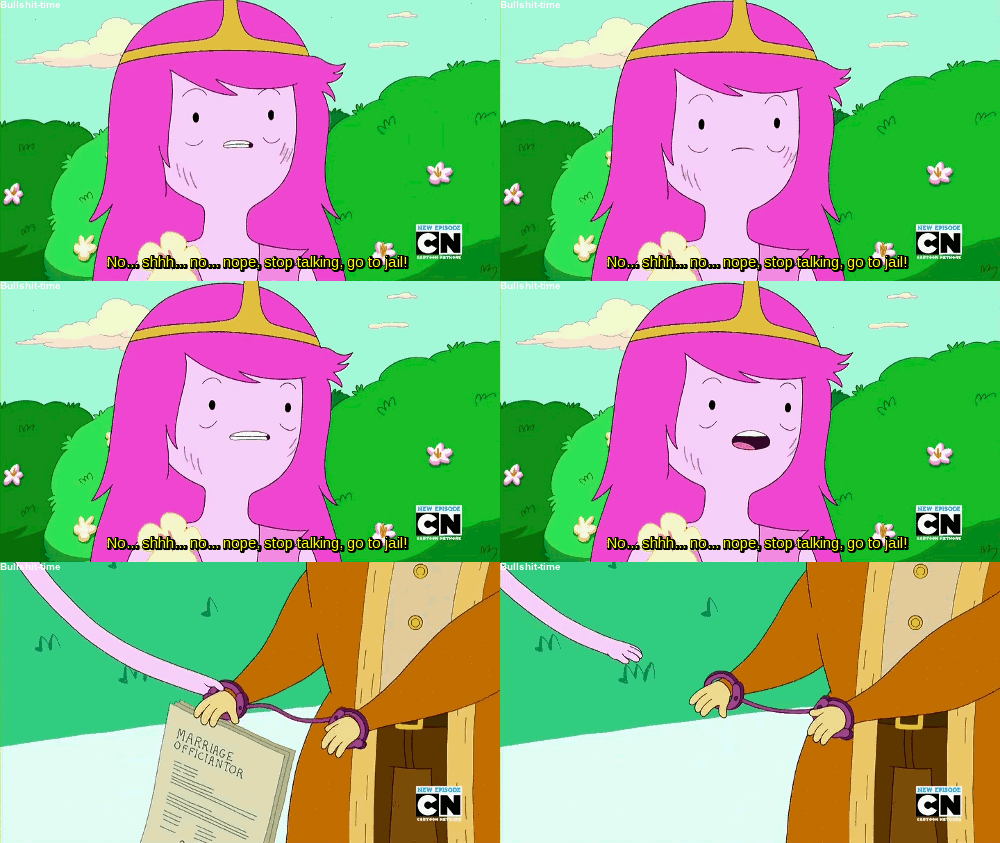
Pictured: Princess Bubblegum cutting someone off and sending them to jail.

No, Dresden, you colossal jackass, that is VITAL FUCKING TACTICAL INFORMATION at this moment.  She's not being a stupid drone; she's determining what's safe and not, since that will seriously impact how you two respond to this invasion.  Sigh.  Dresden shoves her down into the basement (with a brief interlude as Rodriguez notices that his towel has fallen off and he's naked) and then does battle with the demon, hurling a gale-force wind in its face and commanding it dramatically to get out.  It's too powerful even for naked Dresden and his mighty staff (which he summoned into his hand and now holds straight out from his body--everyone praise the ancestor of your choice that this book wasn't illustrated), so he tells Rodriguez to drink the escape potion from earlier (oh god, we saw this coming).  That fails to spirit her away, but she also finds Dresden's revolver, climbs back up the stairs, and unloads all six rounds, giving them time to... run back downstairs.  Well.  Classic horror movie mistake, but okay, at least Rodriguez tried.

And now, of course, it's time for the wacky shenanigans, because Dresden uncovers the copper circle he inlaid in the basement floor, pulls Susan into it with him, and erects an unbreakable anti-demon barrier (also acid-proof, apparently).  Demons can't remain summoned during the day, he explains, so they just have to stay in the circle for the next ten hours and they'll be fine.

It is at this point that Bob the Sex Offending Skull points out what we all realised would inevitably happen back in chapter eight: Susan didn't drink the escape potion; she drank the love potion and she will now disregard their safety in favour of trying to get Dresden to bang her on this concrete floor before they die.

Hang on a second here.

We all know love potions are fucked up; overriding someone's mind and consent is not cool under any circumstances.  But this isn't even a love potion--this is a fucking potion.  Rodriguez isn't suddenly filled with admiration for Dresden's (hypothetical) virtues, she doesn't weep for the family they will never get to make together, she doesn't suddenly ask if she can somehow save him by sacrificing herself.  She stops caring about anything (including her own life) except getting that pasty wizard D.  I'm all in favour of love and sex in whatever combination makes everyone happy, but there are only two conclusions that we can draw here:

Option 1: 'love potion' is a euphemism for 'elixir that causes the drinker to stop wanting anything except sex with one particular person'.  Evidence in favour: classically, love potions lead to sex in most stories, probably because they're introduced as an excuse to get two people to have sex in an unusual circumstance.  Evidence against: the brewing of this potion involved candlelight and love poetry and the sorts of things that are supposed to be associated with high-minded romance, with sex as a possible consequent rather than the entirety of the event.

Option 2: 'do me here and now' is the specific response of Susan Rodriguez to this love potion, because like most women in this book she is nothing more than a projection of lust and she cannot fathom any way to express affection other than sex.  Evidence in favour: look, you've all read as much of this book as I have; you know what it means for her to be pretty and female and brown.  Evidence against: ...

...

Maybe I'll have something by next time.  (Merciful spoiler: they don't have sex.)

---

*I suppose I should make a consistent note that these books don't have chapter titles and I'm just making them up for funsies, lest new readers be confused that the titles are so much more entertaining and thoughtful than the text.

Wednesday, August 26, 2015

The Eye of the World, chapter 49 to the end, in which the best and the worst of this book are on display

Here we are at last.  I could have split this across two posts, but I decided to power on ahead to the end.  Book One of the Wheel of Time comes at last to its end and we find out what passes for a climax in this unnecessary marathon of a pagecount.  Goggles on, dear readers.

The Eye of the World: p. 732--782
Chapter Forty-Nine: The Dark One Stirs

Rand wakes up and, top priority now that they are way deep in the noxious hellscape of Satan County, takes stock of how Nynaeve is feeling about getting rejected by a man.  If I thought this had anything to do with Rand thinking their group might be weakened by inner strife, I'd be less judgey.  Because Egwene is a better person in every way (and praise depersonified Light Jesus that she doesn't end up with Rand, by the way) she doesn't just stare, and instead goes to chat with Nynaeve until she manages to provoke a laugh and a hug from her wounded friend.  Rand just thinks about how "all women are Aes Sedai" because he thinks they have secret methods to read male minds, and I just can't even with this guy.  I mean, I absolutely think it's narratively stupid that Nynaeve is suddenly in love with Lan, but accepting that as our premise, we can presumably agree that Rand is contemptible for just staring at her, hurt, and thinking how freaky women are with their witch-feelings and seeeecrets.

Best possible plot twist at this point: Rand tries to stop the Dark One, instead falls to temptation, and Egwene leaps in to save the day because she is the Dragon Reborn.  Yes, after eight hundred pages it might be questionable to be all 'Hah, that protagonist was a decoy!', but there are literally ten thousand more pages still to go in this series and it's not like it stopped GRR Martin.

But let's move on or we'll never find out how disappointed I'll be.  They are once again riding towards--honest to Hotei--the Mountains of Dhoom.  Dhoom, people.  No editor stopped Jordan from doing this, and we all bear the weight of that sin.  Moiraine is taking them to the last place she found the Eye of the World, and if it moves, they'll count on the Green Man to help, because he "senses need", though why he hasn't come to them already in that case I don't know.

There's more description of the Blight, which is honestly the best part of this story right now, and when I'm this enthusiastic about description near the climax of a book you know it's dire.  The trees shed wet, decaying leaves constantly, ooze from cracks in their bark, and tremble from their footfalls as if they're turning to liquid entirely.  One of them flails around and grabs a furry creature off the ground.  Love it; A-plus evil landscape.  Lan wanders into the undergrowth to slaughter something evil, and upon his return gets jumped by some kind of murderous spider-bear, but Mat of all people takes it down with a single arrow.  That's a prelude to a mass monsters-and-monster-trees ambush, but the farm kids once again go into that ancestral battle-fugue where they shout about Manetheren and Ellisande a lot, and Moiraine elects to spam fireballs, because she definitely hasn't been saying this whole time that subtlety is paramount and we definitely don't have in-text evidence that wielding Fire weakens her more than anything else.  For reasons deeply unclear to me, Lan keeps leaving the group, diving into the trees, slaughtering things, coming back for Moiraine to cast Lay On Hands, and leaving again.  What's he getting done out there that is more valuable than directly protecting the party?  Does the forest have Strategy Bushes that direct and coordinate its malevolent intent?  Give me something, Jordan, don't just have him 'disappear' because it's supposed to be mysterious and cool.

The assault stops at the sound of some other creature's cry chasing them, which Lan identifies as Worms.  I mention this only because, to my endless delight, Jordan asserts that you can hear dramatic capitalisation:
"They were scared off by worms?" Mat said incredulously [...] 
"A Worm"--there was a sharp difference in the way the Warder said it from the way Mat had--"can kill a Fade, if the Fade hasn't the Dark One's own luck with it."
I mean, yes, Terry Pratchett also had audible capitalisation, but Discworld is an intentionally absurd place.  And well-written.  Lan volunteers to make a heroic sacrifice, but Moiraine forbids it, and Rand braces himself and thinks about how scared he is (less than relatable prose, way too tell-don't-show) when they clear a foothill and burst into a mass of healthy greenery that she declares safe.

The Green Man appears, made of nuts and leaves and butterflies, greets Loial and names Perrin a Wolfbrother, then straight up calls Rand 'Child of the Dragon', but no one thinks that might be a big deal.  He agrees instantly to take them to the Eye, and I wonder again if we've ever actually been told what it is, apart from 'plot relevant'.

Chapter Fifty: Meetings at the Eye

They wander deeper into the greenery, the Green Man weaving flower crowns for the women as they go.  Not sure why even he thinks that flowers are only for girls.  Dude is, by chance or choice, a dude, and he's partly made of flowers.  Maybe Lan is just sensitive about crowns.

(At this point, I decided to search the web for some good art of a manly man wearing a flower crown, but after the third photoshopped Benedict Cumberbatch I gave up.  On everything.  Forever.  I am a pointless meat husk screaming towards the void.)

The Eye is inside a hill, entrance marked by a stone arch, and I had thought the Green Man was hella old because he talked as if he had seen entire past turns of the Wheel, but then he says that he was made to guard it when it was first made, during the Breaking, by a hundred male and female Aes Sedai who sacrificed their lives in the effort.  Well.  That's... questionable.  Is it just me or if the villains made something out of the lives of a hundred people would we not assume it was an artifact of terrible evil?

Inside the cavern, the Eye turns out to be a big oval pool of not-water with no apparent bottom.  Mat kicks in a rock (classy) and they watch said rock dissolve into nothing.  Moiraine describes it as the essence of saidin, dude magic, which can either seal the devil's prison or bust it fully open.  Loial asks why anyone would make a thing like that:
"No one living knows [....] Neither the how, nor more of the why than that it would be needed one day, and that that need would be the greatest and most desperate the world had faced to that time. Perhaps would ever face. Many in Tar Valon have attempted to find a way to use that Power, but [...] only a man could channel it [...]"
Well.  That is also questionable.  A contingency device that can either save or end the world and can only be used by male wizards who are actively hunted because magic corrupts them.  Nothing about this plan sounds like a good idea unless you have narrative information that asserts that it will all turn out okay.  That is not a kind of prophecy I favour.

They leave again and outside run into a pair of the Forsaken, the devil's favourite servants, who are apparently loose now.  One is hella old but telekinetically smites Lan; the other is bound up in a fetish-worthy amount of leather and sets about thrashing the others before the Green Man shows up to save them.  Treebeard is not to be taken lightly--they wrassle for a moment and the Green Man looks like he'll burst into flames, but not before Captain Safeword finds himself consumed by an outburst of fungus, nettles, and weeds, plants that love the dark.  Then Big Green does topple, and his collapsing body produces a single acorn that immediately erupts into an ancient towering oak.

You know, I'm actually enjoying this book right now.  It's not exactly mindblowingly original, but at least it's operatically fantastical.  If the book only consisted of events like the last few chapters, and not five hundred pages of trudging through Generic Fantasy Farmlands, I might even recommend it to others.

Moiraine tries to trap old dude--Aginor--in a fiery chasm and tells the others to run, but Egwene tries to help as well, and Rand has to pull her away.  In literally any book where Egwene was the protagonist, it would be a sign of incredible bravery that Egwene dared throw whatever magic she could wield against the villain, and it would make some minor difference that was ultimately key to their victory, but here she's being foolish and has to be rescued by a boy.

Chapter Fifty-One: Against the Shadow

So this chapter gets trippy.  Rand runs from Aginor until he reaches a sheer cliff, inescapable, and Aginor talks about killing him (the devil being okay with undead servants), but Rand is suddenly aware of... I'm not sure.  Lifelines?  He sees a glowing cord running off Aginor, which pulses ever more intensely as they mind-battle until Aginor bursts into flames.  Rand then teleports into the middle of the battle at the borderland pass, where things are going badly for humanity, but in a fit of rage he blasts the draghkars out of the sky with lightning and summons a firestorm to scythe through most of the trollocs and Fades.  There's some unclear dialogue inside his head between himself ("It has to end!") and an unknown voice ("ONLY THE CHOSEN ONE CAN DO WHAT MUST BE DONE, IF HE WILL"), and some reasonably adept prose describing the "terrible heat of the Light" in such a way that makes it sound less cuddly and more like an overwhelming implacable force.  This I also like: if your hero is going to wield supreme power of goodness and use that power to incinerate living creatures, at least make him fucking terrified of it.  (I mean, the whole 'our hero firestorms the bad guys' is an unnecessary scene on principle, but if it's going to be here, this is an okay handling.)

As the human forces rally behind him, Rand climbs a literal stairway to heaven, steps made of light in the void, until he arrives back in the stony balcony from his dreams where he faces off against Ba'alzamon.  Rand can see Ba'alzamon also has a lifeline, and you should all be proud of me for not making any of the jokes that all but tell themselves when Rand marvels at how thick and black it is.

Ba'alzamon explains (indistinctly, but intelligibly if you know Rand's Secret Backstory) that he has orchestrated the events of Rand's ancestors to bring him here, and has only sent small armies or individual Darkfriends after Rand because he'd rather have a living servant than a dead one.  At least that tries to explain why the endless armies of evil haven't made much of an appearance, but I'm still not clear why sending a hundred Darkfriends to abduct Rand would have guaranteed his death rather than his capture.

The devil conjures up Rand's dead mother next, and she pleads with Rand to save her soul.  Fades appear and start torturing her, but Rand conjures a sword of light out of nowhere, blasts them to bits, and hacks Ba'alzamon's lifeline in half, declaring "It is ended!" in what I can only assume is a Revelation reference.  Everything bursts into flames.

Chapter Fifty-Two: There Is Neither Beginning Nor End

You say that, Jordan, but I remember the naive, callow youth I was when I started this book, and I know how eagerly I await my freedom in another twenty pages.  Also, really, that chapter was our grand climax?  Rand is separated from the others and doomed but then instinctively saves himself, saves the army, saves his mother, and sets the devil on fire?  That was literally and without exaggeration the most gratuitous, least foreshadowed, least earned, and most convenient victory I have ever read.

Wait, I'm wrong.  I once read a primary school kid's short story in which a boy gets magically transported to a realm of talking animals and told by the king lion that he is the chosen one who needs to use the magic gems to destroy the villain.  At that exact moment, the villain leaps into the king's court, and the kid raises the gems and vaporises him on the spot.  Like, the lion hadn't even finished the tutorial on these things and boom, quest over, promotions all around.

That is the only other contender for the title.

Rand awakens where he started, near the pile of gross ashes that used to be Aginor.  Memories float back and he sprints back to the others, who are all unharmed, including Moiraine.  He tells them that he killed the devil, and everything else that happened, but everyone else is too plot-savvy to believe that the devil gets dropped in book one.  Moiraine explains that she's seen evidence of Rand channelling all through the book, as far back as when she was casting Refresh Horse on everyone's mounts and Bela didn't need it--because Bela was carrying Egwene and Rand instinctively wanted her safe.  (The possibility that Egwene had refreshed Bela apparently wasn't on the table.)  Moiraine promises not to drag Rand off to be "gentled" like they normally do with man-wizards, and not to tell anyone who doesn't need to know.

The Eye pool is apparent gone, consumed by Rand's victory lap of plot contrivance.  Instead there's a column of stone in the centre, with convenient steps to reach it.  The dudes of the pottery carry three relics retrieved from inside the prison.  First are ancient pottery fragments, which Moiraine fits together into a taijitu (last seen in the prologue) and identifies as heartstone, indestructible relic of a past age, one of seven seals on the devil's prison, shattered by unknown means.  Second is the Horn of Valere, namedropped much earlier in the book, to be used to call spirits of heroes back to fight the devil, and last is the banner of the Dragon, specifically a serpentine gold-maned red dragon.


Just so we're clear on this, Our Heroes are a sea of whitebread and ginger carrying a katana, the prime symbol of Taoism, and now a clearly Asian-style dragon banner.  I know Jordan said he was going for a sort of 'fantasy melange', but I have yet to see a single thing that makes me say 'ah, a reference to African mythology!' or really anything other than 'ah, another white author with a fetish for Asian myths minus all the Asian people!'  People who have read later books: does this ever get better?

Chapter Fifty-Three: The Wheel Turns

The Blight has eaten most of the greenery the next morning, but Loial refuses to let it have the Green Man's oak, and takes an hour (that feels like minutes) to sing a Tree Song that rejuvenates it, assuring the party that he couldn't have invoked so much power if Jolly Green's spirit wasn't still in there.  The Blight is still gross, but doesn't try to murder them as they leave--Moiraine explains that they "struck a mighty blow against the Dark One" and for some reason Rand still hasn't asked for an explanation of how she reconciles that with his memory of killing the devil.

At least the soldiers at Fal Dara aren't so hypermasculine as to reject a good flower crown, and everyone is wearing them to celebrate the incredible victory at the pass.  Moiraine waves off all healers and meets with Agelmar to show him the recovered horn and ask for a small army to escort it to Illian, for reasons not explained.  Montages happen for a week.  Lan starts teaching Rand how to actually use his sword, and everyone gets hyped about finally going to Tar Valon, but Rand refuses to join them, convinced that he'll get gentled if he goes, and go mad-corrupt if he ever accidentally uses magic again.  He's just going to wander off on his own, away from people he might hurt, cursing the luck that his crush has to be a wizard and thus dangerous.  In another garden, far away, Moiraine magically eavesdrops on them:
"The Prophecies will be fulfilled," the Aes Sedai whispered. "The Dragon is Reborn."
And that's it.  That's the book.

I am... thoroughly unimpressed, I have to admit.  I love a good ending.  I love the part of a story where we see how everything that has led to the climax fits together in order to create something with meaning.  I love Frodo and Gollum facing the will of the Ring at the Cracks of Doom, the way the hero's past mercy ultimately saves him from his own final weakness.  I love Katniss, broken and angry, still playing her character so well that she gets a shot at salvation instead of vengeance.  I love the Doctor and Rose up against an army of genocidal zealotry, saved because the Bad Wolf is damnfool implacable hope and she will do anything to protect those she loves.  I love Harry Potter and Narcissa Malfoy in the woods, speaking two words ("Yes."  "Dead.") that declare that love overwhelms hatred in the end.

And I get that those endings are the real endings and this is book one of eleventy, so it's not a fair comparison, but I just waded through seven hundred and ninety-two pages of this stuff and the ending was abrupt, unjustified, and most heinously of all, revealed nothing meaningful about who the characters are or what they believe.  This is an ending that falls like a soggy towel on the page: and there, there's a huge battle and the good guys win but for how long isn't this awesome?  Wasn't this totally worth reading about the four hundred identical innkeepers that populate this world like an unsettling mashup of Barliman Butterbur and Nurse Joy?  Isn't it great how a solid 60% of this book was just setting the stage for later books while somehow failing to have any real impact on the events of its own plot?

I am struggling to think of any way in which the plot might have been hampered if the party hadn't transitioned directly from, say, Baerlon to Fal Dara.  By my estimate, if they had done so, the book would have been about three hundred fifty pages long, maybe three hundred with better editing, a solid book but not a brick.  We lose the City of Mat Don't Touch That Dagger Oh My God, and Perrin being a Man-Wolf, and Rand flirting with a princess, but do we lose anything that actually impacts the plot?  Is there any reason not to consider the intervening thirty-some chapters glorified filler?  I'm really and truly asking.  Because I don't think it should be a controversial opinion to say 'if half your book isn't relevant to your book, cut it', and yet here we are.  And I actually liked the Travellers and the wolfpack, those are good story elements, but they could be in their own book where they were actually plot-relevant and not just a sideshow with no purpose.

Because I don't make good life choices, I am actually considering getting into the second book on this here blog, but I'm definitely not doing that right away.  I need a cleanser.  So, apart from your usual delightful insights and anecdotes, make your nominations, resilient readers, and come back in a week or two to see what I inflict on myself next.

Wednesday, February 11, 2015

The Eye of the World, chapters 19 and 20, in which no one makes good decisions

It's honestly harder to carve into this book than it was for any of Card's works.  Not because this is more horrifying, but because Card is, in comparison, an incredibly concise writer, while Jordan apparently takes pride in writing pages of description I couldn't cut through with a hacksaw and a Loggingbot 3000 Automatic Hewing Droid.  For that reason, please accept my apologies as we only get through two chapters this week.

The Eye of the World: p. 275--313
Chapter Nineteen: Shadow's Waiting

The title trips me up here.  'Shadows Waiting' I would understand to mean 'there are shadows which are waiting', generic but okay.  The apostrophe means it's either a contraction, which seems deeply unlikely (casual language is always less MYTHIC), or a possessive gerund, in which case this chapter is about the waiting that some particular shadow has done, which sounds like really boring performance art.  I've gotten this far in life without seeing Godot and I'm not going to start now.

When last we left Our Heroes, they were creeping into the ruined city now called Shadar Logoth, which is of course hella impressive, as all ancient ruins must be.  Every giant building is capped with one to five marble domes, "each one shaped differently", and I'm not even sure how you do that with a feature that's literally named for its shape.  Very, very creative use of convexity, apparently.  There are also long pillar-lined streets leading up to sky-scraping towers, and I would like to know how it is that Rand didn't see any of those buildings from a distance.  Every intersection has a fountain, monument, or be-pedestalled statue, which must have made for terrible traffic flow back in the day.

Lan picks a ruined tower with an intact main floor and no door whatsoever for their camp.  The doorway is literally so big that they bring the horses inside in pairs, but apparently that's secure enough for Lan's liking.  Nynaeve immediately starts try to herb Moiraine up, and shuts Lan right down when he interjects, but Moiraine says all she needs is a power nap.  She does, however, accept some herbal tea to help with that.  These two were practically made for hurt/comfort fanfic.

The farmboys explore for a while, Mat seems kinda hypnotised by an alleyway, and Rand is bright enough to still be feeling weird about the way he shouted ancient war cries earlier, like he was possessed.  Thom the gleeman tells them not to joke about possession and resurrection, because it's a Big Deal.  Hasn't that already been made very clear with talk of the Dragon Reborn, harbinger of the salvatiomageddon of the world?  Rand angsts more about maybe being adopted.  FORESHADOW FORESHADOW.

Mat, whom I am tempted to only call by his ancient Manetheren name, Makes Bad Decisions, wants to go explore the ruins, and explicitly says not to ask permission because they know they won't get it.  Goddammit, Mat, you are hiding from the devil's besties with the help of a witch who can set you on fire by wishing hard enough.  I hope Perrin leaves you for Rand.  But the three of them obviously go off exploring, and it's time for more of those nudge-wink-modern-world references, as they puzzle out what could possibly be the purpose of a building that's clearly a sports stadium.  There's another building that's just a huge dome covering a single large room; please tell me that's not supposed to be a capitol building like the U.S. senate.  Aridhol isn't just DC, right?  Please?

Mat's talking about climbing a tower when the Most Suspicious Man In The World pops up out of nowhere and introduces himself as Mordeth oh my god I can't.  He claims to be a treasure hunter and says things that are supposed to be sly while a huge neon sign blinks the words VILLAIN over his head.  He asks them to help carry all the loot he's found, and leads them down into a huge trove of gold and weapons, before Rand finally notices Mordeth doesn't have a shadow.  He briefly turns into a huge monster before his illusion fades and he wisps away through a crack in the walls, at which point Rand and Perrin forcibly drag Mat out by his arms.  The lights go out behind them, and on the street again they're still convinced they're being watched, but they make it back to camp, where Moiraine chews them out and gives them another giant history lesson.  TL;DR: Mordeth was an ancient advisor who turned the noble kings of Aridhol evil and sowed chaos until the people of the city destroyed themselves under the influence of something called Mashadar.  'Shadow's Waiting' is the short form of 'the place where the shadow waits', the literal translation of Shadar Logoth.

This is all stuff that would be way more interesting in the hands of someone who was telling a story instead of telling us about telling a story.  Moiraine rattles off a chain of loosely-connected events with no actual explanations, about the last noble prince and how he was betrayed and ran away and found a wife and they both ended up dead, possibly Romeo-and-Juliet-style, but since it lacks much poetic value, it's only compelling if you tell yourself the story.

We did talk, back in Ender's Game, about how the strongest stories are often the ones that we invent for ourselves, and how popular books often seem to try to tap into a null zone where the reader is the one actually filling in the details and explaining things however they like best.  I'm starting to wonder if Robert Jordan's success wasn't that he did that on a grand scale, and for every generic fan of fantasy, not just bitter geeks or teenage girls with unhealthy romantic notions.  What I'm suggesting is that Wheel of Time might perhaps be a book that tries to pretend to be a better book, the way butterflies sometimes have camouflage patterns that look like jaguar eyes.

It makes as much sense as anything else so far.

Anyway, Moredeath Mordeth wants a new host body that will let him escape the city, but they're safe as long as they didn't do any of the fairy-rules types of things that would let him enthrall them, like accepting gifts or whatever.  They all try to rest, but Lan arrives in the middle of the night to report that Trollocs (which we are assured are far too scared to enter the city, that's the point) have entered the city, with sufficient prodding from Halfmen.  I'm 90% sure Our Heroes haven't slept properly since before Baerlon.  How are they not all dead, again?  Magic?  Super.

Chapter Twenty: Dust on the Wind

Our Heroes bravely run away into the nighttime streets, but tendrils of fog creep in at ground level and Moiraine commands them to stop.  The fog is the body of Mashadar, and it kills instantly on contact, so they have to split up to avoid it.  (Jumping over a tendril "as big around as a leg" is apparently not an option.  What did I say last time about CRPG heroes?  Find the jump button, Rand.)

Rand bravely leads the rest of the party on, but they run into trollocs and run madly off in all directions.  We get to see Mashadar eat some trollocs and a halfman, and I'm left wondering: if we know that Moiraine has the power to ward away Mashadar And Friends, why isn't this city the favourite battleground of the forces of good?  Live in its buildings, have your wizards ward away the evil magic, no one goes out at night, and when the forces of evil try to invade again, just drop the street wards and flood them with murder-fog.  BRB, writing a more interesting fantasy novel based on this concept.

Rand finds Mat and Thom again and they escape the city, and we get the first scene from someone else's point of view: Perrin, staring at the path out of town, testing his axe blade and thinking carefully.  He is, we are told, a careful thinker, since he has Mat as his cautionary example of quick decision-making.  He quickly gets found by Egwene and they also run off together.  (I note that for our first non-Rand scene, we've got the hulk's point of view instead of, say, the wizard-apprentice who might have much more extensive thoughts about everything she's seen tonight.)  Perrin manages to drive his horse right over a cliff and into the river, struggles not to drown for about a page, and finally realises that he's actually managed to get all the way across to the far side.  With his heavy cloak, boots, and fricking battle axe.  He's not even a good swimmer.  And Moiraine's plan to cross the river was 'place a magical ward around us while we build rafts'?  Apparently all you need is hip-waders and the strength to dogpaddle for forty seconds.

Back with Rand, they get ambushed by trollocs in the woods and Thom suddenly proves ninja by throwing "my best knives" into the backs of three of them.  All of those big-name heroes are seeming less and less impressive as our backwoods randos laugh off the evil hordes.  They find a boat, there's much scuffling, and Rand is once again moments from death under a trolloc when the ship's boom smacks it overboard.  The narrative all but says 'Yes, that was a deus ex machina'.  Oh, but then there's an extended argument among the crew about whether the boom was secured or not, which I'm guessing is foreshadowing that Rand actually willed it to save him because he is magic.

Captain Domon is kind of a no-win situation in terms of racism, because he speaks in broken English, but it's also not quite clear if he's supposed to be white or not, so either we continue to have the palest cast ever or our first POC has questionable language skills.  Thom bluffs a whole backstory out of the dangers that have assailed them thus far, living the gleeman's life, travelling "like dust on the wind".  But it's not enough to buy passage, and since Rand refuses to give up his sword, he and Mat hand over their silver coins from Moiraine instead.  The chapter ends with Rand leaning overboard, repeating that he tried to convince Egwene not to come with them.  Despite the fact that he's on a boat with a sketchy bard and a ship captain who wants his sword and doesn't care about throwing him overboard, I'm not sure why Rand thinks she'd be safer with him than with the wizard and her pet super-knight.

I apologise for cutting short this week, but my loathing of this book has overwhelmed my work ethic.  Instead, I offer you this:


Next week: sudden unexpected extended Bechdel pass.  I'm looking forward to it.