Showing posts with label at least Bean is supposed to be a jerk. Show all posts

Sunday, October 5, 2014

Ender's Shadow, chapters twenty-one and twenty-two, in which Bean is not the smartest person

(Content: misogyny, emotional manipulation. Fun content: Petra Arkanian and Ace McShane are the best crossover ship.)

Ender's Shadow: pp. 319--351
Chapter Twenty-One: Guesswork

Unnamed Important Military figures (I'm guessing Anderson and... I'm going to pretend Levi as well) open by discussing the logistics of getting Ender's dream-team through all their pre-war training before they're ready for xenocide.  It really drives home just how amazingly inefficient all of their spread-out Secret Schools are:
"ISL is two months away from you,and by the time they're done with Tactical, the voyage from there to FleetCom will be four months. That gives them only three months in Tactical before we have to bring them to Command School. Three months in which to compress three years of training."
The whole 'you have eleven seconds to master this secret technique that most people have to reincarnate to spend a second lifetime to learn' is standard enough child hero fare, but our first question is why again all these various schools need to be so incredibly far apart.  I mean, Eros is only around the orbit of Mars, so we're apparently not using the Park Shift engine for cheap fast easy relativistic flight for some reason, but why are they moving around at all?  This fleet is operating on the basis that there's no difference between having your general aboard the flagship versus sitting at a desk seventy light-years away, but you need to waste half your remaining training time shipping your miracle students on a whirlwind tour of the solar system rather than just using your instant communications tech to access whatever software or skype tutoring they need in one place.  (Sure, they would need to lie properly to cover up the instant communications being used, but as we're about to see, they're already doing that, and not well.)

Also:
"I'm not faulting Colonel Graff, you understand, he had no way of knowing." 
"Knowing what?" 
"That Achilles is a serial killer." 
"That should make Graff happy. Ender's count is up to two."

They talk about how amazing it is that Ender, the team-builder, got cornered and went for a solo fight, while Bean the Lonely Loner brought together a squad for a nonviolent solution, and how that's so far against their predilections, apparently forgetting that Ender's establishing moment is killing a bully in a one-on-one fight and Bean's first moment is transforming a street gang into a sort of microfeudalistic patronage.  Also, remember how I talked about the general who picked Ender's friends for his campaign team feeling foolish once Ender decides to go the Distant Unapproachable Genius route for his leading role?  I was clearly wrong, because they didn't actually put that much thought into it.
"So send ten." 
"Which ten?" 
"How the hell should I know?  Well... Bean, him for sure. And the nine others that you think would work best with either Bean or Ender in command, whichever one it turns out to be."
So from three dozen our dream team roster has been retconned down to 'whichever ten you like, plus Carn Carby since we've already got him here'.  The world-saving world-ending assault force command group has been assembled with all the careful consideration and approval processes of a company softball team.

Bean gets his transfer orders, has a final chat with the Rabbit toon leaders about how they lost all five of their games and that's okay because they were learning improvisation and teamwork from each other, which are more important now than the ability to follow one smart guy's completely battle plan, ending with "losing is a much more powerful teacher than winning", which I feel raises some serious questions about Ender's endless winning streak in this narrative.

He then goes to have a last chat with Nikolai, who has been promoted yet again to be the new Rabbit Commander (that's just a fun phrase), and they speculate on whether it's End of the World time.  Bean says the signals are mixed; the teachers are acting like it's the final countdown, but nothing seems to be happening in the solar system to suggest they're bunkering down for an incoming invasion.  Bean says if they were going to launch their own invasion fleet, the time to do that was right after the Second Invasion.  Nikolai points out that humanity might not know where the formic homeworld is (Bean didn't think of that, especially if they don't communicate via light the way we do; Bean insists light is "still faster than anything else."
"Anything else that we know about," said Nikolai. 
Bean just looked at him. 
"Oh, I know, that's stupid. The laws of physics and all that. I just--you know, I keep thinking, that's all. I don't like to rule things out just because they're impossible."
Once again, a thing I actually really like in this book: Nikolai might not be a miracle child, but he's thoughtful and open-minded, and sometimes that means he's smarter than Bean.

Also, Nikolai was one of those who went to trap Achilles, of course, and Bean is very grateful.
"Someday," said Bean, "you're going to need me the way I needed you. And I'll be there."
Flat-out untrue; Nikolai disappears a few chapters into the next book and we will never speak of him again.  Sigh.

So they get loaded onto a destroyer for the four-month journey, and we get a full roster at last: Dink, Petra, Alai, Shen, Vlad, "Dumper", Tom, Fly Molo, Han Tzu, and Bean (Bustopher Kobayashi is of course already there, with Carn Carby).  Bean remains suspicious of Petra's reliability, obvs, but rather than resolve that sidequest just yet, he spends four months in the library reading recent Earth history, learning about how Russia threatens to conquer the world at any moment so easily.  No, for reals.
Where the Chinese simply took it for granted that they were and should be the center of the universe, the Russians, led by a series of ambitious demagogues and authoritarian generals, felt that history had cheated them out of their rightful place, century after century, and it was time for that to end. [....] Everything was in place for a vast power play the moment the Buggers were defeated--or before, if they thought it was to their advantage. Oddly, the Russians were rather open about their intentions--they always had been. They had no talent for subtlety, but they made up for it with amazing stubbornness. [....] Along with their national vigor, the Russians had also nurtured their astonishing talent for misgovernment, that sense of personal entitlement that made corruption a way of life.
It just goes on like this, vast heaving tracts of telling-not-showing about the nature of Earth back home, making up bad future Russians so Card can tell us how they extrapolate from our own contemporary Russians, generalising the millions of inhabitants of a country with "effective borders back to the peak of Soviet power--and beyond" according to some vague traits found among the ruling class of the 20th century.  I mean to say: why is this here?

(Lest we think Card is just an anti-Russian zealot, he also criticises Chinese national narcissism ("To the Chinese, once something was known in China, it was known everywhere that mattered") and the apathy of "the Euro-American nations", which is a phrase almost as hilarious as 'Judeo-Christian' is in glossing and blurring of radically different histories and traditions and mindsets into a vague 'obviously we all get along in our community of whiteness' melange.)

The actual reason it's here is so Bean can bring up Locke and Demosthenes, consider whether they might really be the same person, decide they think and write too differently despite their similar factual premises, and so write an anonymous essay to mail to both of them.  Bean, with his total lack of access to reconnaissance data, accurately draws up the Russian threat, their Obvious Strategy, and how to pre-empt it.  He is also the one to call for the Battle/Tactical/Command School kids to be sent home immediately after victory, so they won't be captured by the Russians "or kept in ineffectual isolation by the I.F."  Within days, Demosthenes and Locke both demand the kids come home (which, of course, is meant to set up the Shadow sequels, but kind of undercuts the point in Ender's Game that Locke and Demosthenes were never supposed to both throw their support behind something until it was the Big Score, saving the world from itself after Ender wins the war).

Three days later, they ship out with Carn.  We'll find out next chapter that this is because the Battle School kids are already being shipped home, but, despite Bean specifically listing, Battle, Tactical, and Command in his essay, apparently everyone back on Earth has rapidly forgotten that Tactical and Command exist.  Slapdash, which is especially weird given that this is Bean collaborating with the Wiggins, all of whom are supposed to be perfect.

Chapter Twenty-Two: Reunion

Graff and Admiral Whomeverthefuck continue to discuss the arrangements for the students at Command School, and top of Graff's mind is the insistence that "Ender can't do his job unless he knows about the ansible" whereas if Bean finds out "he'll leap straight to the core situation", and I know I complained about this last time, but once again, why does Ender need to know about the ansible in order to play his campaign?  Anything.  I will accept literally any practical reason that Ender's video game proficiency would be reduced if he didn't know about our instant communications technology.  I can't find one.  But this, we are told, is basically the whole reason that Ender and his friends never get to spend any time together apart from their voicechat during games.
"But if this is so, then Bean, is not capable of being Ender's backup, because then he would have to be told about the ansible." 
"It won't matter then." 
"But you yourself were the author of the proposition that only a child--" 
"Sir, none of that applies to Bean." 
Okay, wow, this is now also the first canonical indication that Graff is actually the one who came up with the idea that a twelve-year-old is the ideal commander for their xenocidal campaign.  Now, that's not surprising, since Graff's favourite kind of soldier is one whom he can easily manipulate into anything at a whim, but it re-re-re-emphasises the question from the dawn of time: who the fuck is Hyrum Graff?  How did he, a colonel/schoolteacher, convince the whole Fleet Command and Triumvirate to put their entire desperate suicide-mission plan on the shoulders of a child?

Of course, we know Mazer Rackham said the same thing, and Rackham's existence is secret, so maybe Graff is just the 'public' author of Rackham's plan, except this guy knows the whole plan so he must also know Rackham is still alive, so we're back to Graff being inexplicably influential even though everyone hates him and his ridiculous theories.  Graff and Rackham desperately needed to be the same character.

Now it's time for Bean to resolve the Petra plot thread, when people start for the first time talking about their pre-Battle-School lives.  Bean isn't bashful about spewing his whole street kid deal, including Poke, Achilles, and her eventual murder, which of course moves Petra to tears and she flees the room--Bean follows.  He makes an extended plea for her to tell him what she was doing when she baited Ender, how they need to trust each other, how he has "opened his soul" to them (such a natural line, innit), and Petra neatly shuts him down.
"You told me about your feelings. [...] So good, it's a relief to know you have them, or at least to know that you think it's worth pretending to have them, nobody's quite sure about that. But what you don't ever tell us is what the hell is actually going on here. [....] The teachers told you things back in Battle School that none of the rest of us knew."
Petra's wrath makes me all warm and fuzzy sometimes.

Bean is of course shocked to realise that other people are actually paying attention, and he admits that he hacked the student records and the teachers asked him to assemble Dragon Army, which similarly shocks Petra immensely, though, again, the public facts about Dragon Army (rejects and newbies) are still true, so I don't know why everyone thinks this is such a big deal.

Anyway, Petra admits that she did bait Ender in the hallway That One Time, and elaborates her plan: get into a brawl (with herself protecting Ender, and Dragons and other armies sure to join in), Ender gets punched a little but everything cools off, and all of the bullies (who hated Bonzo only a bit less than they did Ender) get bored and Bonzo loses his power to rabble-rouse.  She adds that she thinks the only reason Ender didn't go along with her plan was that Bean was in the middle of it and guaranteed to get mangled like a soft-centred truffle in a snowblower, and thus it's Bean's indirect fault that Ender had his deathmatch in the showers.  Which--I mean, Petra's not wrong about a lot of this.

(I am left wondering where Petra was the next day, when she looked around the commanders' mess that apparently only had a couple dozen kids in it and noticed that neither Ender nor Bonzo were present.  Was she just forbidden to enter the boys' showers?  There's been no mention of gendered facilities and everyone is naked all the time anyway.  Petra wouldn't have been held back like Dink was; Petra would have been this guy:
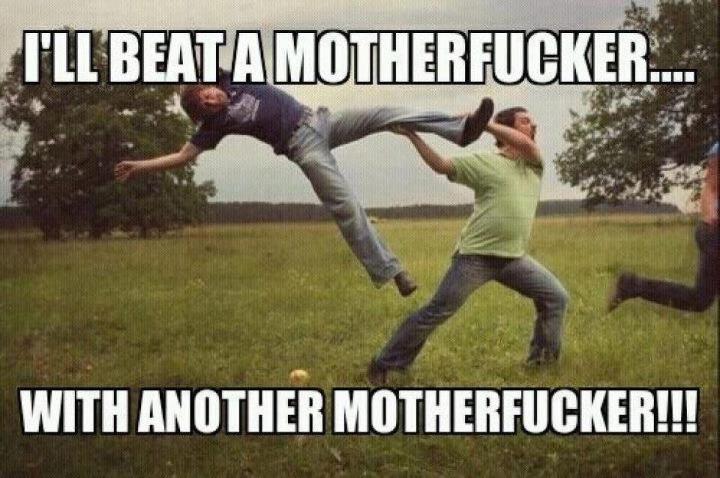

Bean admits his plan kinda sucked too, even if he doesn't like hers, and responds to mockery by telling Petra he's the best friend she's got there.  (He's apparently not paying attention to the amount of time Petra spends with Dink Meeker, Professional Decent Supportive Person.)  His evidence goes thusly:
"Because I'm the only one of these boys who ever chose to have a girl as his commander."
Bean, you colossal jackass.  You chose Poke as your 'commander' because you thought she was foolishly compassionate, and spent every moment with her meditating on how much smarter you were than her, based on no evidence except your own self-satisfaction.  No one else in your class has ever had the chance to pick their commander anyway.  What kind of self-aggrandising entitlement is this now?

Because he's such a supportive friend, Bean goes on to explain that "you're not really one of the guys" and of the estimated dozen (?!) girls in Battle School, Petra was the only really good soldier.  Bean explains that the only reason none of them have ever asked her why she 'betrayed' Ender is that they don't have enough respect for her to believe she didn't just screw up.  Because what good friends do is tell you all your other friends don't like you as much as you think they do and that you can only trust them, because they once did a Thing that objectively proves they respect women.  Oh my god.  This is, like, their first major interaction that will seed all their future trust and friendship and eventual coupling, and it reads like he's grooming her for abuse.  GET IT OFF OF ME.

They arrive at Eros, which Bean quickly realises was originally carved into a base by the formics, and thus was the goldmine of new technology like the gravity manipulators.  He concludes instantly that the I.F. never announced this because it would have scared people to learn how technologically advanced the formics were.  I think that's a really bad conclusion, because 1) a single formic ship killed a hundred million people in the First Invasion and 2) humanity has now survived two full invasions in spite of advanced technology.  We're used to overcoming enemies with advanced technology, we've been used to that forever, since long before Ace McShane beat a dalek down with a baseball bat.  I'm not sure how finding out their gravity-controlling powers were inadequate to resist the might of the human spirit would scare people more.

Because Card has reached his comfort level with gender equality, Petra gets separate quarters and the dozen boys share two rooms.  The environment creeps Bean out, but when he wakes up from nightmares, he instead realises something else is bothering him: he was talking to a technician today, someone fixing a simulator game, and commented that the thing was completely accurate except there was no time-delay for lightspeed communications, and the technician took a minute to even realise what he meant before brushing it off.  The only possible conclusion: humanity got the ansible from the formics as well.  The only possible consequent: they will wage the war from here, never knowing when it stops being simulator games and starts being an invasion campaign.

Now, within the confines that this book has given us, I do think this is at least relatively clever writing: a tiny slip-up by a technician that Bean extrapolates into all of its possible consequences, seeing how it fits with the other oddities (like how they get trained on older-model ships instead of the newest).  It's not easy to write characters who are supposed to be incredibly smart, and this kind of logical leap makes some sense.  Of course, he still hasn't resolved the question of how we found the formic homeworld (and all of their other bases, which, what?), but that doesn't come up in Bean's self counter-argument, as he tries to convince himself that this can't possibly be true because he doesn't want to get distracted thinking about people dying in space while he's leading them.

They start training with the voice command interface, and everyone takes turns being leader, but Bean declares it's obvious that they're getting set up to play under Ender, and he gets dragged before Graff to explain where he's getting all his secret knowledge.  Their real concern, of course, is that Bean has figured out The Terrible Truth, but Bean insists that if he knows anything, it's obviously not affecting his performance.  Graff laughs, turns off the recorder, and tells Bean about the Battle School kids going home, who Locke and Demosthenes are, and that they found Bean's biological family and he's Julian Delphiki, brother of Nikolai.  He grapples with this unprovoked infodump and decides he's being manipulated with sweet, sweet lies, thinks that he won't give up the name Poke gave him so easily as that, and this is reinforced when they are reunited with Ender, who quickly identifies his besties over the headset: Alai, and Bean.  It's not bad.

Next week: the finale grande, in which Bean is a willing accessory to xenocide.

Sunday, August 24, 2014

Ender's Shadow, chapters four, five, and six, in which Bean just barely doesn't sprint into the fourth wall

Y'know, this book really isn't as bad as Ender's Game for a very simple reason: Ender's Game is about what a burden it is to be an amazing person whom everyone else torments even though you're destined to save the entire world someday, and Ender's Shadow is about what it's like to be Bean.  Where Game couldn't go a chapter without telling us how wonderful Ender is or making proclamations on absolute human nature, Shadow is more of a straight underdog story interspliced with a bit of Science Mystery and Finding Your Family in both literal and figurative terms.  I'm finding, as I read ahead, that it's no worse than most books I intentionally keep on my shelves.  And I didn't make this blog to give maximum publicity to Orson Scott Card, so rather than detail every chapter of the book regardless of content, I'm going to start skimming to hit the interesting points.

(Content: starvation, child death, hostile teachers. Fun content: OSC writes his own fanfiction.)

Ender's Shadow: p. 54--101
Chapter Four: Memories

Graff and Carlotta, discussing Achilles and Bean, are basically a standup routine.
"He gives the right answers, but they aren't true." 
"And what test did you use to determine this?" 
"He committed murder." 
"Well, that is a drawback."
Is it, Graff?  Is it really?  But Graff tells her to forget Achilles, then, and focus on Bean.  Bean starts getting Battle School cram school, and when he's not studying, he gets to draw, or play games, or tell Carlotta about his past.  He remembers flawlessly, back to when he was only a few months old, learning to crawl, climbing out of his crib in "the clean place" (some kind of laboratory full of babies) because he had picked up from the adults that there was something bad coming.  So he hid, and a janitor found him but wasn't allowed to keep him (they're in the International Territory and he's not allowed to adopt, despite not having any kids of his own?), so Bean ran away and starved for three years until he found Poke.

Carlotta tells him that this is all impossible ("I guess that means I'm dead") unless God was watching over him, and Bean interrogates the idea that God kept Bean alive because he loved him but he let all those other kids starve   This is again a substantial improvement for Card, I think, as Bean takes a plausible atheistic stance when Carlotta says God kept him alive for a purpose:
It was like, she wanted to give God credit for every good thing, but when it was bad, then she either didn't mention God or had some reason why it was a good thing after all. As far as Bean could see, though, the dead kids would rather have been alive, just with more food. [....] Because if there was somebody in charge, then he ought to be fair, and if he wasn't fair, then why should Sister Carlotta be so happy that he was in charge?
Looking ahead to the later Shadow books, Bean never quite converts; I believe at one point after losing Carlotta he makes an off-hand reference to whatever God thinks and, when asked if he believes, responds 'More and more, and less and less', which I could take to mean that he sees more and more evidence that someone is scripting the universe, but less and less reason to believe that they're any kind of brilliant/benevolent God-figure like Carlotta believes in.  We never really get into the question of millions of starving children again either way.

The rest of the chapter is just investigation, as Bean realises that Carlotta is trying to figure out what kind of lab Bean came from, so he learns how maps work and runs away to track down the janitor with his perfect memory.  When he does, Carlotta arrives with the cops and reveals that she followed him:
"I didn't want to interfere until you found him. Just in case you think you were really smart, young man, we intercepted four street thugs and two known sex offenders who were after you." 
Bean rolled his eyes. "You think I've forgotten how to deal with them?" 
Sister Carlotta shrugged. "I didn't want this to be the first time you ever made a mistake in your life."
Sister Carlotta is probably my favourite of all Card's creations, but lest we forget she's one of Card's creations, we have the next scene.

They interrogate the janitor, Pablo de Noches, and work out that since the company who owned the space Bean came from has no existing records, it was obviously an organ farm, buying babies from poor immigrant families and harvesting them for parts to save rich peoples' babies with defects.  The inspector is the Designated Stupid Character for the scene, and so brushes all of this off as irrelevant even as he explains it to scornful Carlotta.  Carlotta insists that Bean's parents must be remarkably smart and thus prominent, and the Designated Stupid Character continues to be insightful:
"Maybe.  Maybe not," said the inspector. "I mean, some of these refugees, they might be brilliant, but they're caught up in desperate times. To save the other children, maybe they sell a baby. That's even a smart thing to do. It doesn't rule out refugees as the parents of this brilliant boy you have."
Carlotta agrees that this is possible (spoilers: no, Bean's parents aren't broke refugees) and leaves with the conclusion that Bean is a miracle, so it's time to ship him to space.

Chapter Five: Ready or Not

Graff is still snarky about Carlotta sending Bean to Battle School, despite telling her to do literally exactly what she's done, but here we get the reveal that Bean even beat Ender's test scores, to make sure that whomever Card is writing is still the smartest person in the room.

Bean explains away his initial crying in front of Carlotta as a mistake of openness that he learned not to repeat once he realised she kept secrets from him, too, and so he's distanced himself by the time she sends him to the shuttle.  He does methodically calculate that, when she hugs him, she wants to believe he will miss her, and therefore he hugs her back, playing along, in payment for the safety and food and opportunities she's given him.  He may or may not slip a 'beep boop' in there to reassure himself that he does not feel human emotions, but he also justifies it as "the kind of thing Poke would do", helping someone else when it costs him nothing.

We get the Shuttle Scene Redux, and it gives me a strange joy how thoroughly Card is writing fanfic of his own book.  He at first stares at all the other kids on the shuttle, so healthy and well-nourished, and thinks about how easily Sergeant could destroy any one of them, and he feels a brief stab of anger in his emotion chip as he wishes they knew what it was like to starve: "...the dizziness, the swelling of your joints, the distension of your barely, the thinning of your muscles until you barely have strength to stand. These children had never looked death in the face and then chosen to live anyway."  Of course, he then immediately fears that he can never catch up with anyone who's got such a head start on him, and he's torn between wanting to climb to the top of their social hierarchy or disdaining the whole thing as beneath him.

I am oddly charmed by Bean's insistence that he's a cold computer when he's actually this complete emotional mess of repressed fear and hunger and ambition and FEELS.  (He's going to fit in so well among Manly Men.)  If he stayed like this, of course, he'd be insufferable, but his whole arc is about grappling with the existence of emotions and learning to act out of compassion and reason instead of fear and mistrust.

But then we get into the actual replay of the original shuttle scene, where a teacher (Dimak) shows up and tells everyone to keep their egos in check because everyone here is at best on equal footing, if not outclassed, and some boy says that this is obviously not true because someone has to have the highest scores.  So Dimak shuts him down sarcastically:
"You, however, understand the profound truth that you must reveal your stupidity openly. To hold your stupidity inside you is to embrace it, to cling to it, to protect it. But when you expose your stupidity, you give yourself the chance to have it caught, corrected, and replaced with wisdom."
Not really a spoiler: Dimak is president of the Hyrum Graff fan club and intentionally trying to mimic his techniques with Ender.  So, while Bean's Spider-Sense warns him that he had the best scores and so he's going to end up the real target of this scene, the teacher goes on to tell the students how stupid they are, and that even if he had been wrong, it would be a waste of time to point it out.

I would like to believe that this is supposed to be commentary on the American school system, since Dimak also adds that 'teachers are powerful, students are not; don't provoke when you can't defend'.  Bean agrees with this, but silently adds that you have to notice when the teachers are wrong, you just shouldn't point it out because that gives everyone else your advantage.

I'm rarely on-board with stories where the protagonist is meant to be unlikable, but Bean is an exception and I have to conclude that it's because I do actually relate to him, once he's off the streets.  His deep social awkwardness and attempts to calculate appropriate social responses to stimuli, his 'excuse me, I didn't request to be supplied with feelings' ways.  A jackass, but one with the potential to do better, unlike Ender, who's already 'perfect' and just needs the plebes to stay out of his way.

Dimak says that this one loud student was less wrong than normal, because someone aced almost all of the tests, all of the psychology and command-relevant questions, but had terrible physical scores.  Card doubles-down for the paraquel: instead of Graff telling the group that Ender is the only one who matters, Dimak asks Bean to guess who this was, makes Bean say it, then congratulates him on his accurate self-assessment, concluding that the only thing that matters is winning the war, so worship the smart ones and hope they rain undeserved mercy on you.  Bean just thinks about how stupid his tactical advice is, recommending that no one commit to a fight unless they're sure of their advantage, and they blast off into space while Dimak replays Graff's zero-G headstand tricks.

Chapter Six: Ender's Shadow

Graff boggles to learn that Dimak apparently pulls these stunts with every launch group he brings up, because he likes the way it causes an immediate sorting-out of children into differing statuses, because Dimak is a goddamn awful teacher.  His flight summary apparently includes seven pages about how awesome Bean is ("He's cold, sir. And yet--" "And yet hot. yes, I read your report.") which I'm sure isn't meant to be a self-deprecating dig at how this series lavishes adoration on its heroes, but for one lone time I empathise deeply with Graff.

Bean concludes that, since obviously no one will help him, everyone in Battle School is either irrelevant, a rival, or an enemy, "so it was the street again".  That's an interesting frame of reference for schools--personally, all the schools I went to were either in nice enough neighbourhoods or I was out of the loop enough that I can't always relate to the things my friends remember about those days.  We get an SFFy reintroduction to Battle School life, nothing y'all don't remember, but this bit irks the fuck out of me, when older students walk past them in the halls and shout catcalls like 'fresh meat' and 'they even smell stupid':
Some of the launchies ahead of Bean in line were resentful and called back some vague, pathetic insults, which only caused more hooting and derision from the older kids. Bean had seen older, bigger kids who hated younger ones because they were competition for food, and drove them away, not caring if they caused the little ones to die. He had felt real blows, meant to hurt. He had seen cruelty, exploitation, molestation, murder. These other kids didn't know love when they saw it.
So here's a thing about humanity: we're extremely relative.  Happiness is a complicated thing, but it's getting studied, and the results are only shocking to people who think, like Bean, that feelings are calculated decisions. We compare our happiness to our environment and adjust accordingly, which is why billionaires aren't billions of times happier than people on welfare.  As someone currently dragging himself out of a kind of abrupt depressive episode like I haven't felt in years, I'm particularly aware that mental health isn't solely determined by your environment or what seems reasonable.

My point being that Bean is foolish to assume that passing insults are a sign of affection just because he's seen children kill each other, and to think that the other children are all wrong and just don't understand and appreciate the love being poured onto them.  And if those other launchies feel attacked because they are being catcalled, that's not invalid, because any hypothetical intentions don't just neutralise the distress they create.  The normalisation of 'I do this thing, even though you say you hate it, because I want to show affection' needs to be pulled out of our culture by the root.  Anything that resembles 'tough love' can fuck off.  Parents abusing children to 'toughen them up', men catcalling women on the street, children picking on other children on the playground because they don't know what to do with a crush: these things are not equivalent, but they come from a common poisoned well, and it's this nonsense.

Bean in particular gets catcalled for being so small, and thus compared to Ender.  He spends the chapter piecing together Battle School culture: older students form officially-recognised crews (armies), but while they have the potential to be bullies, they only matter because the teachers have turned them against him, so the teachers are the real enemy.  He realises Ender is some kind of celebrity, so being compared to him boosts his ego, but reduces his ability to blend.

There's more food-rejection nonsense; like Ender before him, Bean thinks they served him too much, so he shoves the excess onto other kids' plates.  On the one hand, "letting his hunger be his guide" is excellent advice; on the other, everyone we're supposed to like in this series only ever eats less than they're told.  Sigh.

The rest of his scene is wandering Battle School after lunch, figuring out how to get around, where things are, who the armies are.  He gets caught up in a class-change and catcalled more (two years later, Dink Meeker gets called out for using the exact same line about walking between his legs without touching his balls that he used on Ender, THIS IS FANFICTION) and then grabbed by Petra Arkanian, who solves problems.  She's rational enough that Bean is willing to talk to her, but he brushes her off as "a take-charge person and didn't have anybody to take charge of until he came along", so I guess we're not at the part where we're supposed to go back to liking Petra yet.  (She does, however, make the useful point that it's impossible to do anything without revealing your character to the teachers, such as how Bean's sneaking around will show his insistence on solitude and exploration.)

There's more repeating, this time without the charm, such as Bean showing up in the game room, reaching exactly the same conclusions as Ender about how badly the other kids play the game, asking for a turn, and getting laughed at (though this time they leave rather than actually following through on the offer).  There's an extended sequence about him fitting himself into an air duct just to see if he can, and figuring out that he's just fulfilling his need to always have an escape route, before he finds his barracks again (perfect memory) and settles in for naptime.

There's one more scene in this chapter, but since we've ramped up the pace, I'll leave it until next week.  What do y'all think of moving at this rate?  Anyone who's read Shadow yourselves, did I miss anything that you would have liked to see examined more?

Also, make sure to come back on Thursday for a new post from the blogqueen, especially if you know Judge Dredd.

Sunday, August 3, 2014

Ender's Shadow, chapter one, in which Bean is not as smart as he thinks he is

Welcome back, gentle reader, to the blog of presumptuous, holier-than-thou mudslinging against the bestselling and most critically acclaimed literature of our times.  My novel-writing month was excellent, thank you.  I'm 50K words into a new book about a girl who takes career advice from Satan and the formerly-indentured gay dragon pianist she recruits to help her burn down the capitalist oligarchy.  I'm pretty excited about it.  But the first draft of that probably won't be done until the end of the month, and it would be excessive to leave this blog bereft of content for so long, so, without further ado or due consideration of making good decisions, let's just leap into the Parallax Novel (read: author's own fanfiction) of the first book I leapt into more than a year ago: Ender's Shadow.

(Content: starvation, death, child abuse. Fun content: WHERE CAN SHADOWS HIDE?)

There is no terrifyingly oblivious introduction to this book, only a foreword that explains how it happened: Card remembered that linear time exists, that there are 3000 years of history to cash in on between Game and Speaker, and so we get Bean's story.  Okay, I lied about leaping directly in.  First, an anecdote.

I once met Orson Scott Card, when he came to a local bookstore on the launch tour for this book.  My copy of Ender's Shadow was signed by him, so I know the date: September 29, 1999.  (The inscription to my mother, who took me to the signing and thus introduced me to his books--for which I forgive her--reads "In the light, where can shadows hide?", which I don't hate as much as you might think.  Sure, it's pretentious nonsense, but it's a neatly generic phrase that he could scribble inside basically any fan's book to make it something more than his giant signature.  It's not, like, actively offensive.  That's pretty good for Card.)

Card was, in person, pretty normal.  He said he figured everyone there was going to read the book anyway (it wasn't a huge group), so rather than read aloud a passage, he just talked.  He told us about the many failed drafts of the Ender's Game movie script, which he had to veto because they insisted on giving Ender a love interest.  He talked about how Ender killing Stilson had been cut from the script, because it didn't work as well onscreen and it gave more weight to killing Bonzo later.  He also said that he expected to keep going with these: he would write a second book with Bean, and then go back and write another book from Petra's perspective.  That ended up not happening, of course; as of the next book, Shadow of the Hegemon, Petra is a main character in this series.  And, IRONIC SPOILERS, as of the third book, Shadow Puppets, she is relegated to being Bean's love interest.  Apparently no one vetoed that.

But I don't hate Bean and Petra as a couple, partly because Bean is a vastly better character and person than Ender.  Bean gets justifications: he's wicked smart because of MAD SCIENCE, but he's grievously lacking social skills and empathy, and those things hold him back.  Bean makes actual mistakes, which Ender could never be allowed.  Bean gets to be wrong, and grow, and in spite of his supposed coldness, Bean appreciates people in a way Ender never, ever approaches.  So, with the awareness that this is still a Card novel and reliably terrible, now let's get to it.

Ender's Shadow: p. 15--24
Chapter One: Poke

We're back once more to the realm of disembodied voices.  This time, it's Sister Carlotta talking to her liaison in the International Fleet.
"You think you've found somebody, so suddenly my program gets the ax?" 
"It's not about this kid that Graff found.  It' about the low quality of what you've been finding. [....] Your kids are so malnourished that they suffer serious mental degradation before you even begin testing them." [....] 
"They also represent possibility, as all children do." 
"That's the kind of sentimentality that discredits your whole project in the eyes of the I.F."
Carlotta is a nun of the Order of St Nicholas (Santa!), travelling the slums of Europe, supposedly searching for Battle School candidates, but more accurately trying to save street children, get them food and shelter and education, and using I.F. cash to do it.  I once again credit Card's craft if not any of his ideas; he quickly anchors us at the same time that Graff has started to focus on Ender, without making a big deal about it.  (Although I do wonder how it is that Carlotta heard about Ender.  Does Graff do a weekly email blast rating children he's seen lately from best to worst?)

But the rest of the chapter happens in the slums of Rotterdam, in the Netherlands (called the International Territory in the future, for reasons that are never fully explained).  We meet a girl named Poke, nine years old, leader of a crew of even younger children, watching out for dangers like cops with magnetic whips, who harass and abuse homeless kids in her city, and for the older children, eleven to thirteen.  The adults ignore children, but the older kids, "bullies", thieve from the younger ones all the time, because it's safer than stealing from stores and they get a power rush.

While on watch, Poke spots a tiny kid (she figures age two) who has climbed a garbage can to survey the street.  Poke immediately picks him out as smart, from the alertness in his eyes as he watches, but he's also obviously starving, days from death at best.  Poke thinks he's wasting his time, and we get the absolutely cartoonish level of deprivation in the slums:
If he wanted to survive, he should be following older scavengers and licking food wrappers behind them, getting the last sheen of sugar or dusting of flour clinging to the packaging, whatever the first comer hadn't licked off.
I'm in no position to talk--I'm writing this as I eat peppered broccoli from the farmers' market next to my building--but this has always struck me as taking the 'clinging to the edge of survival' imagery too far out from reality.  Like, you could try to get by on twice-licked pastry wrappers, but I'm pretty sure simple caloric math means you're going to last a day.  What was he eating a week ago that he's alive now?

Poke is briefly accosted by a pair of twelve-year-old prostitutes, whom she attempts to placate with half a stale pastry she's saved for exactly this kind of extortion.  They end up fighting over it, the fight ends when one flees, and they immediately cease to exist in the narrative, since their purpose is complete.  It's a step up from Card's past devotion to tell-not-show.  Poke turns around to see the tiny child, whom she pushes down, but he gets back up anyway.
"No, you little bastard, you're not getting nothing from me," said Poke. "I'm not taking one bean out of the mouths of my crew, you aren't worth a bean."
Guess who the kid is!  He asks why she submits to extortion, and suggests that they should instead hire a bully: get one big kid to agree to protect them in exchange for steady food.
"You think I never thought of that, stupid?" she said. "Only once he's bought, how I keep him?  He won't fight for us." 
"If he won't, then kill him," said the boy. [....] "You kill one bully, get another to fight for you, he want your food, he scared of you too."
He argues that a crew could easily take down a bully with coordination, if they tripped him up and had bricks ready to murder with.  Poke starts out hostile, thinking she'll have to kill him for being so defiant and uppity, but the plan entices her, especially the prospect of getting into the local kitchen.  Poke's self-appointed second-in-command, Sergeant, sarcastically says the kid is, after all, worth "one damn bean", and so he is named.  Poke reluctantly gives him a half-dozen peanuts she's been saving, which he eats one at a time, because he's too weak to make a fist himself.  Fed, Bean goes back to watch from his garbage can, telling Poke again to be ready to kill the first bully if he's too dangerous.

Bean is, predictably enough, a jerk inside his head, but at least this time it makes sense.  He's contemptuous of Poke on one level, thinking she's too compassionate and not ruthless enough to keep herself well-fed, but also acknowledges that he'll only survive because she's compassionate enough not to murder him now that she's taken his idea on.

He's also contemptuous of all the other children.  He came up with his carrot-and-stick hired-bully plan as soon as he understood the way of life in the slums, but couldn't figure out why no one else did it, so he focused on learning everything he could (including Dutch and IF Common) to figure out what he had failed to take into consideration.  He ultimately concluded that there was no other factor, and the other kids hadn't already implemented his plan because they were just too stupid.

Let the record show that Poke literally said she had already thought of Bean's plan but didn't trust that any bully would stay bought.  Bean isn't smarter; he's just too arrogant to believe his plan will fail to convert everyone.

Bean watches in anguish as Poke picks what he thinks is a terrible target: a bully with a damaged leg, called Achilles.  (I'll save you all a huge re-learning headache by saying now that it's pronounced in French style, 'ah-sheel', which the book fails to mention for several chapters, at which point it was too late for me to change the way I read it.)  Bean wanted a big burly guy who wouldn't think too much, but figures Poke has gone for the easy target, since he's disabled.  Poke overacts her subservience, alerting Achilles to the ambush, but with his limp, he can't get away in time.  (Pure coincidence: I'm also walking with a limp today, due to a bike crash.  Please do not ambush-murder me on the street.)  Bean climbs down and across the street again by the time they've bricked him onto his back.
"You get us into the food line at the shelter." 
"Sure, right, I will, I promise." 
Don't believe him. Look at his eyes, checking for weakness. 
"You get more food this way, too, Achilles. You get my crew. We get enough to eat, we have more strength, we bring more to you. You need a crew. The other bullies shove you out of the way--we've seen them!--but with us, you don't got to take no shit. See how we do it? An army, that's what we are."
Let the record further show that Poke specifically tailors her recruitment speech to Achilles in a way that Bean never addressed.  She picked a bully who survives by wits and sells him more with the logic than the threat of force.  She runs with Bean's ambush idea to the point of declaring her crew to be an army that can continue to pick off bullies at will.  Poke never gets credit for any of this, is my point.  Not even in Bean's later reflections on his childhood.  Card continues his theme of writing smart, capable women and failing to acknowledge their capabilities at all.

Achilles asks why they've never done this before, and catches her eyes flicking over to Bean.
"Kill him," said Bean. 
"Don't be stupid," said Poke. "He's in." 
"That's right," said Achilles. "I'm in. It's a good idea." 
"Kill him," said Bean. "If you don't kill him now, he's going to kill you." [....] 
"The next guy won't have my bad leg," said Achilles. "The next guy won't think he needs you. I know I do. [....] It's your crew, not mine [....] This is my family.  These are my kid brothers and sisters. I got to look after my family, don't I?"
Bean instantly determines that Achilles has instantly won the little kids over, by offering them the sense of love and belonging that they hunger for, and therefore it's too late to kill him, so he has to stop Poke as she prepares to brick him one last time.  To recap, these kids were totally on-board with bricking him savagely about five minutes ago, but the instant he says 'you're my siblings' he's untouchable.  This is Ender-level magical charisma we're dealing with, but with a vitally important twist: it's in the hands of the villain.  So, while I still think it's unearned in a narrative sense, it's never bothered me as part of the story.  Villains don't have to explain their magic; that's what makes them scary.  But, at least retroactively, he works for it with his actions for the rest of the chapter.

Poke tries to tell Bean to shove off (Bean's gamble on her compassion failed after all, weird, almost like he's not as smart as he thinks he is) but Achilles turns it into a test of authority by declaring that, crew or not, Bean is family now and therefore Poke can't exile him unless she's willing to kill Achilles as well.  Poke relents.

Achilles starts checking his injuries and laughingly praises the kids who just stoned him to the ground.  He starts learning all their names, apologising when he fails.
Fifteen minutes later, they loved him. 
If he could do this, thought Bean, if he's this good at making people love him, why didn't he do it before? 
Because these fools always look up for power. People above you, that never want to share power with you. Why you look to them? They give you nothing. People below you, you give them hope, you give them respect, they give you power, cause they don't think they have any, so they don't mind giving it up.
This is a pretty good passage, even if it's a little weird for Bean to draw this conclusion after a day in which he's forced his way from starvation into a place of honor in a new street militia/family by demanding respect from people stronger than him.
[Achilles] reached into his pocket, took out the most incredible thing. A bunch of raisins. A whole handful of them. They looked at his hand as if it bore the mark of a nail in the palm.
You're a four-year-old science experiment in the Dutch slums and you don't know what a grape is, Bean; why are you making references to stigmata?

Bean gets the first raisin, as "the one who brought us all together", and Achilles jokes about how holding it in your mouth never turns it back into a grape ("What's a grape?"), and Bean thinks about how this, too, will win them away from Poke.  Poke, he explains, never gave them so much food from her own stash at once, because she never had it, but Bean is sure that they will fail to understand this and will think only of how much more generous Achilles is, "because they were stupid".  Bean hasn't been right in his estimations of anyone this chapter, but he does seem like he'd get along well with Peter 'You're All Sheeple' Wiggin.
So, on the one hand, Bean is supposed to be really bad at people; on the other, he's our viewpoint character and he's making sweeping tell-don't-show proclamations about the nature of humanity.  It's a little hard to decide if we're supposed to think he's right, here, but I suspect we are.  Still, death of the author, and I'm quite happy to take this as evidence of Bean's various failings.  Let's see how long my optimism lasts.

Next week: the Card classics: savage child violence, easily-manipulated adults, and nuns.