I was planning to write a thing today about therapy, about depression, about the general malaise and despair that comes from doing the things that are supposed to make you better and seeing no difference and having no idea where to turn to find any alternative, but 1) it was itself hella depressing to write and 2) it went nowhere productive. Maybe I'll try writing a thing about therapy again some time in the future. Right now if you want to understand where I'm at mentally just read the first half of Depression Part Two by Allie Brosh (everything before things start to get hopeful) and also this tumblr post by Cliff Pervocracy.
So instead today we are going to talk Tarzan, specifically Disney's Tarzan from 1998 and what it's got for it and against it. This is actually an oddly appropriate followup to my previous post about Kingsman, because both stories are about men (Manly Men) and the true marks of civilisation, and are unnecessarily white and prevent the women from having any substantial agency in key moments. (I listed some of my thoughts to the blogqueen over skype, which she summarised as "So, needs more lesbians". She's not wrong.)
Disney did not shake up the classic Tarzan story in any major way: an English couple suffer a shipwreck somewhere on the massive coast of Africa (no more specific than a whole continent) and do their best to survive before getting killed by a leopard, but their infant son survives to be raised by a passing clan of gorillas. Years later, more English explorers arrive, leading Tarzan to the shocking discovery that he's not just a pasty hairless gorilla, but another species entirely, he falls in love with Jane, the young woman on the expedition, and they are torn between his jungle home and hers in London.
The movie has some strong points; one that jumped out at me this time was Clayton, the villain, who follows more in the style of Gaston than Scar, Jafar, or Dr Facilier--far from being a fastidious conniver sowing chaos through whispers (like some kind of woman), he's a great burly gun-toting explorer out to take what he wants from the wilderness through right of conquest. In another time, Clayton would be the intended hero of the story (the writers did this very intentionally--in the original novels, Tarzan's human name was John Clayton). Instead, he's played here as contemptible from the outset, pointing his gun where it doesn't belong and assuming he can get what he wants by shouting demands.
In a movie that's all about Tarzan trying to figure out his identity, Clayton very quickly sees himself as Tarzan's model for what a man is supposed to be: strong, commanding, and ruthless. Tarzan's own father-figure, the gorilla Kerchak, is distant and dismissive, which might have made this a compelling possible bond, but Tarzan spends the middle of the movie focused on Jane, who is helping him discover things like written language, astronomy, and erections. I think maybe my favourite thing about Tarzan's story is that he never does attach himself to a father-figure; his biggest influences are all women (mother Kala, best friend Terk, and love interest Jane). His most important moments with men are rejections: he refuses to let Kerchak's judgment discourage him, he refuses to operate on Kerchak's principles of defensive xenophobia, and he rejects Clayton's temptation to might-makes-right conquest. When Clayton's Evil Scheme to capture all the gorillas is inevitably foiled and Tarzan has him at gunpoint, Clayton even goads him to shoot: "Be a man." Tarzan instead smashes the rifle and declares "Not a man like you" before the forces of plot convenience go to work and Clayton accidentally hangs himself with a vine. It's not uncommon for Disney to allow the hero to keep their hands clean while still killing the villain (Gaston doesn't even get pushed--he just trips and falls to his death once his role in Beauty and the Beast has been completed). It's a little less common for the hero's refusal to implicitly be a rejection of white male entitlement as a whole. So, like, high five on that part, writers.
But on this viewing, what I mostly felt was that Tarzan is a layered story about bigotry and the struggles of mixed identities (from a child's despairing 'why don't I look like everyone else' to an adult's ongoing efforts to not lose either side of himself) which is tragically wasted on a straight white dude. A white dude with dreads. (Fellow white people: as you are hopefully aware, our hair doesn't do dreadlocks. No, the Norse didn't do dreadlocks either.) This whole movie is white. The humans are all white (even the unvoiced extras), the gorillas are all voiced by white actors, everyone. The only character for whom whiteness is arguably an integral part of his character is Clayton, who embodies the colonialist English 'adventurer'--that kind of entitlement is very us. Our other three significant humans are Tarzan himself (whose parents are also onscreen for the intro song), Jane, and Jane's father, Professor Porter. None of these people need to be white.
I'm aware that in the original novels (which are deeply racist and stunningly misogynistic, surprising no one) Tarzan turns out to have been an English Viscount, which has largely been a whites-only club for most of history. (Although the crown was a fan of granting Indian people aristocratic titles under the British Raj.) But the original novels also don't feature any musical numbers with Rosie O'Donnell, so it's not like we're trying to be that purist, and in this movie, Tarzan's parents don't even get dialogue, let alone backstory, so they could be literally anyone and not impact the story. Similarly, even if we imagine that only a white Professor Porter would be likely to have the wealth to boat down to Africa to study wildlife, there's no reason his (dead, never-pictured) wife should have to be white as well, and a biracial Jane opens up a whole new connection to Tarzan, who has also grown up with all the joys of being visibly different from his peers.
(Disney isn't exactly known for doing intricate love stories, and this movie as it stands is no exception: Tarzan admires Jane's fieldwork and she's amazed by his expertise in navigating the wilderness, but for the most part they appear to love each other because they're both very pretty and have literally no other viable partners. It's hard not to wonder whether, five years after the movie, Jane doesn't perhaps raise the subject of making a quick jaunt home to pick up some books and penicillin and clothes not made of skin, especially once she learns that basically all animals can 'talk'.)
Lastly, in a movie about Manly Men Doing Manly Things (not referring to this excellent webcomic of the same name, sadly), how do the women fare? I've already listed the three named women, all defined by their relation to Tarzan--his mother, his bestie, his ladyfriend. Kala is a typical Disney mother (caring and understanding in all things) who at least gets to survive the movie. Jane is primarily a plot object with only one goal (meet the gorillas) who casts aside her entire life up to that point, and any of her prior goals and dreams, to be with her man. (Any hope of interpreting her choice to live in the jungle as something to do with studying the apes is undercut by her willingness to leave until her father reminds her "But you love him".) The least stereotypical woman in the cast is Terk, Tarzan's best friend, who tends toward the disruptive, sarcastic, and acerbic, but this ultimately doesn't do much for her agency. None of her choices really impact the plot--in the moment when she might be most relevant, when Tarzan has decided to leave with Jane but immediately then been captured by Clayton's goons, it's not her loyalty that leads to his rescue--it's the tertiary elephant friend Tantor who overcomes his timidity to reprimand Terk for being emotionally withdrawn and then charges in to save the day. Narratively, I get why the writers would think this is a good twist--the timid character finally standing up to the heroes is generally good stuff, like Neville facing down the trio in the first Harry Potter--but here it means that Terk's last chance to impact the story is instead handed off to the nearest man and she is a barely-consulted tagalong.
I do like this story as it works for the men and the contrasting manly identities, but stories for men aren't a rare commodity. I'm aware of one retelling of Tarzan from Jane's perspective, about which I've heard deeply mixed things, and given the dozens upon dozens of Tarzan stories at this point, I think we can do with a few more that maybe ask what kind of person you have to be to leave civilisation behind, charge headlong into the merciless wilds, and decide that this is the place you will feel most at home, with your mighty half-intelligible beast-master husband at your side. Or wife. Like we always say here at SS&S: this story could have been about lesbians.
Showing posts with label Manly Rules of Warfare. Show all posts
Showing posts with label Manly Rules of Warfare. Show all posts
Wednesday, December 9, 2015

Wednesday, March 11, 2015
The Eye of the World, chapters 28, 29, and 30, in which I am the least disappointed I've ever been
At some point I apparently stopped doing content notes, on the basis that most of the stuff being covered no longer seemed half as startling and triggery as Ender's Game got, but this week it's back with a vengeance because oh my god Perrin that had better have been Satan's idea and not yours.
(Content note: misogyny, discussed murder-suicide. Fun content: candids of Moiraine and Elyas.)
We catch up with Nynaeve and her amazing pals as they also arrive at Whitebridge, and they have experienced zero change in party dynamic over their many days of travel since Shadar Logoth. I mean, if things don't even happen on page I can't really expect them to start acting like real people off-page, can I? She still fumes at Moiraine all day while Moiraine stays perfectly calm and says they're going to Tar Valon once they find the boys. The only new addition to this is that Nynaeve protests a little too much inside her own head about how she totally doesn't have a boner for Lan. Nynaeve is made of self-repression and indignation.
They arrive at Whitebridge and a bunch of homes have been burnt to the ground. Oh no, are our heroes oh screw it if Jordan can't be bothered to create tension I'm not doing it for him.

So most people lie in spite of the glamour, and others have a host of useless rumours, but the gist of it is that folks (including a gleeman) showed up by boat, there was evil magic trouble, and the boat left again just before the mob arrived. Nynaeve wonders aloud if this was Rand and company, because she is not Moiraine and therefore she must be wrong (they did not leave by boat). They eat at the same inn as Rand, and Moiraine does some psychometry to confirm they were there recently, while Lan sniffs around and announces there was a Fade as well. Nynaeve, showing again why she's actually a better person than everyone else, asks what Moiraine intends to do for Egwene, whom she never mentions in spite of Egwene supposedly being a potential superwizard, and Moiraine basically says "Oh, yeah, her too, totally, right, like totally, but shit happens, you know?"
And... oh, that's the end of this chapter. It gave us another view of the White Bridge, and a recap of what happened last chapter, but with fewer details. How extraordinarily unnecessary.
Back with Elyas, Perrin, and Egwene, they're making double-time across the grasslands, and Elyas is trying harder to cover the signs of their camps, but...
We don't know what Elyas is afraid of chasing them--not trollocs, we're assured, partly because Perrin knows the wolves can't small trollocs. He throws this in casually, despite having sworn last chapter that he would never let the wolves inside his head again. I'm starting to feel like that last chapter was supposed to get edited out, since the dream-raven-in-the-eye and his vow against wolf telepathy have apparently been ditched this fast.
They just barely manage to (probably) not get spotted by a flock of a hundred ravens and Elyas mutters about places they can hide, noting that ravens roost at night. Apparently the devil can control ravens' every move (we saw the flock do an abrupt about-face) but can't order them to stay up past their bedtime. They do, however, demonstrate the scientific fact that ravens have the same jaw structure as piranhas, as they flock a fox and devour it in moments. A raven spots Perrin, but Egwene takes it down with her sling, which apparently means that it can't report back to the rest of the flock. I do not in any way understand the rules of the devil's raven telepathy. It can't be one-way only, or they'd make terrible scouts, but apparently it can't give the flock orders based on what that one raven spotted?
Perrin catches the wolves' thoughts as they skirmish with the flock, but the ravens give up after just injuring them a bit. Perrin reveals this, and apparently this is the first confirmation Egwene's had that he's got wolf telepathy, so there's all the usual 'oh no now she'll think I'm terrible and gross because I have innate magic' business, apparently forgetting that Egwene has already been marked as Future Best Wizard by Moiraine. They move on without addressing it. When Perrin calculates they have an hour before the second flock catches up with them, he decides not to tell Egwene, but he does wonder to himself if he'll "have the courage" to mercifully kill her first rather than let the ravens do it.
Perrin, you monstrous tool.
I mean can we just. He doesn't ask Elyas if there's any hope of finding shelter before then (their hiding spot is two hours off, apparently), or if he's got any other solutions or defences. He doesn't ask Egwene if she'd prefer a clean death if they know they're doomed, or if she'd rather fight to the last the way he apparently intends to do. He doesn't ask himself if he could stomach offing himself before the ravens get him either. This isn't a matter of grim mercy, this is a matter of a man seeing a woman as a subordinate object and himself as the one who has the responsibility to prevent her from being despoiled. Does anyone think there's the slightest chance Perrin would be puzzling this murder-suicide business over if he were with Rand or Mat? He sees Egwene as his lesser, incapable of bearing burdens or making difficult decisions, and above even her own life needing to be preserved in her pretty naive state. This is a thing that happens in the real world and it's horrifying. I can't actually think of an adequate obscenity or profanity to sum this up with.
(But he cries while he contemplates this, so we know he's really just scared and sensitive. Retch.)
And then, conveniently enough, they walk into the safe zone ahead of schedule: a 'stedding',a haven of legend, where the One Power doesn't work and no one can touch the True Source and there's a strict limit on the use of Significant Capitalisation. It's actually nicer inside the stedding, more green grass shoots, presumably because the devil doesn't have as much power to poison the land within.
Which... huh.
Remind me again why these places aren't incredibly important settlements where people build fortresses the forces of magic can never touch? Would a stedding not be an ideal community spot to keep all your male wizards in to prevent them from getting magic madness?
Anyway.
They get to a cold pool and drink deeply and Perrin decides to never talk to Egwene ever about his mercy-kill plan, though a voice (guessing the devil) in his head tells him he would have done it. There's actually some further taunting about that, about how easy or difficult it would have been, but none of it addresses the underlying misogyny that riled me in the first place, so whatever.
We get another history lesson, about how this place was going to be the capital of the empire of Artur Hawkwing, beloved king of legend who ruled most of the world under the law of Pax "I Have A Sword And No Conscience", i.e., criminals and tyrants got shanked right quick. He also hated magic, and thus no one could heal him of his final sickness/poisoning, and then his whole peaceful world crumbled as everyone fought for the throne. And apparently in the thousands of years that followed, no one else who hates magic ever decided to build here either. So that question remains unanswered.
I wasn't planning to start on another chapter, but I scoped out the first couple of pages and PRAISE ERU ILUVATAR Elyas calls out the misogynistic stupidity of Perrin's mercy-kill plan.
(Content note: misogyny, discussed murder-suicide. Fun content: candids of Moiraine and Elyas.)
The Eye of the World: p. 414--440
Chapter Twenty-Eight: Footprints in Air
We catch up with Nynaeve and her amazing pals as they also arrive at Whitebridge, and they have experienced zero change in party dynamic over their many days of travel since Shadar Logoth. I mean, if things don't even happen on page I can't really expect them to start acting like real people off-page, can I? She still fumes at Moiraine all day while Moiraine stays perfectly calm and says they're going to Tar Valon once they find the boys. The only new addition to this is that Nynaeve protests a little too much inside her own head about how she totally doesn't have a boner for Lan. Nynaeve is made of self-repression and indignation.
They arrive at Whitebridge and a bunch of homes have been burnt to the ground. Oh no, are our heroes oh screw it if Jordan can't be bothered to create tension I'm not doing it for him.
In the next moment [Moiraine] was down off Aldieb and speaking to townsfolk. She did not ask questions; she gave sympathy, and to Nynaeve's surprise it appeared genuine. People who shied away from Lan, ready to hurry from any stranger, stopped to speak with Moiraine. They appeared startled themselves at what they were doing, but they opened up, after a fashion, under Moiraine's clear gaze and soothing voice.So at first this seems like yet another redundant 'Moiraine is actually nice and Nynaeve should trust her' moment, but the bit about people startling themselves suggests that Moiraine is in fact using Old Jedi Mind Tricks on these folks who've just had their houses burn down. From a narrative standpoint, I fully approve--morally, I think that's really inappropriate, but the Moiraine who steamrolls other people because she's a fricking wizard and she has things to do is the best Moiraine. Give me all your dangerously intent wizard ladies. She's the most compelling character we've met.
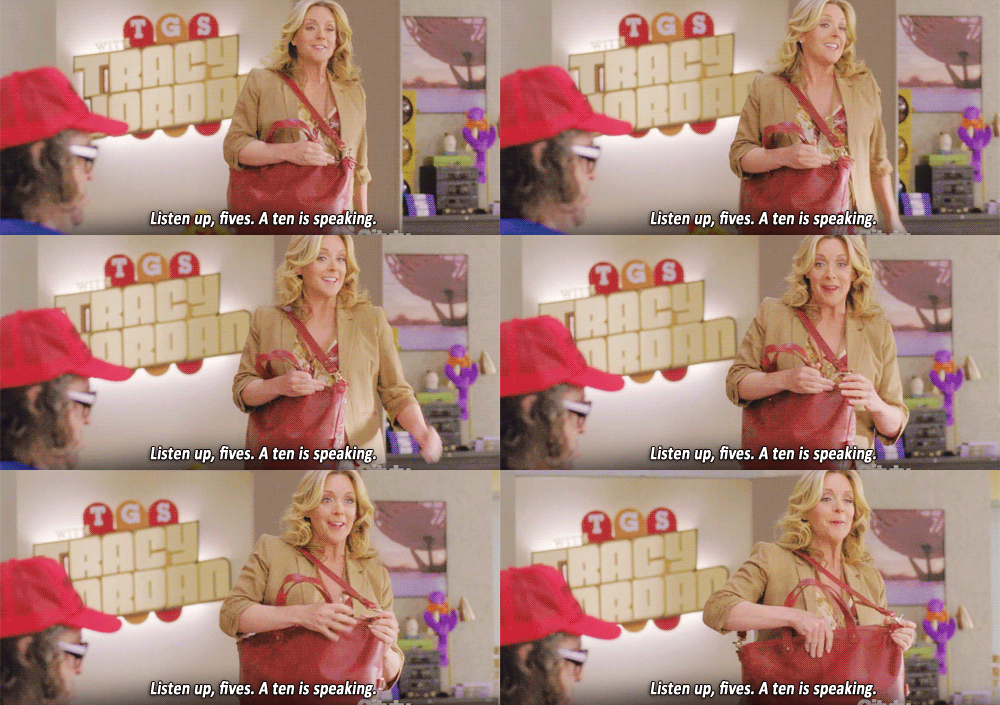
Moiraine [pictured without her magic soothing glamour].
So most people lie in spite of the glamour, and others have a host of useless rumours, but the gist of it is that folks (including a gleeman) showed up by boat, there was evil magic trouble, and the boat left again just before the mob arrived. Nynaeve wonders aloud if this was Rand and company, because she is not Moiraine and therefore she must be wrong (they did not leave by boat). They eat at the same inn as Rand, and Moiraine does some psychometry to confirm they were there recently, while Lan sniffs around and announces there was a Fade as well. Nynaeve, showing again why she's actually a better person than everyone else, asks what Moiraine intends to do for Egwene, whom she never mentions in spite of Egwene supposedly being a potential superwizard, and Moiraine basically says "Oh, yeah, her too, totally, right, like totally, but shit happens, you know?"
And... oh, that's the end of this chapter. It gave us another view of the White Bridge, and a recap of what happened last chapter, but with fewer details. How extraordinarily unnecessary.
Chapter Twenty-Nine: Eyes Without Pity
Back with Elyas, Perrin, and Egwene, they're making double-time across the grasslands, and Elyas is trying harder to cover the signs of their camps, but...
The fires he made were small, and always hidden in a pit carefully dug where he had cut away a plug of sod. As soon as their meal was prepared, he buried the coals and replaced the plug. Before they set out again in the gray false dawn, he went over the campsite inch by inch to make sure there was no sign that anyone had ever been there. He even righted overturned rocks and straightened bent-down weeds.Are you... are you serious? Bent-down weeds? Fact one: these are explicitly described as grasslands; you can't possibly erase all the footprints created by your teenage tagalongs. Fact two: weeds can bend on their own. Fact three: if you cut a fricking hole in the ground, anyone who's paying enough attention to notice a bent weed is going to notice the carved earth, even if you did slap it back in place like a peaty jigsaw puzzle afterwards.
We don't know what Elyas is afraid of chasing them--not trollocs, we're assured, partly because Perrin knows the wolves can't small trollocs. He throws this in casually, despite having sworn last chapter that he would never let the wolves inside his head again. I'm starting to feel like that last chapter was supposed to get edited out, since the dream-raven-in-the-eye and his vow against wolf telepathy have apparently been ditched this fast.
They just barely manage to (probably) not get spotted by a flock of a hundred ravens and Elyas mutters about places they can hide, noting that ravens roost at night. Apparently the devil can control ravens' every move (we saw the flock do an abrupt about-face) but can't order them to stay up past their bedtime. They do, however, demonstrate the scientific fact that ravens have the same jaw structure as piranhas, as they flock a fox and devour it in moments. A raven spots Perrin, but Egwene takes it down with her sling, which apparently means that it can't report back to the rest of the flock. I do not in any way understand the rules of the devil's raven telepathy. It can't be one-way only, or they'd make terrible scouts, but apparently it can't give the flock orders based on what that one raven spotted?
Perrin catches the wolves' thoughts as they skirmish with the flock, but the ravens give up after just injuring them a bit. Perrin reveals this, and apparently this is the first confirmation Egwene's had that he's got wolf telepathy, so there's all the usual 'oh no now she'll think I'm terrible and gross because I have innate magic' business, apparently forgetting that Egwene has already been marked as Future Best Wizard by Moiraine. They move on without addressing it. When Perrin calculates they have an hour before the second flock catches up with them, he decides not to tell Egwene, but he does wonder to himself if he'll "have the courage" to mercifully kill her first rather than let the ravens do it.
Perrin, you monstrous tool.
I mean can we just. He doesn't ask Elyas if there's any hope of finding shelter before then (their hiding spot is two hours off, apparently), or if he's got any other solutions or defences. He doesn't ask Egwene if she'd prefer a clean death if they know they're doomed, or if she'd rather fight to the last the way he apparently intends to do. He doesn't ask himself if he could stomach offing himself before the ravens get him either. This isn't a matter of grim mercy, this is a matter of a man seeing a woman as a subordinate object and himself as the one who has the responsibility to prevent her from being despoiled. Does anyone think there's the slightest chance Perrin would be puzzling this murder-suicide business over if he were with Rand or Mat? He sees Egwene as his lesser, incapable of bearing burdens or making difficult decisions, and above even her own life needing to be preserved in her pretty naive state. This is a thing that happens in the real world and it's horrifying. I can't actually think of an adequate obscenity or profanity to sum this up with.
(But he cries while he contemplates this, so we know he's really just scared and sensitive. Retch.)
And then, conveniently enough, they walk into the safe zone ahead of schedule: a 'stedding',a haven of legend, where the One Power doesn't work and no one can touch the True Source and there's a strict limit on the use of Significant Capitalisation. It's actually nicer inside the stedding, more green grass shoots, presumably because the devil doesn't have as much power to poison the land within.
Which... huh.
Remind me again why these places aren't incredibly important settlements where people build fortresses the forces of magic can never touch? Would a stedding not be an ideal community spot to keep all your male wizards in to prevent them from getting magic madness?
Anyway.
They get to a cold pool and drink deeply and Perrin decides to never talk to Egwene ever about his mercy-kill plan, though a voice (guessing the devil) in his head tells him he would have done it. There's actually some further taunting about that, about how easy or difficult it would have been, but none of it addresses the underlying misogyny that riled me in the first place, so whatever.
We get another history lesson, about how this place was going to be the capital of the empire of Artur Hawkwing, beloved king of legend who ruled most of the world under the law of Pax "I Have A Sword And No Conscience", i.e., criminals and tyrants got shanked right quick. He also hated magic, and thus no one could heal him of his final sickness/poisoning, and then his whole peaceful world crumbled as everyone fought for the throne. And apparently in the thousands of years that followed, no one else who hates magic ever decided to build here either. So that question remains unanswered.
Chapter Thirty: Children of Shadow
I wasn't planning to start on another chapter, but I scoped out the first couple of pages and PRAISE ERU ILUVATAR Elyas calls out the misogynistic stupidity of Perrin's mercy-kill plan.
"You were ready to kill her because you despise her, always dragging her feet, holding you back with her womanish ways. [....] If she had to choose her way of dying, which do you think she'd pick? [....] I know which I'd take."
"I don't have any right to choose for her."
Elyas [pictured after a shave and a mani/pedi].
I am honestly blown away that this was addressed at all, and not just a throwaway moment to show that Perrin was taking the situation seriously. I'm filled with so much less hatred right now. My venom glands aren't even a little swollen.
Of course, these are Manly Men, so when Perrin is filled with disgust just looking at his axe, thinking about throwing it away, Elyas tells him to keep it, use it against the people who actually need an axe in the face, and only throw it away if he ever feels like he is okay with casual murder. Can't get too soft.
[Edit: The more I thought about this after posting, the more I realised that, in the complete context of the scene, it's much more likely that Elyas is being ironic when he says 'you were ready to kill her because you hate her' in order to shake Perrin into realising that he doesn't hate Egwene and his mercy-kill plan was a completely blameless scheme of generosity, not a terrible thing at all. BUT I CAN'T DEAL WITH THAT RIGHT NOW so I'm going to allow the above to stand.]
And that is where I will leave it for this week, because then we get into more stuff with how nowhere is safe and Jordan has the gall to kill off Hopper the bouncy wolf. Note to my readers: if you ever feature a bouncy wolf in your stories, don't kill it off. Make it the backup protagonist.
Sunday, November 10, 2013
Ender's Game, introduction, in which we contemplate empathy
One last Ender's Game post. Think of it as the bonus scene after the credits. Most of y'all have expressed a wish to see Speaker next rather than Shadow, and thanks to a friend oft called Mad Scientist Alex, I will have my hands on a copy of Speaker next weekend without letting Card have any more cash. Not sure how much I'll actually manage to get done, what with Erika getting married next Saturday (and her continued efforts to hook me up with one of her friends just because she thinks it would be funny), but I shall try to get something started.
Card then goes over his thought processes in creating the battleroom, which he states will clearly be used in real military training some day if there is "a manned military in space", leading me to wonder why it's in use in Battle School when they don't seem to have any use for footsoldiers. He pauses to tell us all how unbearably boring archaeology is (sorry, Alex) before summarising the rise of his writing career in plays and short stories, leading to the publication of Ender's Game as the unexpectedly-improved retroactive backstory for the story he really wanted to tell, Speaker for the Dead.
It's not hard to find a record of how incredibly popular Ender's Game is. Card recognises that there are some people who also hate the book--the degree of hatred astonished him. As noted before, he says he expected some of it because, while he wrote in 'layers of meaning' for anyone who cared to analyse them, he also made it as accessible a book as he knew how, and thus those ivory-tower snobs felt that it was crude and were terrified of literature that didn't need them. Et cetera.
Also, I think there might be a difference between saying 'my son loved this book but I hated it' and 'hey everyone my son has terrible taste in books', and Card's inability or unwillingness to consider this might say something about the objectivity of aesthetics in his views.
And just maybe it's a good thing if we grow up and we stop thinking of ourselves as the forever-shunned unmatched genius on whom everyone is counting to save the entire world because they're all so inept and they need us even though they hate us. Yes, kids need someone to identify with, and maybe that means they need to identify with someone who has the same misconceptions they do. That's not something to be ashamed of. But I wonder how much people remember that the ultimate secret of Ender's Game is that everyone was wrong the whole time, they were saving the world from a threat that didn't really exist, and they were so focused on their own egos and their imagined victories that they hurt and killed other children along the way.
Maybe sometimes people pity Ender, not because they don't understand him, but because they know what's coming when he gets some perspective.
There is a second letter excerpted, from an army helicopter pilot in Saudi Arabia, written during the first days of aerial assault in the Gulf War. Ender's exhaustion in the book resonated with his own experiences in training and gave him inspiration to keep going. He tells Card of their conditions, of the way outdated equipment keeps betraying them and people die from stupid mistakes, and suggests that maybe Card and his other favourite military author, John Steakley, could collaborate on a story of helicopter pilots of the near future.
Card goes on to tell us what this means--that this aviator did not read the book as a scare-quotes "work of literature" but "as epic, as a story that helped define his community", which... is not actually something the guy says in the portion of the letter that gets excerpted. Hm. Anyway, Card sees this as the man hoping for "a 'speaker for the dead' and for the living". Author as eulogist. It's an interesting idea, at least.
Card dismisses the idea that we read fiction "to be impressed by somebody's dazzling language--or at least I hope that's not our reason", because apparently fuck Shakespeare. (This might explain why he was apparently unconcerned about the atrocities he visited upon the play Hamlet in his inconceivably homophobic fanfic, which is so incredibly disgusting that I will not link to anything about it and I advise no one to google it. If it's too late for that, then you know what I mean.) Anyway, he starts waxing on the mythic truth of fiction that allows us to identify "our own self-story" and then lists many examples of different people using Ender's Game as a text or subject for analysis in schools and papers and suchlike, which is a little funny after his earlier dismissal of angry lit profs who hated him for not writing something indecipherable.
Ender's Game: p. xi--xxvi
It's not really the point, but I'm kind of amused that Card opens the introduction by saying the first thing he wanted to do for the new hardcover edition of Ender's Game was to "fix the errors and internal contradictions and stylistic excesses that have bothered me ever since the novel first appeared", and I wonder if no one else has ever pointed out that, for example, Bonzo's timeline is complete nonsense. There, now we've got the pettiness out of the way.
Card says that Ender's Game started with speculation fuelled by Asimov's Foundation series and trying to imagine what the future would be like if technology advanced but people mostly didn't, except for the few people "who, not through genetic change, but through learned skills, are able to understand and heal the minds of other people". Not sure what to make of that when there's such a huge undercurrent of 'breeding true' in Game which gets bumped up to literal genetic engineering in Shadow. The healing, I assume, doesn't refer to Game but to Speaker, because if it refers to anything in Game that is hilarious.
The military side of Game, Card explains, was largely drawn off Bruce Catton's "Army of the Potomac" trilogy, which involved the Union having a fantastic army but no general to match Lee until Grant, who lost so many soldiers but always made their deaths count.
It was because of Catton's history that I had stopped enjoying chess, and had to revise the rules of Risk in order to play it--I had come to understand something of war, and not just because of the conclusions Catton himself had reached. I found meanings of my own in that history.If you stop enjoying chess because you realise it bears no similarity to real war, I'm not sure you ever really understood the point of chess, or games in general. (Okay, I lied, the pettiness is not out of the way.) I will refrain from commenting on the meanings that Card drew from military history any more than I already have, which you may recall was when I pointed out that Card/Ender determined that the best soldiers are isolated, lonely, afraid, angry, and untrusting.
And even though I could not then have articulated what I understood of military leadership, I knew that I did understand it. I understood, at levels deeper than speech, how a great military leader imposes his will on his enemy, and makes his own army a willing extension of himself.This actually does match up okay with military modern theory as I understand it--the goal of combat as the Canadian Forces phrase it is 'to impose our will upon the enemy throughout their depth', basically meaning that the fighting is over once you are in such a good position that you can demand the enemy stop fighting. This is what they teach you in some of the very first officer leadership courses, so I'm not sure it's quite the level of numinous epiphany that Card is phrasing here, but I haven't read Catton, so I can't comment.
Card then goes over his thought processes in creating the battleroom, which he states will clearly be used in real military training some day if there is "a manned military in space", leading me to wonder why it's in use in Battle School when they don't seem to have any use for footsoldiers. He pauses to tell us all how unbearably boring archaeology is (sorry, Alex) before summarising the rise of his writing career in plays and short stories, leading to the publication of Ender's Game as the unexpectedly-improved retroactive backstory for the story he really wanted to tell, Speaker for the Dead.
It's not hard to find a record of how incredibly popular Ender's Game is. Card recognises that there are some people who also hate the book--the degree of hatred astonished him. As noted before, he says he expected some of it because, while he wrote in 'layers of meaning' for anyone who cared to analyse them, he also made it as accessible a book as he knew how, and thus those ivory-tower snobs felt that it was crude and were terrified of literature that didn't need them. Et cetera.
[...] A guidance counselor for gifted children reported that she had only picked up Ender's Game to read it because her son had kept telling her it was a wonderful book. She read it and loathed it. Of course, I wondered what kind of guidance counselor would hold her son's tastes up to public ridicule, but the criticism that left me most flabbergasted was her assertion that my depiction of gifted children was hopelessly unrealistic. They just don't talk like that, she said. They don't think like that.Card goes on to explain how Game scares people because it asserts that children are people and not just simplistic little monkeyfolk; how he is writing from his own sense that he has always been a complete person with fully developed thoughts and feelings. I agree that what changes in us is our ability to predict, to express ourselves and--I might argue most importantly--our ability to empathise with others. What's unrealistic about the children of Ender's Game to me isn't their complexity but their narrative convenience: the way Bonzo looks at Ender and on sight, without a word, knows that he has met a great and compassionate leader who will crush his dreams. The way Ender can be at school for a few months out of his seven years of life and suddenly not know what it means to 'just live' like an ordinary civilian. The way Graff (not a child, but no more realistic) can somehow know the perfect way to raise the perfect general despite apparently no one else approving or even recognising his strategies which have never worked before. There are reasons that these people don't feel like people to me, and none of them are Petra Arkanian using the word 'polyglot' at age nine.
Also, I think there might be a difference between saying 'my son loved this book but I hated it' and 'hey everyone my son has terrible taste in books', and Card's inability or unwillingness to consider this might say something about the objectivity of aesthetics in his views.
Because the book does ring true with the children who read it.He includes a letter from a girl named Ingrid on behalf of a dozen friends, all gifted teenagers at a two-week summer residential program at a university.
We are all in about the same position; we are very intellectually oriented and have found few people at home who share this trait. Hence, most of us are lonely, and have been since kindergarten. When teachers continually compliment you, your chances of "fitting in" are about nil.
All our lives we've unconsciously been living by the philosophy, "The only way to gain respect is doing so well you can't be ignored." [....] However, in choosing these paths, most of us have wound up satisfied in ourselves, but very lonely. [....]
You couldn't imagine the imapct your books had on us; we are the Enders of today. Almost everything written in Ender's Game and Speaker applied to each one of us on a very, very personal level. No, the situation isn't as drastic today, but all the feelings are there.I don't want to single these kids out--that would be stupid, millions of people have read this book and I think Card is not wrong when he says that the people who love it best are the people who feel that it is deeply personal, that they are Ender. Card also says that adults tend, not to identify with Ender, but to love or pity him. One option is that this is a matter only of condescension, but another is that people don't stay one way for their whole lives. As the popular wisdom goes, when we think about who we were a decade ago, most of us will agree, perhaps with reluctance, that we were bloody stupid. And all probability is that a decade from now, we'll look back on our current selves and think we were/are bloody stupid. This, in my opinion, is a good thing and vastly preferable to the alternative, that we never grow and improve.
And just maybe it's a good thing if we grow up and we stop thinking of ourselves as the forever-shunned unmatched genius on whom everyone is counting to save the entire world because they're all so inept and they need us even though they hate us. Yes, kids need someone to identify with, and maybe that means they need to identify with someone who has the same misconceptions they do. That's not something to be ashamed of. But I wonder how much people remember that the ultimate secret of Ender's Game is that everyone was wrong the whole time, they were saving the world from a threat that didn't really exist, and they were so focused on their own egos and their imagined victories that they hurt and killed other children along the way.
Maybe sometimes people pity Ender, not because they don't understand him, but because they know what's coming when he gets some perspective.
There is a second letter excerpted, from an army helicopter pilot in Saudi Arabia, written during the first days of aerial assault in the Gulf War. Ender's exhaustion in the book resonated with his own experiences in training and gave him inspiration to keep going. He tells Card of their conditions, of the way outdated equipment keeps betraying them and people die from stupid mistakes, and suggests that maybe Card and his other favourite military author, John Steakley, could collaborate on a story of helicopter pilots of the near future.
Card goes on to tell us what this means--that this aviator did not read the book as a scare-quotes "work of literature" but "as epic, as a story that helped define his community", which... is not actually something the guy says in the portion of the letter that gets excerpted. Hm. Anyway, Card sees this as the man hoping for "a 'speaker for the dead' and for the living". Author as eulogist. It's an interesting idea, at least.
Card dismisses the idea that we read fiction "to be impressed by somebody's dazzling language--or at least I hope that's not our reason", because apparently fuck Shakespeare. (This might explain why he was apparently unconcerned about the atrocities he visited upon the play Hamlet in his inconceivably homophobic fanfic, which is so incredibly disgusting that I will not link to anything about it and I advise no one to google it. If it's too late for that, then you know what I mean.) Anyway, he starts waxing on the mythic truth of fiction that allows us to identify "our own self-story" and then lists many examples of different people using Ender's Game as a text or subject for analysis in schools and papers and suchlike, which is a little funny after his earlier dismissal of angry lit profs who hated him for not writing something indecipherable.
All these uses are valid; all these readings of the book are "correct."YOU HEARD HIM HE SAID IT ENDER/ALAI IS CANON NO TAKEBACKS.
The story of Ender's Game is not this book, though it has that title emblazoned on it. The story is one that you and I will construct together in your memory. If the story means anything to you at all, then when you remember it afterward, think of it, not as something I created,but as something that we made together.This, ultimately, is actually what I hope for more than anything. Because this book is so very popular, and we have just spent eight months looking at all of the reasons that is terrifying, but "Ender's Game" as a cultural phenomenon isn't the words on the pages, it's the storystuff bouncing around inside millions of heads. And if those people are better than Card, then there's a chance they were in it for the lessons that it mostly doesn't teach, about remembering that communication can change everything and that trying to be someone's friend when no one else is willing just might be a small and vital step on the path to saving the world. Or destroying the world. Just... be careful with the world when you're making friends, I guess?
Sunday, October 27, 2013
Ender's Game, chapter fourteen, part two, in which the plan works perfectly
So there was no Ender post last weekend. That was a thing that didn't happen, because my brain was exhausted from a marathon tabletop RPG session the day before. My first attempt at GMing! It was good times. So, to make it all up to you, I'm going to blitz through the entire remainder of the chapter. This is because we are friends, and not because there are a lot of 'action' sequences in this part of the book that are really easy to skim over. It's time for the final campaign! It is time for the game to ender. End. Warning: incoming game.
(Content: sexism, self-harm, genocide apologetics. Fun content: trailers that lie, Bustopher Kobayashi.)
They start having a great time with the games now that they are reunited, and over the next three weeks of practices Ender gets to know everyone's skillset: Dink is great with orders but terrible at improvisation (despite having had years more command experience than Ender--remember, he was a commander even in Rat when he had his independent toon), Bean gets overwhelmed with large groups but shreds up with a small strike force (that will get retconned to bits in Shadow), and Alai is a master strategist almost equal to Ender (not that we've ever seen or ever will see proof of this, nor will it affect the plot at all; Ender suggests replacing himself with Alai at one point but Mazer shoots it down instantly by telling Ender to "be honest").
Ender and Mazer analyse the latest practice and observe that his team basically moves like a formic fleet now, their coordination is so perfect, but they still have independent thought and innovation. Go humanity. So now it's time for the next course of testing, in which they'll simulate an entire invasion campaign just like the one that's going to really happen when the fleet arrives. Mazer also takes a moment to tell Ender not to complain about how hard it is going to get, because he lost his wife to time-travel, which is a pretty good trump card. (Did she not want to come along? Did they think it was too expensive to send her too, ignoring as usual the possibility of compromising their own geniuses with crushing despair?)
The next morning, at 0340, Mazer rouses Ender from a dream of being vivisected and brain-scanned by the formics and takes him to his first campaign mission. They chatter about who'll take what ships (Alai, Petra, and Vlad share a carrier's complement of fighters) and Ender assigns Bean one fighter from each carrier, which echoes back to his Ridiculous Ops squad, but seems like a terrible idea to me in this kind of scenario. If he sees something that requires a ship from someone else's group, can't he just relay the command? What do squadrons get out of having one of their fighters inexplicably not under their own control?
The formics have a spherical formation with an obvious core ship that Ender realises they want him to believe is the queen. Ender ignores it and orders them to try to compress the formation, not telling his friends about Dr Device as they protest the weirdness, and then they sit back to watch as Alai's first shot devours the fleet in a chain reaction. Mazer explains that, for a proper campaign, they had to have one fight in which the formics didn't know what the humans could do, and they'll learn rapidly from now on. He then proceeds to critique their technique, and gets increasingly harsh--a harshness that Ender passes on to his team.
Ender starts having more nightmares, dreaming of the Giant's corpse shaped into a formic village, and child-faced wolves that hunt him, not just the obvious threats like Peter and Bonzo, but Alai and Valentine and Dink, but in his dreams he still kills them all in the river, sobbing as he does so. He accuses Mazer of cheating at programming the game, and feels like his dreams are being watched. This section is just randomly trippy on its own, but it's foreshadowing a bunch of stuff, which is sort of cool. It'd work better for me if more of the stuff it was foreshadowing was in this book and not the sequels, but this is what happens when a standalone novel gets drafted into becoming backstory for an unrelated series.
It finally occurs to Ender that all this psychological stress might be affecting his brilliance, but the first big burnout is Petra, and the contrast between the way it's described here and the way it will be in Shadow is interesting. In Shadow she literally blacks out in the middle of a battle because eleven-year-old children are mortal; here she just makes a stupid maneuver, "and she discovered it in a moment when Ender wasn't with her" and gets shot up. When Ender does notice, he immediately tosses command of the surviving ships to Tom and has to salvage the battle because Petra's forces were the core of his strategy.
Ender's stress continues to mount; he chews his hand in his sleep until it has to be treated by a medic, and starts getting ideas like thinking that any prior candidate who washed out died--he doesn't say whether he thinks they get executed or if they just wasted away or what, but Mazer assures him this is ridiculous and he's perfectly safe.
And then one day he wakes up and no one's there to shepherd him around, but he can't think of anything he could do other than eat breakfast and go to practice. There are other people in the simulator room, but he doesn't ask; Mazer explains that today is his final exam and these are the evaluators. Mazer adds that to switch things up, the test battle will occur around a planet, and Ender lists a few effects (gravity changing fuel costs):
 Humans are raised on vids of terror; one of the famous incidents of the First Invasion was the Scouring of China; suddenly they only ever struck purely military installations?! If they weren't slaughtering civilians, ever, why is the military so convinced this is a war of extermination? How does this not raise any questions in anyone's minds?
Ender runs through some warm-ups with his team and muses on what training will be left for him between today and the war.
Ender once said that all Bonzo knew how to do was fail with style.
In three seconds, the planet is gone and the fleets as well, with only a few human ships surviving at the edge of the system.
So here, in full, is the defence of this entire book.
Anyway, just as Peter and Valentine predicted, Earth has erupted into war. The Russian soldiers aboard Eros are leading an attack, and so Ender is locked down under guard. He dreams, has nightmares of the Giant's Drink again and of the End of the World, where he watches the formic homeworld burst and sees the Queen except it's his mom and her children are his friends and a dying formic is Bonzo accusing him of having no honor and his reflection is Peter. And at last he wakes up and Alai is there in his room, and there was much rejoicing.
They joke about what they'll do next, and how they'll probably be forced to go to school until they're 17 because it's the law, and the chapter has the chutzpah to give us an Everybody Laughs Ending after slaughtering an entire species. But at least they were a species of monsters! And the people we like are alive! And if you talk to enough fans of Ender's Game, you'll find that some people stop here, because they aggressively miss the point. The graphic novel stops here. I'll be curious to see if the movie stops here. There's one more chapter to go, and it's not easy, but it's the only chance this book has at redemption. Next week: everything is terrible forever.
(Content: sexism, self-harm, genocide apologetics. Fun content: trailers that lie, Bustopher Kobayashi.)
Ender's Game: p. 273--304
Ender gets to the game room and the controls are gone, replaced with a switchboard. He'll be playing as commander from now on, with a team of lieutenants, who speak as soon as he puts on the headphones:
"Salaam," said a whisper in his ears.
"Alai," said Ender.
"And me, the dwarf."
"Bean."
And Petra, and Dink; Crazy Tom, Shen, Hot Soup, Fly Molo, Carn Carby, all the best students Ender had fought with or fought against, everyone that Ender had trusted in Battle School.And the scarecrow and the tin man and so forth. We're told there are three dozen of them in total, despite Card having run out of recognisable names after nine of them. A couple more names will come up over the course of the chapter, and Ender's Shadow. Vlad. Who was Vlad? I feel like I would have remembered a Vlad. Still, twenty-six more unnamed heroes helping save the world! I'm just going to assume at least one of them is named Bustopher Kobayashi. If Card didn't want this to happen, he should have said there was only a team of a dozen. Was he afraid Ender wouldn't seem special enough if his elite team was too elite? Also, they made a huge deal about bringing Ender to Eros, but nine months later they ship in thirty-six more kids like it's no big thing? And it's not like they're all the ultimate geniuses--Shen's biggest on-page achievement so far is refusing to let catcalls get to him a few years ago. Is it just narrative convenience that Battle School's greatest students are all Ender's best friends, or are they giving him his friends regardless of their skill level? The latter is sort of plausible, but it will fail utterly in short order.
They start having a great time with the games now that they are reunited, and over the next three weeks of practices Ender gets to know everyone's skillset: Dink is great with orders but terrible at improvisation (despite having had years more command experience than Ender--remember, he was a commander even in Rat when he had his independent toon), Bean gets overwhelmed with large groups but shreds up with a small strike force (that will get retconned to bits in Shadow), and Alai is a master strategist almost equal to Ender (not that we've ever seen or ever will see proof of this, nor will it affect the plot at all; Ender suggests replacing himself with Alai at one point but Mazer shoots it down instantly by telling Ender to "be honest").
Ender and Mazer analyse the latest practice and observe that his team basically moves like a formic fleet now, their coordination is so perfect, but they still have independent thought and innovation. Go humanity. So now it's time for the next course of testing, in which they'll simulate an entire invasion campaign just like the one that's going to really happen when the fleet arrives. Mazer also takes a moment to tell Ender not to complain about how hard it is going to get, because he lost his wife to time-travel, which is a pretty good trump card. (Did she not want to come along? Did they think it was too expensive to send her too, ignoring as usual the possibility of compromising their own geniuses with crushing despair?)
The next morning, at 0340, Mazer rouses Ender from a dream of being vivisected and brain-scanned by the formics and takes him to his first campaign mission. They chatter about who'll take what ships (Alai, Petra, and Vlad share a carrier's complement of fighters) and Ender assigns Bean one fighter from each carrier, which echoes back to his Ridiculous Ops squad, but seems like a terrible idea to me in this kind of scenario. If he sees something that requires a ship from someone else's group, can't he just relay the command? What do squadrons get out of having one of their fighters inexplicably not under their own control?
The formics have a spherical formation with an obvious core ship that Ender realises they want him to believe is the queen. Ender ignores it and orders them to try to compress the formation, not telling his friends about Dr Device as they protest the weirdness, and then they sit back to watch as Alai's first shot devours the fleet in a chain reaction. Mazer explains that, for a proper campaign, they had to have one fight in which the formics didn't know what the humans could do, and they'll learn rapidly from now on. He then proceeds to critique their technique, and gets increasingly harsh--a harshness that Ender passes on to his team.
"You're too kind to us," said Alai one day. "Why don't you get annoyed with us for not being brilliant every moment of every practice. If you keep coddling us like this we'll think you like us."
Some of the others laughed into their microphones. Ender recognized the irony, of course, and answered with a long silence. When he finally spoke, he ignored Alai's complaint. "Again," he said, "and this time without self-pity." They did it again, and did it right.Their friendship withers, their trust in Ender as a commander grows, and somehow Ender knows that "it was to each other that they became close; it was with each other that they exchanged confidences", even though he never talks to them outside of game time or sees them in person at all. Obviously, this makes them all even more effective soldiers, because the Enderverse runs on the Omelas principle and making people sad and wounded always makes everything around them better. I bet whichever general thought they should supply Ender with his friends instead of all their assorted best students is feeling kind of stupid now.
Ender starts having more nightmares, dreaming of the Giant's corpse shaped into a formic village, and child-faced wolves that hunt him, not just the obvious threats like Peter and Bonzo, but Alai and Valentine and Dink, but in his dreams he still kills them all in the river, sobbing as he does so. He accuses Mazer of cheating at programming the game, and feels like his dreams are being watched. This section is just randomly trippy on its own, but it's foreshadowing a bunch of stuff, which is sort of cool. It'd work better for me if more of the stuff it was foreshadowing was in this book and not the sequels, but this is what happens when a standalone novel gets drafted into becoming backstory for an unrelated series.
It finally occurs to Ender that all this psychological stress might be affecting his brilliance, but the first big burnout is Petra, and the contrast between the way it's described here and the way it will be in Shadow is interesting. In Shadow she literally blacks out in the middle of a battle because eleven-year-old children are mortal; here she just makes a stupid maneuver, "and she discovered it in a moment when Ender wasn't with her" and gets shot up. When Ender does notice, he immediately tosses command of the surviving ships to Tom and has to salvage the battle because Petra's forces were the core of his strategy.
Ender knew at once that he had pushed her too hard--because of her brilliance he had called on her to play far more often and under much more demanding circumstances that all but a few of the others.So, I'm mixed on this. Petra falters because she's been pushed too hard, and she's been pushed too hard because she's too awesome not to use, but "a few of the others" like Bustopher Kobayashi have been even pushed harder and they're apparently doing fine. Ender's pushing himself even harder and he still reacts as perfectly as he can, because Petra needs handholding through emergencies? Shen saves the day with a perfect Dr Device shot that eats a swarm of the enemy, and Fly Molo mops up.
She was not there for the next few practices, and when she did come back she was not as quick as she had been, not as daring. Much of what had made her a good commander was lost. Ender couldn't use her anymore, except in routine, closely supervised assignments. She was no fool. She knew what had happened. [....] The fact remained that she had broken, and she was far from being the weakest of his squad leaders.I try not to link to TVtropes very often, but this is just such a flawless Faux Action Girl scenario. Petra, we're told, is totally hardcore and badass and brilliant. She also fails, utterly, and never recovers, and is the only girl we're aware of in the entire group. If you believe what the narrative tells you, then there's nothing wrong with this because Petra is so strong. If you consider the narrative unreliable for two seconds, Petra has been just barely not good enough for the entire book and of course the girl needs her hand held through everything. This comment thread also has some good previous discussion, if you missed it.
Ender's stress continues to mount; he chews his hand in his sleep until it has to be treated by a medic, and starts getting ideas like thinking that any prior candidate who washed out died--he doesn't say whether he thinks they get executed or if they just wasted away or what, but Mazer assures him this is ridiculous and he's perfectly safe.
"I think that Bonzo died. I dreamed about it last night. I remember the way he looked after I jammed his face with my head. [....] My whole life keeps playing out as if I were a recorder and someone else wanted to watch the most terrible parts of my life."
"We can't drug you if that's what you're hoping for. I'm sorry if you have bad dreams. Should we leave the light on at night?"
"Don't make fun of me!" Ender said. "I think I'm going crazy."But Mazer remains unsympathetic and so Ender resolves not to tell him about this ever again, and continues to weaken. The battles get worse, longer, he has to rotate commanders in the same battle, then one day Ender blacks out in the middle of practice and is confined to bed for three days, then back to battles every day.
During the night he thought he felt hands touching him gently. Hands with affection in them, and gentleness. He dreamed he heard voices.
"You haven't been kind to him."
"That wasn't the assignment."
"How long can he go on? He's breaking down."
"Long enough. It's nearly finished." [....]
"I can't bear to see what this is doing to him." [...]
"I know. I love him too."So here we have Mazer and Graff acting as audience surrogates to be ineffectually kind to Ender. Of course this kindness takes the form of unsolicited touching and invading his privacy at night, because that is how these jackwagons roll. Ender thinks he's dreaming it: "If there was love or pity for him, it was only in his dreams. He woke up and fought another battle and won. Then he went to bed and slept again and dreamed again and then he woke up and won again and slept again and he hardly noticed when waking became sleeping".
And then one day he wakes up and no one's there to shepherd him around, but he can't think of anything he could do other than eat breakfast and go to practice. There are other people in the simulator room, but he doesn't ask; Mazer explains that today is his final exam and these are the evaluators. Mazer adds that to switch things up, the test battle will occur around a planet, and Ender lists a few effects (gravity changing fuel costs):
"Does the Little Doctor work against a planet?"
Mazer's face went rigid. "Ender, the buggers never deliberately attacked a civilian population in either invasion. You decide whether it would be wise to adopt a strategy that would invite reprisals."

Ender runs through some warm-ups with his team and muses on what training will be left for him between today and the war.
And as he waited for the game to appear, he wished he could simply lose it, lose the battle badly and completely so that they would remove him from training, like Bonzo, and let him go home. [....] Failure meant he could go home.Then the battle appears: ten thousand formic ships swarming around a planet, constantly shifting through random patterns, versus his own twenty old-model carriers with eighty fighters. Ender hears his team breathing heavily over their microphones (hot) and one of the evaluators swears behind him. They start to shift nervously as they realise how unevenly matched it is.
Ender once said that all Bonzo knew how to do was fail with style.
"Remember, the enemy's gate is down."Bean says that, and they all laugh. Ender decides to remember that it's just a game and so to pursue a strategy that breaks Mazer's rules. He won his last game in the battleroom by ignoring the armies and going for the gate. ender decides that if he goes for the war crime, they'll consider him too dangerous to put in command, "and that is victory". He orders the ships into a 'thick cylinder', to better penetrate the enemy formation, and the enemy happily engulfs him. Supply your own subtext. Ender's ships fly in seemingly random patterns, then at a word they burst in all directions, firing madly, then at another a dozen fighters form up on the far side of the enemy fleet and dive for the planet. The formics cut off his escape, but he doesn't care anyway, because the only point is to get close enough to fire on the planet.
In three seconds, the planet is gone and the fleets as well, with only a few human ships surviving at the edge of the system.
Ender took off his headphones, filled with the cheers of his squadron leaders, and only then realized that there was just as much noise in the room with him. Men in uniform were hugging each other, laughing, shouting; others were weeping; some knelt or lay prostrate, and Ender knew they were caught up in prayer. Ender didn't understand. It seemed all wrong. They were supposed to be angry.Graff and Mazer embrace him and thank him, tell him how proud they are. Ender remains confused until Mazer explains that the entire campaign up to this point wasn't testing, but the actual campaign, humans versus formics, and Ender has just won the war forever by destroying all their queens and committing xenocide. Ender walks out of the room, ignoring everyone, back to his room, strips down [drink!] and gets into bed. He wakes up to find Graff and Mazer in the room, informing him that Earth has heard what happened and every government in the world has given him their highest medal.
So here, in full, is the defence of this entire book.
Ender grabbed Mazer's uniform and hung onto it, pulling him down so they were face to face. "I didn't want to kill them all. I didn't want to kill anybody! I'm not a killer! You didn't want me, you bastards, you wanted Peter, but you made me do it, you tricked me into it!" He was crying. He was out of control.
"Of course we tricked you into it. That's the whole point," said Graff. "It had to be a trick or you couldn't have done it. It's the bind we were in. We had to have a commander with so much empathy that he would think like the buggers, understand them and anticipate them. So much compassion that he could win the love of his underlings and work with them like a perfect machine, as perfect as the buggers. But somebody with that much compassion could never be the killer we needed. Could never go into battle willing to win at all costs. If you knew, you couldn't do it. If you were the kind of person who would do it even if you knew, you could never have understood the buggers well enough."I don't know what to say to this that I haven't said before. Ender's big thing at Eros has been lack of compassion, has been his refusal to be any kinder to his subordinates than Mazer has been to him. If he had been given a raft of brilliant lieutenants who had never met him before, they'd have quite reasonably hated him even if he was a genius. He's running on the love that he supposedly earned from them back when he was in Battle School. Maybe that's why they shipped in Bean and Dink and Bustopher, so that Ender would have subordinates who would put up with his hardassedness. 'Compassion' as a superweapon would also have worked better if it were clear how it actually affected Ender's strategy--it's been a long time since he needed to, for example, identify a queen in an enemy fleet.
"And it had to be a child, Ender," said Mazer. "You were faster than me. Better than me. I was too old and cautious. Any decent person who knows what warfare is can never go into battle with a whole heart. But you didn't know. We made sure you didn't know."Well, apparently any decent person except the ones who plan the campaign, deploy fighters, and pull the trigger to destroy a civilisation. Who planned this war? I mean, the ships have been in flight for seventy years and they successfully scheduled them all to arrive over the course of, what, two, three weeks? Just to maximise the possible burnout of their tacticians? The formic worlds are light-years apart and communications are instant, so there's no actual tactical value in hitting everywhere at once; they can't reinforce each other world-to-world. The battles could have been spread out over months to the same effect. Don't generals like Ender normally have some say in the way the war proceeds and not just individual firefights? What was the entire invasion fleet for, anyway? Wouldn't ansible-equipped drones have been about a jillion times more effective, what with being able to survive much greater physical stresses and save room/weight on life support? That way those could also have been piloted by genius children who think they're playing a video game. Has Earth ever had a competent Polemarch or Strategos or whoever planned this gong show? (Actually, it turns out Mazer plotted the campaign. Graff reprimands him for not leaving the minor outposts for later. Mazer tells him to screw off.)
Anyway, just as Peter and Valentine predicted, Earth has erupted into war. The Russian soldiers aboard Eros are leading an attack, and so Ender is locked down under guard. He dreams, has nightmares of the Giant's Drink again and of the End of the World, where he watches the formic homeworld burst and sees the Queen except it's his mom and her children are his friends and a dying formic is Bonzo accusing him of having no honor and his reflection is Peter. And at last he wakes up and Alai is there in his room, and there was much rejoicing.
"Some of the Russians who came in told us that when the Polemarch ordered them to find you and kill you, they almost killed him. [....] There's a million soldiers who'd follow you to the end of the universe."Ender just wants to go home--good luck with that. The war ends, the lights come on, and Bean enters the room, followed by Bustopher, and Petra and Dink holding hands because of course she needs a man. They further explain the terms of the peace, stuff that won't be relevant until the second Shadow book. The banter is mostly pretty sweet and realistic. And maybe others don't read it the same way, but recalling what Dink taught Ender while naked in the battleroom ages ago:
"You OK?" Petra asked him, touching his head. "You scared us. They said you were crazy, and we said they were crazy."
"I'm crazy," said Ender. "But I think I'm OK."I could be wrong, but I'm pretty sure that the message that mental illness is not shameful, not a mark or cause of evil, and not life-defining is the only consistent positive message in this entire book.
They joke about what they'll do next, and how they'll probably be forced to go to school until they're 17 because it's the law, and the chapter has the chutzpah to give us an Everybody Laughs Ending after slaughtering an entire species. But at least they were a species of monsters! And the people we like are alive! And if you talk to enough fans of Ender's Game, you'll find that some people stop here, because they aggressively miss the point. The graphic novel stops here. I'll be curious to see if the movie stops here. There's one more chapter to go, and it's not easy, but it's the only chance this book has at redemption. Next week: everything is terrible forever.
Sunday, June 23, 2013
Ender's Game, chapter seven, part one, in which we just don't understand Ender's FEELINGS
(Content: racism, abuse, disordered eating. Fun content: Camelot, Ben Folds, OSC being hilariously snobby about his writing.)
Welcome back! Before we get down to the next chapter, it turns out there is even more fascinating and intricate Wrong to discuss in regards to last chapter's festival of gratuitous racism. Y'all will recall that Chapter Six had Ender and his new black best friend bonding in a scene that inexplicably featured them laughing over racial slurs directed first by Alai at Shen (Ender's Chinese friend) and then by Ender at Alai. I was not sure what the deal was there, but thanks to Steve Morrison, we have Card's very own explanation at his website. I also checked the local bookstore's copies of Ender's Game, and can confirm that the new editions now have the exchange in question as thus:
Well, Alai is black. I don't know if we ever find out where he's from, but in the Ender's Shadow series, we'll meet him again living in the Middle East, where he is beloved by many but even still occasionally targeted with racial hatred. And that's when he's considered an incredibly holy and wise and compassionate leader. So I have this wild speculation that maybe, as a child with no such recognition, he was also targeted with even more racism than that. It's just a guess. And I have a further guess that Ender, as the white middle-class boy from the United States, did not suffer from racism. And yet, in order to emphasise how much wiser and more compassionate Our Hero is, we're going to have Ender teach Alai a Lesson About Race Relations, and he's going to do so by aggressively wielding the white privilege that puts him over Alai in the racism hierarchy.
God, I think I liked it better when I thought they were just supposed to be stupid kids using words with power they didn't comprehend.
Time to get into the new stuff. What fresh horrors await in the plane of disembodied voices?
Graff observes that Ender handled the situation with Bernard perfectly (as if he hadn't argued against giving Ender that chance) and intends to move him on to a new situation immediately. Graff's boss hangs a lampshade on these unrealistic children by observing that none of them act like little kids: "They aren't normal. They act like--history. Napoleon and Wellington. Caesar and Brutus." Is this weird to anyone else? I feel like this is Card trying to weasel out of his unchildlike children by telling-not-showing us that this is because they act like great generals of a bygone age. If Napoleon made as many fart jokes as these kids do, history has failed to record him as comprehensively as it should have.
One night at dinner, Alai tells Ender that he's finally figured out how Ender impersonated Bernard on the student messaging system, and explains that he's hacked the system enough to know that Ender has now built his own security system to protect himself. Alai wants Ender's security because he's just hacked another student for fun and fears that retaliation is imminent, and after a little needling, Ender agrees to help. Ender continues to be completely okay with electronic bullying, I guess. It's possible to read this scenario as Alai having a friendly hacking competition with a classmate, but it's hard to be sure.
Anyway, Ender can't help because his desk has been shut down and lockers permalocked, and Alai finds a transfer order on Ender's bed--he's been assigned to an army, despite only having been at Battle School for three months instead of the usual two or more years that kids spend in their 'launch' class.
Ender is upset, of course, on the verge of tears (more 'mustn't cry' stuff) but Alai pretends not to notice and jokes with him until he calms down, which is a reasonable good friend move. He hugs Alai, "almost as if he were Valentine", and talks about not wanting to go, but Alai states that they can all see Ender is the best and they want to teach him everything. Ender says he just "wanted to learn what it was like to have a friend", and Alai assures him they will always be friends.
Ender also knows nothing at all about Islam, enough so that he thinks it might be a secret religion. Maybe at this point in Card's mind it was--it's not until the Shadow books that we see they are one of the strongest and most numerous religions on Earth. Ender apparently never heard 'Salaam alaykum' growing up, since he was far too busy learning the rules of manly warfare (#12: Only one messianic/innocent killer child at a time).
Alai leaves. There's a bit of angst that Ender can't take anything that he owns, but he didn't bring any possessions up from Earth and we don't know of any that he's acquired on the school, so I'm not sure what that's supposed to mean, other than to emphasise again that the teachers are cold heartless beings. WE KNOW, CARD. I am less sure that Card knows.
Ender apparently has some time before he's got to report to his new group, Salamander Army. He goes to the game room and logs into the mind game again, and so it is time for metaphors. Lots of them. Ender starts out at the corpse of the Giant, which has now been pretty much picked clean and merged with the landscape, which frustrates him because he thinks it would help let off tension if he could kill it again now. Instead he wanders off, skips the path to the castle of the Queen of Hearts (apparently he's already spent a lot of time there) and finds himself in a playground instead, swings and slides and laughing children. The playground gear doesn't work for him (he falls through the slide, the merry-go-round throws him off) and the other kids laugh, so he wanders off into the woods and finds a well, but before he can climb in (like you do when you find a well in the woods) the children reappear, human faces on wolf bodies, and devour him. Ender realises that he can incapacitate them while they're all human by using the treacherous playground gear as traps, but they rise up again if he leaves them lying around too much, so he drags their broken bodies into the nearby stream, where they froth and dissolve.
None of this appears to bother him much, despite seeming quite as hideous to me as the attack on the Giant, nor did his earlier remark about killing a rat with a giant pin because it creeped him out to see it chewing on the Giant's corpse. Maybe the Giant was supposed to be unsettling because it represented Ender's loss of innocence and transition to being a perpetrator of violence, except: Stilson. Gah, everything in this book would make so much more sense without Stilson. I could buy Ender as basically peaceful, and the Battle School teachers as breaking a sweet kid to make him effectively violent, and Peter as Ender's best reference point for what brutality looks like. But Stilson screws all of that up. How did editors not see this?
I'd have critical things to say about the way Ender so easily figures out how to deal with the wolfchildren, dragging them into the river to destroy their bodies and all, but this is 'the mind game' and the important thing, from the designers' point of view, is that they see Ender's brain work, so it makes some sense if the game is making up the rules on the fly based on what makes sense to Ender, like a semi-independent dream. So I see it less as Ender guessing right on the first try how to destroy the bodies, and more the game saying "Eh, cool enough, let's go with that".
Under the well he finds caverns full of more games that he passes--figures hidden in the shadows of a treasury; a menagerie of playful animals--but he wants to see what's at the end, and after a long time finds a door: The End Of The World. It leads to another fantastical landscape, green forests and farmers' fields and a distant castle and a sky that is just one vast jewel-encrusted cavern roof, so Ender decides to leap off a cliff because... hell if I know; the point is that a cloud catches him and sweeps him away to a tower with no doors, where the rug in front of the fireplace turns into a snake:
To recap: having reached the promised land by killing the thing no one ever thought to kill before, Ender grows bored with the normal games and instead explores, but is beset by things that pretend to be harmless children but are actually monsters, and so is forced to slaughter them by using his vast intellect, and the laws of the universe bend to ensure that he is brought to the final inescapable conflict at the end of the world.
Remember all the way back at the beginning when Card said that "I deliberately avoided all the little literary games and gimmicks that make 'fine' writing so impenetrable to the general audience [....] Since a great many writers and critics have based their entire careers on the premise that anything that the general public can understand without mediation is worthless drivel, it is not surprised that they found my little novel to be despicable"? We can confirm that he wasn't kidding. But I'm not sure what the narrative value is supposed to rise from barely-veiled analogies that remove all nuance and ambiguity from the story, either.
Ender angrily switches off his computer and goes off to meet his commander, musing on how he might escape the tower and get down into the fields:
What does he mean, he's never been 'just living' in his life? He's not quite seven years old. He has spent all but the last three months of his life living at home with his parents and siblings, playing and going to school and dealing with normal people problems like bullies. There's a bit of extra stress in that he's always known he might be taken to this school to become a soldier, but the threat of alien invasion looms over every human right now.
Ender's getting badly treated, yes, and I sympathise with him, but this 'woe is me for I am special' nonsense infuriates me, because it's the exact opposite of empathy--it's founded in the ideas that other people's lives are as simple on the inside as they look at first glance as a random bystander, that other people don't have pain and problems like you do, that they can't understand your anguish, that they are scenery and you're the main character. This wish is founded in the exact opposite of the compassion that is supposed to be Ender's greatest strength.
The chapters start getting long at this point, so we will cut off here for now--come back Thursday for the next Fifty Shades post (it's so close to being over!) and look forward to the second half of this chapter, in which we finally meet Petra The Exceptional Girl! (Petra will be fun. Everything else will be terrible.)
---
*My views on holiness are perhaps best expressed by the golem Dorfl in Terry Pratchett's Feet of Clay, when he is asked about holidays and says: "Either All Days Are Holy Or None Are. I Have Not Decided Yet." Dorfl also makes the argument that atheists think about the gods constantly, in the form of denial, and therefore should count as religious, but give him a break, it's his first day. Also, on his world, the gods absolutely do exist. So he's in a bit of a bind.
**That version of the song ends in a weird way. In the original, the dancing fails to impact them at all and she asks again, and he says "They sit around and wonder what royal folk would do", and that is when he delivers the line "I have it on the best authority", since he used to be a commoner. Which gets at the point better, I think--there is no actual difference on either side, because they all have the same problems. Hmph.
Welcome back! Before we get down to the next chapter, it turns out there is even more fascinating and intricate Wrong to discuss in regards to last chapter's festival of gratuitous racism. Y'all will recall that Chapter Six had Ender and his new black best friend bonding in a scene that inexplicably featured them laughing over racial slurs directed first by Alai at Shen (Ender's Chinese friend) and then by Ender at Alai. I was not sure what the deal was there, but thanks to Steve Morrison, we have Card's very own explanation at his website. I also checked the local bookstore's copies of Ender's Game, and can confirm that the new editions now have the exchange in question as thus:
They grinned. Then Ender said "Better invite Bernard."
Alai cocked an eyebrow. "Oh?"
"And Shen.""That little butt-wiggler?"
Ender decided that Alai was joking. "If you didn't hold yours so tight it would wiggle, too."
Alai grinned. "Let's go get Bernard and Shen and freeze these bugger-lovers."Card made this change himself, voluntarily, but if you click through to his website you'll find he was swift to assure readers that he was not caving to special interests or aiming to be politically correct (he has only scorn for "the prudes") or any of those soppy damnable liberal things. He just accepted that he had failed to write the passage well, because it was giving readers the impression that Ender and Alai might actually be racist, which OF COURSE THEY ARE NOT THAT IS SILLY. What Card intended to show was that Alai was trying to be funny through racism (as so many people do) and Ender was telling him not to do that. Which is something I am in favour of! So what problem do I have with this now, aside from the flaw Card has already admitted (that it was distractingly clunky)?
Well, Alai is black. I don't know if we ever find out where he's from, but in the Ender's Shadow series, we'll meet him again living in the Middle East, where he is beloved by many but even still occasionally targeted with racial hatred. And that's when he's considered an incredibly holy and wise and compassionate leader. So I have this wild speculation that maybe, as a child with no such recognition, he was also targeted with even more racism than that. It's just a guess. And I have a further guess that Ender, as the white middle-class boy from the United States, did not suffer from racism. And yet, in order to emphasise how much wiser and more compassionate Our Hero is, we're going to have Ender teach Alai a Lesson About Race Relations, and he's going to do so by aggressively wielding the white privilege that puts him over Alai in the racism hierarchy.
God, I think I liked it better when I thought they were just supposed to be stupid kids using words with power they didn't comprehend.
Time to get into the new stuff. What fresh horrors await in the plane of disembodied voices?
Ender's Game, p. 66--74
Chapter Seven: Salamander
"The player's deaths have always been sickening, I've always thought the Giant's Drink was the most perverted part of the whole mind game, but going for the eye like that--this is the one we want to put in command of our fleet?"YOU BOTH KNOW ENDER MURDERED A CHILD ON THE PLAYGROUND FOR PUSHING HIM. PRIORITIES; HOW THE FUCK DO THEY WORK?!
Graff observes that Ender handled the situation with Bernard perfectly (as if he hadn't argued against giving Ender that chance) and intends to move him on to a new situation immediately. Graff's boss hangs a lampshade on these unrealistic children by observing that none of them act like little kids: "They aren't normal. They act like--history. Napoleon and Wellington. Caesar and Brutus." Is this weird to anyone else? I feel like this is Card trying to weasel out of his unchildlike children by telling-not-showing us that this is because they act like great generals of a bygone age. If Napoleon made as many fart jokes as these kids do, history has failed to record him as comprehensively as it should have.
"General Levy has no pity for anyone. All the videos say so. But don't hurt this boy."
"Are you joking?"
"I mean, don't hurt him more than you have to."I feel like the only possible way of capping these intro bits is with Graff and his boss doing an Everybody Laughs Ending into a freeze-frame. Just to let the sociopathy sink in. (Unrelated, I'm pretty sure we'll never meet 'General Levy', but we will learn later on that in this futuristic society, 'brilliant military strategist' is now a Jewish stereotype. Uh, yay for positive discrimination?)
One night at dinner, Alai tells Ender that he's finally figured out how Ender impersonated Bernard on the student messaging system, and explains that he's hacked the system enough to know that Ender has now built his own security system to protect himself. Alai wants Ender's security because he's just hacked another student for fun and fears that retaliation is imminent, and after a little needling, Ender agrees to help. Ender continues to be completely okay with electronic bullying, I guess. It's possible to read this scenario as Alai having a friendly hacking competition with a classmate, but it's hard to be sure.
Ender laughed. "I'll set up a system for you."
"Now?"
"Can I finish eating?"
"You never finish eating."
It was true. Ender's tray always had food on it after a meal. Ender looked at the plate and decided he was through.This isn't much of a recurring theme for Ender specifically, but it's a recurring theme in Battle School--Bean will also have ongoing issues with the approved nutritional allotments and feeling like the school is trying to overfeed him. I don't know what this is supposed to signify, other than that authorities are trying to stuff them with more than they can take in every way, and/or that Our Heroes are all skinny kids with possible indicators of disordered eating. (Well, Bean pretty clearly has disordered eating, but that's not surprising.) I had forgotten what these books are like about food and fat--just wait until we start seeing the toll of the stress on Graff, who apparently 'self-medicates' with extra food. Sigh. It's like Twilight up in here.
Anyway, Ender can't help because his desk has been shut down and lockers permalocked, and Alai finds a transfer order on Ender's bed--he's been assigned to an army, despite only having been at Battle School for three months instead of the usual two or more years that kids spend in their 'launch' class.
Ender is upset, of course, on the verge of tears (more 'mustn't cry' stuff) but Alai pretends not to notice and jokes with him until he calms down, which is a reasonable good friend move. He hugs Alai, "almost as if he were Valentine", and talks about not wanting to go, but Alai states that they can all see Ender is the best and they want to teach him everything. Ender says he just "wanted to learn what it was like to have a friend", and Alai assures him they will always be friends.
Alai suddenly kissed Ender on the cheek and whispered in his ear, "Salaam". Then,red-faced, he turned away and walked to his own bed at the back of the barracks. Ender guessed that the kiss and the word were somehow forbidden. A suppressed religion, perhaps. Or maybe the word had some private and powerful meaning for Alai alone. Whatever it meant to Alai, Ender knew that it was sacred; that he had uncovered himself for Ender, as once Ender's mother had done, when he was very young, before they put the monitor in his neck, and she had put her hands on his head when she thought he was asleep, and prayed over him. Ender had never spoken of that to anyone, not even to Mother, but had kept it as a memory of holiness, of how his mother loved him when she thought that no one, not ever he, could see or hear. That was what Alai had given him; a gift so sacred that even Ender could not be allowed to understand what it meant.I kind of hate to nitpick, because that is, to my mind, a fine turn of wordcraft right there. That's the way I hope my writing sounds, the flow of language and the careful tone. Unfortunately, none of this content makes sense. Ender has apparently been sheltered from religion his whole life (he didn't know that his parents were Mormon and Catholic, he didn't catch that they named their kids for saints), but other peoples' religions have tremendous impact on him, apparently? Not that this is an unusual thing for people like Card to presume about atheists, but it's really tiresome. I can appreciate the good intention if a religious person offers me a blessing, but that's all it means to me. I don't keep 'memories of holiness' and there's no clear reason Ender would either.* In particular, given that Ender is constantly being told things and made to do things that he can "not be allowed understand", which will include rather a lot of unnecessary killing, I wonder if this mystery is supposed to parallel those--Ender is thoroughly appreciative of not having to understand what other people think of him and do for him.
Ender also knows nothing at all about Islam, enough so that he thinks it might be a secret religion. Maybe at this point in Card's mind it was--it's not until the Shadow books that we see they are one of the strongest and most numerous religions on Earth. Ender apparently never heard 'Salaam alaykum' growing up, since he was far too busy learning the rules of manly warfare (#12: Only one messianic/innocent killer child at a time).
Alai leaves. There's a bit of angst that Ender can't take anything that he owns, but he didn't bring any possessions up from Earth and we don't know of any that he's acquired on the school, so I'm not sure what that's supposed to mean, other than to emphasise again that the teachers are cold heartless beings. WE KNOW, CARD. I am less sure that Card knows.
Ender apparently has some time before he's got to report to his new group, Salamander Army. He goes to the game room and logs into the mind game again, and so it is time for metaphors. Lots of them. Ender starts out at the corpse of the Giant, which has now been pretty much picked clean and merged with the landscape, which frustrates him because he thinks it would help let off tension if he could kill it again now. Instead he wanders off, skips the path to the castle of the Queen of Hearts (apparently he's already spent a lot of time there) and finds himself in a playground instead, swings and slides and laughing children. The playground gear doesn't work for him (he falls through the slide, the merry-go-round throws him off) and the other kids laugh, so he wanders off into the woods and finds a well, but before he can climb in (like you do when you find a well in the woods) the children reappear, human faces on wolf bodies, and devour him. Ender realises that he can incapacitate them while they're all human by using the treacherous playground gear as traps, but they rise up again if he leaves them lying around too much, so he drags their broken bodies into the nearby stream, where they froth and dissolve.
None of this appears to bother him much, despite seeming quite as hideous to me as the attack on the Giant, nor did his earlier remark about killing a rat with a giant pin because it creeped him out to see it chewing on the Giant's corpse. Maybe the Giant was supposed to be unsettling because it represented Ender's loss of innocence and transition to being a perpetrator of violence, except: Stilson. Gah, everything in this book would make so much more sense without Stilson. I could buy Ender as basically peaceful, and the Battle School teachers as breaking a sweet kid to make him effectively violent, and Peter as Ender's best reference point for what brutality looks like. But Stilson screws all of that up. How did editors not see this?
I'd have critical things to say about the way Ender so easily figures out how to deal with the wolfchildren, dragging them into the river to destroy their bodies and all, but this is 'the mind game' and the important thing, from the designers' point of view, is that they see Ender's brain work, so it makes some sense if the game is making up the rules on the fly based on what makes sense to Ender, like a semi-independent dream. So I see it less as Ender guessing right on the first try how to destroy the bodies, and more the game saying "Eh, cool enough, let's go with that".
Under the well he finds caverns full of more games that he passes--figures hidden in the shadows of a treasury; a menagerie of playful animals--but he wants to see what's at the end, and after a long time finds a door: The End Of The World. It leads to another fantastical landscape, green forests and farmers' fields and a distant castle and a sky that is just one vast jewel-encrusted cavern roof, so Ender decides to leap off a cliff because... hell if I know; the point is that a cloud catches him and sweeps him away to a tower with no doors, where the rug in front of the fireplace turns into a snake:
"I am your only escape," it said. "Death is your only escape."And then before Ender can do anything to repel it, the game stops itself and tells him that he's late to report to his new army.
To recap: having reached the promised land by killing the thing no one ever thought to kill before, Ender grows bored with the normal games and instead explores, but is beset by things that pretend to be harmless children but are actually monsters, and so is forced to slaughter them by using his vast intellect, and the laws of the universe bend to ensure that he is brought to the final inescapable conflict at the end of the world.
Remember all the way back at the beginning when Card said that "I deliberately avoided all the little literary games and gimmicks that make 'fine' writing so impenetrable to the general audience [....] Since a great many writers and critics have based their entire careers on the premise that anything that the general public can understand without mediation is worthless drivel, it is not surprised that they found my little novel to be despicable"? We can confirm that he wasn't kidding. But I'm not sure what the narrative value is supposed to rise from barely-veiled analogies that remove all nuance and ambiguity from the story, either.
Ender angrily switches off his computer and goes off to meet his commander, musing on how he might escape the tower and get down into the fields:
Perhaps it's called the end of the world because it's the end of the games, because I can go to one of the villages and become one of the little boys working and playing there, with nothing to kill and nothing to kill me, just living there.
As he thought of it, though, he could not imagine what 'just living' might actually be. He had never done it in his life. But he wanted to do it anyway.Oh how Ender wishes he could just be one of the simple folk.** Y'all don't understand what it's like, being male, middle-class, white, and a spectacular genius brought into space to a school where every need is provided for and days are filled with infinite games.
What does he mean, he's never been 'just living' in his life? He's not quite seven years old. He has spent all but the last three months of his life living at home with his parents and siblings, playing and going to school and dealing with normal people problems like bullies. There's a bit of extra stress in that he's always known he might be taken to this school to become a soldier, but the threat of alien invasion looms over every human right now.
Ender's getting badly treated, yes, and I sympathise with him, but this 'woe is me for I am special' nonsense infuriates me, because it's the exact opposite of empathy--it's founded in the ideas that other people's lives are as simple on the inside as they look at first glance as a random bystander, that other people don't have pain and problems like you do, that they can't understand your anguish, that they are scenery and you're the main character. This wish is founded in the exact opposite of the compassion that is supposed to be Ender's greatest strength.
The chapters start getting long at this point, so we will cut off here for now--come back Thursday for the next Fifty Shades post (it's so close to being over!) and look forward to the second half of this chapter, in which we finally meet Petra The Exceptional Girl! (Petra will be fun. Everything else will be terrible.)
---
*My views on holiness are perhaps best expressed by the golem Dorfl in Terry Pratchett's Feet of Clay, when he is asked about holidays and says: "Either All Days Are Holy Or None Are. I Have Not Decided Yet." Dorfl also makes the argument that atheists think about the gods constantly, in the form of denial, and therefore should count as religious, but give him a break, it's his first day. Also, on his world, the gods absolutely do exist. So he's in a bit of a bind.
**That version of the song ends in a weird way. In the original, the dancing fails to impact them at all and she asks again, and he says "They sit around and wonder what royal folk would do", and that is when he delivers the line "I have it on the best authority", since he used to be a commoner. Which gets at the point better, I think--there is no actual difference on either side, because they all have the same problems. Hmph.
Sunday, May 5, 2013
Ender's Game, chapter four, in which Ender Wiggin becomes the blatant reader-fantasy-insert
Before we get down to this week's unrelenting horrors in Smarterthanyouville (Population: Ender Wiggin, Not You, Neener) I want to make sure everyone's seen last week's Sunday post, the very first Book Club post on Vonnegut's Cat's Cradle. The whole point of the Book Club is to get more interactive discussion going (as opposed to these Ender's Game posts where it's more like I've done some kind of hideous dissection experiment for science and now I'm delivering my findings to my learned peers for their review), so if you have ever had thoughts about Cat's Cradle or Vonnegut or the fundamental purpose of religion, get over there and share them. SHARE MORE THAN YOU ARE COMFORTABLE WITH SHARING. That is how we do, 'round these parts.
(Content: bullying, physical violence, reference to suicide. Fun content: Manly Rules of Warfare, a consideration of how Card is to Ender as Meyer is to Edward.)
I'm also kind of vexed by the implication that the normal training system is broken (or at least not good enough) and so it's vitally important to make sure Ender gets special treatment. Partly this bugs me because it's more all about how special and important Ender is, and how even when he goes to a school for impossible geniuses he has to go in Abusive For The Greater Good Advanced Placement. The other reason it bugs me is that it means the administrators like Graff already believe that the current 'system' is not as good as it could be, but they're not apparently trying to make it any better. They're not trying to improve the training of any of their other students because it's all about Ender. And it's not like these are footsoldiers--Battle School kids, as we were told last time, are the best and brightest of everything, and we've just been reminded that Ender will rely on them as subordinates in the coming war, so why does Graff not care if the current Battle School culture is giving them inferior training?
Anyway. The chapter opens with some competent sci-fi of the twenty boys (including Ender) getting into the shuttle to go to Battle School. There are video crews filming them leaving, which seems kind of weird--Battle School has hundreds of students and has been operating for decades, so shouldn't this type of thing be incredibly routine? We will still have slow news days in the future, I guess. Ender doesn't talk to the other boys, who are joking with each other--he doesn't think less of them, but he can't think of how to join in, so he stays apart. He does talk amiably with Graff, who reveals himself to be the Administrator (principal) of Battle School, and Ender thinks about how glad he is that he will have a friend there. Ender is six and doesn't know what foreshadowing is because he was too busy learning the rules of manly warfare (Rule #5: If this is your first night at Xenocide Club, you have to xenocide).
There's a fairly involved physical description that I always find confusing, so I will summarise rather than quoting directly. The shuttle stands upright on its launch pad, so the kids walk inside and then climb a ladder up the aisle to their seats, which are facing upward toward space. Ender notices that the walls tend to be carpeted as well so they're easy to walk on regardless of which way the shuttle orients itself in a gravitational field. He starts playing gravity games in his head, imagining that he has to keep a strong grip on his seat to avoid falling upward and out into the sky, or picturing the shuttle clinging to the bottom of the world and preparing not to launch but to plummet. Inertial reference frames are fun! On this, Ender and I do not disagree.
The shuttle launches, they rapidly escape Earth's gravitational field and become weightless, and Graff appears again, climbing 'upside-down' along the ladder and then flipping himself around because it's zero-G and you can do that. Some kids start retching from the nausea of reorientation. Ender just thinks it's funny, and giggles when he imagines opposite gravity so that Graff is standing on his head, so to speak.
DEPLOY TROPE.
DEPLOY TROPE SUBVERSION.
Graff leaves, some other kids snark at Ender, who is flummoxed but tries to distance himself from it, and then the kid in the seat behind him starts smacking him on the head. Ender tries to suffer in silence, Graff does nothing, and Ender realises that this hostility is exactly what Graff wanted to create, because Ender is a super-genius, but all of the other super-geniuses sitting around haven't given that any thought at all because they aren't viewpoint characters. Ender decides that, since Graff wanted this, he is once again On His Own, and so he waits, figures out the timing of the kid smacking him in the head from behind, and the next time a blow is incoming, Ender grabs the arm and yanks. Ender has forgotten about the null-gravity thing and so his assailant hurtles through the air and slams into a distant wall, badly. (Manly Rule of Warfare #37: If someone taps out or demonstrates that the author's military philosophy is the absolute truth, the fight is over.) Graff arrives instantly and a medic starts first-aiding the kid's busted arm.
Graff tells the other kids, again, that they suck.
This last bit really highlights the false dilemma that keeps ruining everything around Ender: the only responses he seems to be able to imagine are 'take all the suffering right in the face', or 'destroy them and burn their crops and hear the lamentations of their goats'. Bear it and be patient, or default to murder. I get that he's supposed to be malleable, but he instantly and completely assumes that there is never any help from anywhere and his enemies are completely implacable, on the basis that someone told him so.*
They arrive at Battle School; Ender is the last one to leave the shuttle and confronts Graff, who explains that Ender should not count on him to be a friend because his job is to make the perfect general and subordinates. (There's a bit about 'Napoleon lost and Alexander died young and Caesar made himself dictator', which I can't read without hearing Meyer talking about how much better Edward is than Romeo and Tristan and Rhett. This might be a comparison we come back to in future.) Graff tells him outright: "There's only one thing that will make them stop hating you, and that's being so good at what you do that they can't ignore you."
And... well, no. Anyone who's ever had any luck with that strategy is welcome to speak up, but that is not how things work in my experience: being awesome at what you do hopefully gives you the freedom to get the hell away from the jackwagons and only hang out with decent people, but I am skeptical that any bully has ever thought "Wow, that kid I torment regularly is way smarter than I thought; clearly we should be friends". Part of the problem here is that Graff's advice doesn't even logically flow--he's telling Ender that being awesome will make him impossible to ignore, but Ender's problem isn't being ignored, it's being hated. These are not synonyms! Maybe they are in whatever futurespeak language Graff uses. They should fix that. Invent more words.
Graff speechifies SFFily more about how the aliens are an unknowably huge threat and the rest of Earth's biosphere doesn't care whether humanity survives so their only hope is to produce the kind of genius that completely transforms the direction of human history, like the inventors of wheels and airplanes and empires. It's well-written but mostly just about telling us how important Ender is. Et cetera.
Ender moves on, and Anderson, another teacher, stops to talk to Graff, asking if 'that's the one'. Graff basically says that if it's not Ender, then the chosen one had better show up soon or they're all boned.
But probably not. I don't know, maybe Meta-Anderson will turn out to be a good and reasonable person.
I no longer know what this book is about.
Leave your own Manly Rules of Warfare in the comments!
---
*If I keep referencing Ender's Shadow there won't be any point in analysing it directly after Game, but this is another reason that Bean is a vastly more likeable protagonist: for all that he's supposedly aloof and smug and isolated, he believes other people can help and he forms teams, he goes for backup, he works collectively. His biggest victories aren't about being twice as awesome as everyone else, but about bringing people together to find a third option that isn't self-destruction or outright murder. (And once again, this is something that Card himself notices, and has Bean ponder as well.) And yet we're told Ender is the great leader whose esteem everyone hungers for and who wields deadly empathy. Does not compute.
(Content: bullying, physical violence, reference to suicide. Fun content: Manly Rules of Warfare, a consideration of how Card is to Ender as Meyer is to Edward.)
Ender's Game, p. 27--36
Chapter Four: Launch
We begin with the Faceless Powers That Be discussing how important it is for Ender to be simultaneously isolated so that he doesn't just adopt the same kind of system everyone else lives by and lose his creativity, but also to keep him integrated with the other students (so he learns how to be A Leader).
"I'll have him completely separated from the rest of the boys by the time we get to the School."
"I have no doubt of it. I'll be waiting for you to get here. I watched the vids of what he did to the Stilson boy. This is not a sweet little kid you're bringing up here."
"That's where you're mistaken. He's even sweeter than he looks. But don't worry. We'll purge that in a hurry."Just in case we forgot that Ender is not merely a murderer, but also the pinnacle of benevolence and virtue. Since Graff already knows Ender is perfectly willing to use lethal force (at least when he doesn't know it's lethal, which is all part of their plan), I'm not sure what sweetness they intend to break him of. I suspect, based on various things, that they mean he's too nice to his friends, and he will need to be more of a stoic hardass in order to be a good commander. Possibly true, commanders do need to make painful decisions with conviction, but it feels surreal to be discussing that in regards to someone proven willing to kill.
I'm also kind of vexed by the implication that the normal training system is broken (or at least not good enough) and so it's vitally important to make sure Ender gets special treatment. Partly this bugs me because it's more all about how special and important Ender is, and how even when he goes to a school for impossible geniuses he has to go in Abusive For The Greater Good Advanced Placement. The other reason it bugs me is that it means the administrators like Graff already believe that the current 'system' is not as good as it could be, but they're not apparently trying to make it any better. They're not trying to improve the training of any of their other students because it's all about Ender. And it's not like these are footsoldiers--Battle School kids, as we were told last time, are the best and brightest of everything, and we've just been reminded that Ender will rely on them as subordinates in the coming war, so why does Graff not care if the current Battle School culture is giving them inferior training?
Anyway. The chapter opens with some competent sci-fi of the twenty boys (including Ender) getting into the shuttle to go to Battle School. There are video crews filming them leaving, which seems kind of weird--Battle School has hundreds of students and has been operating for decades, so shouldn't this type of thing be incredibly routine? We will still have slow news days in the future, I guess. Ender doesn't talk to the other boys, who are joking with each other--he doesn't think less of them, but he can't think of how to join in, so he stays apart. He does talk amiably with Graff, who reveals himself to be the Administrator (principal) of Battle School, and Ender thinks about how glad he is that he will have a friend there. Ender is six and doesn't know what foreshadowing is because he was too busy learning the rules of manly warfare (Rule #5: If this is your first night at Xenocide Club, you have to xenocide).
There's a fairly involved physical description that I always find confusing, so I will summarise rather than quoting directly. The shuttle stands upright on its launch pad, so the kids walk inside and then climb a ladder up the aisle to their seats, which are facing upward toward space. Ender notices that the walls tend to be carpeted as well so they're easy to walk on regardless of which way the shuttle orients itself in a gravitational field. He starts playing gravity games in his head, imagining that he has to keep a strong grip on his seat to avoid falling upward and out into the sky, or picturing the shuttle clinging to the bottom of the world and preparing not to launch but to plummet. Inertial reference frames are fun! On this, Ender and I do not disagree.
The shuttle launches, they rapidly escape Earth's gravitational field and become weightless, and Graff appears again, climbing 'upside-down' along the ladder and then flipping himself around because it's zero-G and you can do that. Some kids start retching from the nausea of reorientation. Ender just thinks it's funny, and giggles when he imagines opposite gravity so that Graff is standing on his head, so to speak.
DEPLOY TROPE.
"What do you think is so funny, Wiggin? [....] I asked you a question, soldier!"
Oh, yes. This is the beginning of the training routine. Ender had seen some military shows on TV, and they always shouted a lot at the beginning of training before the soldiers and the officer became good friends.Ender explains how he amused himself by mentally rotating gravity as a god would do, and Graff seems like he's going to rip into Ender for not being serious, but this book is too smart for anything that obvious.
DEPLOY TROPE SUBVERSION.
"Scumbrains, that's what we've got in this launch. Pinheaded little morons. Only one of you had the brains to realize that in null gravity directions are whatever you conceive them to be. Do you understand that, Shafts?"
The boy nodded.
"No you didn't. Of course you didn't. Not only stupid, but a liar too. There's only one boy on this launch with any brains at all, and that's Ender Wiggin. Take a good look at him, little boys. He's going to be a commander when you're still in diapers up there. Because he knows how to think in null gravity, and you just want to throw up."
This wasn't the way the show was supposed to go. Graff was supposed to pick on him, not set him up as the best. They were supposed to be against each other at first, so they could become friends later.This part is an interesting parallel to the real world, and for a fair number of readers, probably familiar. If you're the smart kid in class, or the good kid, someone who behaves, and your classmates are not, any teacher who tries to set you up as the example to follow is often just painting a target on your back. Role models we don't choose for ourselves are an imposition, not a support. If this is a book for people who think they're smarter than everyone else, a book for gifted kids who resent the unwashed masses, then this moment barely feels exaggerated: the teacher just told everyone that you're awesome and they suck, which is obviously objectively true, but now you're going to suffer for their shortcomings. Card knows his audience.
Graff leaves, some other kids snark at Ender, who is flummoxed but tries to distance himself from it, and then the kid in the seat behind him starts smacking him on the head. Ender tries to suffer in silence, Graff does nothing, and Ender realises that this hostility is exactly what Graff wanted to create, because Ender is a super-genius, but all of the other super-geniuses sitting around haven't given that any thought at all because they aren't viewpoint characters. Ender decides that, since Graff wanted this, he is once again On His Own, and so he waits, figures out the timing of the kid smacking him in the head from behind, and the next time a blow is incoming, Ender grabs the arm and yanks. Ender has forgotten about the null-gravity thing and so his assailant hurtles through the air and slams into a distant wall, badly. (Manly Rule of Warfare #37: If someone taps out or demonstrates that the author's military philosophy is the absolute truth, the fight is over.) Graff arrives instantly and a medic starts first-aiding the kid's busted arm.
Ender felt sick. He had only meant to catch the boy's arm. No. No, he had meant to hurt him, and had pulled with all his strength. He hadn't meant it to be so public, but the boy was feeling exactly the pain Ender had meant him to feel. Null gravity had betrayed him, that was all. I am Peter. I'm just like him. And Ender hated himself.'Peter' continues for some reason to be shorthand for 'incredibly violent outbursts', despite all on-page evidence suggesting that Peter's violence is premeditated, easy to predict, and seemingly has never left a lasting injury. (Again, I'm not saying Peter is a stand-up guy, but these aren't minor distinctions.) Maybe Peter has done this type of thing, but if so, we've never seen it. And if 'Peter' here actually just means means 'sadist', then Ender's recriminations are weird, because he seems to think that 'hitting someone harder than you meant to' is the same as 'cackling hell demon'. Violence is bad, discipline is good, but context matters. Does Ender hate himself for occasionally having a fleeting desire to cause pain? Because I have a lot of those too, but I have not murdered anybody, so I think he's focusing on the wrong facet of his morality, y'know? Worry about causing harm, not about wanting to cause harm. Inner purity won't actually get you very far in practical situations.
Graff tells the other kids, again, that they suck.
"You were brought here to be soldiers. [....] And when I tell you Ender Wiggin is the best in this launch, take the hint, my little dorklings. Don't mess with him. Little boys have died in Battle School before. Do I make myself clear?"
There was silence the rest of the launch. The boy sitting next to Ender was scrupulously careful not to touch him.
I am not a killer, Ender said to himself over and over again. I am not Peter. No matter what Graff says, I'm not. I was defending myself. I bore it a long time. I was patient. I am not what he said.Not Peter: confirmed. Not a killer: *bzzt*. We will eventually find out that the one previous death in Battle School was a suicide, which is not remotely surprising given that this is apparently how they treat six-year-old children.
This last bit really highlights the false dilemma that keeps ruining everything around Ender: the only responses he seems to be able to imagine are 'take all the suffering right in the face', or 'destroy them and burn their crops and hear the lamentations of their goats'. Bear it and be patient, or default to murder. I get that he's supposed to be malleable, but he instantly and completely assumes that there is never any help from anywhere and his enemies are completely implacable, on the basis that someone told him so.*
They arrive at Battle School; Ender is the last one to leave the shuttle and confronts Graff, who explains that Ender should not count on him to be a friend because his job is to make the perfect general and subordinates. (There's a bit about 'Napoleon lost and Alexander died young and Caesar made himself dictator', which I can't read without hearing Meyer talking about how much better Edward is than Romeo and Tristan and Rhett. This might be a comparison we come back to in future.) Graff tells him outright: "There's only one thing that will make them stop hating you, and that's being so good at what you do that they can't ignore you."
And... well, no. Anyone who's ever had any luck with that strategy is welcome to speak up, but that is not how things work in my experience: being awesome at what you do hopefully gives you the freedom to get the hell away from the jackwagons and only hang out with decent people, but I am skeptical that any bully has ever thought "Wow, that kid I torment regularly is way smarter than I thought; clearly we should be friends". Part of the problem here is that Graff's advice doesn't even logically flow--he's telling Ender that being awesome will make him impossible to ignore, but Ender's problem isn't being ignored, it's being hated. These are not synonyms! Maybe they are in whatever futurespeak language Graff uses. They should fix that. Invent more words.
Graff speechifies SFFily more about how the aliens are an unknowably huge threat and the rest of Earth's biosphere doesn't care whether humanity survives so their only hope is to produce the kind of genius that completely transforms the direction of human history, like the inventors of wheels and airplanes and empires. It's well-written but mostly just about telling us how important Ender is. Et cetera.
Ender moves on, and Anderson, another teacher, stops to talk to Graff, asking if 'that's the one'. Graff basically says that if it's not Ender, then the chosen one had better show up soon or they're all boned.
"Anderson."
"Mmm."
"The kid's wrong. I am his friend."
"I know."
"He's clean. Right to the heart, he's good."
"I've read the reports."I like to think that when Anderson says "I've read the reports", he's actually thinking
"For his sake, I hope it isn't him. I do."
"Cheer up. The buggers may kill us all before he graduates."
Graff smiled. "You're right, I feel better already."Spoilers: they won't. DOUBLE spoilers: if the aliens just killed off a handful of the top military leaders, somewhere between thousands and billions of lives would be saved.
I no longer know what this book is about.
Leave your own Manly Rules of Warfare in the comments!
---
*If I keep referencing Ender's Shadow there won't be any point in analysing it directly after Game, but this is another reason that Bean is a vastly more likeable protagonist: for all that he's supposedly aloof and smug and isolated, he believes other people can help and he forms teams, he goes for backup, he works collectively. His biggest victories aren't about being twice as awesome as everyone else, but about bringing people together to find a third option that isn't self-destruction or outright murder. (And once again, this is something that Card himself notices, and has Bean ponder as well.) And yet we're told Ender is the great leader whose esteem everyone hungers for and who wields deadly empathy. Does not compute.
Subscribe to:
Posts (Atom)