Showing posts with label nice guys. Show all posts

Wednesday, October 7, 2015

Erika vs The Phantom of the Opera (the character, not the play--COME AT ME ERIK)

The Phantom of the Opera is one of those stories everyone seems to know, even if they've never seen it. It's iconic. Long before I saw the 2004 movie, I could have given you a rough outline of the plot. Until last summer, the movie was the only "real" version I had seen. When the Husbeast and I were on our honeymoon in New York we saw it on Broadway. This happened shortly after they had cast a black man in the role of the Phantom (whose name is actually Erik*) for the first time. He was good, very good, but he was the only black actor on that stage, which made the whole thing a touch uncomfortable. Besides the sudden racist over- and undertones the play had suddenly gained, I noticed something else: the Phantom is kind of a Nice Guy. He's blatantly the villain. Christine spends most of the play actively terrified of him. This isn't romantic pining cursed love, this is a man stalking a woman and threatening her and others (and blaming it on her when he hurts them) into doing what he wants her to do. The movie downplays how terrified Christine is and how villainous Erik is, but below is a list of super creepy things that jumped out at me when re-watching the movie.

An non-chronological tally of Erik being a creep:

  • Christine was about 8 when he first came to her as "her angel of music" and started grooming her.
  • Depending on what we go by, the age gap between the two of them is 12-30 years. The movie slants it more as 12 since that's the age gap between the actors, but he's supposed to have been a full grown man when he first met her. His draw to her is supposed to be fatherly and sexual. THOSE ARE NOT THINGS THAT SHOULD GO TOGETHER EVER.
  • He can see through her mirror. He has 100% watched her change and sleep.
  • When, after grooming her as The Angel of Music, he finally does appear in the flesh before her he leads her down to his sex dungeon. In that number he encourages her to turn away from everything she knows. In "Music of the Night" he is trying to isolate her both physically and emotionally by bringing her down to his dungeon and encouraging her to cut ties with everyone else.
  • Erik literally has an altar dedicated to Christine. With a wax statue of her IN A WEDDING DRESS.
  • She faints upon seeing it and he carries her to bed where he watches her sleep.
  • When she takes off his mask (not a sudden or sneaky move) the Phantom shoves her to the ground and starts screaming at her before twisting it to evoke her pity. Once she is a mass of emotions from his outburst he insists she leave now without giving her any opportunity to say or do anything.
  • He threatens to murder people if he doesn't get  his way (which includes Christine on stage as the lead, piles of money, and for the Viscount to never see her again).
  • He strangles a man and drops his body down onto the stage during a performance even after they scramble to get Christine on stage after he sabotages the Diva.
  • The phantom sees Christine being scared, comforted, and romanced by Raul as a personal betrayal and has a whole number about how she totally friendzoned him.
  • Verbatim line: "You will curse the day you did not do all the Phantom asked of you"
  • He emotes with his cape. A lot.
  • He crashes a great party just to yell at people, publicly point out that he's been the one teaching Christine, and to tell her to come back. He also rips Christine's engagement ring off of her and yells that he owns her.
  • We do get his TRAGIC BACK STORY which is that he was abused as a kid and displayed as a side show freak, but...


Pictured: Jake from Brooklyn 99 saying "Cool motive. Still murder."

  • Erik stalks Christine to her Father's grave, where she is going to try and sift through her fear and confusion and loneliness so he can try to lure her back when she's vulnerable. He sings about how the "soul obeys". NO, THAT'S ALL THE GROOMING ERIK.
  • When Raul bursts in to save her, he and the Phantom fight. Phantom was straight up gonna murder Raul but fails. Raul was in position to murder the phantom but Christine tells him not to, so, no questions asked, HE DOESN'T. Just puts his sword away and gets them both onto the horse. Erik declares "war on you both" for this. For... not.. killing him?
  • Did I mention the cape emoting yet?
  • The entire number of "Past The Point Of No Return" is basically a self-insert sex fantasy fanfic that he is forcing Christine to act in. It seriously plays almost like a sex scene, but there's a lot of conflating song and sex.
  • He uses the song Raul and Christine sing together, and forces her to sing it to him during previously-mentioned almost sex scene.
  • When Christine yanks the mask off him, he literally tries to murder a room full of people via chandelier and kidnaps her.
  • He literally makes her wear a wedding dress
  • He insists the reason Christine dislikes him is because he's ugly and says it "poisons their love". You know. Not the murder.
  • 'Give up everything you know and love me or walk away and I kill your lover. Your call.'
  • She picks him, he has a change of heart and angrily tells them to run away but still refers to himself as "the angel in hell" as he weeps over how much he loves her.
  • Somehow outlives her and leaves the wedding ring he tried to force on her by her grave.

ZOMG ALL SO ROMANTIC! And by "romantic" I mean "goddamn terrifying", but it's a story that ties itself off. In the play, she and Raul go off to get married and live their lives, Phantom-free, while Erik remains a huge creep and obsesses over her for literally the rest of his life.

All of this to say: there is a sequel to Phantom of the Opera, set ten years later on Coney Island! I feel the need to specify no, I'm not joking. Erik has come into possession of a freak show/circus. It is run by Madam Giry--you know, the woman who rescued the Phantom as a child and has been enabling his murderin' and creepin' all these years. It also employs her daughter, Christine's best friend from the first installment, Meg. How did Erik come to own this business? Considering he escaped a Freak Show as a kid, why on Earth does he choose that of all things? Where does he keep getting all this money from? When he vanished at the end of the play how did he get in touch with Madam Giry again? Why did she not only agree to go help him, but drag her daughter (a promising ballerina) with her into it? I know she respects his talent and pities him, but why does she keep helping him? If only his mask was ever found at the end of the play (a fact confirmed at the start of the sequel) where did he get a new one? Meg is the one to find it; does she just hold onto it for him, knowing she'll see him again? (But it's established in Phantom of the Opera that Meg doesn't know about Erik repeatedly) Why Coney Island of all places? I'd like to know the answer to all of these questions too! But there are no answers dear reader. Only more questions.

There is no true movie adaptation of this play. There likely will not be a movie adaptation of this play, either. There is however a very high-quality filmed version of it on Netflix, which is where I first found Love Never Dies. My immediate response upon reading the synopsis was "What. Why? How? Andrew Lloyd Webber actually did this? Was he strapped for cash orrr? Oh man, Coney Island, what even--this is going to be amazing" So sit down, this is gonna be fun.

Love Never Dies opens with the Phantom lamenting how for ten long years he has been wasting his time on "smoke and noise" and how he can't write real music since he "lost" Christine. He's too distracted by, uh, the carnival he owns and runs? He has a giant-ass painting of her (less creepy than a lifelike wax statue, but still creepy) and sings about missing her. The number goes on about her just coming by, or thinking she's with him in the dark and waking to realize: nope still alone. As if these were things that ever happened, not him stalking and kidnapping her when he felt like it. But listen, he knows what's going on (like all guys angsting over a woman they never actually dated ten years ago).  It'll all be fine if he can only hear her sing one more time. He just needs one more hit of her sweet sweet singing, yo.

We're then rapidly introduced to the--park? Circus? I'm going with amusement park--that he owns on Coney Island: typical spooky vaguely-gothic old-timey circus as designed in modern times. You know the look. We're then introduced to Meg as their Ooh-la-la girl and to her hopes that Erik is watching her. Basically, she wants to be the object of his obsession like Christine was, which raises some questions for me. Christine obviously didn't tell her what was going on, and in Phantom of the Opera she was clueless. Which means whatever exposure she has had to him has been after he murdered a bunch of people. As far as I can tell, Erik interacts with her little to not at all, so, where does her obsession with him come from? Christine was groomed, and he does the whole "mysterious/dangerous/sexy intensity" thing at her, but as far as I can tell Meg never got the same treatment. This leaves me with the only guess of her Mother, Madam Giry. Why she would want her own daughter to be his new muse is beyond me. Not like anyone died or a whole opera house burnt down or anything last time, Giry.

We're informed that Christine is coming to New York to sing at the opening of a new opera house (her first performance in years), which has Meg excited and Madam Giry pissed. She sees Christine running away from the murderer/stalker as a betrayal, and points out that they were the ones to get Erik set up again. They were the ones who bribed and "charmed" (slept with) politicians to get the permits and such for the park. Where was Christine? Chasing fame and fortune with her stupid viscount husband Raul! Yes. How dare she not be the one to obsessively dedicate her life to a murderer. Which makes me wonder: I mean, Giry has a daughter, but where's Meg's father? I don't think it's Erik, but I wonder if he didn't murder him.

Christine, Raul, and their son Gustav get off the boat to be swarmed by reporters with strange accents, and everyone talks over Christine. Considering we have two plays that freak out over how amazing her voice is, it's kind of interesting how often she's denied it. In Phantom of the Opera her voice isn't really her own property, it's Erik's, or it's Raul and the people using it to try and catch Erik. The only time she gets to sing that is for her is her big debut, "Think Of Me". That's over two plays. The reason she's singing this time is because Raul has lost all their money and gotten them in debt. There will be a plot point in Love Never Dies about how she has to choose who she sings (or doesn't) sing for, but never is she offered the option "herself".

There is another thing that strikes me here though. She hasn't sung in years. We don't know how many, exactly. We know she performed long enough to become famous, but she was also pretty infamous before the Opera Populair burnt down, thanks to everything happening around her. Did she stop singing because she became a mother, or because Erik traumatized her?

Settled in their hotel room Raul stomps around and rages a bit while Christine tries to sooth his ego and Gustav is all "I am cute and innocent, does the audience love me yet? Will their love make up for my own father's disinterest?" Raul will decide to go neglect his wife and child to meet with the guy who hired Christine in the bar, leaving her to explain to their child why his father doesn't love him that his father actually loves him. Christine tries to explain (through song) that love isn't something easily seen, and it's often not pretty and it's hard, so you know, ignore all the things your eyes and brain tell you above what love should or should not look like and just go with your heart. I know this is supposed to be setting the stage for the Phantom to come in and remind her what love really feels like but it comes off a lot like "Yes, he is abusive and awful, but I love him so it's okay: The Musical" and is sending my ears so far around my shoulders I'm getting a cramp.

Erik bursts into the room through the balcony in a dramatic mist with his personal orchestra playing on the ground below. Or at least I'm assuming that's where the music is coming from? Christine promptly faints, giving the Phantom an excuse to scoop her up like a lake monster about to carry her off to the watery depths of his sex pit, but he remembers there's a kid in the other room and instead gently places her in a nearby chair and hovers awkwardly, not sure what the pacing is for someone to regain consciousness after shock fainting. Fortunately, when you're the only two people on stage it's a quick recovery.

This is where things get weird. (Yes, here, not the bit where Erik has an amusement park on Coney Island.) After a moment of being startled, Christine promptly begins to rip into Erik. Not for turning up again, but for letting her think he was dead all this time. She yells at him for trying to turn up now and "claim her voice again". More mention of her voice not being her own.

Erik's response is simply "Do you know how much is sucked for me? 10 years since I was last able to creep on you babe" to which she points out "I WAS ONLY YOUR BABE FOR ONE NIGHT OF FREAKY SEX. ONE NIGHT" before they launch into a number about said night of freaky sex. It also plays some hardcore revisionist history. Christine talks about having loved him and implies she wasn't terrified of him.

I guess 10 years and thinking someone is dead makes it easier to see them in a kinder, less terrifying light. I mean, people get turned into saints when they die, so I guess Christine has been playing revisionist history with herself. As for the "one night": WHEN THE HELL DID THAT HAPPEN? I thought maybe the first time he kidnapped her, but he's there when she wakes up, and he slipped off into the night when they boned because he was scared and ashamed (she's still kinda pissed about that). So it wasn't then... I guess it was when they were preparing for the next opera, the one where he wanted Christine to be the duchess and she was cast as the page and then he killed a dude? So, before the murder, because she is currently singing about how she loved him and would have done whatever he asked. Which makes sense in that time frame and paired with whatever story she's been telling herself about all that murdering he did? I don't even know. This is just--HE KILLED SO MANY PEOPLE AND THREATENED TO KILL RAUL IF YOU DIDN'T LOVE HIM AND ALSO DO YOU REMEMBER THE CREEPY WEDDING DRESS BIT? BECAUSE IT SCARED YOU AT THE TIME AND I THINK IF YOU REALLY ADORED HIM AS MUCH AS YOU SAY YOU DID THEN MAYBE THOSE SCENES WOULD HAVE GONE DIFFERENTLY CHRISTINE. CHRISTINE. REMEMBER THE BIT ABOUT ALL THE STALKING?

The song ends with her telling him off all "No, no. We had great sex and passion but there is no now because you fucked up so bad, bruh. So bad. Didn't even leave a note or one of those weird single roses with a black ribbon you love leaving around so much."  But they both lament their lost chance. AGAIN, YOU HAD A SECOND CHANCE WHEN HE DID THE WHOLE KIDNAPPING AND THREATENING RAUL THING IF YOU REALLY MEANT ALL THIS. He then tries to convince her to sing for him and she promptly tells him "I don't owe you shit, no". They intertwine sex and song and submission with these two a lot, so honestly I don't even know right now.

They're interrupted by Gustav wandering out to be innocent and stuff. Christine is awkward and all "Hey Erik check out my spawn" and Erik is all "Yes hello little boy it is time to traumatize ur Mom" and heaves him up on the railing and asks Gustav what he wants to do. Gustav basically says "all the weird shit" before Christine manages to break them up and get Gustav back to bed, but not before Erik promises to take him adventuring later. Erik realizes he has an even better threat now, and compliments her on her perfect child and says: listen, help me with my depression. Help your mentor Christine. Do me this kindness. Please. Do it or your kid miiiiight go missing. You know. Maybe. He leaves her sobbing over the sheet music.

Romantic.

This play is trying to make him a viable romantic option and I'm still rooting for the absentee drunken husband. Well, no. I'm rooting for Christine and Meg to fuck off and start a show together somewhere far away from wherever  Erik and Raul are (and to take Gustav with them). More on that later.

Meg, Christine, Madam Giry and Raul all meet and realize what a clusterfuck things are about to become. Christine is singing tomorrow, Meg's distressed because she was supposed to be the leading lady, Madam Giry is distressed because she knows what this means, and Raul finds out who her secret employer is and is kind of freaking out. He did try to kill him like seven different times. During all this Gustav is misplaced (and by "misplaced" I mean lured by circus freaks to the Erik's lair). Whoops.

Erik, after hanging out with Gustav near a piano for like, twelve seconds, realizes there is a distinct possibility that he is his secret offspring. Spoilers: He is his secret offspring. He realizes this when Gustav is all "Oh cool look at all this creepy goth stuff" (the goth aesthetic is genetic) and I really enjoy the musical number "Beauty Underneath". It layers Gustav and the Phantom's voices wonderfully, and just has a great intensity to it.

The Phantom gets super excited because he thinks this kid is going to be okay with him just yanking his mask off with no warning or explanation. He isn't. He runs off screaming, which is what leads Christine and Meg to them. Meg is staring at Erik and I suspect rarely if ever has gotten to be face to face with him, there's a certain awe to how she looks at him and moves. He ignores her. Gustav goes off with Meg while the Phantom is all "CHRISTINE HE IS OBVIOUSLY MY SPAWN YOU DIDN'T MENTION THIS YESTERDAY WHEN I WAS THREATENING TO MURDER HIM WHY? Also never let him know I'm his real Dad because he's scared of me. Now please get out of here. UR FREE. AGAIN." However, this is only act one.

Christine takes pity on him and is moved by how moved he is by the discovery of a son and swears to stay and sing. This is the first time that she makes an active, willing choice to do anything in this play. Once she leaves the Phantom sings about how having a son who is so beautiful and perfect has given him a reason to live even if he hates him and he'll leave everything to this kid. Which pisses off Madam Giry (who was just lurking around) because seriously.  It's been ten years of her and Meg working their asses off to get Erik on his feet, come ON! We have a right to it, Erik! (Who knew that having a murderer and stalker for a boss might lead to unpredictable working climates.)

We get to see Raul angsting: he's dead inside and feels awful for how he's been treating Christine and Gustav, et cetera, why can't he be a better dude. The play has been trying to vilify him, so it's nice to see them take a step back to paint him more sympathetically. Meg wanders in for coffee, finds him at the bar, and urges him to take Christine and go very very far away very fast because once she sings for Erik, that's it, she'll do anything for him.

Raul grumbles as she flees and slumps back to the bar muttering about how Erik is just another circus freak. Just in time for the Phantom to pop out... of nowhere, really. Dunno where he came from. Was he just... hiding under the bar? Where did the other bartender go? He and Raul promptly make a bet over Christine. Who will she choose? Her husband, or the guy who knocked her up and let her think he was dead for ten years? If the Phantom wins and she sings, Raul vanishes in the night. If Raul wins and she doesn't, their debts are forgiven and they can go try to start fresh. Again, musically a good scene, but they are literally betting on Christine's fate without her consent or knowledge. Her choosing to sing isn't her picking Erik over Raul, it's her picking music. YOU TWO ARE NOT ONE AND THE SAME ERIK. It's also making her first willing choice to sing no longer about choosing to sing, but about who has ownership of her voice.

What can or would she do if Raul vanished? I can't imagine divorce was an option for her in that time and culture--would she be shamed? Cast from society? She's already followed by the paparazzi, how the hell will Erik deal with that if, in his perfect scenario, Raul leaves her and she decides to be with him? I just--ERIK YOU ARE A SELFISH DICKBAG. You spend a lot of time claiming to love and adore Christine but consistently act against her best interest, without her consent. No. Nope. Do not ship it.

Raul, after the Phantom leaves, realizes "wow I fucked up" and runs off yelling "My Christine"--WHY IS EVERYONE TALKING ABOUT HER IN POSSESSIVE TERMS?

Cut to Meg's big number and then her gushing excitedly to her Mother about how well she did and now surely the Phantom will see how SHE'S THE ONLY ONE HE NEEDS. Her Mother tells her everything they both did was a waste because of Christine and their son. Meg breaks down after her Mother deliberately devastates her, and Madam Giry then just wanders off. She remains more focused on Erik than her own daughter, to the point of psychologically traumatizing her to try and bend her to serve Erik as well. PARENTING.

Raul tries to get his shit together and begs Christine not to sing. She agrees-ish and asks to be alone and unbothered for ten minutes to get her shit together. Raul leaves and Erik locks the door after him. He pops out, convinces her to sing, because music yo, and puts a very fancy necklace on her that looks a biiiit like a collar. When alone she admits she actually wants to refuse the Phantom but doesn't think she can. Because reasons. Pants reasons.

Christine sings the titular song, which... is actually one of the weakest in the show. Raul realizes he has lost, and wanders off. Christine and Erik immediately mash faces with great force and gusto. She spots the note from Raul and realizes that Gustav is MIA. Turns out Meg, who was left a wreck, took him. Whoops. Somehow Erik knows she's at the boardwalk--which, really? How? We see that he pays her little mind, how does he know how she feels about the ocean? Madam Giry is right there, she should be the one to suggest it. Everyone rushes for the boardwalk where she's about to throw Gustav in. This is foreshadowed, but it's obvious they're not going to kill Gustav. There's no wire on him.

Meg sobs and yells at Erik because LOOK AT ME NOW FUCKER! Well, that's one way to get a man's attention. She lets go of Gustav to pull a gun on herself, which I guess is to reinforce that she probably wasn't planning to actually hurt Gustav? It's unclear, but I don't think Meg knows what she was about to do either, so... eh?

Erik, the least qualified person to try to talk her down, tries to talk her down: "Yes I know what it's like to feel ugly but I still see the beauty in you".  He then fucks up by trying to bring Christine into it. Meg starts to lose it, Erik tries to take the gun, and Christine gets shot. I will admit I expected/hoped Erik would get shot, but we don't always get the things we want in life.

Madam Giry and Meg run off, presumably to find a doctor? Christine breaks her promise to Erik and tells Gustav Erik is his real dad. Gustav is pretty sure that Raul should be in this scene, although being ten he'd struggle to explain why, and runs off to find him. Erik and Christine have their dramatic last moment, they hug and kiss and sing, she dies in his arms. Much angst. Very drama. Her husband and kid pop up and Erik awkwardly lets Raul hold his wife's body with his kid, realizing that this isn't actually his family. Oh sure, NOW you fucking realize that Erik? After you got her killed?  (And apparently raising the kid for ten years doesn't make Raul Gustav's 'real' dad?  Nope, only matters who mom boned.  Classy message, Webber.)

He staggers off stage right to sob a bit, so overcome with grief and Gustav wanders over to him, considering his Mother's last words of "look with your heart". He squints at Erik, who is a bit like a puppy here, hoping to be pet, takes the mask off, squints some more, and gives him some ear scritches. This is supposed to be leaving us with a note of hope that hey, sure, his mother is dead and he found out his dad isn't his biological dad and is probably not fit to be a parent, but look, Erik has someone look at his scarred disfigured face and not run screaming!

The whole thing reads like a fanfic written by someone who shipped Erik and Christine and thought he was actually a viable love interest and she picked wrong by going off with Raul. Instead of Andrew Lloyd Webber who wrote the first play (although not the book, which I have never read).

I hate the ending. I hate it so much. So I'm rewriting it. Fuck you, Webber.

They come up on the boardwalk where Meg is about to throw off Gustav, and Erik is promptly shoved to the back. Christine, worried about her son, begs Meg for mercy. Meg breaks down, sobbing, why does Christine have all these blessings? The Viscount chose her. Erik chose her. Even her own Mother chose her the day she suggested Christine take over in Phantom of the Opera, and she has this perfect son--and Christine cuts her off to tell her she's loved and worthy so listen, I've got passage for three to wherever Raul wanted us to flee to. Let's ditch all of these assholes and go. Together. And then they do, leaving Erik and Madam Giry both having lost the things they care about and learned that their selfish actions have consequences. Madam Giry realizes she can't live her whole life dedicated to Erik, and with the sack of money he gives her for all her work she goes off to find her own way in life.

ONLY CHRISTINE MEG AND GUSTAV LIVE HAPPILY EVER FUCK EVERYONE ELSE.

The End.

---

*I'm using his first name because typing The Phantom every time felt a bit absurd but yes, his name being one letter off from mine does make me surly, thanks for asking.


Wednesday, September 16, 2015

Storm Front, chapters 1 and 2, in which Our Hero is one of the "nice" misogynists

I am left with a conundrum, readers.  After much contemplation and debate, I settled on reading some of Jim Butcher's Dresden Files now that WOT is on hiatus, and valued commenter Nerem provided me with a link to the ebooks so I could commence my analysis and thus provide you all with insight and entertainment.  I have wanted to check out Dresden for ages already, so I dove right in with gratitude to Nerem for assisting me in this quest.

I'm three chapters in and the question burns at the front of my mind: is Nerem in fact trying to destroy me?

The Dresden Files are urban fantasy very intentionally riffing off the style of Laurell K Hamilton's Anita Blake.  They concern Harry Dresden, working-class wizard-for-hire of Chicago.  I have never wanted to inflict violence on a protagonist so early in a story before.  Ender Wiggin is an unfortunate abused child.  Bean Delphiki even more so.  Rand al'Thor is a naive farmboy with typical teenage self-obsession.  These are people who can only bear so much responsibility for their faults.

I want to fight Harry Dresden.  But rather than just ranting, let me take you on a journey into Storm Front, the first book of the Dresden Files, and soon you, too, can feel the bone-deep certainty that the world will be made a better place when this jackass meets you in the pit.

(Content: misogyny, gore.  Fun content: I've been perusing my collection of reaction images to help me adequately respond to this tool.)

Storm Front: p. 1--?*
Chapter One: These Chapters Don't Actually Have Titles So I'm Probably Just Going To Make Some Up--This One Will Be Called "The Very Banality And Innocence" Because I Love A Good 'The King In Yellow' Reference

This book is written in first-person, which is a powerful and dangerous tool for any writer to wield--there's no more powerful way to express your protagonist's persona to the reader, but it also raises questions of reliability and relativity, and an irritating narrator is to reader interest what burning windmills are to mad scientists.  If you want to know how badly a first-person narrator can skew your book's contents to readers, ask Vladimir Nabokov to stop spinning in his grave long enough to tell you how he feels about Lolita.  In the first chapter, this won't be too pressing a matter, but in chapter two we're going to very quickly run into some serious questions about how to write flawed characters.

We meet Harry Blackstone Copperfield Dresden (forgivably over-the-top) in his office, where a new mail carrier is delivering a package and snickering at his door, which reads:
HARRY DRESDEN--Wizard.  Lost Items Found. Paranormal Investigations. Consulting. Advice. Reasonable Rates. No Love Potions, Endless Purses, Parties, or Other Entertainment.
In general, recognising that 'love potions' are fucked up is a good way to get me to like you, so I want to open by giving Dresden points for that.  At least, I hope the reason he doesn't do love potions is because he understands they are mind-control drugs specifically optimised to override sexual consent.

The mail carrier is described as "a basketball with arms and legs and a sunburned, balding head", I y'all can bet I am going to be keeping a close gorram watch on how often Butcher makes characters fat when we're not supposed to like them.  He is initially amused, then skeptical, and finally calls Dresden "a nut" before leaving.

Any urban fantasy kind of needs to open by defining its parameters--whether people in general know about magic, what kind of organisation it has in society, whether it's resulted in any major differences from our own Earth history, all that worldbuilding jazz.  Dresden informs us that magic fell out of fashion and awareness in recent centuries because science was more exciting, but "images of exploding space shuttles, crack babies, and a generation of complacent Americans who had allowed the television to raise their children" has pushed people away from "science, the largest religion of the twentieth century" and people are starting to notice magic and psychics and vampires again.

Allow me to provide a visual representation of the way I feel when people call science a religion:

Pictured: a baby harpy eagle who would rather not, today.

Science, performed and organised correctly, is about observation and reproducibility.  It is supposed to be about throwing out old ideas when new evidence contradicts them, about taking nothing for granted, and about always chasing new knowledge.  I don't know the details of every religion in the world, obviously, but I have yet to see one that tries to draw statistical conclusions about the effectiveness and consistency of prayer or invocation.  Religion is pretty big on dogma.  Science isn't supposed to be.  If you're going to call science a religion, I need you to define your terms.  (If Dresden is trying to comment on the way the populace supposedly assumed that the invention of the airplane and the computer meant no one would ever have problems ever again, okay, that can be his opinion, but I have a lot more to say about the way good scientists would approach the discovery of magic as well, which I will spare you all for now only because I need to get to the part where you share my ire towards this jackwagon.)

Anyway.  Dresden is behind on his bills and needs cash soon.  I have some questions about what magic can or cannot do, and why a person with a rare command over supernatural powers works this and only this fetch-quest kind of job.  Like, the absolute #1 question I have about magic in every single setting is 'can magic create food', because if it can, anyone with magical skills is a colossal upset to our normal economy--they don't need to worry about their own food supply and they literally always have access to a vital commodity they can trade to other people.  JK Rowling just declared that magic couldn't conjure food from nothing, which answered that question pretty firmly, except then she footnoted that magic can multiply food, which, in the words of Hermes Conrad, just raises further questions.  I'll allow Butcher more worldbuilding time before I start interrogating his hero's premise too harshly, though.

Dresden is quickly characterised for us as an honest worker; his only job in months was investigating a country singer's house in Missouri and quickly concluding that it was not haunted, unlike the fake psychic whom the singer hired a week later to perform a big fake exorcism.  Dresden describes his own actions as "honest, righteous, and impractical", and I roll my eyes at our hero humblebragging about his heart of gold.  The phone rings with a call from a nervous housewifey kind of person who wants Dresden to find her husband.  Dresden quickly says people aren't his specialty and she should go to the police, which wins him many more points from me than he got by telling me about his honesty dealing with the singer.  She tries to beg off by saying she can't go to anyone else, but Dresden cuts her off before she can hang up.
"I'm sorry, you didn't tell me your name." [....] 
"Call me Monica." 
People who know diddly about wizards don't like to give us their names.  They're convinced that if they give a wizard their name from their own lip it could be used against them. To be fair, they're right.
Dresden will keep doing this in the next couple of chapters: 'silly superstitious people who know nothing are afraid of X, but they absolutely should be afraid of it because it's terrifying and dangerous'.  It takes a specific kind of arrogance to call someone ignorant for believing a true thing even though it sounds fake.  Sigh.

Dresden convinces Monica to come to his office in an hour and explain her situation to him directly.  The moment he sets down the phone, it rings again, and a few lines of dialogue later he declares that the appointment is in forty-five minutes, which would be clever foreshadowing in a book about time anomalies but here just vexes me.  Harry Dresden would have seen nothing wrong with the many ages of Bonzo Madrid.  The second call is from Director of Special Investigations Lieutenant Karrin Murphy of the Chicago police, and she wants Dresden (her preferred magic consultant) at the scene of a double homicide pronto.  She's not worried about Dresden missing his appointment, because she is a gruff cop, and he snappishly agrees to go and be back in time anyway.  Murphy recommends that he not eat lunch on the way.
"How bad are we talking here, Murph?" 
Her voice softened, and that scared me more than any images of gore or violent death could have. Murphy was the original tough girl, and she prided herself on never showing weakness.
I brim with apprehension whenever a female character is described like this, because it strikes me as a guarantee that their tough front will eventually be shattered and they will be left a broken wreck to show that the situation is serious.  Has a male character ever been described like this?  Someone get on that.  (Also, calling an adult woman a 'tough girl' is a blaring orange flag that worse things are ahead.)

Dresden heads out, using the stairs instead of the elevator, half because electronics are unreliable in his presence and half because it's already occurred to him that if there's a murderous wizard on the streets, Dresden himself (the cops' only wizard-on-retainer) is probably a target as well.  Not bad tension-raising for the end of the first chapter.

Chapter Two: This Is It; This Is What I Was Talking About; How Badly Do You Want To Fight Dresden Now

Jim Butcher elects to give us a physical description of his protagonist by explaining all the ways he doesn't look like Murphy, which I kind of like, if only because the duality of it raises Murphy's profile as a secondary protagonist.  Dresden is an incredibly typical brooding gritty hero, tall and lean with dark hair and angular features, while Murphy is short, stocky, blonde and blue-eyed.  Dresden also immediately informs us that Murphy never wears dresses, "though I suspected she'd have muscular, well-shaped legs, like a gymnast", which is obviously not a weird thing to think about your boss.  He goes on with her description, adding her lack of earrings and her makeup-that's-so-good-it-looks-like-she's-not-wearing-makeup, which strikes me as oddly perceptive in a world so choked with men who apparently think women are born wearing a layer of foundation and Pomegranate Extremity lipstick.

Oh my god, Dresden even has a big black duster coat.  I hope Butcher was trying really hard to write to formula here.  Wikipedia seems to suggest that the cliches are intentional.  Anyway.  He also silently gives Murphy kudos for daring to meet his eyes for half a second:
It wasn't really dangerous unless you did it for several seconds, but I was used to anyone who knew I was a wizard making it a point not to glance at my face.
There is only so far I am willing to follow you down the trail of 'I have weird mysterious powers that people are superstitious and intimidated about', Dresden.  You're so powerful that it's dangerous to look into your eyes but you're also borderline unemployed and permanently broke?  I'm going to start needing justifications soon.

They head for the door and Dresden races Murphy so he can open it for her, even though and indeed because he knows it irritates her.  Ah, and here we are:
Maybe my values are outdated, but I come from an old school of thought. I think that men ought to treat women like something other than just shorter, weaker men with breasts. Try and convict me if I'm a bad person for thinking so.
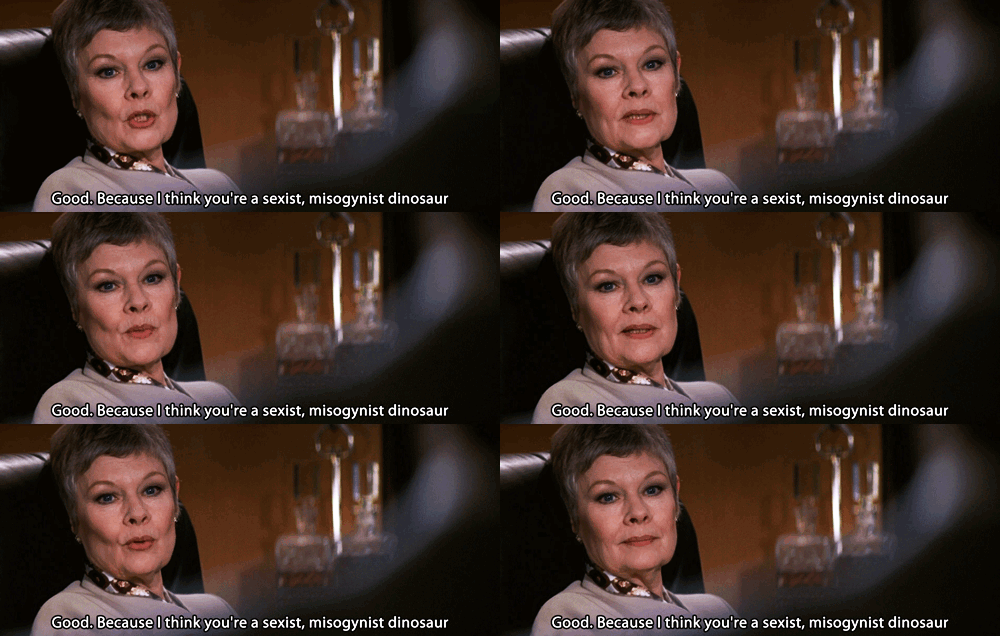
Pictured: MI6 director M is entirely willing to take up Dresden's offer to go to court.

I enjoy treating a woman like a lady, opening doors for her, paying for shared meals, giving flowers--all that sort of thing.


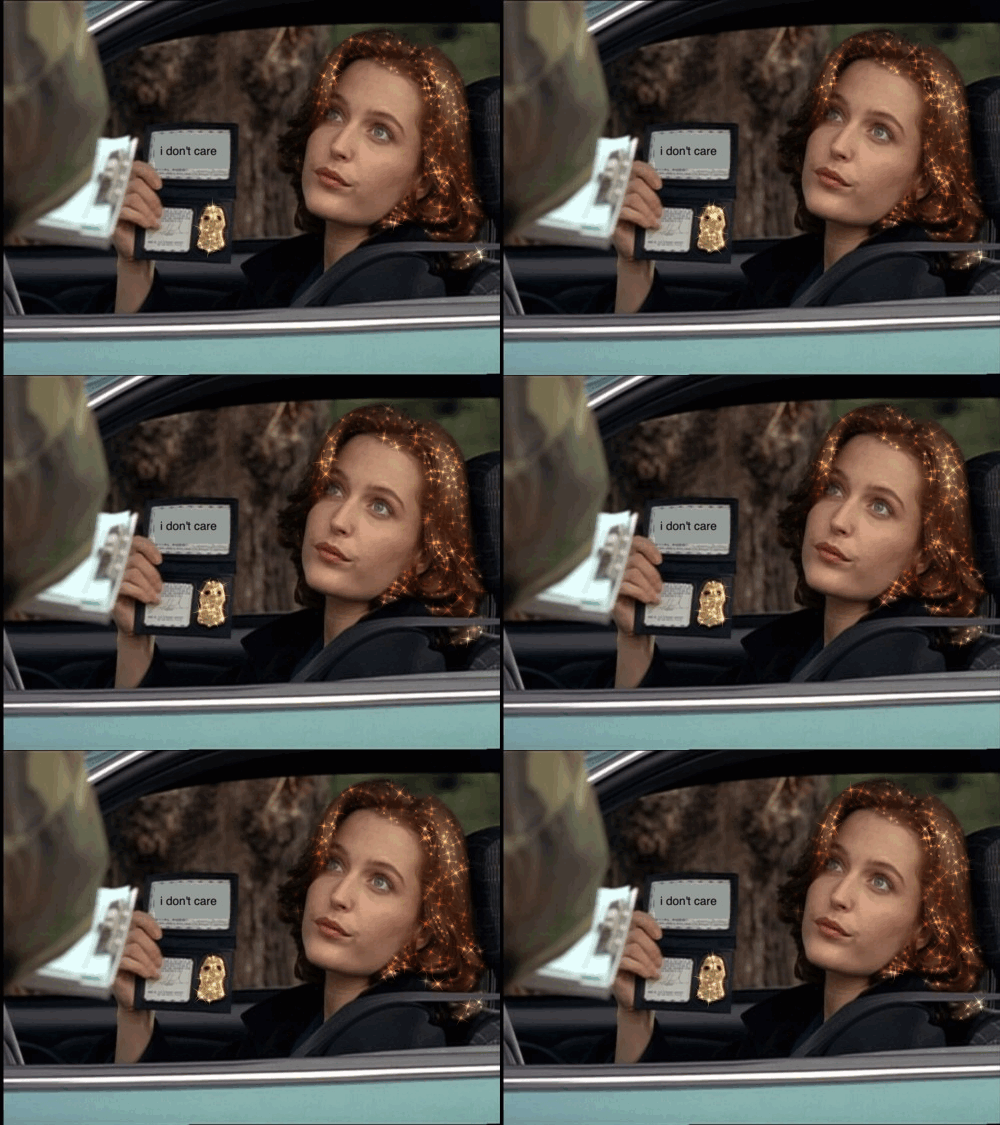
Pictured: Special Agent Dana Scully will tell Dresden when she wants his opinion on women again, which will be never.

I don't even know what to do with this.  "Men ought to treat women like something other than just shorter, weaker men with breasts."  Well, yes, that's true.  That's true for a lot of reasons, starting with women not being shorter, weaker men with breasts.  Faith and fucking begorrah.  I guess we'll start with the purely scientific objection, which is that men being stronger than women on average tells you basically nothing about whether any given man will be stronger than any given woman, because the variations within a gender are vastly greater than the difference in averages.  (Actual studies on this are not the easiest thing to find, especially if you want studies that aren't saturated with biases, bad methods, bad data presentation, and the occasional dash of MRA meninist whining.  Suffice perhaps to compare for yourselves the current world records in that manliest activity, lifting heavy objects: yes, the men's olympic lifting records are higher than the women's, but when comparing similar weight categories, the differences are fairly small and everyone is lifting multiple times their own body weight.  Dresden, bro, do you even lift?)

Next, Dresden, have you considered that maybe the correct way to treat women is LIKE PEOPLE?  Chivalry isn't dead--it's a fricking zombie that refuses to die no matter how many times we bury it because it feeds on the keening wails of men who don't understand why opening doors for women just won't translate into getting laid.  I sometimes open doors for women, I sometimes pay for meals for women, yes, and they do the same for me, and likewise with my friends who are men.  I do these things because they are nice things to do for people I like, not because I'm trying to provide women with the support they need to get over their fundamental deficiencies of ladyness.  So the real question here, Dresden, is why you're only doing nice things for women and not men.  WHY ARE YOU SUCH A MISANDRIST, DRESDEN?


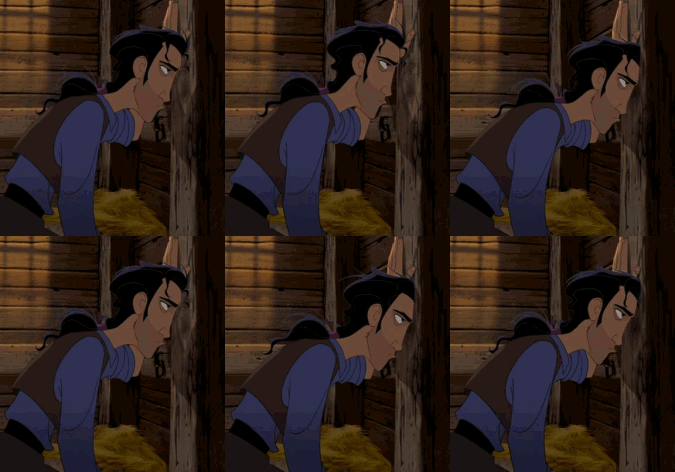
Pictured: Tulio attempts to forget the conversation he just had with a brooding antihero with a heart of chauvinist gold.  Y'all don't even know the kinds of stupid, misogynist screeds I read with my own two eyes in my quest for good data.

In short, locking women into the kitchen to be barefoot and pregnant is unquestionably terrible, but that doesn't mean that putting them on a pedestal to be delicately cared for and pruned or whatever is somehow good.  And I might not be able to convict you for being a sexist creep, Dresden, but I can definitely judge you harshly.

Where were we?  Oh, yeah, double homicide.

Dresden follows Murphy up to the seventh floor to a plush romantic suite that smells of blood.  (The elevator scene is brief, silent, and actually kind of good: "I licked my lips and looked around the interior of the car. My shadow and Murphy's fell on the floor, and almost looked as though they were sprawled there. There was something about it that bothered me, a nagging little instinct that I blew off as a case of nerves. Steady, Harry.")  Murphy leaves him in the first room for a minute, where he examines his surroundings in a vaguely ESP kind of way, making visual observations with his eyes nearly shut, noting champagne, a stray rose petal, and a half-torn black thong under a chair, which Dresden summarises as "Kinky".  Dresden has not read Fifty Shades or he'd save that for the eggbeaters.

We are then introduced to Murphy's skeptical partner, Carmichael.  Dresden rattles off a laundry list of things that are meant to make Carmichael's unattractiveness clear, starting with being fat and bald, and then goes for a swerve with "razor intellect [....] absolutely ruthless at tracking down killers".  I tentatively mark this as the second fat character we've met and the second we're not supposed to like, regardless of the 'razor intellect' remark supposedly showing that Dresden respects him.  They snipe at each other a bit before Dresden comes in to see the bodies.

Now, I realise magic is at play here, but I think it's fair to question how and why it is that these people (who died in the middle of sex) managed to remain frozen in the exact pose they had when an evil wizard literally made their hearts explode like fragmentation piñatas.  The description "she was astride him, body leaned back, back bowed like a dancer's" sounds to me like she's still more or less sitting upright, no?  Either way, now we're apparently seated in the 'erotic violence' section of the train and I'm prepared to tuck and roll.

Clues, blood, gross stuff, clues, and then Dresden finally runs out of the room to throw up--Carmichael wasn't joking when he said he'd bring a bucket.

Dresden's frantic disgusted thoughts weave in some worldbuilding:
...someone had used magic to do it. They had used magic to wreak harm on another, violating the First Law. The White Council was going to go into collective apoplexy. This hadn't been the act of a malign spirit or a malicious entity, or the attack of one of the many creatures of the Nevernever, like vampires or trolls. This had been the premeditated, deliberate act of a sorcerer, a wizard, a human being able to tap into the fundamental energies of creation and life itself.
So now we know magic does have some kind of organisation ('White Council' isn't the name I would choose, but... okay...) and laws, and we have a sort of charmingly juvenile name, 'Nevernever', for the realm of monsters.  And we're only in the second chapter!  Can you imagine how many posts into a WOT book I'd have to get before we heard about 'the Nevernever, what some call Monsterpalooza, where dwells the Scarytown Crew that you know as the Naz'gool'.

Dresden does tend a little bit that way when he starts talking magic:
"Evocation is the most direct, spectacular, and noisy form of expressed magic, or sorcery. [....] 
"What's the other option?" Murphy asked. 
"Thaumaturgy," I said. "As above, so below. Make something happen on a small scale,and give it the energy to happen on a large scale."
Which isn't bad terminology, really.  'Evocation' literally means 'calling something forth', while 'thaumaturgy' means 'magic-shaping', following the same pattern as 'metallurgy'.  I feel some small spark of hope that this will be the first fantasy series I've seen to correctly use '-mancy' suffixes only to refer to divination magic.

There's more magic worldbuilding as Dresden explains the intimacy of spellcasting and concludes that the killer had to know the victims in order to use this particular magical approach, by having intense personal reasons to want them dead. Oh, great, before this chapter can end on a strong note we have to endure another one of Dresden's pontifications on gender:
Murphy glared at me. "You keep saying 'she,' " she challenged me. "Why the hell do you think that?" 
I gestured toward the room. "Because you can't do something that bad without a whole lot of hate," I said. "Women are better at hating than men. They can focus it better, let it go better. Hell, witches** are just plain meaner than wizards. This feels like feminine vengeance of some kind to me."
Pictured: WHATNAPPLE RETURNS TO AID ME

Are you fucking kidding me, Dresden?  Jim Butcher, what the fuck?  Please tell me you're going for an unreliable narrator here.  Please don't be actually this stupid.  Please let the killer also be a man just to highlight how wrong Dresden is.
"Christ, you are a chauvinist pig, Dresden."
Lieutenant Murphy, you have my sword.

Dresden sort of agrees to try to reverse-engineer the magic, and Murphy banishes Carmichael to fetch her coffee before explaining who the victims are: the woman is a sex worker for a well-regarded company run by a vampire ("vampiress" oh my god shut up Dresden) named Bianca, and the man is the personal bodyguard to Chicago's new king of the mob, Johnny Marcone, a relatively civilised crimelord who's put an end to past bloody clashes with the police and gone all Ankh-Morpork Guild of Thieves on excessive elements in the city, doing a better job of stamping out some violent criminals than the police do.

I had honestly forgotten what it was like to have antagonists with immediate presence who are relevant to their environment and not just, like, abstract concepts and generic monsters.  I bet I'd be enjoying this book less if I hadn't just endured so much WOT.

Dresden has tried to put a disclaimer on his ability to work out how the murder spell worked, but Murphy doesn't buy it.  Dresden weasels out of explaining himself, but notes in the narration that he's got some kind of checkered past with the White Council and he's on double secret wizard probation, bearing something called the Doom of Damocles.  I like the name because it's self-explanatory (danger hanging over his head) without sacrificing some mythic flavour.  Anyway, Dresden's pretty sure he'll get a Doom to the head if word gets out that he's trying to build a murder spell, and apparently sending advance notice ("Hey, I'm tracking a murderer who broke our First Law, please don't kill me") is not an option?  He instead concludes that he'll just need to keep it quiet.  Brilliant.  If this incident is so bad, shouldn't the Council have their own investigators on the case?  Shouldn't they at least be able to spare someone to keep an eye on Dresden while he helps the police?  What are the jurisdictional rules for something like this?

They leave, Dresden's got five minutes to make the fifteen-minute trek back to his office for his appointment with Monica the mystery client, and he's halfway there when he gets surrounded by beefy goons who forcibly invite him to get into a car with Johnny Marcone, and that is where the chapter ends.

Initial impressions: Harry Dresden is a gigantic tool made of smaller tools in a sort of fractal jackwagonry array, but Murphy is a good character, I'm interested in the setting, and within a mere two chapters we've got a web of plot threads that connect us to a mysterious disappearance, a vengeful sorcerer, a vampire madam, organised crime, and the secret council that runs all magic. Rand al'Thor needs more pagetime than that to eat lunch and stare longingly at the hot girl he imagines he's in love with.  I may brim with rage throughout this book, but at least it won't linger.

---

*Thanks to ebook formatting, the pagecount varies wildly depending on how I size my reader screen, so I have little hope of keeping a consistent tally of pages as we proceed.  I'm tempted to use abstract concepts (Storm Front: p. Mangrove to Banyan) but combining that with my suggested chapter titles is just going overboard.

**ALSO I HAVE STRONG OPINIONS ON THE GENDERING OF WITCH AND WIZARD.  That's not how it works.  'Wizard' is just 'intensely wise', following the pattern of 'drunkard' and 'coward'.  'Witch' derives from 'wicce', which has a contested etymology to say the least, but originally 'wicca' was male and 'wicce' was female, and we melded both words when we took them for English.  Female wizards and male witches are 100% legit, not a weird special case, and definitely not gendered terms for identical roles.  (I'll stop here instead of further ranting on the notion that 'warlock' is the male equivalent of witch.)

Tuesday, March 19, 2013

I think we should be friends

Hello!  So, Erika the Over Queen of the blog is still hungover and not able to prepare a Tuesday post (because obviously the party was only on Saturday and that is not nearly enough recovery time) so instead, for those of you who are still all "Who is this guy with all the Ws in his name and what makes him think he should be on this blog", we now have a chance to get to know each other better!  But this is also a busy month for me and I have not lately blogged a bunch (the second Ender's Game post will go up next Sunday, though!) and so for your amusement and judgment I offer the following, which was previously posted on my original blog under the title "The Comrade Sector".

(Content: screwed-up gender dynamics, heterocentric discussion of sexist concepts.  Fun content: Klingons and daguerrotypes!)

(Alternate titles for this post included The Ally Territory, The Companion Realm, and Eight Rules For Dating My Non-Age-Specific Fellow Sapient.  [Edit: also, Salacious Tortoises would have been a good one.])

This is one of those subjects that makes it hard for me not to just profane for a while.  I have been spending time (any amount is too much) on parts of the internet where 'The Friend Zone' is treated as an established and accurate concept, and now I just want to reboot the world.  On the plus side, it's also providing me with a fascinating new perspective on the way I view people.

I've mentioned before that one of the reasons I love the heroic villain archetype is that they are doing the right thing even while not feeling like it.  They protect people they don't particularly care about and they stand up for ideals that they think are just daydreamy nonsense.  This is what I feel like most of the time, because while I'm a long-run optimist (I believe that people will eventually transcend their current widespread and colossal failures) I'm a short-run pessimist (I believe that on the road to that transcendence we will oppress, harm, and in various ways kill uncountable multitudes of people and things) and I have unreasonably high standards for folks.  I tend to think of myself as being misanthropic by nature, and continually try to remind myself not to act like it.  And yet the internet, in its signature style, teaches me things that were not the things I expected to learn.

And one of those things is that I'm way less misanthropic than some of the chuweros out there subscribing to supposedly mild and mainstream concepts that are actually totally awful.  And the Friend Zone will here act as our exhibit A.

The definition is simple: a woman (occasionally a man) is said to have 'friendzoned' a man (occasionally a woman) when she spends time with him but rejects the possibility of a romantic relationship, which the man was interested in.  Once it happens, there is no escape from its sorcerous boundaries, no matter how the man may entreat for a fresh trial to prove his suitability.

Or, in normal-person talk, ladies only date dudes they want to date, and callously disregard the dudes they don't want to date who nevertheless want to date them.

I grew up in the age when home video game consoles exploded, and so was bombarded with the insistence that this new form of media would corrupt and ruin the young and completely remove their appreciation of daguerrotypes and that sort of thing.  Is this the reckoning that was foretold?  Do people now believe that relationships have terrain hazards?  If you mistakenly equip the Hylian Shield as you're heading up the river valley, the octorok will shove you off the ledge and you'll land in the friend zone and have to start over?

All of the things wrong with this framework require some effort to disassemble and fully appreciate.  It presents the idea that forming a relationship is, from the dude's perspective, the task of continually avoiding 'getting friendzoned' until some kind of romantic connection can be made.  It's an inherently adversarial concept like something out of Klingon rituals ("Women roar.  Then they hurl heavy objects.  [The male] reads love poetry.  He ducks a lot.") and it repeats the same eternal stupid thing about men wanting (especially sex, but often generalised into 'affection') and women withholding (see previous).  But beyond that, it also implies that a woman can want to friendzone a guy but not be able to until he does something to justify it.  It has to presume this, because otherwise it would have to accept reality, which is: if a woman doesn't want to date a man, then she won't (voluntarily).  There is no complicated process, there are no rules, and there is no rigid categorisation; no one is getting a forehead stamp and sorted into the Non-Dating Cabinet.

Or, in abnormal-person talk: if the friend zone existed, it would be immediate and unstoppable.  You can't dodge it, you can't ward it off - you don't get put in it; it simply eminent-domains the ground under your feet. 

But some people apparently see a personal benefit to operating on this nonsensical framework (elsewise they wouldn't be parroting it to each other), and as near as I can tell, it's about the externalisation.  It lets a person reclassify what they did (or have done, or are doing) that made them an unsuitable date and turn it into something that was done to them.  And this is a particularly important reclassification to pull off if you are a Nice Guy.

The Internet Nice Guy, of course, is the guy who is sweet and caring and giving but women just won't date him because they're only interested in jerks.  At least according to his webpage.  In reality, it turns out that he's a self-important self-entitled guy who thinks that not actively burning down orphanages puts him in the top 1% of humanity and just can't understand why women don't reward his awesomeness with Naked Fun Times.  He's already spending all of his time hanging out with them and only doing what they want and trying to make them completely dependent on him for their emotional needs - what more is he supposed to do, explicitly say that he is attracted to her?  MADNESS.  If he did that, he would just get friendzoned!  Do you expect him to fall for such an obvious ruse?

At this point, I may sound like I'm constructing strawmen and chastising them for their dealings with strawwomen, but it's honestly not that difficult to find examples.  Erika linked me to another blog's post on friendzone concepts, and lo, but the second comment from the top was a guy explaining that Some Women really do manipulate guys and use the dudes' "honest mating attentions" for personal profit which they have no intent to compensate the dude for.  Check it out.  That's a direct quote: "honest mating attentions".  I couldn't make this up if I tried. So: do I have a low opinion of my species as a whole?  Often.  Am I insufficiently sympathetic to others' pains?  Probably.  But am I as much a misanthrope as that guy?  No.  Because that guy believes that women are heartless selfish manipulators and men are conniving fools who are trying to trade for sex but are being hornswoggled by the evil women's superior treachery.  That is what some quality misanthropy looks like. Now, as a socially-awkward person myself (and note that when I talk about Nice Guys, I refer to a group I was previously part of) I do like rules, and I think the desire for rules is part of what makes Nice Guy philosophies and frameworks like 'the friend zone' so attractive to dudes: it purports to take a complex system and reduce it to a simple series of laws, interactions, and consequences.  Never let it be said that I am unwilling to provide good rules to replace bad ones.  Here are some actual rules that serve well:
  1. If a person does not want to date another person, then they won't.  Attempting any strategy that might subvert rule 1 makes you a bad person.  (Trying to actually be a person they would want to date is a somewhat more complicated grey area; even if New You can be sustained, it's still generally a better plan to try with someone else.)
  2. Person A, if treating Person B like a friend when Person B has only ever acted like a friend, is not doing anything wrong.
  3. Acting like a friend purely for the purpose of getting something from your supposed friend makes you a bad person.  (This was true when it was the jerks in school ingeniously absorbing the kid whose family had a pool, and it remains true now.)
  4. If a friendship is all one-way, then it's not a friendship, it's indentured service.  Ditch 'em.
But there's a second aspect to this friendzone concept - its inescapability - that needs to be dealt with separately.  The premise is, again, that once a person has been identified as a friend rather than as a Potential Naked Fun Times Compatriot, the process can never be reversed, and it is impossible to go from being close friends to romantic partners.  Or, more importantly, dudes will claim that women will use their existing friendship as an excuse not to start dating.  So, keep in mind:
  1. If a person says they don't want to date another person, the most probable answer is that they don't want to date them, never have, and never will.
  2. It is possible that a person legitimately believes that, regardless of their possible attraction to you, the potential failure of a romantic relationship is too great to risk the consequences for the friendship.
  3. Ask yourself if you can, if nothing else, imagine a friendship with [member of whatever gender(s) you're attracted to] that you valued so much, in its platonic form, that you would hesitate or turn them down if they propositioned you.  If the answer is 'no', then chances are good we've just identified why your friend didn't want to date you from the beginning.*
  4. No one needs an excuse in order to not date someone.  Therefore, if you have had what you believe to be An Excuse deployed on you: it was for the sake of sparing your feelings and the other person simply doesn't want to explain that, while you're fun to hang out with, they might rather make out with a galapagos tortoise.
I have had a lot of female friends.  I have been attracted to some of them.  I have broached the subject of dating sometimes.  I have sometimes been turned down; I have even had things which I suspect were Excuses deployed on me.  What is the correct response here?

Move on with your life.

Which is bleedin' difficult sometimes, I know.  Great Jaddeth Below, I know.  When I refer to myself as a 'former Nice Guy', I see parallels with 'recovering alcoholic' - with destructive behaviours, we might never stop wanting to backslide, we might have to work constantly to be better than ourselves.  I may never stop wanting to be Romantic Comedy Guy.  But resisting that is the definition of winning.  (And sadly there are no cookies for basic decency.)

I used to dislike stories that made it explicitly clear that Our Heroes could never really win - that they would just right this injustice, push back evil this time, and then some day it would come back, and they would fight it again, or someone else would have to do it, forever.  But I get it now.

---

*Gracious, I almost let a post go by without a footnote.  Well, it occurred to me on rereading this rule that the 'you' here might just be a polysomething person of the sort who doesn't feel any particular need to maintain hard lines between platonic and sexual relationships, and that may be just fine on its own; I'm not saying you're a horrible person.  But I hardly need to tell someone who has a robust set of sociosexual ethics that the turning-you-down person may not be comfortable getting into that, so I think the rule stands on its own, both in its judgey and non-judgey forms.

Sunday, August 5, 2012

Sunday Random. 10 surefire ways to pick up women.

Hello and welcome to the FIRST EVER Sunday Random! 

I figured I should start this feature with something useful, so here is a list of 10 ways to pick up women that will DEFINITELY WORK.

1) Eye brow waggles - No woman can resist a man with strangely dexterous eyebrows.

2) Lasers - Or rather, telling her about that one time you were shot by one. If you HAVEN'T been shot by a laser then you're leading far too dull an existence to hope to impress women.

3) Smell her - Get in real close, and breath deep. She will be positively DRIPPING in a matter of seconds.

4) Tell her you've read 50 Shades of Grey!

5) Walk up to the object of your affection and say "I have lots of money".

6) Tell her you have a horse outside.

7) Walk up to her and gesture to your genitals while staring pointedly.

8) Dress up as a clown! Who doesn't look better when in full clown regalia? No one. That's who.

9) Sensually eat a taco in front of her.

Awwwwwwwww yeah

10) Just be a super Nice Guy! She'll break eventually!


As I am sure you have all seen now, I give the greatest dating advice ever. Send in your questions about relationships/dating and hopefully I'll have enough to run an advice colume on a Sunday in the future. 

Till 50 Shades on Tuesday!

Thursday, June 23, 2011

Dear Nice Guys: Please shut up already.

You might be confused by the title, so before I start, this is what's prompting this post. For those of you who don't feel like reading the link, the gist is a bunch of "oh poor nice guys I still love you! Doormats". I feel I am qualified to talk about this topic, largely because most of my friends are male, and while I would describe many of them as nice, I wouldn't use the term "nice guy" because that describes the type of door mat this writer is talking about. I've also been on the receiving end of the "Nice Guy" treatment.

So, nice guys, wanna know why you don't get the girl?

Well, for starters, you're a doormat. You already give her everything she wants. You tell her she's pretty, put up with her high maintenance irrationality and offer a shoulder to cry on when she needs it. You're there with a cheesy movie, a hug, and ice cream when she's had a bad day, you're basically the perfect boyfriend, without her having to give anything up. She can still go out, be wild, have the thrill of flirting with randoms and still have someone safe and stable waiting for her at the end of the day. I'm not saying leave your lady friends high and dry, but how many times have you not gone after other women because of said lady friends? Funny how they're around a lot more when suddenly YOU'RE the one with a romantic interest, isn't it? If she's pulling that kind of shit, she just wants you on the back burner, sorry Mr. Nice-Guy.

Now, maybe this female friend of yours isn't a soul sucking harpy and actually just wants to be friends, well, why won't SHE date you? First off, she sees you as  FRIEND. Not to say a girl can't fall for or date a friend, but, she might be more hesitant to. Although, I'm going to rat out my gender, the line "I don't want to ruin the friendship!" is often a lie. She's got other reasons, but she doesn't want to crush you, and that seems like a much kinder way out. What are these other reasons? You've probably been over eager, for starters. She asks you to hang out, you ditch your other friends, she's had a bad day, and instead of listening on msn, you turn up with movies and ice cream, you're probably WAAAY to quick to offer a back rub, and are always trying to cuddle her. Now, even not bitches might cave and just go along with it, because it's kinda nice (sometimes) (or they just don't quite realize what's going on until it's far, far too late), but the over eagerness has killed any potential lady boner they could have gotten. I'm not saying play it cold, man, I'm saying don't ditch your buddies and maybe be a bit more reserved in the touching, for starters, at least.

Let's be honest, if it wasn't her, it'd be another girl. You've always got a crush on one of your female friends, and your tactic is to become their best friend and confidant, gain their trust, and then they will see that clearly they are in love with you, right? Sorry, dude, but it hasn't worked yet, maybe you should try asking her out in the early phases, before she starts seeing you as her best friend and suddenly feels betrayed because she realizes you've had this huge ulterior motive the whole time you've been a good friend to her.

Also, it makes you what I like to call a Leg Humper. You do this with ALL of your female friends at some point, right? Why the hell should I take you seriously? Am I just another girl in the parade of women you'll decide you're in love with? And, know what, I've watched you, Mr. Nice-Guy, cycle through a BUNCH of crushes, you always make your move by backing her into a corner, or making it some intense declaration. Shit's terrifying, dude. And if a girl ever actually shows interest in YOU, she's not your type. I think you just want to have something to angst over, and hey, if that's your call, but please, I beg you, shut the hell up. If I listen to you sigh, smile bravely and say "I guess it's because I'm a Nice-Guy. Nice-guys finish last, right?" I will punch you square in the dick.