Wednesday, June 10, 2015

Erika vs Dredd

I feel the need to defend this week's choice first. The idea behind "surprisingly feminist media" is to take the lowest scrape-the-barrel "Hey, this movie is only minimally harmful!" media and analyse its strengths and weaknesses.  Which brings me to said choice of the week: the 2012 Dredd.

Content notes: murder, police violence, threats of sexual violence.

Picture: The title character Dredd in a helmet that covers his eyes, frowning, with flames reflected in his visor.

He makes that face the entire movie and talks like Batman. (The one from the Dark Knight Trilogy, not the perennially wonderful Adam West.) I won't pretend I don't replace half his dialog in my head with "I'M BATMAN" in my head, and it doesn't really change anything. It's wonderful.

Dredd is a movie is set in a post-apocalyptic world where humanity has built one giant mega-city (aptly named Mega-City One) and within this giant mega-city are giant apartment buildings (200+ floors). Because these cities are so huge and everything is corrupt and awful because there was some sort of apocalypse the new system of law enforcement is Judges, who are cops, but also juries and executioners. Sounds a bit like a wish fulfillment for some of the cops in the US, doesn't it? Our title character, the fascist Judge Dredd, is given a failed rookie to take with him to evaluate (she is a powerful psychic, which is why, even in a world of hard yes and no, they're testing her anyways). He will be the sole one to decide this, because this world is big on giving cops that sort of power. These two go to investigate a triple homicide in one of the mega blocks and then OH NO THEY'RE TRAPPED AND AN EVIL MOB BOSS HAS LOCKED THE PLACE DOWN AND SET EVERYONE IN THE BUILDING ON TRYING TO MURDER THEM!

If you are looking for an over the top DARK GRITTY ACTION MOVIE with super cheesy dialogue I will gesture emphatically at Dredd for you. (The Husbeast adores this movie, but is quick to point out that Dredd is supposed to be a fascist and they never address that at all. There are no overt politics, although as we're about to dive into, there are some disturbing implicit ones.)

So, the bad: Dredd is kind of racist. The movie, not the character. Maybe the character? He gets very little development so I legitimately can't say (I also know nothing about the comics, if someone else wants to chime in). The Rookie (Anderson) is cast as a pretty white woman:
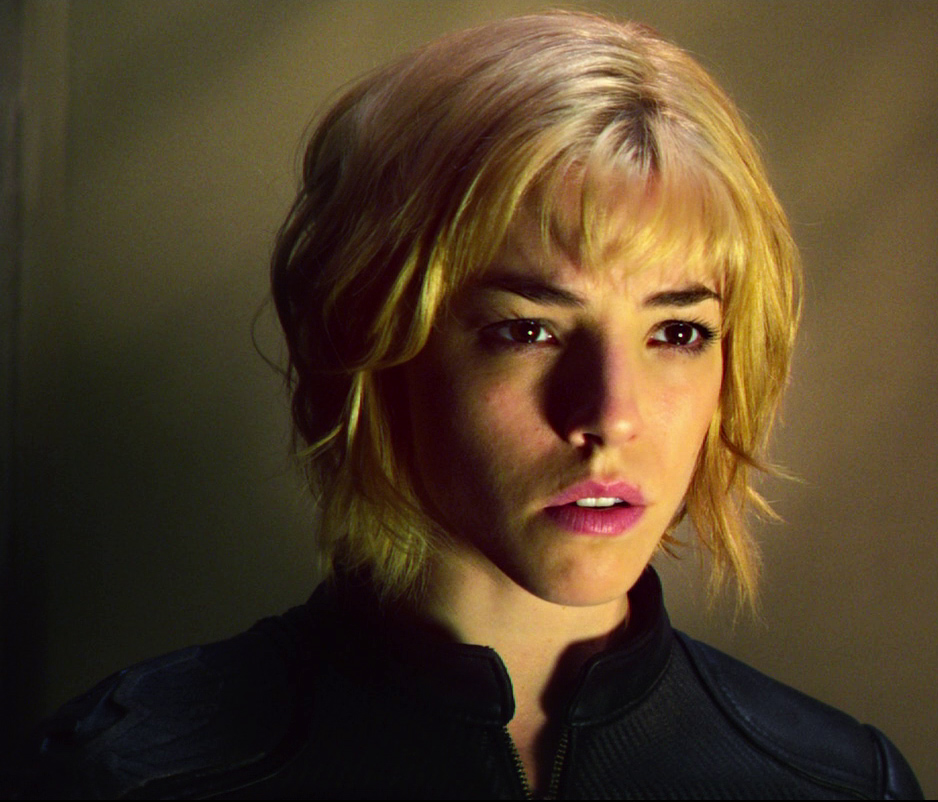
Pictured: A pretty blond white woman wearing a fair bit of make up
She spends a fair portion of the movie fighting with a black villain in their custody, who (on three separate occasions) threatens her with sexualized violence. Yeah. Awk. In one super unnecessary scene occurring psychically in his head, he twists things to make her perform oral on him, but she quickly twists the 'dream' around on him and, long story short, he pisses himself and she walks away completely victorious. She also doesn't wear a helmet so we can keep seeing her pretty face, although I will give them points for justifying why she doesn't (it interferes with her psychic powers, if you were wondering). The movie is set in a mega-block which we're told has an unemployment rate of 96% and one of the highest crime rates in the area. It has some of the most diverse casting of background characters that I have ever seen, which would be great if this wasn't a building mostly full of criminals and the unemployed. (How can a 96% unemployment rate be sustained? Where do they get their food and other necessities?  They clearly can't be farming or ranching.  Do they steal from other blocks?  Does Mega-City One have a vast and abundant welfare program to go with its murderous ultra-cops?)


It would be nice seeing so many POC in the background if it didn't translate to Dredd and Anderson mowing through dozens of men of color without batting an eye. There are three times that we see hesitation from them: One is Anderson's first kill (a white man), another is a victim of violence (another white man, also Anderson being the one to hesitate), and the third is when Dredd tries to talk kids away and stuns them instead of shooting to kill (one is black, one is white). This is the only time we find out he has that capacity; it is never used again or mentioned, even when he is running dramatically low on ammunition.  There are a lot of ways in which feminist goals (the health, safety, and freedom of all women, not just the privileged white ones) aren't compatible with a fascist police state that routinely murders people on a whim, but for the sake of this post, we're working within its premise.

(The 'whim' nature of the judges is both highlighted and ignored--Dredd will enter a room with guns blazing and take out four suspected criminals to make a point, but then declare that he won't execute one of the captives on a mere 99% chance they are a murderous drug dealer.)

With all of that said, we get to the reasons that this movie qualified for SFM in the first place! (Did I mention the sweet action scenes and how all of Dredd's lines can be replaced with "I'M BATMAN"? Because I feel that's relevant.)

Also HOLY NONSEXUALIZED FEMALE CHARACTERS BATMAN! Am I making too many Batman jokes in this post? (Do I care?) Nah. There are two major female characters. Ma-Ma (Madeline Madrigal), the head of Ma-Ma Clan, who is a former sex worker who bit the dick off of her pimp and took over his holdings to become the top gang leader in the block. She's known not for being sexy or sultry, but for violence and cruelty. Her first scene is in the bath, and you see nothing. She's in opaque water up to her neck.  The point is instead to show us what the movie's narcotic Slo-Mo feels like to the user--everything is slow and sparkly, and sometimes the movie feels like Twilight if the vampires were perma-violent gun fanatics.  So, SFX porn, but not actual porn!

Then there's the rookie, Anderson. Her uniform is the same as Dredd's. They don't tighten it up or make it more fitted. They don't put her in awkward boobs and butt poses, she moves and behaves like someone who knows what they're doing. She is (and is treated as) competent. The only time we get anything remotely resembling "but ur a girl" is from villains. When Dredd doubts or questions her, it's because he's evaluating her, not because he doubts her for being a woman and (minor spoilers) by the end of the movie Dredd thoroughly relies on and trusts in her.

The movie on a few occasions actively subverts "sexy" tropes. Ma-Ma is a former sex worker but they never feel the need to show her acting "sexy". She isn't hanging out in heels and a cat suit ordering her minions around, we see her in loose shirt and in the war room. We see her taking action, and being the one to hold the knife to people herself. There's a set up for a GIRL FIGHT between Anderson and another woman, which the movie gleefully skips past by having Anderson psychically foresee the ambush and just shoot them down before carrying on her way. Later Anderson gets shot--it looked like a shoulder shot and when I first watched the movie I sighed. Great. Time for some awkward bloody cleavage. (Why bloody women in pain can be considered sexy yet people are so grossed out by periods baffles me.) But then: they don't do it. There are no weird bloody boobs. They unzip her uniform and she's not wearing a basically-see-through white tank top; she's wearing a dark t-shirt, and even though it looked like she got shot in the shoulder it's a gut wound.

Is Dredd groundbreaking in representation or writing? Absolutely not. It's awkward in how it handles it's POC characters (Dredd's boss is a black woman with two brief scenes, and that's about as good as it gets), and never tries to address the fact that it's about a fascist system of murder-cops. But it's a fun action flick that didn't leave me thinking "Why is it so hard to get action movies made with women as people?", which is depressingly rare.  Whatever credit Dredd could be granted doesn't come from displaying empowered women who are 'just as good as men', but by making characters who simply are women while being cops and criminals.  People who aren't written as if 'woman' is a personality trait, and who aren't just there to fuel sex fantasies.

(And yes, from all we've heard, Mad Max: Fury Road will definitely be the subject of an upcoming Surprisingly Feminist Media post.)

As always feedback and further suggestions for this feature are welcome. Tune in next week for more of Will suffering!

Wednesday, June 3, 2015

The Eye of the World, chapters 34, 35, and 36, in which Rand is literally the centre of the universe

I LIIIIIIIIIVVVVE.

Quick explanation of the last two months: my antidepressants are letting me down, I am tired all the time and I feel lucky if I get six hours' sleep, and there was a three-week break between my first and second therapy sessions because I picked a bad time to start.  Thus, not so much with the energy and willpower to create blogposts, or write much of anything.  But I am by nature a writer and rambler and ranter, and it was long ago foretold that I would eventually be compelled to return.  Fortunately, the blogqueen also saw fit to establish a new posting regimen and nudge me as needed to get material ready in time.  Victory.

Let us now return to that rock of stability: the directionless meandering of Egwene And Her Amazing Pals towards an actual plot development.  Wait.  Dammit, Egwene isn't in this week's chapters.  Instead it's another Randathon as they finally reach Caemlyn without befalling any plot events that would actually engage me in this story.

The Eye of the World: p. 512--556
Chapter Thirty-Four: The Last Village

The eponymous village is Carysford, over the river Cary, and it looks normal enough to Our Weary Heroes, by which I mean it's got a bridge and no other discernible features.  They end up sleeping in haystacks again:
Heroes in the stories never had to sleep in haystacks, or under hedges.
I only have so much patience for characters in books thinking about how their lives aren't like books to begin with--it was probably clever the first time someone did it, back in the Triassic, but it's pure cliché now at the best of times.  At the worst times, like this, when people start thinking 'heroes in stories are never uncomfortable' I just start wondering what kind of unspeakably bland literary traditions this world has been saddled with*.

In the morning they join a slow parade of young men and token girls who are all apparently on their way to see the False Dragon in Caemlyn.  There's an encounter with an angry speeding merchant and a mounted guard that I don't fully understand, in which someone appears to call Rand 'Darkfriend' in a way that they intend to convey 'jackass'.  On the one hand, this makes some sense for people who haven't seen much in the way of apocalyptic cultists for many generations; on the other hand, it also seems linguistically uncreative, and this is a usage that we haven't seen in the previous 500 pages.

Sweet Eru Iluvatar, this is a slog.  I mean, I started this post half an hour ago thinking 'it's been forever; I am totally ready to dive back into the Generic Fantasy Adventures of WOT', but this is truly inedible word-paste.  (And let me add that I wrote this paragraph and then failed to get any further on this post for another two weeks.  Yesterday I climbed 26 flights of stairs for the hell of it, and I have an active World of Warcraft subscription, but Wheel of Time is a grind too far.)

Skim skim skim.  I don't know to what extent Robert Jordan popularised this method of characterisation, but as is my standard operating procedure, I hold him fully accountable for his contributions of human suffering: when Jordan wants to quickly make someone sympathetic and 'deep' even though we're never going to get to know them personally, he gives them a catchphrase and makes them ramble.  Rand and Mat overhear someone looking for them (big bounty on their heads) and then hop a ride with a guy who infodumps at us for a couple of pages, constantly repeating the phrase "I'm a good Queen's man" to shore up his credibility.  I threw the torrent of verbal meandering into the centrifuge and here's what came out:

  • This country strictly has ruling queens, but is not called a queendom, I guess because that's the sort of thing a crazy feminist would do?
  • Tradition states that the crown princess (or "Daughter-Heir" in WOT speak, because that's so much smoother) studies with the Aes Sedai and the eldest son studies with the Warders.
  • This got the last prince killed and the princess disappeared before her coronation, leading to civil war a few decades ago.
  • Queen Morgase also has an Aes Sedai grand vizier advisor whom many people suspect of Scheming.
  • Robert Jordan thought it was reasonable to write "a queen is twice a woman, wed to a man, wed to the land" and no one stopped him.

The quantity of rambling done by minor characters in this book is amazing, and it irritates me, because it doesn't make them seem more realistic--it makes them seem like information nodes where our heroes just Press A To Talk at worst, and naive, scatterbrained inferiors at best.  The protagonists are far too wise to prattle on like that, and when they talk, they say important things, while extra after extra keeps jabbering, to the vexation of smart listeners like Rand and Mat.  The only positive I can spot is that Jordan has white guys doing this, not just women and brown people, but that would also require him to have more women and brown people, and in case you didn't notice he already has three women in this book and a queen who is like two women so obviously we're pretty close to capacity already.

Chapter Thirty-Five: Caemlyn

Our Heroes have finally arrived at the vast gated community metropolis, a fortress-city protected by fifty-foot walls of white stone and silver, the beacon of civilisation in dangerous lands and dangerous times: GondorCAEMLYN I meant--I meant--to say Caemlyn.  It is very unfathomably big and crammed full of people. I note that amongst all the many things about the city and its crowds that startle Rand, he doesn't talk about varied dress or skin tone, which makes me wonder if Caemlyn is a great big homogeneous blob or if it actually allows foreign people inside.

To remind us who's the real protagonist, Mat despairs how they can ever hide with so many people around, and Rand has to point out that they'll be impossible to find among so many people.  I assume this is meant to be Mat's evil dagger making him grouchy and hopeless, but how are they still alive, and is there any good reason that we had the details of their convenient journey chronicled for us for so many pages rather than montaged?  Mat keeps despairing for a few pages, but Rand is determined to find an inn called The Queen's Blessing that the gleeman mentioned before he died to show that the situation was serious.  Seeing that the local fashion involves sword hilts and scabbards wrapped in cloth, Rand finally strikes upon the incredible genius move to cover up the herons on his signature weaponry, although of course this takes two full pages to occur rather than getting summarised in a sentence so we can move on to actual action.  They finally find the inn, where the innkeeper is friendly and cautious and refuses to believe Thom is dead but otherwise accepts their story.

They're warned not to talk too badly of Aes Sedai (lest they draw the attention of royal guards) nor too positively (lest they get mobbed by Whitecloaks) and not to mention Thom, who PLOT TWIST used to be the queen's personal bard and possibly lover right after she was widowed.  Then Thom got tangled up in undefined business and spoke rudely enough to the queen to get a warrant on his head, because "he said some words, all right [...] words you don't say to any woman with Morgase's spirit. [....] And the Queen never forgets anything. You ever know a woman who did?"

Would any lady readers like to comment on this constant stream of WOMEN AMIRITE as compared to Tolkien's unyielding manscape in terms of women in classic high fantasy?  This is an atrocious choice: don't exist, or exist as caricatures and showpieces that explore the variety and complexity of women with all the nuance of open mic night at Judd Apatow's comedy club.

Chapter Thirty-Six: Web of the Pattern

The innkeeper predictably supplies them with the minimum necessary food and shelter and mentions the plague of rats lately, which Rand ties to being the devil's spies.  The maid gives Rand level five giggly eyelash batting, but he is too shy to say anything and she can't talk because she's set dressing.  Oh, no, she does finally talk when Rand asks for a private dining room, and she directs him to the library, where he meets an Ogier for the first time, which looks almost exactly like a trolloc, apparently.  The ogier, Loial, is very polite and very old (but still immature by his standards) and I'm beginning to think they're the elves of the setting--if so, ten points to Jordan for making them 'ugly' by human standards?  He's been hiding in the inn for four days after people tried to mob him in the streets, and there's a lot of the type of hard-to-parse dialogue that comes up whenever Jordan is trying to worldbuild subtly, but by the sound of it Loial ran away from home because official processes to let him set out at the tender age of ninety were taking too long.  He just wanted to see the world, and the Great Trees and you must shape the vision to the land and not the land to the vision et cetera et cetera.

Ogiers apparently built most of the cities for humans after we broke the world.  Nice of them.  Not clear on why.  They can't leave their home steddings for long, also not clear on why, and thus they're content to leave the majority of the planet to humans. Which: this is very convenient for a writer who wants to have non-human characters but still wants basically everywhere to be Humanville, and it's also kind of uncomfortably similar to the way a lot of white people seem to think of people of colour: sure,they're fine, as long as they stick to their enclaves and don't show up too often in our gated communities walled cities.  And yes, clearly we're supposed to like Loial, but so far he's the model minority.  He fully agrees that it's good and right that ogiers are bound to their stedding, he is willing to stay out of sight rather than make people uncomfortable by walking around in the street as if he's normal, and he's just a little bit more 'human' than the other ogiers--he got all hasty and ran away rather than wait years to get permission.

I eagerly wait to see if any of my expectations here steer me wrong.

Rand and Loial bond, and Rand ends up spilling the whole truth to the dude, who sums it up by declaring that Rand is ta'veren.  Y'all, this is the best thing.  Check it:
"...sometimes the Wheel bends a life-thread, or several threads, in such a way that all the surrounding threads are forced to swirl around it, and those force other threads, and those still others, and on and on. That first bending to make the Web, that is ta'veren, and there is nothing you can do to change it [....] Artur Hawkwing was ta'veren. So was Lews Therin Kinslayer, for that matter, I suppose."
LOIAL HAS IDENTIFIED RAND AS PLOT-RELEVANT.  Rand is very literally and metaphysically a main character and everyone else really is a background character swept up in the course of his fate.  I had heard rumours about this but I did not realise how blatant it would be.

In true RPG fashion, Loial immediately declares that he wants to travel with Rand, but Rand refuses because Loial is ten feet tall and less than stealthy, but they agree to hang out as long as they're both in Caemlyn, and hope to meet up again in Tar Valon.

And that's as far as I can make it this week, but come back next Wednesday for the blogqueen's next post, and tune in again in two weeks to catch up at last with Nynaeve.

---

*There was some book I read around age 10 with kids going camping and getting into a competition with their girl-nemeses culminating in some kind of capture-the-flag battle, and the clearest thing I remember about it is near the end, when the protagonist and his buddies are drenched and muddy, in a standoff with their opponents, and he thinks to himself how silly it is to try to look like some grand champion in such a state.  Even as child-me read that, I thought Yes, that is how a champion looks: exhausted, battered, reaching for the pinnacle of the thing that is so difficult everyone would have thought it was impossible.  There's a quote from George Bernard Shaw:
"This is the true joy in life, the being used for a purpose recognized by yourself as a mighty one; the being thoroughly worn out before you are thrown on the scrap heap"
...Which isn't for everyone, obviously, but is something that's always resonated with me.  I learned this last week that my great-grandfather was Shaw's bartender.  Neat.

Wednesday, May 27, 2015

Surprisingly Feminist Media

Erika here! Since Will and I have been spending a lot of time battling a malevolent being (which lives outside the realm of space and time just beyond our mortal understanding that wants to consume consciousness--you can understand why this is a difficult and time consuming task) we're going to try something a little different with the updating. 50 Shades was weakening me in the previously mentioned battle, but we're pretty sure that between the two of us we can get out a weekly post (still Wednesday) as well as save the world so long as I don't lock myself into only 50 Shades. So, without further ado, let me introduce a new feature to the blog:

Surprisingly Feminist Media!

I will take a piece of media that is not trying to be feminist or "empowering" and point out some that are unexpectedly kind of feminist. I've got a short list of things to work on for future posts, but suggestions on songs/books/movies (ideally things that are stand alone) would be wonderful.

And our first entry is...!

Boyz II Men - I'll Make Love to You

Content warning - Aggressively 90s croony boyband ballad, extensive use of soft focus, and a questionable amount of silk pajamas.


Lyrics can be found here.

And no, this isn't a joke. I wish it were. I had initially picked a different song, one that's actually good, but when I double checked the lyrics I realized the line that had initially gotten it qualified is in fact not what I thought it was, and it got disqualified. Also if this doesn't prompt you to send in suggestions, I don't know what will. I had to watch that music video before posting it. I also made Will watch it. Well, I tried to. He gave up halfway through and just giggled at my suffering because he's a good friend like that.

Why this song?

This song is about fucking. Going by the music video it's about courting someone when both parties are openly into it so you can get to slow tender candle- and fire-lit (this is actually just sounding like a fire hazard with all those rose petals scattered around) all-about-her genital mashing. Although it does just talk about being all-about-her sex, so, I mean, if she wanted to get to some pegging there may be no fire or flower petals, I guess that's a your mileage may vary scenario? The singer(s) don't seem to be expecting pegging, but I trust that when they say "anything she wants" they mean it. Meatloaf made it very clear, he would do anything, but he won't do that (I've always suspected that was anal, thoughts?) so who knows where their night took them. Let's be clear, there are a lot of songs about touching junk. So many. Like, at least seven. Maybe even eight or nine. So why this one? Two reasons:

Firstly, it is a song about female pleasure. A lot of songs about boning talk about female pleasure, but often through the lens of male pleasure. The singers are not in this for their bits, they are in this for their partners pleasure. If they, to reference the blog favorite 50 Shades, get to "shatter" as well, hey, awesome, but that's secondary.

Secondly, if you look at the lyrics (and I don't blame you if you don't want to) they often come back to consent and communication.

I'll do anything, girl you need only ask - Pegging or egg beaters? Readers, place your bets.


I'll make love to you
Like you want me to
- The singer is again coming back to communication.  This couple (by the song, not the video) presumably have been together awhile, so he knows what his partner is into, but again, there is an open invite of "tell me what you want".


I'll make love to you
When you want me to
- WHEN you want me to. He isn't just turning up all turgid claiming it's about her LETS GO. He's here, his rocket is ready for lift off, but this is about her, on her terms, and when she wants it. Just because he's ready to pressure wash the quiver bone doesn't mean he expects or demands to right now. If she doesn't want to and just wants to snuggle and instead of dominating him in the bedroom do so at Mario Kart? Hey, her night, her call.


There are depressing few love/banging songs that consider and concentrate on consent or communication. When I googled around many got counted simply because the actual proposition was in the song. I saw Lady Marmalade counted, and while I like that song, it's about trying to get a John, not making sure your partner is safe and comfortable. Also "I would do anything for love" which is kind of about trying to pressure this woman into agreeing to have sex with Meatloaf, so, awk. But they do exist! There is now another entry for that "Not Rapey sexy time" playlist I know you're all secretly working on. May I also suggest the Power Rangers' theme because it's hilarious?


So chime in on things you'd like to see featured here in the future, otherwise I might be forced to do "Do ya think I'm sexy?" by Rod Stewart, so please. Don't force us through that. Make some suggestions.

Wednesday, March 25, 2015

The Eye of the World, chapters 30, 31, 32, and 33, in which a montage could have done all this work in six pages

Sorry about the lack of post last week; I was apparently run ragged (I don't know how) and needed to pass out for many, many hours.  In an attempt to make up for it, I shall forge ahead through four chapters today.  Gods have mercy on our et cetera.

When last we left, I was doing my absolute damnedest to read Elyas' conversation with Perrin as "Dude, WTF" and "Yes, you are right manwolf, that was a very WTF thing for me to think", as opposed to the trainwreck I now believe it to be, in which Perrin is all "Wow, that was awful of me" and Elyas be like "Naw, dog, your plan was way better than getting eaten by ravens, don't worry that you didn't ask her if she wanted you to pre-emptively murder her".

This the first of like a fifteen-book series that is basically the icon of fantasy literature for the end of the millennium and everyone's just okay with that.  Send help.

(Content: violence, animal death, misogyny.)

The Eye of the World: p. 440--512

Perrin and Elyas are still arguing about who's got a right to kill whom when the wolves beam a warning into their heads and they rush back to obliterate their camp in a panic.  Elyas whisper-shouts for Egwene to douse the fire:
She rose to her feet, staring at him uncertainly, then stepped closer to the fire, but slowly, clearly not understanding what was happening.  Elyas pushed roughly past her and snatched up the tea kettle , cursing when it burned him.  Juggling the hot pot, he upended it over the fire just the same.
My first question: after weeks on the run and facing death that very afternoon, why are we to believe that Egwene--quick-witted, daring Egwene--would just not clue in that she needed to hurry when she spotted Perrin and Elyas sprinting toward her with hissed warnings to douse the fire?

My second question: how daft does Elyas have to be to not realise that pouring water all over a fire is going to create an enormous plume of steam towering over their campsite and marking it better than a properly-shielded flame ever could?

My answer to both these questions: Egwene understands the danger, you incompetent wannabe lycanthrope, but she knows that the safe way to kill the fire is to smother it and she's looking for the appropriate tools to do so, since you, Hairy Manly Survivalist, didn't think to prepare something in advance, no doubt because you were too busy unbending weeds behind yourself to exactly the most natural 82-degree angle?

I look back fondly on the days when I liked Elyas, but, as I might have guessed, Egwene the True Protagonist remains the only worthy person present.

With the fire doused and the girl chastised for her girly lack of initiative, Elyas immediately determines that there's no way of actually hiding their camp, and so they have to split up before the danger gets here, not that he's willing to spare a breath to say what the danger is, though he does say that it's not the ravens, which seems unnecessarily uninformative.  Finally, as they ride away, Perrin says that the wolves saw a great bunch of humans on horses, and "they smell wrong [...] the way a rabid dog smells wrong."

There's a lot wrong with that comparison, as we shall shortly see, but first they have to scamper away into the darkness where Perrin (who has already revealed he's mind-linked with the wolves) lies about his newfound night-vision to Egwene.  Egwene, literally and figuratively in the dark, proves to still be the best person by trying to reassure Perrin of their safety and get his mind off the danger (she asks if he'll dance with her if they're home by Sunday, which I take to mean the midsummer festival).  Perrin is treated to a four-camera telepathic slasher flick as the humans and horses hunt the wolves in the dark and get mauled over and over again.  Eventually, they're spotted hiding anyway, and we find out these people are Whitecloaks, though Perrin maintains there's something unusually evil about this batch.  Perrin's about to surrender at lancepoint when Hopper, the wolf who loved to jump and wished he could fly, leaps in to the rescue, begins slaughtering, dies in a heroic sacrifice, and Perrin goes into a berserker rage before blacking out.

We have now had two sympathetic characters die, Thom and Hopper, and they both got biographical retrospectives within a couple of pages of their deaths.  Is this going to be a thing?  Are we going to have a bunch of two-dimensional characters running around until it's time for them to die, at which point they abruptly get a poignant backstory stapled on?  It works much better here than it did for Thom, but that has everything to do with wolf telepathy and not with Jordan finding his groove on the whole death-by-backstory thing.

They waken, heavily bound, in a Whitecloak tent, where the inexplicably malicious Byar gives the gaunt Lord Captain their post-fight statistics, drastically overestimating the number of wolves they fought and inventing a bunch of Darkfriends as well.  The Lord Captain knows better, and introduces himself as Geofram Bornhald, which I think makes him an ancestor of the dude back in Baerlon?  There's much questioning and threatening (Perrin gets smacked with his own axe) and wild theorising by Byar before Perrin and Egwene put together a pretty solid half-true cover story, but they make the mistake of naming Shadar Logoth, which convinces the Lord Captain that they've still lied about something.  He insists no one is irredeemable, especially Egwene, but some punishment awaits Perrin, who axed a couple of whitecloaks before he passed out.  Conveniently, they're on their way to Caemlyn as well (they Must Not Be Late, though of course we're not told for what) so I'm not overly concerned that Perrin will get anywhere near his gibbet.

I realise that this point (as I should have long ago) that Egwene and Perrin have been split off from the main party to be our ripoffs of Merry and Pippin, minus the other heroes' desperate and sympathetic search for them.  Hoping against hope that Egwene is also our Gandalf the White and saves the day with sweet wizardry.

Chapter Thirty-One: Play for Your Supper

All good things come to an end, by which I mean it's a Rand chapter next.  The first several pages mostly assure us that nothing unpredictable has happened or will ever again happen: Rand and Mat are headed to Caemlyn, they hide in hedges and such whenever they see dust trails on the road ahead or behind, Mat is still ensorcelled by his evil dagger, and Thom is still dead.  Villages they pass make them homesick and there's an evil voice whispering demoralising things in Rand's head.  They can't sell their stuff for cash (no economy to take a heron sword or a ruby dagger), and they don't like thieving (mostly because of ever-present watchdogs).

Occasionally they do a few hours' work on a farm in exchange for room and board, but Rand gets nervous because this is time the Fades have to catch up with them.  One extended episode at the Grinwell farm concerns Rand's desperate efforts not to have sex with the eldest daughter.  Let me pause to note here that we're more than 460 pages in and I have no idea why Rand desperately wants to not have sex with this hot farmgirl.  He's not promised or devoted to Egwene; he's barely mentioned her in chapters, although he's had enough turned-on reactions to make me think he's not asexual.  Is he just generally nervous?  Afraid of the consequences if they get caught?  Is he a member of a religion with strict rules on sexual conduct?  (I did some googling just to check up on Jordan's religion, which he described as "High Church Episcopalian", which is a welcome change from the intense LDS theology and morality underlying so much of Orson Scott Card's works.  And Brandon Sanderson, for that matter, who finished WOT after Jordan's death.)

But my point is more that while this book's character exploration has at least been more show than tell, it still hasn't actually shown us much of anything.  I know nothing about what Rand wants in life that would explain to me why he'd do everything to subtly indicate to a farmlady that he wanted her to stop her hot daughter from getting in his pants.  I know more about the architecture of cities our characters have never been than I do about Our Hero's values.  What's up with that?  Is he meant to be a cipher, a blank slate onto which The Reader can project Himself?  IS RAND AL'THOR THE ORIGINAL BELLA SWAN?!

Anyway, Rand starts playing the flute and Mat starts juggling (as Thom taught them), and they are able to make much better time, earning rooms in inns and aboard merchants' carts:
If there was more than one inn in a village, the innkeepers would bid for them once they heard Rand's flute and saw Mat juggle. Together they still did not come close to a gleeman, but they were more than most villages saw in a year.
A year?  These poor bastards live in the worst of all possible worlds.  A few days' flute tutelage (or 'flutelage') makes Rand a better musician than anyone in the average town?  My god.  Let the Dark One win.

Chapter Thirty-Two: Four Kings in Shadow

Four Kings is mentioned at the end of chapter 31, ominously, and proves to be a small town that gets a full page of description to start with, which is more than we can say for Rand's identity.  It's dusty and barren and the women are getting catcalled so badly that "even Mat gave a start at some of them".  (I assume Mat didn't try to get naked with the farmgirl because he's in a devoted relationship with his cursed dagger, which is also a clearer explanation than we have for Rand.)  The misogyny continues with an innkeeper who slaps a barmaid for dissing the local musician, further driving home that these are terrible people, though Rand and Mat do zero to protest her treatment and 'these men hate women' does not feature on Rand's list of reasons he doesn't like the town.  The grime is much more important.  So here I guess we have another example of highlighting misogyny in order to make dudely readers feel better about themselves (they would never do such a thing) while also letting them glide past it instead of having to engage or, y'know, do anything at all ever.  (Rand does threaten the innkeeper with violence if he gives them less than the food and bedding they agree upon.  Priorities: sorted.)

There's some basic but serviceable foreshadowing with the occasional thunder and rising pressure as a storm rolls into town and finally bursts as they play.  Casual violence and sexual harassment of barmaids continues to be the order of the day.  (Rand is baffled that any of the women stay and put up with this treatment, and I'm just going to repeat what I said back in Speaker for the Dead: There are a lot of answers to that question, because people won't stop asking it, because they don't want any answer except the one they've already got, which is that if she stays, it's her own fault.)  Rand and Mat agree that the evil skinny innkeeper is definitely going to rob them, but they don't leave because they're still ravenous and they don't want to sleep in a rainstorm.  I'll spare y'all the prolonged pseudo-detective business that goes into working out that the one fancy dude who shows up at the inn and makes everyone uncomfortable is a rich merchant from Whitebridge who is definitely a Darkfriend.

The rest of the evening is unsurprising but serviceable Our Heroes Are Trapped tension-building, which I'd probably enjoy if I actually cared about anyone here.  The innkeeper and his bouncers are menacing, the inn is described in effective decrepit terms, and as Mat and Rand try to pry the bars off their room's window, they are engaged by the merchant, Howal Gode, who does not pretend even slightly to not be a nefarious villain.  The most interesting thing to get out of his monologuing is that he believes Rand and Mat are two of the new Dreadlords who will meet the devil when he awakens.  I say 'interesting' because for all the random fantasy bits thrown at us, we don't actually understand how pretty much anything is structured, and I'm inexplicably hoping that 'Dreadlord' is actually a title of some defined meaning which will shed further light on bad guy logistics if we ever get it defined.  I don't know why I think that's going to happen any time soon.  Maybe I'm just excited that the bad guys have prophecies too.

Our Heroes are saved by a bolt of lightning that happens to hit the inn at the exact moment that Rand silently wishes for "a way out", HINT HINT, and he and Mat make their getaway in the rain as Gode's lackeys smoulder on the ground.  Wow, saved at the last moment by improbability that precisely lined up with the simultaneous wishes of the character.  Again.  It's almost like there's magic in this world.

Chapter Thirty-Three: The Dark Waits

We ALL wait, Dark.  You're not special.  You're waiting for the end of all things, I'm waiting for a plot development.  Want to take bets on which of us will get what we want first?  Come on, I'll give you odds.

We cut to Rand and Mat riding into another village on a farmer's wagon, where they see uniformed Queen's Guards on patrol, and in a startling development, some worldbuilding actually answers my questions: Rand's never seen Queen's Guards before, and he reflects that he's vaguely aware his hometown is part of the kingdom of Andor, but they never have problems so big that they can't be settled with a meeting among a few villages' councils.  (He specifically mentions Village Councils, which y'all will recall are entirely made up of men, while the Women's Circles apparently aren't involved.  So feminist, y'all.)

Oh, lord.  After they hop off the farmer's wagon and keep walking for Carysford, we then cut back to the end of the last chapter so Jordan can detail for us every single that happened after the lightning strike.  I was not feeling deprived.  This turns out to be yet another dream, in which he is somehow able to confirm that the evil Gode is dead because Rand meets Ba'alzamon wearing his charred corpse like a snuggie.  Rand wakes up when he gets a fireball to the face, and Mat wakes up at the same time screaming about having lost his eyes, leading to Rand cradling Mat tenderly in the dark. (For the record, as much as I dislike most of these characters most of the time, I'm still 100% in favour of them being gay, bi, trans, or really anything other than hetero cis dudes with gender roles instead of bone marrow.

It's practically a montage: more villages and nourishing stew and gifts from farmers who would do more but always include the two-word sentence "My family" as an explanation to why they can't get more involved, more random villagers turning out to be Darkfriends, more questions raised in my mind about how and when Ba'alzamon is capable of making telepathic contact with his minions.  In another inn, Rand suddenly falls ill with chills, then fever, then hallucinations, which go on for pages and tell us nothing about anything or anyone.  The woman who arrives to try to treat him also turns out to be a Darkfriend, who tries to murder Rand with a magic burning dagger, and Rand has to give the usual they-are-evil-but-we-are-not speech in order to keep Mat from killing her before they stagger away.

The chapter ends with them getting on the wagon that we saw them getting off in the first scene of this same chapter, which is basically a metaphor for this entire series and also the Sisyphean hell in which I have trapped myself.  It's not that this chapter was badly written at all, it had solid imagery and creepy stuff and I can legitimately feel the exhaustion that Our Heroes are forcing their way through.  The problem ain't that.  The problem is that we're on page 512 and this book is made of filler.

Next week: they make it to Caemlyn, but your guess is as good as mine whether anything actually happens there.

Wednesday, March 11, 2015

The Eye of the World, chapters 28, 29, and 30, in which I am the least disappointed I've ever been

At some point I apparently stopped doing content notes, on the basis that most of the stuff being covered no longer seemed half as startling and triggery as Ender's Game got, but this week it's back with a vengeance because oh my god Perrin that had better have been Satan's idea and not yours.

(Content note: misogyny, discussed murder-suicide.  Fun content: candids of Moiraine and Elyas.)

The Eye of the World: p. 414--440
Chapter Twenty-Eight: Footprints in Air

We catch up with Nynaeve and her amazing pals as they also arrive at Whitebridge, and they have experienced zero change in party dynamic over their many days of travel since Shadar Logoth.  I mean, if things don't even happen on page I can't really expect them to start acting like real people off-page, can I?  She still fumes at Moiraine all day while Moiraine stays perfectly calm and says they're going to Tar Valon once they find the boys.  The only new addition to this is that Nynaeve protests a little too much inside her own head about how she totally doesn't have a boner for Lan.  Nynaeve is made of self-repression and indignation.

They arrive at Whitebridge and a bunch of homes have been burnt to the ground.  Oh no, are our heroes oh screw it if Jordan can't be bothered to create tension I'm not doing it for him.
In the next moment [Moiraine] was down off Aldieb and speaking to townsfolk. She did not ask questions; she gave sympathy, and to Nynaeve's surprise it appeared genuine. People who shied away from Lan, ready to hurry from any stranger, stopped to speak with Moiraine. They appeared startled themselves at what they were doing, but they opened up, after a fashion, under Moiraine's clear gaze and soothing voice.
So at first this seems like yet another redundant 'Moiraine is actually nice and Nynaeve should trust her' moment, but the bit about people startling themselves suggests that Moiraine is in fact using Old Jedi Mind Tricks on these folks who've just had their houses burn down.  From a narrative standpoint, I fully approve--morally, I think that's really inappropriate, but the Moiraine who steamrolls other people because she's a fricking wizard and she has things to do is the best Moiraine.  Give me all your dangerously intent wizard ladies.  She's the most compelling character we've met.

Moiraine [pictured without her magic soothing glamour].

So most people lie in spite of the glamour, and others have a host of useless rumours, but the gist of it is that folks (including a gleeman) showed up by boat, there was evil magic trouble, and the boat left again just before the mob arrived.  Nynaeve wonders aloud if this was Rand and company, because she is not Moiraine and therefore she must be wrong (they did not leave by boat).  They eat at the same inn as Rand, and Moiraine does some psychometry to confirm they were there recently, while Lan sniffs around and announces there was a Fade as well.  Nynaeve, showing again why she's actually a better person than everyone else, asks what Moiraine intends to do for Egwene, whom she never mentions in spite of Egwene supposedly being a potential superwizard, and Moiraine basically says "Oh, yeah, her too, totally, right, like totally, but shit happens, you know?"

And... oh, that's the end of this chapter.  It gave us another view of the White Bridge, and a recap of what happened last chapter, but with fewer details.  How extraordinarily unnecessary.

Chapter Twenty-Nine: Eyes Without Pity

Back with Elyas, Perrin, and Egwene, they're making double-time across the grasslands, and Elyas is trying harder to cover the signs of their camps, but...
The fires he made were small, and always hidden in a pit carefully dug where he had cut away a plug of sod. As soon as their meal was prepared, he buried the coals and replaced the plug. Before they set out again in the gray false dawn, he went over the campsite inch by inch to make sure there was no sign that anyone had ever been there. He even righted overturned rocks and straightened bent-down weeds.
Are you... are you serious?  Bent-down weeds?  Fact one: these are explicitly described as grasslands; you can't possibly erase all the footprints created by your teenage tagalongs.  Fact two: weeds can bend on their own.  Fact three: if you cut a fricking hole in the ground, anyone who's paying enough attention to notice a bent weed is going to notice the carved earth, even if you did slap it back in place like a peaty jigsaw puzzle afterwards.

We don't know what Elyas is afraid of chasing them--not trollocs, we're assured, partly because Perrin knows the wolves can't small trollocs.  He throws this in casually, despite having sworn last chapter that he would never let the wolves inside his head again.  I'm starting to feel like that last chapter was supposed to get edited out, since the dream-raven-in-the-eye and his vow against wolf telepathy have apparently been ditched this fast.

They just barely manage to (probably) not get spotted by a flock of a hundred ravens and Elyas mutters about places they can hide, noting that ravens roost at night.  Apparently the devil can control ravens' every move (we saw the flock do an abrupt about-face) but can't order them to stay up past their bedtime.  They do, however, demonstrate the scientific fact that ravens have the same jaw structure as piranhas, as they flock a fox and devour it in moments.  A raven spots Perrin, but Egwene takes it down with her sling, which apparently means that it can't report back to the rest of the flock.  I do not in any way understand the rules of the devil's raven telepathy.  It can't be one-way only, or they'd make terrible scouts, but apparently it can't give the flock orders based on what that one raven spotted?

Perrin catches the wolves' thoughts as they skirmish with the flock, but the ravens give up after just injuring them a bit.  Perrin reveals this, and apparently this is the first confirmation Egwene's had that he's got wolf telepathy, so there's all the usual 'oh no now she'll think I'm terrible and gross because I have innate magic' business, apparently forgetting that Egwene has already been marked as Future Best Wizard by Moiraine.  They move on without addressing it.  When Perrin calculates they have an hour before the second flock catches up with them, he decides not to tell Egwene, but he does wonder to himself if he'll "have the courage" to mercifully kill her first rather than let the ravens do it.

Perrin, you monstrous tool.

I mean can we just.  He doesn't ask Elyas if there's any hope of finding shelter before then (their hiding spot is two hours off, apparently), or if he's got any other solutions or defences.  He doesn't ask Egwene if she'd prefer a clean death if they know they're doomed, or if she'd rather fight to the last the way he apparently intends to do.  He doesn't ask himself if he could stomach offing himself before the ravens get him either.  This isn't a matter of grim mercy, this is a matter of a man seeing a woman as a subordinate object and himself as the one who has the responsibility to prevent her from being despoiled.  Does anyone think there's the slightest chance Perrin would be puzzling this murder-suicide business over if he were with Rand or Mat?  He sees Egwene as his lesser, incapable of bearing burdens or making difficult decisions, and above even her own life needing to be preserved in her pretty naive state.  This is a thing that happens in the real world and it's horrifying.  I can't actually think of an adequate obscenity or profanity to sum this up with.

(But he cries while he contemplates this, so we know he's really just scared and sensitive.  Retch.)

And then, conveniently enough, they walk into the safe zone ahead of schedule: a 'stedding',a haven of legend, where the One Power doesn't work and no one can touch the True Source and there's a strict limit on the use of Significant Capitalisation.  It's actually nicer inside the stedding, more green grass shoots, presumably because the devil doesn't have as much power to poison the land within.

Which... huh.

Remind me again why these places aren't incredibly important settlements where people build fortresses the forces of magic can never touch?  Would a stedding not be an ideal community spot to keep all your male wizards in to prevent them from getting magic madness?

Anyway.

They get to a cold pool and drink deeply and Perrin decides to never talk to Egwene ever about his mercy-kill plan, though a voice (guessing the devil) in his head tells him he would have done it.  There's actually some further taunting about that, about how easy or difficult it would have been, but none of it addresses the underlying misogyny that riled me in the first place, so whatever.

We get another history lesson, about how this place was going to be the capital of the empire of Artur Hawkwing, beloved king of legend who ruled most of the world under the law of Pax "I Have A Sword And No Conscience", i.e., criminals and tyrants got shanked right quick.  He also hated magic, and thus no one could heal him of his final sickness/poisoning, and then his whole peaceful world crumbled as everyone fought for the throne.  And apparently in the thousands of years that followed, no one else who hates magic ever decided to build here either.  So that question remains unanswered.

Chapter Thirty: Children of Shadow

I wasn't planning to start on another chapter, but I scoped out the first couple of pages and PRAISE ERU ILUVATAR Elyas calls out the misogynistic stupidity of Perrin's mercy-kill plan.
"You were ready to kill her because you despise her, always dragging her feet, holding you back with her womanish ways. [....] If she had to choose her way of dying, which do you think she'd pick? [....] I know which I'd take."
"I don't have any right to choose for her."
Elyas [pictured after a shave and a mani/pedi].

I am honestly blown away that this was addressed at all, and not just a throwaway moment to show that Perrin was taking the situation seriously.  I'm filled with so much less hatred right now.  My venom glands aren't even a little swollen.

Of course, these are Manly Men, so when Perrin is filled with disgust just looking at his axe, thinking about throwing it away, Elyas tells him to keep it, use it against the people who actually need an axe in the face, and only throw it away if he ever feels like he is okay with casual murder.  Can't get too soft.

[Edit: The more I thought about this after posting, the more I realised that, in the complete context of the scene, it's much more likely that Elyas is being ironic when he says 'you were ready to kill her because you hate her' in order to shake Perrin into realising that he doesn't hate Egwene and his mercy-kill plan was a completely blameless scheme of generosity, not a terrible thing at all.  BUT I CAN'T DEAL WITH THAT RIGHT NOW so I'm going to allow the above to stand.]

And that is where I will leave it for this week, because then we get into more stuff with how nowhere is safe and Jordan has the gall to kill off Hopper the bouncy wolf.  Note to my readers: if you ever feature a bouncy wolf in your stories, don't kill it off.  Make it the backup protagonist.

Wednesday, March 4, 2015

The Eye of the World, chapters 26 and 27, in which there is a shocking and unpredictable death

We come at last to the end of the beginning: this book is 782 pages long, which means the middle is page 391.  To recap for those who fell asleep sometime in the late 1990s when I'm pretty sure I started these posts: Rand al'Thor is a Simple Farmboy (adopted by a master swordsman) who was born at the right time for a prophecy, so he and his besties and his not-girlfriend Egwene (the real protagonist) and his neighbourhood witch have run away from home, under guidance of a wizard and her bodyguard, to escape the hordes of the devil and take refuge in Wizardopolis.  They are also accompanied by a crotchety old bard who has been helpful but formed no close personal bonds with any of our cast members, so I'm sure he'll live to see the end of the book.  Everyone has magic powers and the devil haunts the three boys' dreams.  Girls are scary but okay as long as they know their place.  Our Heroes got split up but are making their separate ways toward the same city.  Ballads are cool, and so are apostrophes.

Is there anything of real substance in the last 400 pages that I actually missed out on, there?  Things that a reader would be confused not knowing if they jumped in now?  I suppose I could detail more prophecies, or the specifics of their magic, or speculate on exactly what 'the sundering' was, but honestly we've only been told fragments of those things already, and they're mostly easily intuited stuff that would take the average reader about four sentences to pick up on.  'The dark lord was fought once before and sealed away but some of his power leaks through and that's how he's able to have armies of minions'--well, fricking obviously.  In terms of Epic Fantasy, that's like saying 'gold can be exchanged for goods and services' or 'none of the protagonists are black'.  There are certain things a reader learns to take as given.

The Eye of theWorld: p. 378--413
Chapter Twenty-Six: Whitebridge

On the boat still, Thom the gleeman and Mat have exactly the same conversation they had last chapter, about Thom taking his 'pretend the kids are your apprentices' story too seriously.  Rand is shocked to hear Mat speak matter-of-factly about the possibility the rest of their party is dead, but then a voice pops into his head asking if he thinks this is all a cheerful fireside story:
The heroes find the treasure and defeat the villain and live happily ever after? Some of his stories don'tend that way. Sometimes even heroes die. Are you a hero, Rand al'Thor? Are you a hero, sheepherder?
FORESHADOW FORESHADOW.  They turn a bend in the river and finally see the White Bridge, a huge smooth white-stone bridge with implausibly thin supports and no seams, and one end in the town of Whitebridge.  We're told it looks like glass but it's never slippery, and it's apparently indestructible, a remnant of the Age of Legends,when apparently Aes Sedai just did this kind of thing regularly.

There's a lot of generic ship-crew-work described, the captain fires the token sailor we hate (who kept trying to get rid of Rand and company), and gives them back the money they paid for fares, plus some, because of all the morale-boosting work Thom did.  (Silver coins from Moiraine: recovered.  Oh no, our heroes almost actually lost something.)  The captain wants them to keep sailing with him, down to some bard competition in Illian, but Rand insists they have friends to meet nearby.  Thom warns them all to be stealthy and cautious, and then completely forgets that his patchwork cloak marks him as a gleeman, the most exciting thing to ever happen to any of these peasants in their whole lives.  (I'm not clear on why gleemen are such a big deal.  Storytelling is important stuff, but folks in this book act like Thom is one in a million.  It played much better in Backwoodston back in chapter two than it does here at a major shipping junction.)

Times are hard in fantasyland:
Hawkers [...] tried to interest the passersby in their skimpy trays of fruit or vegetables, but none was getting much interest. Shops selling food had the same pitiful displays of produce Rand remembered from Baerlon. Even the fishmongers displayed only small piles of small fish, for all the boats on the river.
I... no, that's the opposite of how famine works.  If the best anyone can get is 'hardly anything' then even really unimpressive cabbages are going for heaps of cash and no one can keep them in stock.  People are desperate for any fish at all--meat; real meat!  The only reason for people to ignore the food for sale is if they already have enough themselves, which they can't if the grocers can't get any better than this.  What are these people eating?  (Please say it's tourists.  It's time for something proper scary; let's have a town full of desperate folks eating adventurers.)

Thom leads them to an inn where they can decide on a course of action.
Rand wondered idly if all innkeepers were fat and losing their hair.
It take some chutzpah to write interchangeable self-parodying stereotypes and then have your characters comment on how These People Are All The Same.  After some more meandering, Thom shakes news out of the innkeeper that Logain, the guy who said he was the Dragon Reborn, has been captured by Aes Sedai and they're taking him to Tar Valon via Caemlyn, where the Queen lives.  (These people have a queen?  But--wait, is this feudal?  Are they serfs?  Do they pay taxes?  Are they granted military protection?  Who governs the territory around Two Rivers?  I thought every town was an independent body in a semi-anarchic city-state sort of model.  You can't just stick a queen on top of that and just act like it makes sense!  Why was the first concern of Two Rivers not to inform their marquess or baron or something?  HOW DOES THIS WORLD FUNCTION.)

We also hear that a proclamation has gone out asking everyone to sign up for book two--I mean, swear their lives to the Great Hunt for the Horn of Valere,which must be found before the final battle with the devil.  At last, Thom carefully describes the rest of Our Heroes to the innkeeper, asking if anyone has seen them, and the innkeeper does a full about-face and tells him to literally get out of town.  Apparently first a locally-known 'madman' asked about them, and then a Fade started appearing out of nowhere to ask people about the three farmboys, although by cleverly keeping its hood up all the time it prevented anyone from noticing that it was an eyeless hellspawn brimming with evil powers.  Our Heroes disagree further about whether they should go to Caemlyn as planned or continue to Illian, which Thom would have us believe is the Greatest City Ever, and Mat is near to shanking him with his Evil Knife when that one sailor we hate arrives in the inn and they have to book it quickly.

Thom swiftly exposits to the boys that the reason he's trying to keep them away from Tar Valon is because he was too slow (busy with work) to save his nephew Owyn, who "got in trouble" and within a few years "you could say Aes Sedai killed him", which Rand figures means Owyn had Illegal Boy Magic.  Thom, who is no Abed Nadir, doesn't seem to realise that giving us his poignant backstory is like turning both keys simultaneously on his personal doomsday device, but he disappears briefly and returns in a black cloak that freaks Rand and Mat right out.  They make their way out of town, and half a page later the actual Fade shows up in the middle of a marketplace.  Thom rushes it, daggers out, and yells for them to run, then screams a lot in blue light while everyone everywhere runs away.  Outside town, Rand and Mat agree to follow Thom's instructions (go to a Caemlyn inn called the Queen's Blessing), and off they go, harrowed by the series' first Named Character Death.

Today's aesop: If you have to shoehorn in a character's sad backstory in the last two pages before their death in order to give it any kind of emotional impact, you should probably workshop that character a bit more.

Chapter Twenty-Seven: Shelter from the Storm

Back to Perrin, Egwene, Wolfbrother the Brother of Wolves, and the Irish Rovers Travellers.  Because carelessness and laziness are not in any way problematically coded for Travellers and Romani (I'm not clear if Jordan knew the difference) we are told that they make slow time, never getting moving until mid-morning and sometimes stopping mid-afternoon if they find a nice spot.  Le sigh.

There's actually a huge amount of exoticism going on with the Travellers, who are one and all "joyful on their feet", constantly dancing or singing or otherwise making music.  Sweet Non-Allegorical Lion-Jesus, I just caught sight of a paragraph two pages later where it's still talking about how every last one of them "went about a myriad domestic chores as if they had not a care in the world".  The kindest guess at authorial intent here is that the Travellers are analogous to Tolkien's elves, who were much the same in their song and dance, except that with the elves it was supposed to highlight how otherworldly and implausible they were, so here, applied to a particular human culture, it serves more to Other them as shallow flights of fancy with none of the serious thoughts or concerns that weigh down Our Heroes.  And Aram, with whom Egwene spends much of her time dancing, is thus the most sexualised man we've encountered so far, if only because it's the first time a named girl has been blatantly attracted to anyone.  (Egwene's belligerent sexual tension with Rand does not count, since we've seen exactly zero forms of healthy human affection pass between them.)  Oh, joy, and then on the next page Perrin sees some Traveller women dancing for the first time and he gets the most turgid boner of his entire life.  Othered, exoticised, and sexualised.  I'm like a goddamn prophet.

Perrin tries to talk Egwene out of enjoying herself (and at least nominally Perrin is worried about bringing trollocs down on a pack of pacifists) but she counters that this might be their last chance to do so before Wizardopolis.  There is much distress about pacifism and Perrin insistently carrying his axe, and he's increasingly aware of the thoughts of their wolf entourage as well, et cetera et cetera no plot development.

Perrin hasn't had any devil dreams for some days, but at last he does again, and in it Ba'alzamon incinerates his wolf guardian and throws a raven into his head, declaring "I mark you mine".  He wakes, screaming (as are the wolves), and Elyas finally declares it's time for them to leave.

We're more than halfway through this book and pretty much every plot arc has been 'our heroes arrive somewhere comfy, our heroes try to settle in, the devil Does A Thing, our heroes decide they must run faster'.  Please, for the love of sugar gliders and slow lorises, let them get to Tar Valon soon.

They have a rushed but extended farewell with literally everyone in camp, Perrin gets more boners from hugs from every girl (twice), Egwene refuses to stay with Aram, and when Raen gives them their formal farewell, Elyas replies formally as well, swearing that someone will find the song and it will be sung soon: "As it once was, so shall it be again, world without end."  That... is a really weird choice of moment to toss in a King James Bible reference.  The Travellers echo it back, and off they go, with Elyas gruffly explaining he was just being polite about the ceremony.

The wolves bring Elyas up to speed on Perrin's dream (they call the devil Heartfang, pretty badass) and they try to explain to Perrin that he'll only be safe when he accepts them, but Perrin makes bad decisions and forces the wolves out of his brain fully.  There's a final gender joke, when Perrin asks Egwene what she was always talking to Aram's grandmother about ('advice on how to be a woman', she says, which I assume in context means flirting and maybe some HJ pointers), and he says no one needs advice on how to be a man, which Egwene says is why they're so bad at it.

Ahah.

Instead, I share with you an exchange related to me via ye olde tumblre, between a girl and her mother, bemoaning menstruation.
Mother: You're not really a woman until you've got blood on every pair of pants you own. 
Girl: What about women who don't have periods? 
Mother: I didn't say it had to be your own.
Next week: More Nynaeve, no Rand.  Still some Perrin, but I'll take what I can get.

Wednesday, February 25, 2015

The Eye of the World, chapters 24 and 25, in which nothing happens

Another two-chapter post this week because these chapters sap my will to live.  They also form a nice duology of toss-off ideas.  My working theory at this point is that Robert Jordan realised that instead of writing a lot of books with specific premises, he could write one book that contained six hundred premises and just tour around them without ever developing any, and that would be just as popular but much easier to write.

The Eye of the World: p. 348--378
Chapter Twenty-Four: Flight Down the Arinelle

This chapter again begins with a dream sequence as Rand is running around a fantastical maze, and the scenery as described is all very pretty but it does basically zero to advance the plot.  He's being hunted by the devil, he runs into the devil, he screams that it's all a dream and wakes up, but his finger is still bleeding from a thorn he touched in the dream.  I just gave you several minutes of your life back.  Then it's boat time again:
The Spray made haste slowly down the Arinelle.
FIGHT ME ROBERT JORDAN.

(There's also a note that all the sailors go barefoot because "boots could slip on a wet deck".  I don't--are human feet covered in suckers like octopus tentacles in this world?  I'm pretty sure humans are capable of creating boots with higher coefficients of static and kinetic friction than our feet.)

Most of this chapter appears to be filler--we get rundowns of the cyclical ire of the crew, between working hard to escape trollocs and grumbling that they've left the trollocs far behind; we get descriptions of how Thom keeps up the pretense that he's apprenticing Rand and Mat; we get talk of how Mat is constantly creeping away to 'be alone', which would be more sinister if Mat weren't a fairly typical teenage boy.  Mat does seem to have developed something of a treasure obsession, but since it has no plot relevance yet, I don't care.

Captain Domon rambles for a few pages (I am not exaggerating) about the wondrous things he's seen in the world, cursed metal towers and skeletons of ancient beasts.  Same old same old: instead of any kind of actual depth to the structure of the world, we're 356 pages in and the vastness of this land with its perfectly rectangular borders is being emphasised to us through endless lists of one-off wonders that we'll never hear of again.  There's mention in there of a crater somewhere with a giant silver spike in the centre that kills anyone who comes within a mile of it, and I spent a few minutes struggling to think of any reason that the existence of an instant-kill magic zone wouldn't be extremely important and interesting in a world with a lot of monsters that seem to have trouble properly dying.  These are all cool notions to throw into the world, but it bugs me that everyone's apparently just happy to let these things be completely mysterious untouched curiosities rather than actually incorporating them into their lives.  It doesn't feel more like a great big world to me; it feels like a weird museum for the protagonist to wander.

There's then a detailed explanation of how Rand messes about on top of the mast one day, freaks out the crew, Thom comes to get him, and he inexplicably nimbly clambers down again, in the perfect place to see why Mat keeps sneaking off all the time--he is, as anyone could have guessed, playing with his dagger.  Oh, an actual dagger?  Okay then.  It's very fancy and golden and he took it from Shadar Logoth, but it wasn't a gift so he's sure he didn't accidentally release that incredibly evil ghost-dude Moiraine warned them about.  This, obvs, is the source of his new obsession with treasure, but Rand agrees not to tell anyone, because Rand failed his Genre Savviness check today.  Rand talks about all the cash they'll get by selling it and Mat just says 'if we have to'.  He is also reluctant to admit he's been having more dreams, like Rand, and then they Don't Talk About That for a while.  Rand also retroactively freaks out about the stunts he pulled on the mast, and becomes more convinced that something is messing with his head.

Chapter Twenty-Five: The Traveling People

Oh fuck, are we going to get Fantasy Romani now?  This is gonna suck.  Egwene and the horse, Bela, do not particularly trust the wolf pack now just hanging out with them as they stroll onwards.  I thought for a moment that this was actually from Egwene's perspective, but no, that would be silly because she is a girl and therefore a distraction from serious, slow, thoughtful Perrin the cool dude who can, like, talk to wolves.  Egwene tries to get Elyas to share in riding Bela, like she and Perrin do, and he refuses:
She took a deep breath, and Perrin was wondering if she would succeed in bullying Elyas the way she did him, when he realized she was standing there with her mouth open, not saying a word.  Elyas was looking at her, just looking, with those yellow wolf's eyes. Egwene stepped back from the raw-boned man, and licked her lips, and stepped back again.
We know Elyas is cool because he can make girls shut up just by looking at them, when they try to 'bully' him with their logic and courteous offers.

It's like Tolkien, but feminist!  (Also, raw-boned?  What does that even mean?)

Perrin is slowly adjusting to his new wolfdar, constantly pointing out their presence to him, but he's comforted by his dreams, which no longer feature Ba'alzamon--they're normal dreams like he had back home, except that there's always a wolf in the background, facing away from him like a watchdog.  This is probably one of my favourite mystical things we've seen so far: and it's remarkably succinct and understated rather than getting three pages of explication.  I don't think that's coincidental.

And yet, because Perrin is a useless sack, he also resents and fears the wolves that speak to him, guard him, and bring him food, and thinks he'd be willing to go hungry if they'd just go away.  He also almost takes a shot at some giant mastiffs that leap out of a copse of trees, but Elyas calms them and explains that there are Tuatha'an camping within, and because everything has like fifty names in this world, they're also known as Tinkers or the Traveling People.  Okay, not Fantasy Romani, then, but Fantasy Irish Travellers.  Egwene immediately brings up the stereotype that they're all thieves, and Elyas shuts her down.  Elyas remains the Best Dude, but really, can Egwene just not have nice things anymore?  Perrin has heard about the their legendary tinsmithing skills and wants to check it out.  One point to House Useless Sack.

(We pause now to talk about demonyms.  I note that Jordan here uses most of the common terms for Travellers except for 'gypsy', which is a racial slur, specifically against the Romani and related peoples.  I would give points for that, except that I'm guessing he didn't use it because it sounded too Earthlike, while 'Tuatha'an' is just, like, Dog Gaelic.  WOT hereafter refers to these people mostly as 'tinkers', but the interwebs inform me that this is also sometimes used as a pejorative against actual Irish Travellers, so I'm going to skip that for the sake of simplicity and courtesy.)

Elyas leads them into the trees, and while Perrin has never seen Travellers before, their camp is exactly what he expects from stories, because stories about exotic ethnic minorities are always perfectly accurate and don't overstate anything.  (Except for the stealing, apparently.)  The camp is exactly what a stereotypical Traveller or Romani camp looks like, with giant brightly-painted wagons and clothes with eye-hurtingly contrasting vivid colours.  Well, I say vivid colours, but the other obvious reason to base these people on Irish Travellers instead of Romani is that we were in great danger of accidentally including brown people in this story.  Dodged a bullet there.

They sit down for a meal with the elder and his wife, and a grandson who shows up to hit on Egwene.  (Perrin admits he's cute but figures he's like that player back home who dates all the girls at once.)  We also get some infodumps on Traveller pacifism (they're very pacifist) and Aram takes Egwene away to dance.  The elder relates a story of news from a couple of years ago, some warning that a Traveller band got from a dying Aiel warrior while crossing the Wastes, saying that the Dark One is coming to blind the Eye of the World and kill the World-Serpent.  Perrin spends most of this time baffled at the notion of a society where female warriors are common and accepted.  Egwene dances with Aram until it's late, snaps at Perrin that Aram is a sweet fun boy and not just a player, and then breaks down in tears and begs him to tell her that the others are still alive, before she kisses him on the cheek and heads to bed down among the women.

Why in the world is Perrin our POV character here?  He has, like, two emotions and no direction in life.  Egwene frequently acts like a real person and has a vastly more interesting potential storyline, but she's too busy getting saddled with the role of overemotional token chick who needs a man to support her.  At least if their roles were swapped Perrin wouldn't have any personality to waste on his overwrought outbursts.

I'm also curious about the pacifism the Travellers expound, because the narrative certainly treats them like they're sensible rather than naive fools, but the narrative is also totally onboard with Our Heroes beheading enemies all over the place.  The elder would have Perrin believe that the spiritual self-harm that results from doing violence to other people is much worse than the physical violence that they're doing, but he's saying this in a world with a malevolent ancient god that works tirelessly to destroy all of existence, which makes 'running away' a questionable plan at best.  I mean, I guess it's supposed to be an even presentation of the options, but it feels rather more like 'I beat a bad guy to death with another bad guy this morning, but I appreciate pacifism, so you know I'm a good dude'.  Whereas Egwene, who supports this pacifist notion much more strongly, is an overemotional wreck who needs to deal with her emotions by shoving her tongue down hot nomad boy's throat like it's an ovipositor.

I'm saying that Ender's Game was supposedly about peace and mercy too, and that's full of people who are all about that genocide, 'bout that genocide, 'bout that genocide, no trouble.  Pacifism in fantasy would be more interesting if it were ever brought up with more depth than 'foolish idealism' or 'theoretical notion that we don't actually need to engage with'.

Next week: Rand arrives at Whitebridge, at the end of the White Bridge, which I can only assume is some kind of gated community with a lot of dentists and financiers.