Showing posts with label the most purple of prose. Show all posts

Thursday, January 28, 2016

Storm Front, chapters eight and nine, in which Will endures for you, precious reader

I was actually going to just drop this book and move onto something else (probably Brandon Sanderson's Way of Kings), that is how much I hate Harry Dresden.  The moments when he's supposed to be roguishly charming or witty make me want to lock him on the other side of a door, and the moments when he's supposed to be foolish or abrasive or share Old-Fashioned views on women make me want to throw him off a bridge.  The nature of magic is really fun and interesting, actually, but it's so inadequately explained that it starts forming plot holes. (E.g.: Dresden meets with a vampire and takes a literal pocketful of sunshine with him as a security measure, but no explanation is given for why he can only carry one at a time, so why doesn't he go with cargo shorts crammed full of summer days?  Why does it only work once?  'Plot mandate' is not a good enough reason.)

But I figured I should at least finish reading the book so I could do a quick wrap-up post, and about halfway through (a few posts from now) I hit a line of narrative so strikingly wretched that the heavens rent asunder and a sidereal entity appeared before me to declare: No: the people must know your suffering in its every exacting detail.  Thus bidden by them who turn the wheels of the stars, I opened a new Chrome tab and began to blog.

(Content: misogyny, death, invasion of privacy, discussion of rape.  Fun content: Fred Clark, womanpires, and nitpicking alchemy.)

Storm Front
Chapter Eight: Boners (It's A Pun) (Get It?)*

Dresden stumbles home late from his investigation of the lake house (where he was accosted by White Council enforcer Morgan) and decides to unwind by brewing potions.  He's got a two-floor basement apartment, a giant cat named Mister, and no hobbies apart from magic.  He describes himself as "the arcane equivalent of a classic computer geek", doing magic and nothing else, but I struggle to see how that fits with the rest of what we know about him: that he's broke and most people don't take him very seriously.  If he's starving for work, he's not doing magic professionally, and if he's doing magic for himself, how is he affording it (we're about to see that it's pricey) and why doesn't he seem to have anything to show for it?  His apartment is candle-lit and wood-fired; no enchanted lamps or heated floor or an ensorcelled compass that detects when people lose their keys within a three-block radius.

Dresden occupies an interesting sort of place here, metatextually.  He's sort of like a level 1 character in an RPG, who is supposedly the hero/survivor of a hundred life-or-death struggles, but also has a single Potion of Lesser Cure Wounds in his inventory and is legitimately threatened by a random encounter with two Tiny Bats.  I have no idea where he fits into his world.  Do most wizards live like this?  If other wizards aren't broke, why?  Do wizards normally just run big corporations (meddling with stocks via thaumaturgy, obviously) and funnel their bonuses into building sweet arcane artifacts?  In basically every facet of his life, I can't tell if he's ordinary or exceptional by the book's standards.

Anyway.  Dresden heads down into his basement's basement, where he keeps his lab, and wakes up the air spirit named Bob that lives in a skull on his shelf.  Bob is Dresden's magical database, since he's got unnumbered years of experience assisting various wizards.  Unfortunately, Bob is also an even bigger skeeze than Dresden, requiring us all to recalibrate our skeezometers by an order of magnitude in order to take proper measurements:
"Let me out for a ride, and I'll tell you how to get out of it." 
That made me wary. "Bob, I let you out once. Remember?" 
He nodded dreamily, scraping bone on wood. "The sorority house. I remember." [....] 
"Save it. I don't want to hear it." 
He grunted. "You're trivializing what getting out for a bit means to me, Harry. You're insulting my masculinity."
Their debate on who's more masculine goes on until Dresden trumps Bob with his upcoming date with Susan ("Dark skin [...] dark hair, dark eyes. Legs to die for. Smart, sexy as hell."  Three repetitions of the word 'dark', one unspecified use of 'smart'.  Is there any louder way to scream 'I'm not racist or sexist because I threw in a single word about her that isn't about her body'?)  Dresden moves on to demanding they make an "escape potion" without actually specifying the type of escape (Bob later says it'll temporarily turn him into wind), but Bob refuses unless they also brew a love potion.  Harry makes various threats and refusals back, but ultimately realises Bob has the upper hand and relents.
And, I thought, if Susan should ask me for some kind of demonstration of magic (as she always did), I could always--No. That would be too much. That would be like admitting I couldn't get a woman to like me on my own, and it would be unfair, taking advantage of the woman.
He doesn't quite call it what it would actually be (hint: rape) but at least consent eventually came into his calculations somewhere.  After his own manly pride.  (I hate Dresden so much.)   So they brew the potions, which are interesting enough (Harry at one point pours a jar of mouse scampers into the escape potion, and a sigh into the love potion).  Other ingredients for the love potion include tequila ("Champagne, tequila, what's the difference, so long as it'll lower her inhibitions?"--I also hate Bob), chocolate ("Chicks are into chocolate, Harry"), perfume, lace, candlelight, a love letter (torn from a smutty novel: "women eat these things up"), and powdered diamond (Dresden substitutes a fifty-dollar bill after being assured "Money [...] very sexy").

Predictably, I have Questions.

We're told that the ingredients for any potion vary with the person making it, and Bob's ability to deduce the right ingredients from knowledge of a person is what makes him so valuable, so the above isn't just a love potion, it is a Harry Dresden Love Potion, for use only by Harry Dresden to make a woman fall in love with Harry Dresden.  So... why is it so generic?  Why is it full of stereotypical Chick Stuff instead of items that might actually relate to the kind of person who would love Harry?  Why isn't the liquid base black coffee with a ton of sugar (the way Harry likes it, to keep him working at all hours)?  Why a "passionate love letter" that he could and would never write, and not something that might actually represent his affections for someone, like sharing a personal secret or wish?  Why perfume and not cologne or aftershave or something?  Lace and not a scrap of leather jacket?  Chocolate and not blood shed doing the right thing regardless of cost?

There are societal-level reasons that a Harry Dresden Love Potion reads like a Wal-Mart Valentine's Day Bargain Gift Bag, and they are the same reasons that Wrath personified is always a muscular dude who murders people but Lust personified is always a curvy white woman that causes other people to get aroused.  Love and romance are girl things that are not related to male identities, but are simply catered to for the sake of naked sex times.  And, apart from Exceptional Girls like Murphy, we assume that The Women have largely interchangeable tastes, as if we don't all know women who hate chocolate or never read a romance novel or wouldn't prefer the smell of sawdust and solder to the most expensive perfumed diamonds in the world.  (I assume that a Harry Dresden Love Potion wouldn't work on a man, but would it?  What would go into a manly love potion? Beer, gunpowder, beards, and Neil Patrick Harris' voice saying the word 'turgid'?")

I'm vexed by this in particular because a lot of things in this book can ultimately (maybe) be brushed off as Dresden's own foolishness (his dismissive attitude towards Monica, his interpretations of world politics and wizard history) but this is worldbuilding on an objective level.  This is, we are told, Expert Magicking, and thus the universal power of candlelight and purple prose to make a woman tear off her own undergarments are fundamental Fact.

Anyway.  Harry pours the potions into a couple of clearly-labelled old Gatorade bottles (this chapter is full of noodle incidents like "that diet potion** you tried", "the antigravity potion, remember that", and "ever since the invisibility/hair tonic incident") and goes to bed, head full of the deadly tasks still to face, like talking to a vampire woman vampire woman.

Chapter Nine: WOMANPIRE 

Dresden awakes the following afternoon to Murphy on the phone, and says he's got no leads yet but he'll have something by the end of the weekend.  Apparently Murphy is currently being hounded by the commissioner, who likes to use her as his scapegoat for unsolvable crimes.  It's not clear what makes her a good scapegoat, unless he likes to tell people 'My best detective believes in magic but I can't fire her because somethingorother (female privilege, probably) so I am bound'.  Harry suggests that he would have more luck talking to Bianca than Murphy has had, but she forbids it:
"If you get your ass laid out in the hospital or the morgue, it'll be me that suffers for it." 
"Murph, I'm touched." 
"I'll touch your head to a brick wall a few times if you cross me on this, Harry."
The endless heaping of Murphy's tough-talk without actually seeing her do anything but beg Harry for help does not make for a compellingly deep, plausibly strong, or even vaguely interesting character.  Y'all know how I do--getting attached to the underloved female characters is like my signature move in these posts--but Murphy needs to actually be involved in something before I can particularly care.

After lunch, Dresden monologues at us for a while about how wizards aren't innately special people, but they're very good at preparations, so if they know what they're facing, they'll have a solution.  In the case of going to face a vampire madam, Dresden polishes his cane--I see you snickering there in the back--secretly holsters a silver knife, pockets his escape potion and pentacle (his mother's, given to him by his father, the first indication we have that Dresden had parents), and puts "a small, folded piece of white cloth into my pocket".  Apparently he also wishes he could bring "my blasting rod or my staff, but that would be like showing up at Bianca's door in a tank".

Dresden drives down to the Velvet Room on the lakeside, a 1920s mansion, and his car sputters out just as he arrives, leading to a not-particularly-interesting battle of bluffs between him and the predictably stupid muscly doorman, who ultimately buzzes up to Bianca and lets him in, though the guard takes the cane off him.  (What's the difference between a cane and a staff and a blasting rod?  Is there some reason he couldn't make a staff that looked like a cane?  I have many issues with the Penny Arcade dudes, but all I can think about is this classic comic.)  Dresden gets to keep his pentacle, though, and in this setting vampires are vulnerable to faith, not symbols themselves, so Dresden's faith in magic makes it a good shield.  (On this subject, I look to Fred Clark and his thoroughly alternative take on what kinds of crosses confound vampires--in his philosophy, I'm not sure whether that pentacle would work or not.)

Dresden enters the big old house, passes "a well-groomed young woman with a short, straight haircut" and waits in the library for half an hour before Bianca appears.  A sampling of the descriptions I'm having to read right now:
Her hair was a burnished shade of auburn that was too dark to cast back any ruddy highlights, but did anyway. [....] She approached me and extended her hand, a motion oozing feminine grace.
I have trouble imagining any kind of feminine oozing that could be described as 'graceful', but correct me if I'm wrong that these are words best not put in close proximity to each other.
"A gentleman, they said. I see that they were correct. It is a charmingly passe thing to be a gentleman in this country." 
"You and I are of another world," I said.
Et cetera et cetera Bianca is the most fuckable thing he's ever seen and he draws her chair out for her and she crosses her legs "and made it look good", which is just baffling me.  Anyway, he says he's here to ask about Jennifer Stanton's murder and Bianca instantly leaps over the table to tear out his throat, so Dresden hurls the handkerchief full of sunshine at her and blasts her across the room, shredding bits off her.
I had never seen a real vampire before. [....] It had a batlike face, horrid and ugly, the head too big for its body. Gaping, hungry jaws. Its shoulders were hunched and powerful. Membranous wings stretched between the joints of its almost skeletal arms. Flabby black breasts hung before it, spilling out of the black dress that no longer looked feminine. [....] Its clawed feet were still wearing the three-hundred-dollar black pumps.
Do I even need to explain all the things that bother me here?  Bianca has become 'it' instead of 'she' now that she doesn't look human, but unless Butcher is trying to do something clever here with gender assignment, it seems likely to me that the "flabby black breasts" (wild guess: some humans have those) indicate that Bianca is also a female vampire (not a genderless vampire in a female role), so what does it say that she gets her pronouns revoked for not being sexy enough?  Is there any particular reason that a key element of her hideous transformation is that her flawless white skin has turned black?  I feel these things should speak for themselves.

Dresden pulls out the pentacle and pours enough magic into it to ward her off, creating a standoff situation.  Bianca reveals that she thinks Dresden killed Jennifer, and so there's a lot of 'why should I trust you not to try to kill me if I lower my weapons' haggling.  Dresden swears "by fire and wind" (these are phrases that I want to mean more than 'it sounds cool') that he had nothing to with the murder, and they cautiously sit down again.  Bianca transforms back: "The flabby black breasts swelled into softly rounded, rosy-tipped perfection once more."

I don't know what to make of the obsession with breasts in this chapter (and others).  Is Butcher trying to go for 'scared but erect' in the reader, or can he just not help himself?  Dresden says that she looks perfectly beautiful again, but he can't forget what she 'really' looks like.

After pages of staring, they get back to the plot, but Bianca tells him "You're the only one in the city with the kind of skill required to cast that sort of spell."  Chicago proper has a population of 2.7 million, with about 10 million in the whole metropolitan area.  I don't know what percentage of those people are wizards, but 'best spellcaster in a city of ten million' seems like a pretty good superlative.  Are you a superhero or just clinging to the last rung, man?

Turns out Bianca and Tommy Tomm were old friends and she knew he was always kind to his escorts, so she feels actual remorse at whatever's going on.  Dresden can tell she's hiding something, so he locks eyes with her and they ★SOULGAZE★.
More than anything else, Bianca wanted to be beautiful. And tonight, I had destroyed her illusion. I had rattled her gilded little world. She sure as hell wasn't going to let me forget that.
Not luxury, not power, not control, not secrets or influence or independence or knowledge or any of those classic immortal vampire desires.  Nope.  Bianca, ancient deathless lady of manners, desperately wants everyone to think she's hot.  By human standards.  If I understand the worldbuilding so far, vampires aren't even from Earth; they're immigrants from some spirit world.  What kind of womanpire's most desperate wish is to make human men tumescent?  Ugh.  This is something that could be sold with a sufficiently developed backstory, but we're just supposed to take it as an obviously sensible desire at first glance.

She says she'd kill him now if she hadn't given her word, and he says he'd use his death curse to drag her to hell with him.  Bianca turns her head away, too slow to keep Dresden from seeing her shed a single tear.

What am I even reading.

Bianca reluctantly offers Dresden the name and number of Jennifer's friend (and threesome partner) Linda Randall, and they prepare to say belligerent goodbyes when Bianca notices that Dresden has started bleeding from the scratch she gave him earlier, and she starts getting overpoweringly thirsty.  She croakingly tells him to leave, but Dresden of course lingers by the door to watch her suffering as she tries not to murder him by instinct.  You're a tool, Dresden.  She tells him she'll make him regret the night, and the woman from earlier shows up.  I assume at this point the classic porn saxophone starts playing:
Paula murmured something too soft to hear, gently brushing Bianca's hair back from her face with one hand [...] and pressed her wrist to Bianca's mouth. [....] Bianca's tongue flashed out, long and pink and sticky, smearing Paula's wrist with shining saliva. Paula shuddered at the touch, her breath coming quicker. Her nipples stiffened beneath the thin fabric of the blouse [...]
Harry Dresden can see a woman's nipples stiffen under her shirt from across a dark room.

Again, I feel that is a thing that speaks for itself.

The saliva apparently gets Paula wasted, and Bianca bites her wrist open to start feeding as Paula collapses into some kind of sexual epileptic fit.  Dresden finally leaves: "The scene with Paula might have aroused me, if I hadn't seen what was underneath Bianca's mask. [....] The woman had given herself to that thing, as quickly and as willingly as any woman to her lover."  Dresden thinks a bunch about the implications of addiction to vampire saliva and the possible enslavement of wizard thralls, watches the tow truck guy work on his car for a while, and finally the doorman delivers Linda's phone number.  Dresden had been told Paula would bring it down, but realises that she isn't coming.  Dun dun DUNNN.  I assume we are to conclude that Bianca couldn't stop feeding and has killed Paula, just in case we weren't sure whether we were supposed to find her sympathetic or not.  (She's in the sex industry and she's a secretly-ugly woman; of course we weren't.)

Lest you think our suffering has ended, let me warn you that we haven't even met the sex-addicted sex worker who's sad that she can never make her clients 'feel better about themselves'.  For some reason, I didn't go into this book expecting it to be full of painfully misogynistic sex workers (the sexy corpse, the evil madam, the tragic hooker) but apparently that's what we signed up for.  See you all next time!

---

*I suppose I should make a consistent note that these books don't have chapter titles and I'm just making them up for funsies, lest new readers be confused that the titles are so much more entertaining and thoughtful than the text.

**We are also informed at some point that Dresden is that most curious kind of individual: the tall skinny man who eats constantly but mysteriously never gains any weight, also known as Every Goddamn Protagonist Ever, Sweet Buttered Jehoshaphat.  So why was he trying a diet potion, if he has no body image issues?

Sunday, November 2, 2014

The Eye of the World, chapters 1 and 2, in which nothing happens

Sorry about missing last week's post; hope you all enjoyed seeing the blogqueen back in action.  I was in the American South, where it's apparently reasonable for train stations to have signs that expressly forbid all weapons "except firearms (with a permit)", which says all that is necessary about that.  On the plus side, I spent some more time with my American friends, makers of the excellent YouStar web series.  (I play EruditeConnoisseur64 and try to keep a straight face.)   So the risk was acceptable.  Everyone was very nice and I met very few huge racists.

Now, back to the Wheel of Time.

(Content: gender essentialism. Fun content: how excited are you about blatant theft from random cultures, languages, and mythologies?  No?  What about Mallory Ortberg?)

The Eye of the World: p. 1--31
Chapter 1: An Empty Road

There's a lot of advice out there about how to start your book: with action, with things happening, with decisions being made, with whatever the real inciting event is.  Famously, fantasy novels are bad at this, spending endless quantities of time meandering about with farm chores and pub crawls to be more like Lord of the Rings before they get around to the plot.  I am unsurprised that EOTW is a great example of the latter.
The Wheel of Time turns, and Ages come and pass, leaving memories that become legend. Legend fades to myth, and even myth is long forgotten when the Age that gave it birth comes again. In one Age, called the Third Age by some, an Age yet to come, an Age long past, a wind rose in the Mountains of Mist. The wind was not the beginning. There are neither beginnings nor endings to the turning of the Wheel of Time. But it was a beginning.
Nice for them as likes it, I guess.

Our Hero, Rand al'Thor (and his dad) are walking down the Quarry Road that I thought was a river but in fact just ends at the start of a river, feeling uncomfortable in his wet cloak on a blustery day, other hand on his bow in case of wolves.  Summarising the first three pages: wind, trees, foresty, cold, Dad al'Thor is a tough salt-of-the-earth man, Mom al'Thor is long dead (although it's preemptive, I'm still going to call that Fridged Women Tally: 2).  Four pages in, Rand sees a mysterious black rider on a black horse on the road behind them, who has disappeared by the time Rand points him out to dad.  They agree they need to go smoke and booze in a warm house, and dad suggests Rand wants to see Egwene, the mayor's daughter, though Rand silently disagrees because she makes him feel funny in his bathing suit area without even meaning to.
He we hoping his father had not noticed he was afraid when Tam said, "Remember the flame, lad, and the void." 
It was an odd thing Tam had taught him. Concentrate on a single flame and feed all your passions into it--fear, hate, anger--until your mind became empty. Become one with the void, Tam said, and you could do anything. Nobody else in Emond's Field talked that way. But Tam had won the archery competition at Bel Tine every year with his flame and his void.
Now we've got this randomly introduced pseudo-zen thing from Tam, but also an obvious reference to Beltane, so evidence continues to lean towards this story randomly hodgepodging cool things from various cultures however Robert Jordan whims.  Is there an actual reason this farmer dude is a zen archer?  I'm hoping so, but I'm also worried it's going to be terrible.

They arrive in Emond's Field, where the heads of houses are called "goodmen" and "goodwives" and gender roles are enforced by cosmic law.
Whether or not leaves had appeared on the trees, no woman would let Bel Tine come before her spring cleaning was done. [....] On roof after roof the goodman of the house clamebered about, checking the thatch to see if the winter's damage meant calling on old Cenn Buie, the thatcher.
I feel like I'm in the medieval fantasy version of Pepperidge Farm, except that would probably be more like Mallory Ortberg's Letters from Chris Kimball, which are masterpieces of sothothic horror.  Someone named Wit Congar stops the al'Thors to complain about the Wisdom of Emond's Field, Nynaeve, who is apparently a person and chosen by women.  She apparently badly mispredicted the severity of the last winter, and Wit wants the Village Council to overrule the Women's Circle, but he gets called out by his wife Daise, "twice as wide as Wit, a hard-faced woman without an ounce of fat on her", so as we can see when people don't conform to their expected gender positions they are whiners and nags.  The al'Thors book it before Daise notices them, because they are both single men and therefore the women of Emond's Field would like nothing more than to set Tam (and now Rand) with a widowed friend or someone's daughter.  Rand is much too stubborn to allow himself to be set up with any farmgirl he likes, or something.

I'm skipping a lot of description of the layout of the grounds and of Pepperidge-Farm-remembers type narrative, like the Pole (obviously a maypole): "No one knew when the custom began or why--it was another thing that was the way it had always been--but it was an excuse to sing and dance, and nobody in the Two Rivers needed much excuse but that."  ITS FOLKSY, GOT IT?  DO YOU GET IT?

They're also very excited about the prospect of fireworks for the first time in a decade.

The al'Thors arrive at the al'Veres' place, home of the mayor/innkeeper, and they all talk grumpily about the weather and the prospect of next winter never ending and everyone freezing to death, et cetera.  Rand instead talks with his buddy Mat, who plans to set an old badger loose in town to scare the girls, but by sheer coincidence he also immediately brings up that he recently saw "a man in a black cloak, on a black horse [...] and his cloak doesn't move in the wind" , just as Rand did, and then he vanished as soon as Mat looked away.
"I actually thought--just for a minute, mind--it might be the Dark One." He tried another laugh, but no sound at all came out this time. 
Rand took a deep breath. As much to remind himself as for any other reason, he said by rote, "The Dark One and all of the Forsaken are bound in Shayol Ghul,beyond the Great Blight, bound by the Creator at the moment of Creation, bound until the end of time. The hand of the Creator shelters the world, and the Light shines on us all."
Well, that's one way of getting exposition out of the way.  Just so we're clear on this, that's Shayol as in the Hebrew Sheol, and Ghul as in demon.  Jordan must have spent at least half an hour creating his mythology.

Mat gets roped into helping unload the booze from the cart, with the promise of then getting to go see the visiting gleeman, who is apparently made of awesome.
To have one there actually during Bel Tine, with his harp and his flute and his stories and all... Emond's Field would still be talking about this Festival ten years off, even if there were not any fireworks.
I'm going to assume that 'gleeman' is a euphemism for 'marijuana dealer'.  Nothing much else happens for the rest of the chapter as far as I can tell, beyond talking about how much people will be excited and how much the fireworks cost.

Chapter Two: Strangers

The Village Council (which appears to be all men--please tell me that the neutrally-named council isn't the male counterpart to the Women's Circle, please please please) are gathering in the mayor's home, looking grim and smoking and suchlike.  The mayor's wife arrives with food, of course, and Rand likes her because she doesn't try to set his dad up with anyone.
Toward Rand her motherliness extended to warm smiles and a quick snack whenever he came by the inn, but she did as much for every young man in the area. If she occasionally looked at him as if she wanted to do more, at least she took it no further than looks, for which he was deeply grateful.
The mayor's wife wants to jump our teenage hero, but she only gawks, so he's grateful for the relative lack of inappropriate actions.  Le sigh.  That is not how gratitude is supposed to work.  I suppose/hope Jordan just means grateful in the sense of glad, but the connotation is not the same.  Rand and Mat finish hauling in the booze kegs and meet a younger boy, Ewin, who tells them all about the strangers in town.  Not the black rider:
"And his cloak is green. Or maybe gray. It changes. It seems to fade into wherever he's standing. Sometimes you don't see him even when you look right at him, not unless he moves. And hers is blue, like the sky, and ten times fancier than any feastday clothes I ever saw. She's ten times prettier than anybody I ever saw, too."
I'm kind of charmed by the way everyone in this book at the same time has no familiarity with magic but are constantly like 'Did you see someone teleporting on the road today?' 'Yeah, and the dude in the inn can turn invisible!'  It's almost like magic realism, minus the realism.  Also, while the dudes thus far have been characterised with their skills, their philosophies, their senses of humour, their jobs, all that jazz, all of the women have been characterised based on their interactions with men and/or their physical attractiveness.  That's a lot less charming.

Oh, wait, no, we play Six Degrees of Bechdel Separation, because Rand hears from Ewin who overheard the visiting lady Moiraine talking to the village Wisdom, Nynaeve, who got all huffy because Moiraine called her "child" while asking for directions.  She apologised upon realising she was talking to the Wisdom, and asked a bunch more respectful questions.  So our two plot-relevant living women have now been characterised by their failure to get along and Nynaeve's uncontrolled temper.

Outside, Rand gets another unpleasant feeling of being watched, which apparently comes from a raven on the roof of the inn.  He and Mat both whip stones at it, but it sidesteps them, and then takes off when Moiraine appears and calls it "A vile bird [...] to be mistrusted in the best of times."  Harsh, gal.  #notallravens

Moiraine is indeed the tiny woman from the cover, only as tall as Rand's chest, young but "there was a maturity about her large, dark eyes, a hint of knowing that no one could have gotten young".  Her clothes and jewelry get a half-page of dedicated description.  They all trip over their tongues introducing themselves, and Moiraine explains that she's a historian, come to Two Rivers as "a collector of old stories".  There's some rambling chatter about the Wheel of Time and the Great Pattern and how the names for things and people change over time,and then she leaves,"appearing to glide over the ground rather than walk, her cloak spreading on either side of her like wings."

So far I have no reason to believe Rand is a more interesting protagonist than Moiraine would be.

They finally spot her bodyguard, Lan, standing by the inn, stealthy and hard-faced with a hand on his sword.  Ewin guesses he's a Warder, but Mat shoots this down because Warders are 1) fictional and 2) covered in gold and jewels and spend all their time slaying monsters in the Great Blight up north, which... look, are they real or not?  If your case is 'that's not real', maybe just stick with that, rather than adding the details of the not-real thing you're saying doesn't exist?

Moiraine hired them all as assistants while in town, and pressed a silver coin on each of them that Rand estimates is worth a good horse.  They each agree that it seems like it would be wrong to spend it, and will keep it as their bond with Moiraine, and then they see a huge eight-horse wagon rolling into town, the peddler.
It was going to be the best Bel Tine ever.
Christmas is going to be ruined and I'm legitimately looking forward to it.

So, apart from the rubbish representation of women so far, what I'm noticing is mostly that if I had actual affection for this story, instead of the cold stony husk that is my unbeating heart, I could imagine finding this crawlingly slow opening rather relaxing, the kind of thing that I would look forward to rereading on days when I just wanted something soothing and familiar to dwell in, the literary equivalent of petting a cat.  However, it should probably be noted that I recently started some really great antidepressants and I find damn near everything soothing compared to how I felt a month ago, so maybe I'm not the most unbiased opinion on such matters.

Sunday, October 19, 2014

The Eye of the World, ix to xviii, in which Will fails to keep a straight face

The first character we meet in The Wheel of Time has something in common with me, in that we both brought this suffering on ourselves.

Most of you are probably at least aware of WOT, even if you've never read it--the first book came out in 1990, which is notable for me as the first year that I was aware what year it was.  These books are old, given that the series only finally ground to its conclusion quite recently.  This brick of a book I'm staring at warily is 814 pages long and has a cover with one guy wearing vaguely samurai-ish armor on horseback (with a pair of vaguely Celtic swords strapped to his back in a questionable manner) next to a woman on a much smaller horse, carrying a staff and looking like she is small enough to curl up inside his ribcage.  If I hadn't already guessed, it became apparent to me on the first page that this book is sort of a fantasy Poe: if I were to make up a random phrase that was meant to sound like an absurd parody of sword-and-sorcery mythos, it would be indistinguishable from actual text in this book.

I am not necessarily opposed to this.

If I wanted to try to come up with objective criteria on the quality of storytelling, I guess I'd have two questions: 1) How well does the story achieve what it set out to do and be, and 2) What are the real-world implications of the story?  The works of Orson Scott Card do questionably on both these counts, because people act like they got something completely different out of the book than what is in there.  What little I know of Robert Jordan's works, and his immense, Card-eclipsing popularity, suggests to me that they succeed immensely on Criterion the First: if you want this kind of unabashed over-the-top megalomagical Epic Fantasy, they will fulfill your needs.

This blog, of course, is much more focused on Criterion the Second: who gets walked all over in the service of the story's ends?  Women?  People who are disabled?  People who aren't straight?  People who aren't cis?  People who aren't white?  Some beautiful and terrible Voltron of more than one of these demographics?

What I know in advance about WOT suggests that it's going to be heavy on the gender-essentialism and the heteronormativity.  Dunno yet about the racism, ableism, or anything else.  Dunno what kind of politics it pushes or values it assumes.  I am leaping into the unknown here.  Your fates are now bound to mine.  Let's bounce.

(Content: death, ableism, binarism. Fun content: the phrase 'Nine Rods of Dominion' is used unironically.)

Eye of the World: p. ix--xviii
Prologue: Dragonmount

The first thing that leaps out at me is that this prose is hard to read.  In my own fiction, I've been debilitatingly bare-bones about description in the past, and I think these days I still tend towards sparse narrative.  Jordan does not.  Jordan's prose is the purple of a twilight sky in the eyeblink past sunset when the reds have faded but the black of night is not yet swept over the world.  It gets distracting.  We're inside a ruined palace and I'm piecing together what's going on with the help of phrases like:
Bars of sunlight cast through rents in the walls made motes of dust glitter where they yet hung in the air.
Did you parse that sentence on the first read?  I did not.  I'm also a little fuzzy on the nature of the devastation in the palace,since "scorch-marks marred the walls, the floors, the ceilings. Broad black smears crossed the blistered paints and gilt of once-bright murals, soot overlaying crumbling friezes of men and animals", but also "colorful tapestries and paintings, masterworks all, hung undisturbed".  What kind of fire hits every surface of the room but misses all the art?  Is that supposed to be indicative of something?

Also there are corpses everywhere, all sorts, all kinds, and through it all a dude cheerfully skipping along looking for his wife.  (She's dead on the floor among all the others, naturally.  Fridged Women Tally: 1.)  He spots himself in a mirror, looking mussed, and cracks up.  There's more tons of description, including a blatant taijitu (yin-yang symbol) on his cloak, although his name is Lews Therin Telamon and his dead wife is Ilyena.  Samurai armor on the cover, taijitu on the white dude; is this a secret weaboo fantasy and no one told me?

A dude pops into existence behind Lews, wearing all black and thigh-highs, so it's safe to assume he's evil, I guess.  (Thigh-high boots, that is, but I wanted y'all to consider a different mental image first.)  He's described as "fastidious" about not wanting to touch the bodies, and I begin to wonder if this is going to be a series that requires frequent consideration of queer-coding.  He calls Lews "Lord of the Morning", and we are into Poe territory immediately, because Lews asks if the stranger has "the Voice", because it's almost time for "the Singing".

All-Black Dude immediately determines that "the taint" has taken Lews (no Significant Capitalisation?) and I'm fuzzy on whether he's the devil's lieutenant or not, because he says "Shai'tan take you" in a snappish way, but also calls Lews "Light-blinded idiot".  Shaitan is straightforwardly the Islamic take on 'Satan', though sometimes a whole class of spirits rather than one single adversary.  Guessing Shai'tan is going to just be the embodiment of evil for this world; easier to stab that way.

All-Black introduces himself as "Elan Morin Tedronai", now called "Betrayer of Hope", and I wonder why we don't get titles like that more often in real life.  We never get to say stuff like 'This is my friend Eileen, the Jailor of Infinity'.  We should start doing that.  Elan says that he's embraced his title, and it's no different from people calling Lews "Dragon", though he suspects that Lews will have some public relations problems once word gets out about the massacre--apparently Lews is the one who murdered everybody, including the wife he keeps calling for.

Let me again make the nature of this text clear:
"Once you stood first among the Servants. Once you wore the Ring of Tamyrlin, and sat in the High Seat. Once you summoned the Nine Rods of Dominion. Now look at you! A pitiful, shattered wretch. But it is not enough. You humbled me in the Hall of Servants. You defeated me at the Gates of Paaran Disen. But I am the greater, now. I will not let you die without knowing that."
I was so unprepared for this I cracked up.  THE NINE RODS OF DOMINION.  This book is amazing and I regret nothing and everything.

Elan blasts Lews with "Shai'tan's healing" which wracks him with fiery agony but finally leaves him lucid, and he notices his murdered Ilyena.  (Blonde, obvs.)
"You can have her back, Kinslayer. The Great Lord of the Dark can make her live again, if you will serve him.  If you will serve me."
There go my hopes that Elan was a third party or something.  He's just our evil god's field agent.  Oh well.  Lews says the big bad has terrorised the world for ten years, Elan snaps back that it's happened since the beginning of time, and it sounds like there's a reincarnation cycle or something, "You and I have fought a thousand battles with the turning of the Wheel, a thousand times a thousand, and we will fight until time dies and the Shadow is triumphant", so I'm vaguely intrigued by this.

Elan finally makes it clear to Lews that the big bad mind-whammied him into murdering his entire family, in revenge for Lews' last attack.  Killed his wife (Ilyena Sunhair, she's even named for being blonde), his kids, his friends, his servants.
Desperately he reached out to the True Source, to tainted saidin, and he Traveled.
One of the things about these kinds of fantasy novels (Jack Vance also reads like this) is that it can be very hard to guess when a mythical thing is plot-relevant and when it's just magibabble, since references to big arcane things are getting tossed around all over the place.  Are there a lot of False Sources?  This is that same sort of 'tell the reader nothing and let them figure it out by deduction' style of worldbuilding, which I generally like, but I'm still back wondering what the Rods of Dominion are used to Dominate and why there are Nine of them, and in fact why it's so important that there are Nine of them that the word Nine is in their name, and why they have to be summoned rather than kept in a secure closet or something.

But Lews has Traveled to a huge broad plain, where "he could sense there were no people within a hundred leagues", and begs the Light to forgive him, though he doesn't believe it can.
He was still touching saidin, the male half of the power that drove the universe, that turned the Wheel of Time, and he could feel the oily taint fouling its surface [...]
Oh.  Joy.  Our magical Source is split into male and female, in turn making those universal concepts.  Betting there's no room in there for non-binary genders (and probably not intersex people either, regardless of their gender)?  If they've determined that the Source has male and female sides, would they even be looking for one?  I predict that I will spend much of this book suggesting that each plot point would be a good time for an androgyne person to bust in with new magic and save the day.

Lews blames himself and his pride for making whatever attack provoked the big bad's revenge, trying to "mend what the Creator had made and they had broken", and he overclocks himself on magic until he turns into a colossal pillar of incandescence that raises up a huge volcano in the middle of the plain, shoving the river aside and splitting it around a new island.  Elan finally catches up and mutters about how the Dragon can't escape him so easily, et cetera.

Then we get a couple of excerpts from historical texts, talking about the end of the world, when "the living envied the dead" and the only enduring memory is of "him who brought the Shadow and the Breaking of the World. And they named him Dragon", while the second excerpt calls for "the Prince of the Morning" and the "Lord of the Dawn", and then we get what I know is this series' catchphrase: "Let the Dragon ride again on the winds of time."

To sum up: big bad, eternal war, hero tried to seal big bad, fucked up, slaughtered everyone, world kind of ended but probably not really because there are fourteen books to go, and everyone is waiting for said hero's return.

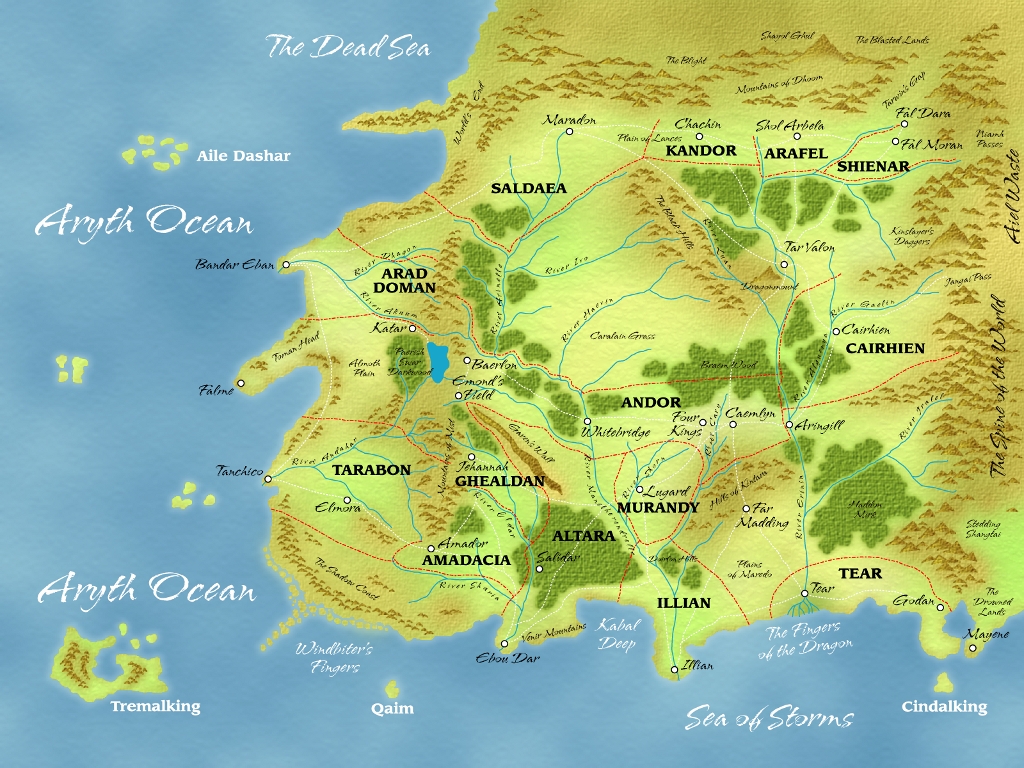
Ooh, then we get a huge convenient map:


Will you look at the 90-degree angle those mountains take?  I would normally bet massive quantities of cash that nothing plot-relevant will ever happen more than an inch beyond the borders of this map, but surely with the millions of words that make up this series I'd be wrong about that?  Please?

I also have some huge questions about the borders as defined above.  Why are they where they are?  We have a lot of weirdly-bounded territories in the world, just look at the eastern US or Europe, but there's a reason for that--they're following rivers, or mountains, or some other significant geological feature.  When we don't need to do that, we end up with things like Wyoming and Saskatchewan, boxes imposed on the boredom of the ground.  Why in the world is Tear's curvy border swooping through that field?  Who owns the ground between Tear and Illian?  There are actually an impressive number of unlabelled swathes in there--is the lack of claim there going to be explained, or are they just international territory for some reason?  These are the questions that will trouble me for months to come.

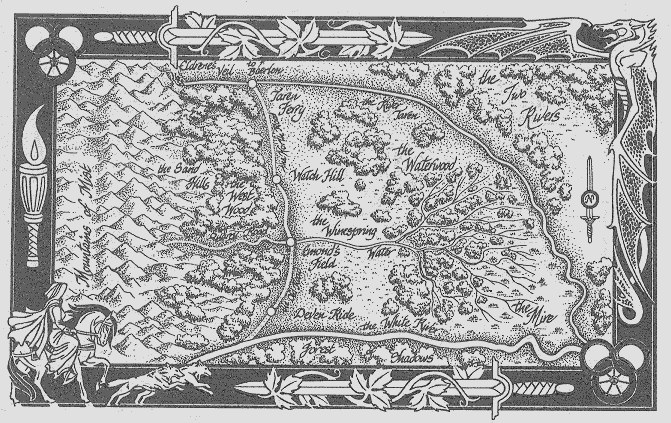
That's followed by this magnificent creation:


Now, correct me if I'm wrong, but this appears to show three rivers coming out of the mountains, and somehow the middle one shatters like a river delta in the middle of a field and branches out in dozens of different directions without ever meeting up with the other two rivers that are arcing together.  And eventually all those little streams just die out, in a presumably-damp region called 'the Mire', which I could sort of accept if not for the way there are still two massive distinct rivers bordering the Mire and cutting cleanly through the land.

I realise most fantasy authors aren't hydrologists, and if an actual hydrologist wants to correct me on this, please do because I love new knowledge, but I'm like 35% sure that is not how rivers work.

This is a bit of a short post, but that's all I can handle for now.  Come back next week for chapter one, in which we meet Our Hero, who at first glance looks to me like he's going to be a humble farmboy.  I should make so many bingo sheets.