Showing posts with label benevolent sexism. Show all posts

Thursday, May 19, 2016

Storm Front, chapters 20 and 21, in which Our Hero just can't be blamed for being terrible and useless

This post would have been done yesterday, but I had to have the 'let's not use homophobic slurs as casual slang' talk with one of my online D&D groups.  I think I surprised them by skipping over 'you can't say that' and going directly to 'I can't control what you say, but I will judge you for it, and if you're my friend I appreciate it if you choose your words such that I can easily distinguish between you and the people who want me dead'.  At least I have the GM's support this time (and the lone woman in the group, who was immediately apologetic for not calling the dudebro out herself).  Anyway, that experience pretty much ruined the day for anything except thinking about the angry rants I couldn't unleash on the guy in question because it would at that point be counter-productive.  I got my unimpressive 'I didn't mean anything by it, they're just words to me, but I'll try to cut back' apology and that's the best I could really hope for in this situation.

Uuuuuuuuuuuuugh.

(Content: parental abuse, partner abuse, implied rape, murder.)

Storm Front
Chapter Twenty: Ebony Black'stone Copperfield Dresden*

Dresden cabs it to Monica Sells' house with zero fanfare or difficulties.  She never gave him her address, but presumably he was able to look her up via the phonebook, because she told him their real last name (Sells) even though she was afraid to speak her husband's true name and we don't know if 'Monica' is really hers.  Now that Dresden has worked out that she was actually just trying to drag him into this to stop whatever evil her husband is getting up to, he (and we) might wonder why she didn't do a better job of trying to clue him in (like giving him all the personal information she could and saying 'I'm like 40% sure he's gone supervillain') but maybe we'll get some justification for that now.

Dresden describes what seems like a pretty typical suburb to me--young trees, minivans, lots of 'for sale' signs on properties, not a lot of birdsong or barking dogs--and declares that it feels "blighted, a place where a black wizard had set up shop".  (I want to make a joke here about property values and white flight as soon as one 'black' person shows up in a neighbourhood, but it's hard to formulate one that's clearly only mocking racist people and Butcher's insistent use of 'black' to mean evil.  I leave it as an exercise for the reader.)

Dresden knocks and rings for a few minutes and is about to magic the door off its hinges when Monica finally answers, and we get another paragraph describing her look (jeans, flannel, and #nomakeup, which makes her look "both older and more appealing" because Dresden is That Guy).  She tries to send him away, but he bluffs that he'll tell the cops Everything if she does, then forces his way through the door.  Monica tries to taze him and I cheer up immensely for a moment, but he dodges once and when she almost gets him in the face the second time he exhales wizardliness all over the taser and it shuts down.

So, Dresden has managed to avoid burning out any of the phones he's used so far, any of the cars he's travelled in, or any of the police computers he's been near, but now that there's a taser in his face his anti-tech field ramps up to full power.  Yes.  Truly this is such an inconvenience to his life.  Butcher continues to not seem to grasp that in order for something to count as a flaw it has to actually impede the character.  It has to have effects they don't want, or that objectively hold them back.  This is also why I can't count Dresden's sexism as a legitimate 'character flaw', because while he's incredibly misogynistic, the book would also have us believe that he's right and his terrible decisions (like pushing Murphy away) are the correct and moral calls to make.  I'm trying to figure out now whether Dresden has any 'flaws' that are actually bad in Butcher's estimation, or if they're all of the same league as 'I'm so beautiful it's a curse'.

Anyway: Monica also makes direct eye contact with Dresden for the first time while she's try to electrocute his face, and they sooouuuuulllgaaaaaaze.  Dresden finally understands All The Things by reading the intense fear and love motivating her.  Monica, being a womanish lady-woman with ladybrain, has the typical soulgaze reaction to Dresden's grimdark man thoughts, freezes in shock, starts shaking, and nearly goes limp.

(Aside: is there any actual reason that a good soulgazing wouldn't prove without a doubt that Dresden was innocent of these murders and also everything else the council hates him for?)

Dresden informs us that from the gaze he learned more than he wanted to about her abused childhood and abusive marriage and her desperate desire to protect her children.  The kids, both preteens, choose that moment to appear and ask mom if they should call the cops, but Monica has just learned that Linda is dead (apparently they knew each other) and tells them it's fine.
I stepped closer to her. I had to have her help. No matter how much pain she was in, no matter what kind of agony she was going through, I had to have her help. And I thought I knew the names to invoke to get it. 
I can be such a bastard sometimes.
So here's that question about flaws again, because we're obviously not supposed to think that Dresden is a terrible person for breaking and entering and interrogating here, we're supposed to think that he's been forced into a bad position and he's doing what he must, for JUSTICE.  Because of that and many other aspects of his personality, Dresden's self-loathing here doesn't really characterise him as a sweet little woobie who needs a hug.  He comes across as another aspect of That Guy, the one who joins a discussion by saying "I know everyone's going to jump on me for saying this, but..." or who vagueblogs about how awful he is as a passive attempt to guilt people into telling him how great he really is.
DRESDEN: I'm so heartless and closed-off; it's no wonder everyone leaves me in the end. Siiiiiiiigh.
ME: I know, right?  And let's not forget your pointless dramatics and condescension.  Like, you never actually stop being awful, you just change the current configuration of awful, like a Rubik's cube constantly rotating into new permutations of overbearing patriarchy.
Dresden rattles off Jennifer, Tommy, and Linda's names again and begs Monica for her help, and she relents, though the chapter ends with her solemn declaration that "There's nothing anyone can do, now."  Personally, this is not a type of tension-raising that works for me, because I'm 100% certain that there will in fact be something that can be done.  A writer can't scare the audience with something that they know won't happen.  A cliffhanger that's meant to actually be scary and not just dramatic won't put the protagonist in danger--it'll have them racing to save a secondary character who legitimately might not make it.  (Or, you know, some other consequence that isn't as heavy-handed as character death, but we're taking little steps here.)  Of course, in this situation that would probably mean Murphy, and I can do without damselling of our lone Strong Female Character, but casting is Butcher's problem to fix.

Chapter Twenty-One: Abusers Are Bad People, This Should Not Be A Controversial Statement

In Monica's prototypical kitchen--her sanctuary, Dresden intuits, sparkling clean from all the time she spends being a Good Wife--he confronts her about the vague resemblance that he's mentioned a couple of times, and she admits that she is Jennifer Stanton's older sister.  (Rebellious Jennifer "ran away to become an actress"... in Chicago?  Is that a thing people do?  I thought it was always New York or Los Angeles.  Or, like, Vancouver if you're Canadian.)  Monica has some pseudo-deep thoughts about her sister becoming a sex worker, but they're not worth repeating here.

She explains that she was evasive in her first meeting with Dresden out of simple uncertainty--she knew her husband was up to something but that didn't mean she was comfortable setting a stranger to hunt him down.
"Who killed your sister?" [....] I knew the answer, already, but I needed to hear it from her. I needed to be sure. I tried to tell myself that it would be good for her to face such a thing, just to say it out loud. I wasn't sure I bought that--like I said, I'm not a very good liar.
Dunno what to make of this either.  'I know who the killer is, but I don't actually know who the killer is, so better maximise this woman's trauma anyway even though I totally don't want to'?  This reads more like Dresden is vaguely aware that he's a sadist but still trying to downplay it to himself.  I generally wouldn't actually put 'sadistic' on Dresden's list of flaws, but it sure sounds like Dresden thinks he is himself.  Anyway, totally unforeseeable plot twist: the killer is Victor Sells.

Dresden accuses her of knowingly sending him to the lake house where he performs his rituals so Victor would see Dresden and pick a fight.  She wanted to protect her children from her husband--her husband, she explains, who was a good man who got so angry that he couldn't provide as much for Monica as her wealthy parents could, and "sometimes he would lose his temper"--I feel like I'm reading Speaker for the Dead again--and then five-ish years ago Victor discovered magic.  He'd spend all night performing weird rituals in their locked attic and get steadily more magical, burst out shouting or laughing for no reason, set the curtains on fire with collateral anger.  Monica didn't confront him, having been raised in an abusive household and thus used to just desperately staying out of the way.

I'd like to think that we're not supposed to have any sympathy for Victor here, an entitled and narcissistic man who felt inadequate because he didn't make enough money 'to provide for his family' and so abused his family to vent his frustrations.  I'd like to think that Monica's remaining loyalty to him is supposed to be the realistic scars of abuse and not some heroic patience hanging onto the goodness that was buried underneath the abuse.  I would really like to.  But I'm not sure.

Victor invented ThreeEye and forced Monica to take a drink so she could see the world as he did.  Dresden informs us of how horrible this is, how she would have seen the true power-obsessed greed-consumed monster that her husband had become and the memory would never fade.  Victor tried to mass-produce ThreeEye but couldn't get enough power for the volume he wanted, no matter how much emotion he tapped into, until he realised he could also siphon emotional power off other people, and that lust was more useful than fear or anger for his purposes.  Obvious conclusion: track down investors to hold magic orgies.  Monica tries to say that even then, "there were moments that I could almost see him again", but Dresden is a Man and he has no room to feel compassion for Monica when he's too busy feeling RAAAAAGE at Victor.  Monica flinches away, fearing Dresden's anger, because of course she fears anger, so much of her life and her trauma revolves around getting trapped in or avoiding other people's anger.  Dresden isn't doing a thing to make this easier for Monica, which ought to count as a flaw, but since it won't actually hold him back at all (send her into a panic attack where she can't exposit plot for him anymore, for instance) it still doesn't count narratively.

Victor found the Beckitts and got their cooperation by promising vengeance against Marcone; used Monica to get to Jennifer to Linda to Marcone's lackey (Lawrence or Tommy?).  That made for enough people that Monica got to stay out of the magic orgies sometimes, but Victor continued power-hungry and she could tell he was starting to think of ways to use the children.  Jennifer threatened to go to the cops and Marcone if Victor didn't let Monica and the kids go, and thus the murdering began.

Dresden tells us that he wants to comfort her, soothing words and arm around her shoulders, et cetera, but he realises that would just make her scream now, so he gets her a glass of cold water and says he's sorry.  It's the least terrible thing he's done yet.
I wanted so badly to tell her that everything would be all right. I wanted to dry her tears and tell her that there was still joy in the world, that there was still light and happiness. But I didn't think she would hear me. Where she was, there was nothing but an endless, hopeless darkness full of fear, pain, and defeat. 
So I did the only thing I could. I withdrew in silence and left her to her weeping.
Funny, innit, how every time Dresden abandons a person to their fears without trying to give them any solace or hope, it's because he intuitively knows that none of the things he could say would actually help.  Forensic scientists want him to explain magic murder--nope, nothing he can say.  Monica thinks Victor is invincible and her children are doomed--better just leave without saying anything to her.  I mean, dude, since you're not apparently in a pit of despair yourself anymore, you must have some idea what you're going to do next, so why not give her a lifeline, or even some vaguely convincing balderdash?  'Your husband might think no one can escape his death traps, Mrs Sells, but my dad named me after Houdini for a reason--I'll be back when I've saved us all'.

Tween Jenny (named for her aunt) stops Dresden on the way out to be innocent and precocious at him, saying she recognises him from the Arcane and if he'll help her mom.
"My daddy used to be one of the good guys, Mr Dresden."
Pictured: Five-Tongue Fleming reminds us that abusive fathers are not, in fact, good guys.
"But I don't think that he is anymore." Her face looked sad. It was a sweet, unaffected expression. "Are you going to kill him?"
(I assume 'unaffected' here has to mean 'sincere, not an affectation' rather than 'dispassionate', but it can be hard to tell after a bit of evocative prose like 'her face looked sad'.)  This is of course Dresden's opportunity to tell the audience that he doesn't want to kill Victor but might have to for everyone's sake, and Jenny goes on about hoping Dresden is "one of the good guys [....] we really need a good guy."  As per usual, the author fails to grasp levels of mental development among children; eleven-year-olds (or thereabouts) might not be up for a serious debate on the morality of lethal force in the apprehension of violent criminals or the acceptability of the death penalty, but they're also not going to ask in childlike wonder if you're 'a good guy' or breeze past the question of killing their superpowered evil father.

Dresden returns to the idling cab and asks to be taken to a payphone.
Then I closed my eyes and struggled to think. It was hard, through all the pain I felt. Maybe I'm stupid or something, but I hate to see people like Monica, like little Jenny, hurting like that.
Bruh, I don't know what the dealio is, but sometimes, like, I have feelings just because other people are having feelings?  Like, someone who isn't even me is in pain, so like, I'm not here for that, bruh, and then I feel bad?  What the heck?  No one else does that, right?  It's just me being stupid and it'll go away?  Bruh.  Bruh.

Dresden thinks about going to Murphy for police support, but concludes that even if she believes him there's too much bureaucracy trying to get a warrant to raid a house in a different jurisdiction on a Sunday.  Going to the Council isn't an option because they're all travelling and thus incommunicado, because apparently there's no wizard version of a text message and despite thousands of years of magical development it's just an inviolable law of nature that people can't be communicated with while moving.  (The lesser-known third corollary of the Heisenberg Principle.)  Not sure why he can't throw a flare into the air for Morgan and just say 'Hey, I know I have a court date tomorrow, but I am 95% sure I've also tracked down an evil wizard selling wizard meth to mundanes, would you get someone to look into that for me if I accede to literally any conditions you demand?'  Like: Dresden's not even taking steps to make sure that someone will go after Victor if Harry fails.  No.  Dresden must do this By Himself Alone Solo With No One Else.

His task is to drop Victor (presumed to be at the lake house for some reason; I guess that's his only ritual spot?) without breaking any Laws of Magic.  Victor, who was untalented and ignorant and easily banished in shadow form just a few chapters ago, is now "as strong a practitioner as I had ever gone up against".  I dunno, Dresden, I bet he doesn't have a bulletproof forcefield like you do.  I feel confident that this is a situation that can be resolved with a smashed window and a blunt instrument.  Or you could go for the quick-draw solution, tap the storm before he has the chance and just pour lightning onto his house, then grab him when he runs for cover.  Or bluff, phone him up and tell him that the cops are about to hit the house on a drug bust.  Victor probably doesn't know how hard you've worked to burn that bridge yet.  'You have until the storm hits to stop this wizard from completing his evil ritual' is the kind of problem that an RPG group could have a field day with.  Have you considered hanging out around gaming shops and grabbing some Call of Cthulhu veterans to be your tacticians?

Dresden realises that he forgot to check the Sells' bathroom for Victor's hair or the like, but "I had the feeling that he wouldn't have been that careless. Anyone who spends time thinking about how to use that sort of thing against people is going to be doubly paranoid that no one have the opportunity to use it against him."  Aren't you supposed to be a magic nerd, Dresden?  Isn't this literally all you think about?  And you can even be bothered to maintain a brushcut?

But then Dresden remembers Chekov's Scorpion, that evil talisman that Monica brought him way back at the beginning of the book, still in his office desk drawer, which he can use to reflect Victor's power easily.  It does finally occur to Dresden to set the cops on Victor as a backup plan, but it turns out that Murphy has already busted into his office with a warrant for his arrest, and she refuses to believe him (over the phone) when he tells her not to go digging in his desk for her own safety.  Murphy, obvs just demands to know what he's hiding and opens the scorpion drawer, followed by screaming and gunshots.

Oh, look.  A cliffhanger where Murphy gets damselled after all.  Joy.

Next week: man save woman from scary insect.

---

*I suppose I should make a consistent note that these books don't have chapter titles and I'm just making them up for funsies, lest new readers be confused that the titles are so much more entertaining and thoughtful than the text.


Wednesday, September 16, 2015

Storm Front, chapters 1 and 2, in which Our Hero is one of the "nice" misogynists

I am left with a conundrum, readers.  After much contemplation and debate, I settled on reading some of Jim Butcher's Dresden Files now that WOT is on hiatus, and valued commenter Nerem provided me with a link to the ebooks so I could commence my analysis and thus provide you all with insight and entertainment.  I have wanted to check out Dresden for ages already, so I dove right in with gratitude to Nerem for assisting me in this quest.

I'm three chapters in and the question burns at the front of my mind: is Nerem in fact trying to destroy me?

The Dresden Files are urban fantasy very intentionally riffing off the style of Laurell K Hamilton's Anita Blake.  They concern Harry Dresden, working-class wizard-for-hire of Chicago.  I have never wanted to inflict violence on a protagonist so early in a story before.  Ender Wiggin is an unfortunate abused child.  Bean Delphiki even more so.  Rand al'Thor is a naive farmboy with typical teenage self-obsession.  These are people who can only bear so much responsibility for their faults.

I want to fight Harry Dresden.  But rather than just ranting, let me take you on a journey into Storm Front, the first book of the Dresden Files, and soon you, too, can feel the bone-deep certainty that the world will be made a better place when this jackass meets you in the pit.

(Content: misogyny, gore.  Fun content: I've been perusing my collection of reaction images to help me adequately respond to this tool.)

Storm Front: p. 1--?*
Chapter One: These Chapters Don't Actually Have Titles So I'm Probably Just Going To Make Some Up--This One Will Be Called "The Very Banality And Innocence" Because I Love A Good 'The King In Yellow' Reference

This book is written in first-person, which is a powerful and dangerous tool for any writer to wield--there's no more powerful way to express your protagonist's persona to the reader, but it also raises questions of reliability and relativity, and an irritating narrator is to reader interest what burning windmills are to mad scientists.  If you want to know how badly a first-person narrator can skew your book's contents to readers, ask Vladimir Nabokov to stop spinning in his grave long enough to tell you how he feels about Lolita.  In the first chapter, this won't be too pressing a matter, but in chapter two we're going to very quickly run into some serious questions about how to write flawed characters.

We meet Harry Blackstone Copperfield Dresden (forgivably over-the-top) in his office, where a new mail carrier is delivering a package and snickering at his door, which reads:
HARRY DRESDEN--Wizard.  Lost Items Found. Paranormal Investigations. Consulting. Advice. Reasonable Rates. No Love Potions, Endless Purses, Parties, or Other Entertainment.
In general, recognising that 'love potions' are fucked up is a good way to get me to like you, so I want to open by giving Dresden points for that.  At least, I hope the reason he doesn't do love potions is because he understands they are mind-control drugs specifically optimised to override sexual consent.

The mail carrier is described as "a basketball with arms and legs and a sunburned, balding head", I y'all can bet I am going to be keeping a close gorram watch on how often Butcher makes characters fat when we're not supposed to like them.  He is initially amused, then skeptical, and finally calls Dresden "a nut" before leaving.

Any urban fantasy kind of needs to open by defining its parameters--whether people in general know about magic, what kind of organisation it has in society, whether it's resulted in any major differences from our own Earth history, all that worldbuilding jazz.  Dresden informs us that magic fell out of fashion and awareness in recent centuries because science was more exciting, but "images of exploding space shuttles, crack babies, and a generation of complacent Americans who had allowed the television to raise their children" has pushed people away from "science, the largest religion of the twentieth century" and people are starting to notice magic and psychics and vampires again.

Allow me to provide a visual representation of the way I feel when people call science a religion:

Pictured: a baby harpy eagle who would rather not, today.

Science, performed and organised correctly, is about observation and reproducibility.  It is supposed to be about throwing out old ideas when new evidence contradicts them, about taking nothing for granted, and about always chasing new knowledge.  I don't know the details of every religion in the world, obviously, but I have yet to see one that tries to draw statistical conclusions about the effectiveness and consistency of prayer or invocation.  Religion is pretty big on dogma.  Science isn't supposed to be.  If you're going to call science a religion, I need you to define your terms.  (If Dresden is trying to comment on the way the populace supposedly assumed that the invention of the airplane and the computer meant no one would ever have problems ever again, okay, that can be his opinion, but I have a lot more to say about the way good scientists would approach the discovery of magic as well, which I will spare you all for now only because I need to get to the part where you share my ire towards this jackwagon.)

Anyway.  Dresden is behind on his bills and needs cash soon.  I have some questions about what magic can or cannot do, and why a person with a rare command over supernatural powers works this and only this fetch-quest kind of job.  Like, the absolute #1 question I have about magic in every single setting is 'can magic create food', because if it can, anyone with magical skills is a colossal upset to our normal economy--they don't need to worry about their own food supply and they literally always have access to a vital commodity they can trade to other people.  JK Rowling just declared that magic couldn't conjure food from nothing, which answered that question pretty firmly, except then she footnoted that magic can multiply food, which, in the words of Hermes Conrad, just raises further questions.  I'll allow Butcher more worldbuilding time before I start interrogating his hero's premise too harshly, though.

Dresden is quickly characterised for us as an honest worker; his only job in months was investigating a country singer's house in Missouri and quickly concluding that it was not haunted, unlike the fake psychic whom the singer hired a week later to perform a big fake exorcism.  Dresden describes his own actions as "honest, righteous, and impractical", and I roll my eyes at our hero humblebragging about his heart of gold.  The phone rings with a call from a nervous housewifey kind of person who wants Dresden to find her husband.  Dresden quickly says people aren't his specialty and she should go to the police, which wins him many more points from me than he got by telling me about his honesty dealing with the singer.  She tries to beg off by saying she can't go to anyone else, but Dresden cuts her off before she can hang up.
"I'm sorry, you didn't tell me your name." [....] 
"Call me Monica." 
People who know diddly about wizards don't like to give us their names.  They're convinced that if they give a wizard their name from their own lip it could be used against them. To be fair, they're right.
Dresden will keep doing this in the next couple of chapters: 'silly superstitious people who know nothing are afraid of X, but they absolutely should be afraid of it because it's terrifying and dangerous'.  It takes a specific kind of arrogance to call someone ignorant for believing a true thing even though it sounds fake.  Sigh.

Dresden convinces Monica to come to his office in an hour and explain her situation to him directly.  The moment he sets down the phone, it rings again, and a few lines of dialogue later he declares that the appointment is in forty-five minutes, which would be clever foreshadowing in a book about time anomalies but here just vexes me.  Harry Dresden would have seen nothing wrong with the many ages of Bonzo Madrid.  The second call is from Director of Special Investigations Lieutenant Karrin Murphy of the Chicago police, and she wants Dresden (her preferred magic consultant) at the scene of a double homicide pronto.  She's not worried about Dresden missing his appointment, because she is a gruff cop, and he snappishly agrees to go and be back in time anyway.  Murphy recommends that he not eat lunch on the way.
"How bad are we talking here, Murph?" 
Her voice softened, and that scared me more than any images of gore or violent death could have. Murphy was the original tough girl, and she prided herself on never showing weakness.
I brim with apprehension whenever a female character is described like this, because it strikes me as a guarantee that their tough front will eventually be shattered and they will be left a broken wreck to show that the situation is serious.  Has a male character ever been described like this?  Someone get on that.  (Also, calling an adult woman a 'tough girl' is a blaring orange flag that worse things are ahead.)

Dresden heads out, using the stairs instead of the elevator, half because electronics are unreliable in his presence and half because it's already occurred to him that if there's a murderous wizard on the streets, Dresden himself (the cops' only wizard-on-retainer) is probably a target as well.  Not bad tension-raising for the end of the first chapter.

Chapter Two: This Is It; This Is What I Was Talking About; How Badly Do You Want To Fight Dresden Now

Jim Butcher elects to give us a physical description of his protagonist by explaining all the ways he doesn't look like Murphy, which I kind of like, if only because the duality of it raises Murphy's profile as a secondary protagonist.  Dresden is an incredibly typical brooding gritty hero, tall and lean with dark hair and angular features, while Murphy is short, stocky, blonde and blue-eyed.  Dresden also immediately informs us that Murphy never wears dresses, "though I suspected she'd have muscular, well-shaped legs, like a gymnast", which is obviously not a weird thing to think about your boss.  He goes on with her description, adding her lack of earrings and her makeup-that's-so-good-it-looks-like-she's-not-wearing-makeup, which strikes me as oddly perceptive in a world so choked with men who apparently think women are born wearing a layer of foundation and Pomegranate Extremity lipstick.

Oh my god, Dresden even has a big black duster coat.  I hope Butcher was trying really hard to write to formula here.  Wikipedia seems to suggest that the cliches are intentional.  Anyway.  He also silently gives Murphy kudos for daring to meet his eyes for half a second:
It wasn't really dangerous unless you did it for several seconds, but I was used to anyone who knew I was a wizard making it a point not to glance at my face.
There is only so far I am willing to follow you down the trail of 'I have weird mysterious powers that people are superstitious and intimidated about', Dresden.  You're so powerful that it's dangerous to look into your eyes but you're also borderline unemployed and permanently broke?  I'm going to start needing justifications soon.

They head for the door and Dresden races Murphy so he can open it for her, even though and indeed because he knows it irritates her.  Ah, and here we are:
Maybe my values are outdated, but I come from an old school of thought. I think that men ought to treat women like something other than just shorter, weaker men with breasts. Try and convict me if I'm a bad person for thinking so.
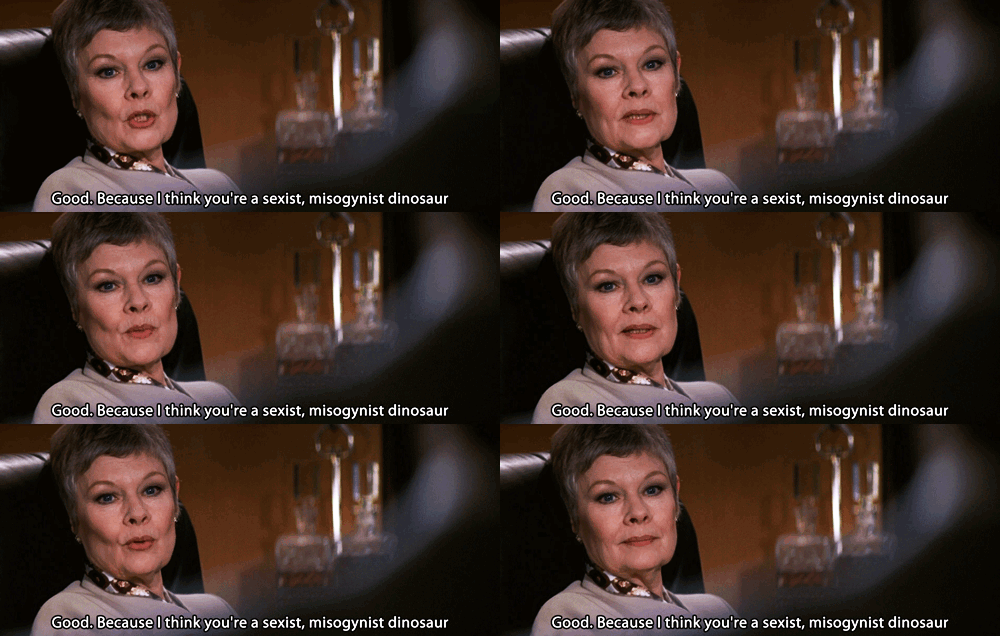
Pictured: MI6 director M is entirely willing to take up Dresden's offer to go to court.

I enjoy treating a woman like a lady, opening doors for her, paying for shared meals, giving flowers--all that sort of thing.


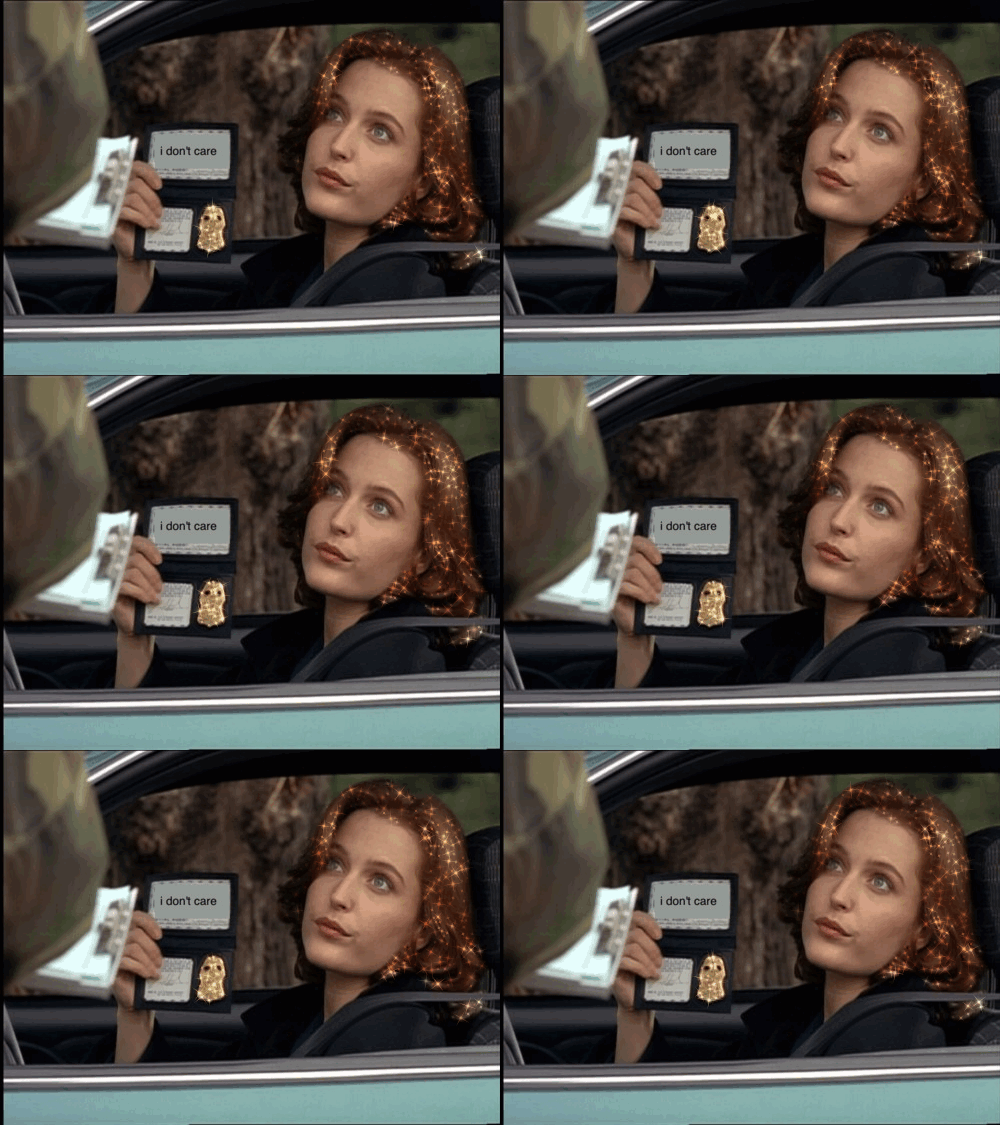
Pictured: Special Agent Dana Scully will tell Dresden when she wants his opinion on women again, which will be never.

I don't even know what to do with this.  "Men ought to treat women like something other than just shorter, weaker men with breasts."  Well, yes, that's true.  That's true for a lot of reasons, starting with women not being shorter, weaker men with breasts.  Faith and fucking begorrah.  I guess we'll start with the purely scientific objection, which is that men being stronger than women on average tells you basically nothing about whether any given man will be stronger than any given woman, because the variations within a gender are vastly greater than the difference in averages.  (Actual studies on this are not the easiest thing to find, especially if you want studies that aren't saturated with biases, bad methods, bad data presentation, and the occasional dash of MRA meninist whining.  Suffice perhaps to compare for yourselves the current world records in that manliest activity, lifting heavy objects: yes, the men's olympic lifting records are higher than the women's, but when comparing similar weight categories, the differences are fairly small and everyone is lifting multiple times their own body weight.  Dresden, bro, do you even lift?)

Next, Dresden, have you considered that maybe the correct way to treat women is LIKE PEOPLE?  Chivalry isn't dead--it's a fricking zombie that refuses to die no matter how many times we bury it because it feeds on the keening wails of men who don't understand why opening doors for women just won't translate into getting laid.  I sometimes open doors for women, I sometimes pay for meals for women, yes, and they do the same for me, and likewise with my friends who are men.  I do these things because they are nice things to do for people I like, not because I'm trying to provide women with the support they need to get over their fundamental deficiencies of ladyness.  So the real question here, Dresden, is why you're only doing nice things for women and not men.  WHY ARE YOU SUCH A MISANDRIST, DRESDEN?


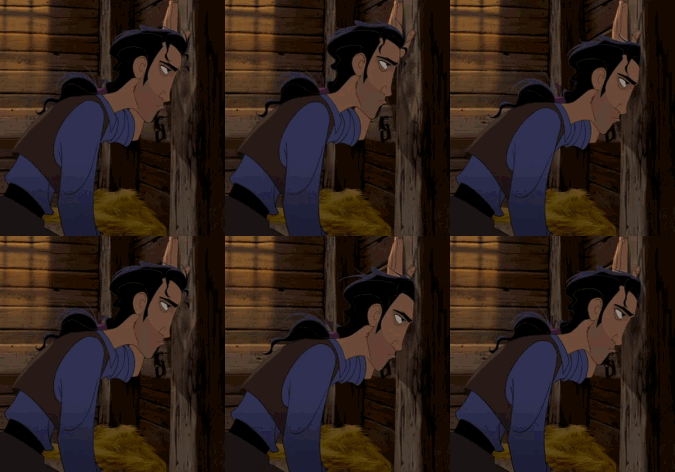
Pictured: Tulio attempts to forget the conversation he just had with a brooding antihero with a heart of chauvinist gold.  Y'all don't even know the kinds of stupid, misogynist screeds I read with my own two eyes in my quest for good data.

In short, locking women into the kitchen to be barefoot and pregnant is unquestionably terrible, but that doesn't mean that putting them on a pedestal to be delicately cared for and pruned or whatever is somehow good.  And I might not be able to convict you for being a sexist creep, Dresden, but I can definitely judge you harshly.

Where were we?  Oh, yeah, double homicide.

Dresden follows Murphy up to the seventh floor to a plush romantic suite that smells of blood.  (The elevator scene is brief, silent, and actually kind of good: "I licked my lips and looked around the interior of the car. My shadow and Murphy's fell on the floor, and almost looked as though they were sprawled there. There was something about it that bothered me, a nagging little instinct that I blew off as a case of nerves. Steady, Harry.")  Murphy leaves him in the first room for a minute, where he examines his surroundings in a vaguely ESP kind of way, making visual observations with his eyes nearly shut, noting champagne, a stray rose petal, and a half-torn black thong under a chair, which Dresden summarises as "Kinky".  Dresden has not read Fifty Shades or he'd save that for the eggbeaters.

We are then introduced to Murphy's skeptical partner, Carmichael.  Dresden rattles off a laundry list of things that are meant to make Carmichael's unattractiveness clear, starting with being fat and bald, and then goes for a swerve with "razor intellect [....] absolutely ruthless at tracking down killers".  I tentatively mark this as the second fat character we've met and the second we're not supposed to like, regardless of the 'razor intellect' remark supposedly showing that Dresden respects him.  They snipe at each other a bit before Dresden comes in to see the bodies.

Now, I realise magic is at play here, but I think it's fair to question how and why it is that these people (who died in the middle of sex) managed to remain frozen in the exact pose they had when an evil wizard literally made their hearts explode like fragmentation piƱatas.  The description "she was astride him, body leaned back, back bowed like a dancer's" sounds to me like she's still more or less sitting upright, no?  Either way, now we're apparently seated in the 'erotic violence' section of the train and I'm prepared to tuck and roll.

Clues, blood, gross stuff, clues, and then Dresden finally runs out of the room to throw up--Carmichael wasn't joking when he said he'd bring a bucket.

Dresden's frantic disgusted thoughts weave in some worldbuilding:
...someone had used magic to do it. They had used magic to wreak harm on another, violating the First Law. The White Council was going to go into collective apoplexy. This hadn't been the act of a malign spirit or a malicious entity, or the attack of one of the many creatures of the Nevernever, like vampires or trolls. This had been the premeditated, deliberate act of a sorcerer, a wizard, a human being able to tap into the fundamental energies of creation and life itself.
So now we know magic does have some kind of organisation ('White Council' isn't the name I would choose, but... okay...) and laws, and we have a sort of charmingly juvenile name, 'Nevernever', for the realm of monsters.  And we're only in the second chapter!  Can you imagine how many posts into a WOT book I'd have to get before we heard about 'the Nevernever, what some call Monsterpalooza, where dwells the Scarytown Crew that you know as the Naz'gool'.

Dresden does tend a little bit that way when he starts talking magic:
"Evocation is the most direct, spectacular, and noisy form of expressed magic, or sorcery. [....] 
"What's the other option?" Murphy asked. 
"Thaumaturgy," I said. "As above, so below. Make something happen on a small scale,and give it the energy to happen on a large scale."
Which isn't bad terminology, really.  'Evocation' literally means 'calling something forth', while 'thaumaturgy' means 'magic-shaping', following the same pattern as 'metallurgy'.  I feel some small spark of hope that this will be the first fantasy series I've seen to correctly use '-mancy' suffixes only to refer to divination magic.

There's more magic worldbuilding as Dresden explains the intimacy of spellcasting and concludes that the killer had to know the victims in order to use this particular magical approach, by having intense personal reasons to want them dead. Oh, great, before this chapter can end on a strong note we have to endure another one of Dresden's pontifications on gender:
Murphy glared at me. "You keep saying 'she,' " she challenged me. "Why the hell do you think that?" 
I gestured toward the room. "Because you can't do something that bad without a whole lot of hate," I said. "Women are better at hating than men. They can focus it better, let it go better. Hell, witches** are just plain meaner than wizards. This feels like feminine vengeance of some kind to me."
Pictured: WHATNAPPLE RETURNS TO AID ME

Are you fucking kidding me, Dresden?  Jim Butcher, what the fuck?  Please tell me you're going for an unreliable narrator here.  Please don't be actually this stupid.  Please let the killer also be a man just to highlight how wrong Dresden is.
"Christ, you are a chauvinist pig, Dresden."
Lieutenant Murphy, you have my sword.

Dresden sort of agrees to try to reverse-engineer the magic, and Murphy banishes Carmichael to fetch her coffee before explaining who the victims are: the woman is a sex worker for a well-regarded company run by a vampire ("vampiress" oh my god shut up Dresden) named Bianca, and the man is the personal bodyguard to Chicago's new king of the mob, Johnny Marcone, a relatively civilised crimelord who's put an end to past bloody clashes with the police and gone all Ankh-Morpork Guild of Thieves on excessive elements in the city, doing a better job of stamping out some violent criminals than the police do.

I had honestly forgotten what it was like to have antagonists with immediate presence who are relevant to their environment and not just, like, abstract concepts and generic monsters.  I bet I'd be enjoying this book less if I hadn't just endured so much WOT.

Dresden has tried to put a disclaimer on his ability to work out how the murder spell worked, but Murphy doesn't buy it.  Dresden weasels out of explaining himself, but notes in the narration that he's got some kind of checkered past with the White Council and he's on double secret wizard probation, bearing something called the Doom of Damocles.  I like the name because it's self-explanatory (danger hanging over his head) without sacrificing some mythic flavour.  Anyway, Dresden's pretty sure he'll get a Doom to the head if word gets out that he's trying to build a murder spell, and apparently sending advance notice ("Hey, I'm tracking a murderer who broke our First Law, please don't kill me") is not an option?  He instead concludes that he'll just need to keep it quiet.  Brilliant.  If this incident is so bad, shouldn't the Council have their own investigators on the case?  Shouldn't they at least be able to spare someone to keep an eye on Dresden while he helps the police?  What are the jurisdictional rules for something like this?

They leave, Dresden's got five minutes to make the fifteen-minute trek back to his office for his appointment with Monica the mystery client, and he's halfway there when he gets surrounded by beefy goons who forcibly invite him to get into a car with Johnny Marcone, and that is where the chapter ends.

Initial impressions: Harry Dresden is a gigantic tool made of smaller tools in a sort of fractal jackwagonry array, but Murphy is a good character, I'm interested in the setting, and within a mere two chapters we've got a web of plot threads that connect us to a mysterious disappearance, a vengeful sorcerer, a vampire madam, organised crime, and the secret council that runs all magic. Rand al'Thor needs more pagetime than that to eat lunch and stare longingly at the hot girl he imagines he's in love with.  I may brim with rage throughout this book, but at least it won't linger.

---

*Thanks to ebook formatting, the pagecount varies wildly depending on how I size my reader screen, so I have little hope of keeping a consistent tally of pages as we proceed.  I'm tempted to use abstract concepts (Storm Front: p. Mangrove to Banyan) but combining that with my suggested chapter titles is just going overboard.

**ALSO I HAVE STRONG OPINIONS ON THE GENDERING OF WITCH AND WIZARD.  That's not how it works.  'Wizard' is just 'intensely wise', following the pattern of 'drunkard' and 'coward'.  'Witch' derives from 'wicce', which has a contested etymology to say the least, but originally 'wicca' was male and 'wicce' was female, and we melded both words when we took them for English.  Female wizards and male witches are 100% legit, not a weird special case, and definitely not gendered terms for identical roles.  (I'll stop here instead of further ranting on the notion that 'warlock' is the male equivalent of witch.)